Affiliate disclosure: Daily Home Decorating may earn a commission if you buy through links in this guide, at no extra cost to you. As an Amazon Associate, we earn from qualifying purchases.
The best constructed sofas are built from parts that work together: a stable frame, secure joints, a suitable suspension system, cushions that retain their intended feel, and upholstery made for the way the sofa will be used. A product name or a claim such as “solid wood” does not explain the entire build. Before buying, look for specific material details, ask how the frame and cushions are assembled, test the seat, and check what the warranty covers. Construction quality is easier to judge when you evaluate the sofa as a system instead of focusing on a single advertised feature.
This guide explains how to assess sofa construction at a showroom or through an online listing. Product examples are Amazon listings returned through Amazon Creators API; we have not purchased or physically tested them. Product specifications and availability can change. Verify the exact material, model, configuration, dimensions, seller, warranty, and care details on the live page before ordering. If important construction details are missing, contact the seller rather than assuming what is inside.
For narrower buying needs, see our affordable sofa construction guide, compare capacity and fit considerations, or read about leather sectional construction.
Quick construction checklist
- Frame: identify what the rails and support parts are made from.
- Joints: ask how corners and load-bearing connections are joined and reinforced.
- Legs and base: check how legs attach and whether the sofa sits level.
- Suspension: find out whether the deck uses springs, webbing, or a combination.
- Cushions: compare core, wrap, firmness, reversibility, and replacement options.
- Upholstery: confirm fiber content, care instructions, seams, and repair support.
- Warranty: review separate coverage for frame, suspension, cushions, and fabric.
- Service: ask about assembly, replacement parts, delivery, and repair procedures.
A sofa may use a combination of materials and construction methods. There is no single material or spring system that guarantees quality. Look for clear specifications and consistent workmanship, then compare comfort and maintenance for your household.
Understand the sofa as a system
The frame carries the load from the seat, arms, and back. The suspension transfers seated weight to the frame. Cushions sit above that support deck, and the upholstery covers the complete assembly. If any part is weak, poorly attached, or unsuitable for use, the sofa may feel unstable or wear unevenly. A durable frame cannot compensate for a cushion that collapses, and a premium fabric cannot fix a poorly fitted joint.
Start by asking what the sofa is designed for. A compact apartment loveseat, a deep lounge sectional, a sleeper, and a reclining sofa have different frames and moving parts. A recliner needs a mechanism and clear operating instructions. A sleeper must support both sitting and an open bed. A modular sectional must keep its connectors and sections aligned. Construction should be judged against the sofa’s intended function.
Separate visible style from hidden construction. Tapered legs, tufting, a thick arm, or a “cloud” silhouette may shape appearance and comfort, but they do not reveal the complete frame, suspension, or cushion design. Ask for the parts list or a construction diagram if available. The more specific the answer, the easier it is to compare models.
Frame materials: what to ask
Frames may use hardwood, softwood, plywood, engineered panels, metal, or combinations of these. Terms such as “solid wood” and “hardwood” are useful but incomplete. Ask which components use that material: rails, corner blocks, legs, or only visible trim. Also ask whether the frame is kiln-dried or otherwise treated if the maker makes that claim, and whether the product documentation explains the intended use.
Engineered wood is not automatically unsuitable, and solid wood alone is not a guarantee. The design, thickness, joinery, support layout, and quality control matter. A well-designed plywood component can perform differently from a thin unsupported panel. Focus on the assembly and warranty rather than using a single material label as a shortcut.
For a sofa with metal components, ask where metal is used and whether it supports the seat, connects modules, or belongs to a mechanism. Inspect exposed edges and brackets for alignment. A metal frame can be appropriate for a particular design, but the seller should be able to explain the materials and how the frame is supported.
Try to compare like with like. One maker may use hardwood rails with plywood panels, while another uses engineered wood in a different load-bearing arrangement. A phrase such as “wood frame” can cover several combinations. Request a diagram or written breakdown that identifies the main rails, cross supports, legs, and corner areas. If the seller cannot provide more detail, give greater weight to direct testing, service support, and warranty rather than filling in the missing information yourself.
Moisture, storage, and assembly also affect furniture. Keep the sofa in a dry indoor environment unless the manufacturer says otherwise, and follow instructions for tightening hardware after assembly. Avoid dragging the sofa by one arm or lifting it by cushions. When moving, use the recommended lifting points and protect the legs. Careful handling cannot make a poor frame strong, but it can prevent avoidable strain on a well-made one.
Joints, corner blocks, and reinforcement
Frame joints connect rails, legs, arms, and back supports. Depending on the design, they may use screws, bolts, dowels, brackets, corner blocks, adhesive, or combinations. A product listing may not provide these details, so ask the manufacturer or retailer how load-bearing corners are assembled and whether they are reinforced.
At a showroom, gently check whether the sofa feels stable when you sit and stand. Do not rock, bounce, or climb on the furniture. Look for visible gaps, misaligned panels, loose fasteners, or uneven legs. A quick inspection cannot reveal every hidden joint, but it can surface assembly issues and help you formulate questions.
Corner blocks and reinforcement can help distribute force at connections, but their presence alone does not tell the whole story. Ask how they are attached and what warranty applies. If a seller says the frame is reinforced, request the location and material rather than treating the word as a guarantee of durability.
Legs, rails, and the base
Legs carry the sofa’s weight and need to connect securely to the frame. Check whether they screw into inserts, attach with plates, or use another system. Follow assembly instructions carefully and confirm that all hardware is included. If a leg does not align, do not force it; contact the seller. An uneven sofa can put stress on the frame and feel unstable.
Look at the base support. Long sofas and sectionals may need center legs or additional supports. Ask whether they are included and where they are placed. A center support should contact the floor once the sofa is assembled and installed on a level surface. Do not remove a support leg because it interferes with a rug without checking with the manufacturer.
Floor type matters. A sofa may sit differently on a thick rug than on hardwood. Use compatible floor protectors and follow the maker’s guidance. If the sofa rocks after correct assembly, check floor level and hardware before assuming the frame is defective. Document the issue and contact the seller if it persists.
Suspension: springs, webbing, and platforms
Seat decks can use sinuous springs, coil units, webbing, platforms, or mixed systems. Each can be designed to support a sofa effectively. Ask which system the model uses and how the springs or webbing connect to the frame. Terms such as “eight-way hand-tied” or “no-sag springs” describe a construction approach but do not alone guarantee comfort or longevity.
When testing a sofa, sit in several seats and compare the feel. Notice whether support is even across the cushion and whether one area feels much softer or firmer. Stand up and observe whether the seat returns consistently. A sudden dip, new noise, or shifted deck may warrant inspection. Do not bounce on the sofa to test springs, because that can stress both the frame and the suspension.
Ask about service parts. Springs, clips, webbing, and ties may need repair eventually. The sofa’s model number and parts availability can make a repair easier. If a retailer cannot explain the system, request written specifications from the manufacturer before purchase.
Cushion cores and support
Seat cushions may use foam, fiber, feathers, springs, or layered combinations. Ask for the core material and whether a wrap is used. Foam density is one data point, but it does not by itself determine firmness, support, or durability. Cushion thickness, shape, foam formulation, wrap, cover tension, and suspension all contribute to the feel.
Test the cushion under body weight, not just with a hand press. Sit for several minutes in your normal posture, then stand and note how quickly the cushion returns. Try each seat if the sofa has multiple cushions. A bench cushion can look streamlined, while separate cushions can be rotated or replaced more easily when designed for that use.
Ask whether cushions are reversible, removable, and replaceable. Some have a designated top or one-sided cover. Follow the manufacturer’s instructions before flipping or rotating. Replacement availability can extend the useful life of a sofa, especially if one seat receives more use than others.
Back cushions and upholstery seams
Back cushions may be tight, loose, attached, or filled with a different material from the seats. Check whether they hold shape and remain in place. Loose cushions may need occasional fluffing; tight backs may look more tailored but be less adjustable. Sit back naturally and see whether the cushion supports the upper back without pushing the head forward.
Inspect seams for even stitching and consistent alignment. Look at corners, piping, tufting, and areas where the fabric wraps around arms. A seam should not be visibly strained or open. On patterned fabric, check whether the pattern aligns where panels meet. These visual checks do not prove long-term durability, but they can reveal finishing quality.
Ask how upholstery can be repaired and whether matching fabric is available. Zippers, removable covers, and replaceable panels can help with maintenance, but they must be described for the exact model. A removable cover is not necessarily machine washable. Follow the care label and avoid unapproved cleaning products.
Upholstery materials and wear
Fabric, leather, and faux leather have different maintenance needs. Woven fabric varies by fiber and weave; velvet and chenille have pile that can show directional shading; leather has a distinct surface and care routine. Confirm the exact fiber content and cleaning code. Marketing terms such as “performance,” “linen look,” or “leather feel” may not identify the full composition.
Ask about any durability or stain-resistance claim and what it covers. If a manufacturer cites an abrasion test, request the test method and what the number represents. Do not treat one rating as a direct prediction of how long a sofa will last in your home. Pets, sunlight, friction, cleaning, and usage all affect wear.
Compare how the fabric feels and how it fits the room. A durable textile you dislike touching may not be a comfortable choice. Request swatches, check them in daylight and evening light, and test care guidance before buying if the maker permits. Choose a fabric and color that match your actual maintenance habits.
Modular connections and moving parts
Sectionals and modular sofas need connectors that keep pieces from drifting apart. Ask how the modules attach and whether connectors are included. Confirm the arrangement can be changed if you plan to reconfigure it. Check that the pieces line up without large gaps and that the connector does not create an uncomfortable hard spot under cushions.
Recliners and sleeper sofas contain moving parts. Verify operating steps, service access, and warranty coverage. Keep cords, rugs, and other items clear of the mechanism. Follow the maker’s instructions and do not force a mechanism that sticks or catches. A sofa that converts between modes should be tested in each position before purchase.
For powered features, ask where the motor, wiring, and power supply are located and what happens if a component needs service. Check the seller’s repair process and whether parts can be replaced. These details matter because a mechanical failure can affect the entire seat even if the upholstery and frame remain sound.
Construction quality at different price points
Price can reflect materials, labor, design, branding, shipping, and retailer margin. A higher price does not guarantee a better frame or more comfortable cushion. A lower price does not automatically mean poor construction. Compare the specifications, assembly, warranty, replacement parts, comfort, and return options for the exact model.
Prioritize the parts that matter most for how you use the sofa. If it will be a daily family seat, frame stability, suspension, cushion replacements, and fabric care may matter more than a decorative detail. For a rarely used guest room, dimensions and delivery may have greater importance. Choose the tradeoffs consciously rather than buying by price or label alone.
Remember that sofas age. A well-built frame may last while cushions or upholstery need attention. Consider whether the maker sells replacement cushions, covers, or legs. A repairable sofa may be a better long-term choice than one with a feature-rich listing but no support after delivery.
Questions to ask before you order
- Which materials are used in the frame rails, supports, legs, and visible wood accents?
- How are load-bearing joints assembled and reinforced?
- What suspension system supports each seat?
- What are the cushion core and wrap, and are cushions reversible?
- Can replacement cushions, covers, legs, or mechanisms be purchased?
- What cleaning methods are approved for the selected upholstery?
- What does the warranty cover for frame, suspension, cushions, and fabric?
- What are the package dimensions, assembly steps, and delivery services?
Ask for answers about the exact model and configuration. A brand may sell sofas with different frames, cushions, and warranties. Save written specifications and the current warranty terms with your order details.
Examples of construction claims to verify
These Amazon listings illustrate how product pages describe frame, cushion, and upholstery details. They are examples for comparison, not a ranking or hands-on quality assessment. Confirm the exact listing, configuration, materials, and current seller details before purchase.
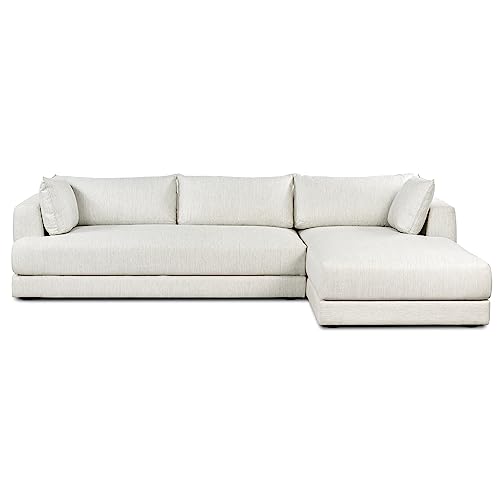
Poly & BARK Marcel sectional
ASIN: B0938DQ2T1
The listing describes a kiln-dried solid wood frame and feather-down cushions. Confirm the current upholstery, exact configuration, cushion care, and warranty terms on the live listing.

Black leather sofa listing
ASIN: B0HGXYZ84S
The title describes a kiln-dried hardwood frame and reinforced corner blocks. Check the exact materials, upholstery surfaces, seat construction, and warranty for the selected item.

Vesgantti six-seat chenille sectional
ASIN: B0HFR5VKQV
The listing describes a hardwood frame and modular configuration. Verify the included modules, connectors, dimensions, upholstery, and whether the current model matches the title’s claims.
How to inspect a sofa after delivery
Before discarding packaging, inspect the sofa for tears, missing hardware, bent legs, and damage to the frame or upholstery. Assemble it according to the manual and do not skip supports or fasteners. Check that modules connect correctly and that the sofa sits level on the intended floor surface.
Sit in each seat and listen for unusual noises. Check that cushions sit evenly and recover as expected. Operate recliner or sleeper mechanisms only as instructed. If something feels loose, damaged, or misaligned, stop using that feature and contact the seller with photos and the model number.
Keep the assembly guide, labels, receipts, warranty, and care instructions. Follow recommendations for cushion rotation and cleaning. If replacement parts are available, save the model and fabric identifiers so you can order the correct item later.
Common construction-shopping mistakes
One mistake is using a single phrase as a quality shortcut. “Solid wood,” “kiln-dried,” “hand-tied,” and “performance fabric” need details and context. Another is focusing on the frame while ignoring the seat: comfort, suspension, and cushion repair matter just as much to everyday ownership.
It is also easy to forget assembly and service. A sofa may have good materials but be difficult to assemble in a tight room, or replacement parts may be unavailable. Check dimensions, package sizes, delivery, and repair support. For modular pieces, verify connectors and reconfiguration details.
Finally, do not assume warranties are interchangeable. Frame, suspension, cushions, and fabric may have different coverage periods and exclusions. Read the exact document, save a copy, and ask questions before purchasing.
Frequently asked questions
What makes a sofa well constructed? A coordinated frame, secure joints, appropriate suspension, well-made cushions, suitable upholstery, and clear service support all matter. Evaluate the complete sofa.
Is a solid wood frame always better? Not automatically. The frame design, joinery, support layout, material quality, and warranty also matter. Ask which components are solid wood and how the frame is assembled.
Are springs better than webbing? Neither is universally better. Both can work when designed and installed properly. Compare the full seat construction and test the sofa.
Does kiln-dried wood guarantee quality? It is one material detail, not a guarantee. Check the complete frame design, joint construction, suspension, cushions, and warranty.
What should a sofa warranty cover? Review coverage for frame, suspension, cushions, mechanisms, and upholstery separately. Check exclusions, service requirements, and who pays labor or transport.
Can I judge construction from online photos? Photos can show visible finishing, but they cannot reveal hidden joints or suspension. Ask for specifications and written answers to construction questions.
How can I tell if a sofa frame is weak? A showroom test may reveal rocking, unevenness, or noises, but it cannot prove long-term strength. Ask about construction and warranty, and inspect the delivered sofa.
Are modular sofas less durable? Not necessarily. Check connector design, alignment, frame support, and whether modules stay secure during normal use.
Final checklist
- Get specific frame and joint information for the exact model.
- Identify the suspension system and how it attaches to the frame.
- Check cushion materials, reversibility, replacement options, and feel.
- Review fabric composition, care, and warranty claims.
- Measure delivery paths and confirm assembly requirements.
- Save written specifications, warranty, model number, and receipts.
The best constructed sofa is one whose frame, joints, suspension, cushions, and upholstery are designed to work together and whose maker clearly explains how to care for and service it. Ask specific questions, test the seat, inspect visible workmanship, and read the warranty. Those steps help you compare real construction details instead of relying on a product label or a single material claim.
Continue with our affordable sofa construction guide, compare support and capacity considerations, or browse Home & DIY.
Certain content on this site comes from Amazon and may change. Amazon product images and listing details are supplied through Amazon Creators API. Confirm the exact option, seller, dimensions, materials, and current terms before purchase.