Best Portable Table Saws: How to Choose a Jobsite Saw
The best portable table saws make table-saw work easier to move between a home shop, garage, and jobsite. Their appeal is straightforward: a compact saw can store in less room than a full cabinet machine, travel with a crew, and set up on a stand or work surface when needed. The tradeoff is that portability affects weight, support area, storage, and setup. A saw that is easy to move may have a smaller table or require extensions and a stand before it can handle larger stock comfortably.
Choosing a portable table saw is not only about finding the lightest model. You also need to consider the material you cut, how often you transport it, how much support a workpiece needs, how the fence locks, what accessories are included, and whether the setup can be used safely in the locations you visit. The stand, fence, guards, push stick, dust collection, and storage system are part of the working tool—not optional details to ignore until after purchase.
This guide focuses on transport, storage, setup, and realistic tradeoffs. It does not present an invented hands-on ranking or claim current prices. The comparison method is based on published manufacturer specifications, manuals, and safety information: evaluate the complete saw-and-stand package, fence and support arrangement, cut capacities stated by the maker, stored footprint, accessories, and the procedures required to transport and set up the saw. OSHA’s [table saw safety guidance](https://www.osha.gov/etools/machine-guarding/saws/table) is used for hazard and work-practice context; actual operation must follow the manual for the specific saw.
Affiliate disclosure: DailyHomeDecorating.com may earn a commission from qualifying purchases through links in this article. This does not change the price you pay.
Amazon product examples to compare

ASIN: B08F9RFJ2K

ASIN: B0842QDW95
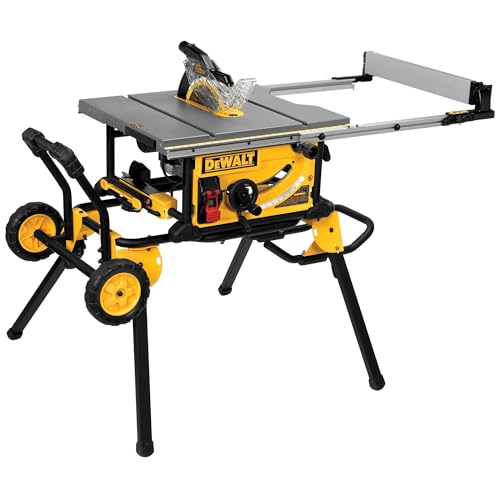
ASIN: B00F2CGXGG

ASIN: B0CKS6G6TC
Certain content that appears on this site comes from Amazon. This content is provided “as is” and is subject to change or removal at any time. Product examples and images are supplied through Amazon Creators API; confirm specifications and availability on the current listing.
Table of contents
- What portable table saws include
- Transport, weight, and stand design
- Jobsite setup and support
- Fence, capacity, and workpiece support
- Features and tradeoffs
- Safety and maintenance
- Frequently asked questions
What counts as a portable table saw?
“Portable table saw” is a broad category that can include compact benchtop saws, jobsite saws with integrated or optional stands, and contractor-style saws that can be moved but are heavier and larger. Manufacturers may use these labels differently. Compare the actual dimensions, weight, stand arrangement, handles, wheel system, and setup procedure rather than relying on the category name.
A benchtop model is typically designed to sit on a stable bench or table. It may be easier to carry and store, but the user needs to provide a safe, rigid support surface and may have less workspace for wide panels. A jobsite model may include a folding or rolling stand and storage for components. A contractor-style saw may be portable between locations but can require more effort to move and may occupy more room than a compact unit. “Portable” does not mean one person can lift every saw safely.
Portable saws differ from full-size cabinet saws in their structure and typical use. A cabinet saw is generally a stationary shop machine with a larger base and often a heavier table. A portable design is intended to pack, move, and set up more readily, but it may have less table mass or support area. This is a compromise, not a defect: many home repair and jobsite tasks do not require a large stationary machine. If your work is almost entirely in one shop and involves heavy repeated stock, compare stationary machines as well.
For a broader overview of table-saw selection and cut types, see the site’s table saw guide. A portable model may suit a mobile workflow, while a more stationary saw may better fit a permanent shop. For breaking down full sheets before bringing pieces to a table saw, a circular saw or track-saw setup may reduce the need to maneuver a large panel alone.
Think through transport before choosing
The saw’s listed weight is only one part of transport. A stand, fence, miter gauge, guard assembly, power cord, blade accessories, and dust-collection hose may add bulk or need separate storage. Check whether the saw has handles, wheels, a folding stand, or a compact stored configuration. Read the manufacturer’s instructions for carrying and folding; do not assume a latch is a lifting handle or that a stand can be moved safely while the saw is attached.
Measure the route from storage to vehicle and job location. Consider stairs, doorways, gravel, uneven ground, narrow hallways, and whether the saw must fit in a car or truck. A rolling stand may help across a smooth site but can be awkward over steps or rough ground. A compact benchtop saw may fit more easily in a vehicle but require lifting onto a stand at each location. If a load is too heavy or awkward for one person, plan a second helper or another safe moving method.
Think about the whole package as two or more loads. Can one person carry the saw and stand together, or are the saw and stand separate? Where will the fence and guard be stored during transport? Will the saw remain protected from rain, dust, and impacts? A product page may highlight a quick-folding stand or rolling wheels, but the manual tells you how those features lock and how the manufacturer expects the unit to be moved. A portable tool still needs secure loading and protection from damage.
Transport frequency changes what matters. If you move the saw every day, setup speed, wheel durability, compact storage, and easy access to components may outweigh a few pounds of weight. For occasional trips from a garage, a less elaborate stand could be adequate. If the tool mostly stays in one location, portability can help with storage, but table support and fence design may be more important than the smallest folded footprint.
Jobsite setup: stability comes before speed
A portable saw is only useful when it can be placed on a stable, level surface with adequate infeed and outfeed room. Before setup, inspect the floor or ground for slope, holes, loose gravel, wet surfaces, cords, and debris. The stand’s feet or wheels must be positioned as the manufacturer specifies and locked before the saw is used. Never operate a saw on an unstable stack of lumber, a folding table that shifts, or a stand with a damaged latch.
Allow space around all sides needed to handle material safely. Long boards need support before and after the blade; wide panels need lateral room and a plan to prevent tipping. A support roller or outfeed table can help, but it must be aligned so the stock does not catch, rise, or steer into the blade. Auxiliary supports should not push the material sideways or lift it above the saw table. Test the path with the saw off before making a cut.
Many folding stands are designed for quick setup, but the steps and locking mechanism vary. Read the manual and learn the sequence at home before taking the saw to a jobsite. Confirm that all braces and latches are engaged, wheels are oriented correctly, mounting points are secure, and the saw sits flat. If a stand requires the saw to be attached before it can unfold, use the specified method and ask for help if the assembly is awkward.
Electrical planning is part of setup. Use a power supply and extension cord rated for the saw and the site conditions, following the manual. Keep connectors dry, away from cutoffs, and out of walkways. Route cords so they cannot contact the blade or be pulled as stock moves. Do not use a damaged cord or plug. If the work area is wet or the circuit protection is uncertain, resolve that before powering the saw.
Set up the workspace in a repeatable order
- Clear a level area and verify the material path.
- Set up and lock the stand according to its manual.
- Mount the saw securely and check that the table is stable.
- Install the fence, guard, riving knife, and anti-kickback components as required for the planned cut.
- Position infeed and outfeed supports without lifting or steering the stock.
- Route power and dust hoses away from the operator and cut path.
- Check lighting, emergency access, and where finished stock and offcuts will land.
This sequence may seem slower than opening the saw and cutting immediately, but it helps catch missing parts and unstable supports before the blade spins. A setup routine also makes it easier to notice when a different jobsite has a slope, obstacle, or power limitation that changes the plan. If any safety component cannot be installed or the stand will not lock, stop and repair or reposition the equipment before use.
Fence accuracy and rip capacity
The rip fence guides a workpiece parallel to the blade. On a portable saw, the fence may use rails that extend or retract to provide more cutting width while keeping the stored package compact. Some manufacturers use rack-and-pinion or other adjustment mechanisms; the practical questions are whether the fence locks securely, stays parallel, is easy to set, and supports the stock in both working and stored positions.
Rip capacity is a published dimension describing how far the fence can be set from the blade on a particular side. A larger number may let the saw rip wider panels, but it does not guarantee that one person can safely handle a large sheet. You still need infeed and outfeed support, help moving the material, and a plan for keeping the stock flat. Compare capacity with the material and tasks you actually expect, not with the largest possible workpiece you might cut once.
Fence scales can make adjustment faster, but verify them with a reliable measurement and a test cut before producing precise parts. Check that the fence locks at both ends, if the design uses more than one lock point, and that pressure does not skew it. A fence that appears close to the mark may still be out of parallel. Follow the calibration procedure in the manual, and do not force a lock that does not engage correctly.
For narrow rips, inspect the manufacturer’s narrow-rip setup and any auxiliary fence position. Use the provided push stick or another approved push device, keep hands out of the blade path, and do not improvise a cut that leaves inadequate clearance. OSHA’s table-saw guidance notes the importance of guards, keeping hands out of the line of cut, using a push stick for small stock, supporting stock, and guiding it parallel to the fence.
Table support, extensions, and material handling
Portable saws trade table size for mobility. A smaller tabletop can be easier to transport but may provide less support for wide or long stock. Some saws add side or rear extensions; others use support accessories or a stand that provides attachment points. Think about whether the extension deploys quickly and locks flat, whether it stores on board, and whether it supports the exact material dimensions you use.
Support must be level with the saw table and aligned along the stock’s travel. If an outfeed support is too high, it can lift the material and cause binding; too low, and it may allow the piece to tip. If a side support is out of alignment, it can steer a sheet toward the blade. Check support positions before the saw is on, and ask a helper to guide a large panel only from a safe position and without pulling it sideways.
Material handling is a key limitation for portable table saws. A full sheet of plywood can be large, flexible, and difficult to control. A circular saw or track saw can break down sheet goods while the panel lies on a supported surface, after which smaller parts can be ripped on the table saw. The site’s circular saw guide and track saw guide cover those alternatives. This workflow can reduce awkward lifts, but it still requires a stable surface, correct blade, and safe dust control.
Features that matter on a portable saw
Stand and wheels
A stand can make the saw more comfortable to use and improve stability when it is designed for that model. Compare folded size, setup steps, locking points, wheel placement, and whether the stand can be moved with the saw mounted. Wheels can make a heavy package easier to reposition on a smooth floor but do not make it easy to lift into a vehicle or roll over every surface. Review the manual for the approved transport method.
Check whether the stand is included or sold separately. Product images may show accessories that are not in the base package. Confirm the precise bundle, mounting hardware, and any weight limits. If the stand is optional, compare the total cost and whether a compatible stand is available locally. A generic stand may not provide the correct mounting or stability.
Onboard storage
Storage for the fence, push stick, guard parts, wrenches, and miter gauge can reduce lost components during transport. It also helps keep accessories close when setting up. Look for storage that holds parts firmly and does not obstruct the saw’s controls or cord wrap. Loose accessories can rattle, fall off, or be damaged in a vehicle. Onboard storage does not replace a case or secure tie-downs.
Blade height, bevel, and adjustment controls
Compare the manufacturer’s stated cutting depth and bevel range with the stock you expect to use. Height and bevel adjustments should move predictably and lock securely. Scales are references that may need calibration. Check access to controls when the saw is on its stand and whether a blade change requires tools. The tool should come with instructions for changing blades and restoring guards and riving components afterward.
Dust collection and noise
Portable table saws can generate substantial chips and dust. Check whether the saw has a dust port, guard port, or adapter and whether your extractor fits. A portable dust extractor or shop vacuum adds another item to transport and may affect setup space. Dust collection may reduce cleanup but should not be assumed to capture everything. Use eye, hearing, and respiratory protection appropriate to the material and workspace.
Power source
Many portable table saws are corded. The motor and blade capability, circuit requirements, extension-cord rules, and startup behavior are model-specific; follow the manual. If a saw’s power supply is incompatible with the site, do not use an improvised adapter or undersized cord. Plan outlet access, cord routing, and protection from weather before loading the tool.
Realistic tradeoffs: portability versus work support
Portable saws often ask the user to trade mass and tabletop area for easier storage and transport. A compact package may be easier to carry but need extra support for long stock. A larger rolling setup may be more stable and provide extensions but take more room in a vehicle and more time to store. Neither format is automatically superior; the right compromise depends on how often you move the saw and how you work with material.
A lighter saw can be easier to move between rooms, but if it shifts during a cut, the portability advantage has become a safety problem. A heavier stand may improve stability but make loading more demanding. Look for clear handling guidance and consider whether you can safely carry the components. If a saw is frequently moved, protect its fence alignment and guard components during transport; an impact can change setup even if the motor still runs.
Portability also affects accuracy workflow. A saw that is moved and folded may need a quick alignment check each time it is set up. A permanent machine can stay calibrated in one location but uses valuable floor space. Build verification into your setup routine: check fence parallelism, blade-to-miter-slot relationship where applicable, guard installation, stand stability, and support level before precise work.
Price and current stock vary, so compare the complete configuration rather than relying on a product category or photo. A tool-only listing may exclude the stand, and a rolling stand may be optional. Account for blade, guard accessories, push sticks, dust hose, clamps, and storage. Keep the manual and support information for the exact model so you can check setup, replacement parts, and safety procedures.
Research-based comparison method
This guide does not claim to have physically tested or ranked current saw models. To compare portable table saws, use published manufacturer information and manuals to evaluate: (1) the saw-plus-stand package and stored dimensions; (2) carrying, folding, and rolling procedures; (3) rip capacity and cut depth as stated by the manufacturer; (4) fence adjustment and locking method; (5) table and extension support; (6) onboard storage and included safety accessories; and (7) dust and power requirements. Verify each detail against the specific product page and manual because bundles and revisions can differ.
For safety context, OSHA’s [Table Saws eTool](https://www.osha.gov/etools/machine-guarding/saws/table) covers guarding, kickback, support, and push sticks in workplace table-saw operations. It is not a substitute for a consumer saw manual or training, and workplace rules may not apply identically to every home shop. DEWALT’s [portable jobsite saw product page](https://www.dewalt.com/en-us/product/dwe7491rs/10-jobsite-table-saw-and-rolling-stand) illustrates the kinds of features manufacturers publish—such as telescoping rails, onboard storage, and a folding or rolling stand. Those are examples of comparison criteria, not an endorsement or test result.
Where product claims are unclear, verify them in the instruction manual. A retailer’s title may not distinguish a tool-only version from a kit, and a pictured stand or accessory may not be included. Record the exact model number and configuration before comparing. Treat user reviews as anecdotal signals about recurring issues, not proof of performance or safe operation.
Safety and setup boundaries
A table saw exposes a fast-moving blade at the point where stock is fed. Read the exact manual, install and use the blade guard, riving knife or spreader, and anti-kickback components as intended, and keep safety devices in working order. Do not remove a guard because it is inconvenient; if a cut requires a different configuration, follow the manufacturer’s approved procedure and use suitable jigs. OSHA identifies contact with the blade, kickback, and flying particles among table-saw hazards.
Keep hands out of the cut line. Use the provided push stick or an appropriate push device for narrow stock and when hands would otherwise approach the blade. Do not reach over or behind a moving blade to retrieve a cutoff. Wait for the blade to stop and disconnect power before clearing scraps, measuring close to the blade, or making adjustments. Maintain a clear floor and stable footing around the saw.
Kickback can occur when stock binds or is caught by the blade and is thrown toward the operator. Properly aligned fences, suitable guards and spreaders, compatible blades, supported stock, and correct feed technique help reduce common risks. They do not make a bad setup safe. Do not feed warped, split, cracked, or poorly supported stock in a way that can bind. Stand in a position that follows the manual and keeps you out of the direct kickback path.
Do not crosscut long boards against a rip fence in an unsafe configuration. Use the appropriate miter gauge or crosscut sled only when designed for the cut and used as instructed. Do not use both fence and miter gauge in a way that traps the offcut unless a proper stop or auxiliary fence setup is specified. A portable saw’s small table can make long or wide stock especially difficult to control; add safe support or choose another tool.
Wear eye and hearing protection and use dust control appropriate to the material. Keep loose clothing, jewelry, hair, and cords away from moving parts. Do not operate the saw in rain or a wet location unless the manufacturer explicitly approves the conditions and electrical setup. Keep children and bystanders away. If the stand shifts, a guard fails, the fence will not lock, or the blade binds, stop immediately and correct the issue before continuing.
Maintenance, transport, and storage
Disconnect power before cleaning or servicing. Remove dust from the table, motor vents, fence rails, stand joints, and dust ports as the manual allows. Do not force debris into the motor or use solvents that can damage plastic or labels. Inspect the blade for cracks, missing teeth, resin buildup, or damage and replace it according to the maker’s instructions. Keep blades appropriate for the cut and within the saw’s rating.
Check that the fence locks and aligns, the table extensions move and lock, the guard and riving components fit securely, the stand latches engage, and wheels and feet are intact. Inspect the cord and plug. A portable saw experiences more handling and vibration than a stationary machine, so fasteners and alignment should be part of routine checks. If something shifts or binds, stop and consult the manual or a qualified service provider.
Before folding the stand, clear the saw table and store accessories in their intended holders. Follow the maker’s order for removing or securing the fence and guard. Do not fold a stand with loose components that could fall or catch. When loading a vehicle, secure both saw and stand against movement, protect the fence and alignment surfaces from impact, and keep the tool dry. Do not carry the saw by a part not designed as a handle.
Store the machine in a dry area with the blade protected and controls inaccessible to children. Keep the manual, model identification, and parts information with the tool. If a saw is shared, maintain a checklist for guard installation, fence alignment, stand locking, and accessories before each use. This is especially useful when the machine moves between worksites and users.
Portable table saws versus other workshop tools
A portable table saw is designed for straight cuts and rip operations where the stock can be supported and fed safely. It is not a substitute for a track saw when large panels are better left flat on a sacrificial surface, nor is it the easiest choice for every short crosscut. A track saw guide covers rail-guided panel breakdown, while a circular saw guide explains portable straight cuts with a handheld tool.
For repeated angled crosscuts, a miter saw guide describes another stationary approach. Each machine has different support needs and hazards. Consider workpiece size, cut geometry, available space, and experience before choosing. If a full sheet cannot be controlled safely on a small portable table, breaking it down with a guided saw may be more practical before using the table saw on smaller pieces.
Frequently asked questions
What makes a table saw portable?
Portability may come from a compact benchtop body, handles, folding stand, wheels, retractable rails, or a stored configuration. Manufacturers use category labels differently. Check actual weight, dimensions, setup instructions, and whether the stand is included rather than relying on the word “portable.”
Is a benchtop saw the same as a jobsite saw?
Not always. Benchtop models are generally designed to rest on a bench or support surface; jobsite models may include a stand and storage features for moving between sites. The names are not universal, so compare construction, capacity, accessories, and use instructions for the exact model.
Do I need a rolling stand?
A rolling stand can make repositioning easier on suitable surfaces, but it adds bulk and does not eliminate lifting or loading. If you rarely move the saw, a stable bench or simpler stand may be enough. Check the manufacturer’s setup and transport procedures.
How much rip capacity do I need?
Choose capacity based on common part widths and the materials you can safely handle. A larger capacity does not make full sheets easy to feed alone. Consider support, helpers, and whether a circular or track saw should break down panels first.
Can I use a portable table saw for plywood?
It may be suitable for smaller panels or sheet parts when the saw’s capacity and support setup allow safe feeding. Full sheets can be unwieldy on a compact table. Use adequate infeed and outfeed support, keep the panel stable, and choose a guided breakdown method if you cannot control the sheet safely.
What should I check on the fence?
Check that it locks securely, stays parallel to the blade, adjusts predictably, and has a readable scale. Verify the setting with a measurement and test cut when accuracy matters. Do not operate with a fence that slips or will not align.
Are portable table saws less accurate?
Accuracy depends on the saw’s condition and setup, including blade quality, fence alignment, table stability, and how material is supported. Portable designs can require alignment checks after transport. Follow calibration steps in the manual and verify with a test cut.
What safety parts should stay installed?
Keep the guard, riving knife or spreader, and anti-kickback components installed and functioning according to the manufacturer’s instructions. Use push devices for appropriate cuts and never bypass a safety feature because setup takes time.
How do I move a portable saw safely?
Disconnect it, wait for the blade to stop, secure accessories, and follow the instructions for folding or lifting. Use intended handles and ask for help if the load is too heavy or awkward. Secure the saw in a vehicle so it cannot shift or damage its fence and guard.
Can I use a portable table saw outside?
Only in conditions and with electrical protection allowed by the manual. Keep the saw dry, stable, and protected from rain and excessive dust. Route cords safely and use an appropriate outlet and extension cord. Do not operate electrical equipment in wet conditions outside its rating.
How often should I align the fence?
Follow the manual’s inspection and adjustment guidance. Check alignment after transport, impact, unusual binding, or any indication the fence shifted. A quick test before precision work is worthwhile even if the saw has not moved.
Conclusion: choose the complete portable setup
The best portable table saws balance transport and storage with a stable stand, useful table support, a fence that locks reliably, and cut capacity suited to real projects. A rolling stand or onboard storage can improve mobility, while a compact body can simplify storage; each still needs a safe work area, appropriate supports, and verified setup.
Compare the complete package, including stand, fence, guard, push stick, rails, dust connection, and transport method. Read the manual before the first setup, check alignment after moving the saw, and do not force a large panel onto an undersized work surface. For work that exceeds your capacity to control or support the stock, break it down with a suitable guided tool or choose a larger stationary setup. Portability is most useful when the entire workflow—from vehicle to cut and back to storage—remains safe and practical.