Best Table Saws: How to Choose the Right Saw for Your Shop
The best table saws make repeated straight cuts easier to set up, reproduce, and control than cutting every board freehand. The right saw can help a homeowner build shelves, a cabinetmaker break down sheet goods, or a contractor trim stock at a jobsite. Yet “best” depends on the work. A compact saw that fits in a car may be ideal for installation work and frustrating in a full-time furniture shop. A heavy cabinet saw may offer a stable work surface but make little sense in a one-car garage that still needs to hold a vehicle.
This guide compares the main table saw types and explains how to judge a saw’s fence, table, power, dust handling, blade adjustment, storage, and safety equipment. It is a research-based buyer guide, not a report of hands-on testing or a claim that one model is universally best. Use it to make a shortlist, then check the exact model’s current manual, dimensions, included accessories, warranty, and availability before buying.
Affiliate disclosure: DailyHomeDecorating.com may earn a commission from qualifying purchases through links in this article. This does not change the price you pay.
Amazon product examples to compare

ASIN: B08F9RFJ2KView on Amazon

ASIN: B0842QDW95View on Amazon
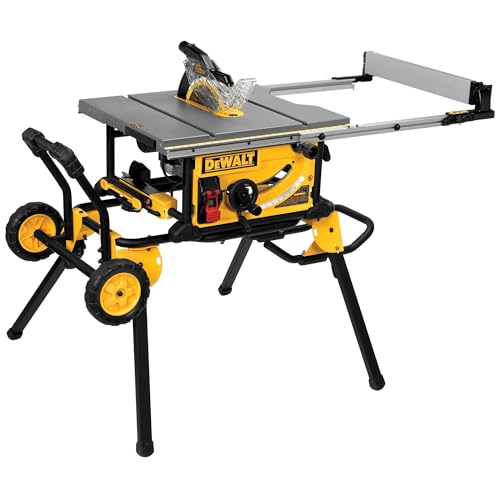
ASIN: B00F2CGXGGView on Amazon

ASIN: B0DVCZWB19View on Amazon
Certain content that appears on this site comes from Amazon. This content is provided “as is” and is subject to change or removal at any time. Product examples and images are supplied through Amazon Creators API; confirm specifications and availability on the current listing.
Quick comparison: which table saw type fits your work?
| Type | Best fit | Main advantage | Trade-off |
|---|---|---|---|
| Benchtop | Occasional home projects and tight storage | Compact and easy to store | Small work surface and limited support for large panels |
| Jobsite | Remodeling, installation, mobile crews | Portable design, often with a stand or cart | Less mass and usually a smaller table |
| Contractor | Dedicated garage or small shop | More work surface and capacity than many portable saws | Requires more floor space and transport planning |
| Hybrid | Serious hobbyists seeking a shop-oriented format | Substantial base and table in a workshop format | Construction varies widely by model |
| Cabinet | Frequent production work in a permanent shop | Heavy platform and a built-in dust-collection path | Cost, weight, space, and electrical requirements |
These names are useful starting points, not a guarantee of identical construction. Compare the actual footprint, weight, rip capacity, fence travel, motor requirements, and included guard system. Two saws with the same category label can suit different workflows.
What jobs are table saws good at?
A table saw is designed for straight cuts with the workpiece guided across a flat table. A rip cut follows the length of a board, typically with the rip fence setting the width. A crosscut runs across the board’s width and is usually guided with a miter gauge or purpose-built crosscut sled. With suitable blades, setups, and training, a table saw can also make bevel cuts and repeatable grooves. Some tasks require specialized jigs and a clear understanding of the machine’s manual.
The saw is useful when the same dimension must be cut repeatedly. A cabinet project may need panels trimmed to matching widths, while a trim project may call for consistent strips. A table saw does not replace every woodworking tool. A circular saw with a straightedge can be more convenient for breaking down a full sheet on a floor or workbench. A miter saw is often better for repeated crosscuts on long trim. A hand saw may be quieter and simpler for one small cut. For garden pruning or branch work, choose tools intended for that material, such as the hand saws for gardening guide or pole saws for tree trimming guide.
Table saw types explained
Benchtop saws
Benchtop saws are small enough to store on a shelf or place on a sturdy workbench. Their light weight and compact frame can suit renters, homeowners with limited storage, and people who use a saw for occasional projects. Some can be mounted to a compatible stand, but the work surface is generally smaller than a shop saw’s. The operator may need carefully planned support for long boards and panels.
Measure the usable table area and the distance from the blade to the fence at its maximum setting. Look at how the fence locks and whether it stays parallel to the blade across its range. Consider whether the saw can accept the blade guard, riving knife, and dust port in the configurations you expect to use. A compact tool should not be asked to manage a panel too large to control safely without suitable infeed, outfeed, and side support.
Jobsite saws
Jobsite models are built around mobility. Many include a folding stand or wheeled base, and onboard storage may be provided for common accessories. A crew can move the saw between work areas, while a homeowner can fold it away between projects. Portability is useful when the worksite changes, but check the folded dimensions, handle placement, wheel quality, setup time, and the mass you will lift into a vehicle.
Jobsite models vary in how rigid the stand feels and how much support their tables provide. If you routinely cut long stock, look at compatible outfeed or side supports and determine whether they can be set up on uneven ground. A portable saw that is difficult to level or lock in place may be a poor match for repeated precision work. Review the fence’s adjustment method and verify that it locks securely at narrow and wide settings.
Contractor, hybrid, and cabinet saws
Contractor saws typically occupy a more permanent place in a garage or small shop. Hybrid models aim to offer a shop-oriented design with a smaller footprint or different price level than a full cabinet saw, but the name alone does not establish performance. Cabinet saws are generally intended for stationary workshop use and can have a heavy base, broad table, and dedicated dust-collection connection. Weight can improve stability, yet it makes placement and future moves more demanding.
Before purchasing a stationary saw, plan the workflow around it. Include room for the operator, stock infeed, outfeed, blade changes, maintenance, dust-collection ducting, and material storage. Check the electrical service required by the specific model and have qualified help assess a new circuit if needed. An oversized saw can reduce useful workspace if lumber cannot be handled safely around it.
How to choose among the best table saws
Start with your material and most common cut
Write down the projects you expect to complete during the next year. Note the material type, thickness, longest stock, widest rip, and number of repeated cuts. Cutting plywood for built-ins creates different support needs from trimming narrow hardwood boards for furniture. Sheet goods are large, flexible, and awkward; narrow strips call for a fence and push devices that support controlled feeding. Measure a saw’s listed capacity against your real stock, not only the largest number in a listing.
Consider where the first cut will happen. A full sheet can be difficult to balance on a small table saw before it is reduced to manageable parts. Many woodworkers make an initial breakdown with a track saw or circular saw and then use a table saw for final sizing. That division can improve handling and reduce the need to manage a large panel alone.
Fence accuracy and repeatability
The rip fence is central to a table saw’s usefulness. It should be easy to position, lock firmly, and remain aligned with the blade according to the manufacturer’s setup procedure. A fence that shifts as it locks can produce inconsistent widths and make feeding less predictable. Look for readable measurements, a clear pointer, smooth travel, and an adjustment system that does not require excessive force.
When evaluating a saw in a store, follow the manufacturer’s allowed inspection process. Check whether the fence contacts its rails evenly and whether its lock feels secure. At home, verify alignment before relying on the scale for precise work. The scale is convenient, but a ruler or measuring setup can confirm the distance between fence and blade. Recheck the setup after transporting a portable saw or making significant adjustments.
Table size, flatness, and support
A larger table can make it easier to control long boards, but it cannot solve every stock-handling problem. Consider the extension wings, front and rear rails, support accessories, and total footprint when the fence is extended. If the work area is limited, a compact machine with properly placed roller or folding supports may be more practical than a wide saw that blocks a walkway.
The work surface should be clean and in good condition. Confirm the table and extensions meet evenly enough for your work, and keep them free of debris that could tilt or snag stock. Any outfeed table or roller support must be positioned to support material without lifting it or steering it away from the intended path. Support is part of the setup, not an afterthought.
Motor and electrical requirements
Do not judge a saw by a single power number without checking operating conditions and the manufacturer’s specifications. Cutting experience depends on the motor, blade, material, feed rate, electrical supply, and maintenance. A blade that is dull, dirty, or wrong for the cut can make a capable saw perform poorly. A suitable sharp blade and a controlled feed are often more valuable than forcing stock through quickly.
Check the voltage, amperage, plug, circuit, and extension-cord guidance in the manual. Do not assume a household outlet can support every saw or that any long extension cord is acceptable. If installation requires a new circuit or changes to electrical service, use a qualified electrician and follow local rules. Never remove a grounding feature or alter a plug to make it fit.
Blade size, adjustment, and accessories
Choose a saw whose supported blade type and size fit the work you do. The manual explains compatible blades, maximum diameter, arbor details, speed limits, and installation procedures. Avoid using a blade with visible damage, cracks, missing teeth, or a speed rating below the saw’s operating speed. Different tooth geometries suit different cutting actions and materials. Follow blade and saw instructions rather than assuming a general-purpose blade is ideal for every task.
Check how easily the blade height and bevel angle can be adjusted and locked. Clear scales and accessible controls can reduce setup friction, but calibration still matters. A miter gauge, compatible crosscut sled, push stick, push block, blade guard, riving knife, and anti-kickback devices should be considered part of the system. Confirm which accessories are included and whether replacements or compatible options are available.
Safety features and safe operating habits
Table saws can cause severe injuries. A guard or safety feature does not remove the need for training, careful setup, and attention. OSHA identifies hazards including contact with the blade, kickback, and flying particles, and advises using appropriate guards and eye or face protection. Its table-saw guidance also discusses push sticks for small pieces, stock support, keeping the rip fence parallel with the cut, and standing to the side of the blade path. Read the OSHA table saw safety guidance and the manual for your exact model before use.
A riving knife or spreader helps keep the kerf from closing on the blade during applicable cuts. A blade guard covers exposed blade from above, and anti-kickback devices are intended to help control stock movement. They have different jobs. The proper configuration depends on the cut. Do not remove safeguards casually, and never run a saw if a required guard or safety component is missing, damaged, or not working. Non-through cuts may use a different configuration described by the manufacturer; if you are not trained to set it up, get qualified instruction instead of guessing.
Set up the work area before switching on
- Place the saw on a firm, level base and make sure the stand or cabinet cannot shift.
- Clear the floor, cord, and table of offcuts, tools, and trip hazards.
- Plan where the board will go before, during, and after the cut; support cut and uncut ends.
- Check the blade, fence, guard, riving knife, and accessories according to the manual.
- Wear suitable eye and hearing protection, and manage dust with compatible collection and respiratory protection when needed.
- Tie back long hair, remove jewelry, and avoid loose clothing or gloves that can catch moving parts.
- Keep bystanders away from the cutting path and the area where kickback could travel.
Feed stock with control
Use the fence for ripping and the appropriate miter gauge or fixture for crosscutting. Do not use the rip fence as the sole guide for a crosscut if the offcut can become trapped between the fence and blade. Avoid feeding twisted, bowed, or damaged stock when it cannot sit securely against the table and guide. Stand out of the likely kickback path, use a push stick or push block when the cut or stock requires one, and keep hands away from the blade. Do not reach over or behind a moving blade to retrieve offcuts.
Keep a steady pace that lets the saw cut without forcing the work. If stock binds, shifts, or makes an unusual sound, stop using the procedure in the manual and wait until all motion has stopped before investigating. Disconnect power before blade changes, adjustments, clearing jams, or service where the manufacturer directs it. Never attempt to free a stuck workpiece while the blade is turning. If a cut feels unstable, stop and redesign the setup.
Long boards can require additional support and a second trained person, but a helper should not pull or steer the stock in a way that changes its alignment. OSHA cautions against crosscutting long boards on table saws because hand pressure near the blade and board movement can create hazards. Choose a tool and setup appropriate to the material length, or ask a qualified instructor to demonstrate a safe method.
Dust collection, noise, and shop comfort
Sawing creates chips and fine dust. A dust port can make collection more convenient, but it does not guarantee every particle is captured. Check the size and location of the connection and whether the saw can connect to your dust collector or shop vacuum. Confirm airflow needs and filter maintenance with both manufacturers. If the saw will be used indoors, consider how dust will spread to nearby rooms and whether your collection setup can handle the work.
Noise and vibration affect comfort over time. A stable stand, secure fasteners, and a clean blade help reduce avoidable vibration, but use hearing protection whenever appropriate. Keep the workspace ventilated and follow guidance for the material. Some sheet goods, treated lumber, plastics, or coated materials can have additional dust or cutting concerns; use only materials the saw and blade makers approve, and consult the material manufacturer if uncertain.
Choosing a table saw for common buyers
For a first home workshop
A new woodworker can benefit from a saw that is simple to set up and supported by a clear manual, accessible accessories, and replacement parts. A portable model may be a sensible start if storage and budget are tight, but do not buy a machine whose fence or support arrangement makes planned work difficult. See the setup in person or study the manual and dimensions before ordering. Allow room in the budget for a suitable blade, push devices, measuring tools, eye and hearing protection, and safe stock support.
For a remodeling contractor
A contractor may prioritize transport, reliable setup, fence adjustment, stable stand design, and onboard storage for guards and accessories. Check whether the saw can be moved through actual doorways, stairs, or vehicle space on a typical job. If the machine will be used on uneven floors or outdoors, confirm the stand can be secured and leveled. Consider how quickly it can be packed away without leaving safety components behind.
For furniture and cabinet work
Frequent furniture or cabinet work usually benefits from a well-aligned fence, predictable adjustments, a stable table, and a workable dust-collection path. A stationary saw may fit if stock sizes and daily use justify its space and cost. Consider how it integrates with an outfeed table, crosscut sled, mobile base, and existing shop layout. High capacity is useful only when the operator can safely support the material and maintain clear travel paths.
For occasional DIY projects
If the saw will be used a few times a year, storage, maintenance, and setup time may matter as much as maximum capacity. A portable model or a different tool may fit a small project list better. A track-guided circular saw can be convenient for sheet breakdown, while a hand saw can handle a small trim or garden project without setup. Compare the cost of a table saw with supplier panel-cutting or a tool already in your shop.
How to compare product listings responsibly
Product pages often emphasize a few headline figures, but a careful comparison looks beyond them. Verify the complete model number, included stand, blade, guard, miter gauge, push stick, and extension table. Check the manual for supported blade sizes, cutting capacity, electrical requirements, and permitted operations. Read the warranty language and determine who handles service. Listings can combine multiple variants, so confirm reviews and specifications correspond to the exact configuration you intend to buy.
Look for current information on return terms, replacement parts, service locations, and manufacturer support. Confirm the saw’s folded and operating dimensions against your workspace. If a listing uses terms such as “professional,” “precision,” or “heavy duty,” treat those as marketing descriptions until the specification sheet explains them. Do not infer cut quality from a product photo, an unverified star rating, or a feature list without checking the details.
For painting and finishing cabinet projects after cutting and assembly, see our guide to paint sprayers for cabinets. That is a separate step from choosing a saw; finishing equipment should be matched to the coating and ventilation requirements rather than selected as a table-saw accessory.
Setup checklist before your first cut
- Read the operator’s manual and identify the controls, safeguards, and emergency stop procedure.
- Place and secure the machine according to the manual, leaving room for the operator and stock.
- Inspect the blade and install a compatible blade with power disconnected, following the specified direction and tightening procedure.
- Install the required guard, riving knife, and anti-kickback devices for the operation.
- Verify fence and blade alignment using the manufacturer’s method; do not rely only on the printed scale.
- Connect dust collection if available and test the collection path without placing hands near moving parts.
- Set up infeed, outfeed, and side support so material stays level and controlled.
- Practice the planned sequence with the saw off: hand position, push-device use, stock travel, and where the finished piece will land.
- Make a test cut on suitable scrap only after the setup is stable and safeguards are in place.
Common table saw buying mistakes
Choosing by motor claims alone
Power numbers do not tell the whole story. The blade, feed rate, stock condition, electrical supply, and fence setup affect the cut. Compare the manufacturer’s stated operating requirements and the complete saw configuration, then select a blade designed for your material. Do not force a cut to make a tool meet a performance expectation it was not designed to meet.
Ignoring the stock support plan
A table’s width is not a safe support plan for large panels or long boards. If stock can tip, sag, or rotate during a cut, change the setup before turning on the saw. Plan support that holds material level without pinching it or pulling it out of alignment. For sheet goods, consider breaking the sheet down with an appropriate guided saw before final cuts on the table saw.
Underestimating storage and electrical needs
A stationary saw, stand, fence rails, dust collector, and infeed/outfeed tables can take over a small room. Measure the working envelope rather than only the machine base. Portable saws still require a stable place to operate, safe cable routing, and somewhere to store the stand and accessories. Check electrical requirements before delivery to avoid improvised adapters or unsafe wiring.
Removing safety parts for convenience
Guards can be inconvenient to reinstall if stored away, so compare onboard storage and quick setup features. Convenience should not become a reason to operate with a missing or malfunctioning safeguard. Understand which configuration is required for each cut and seek appropriate training for special operations. If the right safeguard cannot be installed, choose a different method.
Maintenance that helps preserve accuracy
Unplug or otherwise isolate power before cleaning, adjustment, blade changes, or maintenance as directed by the manual. Remove pitch and dust buildup using products approved for the saw and blade. Keep the table and rails clean, inspect the cord and switch, and check fasteners and stand locks periodically. Clean moving mechanisms without introducing debris into bearings or electrical components.
Inspect the blade before use. A dull, dirty, damaged, or unsuitable blade can increase feed effort and make stock behave unpredictably. Replace or service blades according to the blade maker’s instructions; stop using any cracked or damaged blade. After moving a portable saw, recheck the fence, blade, guard, and stand. If the saw develops unusual vibration, noise, binding, or electrical behavior, stop and follow the manufacturer’s service guidance.
Keep a simple maintenance log for a frequently used shop saw. Record blade changes, alignment checks, adjustments, repairs, and unusual behavior. The log can help identify whether a change in cut quality comes from the blade, setup, material, or machine condition. It also helps you follow maintenance intervals specified by the manufacturer.
Frequently asked questions
What type of table saw is best for a beginner?
There is no single type that is best for every beginner. A jobsite or benchtop saw may suit limited space and occasional use, while a stationary saw can make sense for a dedicated shop. Prioritize a clear manual, a fence that locks securely, compatible guards, stable support, and a size that matches your projects. Get hands-on instruction before attempting unfamiliar cuts.
Is a jobsite table saw accurate enough for furniture?
Some portable saws can produce repeatable cuts when correctly set up, maintained, and paired with suitable blades and support. Accuracy depends on the specific saw and workflow, not just its category. Verify fence alignment and repeatability, test on scrap, and check dimensions with measuring tools. If your work demands a wide, stable support surface and frequent precision adjustments, compare stationary options too.
Do I need a cabinet table saw?
A cabinet saw may suit frequent work in a permanent shop where the operator can support its space, cost, dust collection, and electrical needs. It is not automatically the right purchase for an occasional DIY user. Compare the total setup cost and workflow advantages with a contractor or hybrid saw before choosing.
Can I cut plywood on a table saw?
Many table saws can cut sheet goods when the blade and setup are appropriate, but full sheets are large and difficult to control. The saw must have sufficient capacity and carefully planned infeed, outfeed, and side support. Many woodworkers first reduce a sheet with a track saw or circular saw, then use the table saw for final sizing. Follow the saw and blade instructions.
What is the difference between a riving knife and a blade guard?
A blade guard forms a barrier over the exposed blade from above. A riving knife or spreader sits behind the blade and helps keep the kerf open during applicable cuts, reducing conditions associated with binding and kickback. They have different functions and are not interchangeable. Use the configuration specified by the saw manual for the cut.
How much rip capacity do I need?
Choose capacity based on the widest cut you routinely make and whether your shop can safely support that material. Maximum fence travel does not mean a wide panel is easy to control. If large sheets are occasional, breaking them down first with a guided saw may be more practical than buying a larger table saw solely for that task.
Can I use an extension cord with a table saw?
Only if the saw’s manual allows it and the cord meets the specified gauge, length, and electrical rating. Long or undersized cords can cause voltage drop and overheating. Do not use damaged cords, remove grounding features, or improvise adapters. Ask a qualified electrician about the circuit if you are unsure.
How often should a table saw blade be replaced?
There is no universal schedule. The interval depends on the blade, material, use, maintenance, and whether it can be professionally sharpened. Clean and inspect blades as directed, and stop using any blade that is cracked, damaged, or producing abnormal cuts. Sharpen or replace a dull blade according to the manufacturer’s recommendations.
Are used table saws worth buying?
A used saw can be a good value if its condition, safety equipment, parts availability, and electrical setup can be verified. Inspect the table, fence, arbor, switch, cord, stand or cabinet, and guard system. Confirm required components are present and the saw can be serviced. If you cannot establish its condition or obtain the manual, consider a different machine.
Can I make non-through cuts on any table saw?
Do not assume every saw, blade, or setup supports the same operations. The manual may specify a particular riving knife or guard configuration for non-through cuts. Such operations can carry additional risk and should be attempted only by a trained operator using an approved setup. If the manual is unclear, contact the manufacturer or use another method.
Final decision: choose for the whole workflow
The best table saws match the work, space, stock, and operator—not simply the models with the biggest capacity or longest feature list. Define your common cuts and materials. Then compare the fence, table support, blade adjustments, safeguards, dust collection, electrical needs, portability, maintenance, and service support. Read the current manual before purchase and confirm the saw can be installed and used safely in your shop.
A smaller machine may be practical for a limited workshop, while a heavy stationary saw may support frequent cabinet or furniture work. In every case, safe stock support and correct setup matter as much as the saw itself. Check current model details, use the guards and push devices specified for each cut, and get qualified instruction before attempting unfamiliar operations.
This guide is for general product research and is not a substitute for the saw manufacturer’s instructions, formal woodworking training, or workplace safety requirements.