Disclosure: As an Amazon Associate, dailyhomedecorating.com earns from qualifying purchases. Links on this page are affiliate links; they cost you nothing extra. Prices and availability change often, so check the current Amazon listing before you buy.
Reading outdoor storage box reviews across the internet can feel like reading weather reports from different planets: one owner swears a box kept cushions bone-dry through a hurricane season, the next reports a puddle inside after one storm. This article is a guide to the category written the way a careful reviewer should write it, reconciling those contradictions, explaining what the main designs do well, and showing you how to read any review, including this one, with the right questions in hand.
Outdoor Storage Box Reviews — The Complete Picture
In this guide
Key Takeaways
- Reviews disagree mostly because conditions differ, not because owners lie.
- Praise and complaints cluster on lids, seals and honest sizing.
- Assembly quality explains a surprising share of leak reports.
- Weight long-term reviews above first impressions.
- Safety and water honesty are the two lenses every review needs.
Why Reviews of the Same Box Disagree
Most contradictions in deck box reviews are not about honesty; they are about conditions. A box on a covered porch lives a different life from the identical box on an exposed coastal deck. A reviewer who stores dry cushions and opens the box weekly judges it differently from a parent loading damp towels daily. Once you learn to ask where the box lived, what it held, and how it was placed, the conflicting reports start to agree with each other remarkably well.
The second source of disagreement is assembly. A surprising share of negative reviews describe lids that gap, panels that bow and water that enters, on boxes that were assembled slightly out of square or set on uneven ground. That does not excuse genuinely flimsy designs, but it means a cluster of leak complaints should be read alongside the assembly complaints, because the two often describe the same afternoon.
What Good Reviews Consistently Praise and Condemn
Across the category, praise clusters on the same points: lids that stay open, interiors that swallow a full cushion set without a wrestling match, finishes that make the box look like furniture, and the simple daily pleasure of a clear deck. When owners love a box, they describe their evenings, not its specifications, which tells you what the purchase is really about.
Condemnation clusters just as predictably: lids that warp or crack, water found after storms, assembly clips that fought back, and interiors smaller than the headline suggested because walls slope or the lid mechanism intrudes. Notice that almost none of these are about the box failing to be a box; they are about the details of lids, seals and honest sizing, which is why those details dominate this article too.
Child Safety: Read This Before Anything Else
A deck box is never a hiding place and never a toy, and this needs saying plainly because every summer brings the same preventable accidents. Children must not climb inside a storage box: a child inside a closed box faces entrapment and suffocation risk, and a heavy lid can trap small fingers or worse. Teach the rule early, repeat it often, and treat the box in conversation the way you treat the road or the pool: not forbidden fruit, just not a plaything.
Choose and use the box to make the safe behaviour the easy behaviour. Prefer lids that cannot latch a child in, keep the lid closed when the box is not being loaded, and never store pool chemicals, sharp tools, or anything hazardous in a box that children can open. If your household includes toddlers, a box in a spot you can see from the house, opened only by adults, is the sensible arrangement until the rule is fully understood.
Supervision beats hardware here. A stay-open lid reduces slam injuries but does not make the interior safe, and no hinge design changes the fundamental point: the inside of the box is for cushions and equipment, never for children, not for a game, not for a dare, not for a photograph. Households that state this once, clearly, and enforce it kindly tend to have no trouble with it at all.
How Water-Resistant Is Water-Resistant, Honestly?
The phrase on the box is water-resistant, and it deserves an honest translation. A well-designed lid sheds normal rain: showers run off the overlapping lip, the contents stay dry, and the system works as advertised through ordinary weather. Driving rain is a different test. Wind pushes water sideways and upward into seams that shrug off vertical rain, and a storm that soaks the deck from every direction will find the way into many boxes that kept contents dry all spring.
Standing water is the other honest limit. A box sitting in a puddle on a low patio, or under a dripping gutter, lives in conditions its designers did not promise to defeat; water can wick through base seams and panel joints given time and pressure. Raising the box slightly on a level hard surface, moving it out of the drip line, and checking after major storms are the practical answers, none of which require a different box.
For real protection of the things that matter most, store cushions in bags inside the box. A large breathable or waterproof storage bag around the cushion set turns the box from the only line of defence into the outer of two, and that combination survives weather that defeats either layer alone. Judge any box you buy by this standard: excellent against normal rain, assisted by bags and placement against the worst rain, and never honestly described as a submarine.
Lockable Lids: What a Lock Does and Does Not Do
Many deck boxes accept a padlock through a hasp on the lid, and the feature is worth having for the right reasons. A lock deters casual access: it keeps curious children out of the contents, stops a neighbour’s toddler opening the box at a barbecue, keeps the lid down in storms, and signals to an opportunist that easier targets exist elsewhere on the street. For tools and pool supplies in an open front garden, that deterrence is real value.
Be equally clear about the limit: a lockable lid is not a safe. Resin panels can be forced, hasps are light hardware, and a determined thief with time and privacy will not be stopped by a deck box. Valuable power tools, documents, and anything you could not shrug off losing belong indoors or in genuinely secure storage. The lock manages everyday access and temptation; it does not create a vault, and buying a box believing otherwise sets up a painful lesson.
Practical notes: choose a weather-resistant padlock, because a cheap one will seize outdoors and leave you cutting your own lock off; keep the spare key indoors rather than in the box’s own vicinity; and if children are the concern, remember the lock works only when it is actually on, so a lid routine at the end of the day matters more than the hardware itself.
The Main Models Worth Knowing
Because this wave of the guide is written prose-first, the models below are described without purchase links while listing verification is completed. Treat each as a starting point for your own comparison, positioned by tier in words rather than by price, and check the current listing for the exact configuration before you buy.

Suncast deck box
The Suncast deck box is a long-running American resin maker whose boxes lean practical: straightforward panels, stay-open lids on many designs, and a reputation for honest, unfussy construction. In daily use its strengths show up in the ordinary moments: the lid behaviour when your hands are full of cushions, the interior shape when a full set needs to go away quickly before rain, and the way the finish sits alongside furniture rather than against it. Its trade-offs are the usual ones for its tier, and the sections throughout this article on materials, lids and placement apply to it exactly as written.
Best for: households whose priorities match the Suncast approach of balancing weather resistance, capacity and presentation. Not suited for: anyone expecting a lockable resin or light metal box to act as a security safe, or anyone whose cushion set is at the very largest end and has not first measured the interior against it. As a prose-only pick in this edition, it is positioned qualitatively in the mid-to-premium conversation for its class rather than by any fixed figure.

Rubbermaid deck box
The Rubbermaid deck box is the utility-first choice from a brand built on household storage, typically double-walled resin with a sturdy, workmanlike feel and little interest in decoration. In daily use its strengths show up in the ordinary moments: the lid behaviour when your hands are full of cushions, the interior shape when a full set needs to go away quickly before rain, and the way the finish sits alongside furniture rather than against it. Its trade-offs are the usual ones for its tier, and the sections throughout this article on materials, lids and placement apply to it exactly as written.
Best for: households whose priorities match the Rubbermaid approach of balancing weather resistance, capacity and presentation. Not suited for: anyone expecting a lockable resin or light metal box to act as a security safe, or anyone whose cushion set is at the very largest end and has not first measured the interior against it. As a prose-only pick in this edition, it is positioned qualitatively in the mid-to-premium conversation for its class rather than by any fixed figure.

Lifetime storage box
The Lifetime storage box is the heavy-duty end of the mainstream, from a maker known for sheds and tables, with rigid panels and lids that feel noticeably more structural than most. In daily use its strengths show up in the ordinary moments: the lid behaviour when your hands are full of cushions, the interior shape when a full set needs to go away quickly before rain, and the way the finish sits alongside furniture rather than against it. Its trade-offs are the usual ones for its tier, and the sections throughout this article on materials, lids and placement apply to it exactly as written.
Best for: households whose priorities match the Lifetime approach of balancing weather resistance, capacity and presentation. Not suited for: anyone expecting a lockable resin or light metal box to act as a security safe, or anyone whose cushion set is at the very largest end and has not first measured the interior against it. As a prose-only pick in this edition, it is positioned qualitatively in the mid-to-premium conversation for its class rather than by any fixed figure.
YITAHOME deck box
The YITAHOME deck box is a value-tier regular in online listings, offering large capacities and bench-style designs at the accessible end of the market, with assembly that rewards patience. In daily use its strengths show up in the ordinary moments: the lid behaviour when your hands are full of cushions, the interior shape when a full set needs to go away quickly before rain, and the way the finish sits alongside furniture rather than against it. Its trade-offs are the usual ones for its tier, and the sections throughout this article on materials, lids and placement apply to it exactly as written.
Best for: households whose priorities match the YITAHOME approach of balancing weather resistance, capacity and presentation. Not suited for: anyone expecting a lockable resin or light metal box to act as a security safe, or anyone whose cushion set is at the very largest end and has not first measured the interior against it. As a prose-only pick in this edition, it is positioned qualitatively in the mid-to-premium conversation for its class rather than by any fixed figure.
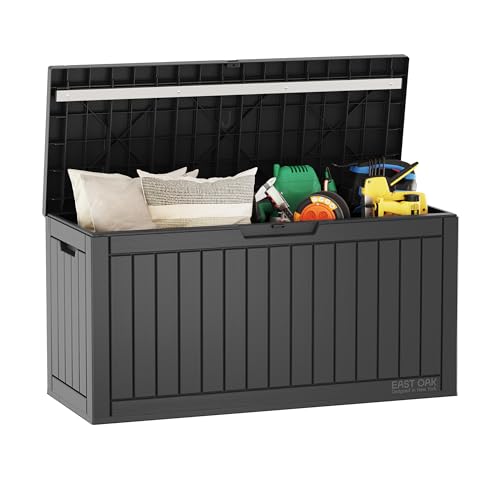
EAST OAK deck box
The EAST OAK deck box is a newer online brand that has built a following on clean styling, galvanised or resin builds depending on the line, and lids that present well on modern patios. In daily use its strengths show up in the ordinary moments: the lid behaviour when your hands are full of cushions, the interior shape when a full set needs to go away quickly before rain, and the way the finish sits alongside furniture rather than against it. Its trade-offs are the usual ones for its tier, and the sections throughout this article on materials, lids and placement apply to it exactly as written.
Best for: households whose priorities match the EAST OAK approach of balancing weather resistance, capacity and presentation. Not suited for: anyone expecting a lockable resin or light metal box to act as a security safe, or anyone whose cushion set is at the very largest end and has not first measured the interior against it. As a prose-only pick in this edition, it is positioned qualitatively in the mid-to-premium conversation for its class rather than by any fixed figure.
Keter deck box
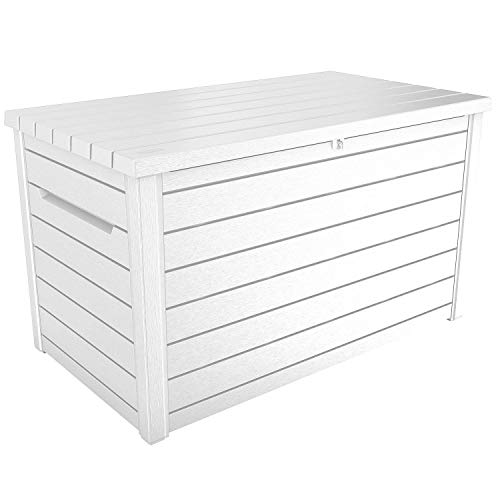
The Keter deck box is the household-name resin option, widely sold in sizes from compact balcony boxes to large cushion stores, with woven-look and wood-look finishes that suit styled decks. In daily use its strengths show up in the ordinary moments: the lid behaviour when your hands are full of cushions, the interior shape when a full set needs to go away quickly before rain, and the way the finish sits alongside furniture rather than against it. Its trade-offs are the usual ones for its tier, and the sections throughout this article on materials, lids and placement apply to it exactly as written.
Best for: households whose priorities match the Keter approach of balancing weather resistance, capacity and presentation. Not suited for: anyone expecting a lockable resin or light metal box to act as a security safe, or anyone whose cushion set is at the very largest end and has not first measured the interior against it. As a prose-only pick in this edition, it is positioned qualitatively in the mid-to-premium conversation for its class rather than by any fixed figure.
Lids, Hinges and Gas Struts
The lid is the part you will interact with most, and its engineering decides whether the box feels like a help or a nuisance. A good lid opens wide enough that you are not holding it with one hand while fishing with the other, stays where you leave it, and closes without a slam. Gas struts or spring hinges that hold the lid open are more than a luxury: they free both hands and they remove the guillotine worry when children are nearby, though they never remove the need for supervision.
Hinges live a hard life outdoors. Metal hinges can corrode in coastal air; living hinges moulded into the resin avoid rust but can fatigue. Whatever the design, grit is the enemy, so a lid that sheds water away from the hinge line and a quick brush-out each season keep the action smooth. A lid that warps even slightly stops sealing along its lip, and that is when rain starts finding its way in.
Check the lip design as carefully as the hinge. Overlapping lips and raised interior rims channel water outward before it can drip inside, while a simple flat-on-flat closure relies entirely on perfect alignment. On a deck that sees wind-driven rain, the channelled designs earn their keep. None of this is visible in a hero photograph, which is why detailed owner reports matter so much in this category.
Ventilation, Mildew and the Damp-Cushion Problem
A sealed box full of slightly damp cushions is a mildew incubator, and this is the failure mode nobody warns about at the point of sale. Cushions should go in dry, or as close to dry as a day of use allows; if they were caught in a shower, stand them to drain and air before boxing them. Boxes with subtle ventilation, or lids that do not hermetically seal, trade a little weather protection for a lot of freshness, and for cushion storage that trade is usually right.
If you open the box to a musty smell, act early: remove everything, wash the interior with mild soapy water, let it dry fully in the sun, and air the cushions before they go back. A small open container of baking soda inside helps between deep cleans. Storing cushions inside large breathable bags adds a second line of defence, keeping dust and any stray drips off the fabric while still letting moisture escape.
Location influences all of this. A box in full sun dries its contents’ ambient air and discourages mould, but bakes fabrics and ages resin faster. A box in permanent shade stays cooler and kinder to colours, yet dries slowly after rain and grows algae on its north face. Most households do best with partial sun and a few centimetres of clearance from walls so air can move around the shell.
Placement: Deck, Patio, Poolside and Garden
Put the box where the items are used, not where it looks tidiest in a photograph. Cushion storage belongs within a few steps of the seating; pool storage belongs on the pool deck, not across the lawn; tool storage belongs near the beds it serves. Every extra metre of distance is a small tax on tidiness that compounds daily, and within a month the tax wins and the clutter returns to the chairs.
The surface underneath matters. A level, hard surface keeps the box sitting true so the lid aligns and seals; on lawn or gravel the shell can rack slightly, the lid lip gaps, and water finds the gap. A couple of pavers under a garden box solve this cheaply. Leave clearance behind the box for the lid to swing fully, and think about the arc before you commit to a spot against a wall or railing.
Sun, wind and sightlines complete the picture. A box that doubles as extra seating earns a place in the social centre of the deck; a purely functional box can retire to a side wall. In windy spots, a heavier box or a sheltered position stops lid-slam and, in storms, stops the whole box travelling. Empty resin boxes are surprisingly mobile in a gale, which is an argument for keeping some ballast of contents in them year-round.
Assembly: What to Expect on Day One
Most resin deck boxes arrive flat-packed and assemble by panels clicking or screwing together. The honest expectation is a straightforward but physical job: large panels, some force to seat the clips, and a much easier time with two people when the base and lid are being aligned. Read the panel-orientation diagrams twice, because resin panels often fit almost-right in the wrong orientation, and undoing a seated clip without damaging it is the fiddliest part of the whole build.
Assemble on the surface where the box will live, or at least on something flat, so the shell sets square. A box assembled on uneven ground can lock in a slight twist that follows it forever, showing up as a lid that never quite closes evenly. Tighten and seat everything fully before loading it; a half-seated base panel announces itself the first time the box is dragged with weight inside.
Keep the instructions and any spare clips. Panels can be replaced on many designs, and knowing your model’s panel layout makes a warranty conversation far easier. A photograph of the finished box and the box it arrived in, taken on day one, sounds excessive until the day it settles a question about a crack or a missing part in a single message.
Cleaning and Seasonal Care
Resin care is refreshingly dull: a bucket of warm water, a drop of mild detergent, a soft brush for the textured grain, and a rinse. Avoid aggressive solvents and abrasive pads, which dull the finish and can make future dirt stick harder. Once a year, check the hinge area and the lid lip, clear out the grit and leaf litter that collect there, and confirm any drainage or ventilation paths are open.
Wood asks for more: a gentle wash, a full dry, then oil or sealant as the maker directs, usually annually. Metal wants its scratches touched in before rust starts and its hinges given a drop of suitable lubricant. In every material, the pre-winter clean is the one that counts, because a box put away dirty stays damp and dirty in exactly the places mould likes.
Before the first hard frost, decide what stays in and what migrates indoors. Fabrics tolerate a dry, ventilated box through winter in most climates; anything with batteries, liquids that can freeze, or sentimental value deserves indoor storage. A mid-winter check after a storm, confirming the lid held and the interior stayed dry, takes two minutes and catches small problems while they are still small.
Using the Box as Extra Seating
Many deck boxes are sold as bench seating as well as storage, and the dual role is genuinely useful on small decks where every piece must earn its footprint twice. As a seat, the box suits occasional overflow guests and children best; the flat lid takes a cushion pad comfortably, and the height is roughly chair-like on larger models. It is not a substitute for a proper bench if you seat adults there every evening.
Be honest about load. Lids are engineered to a limit, and standing on a lid to reach a gutter or a string light is the classic way to crack one. If your household includes enthusiastic climbers, treat the box top as a surface for sitting only, and say so plainly and often. A cracked lid compromises the weather seal for everything inside, so the rule protects the contents as much as the climber.
If seating is a primary goal, look for reinforced lids and a shape that reads as a bench, and consider a dedicated bench pad stored, fittingly, inside the box itself. The neatest small-deck arrangement we see is a storage bench along the railing, cushions inside it, pad on top of it, and nothing else on the deck floor at all.
Pool Storage Without the Chaos
Pools generate a special category of clutter: inflatables that never fully deflate, towels that are always damp, a skimmer net with a long pole, and chemicals that must be stored responsibly. A deck box handles the soft goods beautifully. Inflatables last longer stored loosely folded out of the sun, and towels aired then boxed stay fresher than towels draped over rails for days.
Keep pool chemicals out of any box children can open, and ideally out of the general deck box entirely: they belong in a dedicated, ventilated, child-inaccessible store, because mixing family storage with chemical storage is how accidents get their opportunity. The same applies to sharp tools and anything heavy that could fall on small fingers rummaging at the bottom of the box.
The long-handled equipment still needs its own answer, usually hooks on a fence or a tall narrow store, because a standard deck box swallows poles awkwardly. Accepting that the box is for the soft and bulky, while rails and hooks handle the long and thin, gives you a pool deck that can be cleared in minutes before guests arrive, which is the real luxury on offer.
Garden Tool Storage That Stays Usable
Hand tools, twine, gloves, kneelers and seed packets suit a deck box well; long tools do not, and forcing them in diagonally creates the jumbled pit everyone dreads opening. The fix is layering: heavy and rarely used items at the bottom, everyday tools in a caddy or bucket that lifts out as one piece, and gloves and small consumables in a pouch hung or placed at the top where hands land first.
Damp is the enemy of tools. Soil left on trowels holds moisture against the metal, so a quick brush-off before storage and a dry box interior keep edges bright far longer. A small tray or mat in the base catches the grit that inevitably migrates, and lifting it out for a shake is easier than vacuuming a textured resin floor.
If the box lives at the far end of the garden, weight your choice toward weather resistance and a lid that seals well, because it will face the worst of every storm unsupervised. If it lives by the back door as a mudroom overflow, convenience features matter more: a lid that stays open, a smooth interior that wipes clean of boot-room mud, and room for the watering can to stand upright.
Small Decks and Balconies: Thinking Compact
On a small deck, the box competes directly with the furniture it serves, so footprint discipline matters more than raw volume. A slim box along a railing or a compact cube in a corner can hold a surprising amount if the contents are chosen honestly: the cushions for the two chairs you actually own, not the six you host twice a year. Vertical thinking helps too, since a taller compact box uses airspace that a long low one cannot.
Measure the door and gate the box or its panels must pass through before ordering; assembled dimensions are quoted everywhere, but the delivery path is your own problem to solve. Flat-packed resin panels are forgiving here, which is one reason the style dominates apartment-friendly listings. Check building or HOA rules as well, because some balconies restrict storage furniture, and a box that must be returned helps nobody.
Dual purpose is the small-space superpower. A compact box that serves as a side table between two chairs, holding the cushions for those chairs inside it, is the tidiest trick in this entire category. Add a tray on top for drinks and the piece stops reading as storage at all, which on a small deck is exactly the point.
Style: Making Storage Look Like Furniture
A storage box is a large object, and on a styled deck it will be seen more than it is opened. Finishes that echo your furniture, woven-look textures that nod to wicker, and colours drawn from the house trim or the decking all help the box disappear into the scheme rather than announce itself as equipment. The current generation of resin designs is far better at this than the shiny utility boxes of a decade ago.
Placement and dressing finish the job. A box aligned with the railing line, centred under a window, or paired symmetrically with a planter looks placed rather than parked. A cushion pad in your scheme’s fabric turns it into a bench visually even if nobody sits on it, and a lantern or a pot on a corner of the lid, moved aside when you open it, softens the silhouette further.
None of this requires the premium tier. It requires choosing the colour and texture deliberately instead of accepting whatever was cheapest that week, and giving the box a considered position instead of the leftover corner. The difference between a deck that looks stored-on and a deck that looks styled is usually exactly these two decisions.
Delivery, Returns and Warranty Realities
These are bulky items, and the logistics deserve a thought before the purchase rather than after. Panels arrive in a large flat carton that needs a dry place to wait if assembly day is rainy. Check panels on arrival for transit cracks, especially at corners and clip points, and photograph anything suspect before assembly, because a pre-assembly photograph is the strongest evidence there is in a damage conversation.
Read the warranty for what it actually covers: typically manufacturing defects and sometimes fading or rust, rarely misuse, storm damage or a lid cracked by standing. Keep the receipt and the model identification together, and note that a box used within its intended purpose, on a level surface, with a lid that has not been forced, is a box whose warranty story stays simple.
Returns of assembled bulky goods are painful enough that measuring twice is the real returns policy. Confirm the interior dimensions against your largest item, confirm the footprint against your marked-out tape outline on the deck, and confirm the lid swing against your wall or railing. Ten minutes with a tape measure and some painter’s tape is the cheapest insurance in this category.
Comparing Sizes Without the Numbers Game
Capacity figures are the least honest numbers in this category, not because makers lie but because a shell’s volume says nothing about sloping walls, lid mechanisms that intrude when closed, or the shape of your actual cushions. The reliable method is analogue: build your inventory pile on the deck, measure its length, width and settled height with a tape, and compare those three figures with the interior dimensions of any box you are considering, leaving a hand’s width of slack on each side.
Shape beats volume every time. A long low box swallows cushions and frustrates tool storage; a squarer box stacks games, pots and gear but may refuse a full-width cushion. If your inventory is mixed, the answer is often a long box for the soft goods plus the discipline of a lift-out caddy for the small hard goods, rather than a single compromise shape that serves both badly.
When two sizes both fit, buy the larger if the footprint allows it. Seasonal rotation guarantees that whatever slack exists in July will be spoken for by November, and the price of slightly too big is a little air, while the price of slightly too small is a box lid that will not close in the first week of ownership.
Zoning: Two Smaller Boxes Versus One Large One
One large box is the default, but two smaller boxes placed where their contents are used can beat it. A compact box at the pool end for towels and inflatables, and the main box by the seating for cushions, removes the cross-deck carrying that a single central box still demands. Zoning works because storage succeeds on proximity, and proximity is easier to buy in two small footprints than in one large one.
The costs are real: two lids to keep aligned, two assemblies, and a deck that can start to look like a storage yard if the boxes do not match. Keep finishes and colours in the same family and align both boxes on the same visual line, and the pair reads as furniture planning rather than accumulation.
Zoning also helps families. A low, light box designated for children’s outdoor toys, with nothing hazardous in it and a lid they can manage under supervision, separates the play inventory from the adult one. The main box, holding tools and household gear, can then carry the stricter rules without negotiation at every opening.
When a Shed, a Bench or Nothing Is the Better Answer
Honesty about alternatives improves every purchase. If your inventory is dominated by long tools, machinery, bicycles or anything valuable, a shed is the right answer and a deck box is a detour. If your only problem is two cushions, a simple bench with a storage seat, or even a weatherproof bag in a covered corner, may serve you without a new large object on the deck.
If your outdoor space is fully covered, the calculus shifts again: weather protection matters less, and open shelving or a simple chest kept for looks may do the job at the tier you prefer. The deck box earns its place specifically in exposed spaces with bulky soft inventory, and forcing it into other roles produces the disappointed reviews this category collects.
The test is to name the three items the box will hold most. If you cannot, you are shopping for tidiness in the abstract, and no product delivers that. If you can name them instantly, measure them, and the box that fits them will feel less like a purchase and more like the end of an argument.
Renters, Balconies and HOA Rules
Renters should weight assembly and disassembly more heavily than owners: a box that panels apart cleanly will move house with you, while one that must be half-destroyed to dismantle will be left behind. Keep the carton if you can, because flat panels travel best in the packaging shaped for them, and photograph the assembly order as you build so the rebuild is painless.
Balcony rules vary by building: some restrict storage furniture, some restrict anything visible above the railing, and some landlords have opinions about weight on older structures. A quick message before ordering is cheaper than a return. Weight when loaded is rarely a problem with soft goods, but a box full of wet soil-covered pots is a different object from a box full of cushions.
Shared and visible spaces reward discretion. A box in a front garden or shared courtyard should look like furniture, sit neatly, and ideally be lockable, not for security but to keep the shared space’s children and passers-by out of your things and your things out of trouble.
Questions to Ask Before You Order
Run this checklist against any candidate. Does my largest single item fit the interior shape, not just the volume? Does the footprint, taped out on the deck, leave the lid a full swing and me a walking path? Is the surface level and hard, or am I budgeting pavers too? Does the lid stay open unaided, and can it take a padlock if I want one? What is the panel replacement story if a lid cracks in year three?
Add the household questions. Who will actually put things away, and is the box where their habits already go? What is the rule for children, stated before the box arrives rather than after the first game of hide and seek suggests itself? What will live in it in winter, and does that change the size I need?
If a listing cannot answer the product questions and you cannot answer the household ones, the correct move is to wait a day. Deck boxes are not scarce, sales recur, and a measured purchase in this category is very nearly a permanent one, which makes the day’s patience the best value in the whole transaction.
The First Month: Calibrating the System
Expect the first month to be calibration, not failure. You will learn that the hose nozzle lives better in the caddy than the corner, that one cushion only fits happily in one orientation, and that the box wants to sit a hand’s width further from the wall than you placed it. Adjust without self-reproach: the households with immaculate systems are the ones that moved things twice in month one.
Build the closing routine early. Box closed, lid latched or locked, cushions in dry, nothing leaning against the outside. Two minutes at dusk is what separates a system from a pile with a lid, and it is also the moment the safety rules get reinforced for children without a lecture, simply by watching the adults treat the box as furniture with a purpose.
By the end of the first month, do one honest audit: open the box and remove anything that has not been touched. That item does not belong in prime outdoor storage, and evicting it returns the slack that makes everything else easy to reach. The box you audit monthly stays the box you praised in week one.
Why Outdoor Clutter Builds Up So Fast
Every patio develops the same slow drift. Cushions come off the chairs and land on a bench, pool towels pile onto the loungers, the watering can migrates to the steps, and by midsummer the space that was meant for slow evenings is mostly a holding area for things with nowhere to live. An outdoor storage box works because it gives that drift a single destination close to where the items are actually used, which is the only kind of storage system anyone keeps using.
The alternative most households try first is carrying everything indoors, and it fails on friction alone. Cushions dragged through a kitchen twice a day get dirty, get forgotten, and eventually get left outside anyway, where dew and pollen do the damage the carrying was meant to prevent. A box on the deck removes the trip, and removing the trip is what turns good intentions into a habit that survives the whole season.
It also changes how the space feels. A clear deck reads as an invitation; a deck covered in leaning tools and stacked cushions reads as a chore. The box is therefore doing two jobs at once, one practical and one visual, and judging it only on capacity misses half of what you are paying for when you choose a size and a finish that suit the space.
After the Boxes Are Gone: Long-Term Ownership Notes From Outdoor storage box Reviews
Most outdoor storage box coverage stops at unboxing, yet almost everything that decides owner satisfaction happens afterwards. The first evening tells you about finish and first impressions; the third month tells you about durability, upkeep and whether the design still suits the way your household actually behaves. This section looks at the ownership phase in detail — the settling-in period, the first signs of wear worth watching for, and the small habits that separate owners who stay pleased from owners who start browsing replacements. If you are weighing Suncast deck box, Rubbermaid deck box or any similar design, treat the points below as the questions a good long-term review should answer.
The Settling-In Period: What Changes in the First Weeks
New materials and mechanisms relax. Fabrics soften, joints settle, finishes lose their showroom sharpness, and moving parts either bed in smoothly or start to complain. With a outdoor storage box, use the first fortnight deliberately: operate everything daily, check fixings once after the first week, and keep a mental note of any sound, wobble or resistance that was not there on day one. Changes that stabilise after a small adjustment are normal settling; changes that keep progressing are early warnings, and they are far easier to raise with a seller while the purchase is recent.
Wear Worth Watching, and Wear Worth Ignoring
Not all wear is failure. Honest materials in the patio & outdoor living category develop a patina — slight softening of edges, gentle colour shifts where hands and light fall — and most owners come to like it. The wear that matters is functional: looseness that returns after tightening, surfaces that mark from ordinary use rather than accidents, parts that need persuading, and finishes that fail at edges and corners first. Check those high-contact zones on any outdoor storage box you already own, and look for honest close-up photographs of exactly those zones when you judge a replacement.
Notice which parts are replaceable and which are not; a outdoor storage box whose wear parts can be swapped cheaply often outlasts a sealed design twice its price in spirit, if not in years. Consider the outdoor storage box from the perspective of the person who cleans around it, because designs that trap dust, block access or demand special products quietly tax every week of ownership. Think about noise, light and heat as neighbours of the outdoor storage box, not afterthoughts, since a choice that performs well but disturbs the room around it rarely stays popular for long.
Ownership rewards attention in small doses. A outdoor storage box that is checked monthly and cleaned gently will usually outlast a neglected premium model, and it will certainly stay pleasanter to live with. Judge any review — including the detailed assessments earlier in this guide — by whether it helps you through this long middle phase of ownership, because that phase, not the unboxing, is where the money is really spent.
Frequently Asked Questions
Why do reviews disagree about leaks?
Because conditions differ more than boxes do. Placement, assembly squareness, storm exposure and whether cushions went in damp explain most contradictions, which is why good reviews describe the setting and the routine, not just the product.
How many reviews should I read before buying?
Enough to see the pattern rather than the average: look for repeated mentions of lid behaviour, interior size and assembly, across owners whose setup resembles yours. A handful of detailed, specific reviews outweigh a pile of one-line verdicts.
Are negative reviews about assembly a red flag?
They are information, not verdicts. Some designs genuinely fight back, but many assembly complaints trace to panels fitted in the wrong orientation or boxes built on uneven ground. Clusters of cracked lids or warped panels are the more serious signal.
Can I trust that a box is waterproof because reviewers say so?
Trust the translation instead: reviewers mean it kept their things dry in their weather. Water-resistant lids shed normal rain; driving rain and standing water defeat many designs, so bags inside the box remain the honest route to full protection.
Do reviewers mention child safety?
Rarely, and they should. A deck box is never a hiding place or toy, children must not climb inside because of entrapment and suffocation risk, and chemicals or tools should never be stored where children can open the box. Judge a household’s routine, not just its hardware.
What do long-term reviews reveal that new ones cannot?
Fading, hinge fatigue, lid warp and mildew habits: the slow story. A box praised at a week and cursed at a year usually has a lid or seal weakness, so weight reviews that mention seasons of use far above first impressions.
Related Guides
Keep reading with the companion pieces in this series and the closest live guides on the site: outdoor storage box review outdoor storage box buying guide outdoor storage box pros and cons is an outdoor storage box worth it how to choose an outdoor storage box best outdoor chairs for patio best patio chaise lounge chairs best garden hoses best rain barrels for gardening