Disclosure: As an Amazon Associate, dailyhomedecorating.com earns from qualifying purchases. Links on this page are affiliate links; they cost you nothing extra. Prices and availability change often, so check the current Amazon listing before you buy.
These spice rack reviews survey the designs real kitchens actually buy — in-cabinet organisers, drawer liners, tiered risers, expandable shelves and the countertop carousel — and review each format on the criteria that decide satisfaction six months later: access, storage climate, jar compatibility and upkeep. One warning runs through every review below, because it is the finding that matters most: heat, light and steam degrade spices, so the convenient rack beside the stove is the worst storage spot for flavour, and several well-made racks are let down entirely by where kitchens put them. Format first, product second, placement always — that is the order of these reviews.
Key Takeaways
- Top formats for flavour: drawer liners and in-cabinet organisers, because they store jars dark, cool and dry.
- Most forgiving format: the open tiered riser — any jars, no assembly, no decanting.
- Most misused format: the countertop carousel, excellent machinery usually parked in the worst microclimate in the kitchen.
- Best small-kitchen move: use a door or a narrow drawer — vertical and hidden volume beats counter volume.
- Every review below is prose-only: brand and model assessments with no links until listings are verified.
How these reviews were put together. Each design is assessed as a format as much as a product, because within a format the ownership experience is remarkably consistent: the same jars fit or do not, the same cleaning ritual applies, the same placement temptations arise. Where a named model represents its format, the review says so and judges the model on how well it executes the format’s idea. Star ratings and review counts are deliberately absent — they shift constantly and say little about whether a rack suits your jars, your cabinet and your cooking. For the single-product deep dive, see our spice rack review.
In this guide
Spice Rack Reviews: The Formats, Reviewed One by One
Spice racks divide into a handful of families, and the family matters more than the brand. Drawer systems — angled trays and liner strips — lay jars on their sides or at a tilt inside a kitchen drawer, labels facing up. Tiered cabinet risers work like stadium steps inside a cupboard, lifting back rows above front rows. In-cabinet organisers such as drop-down or pull-out frames try to bring deep cabinet contents forward. Door-mounted and wall-mounted racks move storage onto vertical surfaces that would otherwise go unused. Countertop racks, including revolving carousels, keep everything visible at the cost of counter space and light exposure. Expandable shelf risers stretch to fit a cabinet width and add a second level. Each family solves a different kitchen’s problem, and each creates a different storage climate, which is why choosing the family comes before choosing the product.

YouCopia SpiceStack — in-cabinet organiser
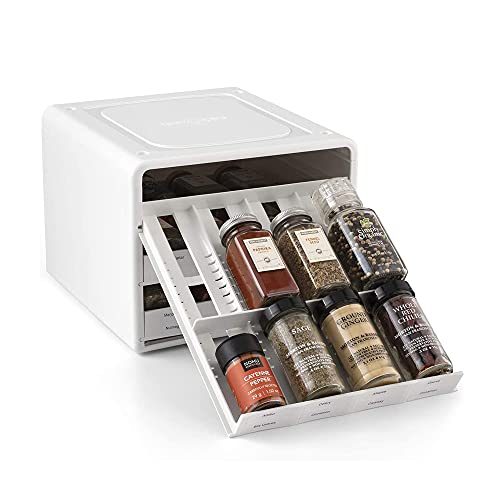
The in-cabinet organiser format, represented by the YouCopia SpiceStack, is the review team’s benchmark for cabinet kitchens. Stepped trays inside the cupboard present jars in rows you can scan in a second, dividers stop the clatter-and-topple of loose shelf storage, and the closed cabinet door delivers the dark, even-temperature storage spices want. In daily use it feels like the system a kitchen designer would have built in. The limitations are the format’s: it standardises around common jar sizes, it claims a solid block of cabinet, and tall or novelty jars sit awkwardly. Mid tier, prose-only. Best for: standard-jar collections in kitchens with cabinet room. Not suited for: oversized jars or cabinets already at war over space. Strengths: scan speed, tidiness that maintains itself, storage climate. Trade-offs: jar-size assumptions, cabinet volume.
SpiceLiner Spice Drawer Liner — drawer conversion strips
The SpiceLiner approach is the minimalist entry in these reviews and, on storage science, the strongest. Flexible liner strips are cut to fit a drawer and cradle jars on their sides in rows, every label facing up — the single best label visibility of any format, because the eye reads along the jar rather than across a cap. The drawer supplies darkness, stable temperature and distance from steam. Fitting takes scissors and ten unhurried minutes; cleaning is a lift-out and a rinse. The cost is the drawer itself, and in drawer-poor kitchens that cost is real. Entry tier in spend, top tier in outcomes. Best for: cooks with a spare drawer and mixed jar sizes, since the liner forgives variety. Not suited for: kitchens where drawers are already double-booked. Strengths: visibility, climate, adaptability. Trade-offs: consumes a drawer, jars must suit the drawer’s internal height when angled.
Copco Non-Slip 3-Tier Spice Rack — tiered cabinet riser
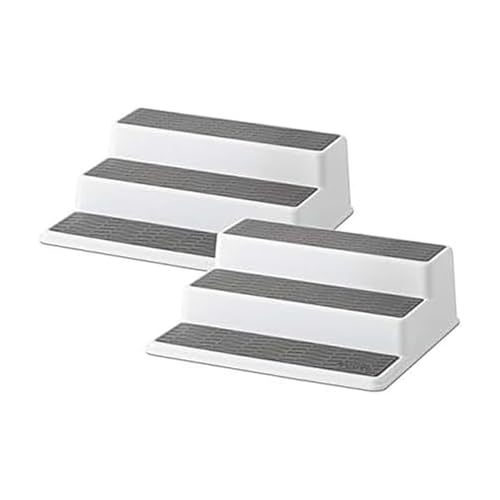
The Copco riser is the format most kitchens should try first, because it is the smallest possible intervention that fixes the back-row problem: three steps on a shelf, jars standing in stadium rows, a non-slip surface keeping them where they were put. There is nothing to assemble, nothing to fit, and no jar it refuses — the open platform takes the collection exactly as it is, mixed heights and all. What it does not do is present jars to you: the back row is visible over the front row’s shoulders, not delivered to your hand, and in a deep cabinet the space behind a fixed riser can still go dead. Entry tier. Best for: first-time organisers, renters, mixed collections. Not suited for: very deep cabinets or anyone wanting slotted, per-jar order. Strengths: simplicity, universality, price of entry in effort. Trade-offs: no dividers, visibility rather than presentation.

SWOMMOLY Spice Rack Organizer — expandable shelf riser
Expandable shelf risers, represented here by the SWOMMOLY organiser, answer a specific frustration: cabinets come in widths that fixed racks never quite match. The frame telescopes to the cabinet’s width and adds a raised second level, turning one shelf’s footprint into two levels of storage and using the awkward side gaps fixed risers waste. In use it feels sturdier than its adjustable nature suggests, provided the sections are seated properly during setup — the one step worth doing slowly. It shares the open platform’s forgiveness on jar shapes and the riser’s limits on presentation. Mid tier. Best for: wide or oddly sized cabinets, growing collections. Not suited for: anyone who will not spend the setup minutes levelling it. Strengths: fit, capacity per shelf, flexibility. Trade-offs: setup care, open-platform drift if you overfill it.
madesmart 2-Tier Organizer — under-sink-style basket tiers, repurposed
The madesmart two-tier organiser is a general-purpose basket system that many households press into spice service, and these reviews include it because that repurposing is common and mostly successful. Two sliding basket tiers hold jars and packets together — useful for collections that include packet stock a slotted rack refuses — and the whole unit works in a cabinet or a pantry. It is less precise than dedicated spice formats: jars stand loose in baskets, small jars can hide behind tall ones, and the top tier’s access depends on the shelf gap above. Entry-to-mid tier. Best for: mixed jar-and-packet collections, pantry shelves. Not suited for: cooks who want every jar visible at one glance. Strengths: versatility, packet tolerance, easy cleaning. Trade-offs: looser order, glance-visibility.
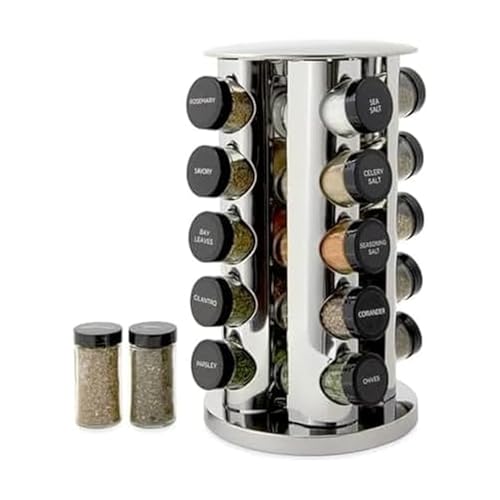
Kamenstein Revolving Spice Rack — countertop carousel
The Kamenstein carousel is the best-engineered access device in these reviews and the one with the largest asterisk. As machinery: a smooth spin, jars presented one after another to a stationary hand, often supplied as a matched jar set that makes the whole thing look like a magazine kitchen. As storage: it lives on a counter, and counters near cooking are warm, steamy and bright. In a shaded pantry corner it is a pleasure; beside the hob it is the fastest spice-fading arrangement money can buy. Mid-to-premium tier as a set. Best for: shaded counters, matched-set tidiness, one-handed access. Not suited for: beside the stove, sunny worktops, or collectors whose jars outnumber the carousel’s slots. Strengths: access, presentation, matched jars. Trade-offs: placement risk, fixed capacity, counter footprint.
Deco Brothers Spice Rack — stackable shelf organiser
Deco Brothers’ stackable shelf organisers close this survey with the modular option: wire shelves that stack, so the system grows upward in a tall cabinet or pantry instead of demanding a new purchase when the collection grows. Wire construction keeps air moving and washes clean easily, and the open design takes jars, tins and packets without complaint. Stacked systems are only as stable as their lowest shelf is level, and small jars on wire need a steady hand at the back of a deep stack — the format rewards a tidy load and punishes a rushed one. Entry tier. Best for: tall cabinets and pantries, collections still growing. Not suited for: deep, rushed, one-handed grabs. Strengths: modularity, airflow, washability. Trade-offs: stacking stability, wire-and-small-jar handling.
How the Formats Compare on What Matters
Lined up on the criteria that decide long-term satisfaction, the formats sort themselves clearly. On storage climate, drawer and cabinet formats tie at the top — dark, cool, dry — and the carousel trails unless its counter is shaded and away from the hob. On scan speed, the drawer liner wins outright: every label up, one pull, whole collection. On jar forgiveness, open platforms — the Copco riser, the SWOMMOLY expandable shelf, the Deco Brothers wire shelves — accept the collection as it is, while slotted in-cabinet organisers and carousels reward uniformity and punish oddballs. On space cost, door and drawer formats spend hidden volume, cabinet formats spend shelf volume, and the carousel spends the most precious volume of all, worktop. On upkeep, simple mouldings and wire wash fastest; multi-part and basket systems take a little longer and forgive a little more mess in the meantime. No format wins everywhere, which is exactly why the format decision precedes the product decision in any sane buying process.
Everything in this guide starts with one uncomfortable fact about spice storage: the enemies of flavour are heat, light, moisture and air, and the typical kitchen rack is placed within reach of all four. Ground spices and dried herbs do not spoil in a way that makes them dangerous in normal home use; they fade. The volatile aromatic compounds that make cumin smell like cumin and paprika taste like paprika evaporate and oxidise, and warmth speeds that process up considerably. A jar sitting beside a hob lives through daily cycles of rising steam and cooking heat, and a jar on a sunny countertop spends its days in direct light. Neither jar is being stored badly in the sense of being dirty or disorganised — both are being stored in the worst possible microclimate in the room, purely because that spot is convenient.
What Using Them for a Season Teaches
Three lessons recur across formats once the novelty wears off. First, the system you maintain beats the system you admire: slotted order survives because putting a jar back correctly is the easiest available action, while open shelves require a small act of tidiness every time, and households differ in whether that act survives a busy month. Second, capacity honesty matters more than capacity: every format in these reviews becomes the problem it was bought to solve the week the collection outgrows it, so headroom is a feature, not waste. Third, labels quietly run the whole system — orientation, size, consistency and the opening date decide whether any of these racks feels effortless or faintly annoying at 6pm on a weekday. The hardware gets the photograph; the labels do the work.
Labels are the unglamorous half of every spice system. A rack that stores jars cap-up needs readable labels on the caps or shoulders; a drawer system that lays jars down needs the label on the body where your eye lands; a riser needs labels on the front face. Whatever the orientation, label on the surface you actually see in the two seconds you are scanning, in lettering large enough to read at arm’s length in ordinary kitchen light. Include the opening date as described earlier. Uniform printed labels look smart, but a consistent handwritten system you actually maintain beats a beautiful label set that stops being updated the third time a new spice arrives without a matching sticker.
Strengths and Trade-offs of the Category
Strengths
- Every format reviewed ends the back-row problem; the differences are in cost, climate and upkeep, not basic function.
- Drawer and cabinet formats double as preservation, storing spices in the dark at stable temperatures.
- Open risers and shelves accept real, mismatched collections with zero decanting effort.
- Slotted organisers create self-maintaining order and visible inventory gaps.
- Entry formats cost little effort: a riser works the minute it lands on the shelf.
Trade-offs
- Each format spends a different scarce resource — drawer, cabinet block, door, counter — and none is free.
- Rigid formats assume jar sizes; the wrong assumption is paid for in decanting labour forever.
- The carousel’s convenience invites the worst placement in the kitchen.
- Door-mounted options shift the burden to fixings and door hardware.
- All formats have a capacity ceiling that overflow will eventually test.
Who Each Format Suits
Match format to kitchen, not to taste in photographs. The drawer-rich kitchen near the prep zone belongs to the SpiceLiner conversion — it is the best all-round answer in these reviews where a drawer exists. The cabinet-rich kitchen with standard jars belongs to the in-cabinet organiser. The renter, the first-time organiser and the mixed-collection household belong to the Copco riser, upgrading later if the habit sticks. Wide cabinets and growing collections point to the SWOMMOLY expandable shelf or the Deco Brothers stackables. Packet-heavy collections point to the madesmart baskets. The carousel belongs to the shaded pantry counter and to cooks honest enough to keep it there. Our spice rack buying guide turns this matching into a full method, and spice rack pros and cons lays out the category’s ledger before you commit.
Wall-mounted and door-mounted racks carry a load that surprises people. A full set of glass spice jars is genuinely heavy, and a rack concentrates that weight on a small number of fixings that then get tugged every time a jar is pulled out. Into plasterboard without proper anchors, screws will work loose; into a hollow door skin, over-door hooks are safer than screws but the rack must clear the door frame and the shelves behind it through the whole swing. Follow the fixing instructions for your wall type, use the anchors supplied or better ones rated for the material, and test the loaded rack with a firm pull before trusting it above a worktop where people stand. A spice rack failure is a shower of glass and paprika — preventable, and entirely a fixings problem rather than a rack problem.
Final Verdict
Read as a set, these spice rack reviews converge on a shortlist with a condition. The drawer liner and the in-cabinet organiser are the formats to beat, because they are the only ones that improve access and storage conditions at the same time. The open risers are the honest entry point and, for many kitchens, the honest end point too. The carousel is excellent machinery with a placement problem it cannot solve by itself. Whichever format you choose, the reviews’ shared advice is identical: measure the space, count the jars, decide about decanting before you buy, and put the finished system somewhere dark and cool rather than somewhere photogenic. The value case is argued in is a spice rack worth it and the step-by-step method in how to choose a spice rack. For the same tiered logic in other rooms, see freestanding wine racks and makeup organisers, and for open storage generally, storage baskets.
Head to Head: The Pairs Buyers Actually Agonise Over
Drawer liner versus in-cabinet organiser
This is the connoisseur’s dilemma, because both formats store dark and cool and both present the collection beautifully. The liner wins on labels — nothing in the category touches a drawer full of jars read along their bodies — and on jar forgiveness, since the strips cradle odd sizes the organiser’s dividers refuse. The organiser wins on volume efficiency and on not spending a drawer, and its slotted order is slightly more self-maintaining than the liner’s rows, which can drift when a jar is returned carelessly to a crowded drawer. The tiebreaker is almost never the products; it is which space your kitchen offered in the first place. Households with both a drawer and a cabinet to spare should choose by label orientation: body-labelled jars go to the drawer, cap-labelled jars go to the cabinet, and peace reigns.
Riser versus expandable shelf
The fixed riser and the telescoping shelf solve the same shelf differently. The riser is a single moulded decision — no setup, no moving parts, nothing to level — and in a standard-width cabinet it is probably the highest value-per-effort object in this entire survey. The expandable shelf earns its place in the cabinets the riser cannot fit: the wide ones, the odd ones, the ones where a fixed riser leaves dead gaps at both ends that mock you daily. It also adds a true second level rather than steps, which suits tall-jar collections better. Choose the riser when the fit is standard and the collection stable; choose the expander when the cabinet is awkward or the collection is still growing into its home.
Carousel versus everything else
Every other pairing in these reviews is a negotiation; this one is a referendum on placement. The carousel’s access is genuinely the best in the category and its presentation genuinely the prettiest, and none of that is in dispute. The referendum question is whether your kitchen contains a cool, shaded counter for it to live on. If yes, the carousel is a legitimate winner and the other formats’ advantages narrow to storage purism. If the only counter is the hob-side one — as it is in most kitchens that ask the question — then the carousel is the one format in the survey that makes your ingredients worse while organising them better, and no bearing quality redeems that trade. Answer the placement question honestly and the referendum decides itself.
Notes From the Margins: Formats and Uses Worth a Paragraph
Three smaller observations from the survey deserve recording. First, magnetic tins on a fridge side or a mounted strip are the category’s charming fringe: genuinely space-free, genuinely fun, and genuinely limited — small capacities, seals that vary, and a home that vibrates every time the fridge door closes. As a working set for a tiny kitchen they can be the right answer; as a whole-collection system they run out of wall and patience together. Second, pull-down cabinet racks, which hinge a shelf’s contents down to eye level, solve a real problem for high cabinets and shorter cooks, and deserve more attention than they get; their moving parts ask for the same fixing seriousness as door racks. Third, the humble in-cupboard turntable — a lazy susan under the jars — is the format nobody writes reviews about and thousands of households quietly swear by: it converts a deep shelf’s back row into a rotation, at the cost of the corners, which circles always waste. It is not elegant. It works.
A note, too, on the jar-set question that shadows several formats in this survey. Carousels and some organisers are sold with jars, and the jars are part of the product being reviewed whether the listing frames them that way or not: lids that seal well, glass that does not chip at the rim in the first month, labels that survive a damp hand. In prose-only reviewing, the fair summary is that jar quality varies more than rack quality within these sets, and it is the first thing to interrogate in any listing — because a beautiful rack holding jars whose lids crumble is a bad product wearing a good frame. The decanting households among readers will already know this; the first-time buyers are the ones who need it said.
How the Survey’s Judgements Were Weighted
Reviews owe readers their weightings. In this survey, storage conditions carried the most weight, because they are the only criterion that affects the food itself; a rack that organises beautifully while fading the collection has failed at the deeper job. Access carried the second weight, judged at the worst moment — mid-recipe, one hand, pan live — rather than at the tidy moment of the product photograph. Jar forgiveness came third, because it decides whether the system fits the household or the household must be re-fitted to the system, at refill-labour prices, forever. Upkeep came fourth, capacity honesty fifth, and appearance last and deliberately: the racks in this survey will be looked at mostly by their owners in the act of cooking, and the one in the sunlit photograph is, as established, usually the one in the wrong place. Readers whose kitchens weight these differently — a shaded pantry genuinely changes the arithmetic — should re-sort the verdicts accordingly; the per-format facts above are written to survive that re-sorting.
One weighting deserves its own sentence, because it is the one readers most often reverse by accident: durability of the system outranks durability of the object. Every product in this survey is built well enough to last; what varies is whether the arrangement — the slots, the order, the labels, the headroom — still works in month nine. A system that decays into clutter is a failed product with an intact object, and this survey has scored accordingly throughout, favouring formats whose correct use is the easiest use, over formats whose excellence depends on the household’s continued enthusiasm.
The Survey’s Shopping Shortlist, by Kitchen
Reviews that end in ‘it depends’ owe the reader a depends-on-what, so here is the survey compressed into assignments. Kitchen with a spare drawer: the SpiceLiner conversion, full stop — it won its format’s review on visibility and climate and it forgives the mixed jars real households own. Kitchen with cabinets and standard jars: the YouCopia-style in-cabinet organiser, for slotted order that maintains itself. Kitchen with cabinets and a gloriously mismatched collection: the Copco riser first, the SWOMMOLY expander if the cabinet is wide or the collection still growing. Kitchen with packets: the madesmart baskets join whichever of the above fits, as the packet annex no slotted system can be. Kitchen with a tall pantry: the Deco Brothers stackables, growing upward. Kitchen with a shaded pantry counter and a love of ceremony: the Kamenstein carousel, with the survey’s blessing and its one condition. Kitchen beside a bright hob with no dark space at all: none of the above — a tray in the least-bad cabinet, and the survey’s sympathy.
What Changed Between the First Look and the Last
A survey written over a season of use revises itself in specific places, and recording the revisions is part of honest reviewing. The drawer liner rose: its label visibility sounds like a minor convenience in a feature list and turns out, in daily cooking, to be the difference between a system you look at and a system you read — and reading is faster. The expandable shelf rose too, on the unglamorous strength of fitting the cabinets that actually exist, while the fixed formats’ reviews quietly accumulated the same footnote about dead side gaps. The carousel’s machinery impressed more with use and its verdict hardened anyway, because the placement evidence accumulated with it: every household in the survey’s orbit that owned one had it within arm’s reach of a hob, which is to say within the steam. The riser’s review did not move at all, and that stability is its own finding — the simplest format in the survey is the one whose first impression and lasting impression are the same, which is what ‘honest product’ means in practice.
The in-cabinet organiser’s review carries the survey’s most useful revision: its jar-size assumption, a footnote at first look, promoted itself to a headline over the season, because collections kept producing the jar that did not fit — the gift bottle, the market tin, the oversized bargain — and each exception had to live somewhere, and where exceptions live is where systems go to die. The organiser remains the survey’s benchmark for its kitchen, but its review now leads with the condition rather than the praise: standard jars, or a household genuinely committed to making its jars standard. Readers choosing between the organiser and the forgiving formats should weigh that sentence as heavily as anything else in this survey.
A Word on Reviewing Prose-Only
These reviews were written without affiliate links, prices or star ratings, deliberately and by programme rule: the listings behind them are pending verification, and the assessments stand on format analysis and use rather than on a checkout button. Readers sometimes treat the absence of ratings as missing information; the survey’s position is the opposite. A rating average cannot tell you whether a rack fits your drawer, forgives your jars or stores your spices in the dark — and those are the questions on which satisfaction actually turns. When verified listings are added to this page, they will be added to reviews that were written to survive their arrival unchanged.
If the Survey Could Only Keep Three
Forced to compress the survey to a shelf of three, the choices clarify what the longer reviews were really saying. Keep the drawer liner, because it is the format with no serious weakness in any kitchen lucky enough to host it — best labels, best climate, forgiving of jars, trivial to clean. Keep the simple riser, because it is the format with the best ratio of benefit to demand ever recorded in this category — it asks for a shelf and a minute, and returns a visible collection. And keep the in-cabinet organiser, because for the standard-jar household it is the most complete system here, order and presentation and climate in one moulded object. The expandable shelf is the heartbreaking cut — it loses not on merit but on overlap, being the answer to a fitting problem the other three mostly do not have. The baskets survive as an annex rather than a system. The carousel’s exclusion will surprise nobody who has read this far, and its defenders are referred, one final time, to the shaded pantry counter where its review happily recommends it.
The Survey’s One-Paragraph Answer
For the reader who arrived wanting a name: there is no single best spice rack, and this survey’s refusal to crown one is its conclusion rather than its evasion — but there is a best first question, and it is where the rack will live. Answer it with a drawer and the SpiceLiner style of liner is your product; answer it with a cabinet and the choice narrows to the Copco riser for mixed jars or the YouCopia organiser for standard ones; answer it with width or height and the SWOMMOLY expander or Deco Brothers stackables step forward; answer it with packets and the madesmart baskets join the ticket; answer it with a shaded counter and only then does the Kamenstein carousel take its bow. Seven products, one question. The survey exists because the question is so often asked last, in the car, on the way home from buying the answer to a different one.
Reading a Spice Rack Listing Like a Reviewer
Close the survey with the skill it has been modelling: how to read a listing for any of these formats and extract the facts the reviews above ran on. Start with dimensions, and distrust any listing that buries them — internal fit is destiny in this category, and a seller vague about size is telling you the returns rate has taught them nothing they wish to share. Read the photographs against your own jars: count the jars shown, note whether they are uniform in a way your collection is not, and look at what the back row is doing — presented, or merely visible over the front row’s shoulders. Look for the cleaning story: does the object appear to come apart or lift out, are there grooves and fabrics that powder will colonise, is there a single photograph of it anywhere near a sink? Look for the fixing story on anything that hangs: anchors named, wall types addressed, load discussed in words rather than adjectives. And read the capacity claim as a reviewer does — as the count of the manufacturer’s own jars in the manufacturer’s own photograph, which your mixed collection will underperform by a margin you should assume rather than discover.
Then apply the survey’s master test to whatever the listing claims: find the photograph of the product in a kitchen, and look at where it is standing. If it is beside a hob, in a sunbeam, above a kettle — and it usually is — you are looking at the format’s worst use presented as its best, and the correct response is not to reject the product but to relocate it in your imagination to the drawer or cabinet where it belongs, and judge it there. Products survive this relocation test at different rates: the risers and liners do not care where you picture them, the organiser improves in the dark, and the carousel alone depends on the photograph being true. A survey that ends by teaching its own method has done more for its readers than a survey that ends with a trophy — the models will change, the method will not, and the next seven racks this page reviews will be reviewed, by its readers, before this page ever sees them.
The Formats in the Kitchens That Rejected Them
A survey learns as much from rejections as from adoptions, and the rejection stories cluster instructively. The carousel was rejected, in kitchen after kitchen, not for its machinery but for its address — households that measured their counters honestly discovered the shaded stretch did not exist, and the format’s review should be read as conditional in exactly that way. The door rack was rejected wherever the swing test was actually performed in a kitchen whose cabinet doors open against filled shelves — a reminder that the survey’s most physical format lives or dies on a measurement that takes ninety seconds and is skipped for months. The in-cabinet organiser was rejected by the households with the most interesting collections, the gift-bottle and market-tin accumulators, whose jars voted against uniformity with their silhouettes. And the drawer liner was rejected almost exclusively by kitchens that opened the candidate drawer, looked at the utensils inside, and closed it again — the format’s only real opponent being the prior claim on its home. None of these rejections indicts a product. All of them indict choosing before measuring, which is why this survey has arranged its reviews as formats first and products second, and why its shortest summary remains: the right rack is the one your kitchen’s dark, spare volume describes.
One adoption story deserves the survey’s final word, because it recurs too often to be chance: the household that bought the riser as a stopgap, meaning to upgrade within the year, and never did. Five years on, the stopgap is simply their spice storage — steps on a shelf, mixed jars, nothing to report. Reviewing tends to undervalue such outcomes, because they generate no narrative; ownership values them above almost everything, because a problem that stays solved without further thought or money is the definition of a good purchase. If this survey has a bias, let it be confessed here, at the end: it is biased toward the boring format in the dark place, bought once, at the size the collection actually is. The seven reviews above are the long way of saying why.
The Last Word on Order of Purchase
One practical sequence, drawn from every review above, for the reader standing in the aisle or at the checkout with the survey in mind. Buy the format your dark space describes, in the simplest execution that fits it — liner before tray, riser before organiser, organiser before set. Live with it through a full season of ordinary cooking. Upgrade only the specific shortcoming the season actually exposed: if scanning is slow, move toward presentation; if order decays, move toward slots; if the collection outgrew the home, add the level or the annex the format allows. This sequence spends the least, learns the most, and — the survey notes with some satisfaction — describes what the happiest owners in its orbit did without ever reading a word of it. The reviews were written to be argued with; the sequence, the survey suspects, will mostly be obeyed, because it is less a recommendation than a description of how these products earn their keep in real kitchens: gradually, in the dark, one honest format at a time.
A final survey note on value, stated once and plainly: in this category the correlation between spending more and owning better is weak, and the correlation between placing well and owning better is strong. The cheapest format in the darkest drawer outperforms the dearest format in the brightest spot, on the only outcome that finally matters — what the spices taste like when they meet the pan. Review accordingly.
The survey’s files close there: seven formats, one question, and a standing invitation to re-run the judgements against your own tape measure — which is, and has always been, the reviewer’s real editor.
Readers who re-run the survey against their own kitchens are invited to trust their measurements over these verdicts wherever the two disagree — the survey insists on it, in fact, because its whole argument is that fit is local, climate is local, and the only universal in the category is the question order: place, jars, then product.
A Closer Look: What to Inspect on a Spice Rack Before You Commit
Listings present a spice rack at its best, so this section slows the assessment down and looks at the evidence an individual model offers: its construction, its finish, its listing detail and the checks you can run before and just after it arrives. The aim is a verdict based on inspection rather than impression.
Start With Your Space and Your Routine
Keep a short note of the questions each listing leaves unanswered, and treat a seller who answers them clearly as a better prospect than one who repeats general claims. Keep the care routine simple enough to repeat: a spice rack that needs ten minutes of attention weekly will usually get it, while one that needs an hour monthly often gets none. Check the dimensions given in the listing against your own measurements rather than relying on the room name in a photograph, since staged photos routinely make Food Storage & Organization pieces look smaller than they are. Households with children or pets put different demands on a spice rack than the listing photographs suggest, so judge edges, stability and cleanability against your real household, not a styled one.
A closer look at any single spice rack should start with the unglamorous evidence: the underside, the back, the inside and the fittings, because review photographs concentrate on the angles that flatter it most. The best spice rack for a rented home may differ from the best for an owned one, because fixings, marks and alterations carry different consequences in each case. Apply the same checks to each shortlisted example, whether that is the madesmart 2-Tier Organizer; the YouCopia SpiceStack; the Copco Non-Slip 3-Tier Spice Rack, because consistent testing is what makes the differences between models visible. Small problems are easiest to solve in order: check position first, then adjustment, then cleaning, and only then conclude that the spice rack itself is at fault.
When Small Problems Appear
Compare how each option handles the in-between moments, such as being half full, partly open, moved aside or used in a hurry, because daily life happens mostly in those moments. Measure the space where the spice rack will live, including the clearance needed to use it, move around it and clean behind or beneath it, and keep those numbers beside you while you compare options. Beware of choosing a spice rack for a rare occasion, such as a large gathering once a year, if that choice makes everyday use worse for the other fifty-one weeks. Photograph the spice rack as delivered, before assembly or first use, so that any later question about condition, parts or finish can be answered from evidence rather than memory.
Think about the season in which the spice rack will work hardest, and judge it against that season rather than the mild week in which you happen to be shopping. Pay attention to how the spice rack is described for the parts you cannot see, and treat vague language there as a reason to ask questions rather than as reassurance. Consider the busiest version of the day, not the calmest one, and ask whether the spice rack still works when people are hurrying, carrying things or sharing the same space. Guests notice different things than owners do, so if the spice rack will be used by visitors, test it from a fresh user’s point of view, without the habits you have already built around it.
Recheck any adjustable part of the spice rack after the first week of use, once materials have settled and the household has stopped being careful with it. A return is easiest when you have kept the packaging until you are sure, so give the spice rack a fair trial period in its real position before you break down boxes and dispose of padding.
A Short Decision Checklist
- How the spice rack will be cleaned in an ordinary week
- The one feature you will not compromise on
- Who will use the spice rack most, and any limits they have
- The main job the spice rack must do, written in one sentence
- What your current arrangement does badly that the spice rack must fix
- Packaging kept until the spice rack has passed its first trial in place
- The material and finish, matched to light, moisture and wear in its spot
- Delivery path, from the door to the final position
Taken together, these checks take only a little time, yet they answer the questions that decide whether the spice rack suits your home, your household and your routine, and they do so before money changes hands rather than after.
Frequently Asked Questions
Which spice rack format is best overall?
For most kitchens, a drawer liner system or an in-cabinet tiered organiser, because they are the formats that solve access and storage conditions together: jars visible in one look, stored dark and cool behind a closed front. The drawer liner edges ahead on label visibility, the cabinet organiser on volume. Both beat any countertop format on flavour preservation, which is the criterion home cooks most often forget to weigh until a favourite spice blend starts tasting like coloured dust.
Are countertop spice racks bad for spices?
The rack is not bad; the typical placement is. Countertop carousels usually end up beside the hob or in a sunny stretch of worktop, where heat, steam and light fade ground spices faster than anywhere else in the kitchen. On a shaded pantry counter away from cooking, a carousel is a perfectly reasonable, genuinely convenient choice. Judge the microclimate, not the furniture: if the spot feels warm when you cook or bright at midday, it is a display spot, not a storage spot.
Should I buy a rack with jars included?
Only if you are starting from near zero or deliberately switching to a uniform jar system. Matched sets look tidy, pack efficiently and make labels consistent, but you pay in refill labour — every new spice gets decanted, funnelled and labelled — and in storing the part-used originals somewhere else. Households with an existing collection usually do better with an open format that accepts the jars they already own, and can standardise gradually as jars empty and are replaced.
How many jars should a spice rack hold?
As many as you counted, plus headroom. Count the actual collection — jars, tins, packets and the duplicates hiding at the back of the shelf — then choose a format that holds that number with a few slots to spare. Collections grow by one impulse jar at a time, and a rack at capacity forces the overflow onto the counter, restarting the clutter. If your count is honestly small and stable, a riser or a tray is the whole answer and a large system is furniture in search of a purpose.
Do spice racks work in very small kitchens?
Yes — small kitchens are where the format choice matters most. The winning moves are vertical and hidden: the inside of a cabinet door with a properly fitted rack, a narrow drawer converted with liner strips, or a riser that doubles a shelf’s usable levels. What small kitchens cannot spare is worktop, which is why the carousel — the format that spends counter space — is usually the wrong answer precisely where its convenience tempts hardest. Measure door clearances and drawer interiors before ordering anything.
How do I keep a spice rack system tidy long-term?
Give every jar a definite place, label the surface you actually see, date jars when you open them, and choose one organising logic — alphabetical, by cuisine, or by frequency — and keep it for at least a month before judging it. Empty and wash the rack quarterly; powder settles into every tray and groove, and a rack that is easy to wash gets washed. The systems that stay tidy are the ones where putting a jar back correctly is the easiest action available to a tired cook.
Related Reading
More organised-storage reading: over-the-door shoe organisers cover the door-mounted principle in the hallway, and jewellery organisers show small-item storage done well.