Disclosure: As an Amazon Associate, dailyhomedecorating.com earns from qualifying purchases. Links on this page are affiliate links; they cost you nothing extra. Prices and availability change often, so check the current Amazon listing before you buy.
This spice rack buying guide is built around a single organising truth: a spice rack is not really a purchase of plastic, wire or wood — it is a decision about where your spices will live, and that decision quietly decides how they will taste in six months. Heat, light and steam degrade spices, so this guide treats placement and storage climate as buying criteria equal to capacity and access, and it will steer you, firmly, away from the convenient rack beside the stove and toward the dark drawer and cabinet that keep flavour intact. Work through the criteria in order — format, fit, jars, labels, upkeep — and the right product usually selects itself.
Key Takeaways
- Choose the format family first (drawer, cabinet, door, counter); the brand decision is the easy last step.
- Storage climate is a feature: dark, cool and dry beats bright, warm and steamy every time.
- Measure internal dimensions — drawer height and cabinet depth are the two that catch people out.
- Decide the decanting question before buying; rigid systems assume uniform jars.
- Buy capacity for the counted collection plus headroom, never for an aspirational set.
In this guide
Spice Rack Buying Guide: What a Spice Rack Does and the Main Types
A spice rack defeats the single-row problem: jars stored in one line on a shelf hide everything behind the front row, and a rack brings the whole collection into view and reach — by stepping jars up, laying them down at an angle, hanging them vertically, or rotating them. That is the whole job description, and every type below does it differently, at a different price in space, effort and storage conditions. Read the types as trade-offs, not as a league table.
Drawer trays and liner systems
Angled trays and cut-to-fit liner strips convert a drawer into spice storage: jars lie tilted or on their sides, labels facing up, the whole collection surveyable in one pull. This type offers the best label visibility and the best storage climate in the category — a drawer is dark, close to room temperature and away from steam. Its price is the drawer itself, plus a fitting session, and it demands a jar check against the drawer’s internal height, the dimension everyone forgets.
Tiered cabinet risers and in-cabinet organisers
Risers step jars up like stadium seating on a cabinet shelf; in-cabinet organisers go further, with dividers or drawers-within-the-cabinet that present rows of jars in slotted order. Both keep spices behind a closed door in the dark. Risers are the simplest purchase in the category — no fitting, any jars — while slotted organisers give tidier, self-maintaining order at the price of assuming standard jar sizes. Cabinet depth is the trap: a riser in a deep cabinet can leave dead space behind it.
Door-mounted and wall-mounted racks
These spend vertical surface instead of shelf or drawer volume: racks on the inside of a cabinet door, over-door hanging racks, and wall-mounted shelves or rails. They are the small kitchen’s best trick and the category’s only installation risk — a loaded rack of glass jars is heavy, and the fixings, the door’s hinges and the swing clearances all have to be right. Done properly, they free an entire shelf; done casually, they are the only spice storage that can fall.
Countertop racks and carousels
Countertop formats — revolving carousels, standing racks, matched jar sets — maximise access and visibility and spend the kitchen’s scarcest resource, worktop, to do it. They also place spices in light and, in their usual position near the cooker, in heat and steam: the worst storage climate available. This type is legitimately right for a shaded pantry counter and wrong for the strip beside the hob, and this guide will keep saying so, because it is the most common and most costly mistake in the category.
Expandable shelves and stackable organisers
Telescoping shelf risers and stackable wire shelves adapt to the cabinet you have rather than the cabinet in the listing photo: they stretch to odd widths, add a level, and grow upward as the collection grows. They are the flexible middle of the category — open platforms that forgive jar variety, at the price of a little setup care and a little less inherent order than slotted systems.
Top Picks at a Glance
The picks below are prose-only recommendations in qualitative tiers — no links and no prices in this guide, just the designs that best represent each job. The deep assessments live in our spice rack reviews and the single-format deep dive in our spice rack review.
Best for flavour: SpiceLiner Spice Drawer Liner
Badge: Best for Flavour. The liner conversion puts jars in the best storage environment in the kitchen — a dark, cool drawer — with every label facing up. Entry tier in spend, top tier in outcomes. Best for: a spare drawer and mixed jars. Not suited for: drawer-poor kitchens.

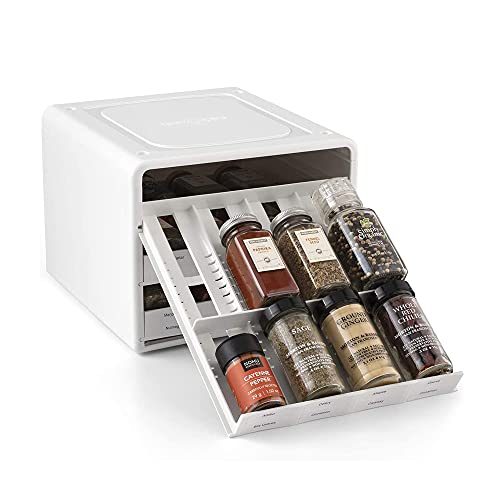
Best cabinet system: YouCopia SpiceStack
Badge: Best Cabinet System. Stepped, divided in-cabinet storage that presents standard jars in scannable rows and keeps order self-maintaining. Mid tier. Best for: standard-jar collections with cabinet room. Not suited for: oversized or novelty jars.
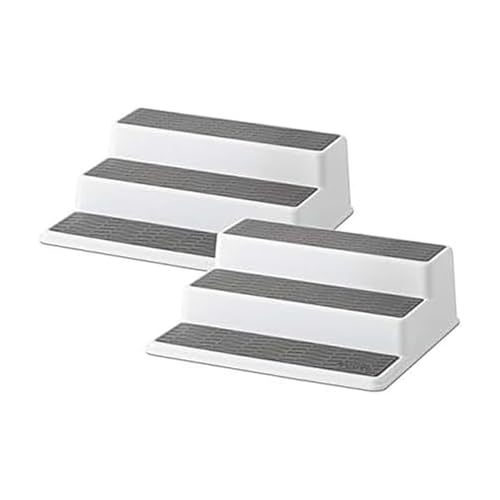
Best first step: Copco Non-Slip 3-Tier Spice Rack
Badge: Best First Step. A simple non-slip stepped riser that fixes the back-row problem in minutes, accepts any jars, and asks nothing of you. Entry tier. Best for: renters and first organisers. Not suited for: very deep cabinets.

Best for odd cabinets: SWOMMOLY Spice Rack Organizer
Badge: Best for Odd Cabinets. An expandable shelf that stretches to the width fixed racks miss, adding a second level across the full cabinet. Mid tier. Best for: wide or awkward cabinets, growing collections. Not suited for: anyone skipping the levelling step at setup.
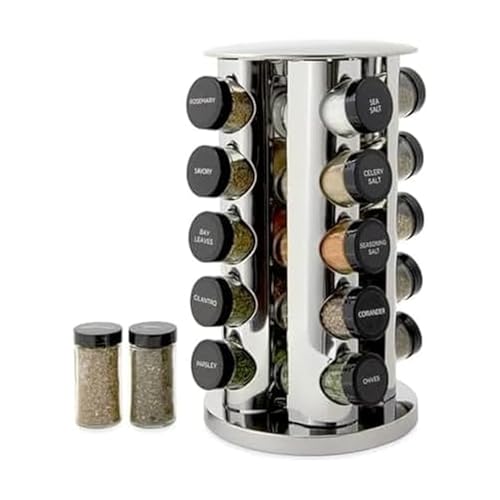
Best countertop — with a condition: Kamenstein Revolving Spice Rack
Badge: Best Countertop, Shaded Counters Only. Superb one-handed access and matched-set tidiness, recommended strictly for cool, shaded counter space away from the hob. Mid-to-premium tier as a set. Best for: pantry counters. Not suited for: beside the stove.
Where Will It Live? The Placement Question
Everything in this guide starts with one uncomfortable fact about spice storage: the enemies of flavour are heat, light, moisture and air, and the typical kitchen rack is placed within reach of all four. Ground spices and dried herbs do not spoil in a way that makes them dangerous in normal home use; they fade. The volatile aromatic compounds that make cumin smell like cumin and paprika taste like paprika evaporate and oxidise, and warmth speeds that process up considerably. A jar sitting beside a hob lives through daily cycles of rising steam and cooking heat, and a jar on a sunny countertop spends its days in direct light. Neither jar is being stored badly in the sense of being dirty or disorganised — both are being stored in the worst possible microclimate in the room, purely because that spot is convenient.
This is why storage location matters more than rack design. A drawer or a cabinet interior is dark by default, stays close to room temperature, and is shielded from the steam plume that rises off a boiling pan. A rack that puts spices into that dark, cool, dry environment starts with an advantage no amount of clever tiering on a countertop can match. When you compare two racks, compare first where each one will actually live. A plain drawer insert in a cabinet away from the oven will preserve flavour better than a beautiful revolving countertop rack parked next to the kettle, and any honest assessment of a spice rack has to weigh the storage conditions it creates, not just the access it provides.
Turn that science into a buying rule: shortlist only the formats your kitchen can host in a cool, dark, dry place, and let the photogenic options argue their way back in only if they can name their spot. A carousel with a genuinely shaded pantry counter to live on passes the rule. A wall rack destined for the sunlit wall beside the oven does not, however handsome the listing. Placement first is the whole method of this buying guide in four words, and every criterion below assumes the rack has already passed it.
How Much Capacity Do You Actually Need?
Count, do not estimate. Take everything out — every jar, tin, packet and duplicate — and count it on the worktop. Then sort ruthlessly before you measure anything: combine duplicates, bin the jar that has smelled like dust since a house move ago, and note the packets, because packet stock rules out slotted formats unless you decant. The number you land on is your minimum capacity; add headroom for the jars future recipes will send you out for, because collections only ever grow. Then match capacity to format honestly: a carousel’s fixed slots are a hard ceiling, a riser’s steps are a soft one, and a drawer conversion’s capacity is set by the drawer you measured. Buying for an aspirational collection you will never assemble wastes money and space; buying exactly to today’s count guarantees overflow. The counted number plus breathing room is the target.
Decide early whether you will decant. Racks fall into two camps: those designed around a matched set of jars they supply or assume, and open platforms — risers, shelves, liners — that accept whatever jars you already own. Decanting into uniform jars looks tidy, makes labels consistent, and lets a drawer system hold more, but it costs time at every refill, creates a funnel-and-spillage ritual, and leaves you storing half-empty original containers somewhere else anyway. Keeping supermarket jars avoids all of that but means mixed heights and widths that waste space in rigid trays. Neither answer is wrong; the mistake is buying a rigid, jar-specific system while intending to keep a mismatched collection, or buying an open riser and then being annoyed that the result does not look like a magazine photograph.
Will It Fit? Measuring Like You Mean It
Measure before you shop, and measure the right things. For a drawer system you need the drawer’s internal width, depth and — the one people forget — its internal height, because a jar lying at an angle still has to clear the drawer front when it closes, and the runners and the underside of the worktop steal space you cannot see on a tape measure held above an open drawer. For a cabinet riser you need the shelf width, the depth from the cabinet face to the back panel, and the vertical gap to the shelf above, because a tiered riser loaded with tall jars must still slide in and out. For a door rack you need the door’s thickness, the clearance between the door and the shelves it swings past, and confirmation that the hinges carry the extra load without complaint. Write the numbers down and take them shopping; a rack that is a fraction too wide is not a bargain, it is a return.
Two more fit checks separate happy purchases from returns. Jar fit: take your tallest jar and your widest jar and compare them, in your hands, against the design’s dividers, tiers or slots as honestly as listing photographs allow — tier heights that look generous in a photo are calibrated to the jars the photographer chose. Access fit: a cabinet organiser must still let your hand close around a jar on its top tier without barking knuckles on the shelf above, and a door rack must swing its full loaded arc without kissing the shelves behind it. If a listing leaves you unsure on either check, choose the more forgiving format; open platforms forgive, rigid systems do not.
How Will You Read the Labels?
Labels are the unglamorous half of every spice system. A rack that stores jars cap-up needs readable labels on the caps or shoulders; a drawer system that lays jars down needs the label on the body where your eye lands; a riser needs labels on the front face. Whatever the orientation, label on the surface you actually see in the two seconds you are scanning, in lettering large enough to read at arm’s length in ordinary kitchen light. Include the opening date as described earlier. Uniform printed labels look smart, but a consistent handwritten system you actually maintain beats a beautiful label set that stops being updated the third time a new spice arrives without a matching sticker.
Build the label question into the purchase itself. If you are keeping supermarket jars, their labels sit on the jar body — which suits drawer systems and risers, and fails in cap-up slotted trays unless you add cap labels. If you are decanting into a matched set, the labelling system is part of the product: check that it covers the spices you actually own and that replacements or additions are possible, because a labelling set that cannot grow with the collection becomes a two-tier system of labelled old jars and anonymous new ones. Either way, plan the opening-date habit from day one; it is the cheapest flavour-preservation tool in this entire guide.
Whatever rack you choose, add one habit that costs nothing: write the month and year you opened each spice on the underside of the jar or on a small label. Ground spices give their best for a matter of months rather than years once opened, and whole spices keep their character considerably longer, but without a date you are guessing from memory, and memory is optimistic. A rack makes this easier, not harder — when every jar faces you in a row or a tier, a quick scan of dates during a tidy-up tells you which jars to use up first and which ones have quietly become coloured dust that will disappoint the next sauce you stir them into.
How Much Upkeep Are You Signing Up For?
Spice storage gets dirty in a specific way: fine powders escape every time a jar is opened, and they settle into tray corners, liner grooves and the threads of lids. A rack you cannot easily empty and wash will slowly become a rack you avoid emptying at all. Prefer designs that lift out in one piece, tolerate a sink of warm soapy water, and dry without trapping moisture in joints or fabric. Wipe jars before they go back, check lids for powder in the thread that stops them sealing, and treat the quarterly empty-and-wash as part of the system rather than an admission of failure. This maintenance reality is a genuine point of difference between designs, and it is one glossy product photographs never show.
Upkeep also includes the refill ritual, and formats differ sharply. Slotted and matched systems make refills a small ceremony — decant, funnel, label, date. Open platforms make refills a non-event: new jar, shelf, done. Neither is virtuous; the question is which ritual your household will still be performing in month six. Be honest about the answer at buying time, because a system whose upkeep you abandon does not stay neutral — it decays into the clutter it replaced, with better hardware.
How to Prioritise by Use Case
The daily family cook
Priorities: scan speed, self-maintaining order, headroom. A drawer conversion or an in-cabinet organiser near the prep zone serves this household best, with the daily handful at the front regardless of the organising logic behind them. Avoid matched-set decanting unless someone genuinely enjoys it; the refill volume in a family kitchen punishes ceremony.
The keen baker and batch cook
Priorities: capacity, staging, packet tolerance. Baking spices cluster and get used in groups, and batch days want many jars out at once with visible gaps showing what is missing. Open risers, expandable shelves and basket tiers stage best; group the collection by cuisine or course rather than alphabetically, and size for the counted collection at its largest, post-shop state.
The small-kitchen renter
Priorities: hidden and vertical volume, zero installation. A riser inside a cabinet, a liner in a narrow drawer, or an over-door rack with clearances checked — all reversible, all landlord-safe. The carousel is the trap here: it spends the worktop a small kitchen cannot spare. The door-rack logic generalises, incidentally — see over-the-door shoe organisers for the same principle in the hallway.
The flavour-first cook
Priorities: storage climate above all, then dating discipline. Drawer or deep cabinet, away from the oven wall; whole spices where the recipe allows, ground in small jars refilled often; every jar dated. This household should read placement as the product and the rack as its accessory — and should be the most suspicious of all of countertop formats, however beautiful.
First Setup and Care Essentials
Set up once, properly: wash the rack or liner, empty the host drawer or cabinet completely, load in your chosen order rather than the order jars come to hand, label for the orientation you bought, and date everything as it goes in. Cook with the system for a month before reorganising — early dissatisfaction is usually unfamiliarity wearing a disguise. After that, the rhythm is quarterly: empty, wash, wipe jars, check dates, use up the old before the new. The full step-by-step method lives in how to choose a spice rack, and the honest value argument in is a spice rack worth it.
Once the rack is in, choose an organising logic and stick to it for at least a month before judging it. Alphabetical order is the easiest to search and the easiest for other household members to maintain, because there is exactly one right place for everything. Grouping by cuisine — the curry spices together, the baking spices together — matches how recipes are actually cooked and keeps a whole flavour family in one grab. Grouping by frequency puts the daily handful at the front and the once-a-year jars at the back, which is efficient but drifts as habits change. Most households end up with a hybrid: frequency at the front, alphabetical within groups. The rack does not care; your future self, mid-recipe with wet hands, cares a great deal.
Mistakes to Avoid
- Buying capacity for the collection you wish you had: count your actual jars first, including the duplicates and the half-used packets, and buy for that number plus a little headroom — not for an aspirational forty-jar set you will never assemble.
- Placing the rack beside the hob for convenience: it is the warmest, steamiest spot in the kitchen and the fastest way to fade every jar on it. Convenience at cooking time should come from a small working set near the stove, with the main collection stored cool and dark.
- Ignoring jar orientation: a tray that lays jars down hides cap labels; a riser that stands them up hides body labels. Buy the rack that matches how your jars are labelled, or budget the time to relabel.
- Filling every slot on day one: leave gaps. Collections grow one impulse purchase at a time, and a rack with no spare slots forces a second, worse system to start growing beside it.
- Choosing the format from a photograph: the listing kitchen has a shaded pantry counter and a matched jar set; yours has a hob-adjacent worktop and seventeen mismatched jars. Buy for your kitchen.
- Skipping the fixing check on door and wall racks: glass jars are heavy, loads concentrate on few screws, and the failure mode is a shower of glass — verify anchors for your wall type before the rack goes up.
Wall-mounted and door-mounted racks carry a load that surprises people. A full set of glass spice jars is genuinely heavy, and a rack concentrates that weight on a small number of fixings that then get tugged every time a jar is pulled out. Into plasterboard without proper anchors, screws will work loose; into a hollow door skin, over-door hooks are safer than screws but the rack must clear the door frame and the shelves behind it through the whole swing. Follow the fixing instructions for your wall type, use the anchors supplied or better ones rated for the material, and test the loaded rack with a firm pull before trusting it above a worktop where people stand. A spice rack failure is a shower of glass and paprika — preventable, and entirely a fixings problem rather than a rack problem.
Materials and Build: What the Rack Is Made Of
Materials decide cleanability, longevity and feel more than they decide function, and each of the category’s three main materials has an honest character. Moulded plastic — the material of most risers, trays and in-cabinet organisers — is light, washable in a sink without ceremony, and kind to glass jars; its failures are flex under heavy loads in the cheapest mouldings and a lightness that can skate on a smooth shelf, which is why non-slip feet and surfaces matter more than the plastic’s brand name. Wire and coated metal — the material of stackable shelves and many door racks — is rigid, airy and honest about its construction; its failures are chips in the coating where jars strike, and small jars’ tendency to tip between rails at the back of a deep stack. Wood — the material of drawer inserts and premium countertop pieces — is the most beautiful and the most demanding: it wants wiping rather than soaking, it can hold spice stains and odours in a way the other materials shrug off, and in a drawer, where it is wiped rather than washed, it earns its place on looks and on the quiet solidity of jars resting in routed slots.
Across all three materials, the build details that predict satisfaction are the same short list. Edges and corners should be smooth enough that a cloth passes without snagging, because the rack will be wiped more often than washed. Joints and moving parts — telescoping sections, hinges, turntable bearings — should operate without grit or wobble on day one, since neither improves with age. Feet and contact surfaces should grip, because a spice rack that migrates across its shelf migrates toward the shelf’s edge. And the whole object should survive being lifted one-handed while loaded-adjacent — carried empty to the sink, in practice — without feeling like it is negotiating. None of this requires expertise to check in a listing’s photographs and description; it requires only remembering to look, which is what buying guides are for.
Buying by Budget Tier, in Words
This guide publishes no prices, because prices move and the tiers below are more durable than any figure. At the entry tier, the honest purchases are the simple riser and the drawer liner: minimal spend, minimal commitment, and — this is the tier’s surprise — nearly the full benefit of the category for standard kitchens. Entry tier is where first systems belong, because the household is buying information about its own habits as much as it is buying hardware. At the mid tier sit the divided in-cabinet organisers, the expandable shelves and the better door racks: what the extra buys is order quality — dividers, presentation, fit — and for households whose habits are proven, it buys it fairly. At the premium tier sit the matched jar sets, the furniture-grade wooden pieces and the large carousels: what the extra buys is largely appearance and uniformity, which are real goods, honestly purchasable — provided the placement and jar questions have already been answered, because premium hardware in the wrong spot is the category’s most expensive mistake and its most common one.
One tier warning applies across the whole ladder: do not let a premium purchase smuggle in a format change you did not decide. The household that sets out to buy a riser and comes home with a carousel set has not upgraded; it has changed systems — from open to rigid, from cabinet to counter, from cool storage to bright — while believing it merely spent more. The steps in this guide exist to keep the format decision and the budget decision separate, and the format decision is the one that decides whether the spices taste right in six months.
Buying for Someone Else, and Buying Second-Hand
Spice racks are gifted more often than their practicality suggests, usually as part of a kitchen-shower or new-home bundle, and the gift logic inverts the guide’s usual order: you cannot measure someone else’s drawer from a wrapping-paper distance. The safe gifts are the forgiving formats — a riser, which fits almost any cabinet, or a liner, which cuts to fit the drawer it meets — and the dangerous gifts are the rigid ones, whose jar assumptions and fixed dimensions gamble against an unknown kitchen. If the gift is a matched jar set, gift it to a household starting from zero, where uniformity is a present rather than an imposition. Second-hand buying follows the same logic with the materials section’s checklist attached: moulded plastic and wire forgive previous owners almost completely after a wash; wood carries its history in stains and odours and should be inspected like the furniture it is; and any second-hand door or wall rack should be assumed to need new fixings, because anchors are single-context consumables, not heirlooms.
The Sustainability Angle, Briefly and Honestly
A spice rack is a small object with a long life, and the sustainable choice is mostly the durable one: a rack bought once, in a format the household keeps for a decade, beats a cleverer rack replaced twice. The category’s quiet sustainability win is elsewhere, though — in the food itself. Spices faded by bad storage get thrown away and rebought, and a rack that stores them dark and cool, with dates on the jars and an inventory you can see, cuts that waste at the source: fewer duplicates bought, fewer jars binned half-full, more of what you purchase actually eaten at its best. Buy the format you will keep, in the material that suits how you clean, and let the system’s longevity do the environmental work.
A Worked Buying Example, Start to Finish
Watch the guide’s criteria operate on one ordinary kitchen. The collection, counted honestly on the worktop, comes to a few dozen jars plus a packet pile and two duplicates of the same blend — the duplicates being the reason for the exercise. The kitchen offers a narrow drawer doing light duty beside the prep zone, cabinets of standard depth, and a bright counter the household had imagined for a carousel. The climate criterion speaks first and removes the counter from consideration, to mild disappointment. The drawer passes measurement — internal height sufficient for angled jars — and the jar audit shows supermarket originals in mixed sizes, which rules out slotted systems and points at open formats. The packet pile rules out a pure liner layout, so the decision lands as a hybrid the guide endorses often: liner strips in the drawer for the jar collection, labels up and dated, plus one small basket in the cabinet above for packets. Capacity fits with headroom to spare. Total ceremony at refill: none. The example is unglamorous, and that is the point — good buying in this category looks like a series of small correct eliminations, not a single inspired purchase.
Run the same kitchen through the photograph-first method for contrast: the carousel is bought for the bright counter, the packets have no home and colonise the counter’s end, the jars beside the hob fade through the season, the duplicates keep accumulating because the back of the carousel is as hidden as the back of the shelf was, and within a year the household owns a beautiful object and the same problem. Every step of that failure was a skipped criterion in this guide, in order: climate, jars, packets, capacity. The guide is long because the failure modes are many; the worked example is short because the success mode is always the same shape — measure, count, decide, then buy.
When to Buy, and When to Wait
Timing advice for a spice rack sounds absurd until the failure cases are examined: a striking number of bad systems were bought in the wrong week. Buy after a sort, never before one — the collection you count after combining duplicates and retiring the dead jars is smaller and truer than the one that panicked you into shopping. Buy after measuring, obviously, but also after living a week with the intended location emptied or mocked up: a drawer cleared for a trial week teaches more about whether the household can spare it than any amount of staring. Wait if a kitchen renovation, a house move or a change in who cooks is on the horizon, because all three rewrite the location audit. And wait, specifically, if the purchase is being driven by a photograph encountered at a tired moment — the guide’s criteria will still be here after a night’s sleep, and the kitchens that buy by them are the ones whose systems are still working when the photograph’s kitchen has been redecorated twice.
The Guide in One Pass: A Final Checklist
Compress the whole guide into the order of operations to carry into any shop or listing page. One: name the location, and certify it dark, cool and dry — drawer or cabinet, away from the oven, out of the sun. Two: produce your numbers — the counted collection, the measured space, the tallest and widest jars. Three: state your jar decision out loud — originals, decanted, or gradual — and let it veto the formats it vetoes. Four: choose the format the first three steps leave standing, and the product within it by cleanability, grip and honest dimensions. Five: confirm headroom, fixings if it hangs, and a wash-easy build. Six: plan day one — the order you will load in, the labels, the dates — before the box arrives. A purchase that survives all six steps in order is, in this category, as close to a guaranteed success as buying advice can honestly offer; a purchase that skips to step four is a lottery ticket with good photography.
After the Purchase: The First Week Done Right
A buying guide owes a paragraph to the week after the box arrives, because that week is where good purchases are confirmed or quietly undone. Day one is for the setup ritual this guide has described — wash, empty, load in order, label, date — and for nothing else; do not cook a feast on the new system the same evening and judge it under fire. The first ordinary week is for leaving the system alone: no reorganising, no logic changes, no verdicts. Let every cook in the household fumble and learn; the fumbling is the learning, and it ends. By the second week the reaches become automatic, and the only remaining task is the honest one — noticing which jar the system genuinely serves badly, and giving that jar a sanctioned exception rather than letting it become an unsanctioned one. A system with two deliberate exceptions is a success. A system at war with its exceptions is a return waiting for its window to close.
Questions to Ask in the Shop, Answered in the Aisle
End the guide where purchases happen, with the aisle-side version of its method. Hold the product — or its listing — against five sentences. It will live in a named drawer or cabinet whose internal measurements I know, and it fits them with room for my hand. It takes my jars as they are, or I have honestly chosen the decanting life it assumes. It holds my counted collection with slots to spare, packets planned for separately. It lifts out and washes in one piece, and its fixings, if it hangs, are matched to my walls. And it will sit in the dark, away from the hob’s weather, however the display kitchen arranged it. Five sentences, each traceable to a section of this guide, each fatal to a different family of regrets. The product that survives all five is not merely a good spice rack; it is, for your kitchen, the right one — and the guide’s work is done the moment you can say the sentences without crossing your fingers.
One Sentence to Take Shopping
Guides should survive compression, so here is this one at its smallest: buy the rack your darkest spare space describes, sized to the collection you counted, kind to the jars you own, washable in one piece, and hung — if it hangs — like you mean it. Every section above is that sentence unfolded; every mistake in the mistakes list is that sentence skipped. Print it on the inside of the shopping list, and the category holds no further terrors for you.
And one last buying note, because it is the one readers write in about: if two products survive every step of this guide and differ only in looks, choose the looks without a flicker of guilt. The criteria exist to eliminate the wrong purchases, not to ration pleasure — a rack you enjoy seeing in your own cabinet, chosen after the climate, fit and jar questions have all been answered honestly, is a legitimate tiebreak and no part of this guide begrudges it.
Measure twice, buy once, store in the dark — the guide accepts the old workshop proverb as its colophon, with the third clause added for the kitchen.
Measuring, Matching and Checking: The Spice Rack Decision Worksheet
Most of the groundwork for choosing a spice rack is covered above, so this section turns to the stage where orders are actually placed: verifying fit, reading listings critically and checking the practical details that photographs tend to hide. Work through it with your measurements and your shortlist in front of you.
Start With Your Space and Your Routine
Write down the three tasks you will do most often with the spice rack and score each shortlisted option against those tasks alone, ignoring features you are unlikely to touch. Where the spice rack meets the floor, the wall or another surface, check what protects both sides, because scuffs and marks in those contact zones are the most common early complaint. If a part of the spice rack can be replaced, refreshed or re-covered separately, that option can extend its useful life well beyond the point where a sealed design would be thrown out. Photograph the spice rack as delivered, before assembly or first use, so that any later question about condition, parts or finish can be answered from evidence rather than memory.
In a buying guide the order of decisions matters, so settle size and placement for the spice rack first, materials and build second, and style last, when the practical questions can no longer be changed by a prettier photograph. Households with children or pets put different demands on a spice rack than the listing photographs suggest, so judge edges, stability and cleanability against your real household, not a styled one. Apply the same checks to each shortlisted example, whether that is the YouCopia SpiceStack; the SpiceLiner Spice Drawer Liner; the Copco Non-Slip 3-Tier Spice Rack, because consistent testing is what makes the differences between models visible. Recheck any adjustable part of the spice rack after the first week of use, once materials have settled and the household has stopped being careful with it.
Keep the fittings, spare parts and instructions that come with the spice rack together in one labelled place, because the part you need in a year is always the one that was put somewhere safe. Set the assembled spice rack up fully before deciding it is wrong for the space, since partly built or badly positioned pieces often look worse than they will once finished and levelled. The best spice rack for a rented home may differ from the best for an owned one, because fixings, marks and alterations carry different consequences in each case. When something about the spice rack starts to annoy you, note whether the cause is the product itself, its position, or the way it is being used, since each cause has a different and usually cheaper fix.
When Small Problems Appear
Plan where the packaging and any old item being replaced will go on delivery day, a small step that prevents a rushed, careless first setup of the new spice rack. If a spice rack comes in several sizes or configurations, choose by the measured demands of your space and household rather than by the middle option, which is a common default that suits nobody in particular. If you shop with someone else, agree the must-haves together before looking, so that the spice rack you choose is a shared decision rather than one person’s compromise discovered later. Storage is part of ownership, so decide now where the spice rack, its accessories and its seasonal extras will go when they are not in use, and measure that space too.
Take a photograph of the space before you order and mark the intended position of the spice rack on it, then revisit that photo whenever a listing tempts you toward a larger or different style. Where the spice rack has a surface you will set things on, lean on, or load, consider the heaviest realistic load in your household rather than the lightest display load in the photos. Start by writing down the job the spice rack has to do in your home, in one plain sentence, before you look at another listing, because a clear job statement turns a long shortlist into a short one. If the spice rack will be seen every day, its proportions matter as much as its function, so hold the listing dimensions up against a familiar piece nearby to judge the visual weight honestly.
Dust, moisture, sunlight and heat each age Food Storage & Organization items in different ways, so match the finish and material of the spice rack to the conditions of the room or outdoor spot it will occupy.
A Short Decision Checklist
- How the spice rack will be cleaned in an ordinary week
- The material and finish, matched to light, moisture and wear in its spot
- Delivery path, from the door to the final position
- Packaging kept until the spice rack has passed its first trial in place
- The measured space, including clearance to use and clean around the spice rack
- What your current arrangement does well that the spice rack must not lose
- Where the spice rack and its accessories will be stored when not in use
- The one feature you will not compromise on
Taken together, these checks take only a little time, yet they answer the questions that decide whether the spice rack suits your home, your household and your routine, and they do so before money changes hands rather than after.
Frequently Asked Questions
What is the best type of spice rack for flavour?
A drawer system or an in-cabinet organiser, because both store jars in the dark at a stable, room-level temperature, away from the steam and heat of cooking. Flavour loss in spices is driven by heat, light, moisture and air, so the best rack is the one that removes the first three. A simple riser inside a cabinet beats a premium carousel on a bright counter beside the hob every time — the storage conditions matter more than the hardware’s price tier or polish.
How do I know what size spice rack to buy?
Count the collection first — jars, tins, packets and duplicates, all out on the worktop — then measure the intended drawer’s or cabinet’s internal dimensions, including the drawer’s internal height and the cabinet’s usable depth. Buy for the counted number plus modest headroom. Estimates fail in both directions: people overbuy for aspirational collections and underbuy for the packets and duplicates they forgot they owned. The tape measure and the count are the whole method; everything else is guessing.
Is it better to keep spices in their original jars?
For most households, yes — original jars avoid refill labour, keep the supplier’s labelling and dates, and suit open formats like risers and liners perfectly. Decanting into a matched set pays off only with rigid slotted systems or carousels designed around uniform jars, and it commits you to decanting every refill forever. A sensible middle path is gradual standardisation: as jars empty, replace them with your chosen uniform jar, and let the collection converge over a season without a single big decanting day.
Where should a spice rack go in the kitchen?
In a drawer or cabinet away from the oven and hob, out of direct sunlight, where the temperature stays closest to the room’s average. Near the prep zone is ideal — close enough for a mid-recipe grab, far enough to escape the steam plume and radiant heat. Avoid the wall and counter beside the cooker and any spot a window’s sun reaches during the day. If the only available spot is a warm one, shrink the working set kept there and store the main collection properly elsewhere.
Are wall-mounted spice racks safe?
Yes, with fixings matched to the wall and the load respected. A full set of glass jars is heavy, and a rack concentrates that weight on a few screws that get tugged at daily. Use anchors rated for your wall material — plasterboard needs proper anchors, not bare screws — follow the rack’s fixing guidance, and test the loaded rack with a firm pull before trusting it. Over-door designs avoid screws but need clearance checks through the door’s full swing. Safety here is a fixings question, not a rack question.
How often should I clean and reorganise a spice rack?
A quarterly rhythm suits most kitchens: empty the rack, wash it, wipe every jar, check the opening dates, and move the oldest jars to the front of the system. Fine spice powder escapes at every opening and settles into trays and grooves, so a rack that lifts out and washes whole will actually get cleaned, while a fiddly one will not. Reorganisation should be rare — if the organising logic is right, the quarterly session is maintenance, not redesign.
Related Reading
Apply the same thinking elsewhere: modular wine racks for tiered bottle storage, closet organiser shelves for wardrobe volume, and the balanced ledger in our spice rack pros and cons.