Disclosure: As an Amazon Associate, dailyhomedecorating.com earns from qualifying purchases. Links on this page are affiliate links; they cost you nothing extra. Prices and availability change often, so check the current Amazon listing before you buy.
Is a snow blower worth it? The short answer: is a snow blower worth it for your household depends on four things — how much driveway you clear, how much snow your winters actually deliver, what your mornings demand, and what your body thinks of shoveling. Worth it if you clear a real driveway in a real snow region and your schedule or your back argues against the shovel: the machine pays for itself in time, certainty, and spared strain within a few seasons. Not worth it if your clearing is a few steps in a mild climate, if you have nowhere to store a machine, or if a plow service already handles your winter on terms you like. The rest of this page exists to help you place your own household on that line honestly, with the full costs — money and otherwise — on the table.

Key Takeaways
- Worth is measured in mornings: time saved, departures kept, and storms handled without dread.
- The machine pays back fastest where driveways are long, snow is heavy, and schedules are fixed.
- The real costs beyond money are storage space, a small maintenance routine, and non-negotiable safety habits.
- A right-sized machine is worth it far more often than a bargain one that cannot finish the job.
- If the honest answer is no, the money serves you better in a service contract, an electric snow shovel, or winter gear.
In this guide
What You Actually Get
Technique multiplies whatever machine you own. Start as soon as snow stops — or during a long storm, clear once midway — because six inches cleared twice is far easier than twelve inches cleared once, and because tires and boots pack fresh snow into ice that no blower fully removes. Work with the wind at your back and throw downwind so snow does not blow back onto cleared ground or into your face. Take full-width passes in light snow and narrower bites in heavy snow rather than forcing the machine and clogging the chute. Keep a steady walking pace; a blower that is lugging and slowing is telling you to narrow the bite. Finish with the end-of-driveway ridge while it is still fresh from the plow, and clear around mailboxes, hydrants, and the path your household actually walks to the car.
What you actually get, first, is time — measured not in minutes saved per storm but in the shape of your winter mornings. The driveway stops being a negotiation with the weather and becomes a fixed, short routine. You get the plow ridge handled the hour it appears instead of the evening after it freezes. You get walkways, the path to the car, and the route to the door cleared to the same standard as the driveway, which no plow service provides. You get the ability to clear during a storm in easy stages rather than facing its full depth at dawn. And you get something owners mention surprisingly often: the end of the low-grade dread that attaches to a winter forecast, replaced by the mild satisfaction of being equipped.
Not all snow asks the same of a machine. Light, dry powder is the easy case: almost any blower throws it far and fast, and the main risk is wind blowing it back into your face. Wet, heavy snow — the kind that falls near the freezing point and packs into a solid snowball — is the real test, because it is dense, it clogs chutes, and it punishes undersized machines; taking narrower bites and slowing your ground speed matters more than raw power. The plow ridge at the end of the driveway is its own category: compacted, icy, and full of road grit, it is where single-stage machines struggle most and where two-stage augers earn their keep. Clearing early and often, before snow gets deep or gets driven over and packed, is the oldest and most effective technique there is.
Throwing distance sounds like a spec-sheet contest, but what matters in a real driveway is control, not maximum range. You need enough throw to clear the full width of your driveway from a sensible number of passes, and enough chute control to place snow precisely: low and close when the wind is up or the neighbor’s walk is near, high and far when you are building the season’s bank along open ground. A chute you can rotate and tilt quickly from the operator position, without stopping and walking around the machine, is worth more than a few extra feet of theoretical distance. Deflector control also protects windows and cars, because the safest throw is the one aimed exactly where you intended, every single pass.
The Real Costs Beyond Money
The purchase is only the first cost of ownership, and the others arrive quietly. Gas machines consume fuel, oil, stabilizer, plugs, belts, and shear pins, and they occasionally consume a service visit when a carburetor gums up after a careless summer. Battery machines concentrate their cost in the packs: a second set doubles your runtime and your flexibility, and packs eventually age and need replacing, though they often earn their keep across a whole platform of tools. Every machine needs storage space, a clearing tool, spare shear pins where applicable, and eventually a scraper bar or skid shoes. None of this is a reason to avoid buying; it is a reason to buy the machine whose ongoing costs match the way you actually live, rather than the one that merely looked simplest on the shelf.
Storage is the hidden cost of snow equipment, and it is worth planning before you buy. A two-stage gas blower needs a floor footprint roughly like a large lawn mower, plus room to maneuver it in and out without scraping the car. Single-stage and cordless machines are far more forgiving: many hang on wall hooks or stand in a corner, which is why they suit small garages, sheds, and townhouse storage closets. Off-season, clean the machine before you put it away, treat fuel or remove batteries according to the manual, and store batteries indoors at a moderate charge rather than in a freezing or sweltering garage. A machine that is easy to store is a machine that stays accessible, and accessibility is what gets a driveway cleared at six in the morning instead of argued about.
Add the human costs honestly. There is a learning curve: the first storm with a new machine is slower than the third, because lanes, chute management, and pace are skills. There is a care curve: fuel discipline or battery habits, shear pins, skid shoes, and the ten minutes after each storm that keep the machine honest. And there is a safety discipline that is not optional and never graduates: the auger lockout before any clog is touched, carbon monoxide respect for gas models, a chute never pointed at people, windows, or cars. Households that accept these as the price of the capability get full value; households that resent them should count that resentment as a real cost when deciding.
The single most important safety rule in this entire guide is the auger lockout: before clearing any clog, turn the engine or motor fully off, remove the key or disconnect the power source, and wait until every moving part has stopped completely. Never put your hands in the discharge chute or the auger housing, for any reason, at any time — a clogged impeller can hold stored tension and spin without warning even after shutdown, which is exactly how the most serious snow blower injuries happen. Every reputable machine ships with a clearing tool for a reason; keep it clipped to the machine and use it, with gloves on, for every blockage. If a clog will not clear with the tool, that is a job for a service shop, not for your fingers.
Who It Pays Off For
The fixed-schedule commuter. For this household the calculation is not really about snow at all; it is about the cost of a missed departure. A blower that opens the driveway in one calm session, at the hour required, in any storm the region reasonably produces, pays for itself the first winter it saves a job, a flight, or an exam. Quiet electric models earn a premium here because the clearing hour is early.
The long-driveway and rural household. Shoveling a long lane is not a chore, it is an expedition, and wet snow makes it a risky one. A two-stage blower converts it into the household’s most reliable routine. The payoff grows with every foot of driveway and every inch of typical snowfall, which is why rural owners are the most emphatic group in any worth-it discussion.
The homeowner protecting a back, a heart, or a recovery. Here the comparison is not blower versus shovel but blower versus risk. Driven wheels, steering help, and electric starting remove the lifting and most of the pushing from winter. For this household a blower is worth it at almost any plausible price tier, and the correct question is not whether to buy but which machine removes the most effort — a question our snow blower buying guide answers in detail.
Matching machine size to property is the decision everything else hangs on. Start with the honest measurements: how long and wide is the driveway, is it paved or gravel, how steep is any slope, and how much walkway, patio, and deck comes with it. Then be honest about your snow: how much falls in a typical storm, how much falls in the worst storm you actually intend to handle yourself, and how wet it usually is. A compact machine on a small paved driveway clears quickly and stores easily; that same machine on a long gravel lane in lake-effect country will exhaust its owner and itself. Buy for your worst realistic storm, not your worst imaginable one, and remember that clearing twice during a big storm with a right-sized machine beats wrestling an oversized one out of a crowded garage.
Who Should Skip It
The small-lot, light-snow household. A few steps, a short walk, and two modest storms a year do not justify a machine’s cost, storage, and upkeep. A good shovel, perhaps joined by a compact electric snow shovel for the steps, covers this winter completely — see the direct comparison in snow blower vs electric snow shovel.
The household with no dry storage. A blower stored outdoors under a tarp ages fast and starts reluctantly. If the garage, shed, and closets are genuinely full, the honest options are a wall-hung compact electric, a reorganization, or a service — not a good machine slowly ruined in the weather.
The winter traveler and the hands-off household. If nobody is home during storms, or nobody at home should be outdoors working in one, a blower sits idle while the driveway stays buried. A plow service clears regardless of your presence and your health, and for this household it is not the lazy option; it is the correct one.
Regional snow character should steer the purchase as much as driveway size. Lake-effect and mountain regions get deep, frequent storms where two-stage capacity and fuel runtime pay for themselves by mid-winter. Coastal and mid-Atlantic snow tends to arrive wet and heavy near the freezing point, which favors torque, anti-clog chute design, and taking narrower passes over headline clearing width. The upper Midwest and plains add brutal cold, where battery performance dips, cords stiffen, and a reliable gas start or a well-kept battery stored indoors matters. Mild-snow regions — a handful of modest storms a year — are where compact electric machines and even the humble shovel stay competitive, because the machine spends most of its life in storage and should be chosen for how little it asks during those months.
The Ownership Ledger: Strengths and Trade-Offs
Strengths of owning
- Certainty: the driveway opens on your schedule in any reasonable storm.
- Time: clearing shrinks from an ordeal to a routine measured in a short walk.
- Safety of the body: no lifting, minimal pushing, no packed-snow wrestling.
- Coverage: walkways, paths, and patios cleared to driveway standard.
- Longevity: a cared-for machine spreads its cost across many winters.
Trade-offs of owning
- Storage: floor or wall space committed all year.
- Upkeep: fuel or battery discipline, shear pins, and seasonal checks.
- Safety discipline: auger lockout, carbon monoxide awareness, chute control — every use, forever.
- Idle capital: the machine earns its keep a few weeks a year and waits the rest.
Alternatives to Consider
The honest baseline for every snow blower decision is the shovel already in your garage. Shoveling costs nothing to buy, nothing to maintain, and nothing to store, and for a short walkway in a light-snow climate it remains a perfectly rational choice. Its costs are paid in time and in your back: a moderate driveway in a moderate storm is a long, heavy session, wet snow is genuinely strenuous, and the heart-attack statistics around snow shoveling are not a myth. A blower converts that labor into a walk, clears a wider path in a fraction of the time, and throws snow clear instead of asking you to lift it onto an ever-taller bank. The households that benefit most are the ones with longer driveways, heavier snow, older backs, or mornings that start with a commute deadline.
An electric snow shovel is best understood as a powered hand tool rather than a small snow blower. It uses a spinning paddle or auger in a narrow head to scoop and toss snow forward or to the side, and you supply the pushing, the lifting, and the steering, much as you would with a manual shovel. That design keeps it light, inexpensive, and easy to store on a hook, and it shines on steps, decks, patios, short walkways, and the narrow strip between parked cars. Its limits are reach and depth: the head is narrow, the throw is short, and deep or heavy snow turns the work back into labor, pass after shallow pass. It is a specialist, and judged as a specialist it is a very good one.
The plow service is the third alternative and the right one more often than blower enthusiasts admit. It costs money every season forever and buys complete freedom from the work and the machine. Compare it fairly: a service contract against a blower’s full ownership cost — purchase, upkeep, storage, and your time valued honestly — over the years you expect to stay in the home. Households that expect to move soon, travel often, or simply hate the chore at any price will find the service wins that arithmetic, and there is no virtue in owning a machine you resent.
How to Get the Most Value If You Buy
The classic buying mistakes repeat every winter. The first is sizing for the average storm and being helpless in the big one, or sizing for the storm of the century and fighting an oversized machine out of a small garage all season. The second is ignoring surface: a single-stage auger on gravel is a stone-throwing machine, full stop. The third is forgetting storage and discovering in November that the new blower and the car do not actually fit together. The fourth is buying a battery platform you own nothing else on, when a rival platform already runs your mower and trimmer. The fifth is waiting for the first forecast: shelves empty fast, and the household that shops in autumn chooses, while the household that shops during a storm takes what is left.
A snow blower asks for a short list of care in exchange for years of reliable starts. Before the season, check the auger and impeller for damage, inspect belts and shear pins, confirm the skid shoes and scraper bar are set correctly, and make sure you own spare shear pins, because they are designed to break to protect the gearbox and they always break mid-storm. Gas machines add oil changes, fresh fuel discipline, and an occasional spark plug; electric machines mostly ask that cords, batteries, and connections stay clean and dry. During the season, knock packed snow out of the housing after each use so it does not freeze into a block overnight, and never store the machine with wet snow still packed around the auger. Ten minutes of care after a storm is what separates a blower that starts on the first pull from one that does not.
Good snow clearing starts before the blower does. Mark the edges of the driveway and any obstacles — curb lines, sprinkler heads, landscape stones, the low wall by the garden — with tall stakes while the ground is still visible, because fresh snow hides every boundary. Move cars out of the clearing zone or plan your passes around them, and decide in advance where the snow will go: piling it all at the driveway entrance creates a wall you will fight at the next storm. Check that the machine has fuel or charged batteries, that the clearing tool is clipped in place, and that you are dressed for the work, with boots that grip, gloves that let you feel the controls, and eye protection if the wind is throwing snow back at you.
Snow clearing has a footprint worth a moment’s thought. Gas machines burn fuel and emit exhaust at ground level in still winter air, which is one more reason the quieter electric options have grown so popular for smaller properties. Battery machines shift the impact to the grid and the pack, and they repay careful owners: packs kept indoors, charged moderately, and used across several tools spread their cost and footprint over years of work. Whatever you run, clear snow onto lawns and planting beds rather than into the street, where meltwater carries grit and de-icer toward drains, and go easy with salt on freshly cleared pavement, because a well-cleared surface usually needs far less de-icer than a neglected one. A machine matched correctly to the property is also the greener machine, since it finishes faster and works less hard.
Value also compounds through small decisions after the purchase. Buy in autumn when choice is widest. Learn the machine on the season’s first light snow rather than its worst. Keep the clearing tool clipped to the housing and spare shear pins in a labeled drawer. Clear early and often instead of heroically and once. Lend the machine to a neighbor in a pinch and you will find the favor returned in kind — a cleared ridge, a watched house — which never appears in any cost table but belongs in the honest accounting of what a snow blower is worth. For the balanced ledger behind this verdict, read the full snow blower pros and cons.
The Decision Checklist
- Does clearing your driveway with a shovel take long enough, often enough, that you dread a forecast?
- Does anyone’s schedule, back, heart, or health argue against heavy shoveling?
- Is your typical storm — and your worst realistic one — more than a shovel session handles well?
- Do you have dry storage you are genuinely willing to commit, all year?
- Will you keep a small maintenance and safety routine without resenting it?
- Would you still choose the machine over a plow service at honest full cost?
Answer yes to the first three and the last three together, and a snow blower is worth it for your household — buy it right-sized, in autumn, and keep it well. Answer no to the storage or the routine questions, and the honest purchase is a service or a smaller tool. The checklist’s purpose is not to sell you a machine; it is to make sure the machine, if bought, is bought by the household it will actually serve. When you are ready to choose the model itself, start with how to choose a snow blower.
Is a Snow Blower Worth It for Your Household? The Full Picture
Gasoline power remains the reference point for raw clearing ability. A gas blower refuels in minutes, runs as long as you keep feeding it, and shrugs off the wettest, heaviest snow that stalls lesser machines. That freedom comes with obligations: fresh fuel, fuel stabilizer for storage, oil changes, a spark plug now and then, and a pull cord or electric starter that must be kept in working order. Gas engines are loud, they produce exhaust, and they absolutely must never be run inside an enclosed garage, because carbon monoxide builds up invisibly and can be lethal. Owners who accept the maintenance rhythm get a machine that is ready for the worst storm of the decade, not just the average one.
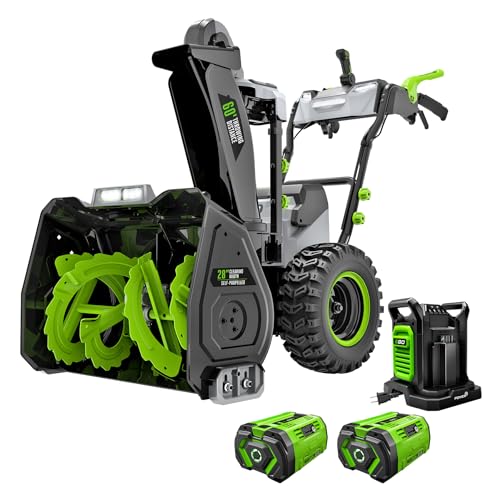
Cordless battery blowers have changed what a lot of households expect from snow clearing. They start instantly with a button, run quietly enough for early-morning clearing without waking the street, need no fuel, no oil, and almost no seasonal maintenance, and they store without any fuel smell in the garage. The honest limits are runtime and deep-snow stamina: a battery holds a finite amount of energy, heavy wet snow drains it quickly, and very long driveways may need a second set of batteries to finish in one session. Battery platforms soften that limit, because the same packs often power a leaf blower, a trimmer, or a mower the rest of the year. For small to mid-sized paved driveways in regions with moderate snowfall, a cordless blower is frequently the easiest machine to live with.
Single-stage blowers earn their popularity honestly. The auger touches the ground, so a paved surface comes out nearly bare in one pass, and the machine stays compact enough to hang on a garage wall or tuck beside a car. Because there is no separate impeller, there are fewer parts to service, and starting is usually a matter of plugging in, pressing a button, or pulling a cord a time or two. The limits show up in heavy, wet snow and on gravel, where a ground-hugging auger can pick up stones and throw them, and where deep accumulation forces you to take partial bites and make extra passes. For households whose storms are usually modest and whose surfaces are paved, a single-stage machine is often the sweet spot between capability and simplicity.
Two-stage blowers are the workhorses of snow country. The auger does not touch the ground; instead it chews snow and feeds it to a high-speed impeller that throws it clear of the driveway, and adjustable skid shoes let the machine ride safely over gravel and uneven surfaces. Driven wheels, often with several forward speeds and a reverse gear, mean the machine does the pushing, which matters enormously when you are clearing a long driveway in deep snow. Power steering, heated grips, headlights, and chute controls you can adjust from the operator position all appear in this class. The cost of that capability is size and weight: a two-stage blower needs real storage space, asks for more maintenance, and is more machine than a small townhouse driveway will ever need.
Throwing distance sounds like a spec-sheet contest, but what matters in a real driveway is control, not maximum range. You need enough throw to clear the full width of your driveway from a sensible number of passes, and enough chute control to place snow precisely: low and close when the wind is up or the neighbor’s walk is near, high and far when you are building the season’s bank along open ground. A chute you can rotate and tilt quickly from the operator position, without stopping and walking around the machine, is worth more than a few extra feet of theoretical distance. Deflector control also protects windows and cars, because the safest throw is the one aimed exactly where you intended, every single pass.
A snow blower throws more than snow, and the discharge chute deserves constant respect. Never point the chute at people, pets, windows, vehicles, or anything breakable, and keep bystanders — especially children — well clear of the work area while the machine is running. Before the first pass of any storm, walk the area and clear away stones, branches, frozen newspapers, garden hoses, holiday decorations, and the doormat by the steps, because anything the auger picks up leaves the chute at speed. Aim discharge downwind and toward open ground where the thrown snow will not bury a neighbor’s cleared walk or block a doorway. If you must adjust the chute direction or deflector angle, use the machine’s controls from the operator position rather than reaching toward the chute itself.
Fuel handling deserves the same respect as the auger. Refuel a gas blower only outdoors, only with the engine off and cool, and never anywhere near a pilot light, heater, or open flame. Use a proper approved fuel container, wipe up spills before starting, and change out of fuel-splashed clothing rather than working in it. Buy fuel in quantities you will actually use within the season, add stabilizer when the label calls for it, and store the container in a cool, ventilated spot away from living spaces and ignition sources. At the end of the season, follow the manual: either run the carburetor dry or store the machine with stabilized fuel, so spring does not begin with a no-start and a repair bill.
Electric models trade fuel hazards for cord hazards, and the rules are simple but strict. Use only an extension cord rated for outdoor use and sized for the load the blower draws, inspect it for cuts or cracked insulation before every storm, and retire it if the jacket is damaged. Plan your clearing pattern so the cord trails behind you and stays clear of the auger path at all times; a cord that drifts in front of the machine can be pulled in and severed in a second. Keep connections dry and off the snow where practical, plug into a ground-fault protected outlet, and never use a cordless or corded electric blower in standing water or freezing rain. When the session ends, coil the cord loosely and store it indoors so the insulation stays flexible for the next storm.
A snow blower changes the household’s whole winter routine, not just its driveway. Storms get planned for the way rain gets planned for: the forecast is checked the night before, fuel or batteries are confirmed, the car is parked where clearing is easiest, and the morning alarm accounts for a short, known routine instead of an unknown ordeal. Deliveries reach the door, the dog gets its path, the bins reach the curb, and the walkway a visitor uses is as clear as the drive. Households underestimate this compounding effect when they shop, because it does not appear on any feature list, yet it is the benefit owners describe most warmly by their second winter: winter stopped being an ambush and became a schedule.
Experienced owners develop a forecaster’s habits, and the machine rewards them. A storm expected to end before dawn calls for one full clear in the morning; a long storm argues for a mid-storm pass that keeps depth manageable and prevents tires from packing a base layer into ice. Snow expected to turn wet argues for clearing early while it is still light; a deep freeze after the storm argues for finishing the ridge before it sets like concrete. The blower makes these strategies possible because each session is short; the shovel makes them theoretical because nobody volunteers for three sessions of lifting. Matching your clearing timing to the storm’s character is the closest thing this chore has to a professional secret.
A cleared property is a safer property in ways that extend past the driveway. Clear walkways mean surer footing for your household, for visitors, for delivery drivers carrying loads they cannot see past, and for anyone — a neighbor, a nurse, a paramedic — who may need to reach your door quickly on the worst night of the year. Clearing around fire hydrants, keeping exits and the path to utility meters passable, and preventing meltwater from refreezing across the walk are all part of the same discipline. A snow blower does not create this safety by itself, but it makes achieving it a short routine instead of an exhausting project, and routines are what actually happen all winter long.
A snow blower quietly changes your standing on the street. The household that can clear its own ridge can also, in ten spare minutes, clear the ridge of the elderly neighbor whose plow service came at dawn, or open the driveway of the family that just brought a baby home. These small rescues are the currency of winter neighborhoods, and owners consistently report them among the machine’s unlisted benefits: favors given are favors banked, and the street where two or three households own capable machines is a street where nobody is ever truly snowed in. None of this appears in a buying guide’s tables, but it belongs in an honest accounting of what the machine is for.
Every new owner has a first-storm learning curve, and planning for it is part of using the machine well. The first session teaches what no manual can: where your driveway’s low spots hold slush, which direction the wind actually blows across your lot rather than the forecast’s, how the plow ridge on your street is built, and exactly how wide a bite your machine likes in your typical snow. Smart owners treat the season’s first light snowfall as a rehearsal — full routine, low stakes — and save their ambitions for later storms. By the third session the routine is muscle memory: lanes, chute, ridge, details, shutdown, in an order that feels less like operating equipment and more like a walk you happen to take with a machine.
Longevity in this category is less about the badge and more about the pattern of care, which is good news for buyers: the machine’s lifespan is largely in your hands. Housings rust where paint chips go untended and where wet snow is left packed against steel. Engines suffer from old fuel far more than from hard work. Batteries age fastest when stored empty, frozen, or baking. The owners who report decades of service share unglamorous habits: a dry storage spot, an end-of-season cleaning, fresh fuel or sane battery storage, and small problems fixed in October rather than discovered in January. Choose any reputable machine, keep those habits, and the question stops being how long it will last and becomes how long you will live with snow.
Big storms reward a staged approach that smaller machines and wise owners share. The first stage, during the storm, is a quick pass that keeps the driveway passable and prevents depth from compounding; it does not need to be pretty. The second stage, when the snow stops, is the full clear: lanes, edges, walkways, and details. The third stage waits for the municipal plow’s final pass and deals with the ridge it leaves, fresh rather than frozen. Staging converts one overwhelming job into three ordinary ones, keeps batteries and fuel ahead of demand, and means the household is never more than one short session from an open driveway at any point in the storm. It is the single most useful habit a new owner can adopt.
Clearing is only half of winter surface management; the melt is the other half. Snow thrown against the house melts toward the foundation, snow piled at the top of a slope melts across the driveway and refreezes as sheet ice by morning, and banks left at the street edge channel meltwater into exactly the ruts tires follow. Aim your season’s piles at ground that drains away from pavement and foundation, keep the driveway’s downhill edge open so melt escapes, and after a sunny day, check for the thin ice film that forms where melt crossed a walk — that film, not the storm, is what slips visitors. A blower’s precise chute makes this management possible; where the snow goes is a decision you make with every pass.
A well-kept snow blower holds its usefulness across owners and even across houses. Machines from reputable makers, stored dry and maintained on schedule, are sought-after secondhand purchases every autumn, which softens the true cost of buying new. If you sell, the things that protect value are the same things that protected you: a clean housing without rust blooms, a service history you can describe, the manual and clearing tool present, and a machine that starts willingly in the buyer’s presence. If you buy secondhand, those same checks are your inspection list, plus a cold start, a look at the auger and impeller for damage, and a test of every control — a used machine’s past is written in exactly the places this guide teaches you to look.
The accessories that matter are the unglamorous ones. A fitted cover keeps a stored machine clean in a working garage. A drift cutter helps in regions where snow piles higher than the housing along driveway edges. Tire chains or upgraded tread answer specific slope problems on specific properties. A spare drive belt, kept with the shear pins, turns a mid-season failure into an evening’s repair instead of a service queue. What does not matter much: cosmetic extras and novelty attachments that add weight, cost, and storage bulk without touching the core job. Spend on the items that keep the machine clearing — pins, belts, covers, traction — and let the rest wait until a real storm proves you need it.
Earning Its Keep: The Long View on Owning a Snow Blower
Whether a snow blower is worth it is rarely settled on the day it arrives, so this section judges value across ordinary weeks of ownership: how often it is used, what it replaces, what it costs in space and upkeep, and the point at which it has quietly paid for its place in the home.
Start With Your Space and Your Routine
Check the dimensions given in the listing against your own measurements rather than relying on the room name in a photograph, since staged photos routinely make Seasonal & Holiday pieces look smaller than they are. Keep the care routine simple enough to repeat: a snow blower that needs ten minutes of attention weekly will usually get it, while one that needs an hour monthly often gets none. Take a break between shortlisting and ordering if you can, and return to the listings with fresh eyes, because fatigue makes almost any snow blower look acceptable late in a long search. Look for the detail photographs in the listing, not just the wide shots, and zoom in on edges, joints, fasteners, controls and finishes, which is where build quality usually shows itself first.
The worth question changes with the household, so revisit it whenever your space, routine or family changes rather than treating today’s verdict on the snow blower as permanent. If the listing offers accessories for the snow blower, decide which ones solve a problem you already have, and set aside the ones that only solve problems the listing itself invented. Start by writing down the job the snow blower has to do in your home, in one plain sentence, before you look at another listing, because a clear job statement turns a long shortlist into a short one. Plan where the packaging and any old item being replaced will go on delivery day, a small step that prevents a rushed, careless first setup of the new snow blower.
When Small Problems Appear
A snow blower that fits on paper can still fail in daily use if a doorway, a corner, a cupboard door or a walkway cuts into the space it needs, so trace the full path from delivery to final position. Read the listing for what it does not say as carefully as for what it does, because missing information about materials, assembly or care is itself a useful signal when you compare snow blower options. Compare how each option handles the in-between moments, such as being half full, partly open, moved aside or used in a hurry, because daily life happens mostly in those moments. Finally, judge the snow blower against the life you actually lead this year, not the tidier or more ambitious life in the listing photographs, and the choice will usually make itself.
If you already own something that does part of the snow blower’s job, judge the newcomer only on the improvement it adds, since paying twice for the same capability is where value usually leaks away. Seasonal checks suit most Seasonal & Holiday items well, so tie a quick inspection of the snow blower to a job you already do, such as changing clocks or clearing gutters. Beware of choosing a snow blower for a rare occasion, such as a large gathering once a year, if that choice makes everyday use worse for the other fifty-one weeks. Colour and finish samples in listings are taken under controlled light, so expect the snow blower to look different at home and favour options that sit comfortably with the tones already in the room.
Recheck any adjustable part of the snow blower after the first week of use, once materials have settled and the household has stopped being careful with it. Ask how the snow blower will be cleaned on an ordinary week, with the products and time you actually have, not with a special routine you are unlikely to keep up. Think about the season in which the snow blower will work hardest, and judge it against that season rather than the mild week in which you happen to be shopping.
A Short Decision Checklist
- Delivery path, from the door to the final position
- The one feature you will not compromise on
- Assembly needs, tools required and whether help is needed
- What your current arrangement does badly that the snow blower must fix
- Where the snow blower and its accessories will be stored when not in use
- The measured space, including clearance to use and clean around the snow blower
- Who will use the snow blower most, and any limits they have
- How the snow blower will be cleaned in an ordinary week
Taken together, these checks take only a little time, yet they answer the questions that decide whether the snow blower suits your home, your household and your routine, and they do so before money changes hands rather than after.
Frequently Asked Questions
How many storms a year make a snow blower worth it?
There is no universal count, because worth depends on storm size and driveway size as much as frequency. A household facing six modest storms on a long driveway may gain more than one facing ten light storms on a short one. As a rough guide, if shoveling regularly costs you long, dreaded sessions several times a season — or even one session that endangers a back or a departure — the machine starts paying for itself immediately.
Is a snow blower worth it for a small driveway?
Usually only in compact form, and only when a person rather than the driveway drives the decision. If the one clearing has a back, heart, or schedule constraint, even a small blower is worth it because it removes risk, not just effort. If everyone at home is fit, the driveway is short, and the snow is light, a shovel or an electric snow shovel covers the job at a fraction of the cost and storage.
How long does a snow blower take to pay for itself?
Compare against what you would otherwise spend: a plow service season after season, or your own time and strain valued honestly. Against a service, a mid-tier machine commonly breaks even within a few seasons and then clears nearly free for years, since a cared-for blower lasts a long time. Against shoveling, the payback is immediate but non-financial: the first storm that would have cost you a morning, a back, or a departure.
Is a cheap snow blower worth it, or should I buy mid-tier?
A bargain machine that cannot finish your driveway in your worst realistic storm is the most expensive kind: it fails exactly when it matters and gets replaced. Buy the tier that fits your property — entry tiers are genuinely sufficient for small paved driveways and light snow — rather than the cheapest or the flagship. Fit is the value; both underbuying and overbuying waste money, just in different directions.
What ongoing costs should I count when deciding?
Count fuel, oil, and stabilizer or spare battery packs; shear pins, skid shoes, and scraper bars as they wear; an occasional service visit if you will not do basic care yourself; and the storage space the machine occupies all year. None is large alone. Together they are the honest annual cost of ownership, and they belong in the comparison against a plow service’s seasonal fee before you decide which side is cheaper for you.
Can a snow blower increase my home’s winter safety?
Yes, in ways that rarely make the brochure. A reliably cleared driveway and walkway mean safer footing for your household, visitors, delivery drivers, and anyone reaching your door in an emergency, and a cleared route matters for mail, bins, and the path a plumber or paramedic might need. Clearing around hydrants and keeping exits passable are part of the same picture. The machine’s value includes the accidents that never happen.
Related Guides
Keep reading with these companion guides from this site: snow blower reviews to compare the options; how to use a snow blower once you own one; best leaf blower vacuums for the rest of the yard year; indoor rugs that survive snowy boots; quilts for winter warmth indoors.