Disclosure: As an Amazon Associate, dailyhomedecorating.com earns from qualifying purchases. Links on this page are affiliate links; they cost you nothing extra. Prices and availability change often, so check the current Amazon listing before you buy.
The sectional sofa pros and cons deserve a plainer hearing than they usually get, because this is a format people tend to buy emotionally and judge practically. The photograph promises a sprawling landscape of cushions where the whole household gathers; the reality includes a corner unit negotiating a stair turn, a chaise that cannot change sides, and a corner seat that collects crumbs with gravitational reliability. None of that makes the sectional a bad purchase — for the right household it is the best seat in the home by a wide margin — but the right household is a specific one. This page lists the genuine advantages and the honest disadvantages, explains what each one means for different kinds of homes, and ends with the buying and care habits that shrink the cons list in practice.
Key Takeaways
- Biggest pro: shared comfort — the corner and chaise turn separate sitters into a group, which is why owners rarely go back to straight sofas.
- Biggest con: commitment — size, orientation, and layout are decided at purchase and resist every later change of room, house, or mind.
- The delivery route is a hidden con that cancels all pros if it fails: doorways, hallways, and stair turns must be measured first.
- Most cons shrink with the right variant: modular for change, reversible for orientation doubt, washable covers for pets and children.
- Suits: gathering households in settled rooms. Does not suit: frequent movers, tight entry routes, or chronic rearrangers.
Quick verdict. If your household gathers, lounges, and stays put, the pros dominate and it is not close. If your life involves moving, rearranging, or squeezing through difficult doorways, the cons are structural rather than incidental, and a loveseat-and-chairs arrangement will serve you better. Everything below is the evidence for those two sentences.
In this guide
Sectional Sofa Pros and Cons: The Pros
Pro: Everyone sits together, turned toward each other
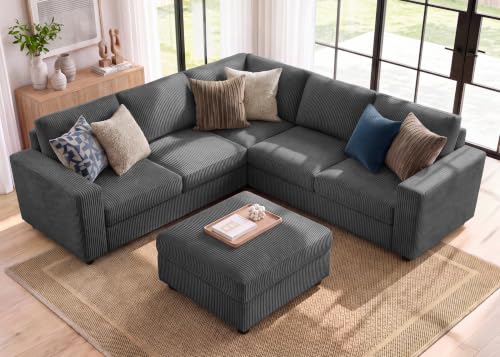
The sectional’s defining advantage is social geometry. A straight sofa lines people up like passengers; a sectional angles them toward one another, so conversation happens across a corner instead of along a row, and a shared screen still sits comfortably in everyone’s view. Households feel this difference every single evening, in the way talk flows without anyone craning, and in how a guest in the corner is part of the group rather than at the end of it. It is the pro that owners mention first and the one that converts sceptics who sit in a well-placed corner seat for one long evening.
Pro: More real seating on the same wall
The corner seat is found space. A sectional extracts a genuinely comfortable extra place from the junction that a straight sofa wastes, and it does so without claiming another wall for a chair or another patch of floor for a footstool. In small and medium rooms this efficiency is decisive: one L-shaped piece against two walls can seat a whole household and its guests while leaving the centre of the room open, where a sofa plus armchairs would scatter furniture across every wall and still seat fewer people. For apartments especially, the arithmetic is the argument.
Pro: A true stretch-out seat, built in
The chaise gives one person full-length lounging — legs supported, back upright, still in the conversation — without a recliner mechanism, a separate ottoman, or exile to a bedroom. In practice the chaise becomes the household’s most contested territory: the reading seat, the recovery seat, the seat a parent claims after bedtime stories. Designs that would otherwise need a footstool per person fold that comfort into the footprint, and households that host film nights or value an afternoon nap in company get daily value from a feature that looks, in a listing, like a minor shape detail.
Pro: It organises the room
A sectional does quiet architectural work. Its corner anchors a seating zone, its back can divide an open-plan space into living and dining without a wall or a screen, and its shape tells everyone where the room’s centre of gravity is. Rooms with a sectional tend to need less other furniture to feel finished, because the piece itself provides the structure that rugs and chairs are otherwise recruited to fake. In open-plan homes this organising power is a pro in its own right, separate from comfort entirely.
Pro: Variants solve real problems
The format’s family is unusually capable. A sleeper sectional gives a home without a guest room a real bed to offer. A storage chaise swallows the blankets, games, and spare cushions that otherwise colonise a living room’s surfaces. A modular sectional adapts to new rooms and new households instead of being replaced by them. A reclining sectional personalises comfort at each end. Each variant charges for its cleverness — in weight, firmness, or complexity — but the problems they solve are real, recurring, and otherwise expensive in space.
Pro: One purchase finishes the room’s seating
There is a practical, budgetary elegance to a sectional: one decision, one delivery, one fabric, and the room’s seating is complete and coordinated. The alternative — a sofa, then chairs that must match it, then an ottoman that must match both — multiplies decisions, deliveries, and the chances of a mismatch that nags for years. For households that want the room done, and done coherently, the sectional’s completeness is a genuine advantage, and it is why the format dominates family-room furnishing despite every con listed below.
The Cons
Con: It might not fit through your door
The most serious disadvantage in this entire list is logistical: sectional pieces, above all the corner unit of a fixed design, are large, rigid, and awkward, and homes are full of doorways, hallways, and stair turns that were never designed for them. A sectional that cannot complete the journey from street to living room delivers none of its pros at all, and this failure — measurable in advance with a tape — remains the category’s most common return story. Modular designs soften the con considerably, since their largest piece is a single seat, but for fixed and sleeper designs it must be treated as a gating question, answered before fabric is even discussed.
Con: The layout is a commitment
A fixed sectional fits one room plan gracefully and resists every other. The chaise is on the side the maker chose; the corner turns the way it turns; rearranging the room around it usually means discovering that the sofa only truly works where it already is. Households that rearrange with the seasons, or that expect to move within a few years, feel this con as a slow friction that never quite becomes a crisis and never goes away. Reversible chaises and modular systems exist precisely to answer this con, and households with any doubt about their future floor plans should let those variants outrank prettier fixed designs.
Con: It can overwhelm the room
Scale cuts both ways. A sectional sized generously for a large room becomes, in a medium room, a soft monument that everything else must orbit: walkways narrow, doors swing into it, and the remaining furniture crowds the edges. Even where it technically fits, a deep, high-backed design in a low-ceilinged room changes the room’s weather. The taped-footprint test exists to expose this con before purchase — mark the outline, live with it for a day — but buyers who skip the tape and trust a listing photograph discover the con at full size, fully assembled, in the middle of their living room.
Con: The worst seat and the crumb corner
Sectionals are not uniformly comfortable. Junction and middle seats, where cushions meet, are often noticeably less supportive than the celebrated corner, and in cheaper constructions they become the seats nobody chooses — which quietly converts a family-sized sofa into a smaller one at full price. Meanwhile the corner and the junctions act as the room’s crumb and pet-hair trap, collecting what every snack and every pet sheds, in exactly the places a vacuum reaches least easily. Neither flaw is fatal, but both are structural to the format, and both reward the weekly cleaning rhythm described later in this page.
Con: Cleaning and care are heavier work
More sofa means more upholstery to vacuum, more cushions to rotate, more covers to wash, and a piece too large to move casually when something rolls beneath it or a spill reaches the floor behind. Floating layouts collect a hidden dust field at the back that owners discover with dismay twice a year. Fabric choices made carelessly — delicate weaves with pets, pale colours with children — convert this con from a rhythm into a grievance. The format does not demand unusual skill, but it does demand unusual consistency, and households should adopt it with their eyes open about that.
Con: Moving house with it is a project
Every advantage of permanence reverses on moving day. A large fixed or sleeper sectional is heavy, awkward, and may not fit the next home’s route or room at all — the format’s saddest story is the beloved sectional sold cheaply because the new hallway said no. Modular designs are the exception that proves the rule, separating into portable pieces and re-forming in the new space. Households with a move visible on the horizon should weigh this con at full value, because it is the one most likely to end the sofa’s life early regardless of its condition.
What the Trade-Offs Mean for You
For the settled gathering household, the ledger is lopsided in the sectional’s favour: the cons are one-time or weekly-rhythm problems, while the pros pay out every evening. For the small apartment, the ledger depends entirely on proportion — a compact sectional’s seating efficiency is a genuine pro, while an oversized one’s domination of the room is a daily con — and the tape test, plus the compact field in the best apartment sectional sofas, decides which side a given purchase lands on. For the pet household, fabric converts the cleaning con from severe to manageable, and washable covers matter more than any other single feature.
For renters and movers, the commitment and moving cons are structural, and only the modular branch of the family honestly answers them. For households with older relatives, the format’s lower, deeper seats can turn the exit into a negotiation — a con that upright, tailored designs mitigate and that the deep lounging designs aggravate. And for households divided internally, sprawlers versus upright sitters, the pros and cons split by seat rather than by sofa, which is why the comparison work in sectional sofa reviews compared judges every design by its worst seat as well as its best.
| Alternative | Where it beats a sectional | Where a sectional beats it |
|---|---|---|
| Straight sofa plus armchairs | Flexibility, moving, rearranging, tight routes | Shared lounging, corner seating, room organisation |
| Reclining sofa | Personalised comfort per seat, smaller footprint options | More genuine seats, cleaner look, no mechanism weight |
| Loveseat plus ottoman | Small rooms, renters, narrow doorways | Capacity, hosting, stretch-out comfort for a group |
The alternatives table makes the pattern plain: everything that beats the sectional does so on flexibility, and the sectional beats everything on togetherness and capacity. Households should therefore decide which currency their life actually spends. A home whose evenings are shared and whose address is stable is rich in exactly the currency sectionals trade in. A home in motion is not, and no fabric upgrade changes that exchange rate — a point the value analysis in is a sectional sofa worth it presses further.
How to Buy Smart
Buying smart means choosing the variant that answers your household’s worst con. If the route is tight, buy modular — a HONBAY-style design whose largest piece is one seat — and let other refinements wait. If orientation is uncertain, buy reversible. If pets or children headline the household, buy washable covers in a tight weave and a mid-tone colour, whatever the silhouette. If guests are frequent, buy the sleeper knowingly, accepting its firmer sit; if they are rare, refuse the sleeper and buy daily comfort. The representative models used across this cluster — the Belffin style for settled family rooms, the Mopio style for compact rooms, the Rivet style for upright sitters, the Stone and Beam style for large permanent homes — are best read as answers to specific cons, not as a league table.

HONBAY Sectional Sofa — the con-reducing pick for changing homes
As a modular design, this representative directly answers the delivery, layout, and moving cons: pieces pass tight routes, rearrange when rooms change, and separate when households move. Its own trade-offs — visible seams and sections that must stay clipped — are the mildest cons in this article for the households it suits. In prose terms it sits at the entry-to-mid tier.
Belffin Sectional Sofa — the pro-maximising pick for settled families
This chaise-led representative leans into the pros: unified family seating, daily chaise comfort, and storage that keeps the room organised. Its cons are the format’s classic ones — fixed orientation, larger pieces — accepted knowingly by households whose rooms are settled. In prose terms it sits in the mid tier, and its buyers should confirm the chaise side from inside the room before ordering, using the method in our sectional sofa buying guide.
Setup and Care That Reduce the Cons
Several cons shrink dramatically under the right habits. Connect sections fully at setup and re-check the brackets twice a year, and the drifting, gap-opening con mostly disappears. Rotate and flip cushions weekly, and the worst-seat and slump cons slow to a crawl, because wear spreads across every seat instead of concentrating on the corner and chaise that everyone loves. Vacuum junctions with a crevice tool on the same weekly rhythm, and the crumb corner becomes a two-minute task instead of a archaeological dig. Keep a washable throw over the most contested seat, and the pet-and-snack con is laundered rather than upholstered.
Positioning shrinks other cons. Leave an honest walkway behind a floated sectional and clean it on the same schedule as the front, and the hidden dust field never forms. Put the lamp at the chaise end and a tray within the corner’s reach, and the format’s small ergonomic gaps close. None of this requires money or skill — it requires adopting the sectional as a maintained system rather than a delivered object, a distinction the deep-dive in our sectional sofa review returns to in its ownership section.
Bottom Line
The sectional sofa’s pros are about evenings and its cons are about logistics, and households should weigh them in that spirit. If the logistics clear — the route measures up, the room carries the footprint, the orientation is chosen from inside the room, the household is settled enough to commit — then the pros are not marginal advantages but a daily transformation of how a home gathers. If the logistics fail, no pro on this page can rescue the purchase, and the honest answer is a different format, bought without regret. Decide the logistics first, and the pros and cons will have already decided the rest.

LINSY HOME Sectional Sofa — the guest-ready pick, with its cons priced in
This convertible representative maximises the variant pro — a home without a guest room gains a real bed and hidden storage — while carrying the variant cons at full weight: heavier delivery, a firmer daily sit, and a mechanism that must be used to stay happy. In prose terms it sits at the entry-to-mid tier. For weekly-guest households the pros win clearly; for twice-a-year hosts the same design is this article’s clearest example of a pro that is not worth its cons.
Mopio Sectional Sofa — the small-room pick that keeps the pros honest
This compact representative preserves the core pros — corner seating, chaise lounging, room organisation — inside a footprint that does not trigger the overwhelm con. Its trade-offs are moderated depth and capacity. In prose terms it sits in the mid tier, and for apartments it shifts the whole pros-and-cons ledger positive, provided the tape test confirms the walkways survive.
Rivet Sectional Sofa — the upright pick for households split on softness
This tailored representative trades some sprawl pro for a posture pro: firmer, more supportive seating that upright sitters and home workers experience as the format’s biggest advantage. Its cons are less sink-in comfort and upholstery that shows displacement honestly. In prose terms it sits in the mid-to-premium tier.
Stone and Beam Sectional Sofa — the maximum-pro, maximum-con pick
This generous traditional representative takes both columns to their limit: the fullest shared comfort in the cluster, and the heaviest delivery, footprint, and moving cons in the cluster. In prose terms it sits in the premium tier. It is the right answer exactly when a large, settled home can absorb every con without noticing — and the wrong answer the moment any con needs the word hopefully in front of it.
Myths That Distort the Ledger
Several myths reliably corrupt households’ pros-and-cons thinking, and they are worth retiring explicitly. The first is that a sectional is automatically too big for a small room; in truth a compact sectional often seats more people on less wall than the sofa-and-chairs arrangement it replaces, and it is oversizing, not the format, that overwhelms rooms. The second myth is the mirror image: that a bigger sectional is automatically more comfortable. Depth and sprawl serve tall loungers and exile shorter sitters, and a household’s comfort is set by its least-served member, not its most indulged one.
The third myth is that a sleeper mechanism is free value — a bed you might as well have. It is not free; it is paid for daily in weight and firmness, and it is only good value when guests actually sleep on it regularly. The fourth myth is that orientation is a detail to settle when the sofa arrives. On a fixed design it cannot be settled then at all, and the households living with a chaise jutting into a walkway are the ones who treated it as a detail. The fifth myth is that expensive means safe: tier buys construction and fabric, not geometry, and the priciest sectional in this cluster fails a narrow stair turn with exactly the finality of the cheapest. Retire these five, and the honest ledger on this page becomes much easier to read.
The Ledger by Household, in Full
For the young household in its first real home, the pros that matter are capacity and completeness — one purchase that seats friends, hosts film nights, and finishes the room — while the cons that matter are moving and commitment, because this household’s life is the most likely to change. Modular designs tilt this ledger decisively positive. For the established family, the daily pros dominate overwhelmingly and the cons reduce to a cleaning rhythm and a delivery day planned properly; almost any well-chosen variant serves them, and fabric is their highest-stakes decision. For the downsizing household, the ledger inverts in an interesting way: the togetherness pro still appeals, but seat height, exit ease, and a footprint that respects a smaller home become the deciding entries, favouring compact, upright designs over deep loungers.
For the household that entertains formally, the sectional’s casual gravity can itself be a con — the format invites sprawling, perching, and feet-up informality that some rooms and some hosts do not want — and the tailored branch of the family, or a conventional sofa arrangement, may honestly serve better. For the household sharing space with lodgers, students, or extended family in rotation, the sleeper and storage pros compound, because the room must be several rooms in turn. There is no household for whom the ledger is empty on either side; there are only households who have read their own side honestly and households who will discover it after delivery, at considerably more trouble.
The Pet and Children Ledger, in Detail
No household feels the pros and cons more asymmetrically than one with pets and children, so the ledger deserves its own accounting. On the pro side, the sectional is the natural habitat of family life: children claim the corner as a fort and reading nest, the chaise absorbs a sleeping toddler and a supervising parent simultaneously, and the whole household can occupy one piece of furniture for a film without a seating negotiation. Dogs, in particular, regard a sectional as a landscape designed for them, and a household that accepts this gains a genuinely shared living room rather than a sofa under permanent guard.
On the con side, the same household generates the format’s heaviest wear and mess, concentrated by the sectional’s own geometry into its hardest-to-clean places. Crumbs migrate to the junctions; hair works into the corner; spills land, with statistical inevitability, on the chaise. The ledger balances only when fabric is chosen as a countermeasure — tight weaves that release hair, covers that wash, mid-tones that forgive — which is why this cluster keeps returning to the most comfortable sofa fabrics as required reading for pet households. Chosen well, the sectional is the most pet-compatible large furniture a home can own; chosen for a photograph, it is the fastest-ruined.
The Money Ledger, Without Numbers
Because prices in this category move constantly, the honest money discussion is about structure rather than figures. On the pro side, a sectional consolidates spending: one purchase covers seating that would otherwise be assembled from a sofa, chairs, and an ottoman across several decisions and deliveries, and a well-chosen mid-tier sectional can serve a household for many years, spreading its cost across thousands of evenings. Modular designs add a quiet financial pro — a worn or damaged section can be replaced alone, and the sofa can move house instead of being sold at a loss and replaced.
On the con side, the format concentrates risk in the same way it concentrates seating. A wrong orientation, a failed delivery route, or a fabric ruined by the wrong household is a whole-sofa problem, not a one-chair problem, and returns of furniture this size are the most painful in home furnishing. Sleeper and reclining mechanisms add future maintenance exposure that plain designs do not carry. The financial wisdom of the format is therefore identical to its practical wisdom: the money is safe exactly when the measurements were honest. Households hunting seasonal value can watch sectional sofa Black Friday deals, but a deal on the wrong configuration is still the wrong configuration.
The Space and Light Ledger
A final, under-discussed pair of columns concerns what a sectional does to a room’s space and light. As a pro, a low-profile sectional with raised legs preserves the visible floor and lets light travel, making a modest room feel larger even as it seats more people; placed as a divider, it can give an open-plan home the defined living zone it was missing, an effect no other single furniture purchase matches. The corner’s geometry also creates a natural home for a floor lamp and a side table at its outer edges, completing a reading corner that smaller arrangements struggle to form — see the best lamps for sectional sofas for that pairing done well.
As a con, a deep or high-backed sectional blocks light and sightlines in smaller rooms, darkens the corner it occupies, and can make a low-ceilinged space feel like weather moving in. Its bulk also dictates the rest of the room: bookcases, desks, and dining furniture must arrange themselves around a piece that cannot be nudged aside for a party or a project. Households that use their living room for many purposes — exercise, play, work, guests — should count that inflexibility at full weight, because the sectional will win every negotiation about the room, every time, simply by being the largest thing in it. Where that dominance serves the household’s main life, it is a pro wearing a con’s clothing; where the room must stay versatile, it is the deciding argument against.
The Long View: How the Ledger Changes Over the Years
Pros and cons are not static, and a fair hearing has to follow the sectional past its first season. In year one, the pros are at their loudest — the gathering, the chaise, the finished room — and the cons are mostly hypothetical, a delivery survived and a cleaning rhythm not yet tested. By year three, the ledger has quietly re-sorted itself. The pros that remain loud are the social ones, which do not diminish; the comfort pros now depend entirely on whether cushions were rotated and covers washed, because a neglected sectional’s sit degrades from indulgent to apologetic, while a maintained one still feels like the purchase its owners remember. The cons that grow are the commitment ones, as households feel the fixed layout against Christmases, new hobbies, a home office that appeared in the corner where the chaise points.
By the time a move arrives — and for most households one eventually does — the moving con either dissolves, for modular owners who carry their sofa out in pieces and re-form it in the new home, or detonates, for fixed owners discovering a new hallway’s verdict. This is why this page, like the rest of the cluster, keeps steering uncertain households toward modular and reversible designs: not because they are better furniture in the showroom sense, but because their cons stay small across the whole arc of ownership, while the fixed designs’ cons are back-loaded into exactly the moments — a move, a rearrangement, a growing family — when a household can least use a furniture problem. Judged across a decade rather than a delivery day, forgiveness is the sectional virtue that compounds.
Accessibility and Mixed Households: A Fairer Hearing
One more column belongs in an honest ledger, and it is the one showrooms never print: how the format treats the household’s least mobile members. Deep, low sectionals are genuinely difficult furniture for older relatives, anyone recovering from an injury, and anyone whose knees have opinions — the pro of sink-in comfort for the young is a con of real consequence for them, expressed not in complaints but in quietly avoided visits to the room. Upright, firmer, higher designs reverse that column completely, and a household that hosts grandparents weekly should weight this entry as heavily as any fabric decision.
The sectional format also has an accessibility pro that straight arrangements lack: the chaise and corner give a person who needs to elevate their legs, or sit sideways for comfort, a dignified place inside the group rather than a special chair at its edge. Mixed households — which is to say, nearly all households across a long enough ownership — should therefore read the pros and cons seat by seat, not sofa by sofa, and choose the design whose worst seat still serves the person most likely to struggle with it. That principle, applied consistently, prevents the saddest sectional outcome of all: a beautiful, expensive piece of furniture that one member of the household simply stops using.
When the Cons Should Win: Saying No Well
An honest pros-and-cons page must be willing to conclude no, and there are households for whom it should. If the delivery route fails on paper, the answer is no to that design — not a hopeful maybe — and the alternatives in sofas for narrow doorways or a modular configuration are where the search restarts. If the household rearranges its rooms the way other households change their minds, the answer is no to every fixed design, however beautiful, because the layout con will be re-experienced monthly. If the room is the home’s thoroughfare, exercise space, playroom, and office in rotation, the answer may be no to the format entirely, in favour of seating that can be moved by one person in one minute.
Saying no well also means recognising when the answer is not yet. A household weeks from moving house, or expecting a baby, or waiting on a landlord’s decision, is a household whose floor plan and routines are about to be rewritten; buying a committed, fixed sectional into that uncertainty is how the cons column gets its saddest entries. Waiting, or buying modular as a bridge, preserves every pro for later. The sectional will still be there when the household knows its own shape — and the household that buys then, tape measure in hand and ledger honestly read, is the one whose pros-and-cons story ends the way this page’s verdict promises: with the pros paying out every evening, and the cons reduced to a delivery day survived and a vacuum rhythm nobody thinks about anymore.
A Short History of the Argument
It is worth noticing, in closing the ledger, that the argument about sectionals has not changed in decades, only its vocabulary. The format has always promised the same thing — a household gathered into one generous piece of furniture — and has always charged the same price: room, permanence, and a delivery day that must be respected. What has genuinely improved is the escape hatches. Modular construction, reversible chaises, washable covers, and compact designs have each retired one of the classic cons for the households willing to choose them, which means the modern ledger is kinder than the traditional one — provided the buyer reads it before ordering rather than after. The pros and cons themselves are permanent; which of them you actually experience is, more than in almost any other furniture purchase, up to you.
Guests, Gatherings and the Social Ledger
One column of the ledger only fills in when other people arrive, and for sociable households it may be the heaviest column of all. On the pro side, a sectional changes what a home can offer: film nights that seat everyone in one conversation, holiday gatherings where the seating arranges itself, overnight guests in sleeper households who are given a real bed rather than an apology. Hosts feel this as capability — the house simply becomes able to do things it could not do before — and guests feel it as welcome, because there is always a good seat and it is always in the middle of things rather than exiled to a dining chair at the edge.
On the con side, the same sociability has a price in wear and in order. Guests are harder on furniture than owners are; gatherings generate the crumbs, spills, and cushion displacement that the corner collects; and a household that hosts weekly will age a sectional visibly faster than one that hosts quarterly, in exactly the seats guests prefer. None of this argues against hosting — it argues for the fabric and cover decisions this page has already recommended, and for counting hosting frequency as a first-class entry in the ledger rather than a footnote. A sectional bought by a sociable household, in a washable fabric, is among the best-used furniture in any home; the same sectional bought by a private household is capacity paying rent on evenings that never happen.
Scoring the Ledger for Your Own Home
Readers who want the argument converted into an act can score it directly. Walk this page’s two columns and, for each entry, ask only whether it is true of your home, at full strength, at half strength, or not at all. The delivery con counts at full strength only if a measurement — not a feeling — says the route is doubtful. The togetherness pro counts at full strength only if your household’s ordinary evenings actually gather. The sleeper entries count only against counted guest nights. Scored this way, most households find the ledger is not close: one column accumulates full-strength entries while the other collects half-strength maybes, and the purchase decides itself in the scoring. Where the score is genuinely even, the tie belongs to flexibility — modular designs, reversible chaises, washable covers — because an even ledger today becomes an uneven life tomorrow, and the flexible purchase is the one that can follow it. That is the last refinement this page can offer: when the pros and cons balance, buy the version whose cons can still change their mind.
The Verdict in One Breath
If the whole page must collapse into a breath, it is this: the pros are evenings and the cons are logistics, evenings repeat and logistics happen once, so clear the logistics honestly — route, room, orientation, household — and then buy the evenings without further hesitation, in the variant whose remaining cons your household will notice least and whose pros it will use most, maintained on a light weekly rhythm that keeps the bargain true for years.
Hold that breath for one more consideration: the household that scores its ledger, clears its logistics, and still feels a flicker of doubt should listen to the doubt’s address — if it lives in the route, measure again; if it lives in the layout, go modular; if it lives in the fabric, choose the forgiving one — because doubt in this category is almost always a specific, answerable question wearing a general disguise.
Living With the Trade-Offs: How the Sectional sofa Balance Plays Out Over a Season
A pros and cons list is a snapshot, but a sectional sofa is a long-term housemate. Advantages that look decisive on paper can shrink once the seasons turn, and drawbacks that seem minor in a showroom can grow teeth in February or during a busy holiday week. The fairest way to weigh a sectional sofa is to follow one full season of ordinary use and ask how each side of the ledger behaves when the weather, the light and the household routine all change. This section does exactly that, so the balance you act on reflects lived experience rather than first impressions.
When the Advantages Grow — and When They Fade
The strengths of a good sectional sofa tend to compound quietly. A design that saves steps, stores more, or cleans easily gives that benefit back every single day, and over a season those small repayments add up to the real value of the purchase. By contrast, advantages based on novelty — an unusual finish, a fashionable shape, a feature you showed to guests twice — fade within weeks. When you re-read any pros list, sort each point into one of those two families: daily-compounding benefits deserve heavy weight, while novelty benefits deserve almost none, however attractive they looked at the point of ordering.
When the Drawbacks Bite Hardest
Weaknesses in a sectional sofa rarely bite at random; they bite at predictable pressure points. Guests arriving, a seasonal deep clean, a heatwave, a power cut, a house move, or a child or pet entering a new stage will each stress a different limitation. Think through those moments for the sectional sofa you are considering and ask whether the drawback is an occasional annoyance you can plan around or a recurring friction you will meet every week. An occasional annoyance is a fair price for a strong advantage elsewhere; a weekly friction almost never is, and it is the single most common reason owners replace a sectional sofa long before it wears out.
Use these seasonal pressure tests to judge the trade-offs in any sectional sofa:
- Picture the sectional sofa during your busiest week of the year and decide whether its main drawback would matter more, less, or about the same.
- Picture it during the opposite season from now — high summer if it is winter, the dark months if it is spring — and re-check light, heat, moisture and ventilation around it.
- Ask who else in the household touches the sectional sofa most, and weigh the cons from their height, strength and habits rather than your own.
- Separate the drawbacks you can fix with an accessory or a habit change from the ones built into the design itself.
- Give the sectional sofa a simple verdict for each season rather than one verdict for the year, and only buy when it passes the seasons you care about most.
Plan for the sectional sofa to be moved at least twice in its life — for cleaning, redecorating or a change of room — and favour designs that forgive being shifted, tilted or carried. Look at the edges and undersides when you judge build quality, because those are the places makers save money first and the places owners discover last. Ask how the sectional sofa behaves on your worst floor, wall or surface rather than your best one, since homes are uneven and listings are photographed in perfect rooms. Keep the receipt, delivery note and a photograph of the label together, because warranty conversations go smoothly when dates and model details are at hand. If two people in the household disagree about the sectional sofa, let the person who will use or maintain it most have the deciding vote on practical questions. Beware of buying for the household you hope to become; the sectional sofa that serves the household you already are will be used this week, not someday. A tape measure, a spirit level and ten patient minutes prevent more sectional sofa regrets than any amount of comparison shopping after the fact.
Judged across a season, most sectional sofa choices become clearer, not harder. The right model is rarely the one with the longest pros list; it is the one whose drawbacks land in the moments you can tolerate and whose strengths land in the moments you repeat every day. Hold any candidate up against your own calendar before you commit, and the pros and cons stop being abstract and start being a forecast you can trust.
Frequently Asked Questions
What is the biggest disadvantage of a sectional sofa?
Commitment, in its several forms: the size that may not pass a tight doorway or stair turn, the fixed orientation that cannot change sides, and the layout that fits one room plan and resists the next. Of these, delivery is the most absolute — a sectional that cannot enter the home delivers none of its advantages — which is why measuring the full route comes before every other buying decision. Modular and reversible designs soften the commitment cons considerably and are the right answer for households whose lives are still changing.
Do sectionals really seat more people than a sofa and chairs?
On the same wall length, generally yes, because the corner becomes a genuine, comfortable seat instead of dead junction space, and the chaise adds full-length lounging without a separate ottoman. The gain is largest in small and medium rooms, where one L-shaped piece against two walls leaves the centre open while seating the whole household. The honest caveat is seat quality: junction and middle seats on some designs are less supportive than the corner, so judge a sectional by its worst seat, not by a simple count of places.
Are sectionals hard to clean and maintain?
They ask for more consistency rather than more skill. The corner and the junctions between sections collect crumbs and pet hair and need a weekly vacuum with a crevice tool; cushions need rotating so favourite seats do not wear alone; and a piece this large cannot be moved casually for cleaning behind it. Removable washable covers transform the burden for pet and child households. Households that adopt the light weekly rhythm find upkeep unremarkable; households that clean in occasional rescues find the format genuinely burdensome.
Is a sectional a bad idea in a small room?
Not inherently — a compact sectional can seat more people on less wall than a sofa plus chairs, leaving the centre of a small room open. It becomes a bad idea when the footprint swallows the walkways, blocks a door swing, or forces the room’s main path past its chaise. The deciding tool is painter’s tape: mark the full outline, live a normal day inside it, and let the room vote. If the taped day flows, a compact design will serve the room well for years.
Which sectional variant has the fewest disadvantages?
Modular designs carry the lightest con list for most households, because they answer the delivery, layout, and moving objections directly: pieces pass tight routes, rearrange freely, and separate for transport. Their own trade-offs — visible seams, sections that must stay clipped, a less sculpted look — are cosmetic rather than structural. Fixed designs remain better for settled households that value a unified feel. The variant with the heaviest con list is the sleeper, whose weight and firmness are only justified by genuinely frequent guests.
Can the cons be fixed after purchase?
Some can and some cannot, and knowing which is which is the point of this page. Drifting sections, slumping cushions, and crumb corners all respond to setup and care habits adopted at any time. A chaise on the wrong side of a fixed sectional, a footprint too large for the room, and a design that cannot leave through the door it entered cannot be fixed at any price — they can only be sold, returned, or endured. Spend your caution on the irreversible cons before ordering, and your effort on the reversible ones after.
Related Guides
Apply this balance sheet with how to choose a sectional sofa, read the ownership verdict in is a reclining sofa worth it for the powered comparison, or browse the best massage sectional sofas for reclining sectionals with massage features.