Disclosure: As an Amazon Associate, dailyhomedecorating.com earns from qualifying purchases. Links on this page are affiliate links; they cost you nothing extra. Prices and availability change often, so check the current Amazon listing before you buy.
This outdoor string lights buying guide is written for one purpose: to help you choose a string that fits your space, your power supply and the way you actually spend evenings outside, the first time. The market looks simple from a search page and confusing in detail, because listings mix plug-in and solar, glass and plastic bulbs, decorative mini strings and commercial-grade festoon runs as if they were interchangeable. They are not. A string that is perfect over a balcony rail can be wrong over a wide patio, and a bargain that needs replacing every season is not a bargain at all. Work through the types, the picks and the questions below and the right choice usually becomes obvious.
Three decisions matter more than everything else combined. First, power: plug-in for gathering spaces near a protected outdoor socket, solar for sunny corners far from one. Second, grade: a robust, permanent-style string for runs that stay up, a lighter string for occasional, removable use. Third, support: any long span needs a guide wire and sound anchors, whatever the listing photographs imply. Get those three right and bulb shape, colour warmth and brand become pleasant details rather than expensive mistakes.
Key Takeaways
- Decide power first: plug-in for main patios, solar only where direct sun is reliable.
- Match the grade to the job: permanent runs deserve commercial-style cord and replaceable bulbs.
- Every long span needs a steel guide wire, solid anchors and clearance from roofs and heat.
- Power only from an outdoor-rated, GFCI-protected socket; keep connectors off the ground.
- Buy the hardware, timer and correct spare bulbs as part of the same purchase.
What Outdoor String Lights Do and the Main Types
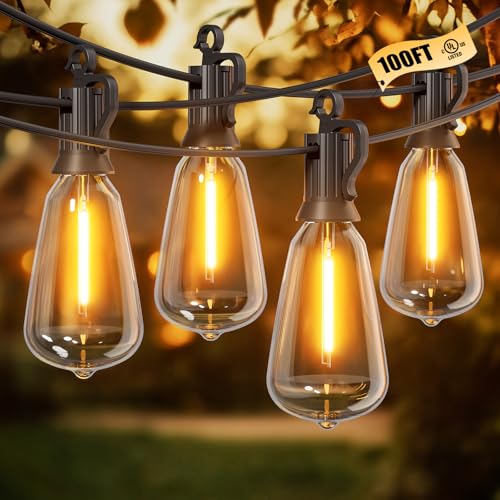
Outdoor string lights are a flexible lighting system, not a single product. A cord carries a series of sockets, each holding a bulb, and the run is suspended between anchor points to spread warm, low-level light across a space. Unlike a fixed fitting, the system can follow a fence, canopy a patio, zigzag a courtyard or outline a pergola. Understanding the main types matters because each type solves a different problem, and most disappointment comes from asking one type to do another type’s job.
Plug-In Festoon and Cafe Strings
The workhorse type. A mains-powered cord with evenly spaced sockets, hung overhead in swags, giving consistent brightness for as long as you want it. Cafe-style strings use larger, vintage-look bulbs and heavier cord; standard festoon strings are lighter but follow the same principle. This is the right type over dining tables, seating areas and anywhere people cook, serve and read. Many models allow strands to connect end to end up to a stated limit, and many work with a compatible dimmer, which transforms the same run from task light to background glow across one evening.
The obligations are real: you need a suitable outdoor socket, a safe cable route, support wire on long spans, and the discipline to keep the run clear of roofs, heaters and fabrics. In exchange you get the most capable, longest-lived form of string lighting, and the one this guide recommends for any primary gathering space. If you buy only one type, buy this one, sized honestly to the spans you measured.
Solar String Lights
Solar strings carry a small panel that charges a battery by day and powers the bulbs after dark. Their gift is freedom: no socket, no cable route, no electrician, and light in places mains power will never sensibly reach, such as a far fence, a tree or a shed. Their limit is physics. Output and run time depend entirely on the sun the panel actually receives, so a bright product page cannot rescue a shaded site. Expect a softer glow and a shorter evening than plug-in equivalents, and treat solar as atmosphere and way-marking rather than dining light.
Choose solar deliberately, not by default. Site the panel in the sunniest position the lead allows, clean it occasionally, and accept that midwinter evenings will be shorter than midsummer ones. Used where it belongs, solar is delightful and genuinely useful. Used as a cheap substitute over a main patio, it is the single most common cause of the complaint that string lights are disappointing, a complaint this outdoor string lights buying guide exists to prevent.
Shatterproof and LED Bulb Variants
Bulb construction cuts across both power types. Glass bulbs give the classic look and a beautiful, clear glow, but they can break in storms, during installation or when a run is handled carelessly, and every broken bulb must be replaced promptly with the specified type. Plastic or shatterproof-style bulbs survive knocks, children, pets and clumsy storage far better, and modern versions look convincingly warm. LED filaments inside either construction sip power, run cooler and last far longer than old incandescent bulbs, at the cost of needing a compatible dimmer if you plan to dim.
For family spaces, high runs that are awkward to reach, and any string that will be taken down and stored, shatter-resistant bulbs are the pragmatic choice. For a permanent, carefully mounted dining canopy where the classic glass look is the whole point, glass remains lovely provided you keep spares of the exact bulb. Either way, confirm what the listing actually supplies, because photographs rarely reveal bulb material and the detail changes ownership completely.
In this guide
Outdoor String Lights Buying Guide: Top Picks at a Glance
The six picks below cover the realistic buying positions for this category, from a permanent patio canopy to a first solar trial. Each is presented prose-only here with its tier and best use, so you can shortlist by fit rather than by a headline figure. Full ownership impressions live in outdoor string lights reviews, and the value case for the category as a whole is argued in are outdoor string lights worth it.
Best Overall: Brightech Ambience Pro, premium tier, for a permanent main-patio run. Best for Beginners: Brightown Outdoor String Lights, entry-to-mid tier, for a first balcony or deck install. Best for Dimmed Dining: SUNTHIN Outdoor String Lights, mid tier. Best for Large Yards: addlon Outdoor String Lights, mid tier, for linked long runs. Best Permanent Cafe Style: Enbrighten Cafe Lights, premium tier. Best No-Socket Option: Brightown Solar String Lights, entry tier, for sunny remote corners.
Brightech Ambience Pro
The Brightech Ambience Pro is a commercial-feel plug-in string with heavy-gauge cord and vintage-style exposed bulbs, positioned in the premium tier for permanent patio installations. In daily use the appeal is consistency: the light colour stays even from bulb to bulb, the cord hangs in a clean catenary when it is properly supported, and the whole run behaves like one fixture rather than a tangle of separate lamps. Treat it as infrastructure for the space rather than decoration you drape and forget, and it will reward you with the calm, even glow that makes people linger outside after dinner.
Installation follows the same discipline as every pick in this guide. Measure the run first, fix your anchor points, and string a steel guide wire between them on any long span, clipping the light cord to the wire so the wire carries the weight and the wind load. Never let a sagging cord rest against a roof edge, gutter, timber beam or fabric canopy, and never allow slack loops to touch anything flammable. Power the run only from an outdoor-rated socket protected by a GFCI, keep every connection off the ground and out of puddles, and if a bulb breaks, switch off, let it cool, and replace it with exactly the same bulb type and fitting the maker specifies rather than whatever happens to be in a drawer.
Best for: Homeowners who want one long, durable run over a main patio or pergola and plan to leave it up through the seasons. Not suited for: Renters or anyone who needs to take lights down weekly, because the heavier cord and permanent mounting hardware reward a set-and-forget install.
On price, treat this model by tier rather than by a fixed figure, because listings change often. Check price on Amazon on the day you buy, confirm the listing still matches the bulb type, cord length and power source described here, and confirm the outdoor rating is stated for the exact version in your basket before you check out.

Brightown Outdoor String Lights
The Brightown Outdoor String Lights is a widely chosen plug-in string in the entry-to-mid tier, with shatterproof-style plastic bulbs on many versions and straightforward connectable runs. In daily use the appeal is consistency: the light colour stays even from bulb to bulb, the cord hangs in a clean catenary when it is properly supported, and the whole run behaves like one fixture rather than a tangle of separate lamps. Treat it as infrastructure for the space rather than decoration you drape and forget, and it will reward you with the calm, even glow that makes people linger outside after dinner.
Installation follows the same discipline as every pick in this guide. Measure the run first, fix your anchor points, and string a steel guide wire between them on any long span, clipping the light cord to the wire so the wire carries the weight and the wind load. Never let a sagging cord rest against a roof edge, gutter, timber beam or fabric canopy, and never allow slack loops to touch anything flammable. Power the run only from an outdoor-rated socket protected by a GFCI, keep every connection off the ground and out of puddles, and if a bulb breaks, switch off, let it cool, and replace it with exactly the same bulb type and fitting the maker specifies rather than whatever happens to be in a drawer.
Best for: First-time buyers covering a balcony, small deck or fence line who want a simple, forgiving first install. Not suited for: Anyone lighting a very long open span without support, because lighter cords still need a guide wire on long runs just like heavier ones.
On price, treat this model by tier rather than by a fixed figure, because listings change often. Check price on Amazon on the day you buy, confirm the listing still matches the bulb type, cord length and power source described here, and confirm the outdoor rating is stated for the exact version in your basket before you check out.

SUNTHIN Outdoor String Lights
The SUNTHIN Outdoor String Lights is a mid-tier plug-in option often chosen with dimmer compatibility in mind, suited to dining areas where brightness control matters. In daily use the appeal is consistency: the light colour stays even from bulb to bulb, the cord hangs in a clean catenary when it is properly supported, and the whole run behaves like one fixture rather than a tangle of separate lamps. Treat it as infrastructure for the space rather than decoration you drape and forget, and it will reward you with the calm, even glow that makes people linger outside after dinner.
Installation follows the same discipline as every pick in this guide. Measure the run first, fix your anchor points, and string a steel guide wire between them on any long span, clipping the light cord to the wire so the wire carries the weight and the wind load. Never let a sagging cord rest against a roof edge, gutter, timber beam or fabric canopy, and never allow slack loops to touch anything flammable. Power the run only from an outdoor-rated socket protected by a GFCI, keep every connection off the ground and out of puddles, and if a bulb breaks, switch off, let it cool, and replace it with exactly the same bulb type and fitting the maker specifies rather than whatever happens to be in a drawer.
Best for: Hosts who dim the lights for dinner and want a warmer, lower glow after the meal rather than full brightness all evening. Not suited for: Buyers who will never use a dimmer and simply want the simplest possible on-and-off setup with no extra controls to manage.
On price, treat this model by tier rather than by a fixed figure, because listings change often. Check price on Amazon on the day you buy, confirm the listing still matches the bulb type, cord length and power source described here, and confirm the outdoor rating is stated for the exact version in your basket before you check out.
addlon Outdoor String Lights
The addlon Outdoor String Lights is a long-run plug-in string in the mid tier, frequently picked for covering larger yards with connectable strands. In daily use the appeal is consistency: the light colour stays even from bulb to bulb, the cord hangs in a clean catenary when it is properly supported, and the whole run behaves like one fixture rather than a tangle of separate lamps. Treat it as infrastructure for the space rather than decoration you drape and forget, and it will reward you with the calm, even glow that makes people linger outside after dinner.
Installation follows the same discipline as every pick in this guide. Measure the run first, fix your anchor points, and string a steel guide wire between them on any long span, clipping the light cord to the wire so the wire carries the weight and the wind load. Never let a sagging cord rest against a roof edge, gutter, timber beam or fabric canopy, and never allow slack loops to touch anything flammable. Power the run only from an outdoor-rated socket protected by a GFCI, keep every connection off the ground and out of puddles, and if a bulb breaks, switch off, let it cool, and replace it with exactly the same bulb type and fitting the maker specifies rather than whatever happens to be in a drawer.
Best for: Larger gardens where several strands will be linked end to end and a single circuit needs to cover a wide entertaining area. Not suited for: A tiny balcony where a long commercial-style run would need awkward coiling and wasted length bunched at one end.
On price, treat this model by tier rather than by a fixed figure, because listings change often. Check price on Amazon on the day you buy, confirm the listing still matches the bulb type, cord length and power source described here, and confirm the outdoor rating is stated for the exact version in your basket before you check out.
Enbrighten Cafe Lights
The Enbrighten Cafe Lights is a premium-tier cafe-style string from a well-known lighting brand, with impact-resistant bulbs designed for permanent outdoor mounting. In daily use the appeal is consistency: the light colour stays even from bulb to bulb, the cord hangs in a clean catenary when it is properly supported, and the whole run behaves like one fixture rather than a tangle of separate lamps. Treat it as infrastructure for the space rather than decoration you drape and forget, and it will reward you with the calm, even glow that makes people linger outside after dinner.
Installation follows the same discipline as every pick in this guide. Measure the run first, fix your anchor points, and string a steel guide wire between them on any long span, clipping the light cord to the wire so the wire carries the weight and the wind load. Never let a sagging cord rest against a roof edge, gutter, timber beam or fabric canopy, and never allow slack loops to touch anything flammable. Power the run only from an outdoor-rated socket protected by a GFCI, keep every connection off the ground and out of puddles, and if a bulb breaks, switch off, let it cool, and replace it with exactly the same bulb type and fitting the maker specifies rather than whatever happens to be in a drawer.
Best for: Anyone building a permanent cafe-style canopy over a patio who values robust bulbs and tidy, hardware-mounted runs. Not suited for: Party-only users who hang lights twice a year, because a permanent-grade string is more product than occasional use requires.
On price, treat this model by tier rather than by a fixed figure, because listings change often. Check price on Amazon on the day you buy, confirm the listing still matches the bulb type, cord length and power source described here, and confirm the outdoor rating is stated for the exact version in your basket before you check out.

Brightown Solar String Lights
The Brightown Solar String Lights is a solar-powered string in the entry tier, charging from a small panel by day and removing the need for an outdoor socket near the run. In daily use the appeal is consistency: the light colour stays even from bulb to bulb, the cord hangs in a clean catenary when it is properly supported, and the whole run behaves like one fixture rather than a tangle of separate lamps. Treat it as infrastructure for the space rather than decoration you drape and forget, and it will reward you with the calm, even glow that makes people linger outside after dinner.
Installation follows the same discipline as every pick in this guide. Measure the run first, fix your anchor points, and string a steel guide wire between them on any long span, clipping the light cord to the wire so the wire carries the weight and the wind load. Never let a sagging cord rest against a roof edge, gutter, timber beam or fabric canopy, and never allow slack loops to touch anything flammable. Power the run only from an outdoor-rated socket protected by a GFCI, keep every connection off the ground and out of puddles, and if a bulb breaks, switch off, let it cool, and replace it with exactly the same bulb type and fitting the maker specifies rather than whatever happens to be in a drawer.
Best for: Fence lines, trees and garden corners far from any socket, where running mains power would be impractical. Not suited for: Deeply shaded patios or north-facing balconies with little direct sun, where a solar panel cannot charge reliably through the day.
On price, treat this model by tier rather than by a fixed figure, because listings change often. Check price on Amazon on the day you buy, confirm the listing still matches the bulb type, cord length and power source described here, and confirm the outdoor rating is stated for the exact version in your basket before you check out.
How Much Light Do You Actually Need?
Enough to see faces, food and steps comfortably, and no more. String lights are atmosphere lighting with a practical edge, not floodlighting, and the most elegant patios are usually the dimmest ones that still work. Over a dining table, you want to read a menu and see the food clearly; over a lounge corner, half that level feels luxurious; along a fence, a gentle sparkle is plenty. Because many plug-in strings can be dimmed, buying slightly more light than the minimum and dimming down is wiser than buying the minimum and wishing for more on the night you are carving a roast outside by bulb light.
Think in zones rather than totals. Count the areas you genuinely use after dark, give each its own run or span, and resist lighting the whole garden uniformly, which flattens the very depth that makes outdoor lighting beautiful. Dark gaps between lit zones are not failures; they are what makes the lit zones feel like rooms. If a zone is purely decorative, solar may serve it. If people eat, cook or read there, give it plug-in power and, where the span is long, its own supported run rather than an overstretched shared one.
Which Power Source Fits Your Space?
Outdoor electricity deserves outdoor hardware. Plug in only at a socket with GFCI protection, use only components stated as rated for outdoor use, keep plugs and connectors raised off soil and decking where water pools, and never run the cord through a doorway or window where it can be pinched shut. If a breaker or GFCI trips, unplug and find the cause instead of repeatedly resetting it.
Start at the socket. A plug-in plan begins with locating an outdoor-rated, GFCI-protected socket and tracing a cable route that stays off the ground, out of water and away from doors and windows that could pinch it. If that route exists, plug-in is almost always the better main-space choice. If it does not, the honest options are fitting a proper outdoor socket, which is electrician work, or choosing solar for the zones that suit it. The dishonest option, an indoor socket and a cord through a cracked window, should never appear in a buying plan at all.
Then audit your sun with equal honesty. Watch the intended panel position across a full day, in the season you will use the lights most, and note buildings, fences and trees that shade it. Several hours of direct sun is the working minimum for a satisfying solar evening; dappled shade under a tree is not the same thing, however bright it feels at noon. Match the power source to the evidence of your own garden, not to hope, and the lights will perform the way the product page promised.
How Long, How Many Strands, and What About Support?
Keep every run clear of heat and fuel. Do not let bulbs or cord rest on a roof surface, against a chimney, over a fire pit or grill, or tangled into dry planting and fabric shades. Leave air around each bulb, keep the lowest point of the swag well above head height and above anything that could be knocked up into it, and take the run down rather than leaving it if a section can no longer be kept clear.
Measure before you browse. For each span, measure anchor to anchor, then allow extra for the natural swag, because a string hung in a graceful curve travels further than the straight-line distance. Note the drop you can afford: the lowest point of each swag must stay above head height and well clear of umbrellas, shade sails and planting. Add the spans together, compare with the lengths on offer, and respect the maker’s stated limit for connecting strands end to end, since that limit protects the cord and the first socket in the chain from carrying more than they should.
Anchors deserve the same care as lengths. A house wall, a sound post or a substantial structure will hold a run for years; a flexing fence panel or rotten pergola rail will not. Where no structure exists at the right place, install a proper pole or post for the purpose rather than improvising. It feels like a detour, but every experienced installer will tell you the same thing: strings fail at their ends and supports far more often than they fail at their bulbs. Buy the ends properly and the middle looks after itself.
What Should You Check About Bulbs and Weather Rating?
Confirm three things on the exact listing you will buy, not on a sibling model. First, the outdoor rating is stated for outdoor use, because indoor decorative strings have no place outside whatever their photographs show. Second, the bulb type, base and replacement specification are named, so you can buy correct spares on day one rather than hunting after the first breakage. Third, whether bulbs are replaceable at all: sealed strings can be cheap and cheerful for a season, but a permanent run deserves replaceable bulbs, because one failed sealed unit eventually means replacing a whole strand.
Then match bulb character to the job. Warm colour temperatures flatter skin, food and timber and suit almost every domestic setting; very cool light belongs to task areas, not dining canopies. Shatter-resistant bulbs suit family gardens, high awkward runs and strings that travel in and out of storage. Glass suits permanent, reachable, carefully handled installs where the classic look justifies the care. None of these choices is about taste alone. Each one predicts how the string will behave in your specific household, which is the only prediction that matters. For the honest downsides of each direction, see outdoor string lights pros and cons.
How to Prioritise by Use Case
The Dining Patio
Prioritise plug-in power, dimming and support. You need reliable brightness for cooking and serving, a warmer dimmed glow afterwards, and a run that stays exactly where you put it above the table through a season of weather. Choose a permanent-grade string, hang it on guide wire across the span, keep every bulb clear of shade sails and umbrella fabric, and put the circuit on a timer or smart control you will actually use. Decorative extras rank last; even, dependable light over the table ranks first, every time.
The Balcony or Courtyard
Prioritise length discipline and removable fixings. Small spaces need one well-judged run, not three tangled ones, and renters need fixings that leave no trace. Measure the single best line, wall to railing or across the courtyard’s narrow axis, and let that one swag define the space. Solar can work here if the balcony is sunny, but a short plug-in run is more predictable where a socket exists. Shatter-resistant bulbs are a kindness in tight spaces where chairs, planters and people brush past the run.
The Large Garden
Prioritise zoning and realistic power. No single string civilises a large garden, and pretending otherwise produces one overstretched, overloaded run and a lot of gloom. Divide the garden into the gathering zone, which deserves plug-in light on proper supports, and the edges, paths and features, which solar strings and ground lights can mark beautifully. Plan anchor posts where structures are missing. Build the gathering zone first, live with it for a few evenings, and let experience, not enthusiasm, decide where the next run belongs. Related ground-level options are gathered at best solar pathway lights.
First Setup and Care Essentials
Set up in daylight, in order. Fit anchors, run and tension the guide wire on long spans, hang the string loosely, clip it to the wire at intervals so the wire takes the load, dress the swags evenly, and only then connect power and test. Check from below that no bulb touches anything, that the lowest points clear heads and fabrics, and that the cable route to the socket is raised, dry and unpinched. Photograph the finished run; the picture is a useful reference when you re-hang after winter or troubleshoot a section months later.
Care is a rhythm, not a project. A start-of-season inspection for cracked bulbs, damaged cord, loose clips and encroaching growth. A quick look after serious storms. Prompt, like-for-like replacement of any broken bulb, with the power off and the bulb cool. An occasional wipe of solar panels. Loose coiling and dry storage for any run that comes down. Five small habits, repeated, are the entire difference between a string that serves for years and one that becomes a hazard with bulbs. The single-model deep dive in outdoor string lights review shows this rhythm applied in detail.
Mistakes to Avoid When Buying
The classic mistakes are all versions of buying the picture instead of the space. Buying by bulb count or headline length without measuring spans. Choosing solar for a shaded patio because the listing was cheaper. Stretching a string tight on its own cord because the wire felt like an optional extra. Linking more strands than the maker allows. Assuming a dimmer will work without checking compatibility. Forgetting anchors, hooks, clips, timer and spare bulbs until the afternoon of the party. Every one of these is avoidable with the measurements and checks in this guide, and every one is far cheaper to avoid than to fix.
A subtler mistake is buying one grade for every job: delicate decorative strings on a permanent exposed run, or heavy commercial cord for a string that travels to two parties a year and lives in a cupboard between them. Grade follows duty. Permanent and exposed means robust, replaceable and supported. Occasional and handled means light, forgiving and shatter-resistant. When the grade matches the duty, string lights are one of the most reliable purchases in the garden. When it does not, no brand name will save the mismatch. Round out your patio planning with best outdoor string lights, best patio chaise lounge chairs and best deck box for cushions.
A Worked Example: Three Gardens, Three Right Answers
Consider a small, sunny balcony, six paces long, with a railing, two chairs and a tenant who reads outside on summer evenings. The right answer is one short run, a single swag from a removable hook on her own shelving unit to the railing’s far post, shatter-resistant bulbs, and power chosen by evidence: the balcony faces the afternoon sun, so a solar string is a genuine candidate, while a short plug-in run remains the predictable option if a protected socket exists indoors-adjacent and the route is safe. Guide wire is unnecessary at this span. The whole purchase, hardware included, is modest, and the transformation is total, because one swag is the balcony’s entire sky.
Consider next a family patio, wide enough for a dining table and a lounge corner, with a house wall on one side and open garden on the other. The right answer is plug-in and permanent-grade: a post installed at the open corner to complete the anchors, guide wire across the main span, one run over the table with verified dimming for the evening’s second act, and a second, simpler run over the lounge corner. A solar string marks the far fence. The budget concentrates on anchors, wire and the dining run, in that order, because those are the parts that cannot be upgraded later without starting again.
Consider finally a large, tree-filled garden with no outdoor socket and dappled shade. The honest answer surprises its owners: overhead plug-in strings wait until an electrician fits a proper socket near the terrace, and meanwhile the garden is lit at ground level and at its sunny edges, where solar strings on the one bright fence and path lights along the routes deliver a beautiful, truthful result this season. Buying a heroic solar canopy for the shaded terrace would have manufactured a disappointment. Sequencing the project, ground and edges now, canopy when power arrives, is what buying smart looks like when the space argues back.
Reading a Listing Like an Installer
Product pages reward a particular reading order. Ignore the lifestyle photograph and the bulb count. Find, in this order: the stated outdoor rating, the power source and, for solar, the panel arrangement; the cord length and the number of sockets, from which the spacing follows; the bulb type, base and whether replacements are specified and available; the stated limit for connecting strands; dimmer compatibility, claimed precisely or not at all; and what the package actually includes in the way of clips, hooks or support hardware, which is usually less than the photographs imply. A listing that answers all six points plainly is selling to installers. A listing that answers none of them is selling a photograph.
Then read the questions and owner reports with a filter. Complaints about dimness from shaded solar sites tell you about sites, not products. Complaints about sagging tell you about missing guide wire. The complaints worth your attention are about sealing failures, mismatched replacement bulbs, connectors that corrode and cords that stiffen, because those are product truths no installation can fix. Learn to sort the two kinds and the whole category becomes transparent: you will know which failures you can prevent and which you must avoid by choosing differently.
Budgeting the Whole System, Not Just the String
Plan the purchase as a system with four lines. The string itself. The support: anchors, posts where needed, guide wire and clips. The control: a timer at minimum, a verified dimmer where dining justifies it. The upkeep kit: spare bulbs of the exact specified type, bought while the listing is in front of you, plus any storage box for a run that winters indoors. Households that budget all four lines spend slightly more on day one and dramatically less over the string’s life, because the expensive failures in this category, the fatigued cord, the chafed run, the unmatchable bulb, are almost all failures of an omitted line rather than a faulty product.
Sequencing matters when the budget is tight. Anchors and support cannot be retrofitted gracefully, so they come first, even if that means a shorter or simpler string this season over the dining zone alone. Control comes next, because a timer multiplies use and use is value. Expansion comes last and can wait a whole season without penalty. The reverse order, maximum string, minimum support, is the classic false economy of this category, and it converts a good product into a bad experience with impressive reliability.
Questions to Ask Before You Check Out
- Is the outdoor rating stated for this exact model, in plain words?
- Do I know the bulb type and base, and can I order correct spares today?
- Does my strand count stay inside the maker’s stated linking limit?
- Have I measured every span, including the extra length the swag consumes?
- Is every long span planned on guide wire, between anchors I trust?
- Is the power route to a protected outdoor socket raised, dry and unpinched, or is my solar site proven sunny?
- Does the whole run, as planned, stay clear of roofs, heat, fabric and foliage?
- Are wire, clips, hooks, timer and spares in the same order as the lights?
Eight yes answers mean you are ready to buy with confidence, and the rest of this guide becomes a reference rather than a warning. Any no is not a stop sign; it is a shopping list. Fix the no, in the order the questions are asked, and the purchase that follows will be the one the delighted owners in this category describe: unremarkable to install, invisible to maintain, and quietly transformative every single evening.
A Pre-Purchase Measurement and Compatibility Audit for Your Outdoor String Lights
Use this audit in the final ten minutes before you order a outdoor string lights, because that is when most buying-guide advice stops being abstract and starts being a tape measure, a doorway and a return label you would rather not need. Write down three numbers for the outdoor string lights you are considering: the footprint where it will sit or be stored, the largest dimension it reaches in normal use, and the clearance it needs so doors, drawers, lids, handles or moving parts can work without catching. Then measure the route, not just the destination, since a outdoor string lights that fits its final spot perfectly can still fail at a narrow hallway, a tight turn, a low doorway or a cupboard mouth that is smaller than the space behind it. Consider the cleaning rhythm honestly: a outdoor string lights that needs attention after every use suits a household that enjoys small rituals, and frustrates a household that wants to finish a job and walk away, so match the upkeep to the temperament, not the intention.
Shortlist discipline helps here: keep two outdoor string lights options that pass the audit and let one fail on paper, because comparing a clear pass against a clear fail teaches you more about your real priorities than comparing three near-identical maybes. Watch for edge cases in your own home: the pet that investigates everything, the child who treats every new object as furniture, the guest who uses force where you use familiarity, and the weather, light or season that changes how a outdoor string lights behaves. Check the floor, wall, ground or surface the outdoor string lights will meet, since level, texture, moisture and finish decide more about everyday performance in patio & outdoor living settings than most shoppers expect when they are comparing listings on a screen. Compatibility is the second audit, and for a outdoor string lights it means checking what it must work alongside: the surfaces, fittings, power or water access, storage and other pieces already in your patio & outdoor living setup that the new purchase has to cooperate with every day.
Plan the storage home for the outdoor string lights before it arrives, naming the exact cupboard, corner, shelf, hook or stretch of floor, because a product without a home migrates around the house and slowly becomes the clutter it was bought to reduce. Test the outdoor string lights in the first week under deliberately ordinary conditions rather than saving it for a special occasion, so that any problem surfaces while returning, exchanging or adjusting your setup is still simple. Decide in advance what good enough looks like for the job the outdoor string lights does in your home, because chasing a flawless result usually costs more time than the flaw itself, and most households are happier with a reliable ninety percent they actually repeat. Use a simple decision checklist at the end: the outdoor string lights fits the measured space, suits the real frequency of the job, matches the household’s cleaning temperament, has obtainable parts, and has a named storage home — five yeses make a confident order.
Look at replacement parts and consumables for the outdoor string lights while you are still comparing, confirming that the pieces most likely to wear, clog, tear, fade or get lost can actually be obtained without replacing the whole product. Think about who else will use the outdoor string lights and what they will do differently: shorter reach, less patience, stronger habits, no interest in the manual, and a tendency to leave things wherever they were last set down. Finally, remember that the best outdoor string lights for your home is the one whose size, habits and upkeep disappear into your routine, leaving only the result behind — a cleaner surface, a better-lit seat, a tidier shelf, an easier job — week after ordinary week. When something about the outdoor string lights disappoints, change one variable at a time — position, setting, timing, load, accessory or technique — and give the change a fair trial, because changing three things at once leaves you with a better or worse result and no idea why.
Frequently Asked Questions
What is the best type of outdoor string lights for a patio?
For a main patio, a plug-in festoon or cafe-style string is the strongest all-round choice, because it gives consistent brightness for dining and gathering, can often be dimmed, and can stay up as a permanent installation. Choose a robust cord, replaceable bulbs and an explicit outdoor rating, support long spans on a guide wire, and power it from a GFCI-protected outdoor socket. Solar belongs on the edges of the space, not over the table, unless the patio is unusually sunny and your expectations are set for a softer glow.
How many strands of string lights can I connect together?
Only as many as the manufacturer states for that exact model, and the limit varies widely between strings, so it must be checked on the listing or packaging rather than assumed. The limit protects the cord and connectors from carrying more current than they are designed for. If your spans need more length than one chain allows, run a second chain from its own power point instead of overloading the first. Never defeat the limit with adapters or by mixing different strings in one chain.
Do outdoor string lights need a guide wire?
On any long span, yes. A steel guide wire or cable between solid anchors carries the weight and wind load, while the light cord simply clips to it. Without a wire, the electrical cord itself takes the tension, which fatigues it, deepens the sag over time and lets the run swing and chafe against edges. Short runs over a balcony rail or between close fixings may not need one, but the moment a span crosses a patio or garden gap, treat the wire as part of the product, not an accessory.
Can I use a dimmer with outdoor string lights?
Often, but only when both the string and the dimmer are compatible, which is a detail to verify for the specific models rather than a feature to assume. LED strings in particular need a dimmer designed for them, or the result can be flicker, buzz or a narrow, jumpy dimming range. If dimming matters to you, and for dining spaces it genuinely improves the light, choose the string and dimmer as a pair, test the full range before the first dinner, and keep the instructions with your spare bulbs.
Are plastic or glass bulbs better for string lights?
Neither is universally better; they suit different households. Shatter-resistant plastic bulbs survive knocks, storms, children, pets and storage, and modern versions give a convincingly warm glow, which makes them the pragmatic default for family gardens and high or frequently handled runs. Glass bulbs give the classic, crisp cafe look and suit permanent, reachable installations where they will be handled carefully. Whichever you choose, keep spares of the exact specified bulb, and replace any broken bulb promptly and like for like.
What should I do if my patio has no outdoor socket?
You have three honest options. Have a proper outdoor socket with GFCI protection fitted by an electrician, which unlocks the best plug-in options permanently. Use solar strings in the sunny zones they suit, accepting a softer, shorter evening of light. Or light the ground level instead, with path and stake lights that need no overhead power at all. What you should not do is run a cord from an indoor socket through a window or door, where it can be pinched, let in weather and defeat the protection the outdoor circuit is supposed to provide.