Disclosure: As an Amazon Associate, dailyhomedecorating.com earns from qualifying purchases. Links on this page are affiliate links; they cost you nothing extra. Prices and availability change often, so check the current Amazon listing before you buy.
If you are asking are outdoor string lights worth it, the honest answer depends less on the lights themselves than on how you actually use your outdoor space after dark. A patio that hosts dinner twice a week, a balcony where you read on warm evenings, or a garden path you cross every night will repay a well-chosen string many times over. A yard you admire from the kitchen window but rarely sit in will not, no matter how pretty the bulbs look in photographs. This guide works through what you genuinely get, what ownership really costs in time and effort, who benefits most, who should skip the purchase, and how to get full value if you do buy.
The short answer is this. Worth it if you spend real evenings outside, you have solid anchor points, and you are willing to install the run properly once, with support wire on long spans and power from a protected outdoor socket. Not worth it if the space is deeply shaded and you were counting on solar alone, if there is nowhere sound to anchor the ends, or if you know the lights would be hung in a hurry before a party and left tangled afterwards. The sections below turn that short answer into a decision you can trust.
Key Takeaways
- String lights are worth it when the space is genuinely used after dark several evenings a week in season.
- Installation quality decides value more than bulb style: supported, clear of roofs and heat, and powered safely.
- Plug-in strings suit main patios; solar strings suit remote corners far from a socket.
- Ownership costs are mostly effort: seasonal checks, occasional like-for-like bulb swaps and tidy storage.
- Renters and party-only users usually get better value from a single short, removable run.
Are Outdoor String Lights Worth It? The Short Answer in Full
Strip away the marketing photographs and outdoor string lights do one simple job: they put a soft, even layer of light exactly where people gather, at a height that flatters faces, food and planting instead of flattening them the way a single bright wall light does. That quality of light is the real product. It changes behaviour, which is the test of any home purchase. Families eat outside more often. A balcony that felt exposed becomes a room with a ceiling of light. Teenagers migrate outdoors instead of disappearing inside. If a modest string of bulbs can reliably buy you extra hours in a space you already own, it earns its keep quickly.
The counterweight is equally simple. String lights are not a fit-and-forget gadget. They live outdoors in wind, rain and sun. They need sound fixings, sensible cable routes and occasional attention. Bought carelessly, draped over weak hooks and plugged into an indoor socket through a cracked window, they become a shabby tangle within a season and a genuine hazard long before that. Worth, in other words, is not a property of the product. It is a property of the match between the product, the space and the owner. Everything that follows is about judging that match honestly for your own home.
In this guide
What You Actually Get When You Buy Outdoor String Lights
First, you get usable evenings. Most gardens and patios are lit, if at all, by a single harsh fitting by the back door. It lights the door, dazzles anyone facing it, and leaves the seating area in comparative gloom. A string run overhead spreads the same total light across the whole gathering zone, so eyes relax, food looks appetising and nobody is squinting into a bulb. That transformation is immediate and it repeats every single evening, which is why owners consistently describe string lights as the change that made them use the space, rather than one decoration among many.
Second, you get definition. A swag of lights draws a boundary in the air, marking this corner as the dining room, that stretch as the lounge, without fences, screens or building work. On a large open patio that sense of a defined room is surprisingly powerful, and on a small balcony it is what turns a railing and two chairs into a destination. Photographs of the effect are not exaggerated; the ceiling-of-light effect is real, and it is the reason cafes and courtyards have used festoon lighting for generations.
Third, you get flexibility that fixed fittings cannot match. A run can be re-hung for a party, extended along a fence when you add seating, or taken down for winter and stored in a single box. Renters who cannot drill into walls or wire new fittings can still transform a space with removable hooks on their own structures and furniture. Few lighting purchases offer that combination of impact and reversibility, and it is a large part of the value case, especially for anyone whose home or tenancy may change.
Fourth, you get atmosphere that supports other spending you have already made. The patio set, the outdoor rug, the planters and the grill all look and work better under warm, even light. Owners often find that string lights rescue earlier purchases that never quite gelled, because the missing ingredient was never furniture at all. It was light at the right height, in the right warmth, spread across the whole scene instead of pooled in one corner. Judged as the finishing layer for an outdoor room you have already furnished, the value is easy to see.
Finally, you get a gentle kind of security and orientation. A lit garden is easier to cross safely, steps and level changes are visible, and the house looks occupied and cared for from the street. String lights are not security lighting and should never be sold as such, but the soft visibility they provide on paths between anchor points is a genuine everyday benefit, particularly for older family members and guests who do not know the garden. Value, added up, is evenings, definition, flexibility, finish and safe movement. That is a lot for a product with no moving parts.
The Real Costs Beyond Money
The first hidden cost is installation effort, and it is front-loaded. A good install means measuring spans, choosing anchor points that are structurally sound, fitting hooks or eye bolts properly, and running support wire on longer spans. Allow a proper afternoon for a main patio run, not twenty minutes before guests arrive. People who resent that afternoon, or whose anchor options are genuinely poor, often end up with the sagging, chafing, short-lived installation that makes the whole category look disappointing. The lights did not fail. The install was never given a chance.
The second cost is ongoing attention, small but real. Outdoor strings should be looked over at the start of the season and after serious storms. You are checking for cracked bulbs, perished seals, chafed cord, loose clips and any point where growth or a shifted canopy has brought something flammable close to the run. Bulbs will occasionally fail or break, and each one must be replaced with exactly the type specified for that string. None of this is difficult, but it is not zero, and a household that wants literally maintenance-free lighting should choose a fixed, professionally fitted alternative instead.
Support is the safety point most people skip. On any span longer than a short balcony rail, run a steel guide wire or cable between solid anchor points and clip the string to it, so the wire — not the electrical cord — carries the tension. A cord stretched tight on its own will fatigue, and a cord left to sag deeply can swing in wind, chafe against edges and droop onto roofs, awnings or foliage where it does not belong.
Outdoor electricity deserves outdoor hardware. Plug in only at a socket with GFCI protection, use only components stated as rated for outdoor use, keep plugs and connectors raised off soil and decking where water pools, and never run the cord through a doorway or window where it can be pinched shut. If a breaker or GFCI trips, unplug and find the cause instead of repeatedly resetting it.
The third cost is storage and seasonality in harsher climates. Many owners leave commercial-grade runs up all year, and well-made strings are built for that. Others, facing ice, heavy snow load or violent winter storms, sensibly take runs down, coil them loosely without tight kinks, and store them dry. That twice-yearly ritual takes an hour or so and a storage box. If the thought of it irritates you, factor it honestly into the decision, because a string abandoned to a winter it was not coping with is money thrown away by spring.
The fourth cost is the accessories nobody budgets for at the start: the guide wire and clips for long spans, proper outdoor hooks, possibly a dimmer or timer, and a weatherproof way to reach a socket that is never quite where the run ends. None of these are exotic, and together they are usually modest beside the lights themselves, but a buyer who spends the entire budget on the string and nothing on the hardware that makes it safe has bought half a system. Judge worth against the whole installed cost, in effort as much as in money.
Who Outdoor String Lights Pay Off For
The Regular Outdoor Diner
If your household eats outside whenever the weather allows, string lights are close to an automatic yes. Dining is the use case they serve best: light directly over the table, warm enough to flatter food, dimmable on many plug-in setups for the long tail of the evening after plates are cleared. The cost per evening falls to almost nothing within a single season of regular use, and the pleasure compounds, because a beautiful dining space gets used even more. For this household the only real questions are plug-in versus solar and how many spans the space needs. Our companion guide can help: outdoor string lights buying guide.
Choose a plug-in run for the dining zone whenever a protected outdoor socket is within sensible reach, because mains power gives consistent brightness for cooking, serving and clearing up, and add a timer so the lights greet you rather than waiting for someone to remember a switch. Keep the run on a guide wire if the span crosses the whole patio, keep bulbs clear of any shade sail or umbrella fabric, and the setup will serve for years of dinners.
The Balcony and Small-Space Dweller
Small spaces get disproportionate value from string lights, because one short run transforms the entire area rather than one corner of it. A balcony with a single swag from wall to railing gains a ceiling, a mood and a reason to sit out with a book or a drink instead of treating the space as storage for a drying rack. Installation is simpler too: spans are short, anchor points are close, and a single string usually suffices, so both the money and the effort stay small while the transformation stays total.
Apartment dwellers should check building rules before drilling anything, favour removable fixings on their own furniture and structures, and consider solar or battery-friendly options where sockets are absent, while remembering that a shaded balcony charges solar panels poorly. Even with those constraints, the verdict for small, genuinely used spaces is strongly positive. Few purchases change a small home this much for this little.
The Host and Gardener
People who host, and people who garden, share a trait: their outdoor space is a project they are proud of. For hosts, string lights are the difference between a party that drifts indoors at dusk and one that settles outside for the night. For gardeners, a run along a fence or through a pergola extends the hours in which the garden can be enjoyed and admired, and lights the paths between beds for evening watering and picking. Both groups tend to install carefully and maintain willingly, which is exactly the ownership style string lights reward.
Hosts should plan zones rather than one heroic span: a brighter run near food preparation, a softer run over seating, and perhaps a solar string marking a far corner or tree where mains power will never reach. Gardeners should route runs so they never sag into growth that will be taller by midsummer, and should re-check clearance as climbers advance. Done that way, the lights become part of the garden’s structure rather than an afterthought draped over it.
Who Should Skip Outdoor String Lights
Skip them, honestly, if the space is barely used. A beautiful installation over a patio that hosts two barbecues a year is poor value by any measure, and the lights will age in the weather whether they are switched on or not. The same money and effort spent on a space you live in daily will return far more. Be suspicious of the purchase if the real motivation is a photograph you saw rather than an evening you actually spend outside; photographs do not need to survive February.
Skip them, too, if there is nowhere sound to anchor. Strings need ends that hold: a house wall, a substantial post, a mature structure. Fences that flex, rotten pergola timbers and lightweight screens are not anchors, and a run that pulls its fixings out in the first storm is worse than no run at all. If the space lacks structure, spend first on a proper post or pole installed for the purpose, or choose ground-level lighting such as path lights instead. You can browse alternatives among best solar pathway lights for routes and borders that need no overhead support at all.
Finally, skip solar string lights if your space is deeply shaded, and skip the whole category for now if you cannot power it safely. A north-facing, tree-covered patio will starve a solar panel, and the resulting dim, short-lived glow will convince you the product is useless when the site was simply wrong. Likewise, if the only available socket is indoors and the plan involves trapping a cord in a window, stop. Wait until a proper outdoor socket with GFCI protection can be fitted. Safe power is not an optional accessory; it is the foundation the whole purchase stands on.
There is also a temperament test. If you know, truthfully, that seasonal checks, careful coiling and like-for-like bulb replacement will never happen in your household, choose hardwired or fixed solar fixtures fitted once and left alone. String lights forgive a lot, but they do not forgive total neglect, and an honest skip today beats a neglected, deteriorating run tomorrow. The balanced picture is set out in outdoor string lights pros and cons.
Strengths and Trade-Offs of Owning Them
Strengths
- Transforms how a space feels and how often it gets used, from the very first evening.
- Reversible and renter-friendly compared with fixed wired lighting.
- Scales from one balcony swag to a whole garden, one span at a time.
Trade-offs
- Needs a proper install with support on long spans, plus small seasonal checks.
- Lives outdoors, so weather, growth and storms must be kept an eye on.
- Solar versions depend entirely on the sun your specific space actually receives.
Weighed together, the strengths are about daily life and the trade-offs are about diligence. That is why the same product delights one household and disappoints another. The lights are constant; the match varies. If your household’s pattern is regular use plus basic diligence, the balance tips clearly in favour. If either half of that pattern is missing, the trade-offs stop being footnotes and become the experience itself. Read the fuller hands-on picture in outdoor string lights review before you decide which household you are.
Alternatives to Consider Before You Commit
Fixed wall lights and fitted downlights are the permanent alternative. They cost more to install, need an electrician, and cannot move, but they ask almost nothing of you afterwards and suit households that want light as a utility rather than a feature. If your priority is simply seeing the steps and the door reliably for a decade, fixed fittings may be the wiser spend. If your priority is atmosphere over a gathering space, strings win on effect per effort, which is why so many homes end up with both, each doing the job it is good at.
Solar stake and path lights are the no-wiring alternative for borders, steps and beds. They install in minutes, move freely as planting changes, and never touch the mains. What they cannot do is light a dining table or define an overhead room. Treat them as complements or as the answer for ground-level problems, not as substitutes for overhead light. A garden often needs both layers, and buying the ground layer first is a perfectly sensible way to test how much you use the space after dark before committing overhead.

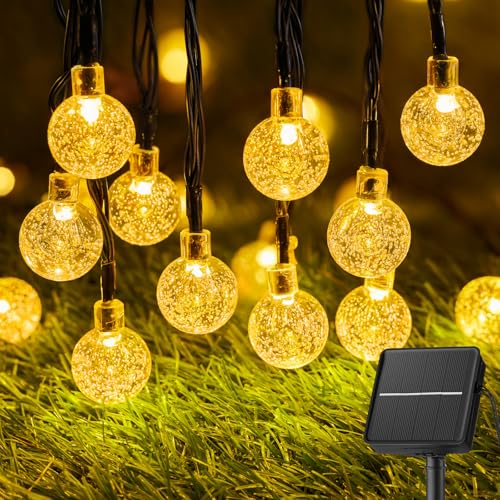
Brightown Solar String Lights
The Brightown Solar String Lights is a solar-powered string in the entry tier, charging from a small panel by day and removing the need for an outdoor socket near the run. In daily use the appeal is consistency: the light colour stays even from bulb to bulb, the cord hangs in a clean catenary when it is properly supported, and the whole run behaves like one fixture rather than a tangle of separate lamps. Treat it as infrastructure for the space rather than decoration you drape and forget, and it will reward you with the calm, even glow that makes people linger outside after dinner.
Installation follows the same discipline as every pick in this guide. Measure the run first, fix your anchor points, and string a steel guide wire between them on any long span, clipping the light cord to the wire so the wire carries the weight and the wind load. Never let a sagging cord rest against a roof edge, gutter, timber beam or fabric canopy, and never allow slack loops to touch anything flammable. Power the run only from an outdoor-rated socket protected by a GFCI, keep every connection off the ground and out of puddles, and if a bulb breaks, switch off, let it cool, and replace it with exactly the same bulb type and fitting the maker specifies rather than whatever happens to be in a drawer.
Best for: Fence lines, trees and garden corners far from any socket, where running mains power would be impractical. Not suited for: Deeply shaded patios or north-facing balconies with little direct sun, where a solar panel cannot charge reliably through the day. For a low-commitment trial of the whole idea, a solar string on a fence or tree is the gentlest first step: no socket, no wiring, and a clear answer within a fortnight about whether your household actually sits out more.
On price, treat this model by tier rather than by a fixed figure, because listings change often. Check price on Amazon on the day you buy, confirm the listing still matches the bulb type, cord length and power source described here, and confirm the outdoor rating is stated for the exact version in your basket before you check out.
Brightech Ambience Pro
The Brightech Ambience Pro is a commercial-feel plug-in string with heavy-gauge cord and vintage-style exposed bulbs, positioned in the premium tier for permanent patio installations. In daily use the appeal is consistency: the light colour stays even from bulb to bulb, the cord hangs in a clean catenary when it is properly supported, and the whole run behaves like one fixture rather than a tangle of separate lamps. Treat it as infrastructure for the space rather than decoration you drape and forget, and it will reward you with the calm, even glow that makes people linger outside after dinner.
Installation follows the same discipline as every pick in this guide. Measure the run first, fix your anchor points, and string a steel guide wire between them on any long span, clipping the light cord to the wire so the wire carries the weight and the wind load. Never let a sagging cord rest against a roof edge, gutter, timber beam or fabric canopy, and never allow slack loops to touch anything flammable. Power the run only from an outdoor-rated socket protected by a GFCI, keep every connection off the ground and out of puddles, and if a bulb breaks, switch off, let it cool, and replace it with exactly the same bulb type and fitting the maker specifies rather than whatever happens to be in a drawer.
Best for: Homeowners who want one long, durable run over a main patio or pergola and plan to leave it up through the seasons. Not suited for: Renters or anyone who needs to take lights down weekly, because the heavier cord and permanent mounting hardware reward a set-and-forget install. At the other end of commitment, a permanent-grade plug-in string is the choice once you already know the space earns it, because the heavier build is designed to stay up and be enjoyed rather than be repeatedly handled.
On price, treat this model by tier rather than by a fixed figure, because listings change often. Check price on Amazon on the day you buy, confirm the listing still matches the bulb type, cord length and power source described here, and confirm the outdoor rating is stated for the exact version in your basket before you check out.
How to Get the Most Value If You Buy
Buy for the space you measured, not the space in the photograph. Measure every span, count the anchor points, and choose lengths that fit with a natural swag rather than forcing a too-short string tight or bunching a too-long one. Fit the guide wire first on long spans and clip the cord to it. Keep the whole run clear of roofs, heat and fabric, power it from a protected outdoor socket, and put it on a timer so it is used on ordinary evenings, not just occasions. Use is value; a timer quietly guarantees use.
Maintain the value with tiny habits. Glance at the run when you are out there anyway. After a storm, check clips and clearance before you switch on. Replace a failed bulb promptly with the exact specified type, because one wrong bulb in a dimmed or sealed socket causes more trouble than the small delay of ordering the right one. At season’s end, decide honestly whether your climate and the maker’s guidance favour leaving the run up or storing it, then coil it loosely if it comes down. None of this takes long. All of it is the difference between a three-season novelty and a fixture that serves for years. Compare ownership impressions across models in outdoor string lights reviews.
The Decision Checklist
- Do we sit outside after dark at least twice a week in season?
- Are there two sound anchor points for every span we plan?
- Can every span be supported on a guide wire where it is long?
- Is there a GFCI-protected outdoor socket within sensible reach, or enough direct sun for solar?
- Can the whole run stay clear of roofs, heat sources and flammable material?
- Will someone in this household do a short check each season and after storms?
- Have we budgeted for wire, clips, hooks and a timer as well as the lights?
Four or more honest yes answers, including the anchor and power questions, means outdoor string lights are very likely worth it for your home. Fewer than that does not mean never; it means fix the missing piece first, whether that is a post, a socket or simply a season of noticing how often you truly sit out. For wider patio context while you decide, see best outdoor string lights, best outdoor chairs for patio and best outdoor lights for planters.
A Season-by-Season Look at the Value
Spring is when the purchase proves itself fastest. The first warm evenings arrive, the run goes up or is switched back on after its winter check, and the household rediscovers the patio weeks before it would naturally have drifted outside. That early-season dividend repeats every year, and owners who keep rough count are often surprised by it: the lights do not merely improve evenings that would have happened anyway, they create evenings in the shoulder weeks that would otherwise have been spent indoors. Value measured in created evenings is the strongest form of the case, and spring is where it is most visible.
Summer is the peak dividend and the peak test. The run works nightly, hosts parties, and takes the weather as it comes, heat, sudden rain and the odd violent storm. A string bought well and hung properly passes the summer almost invisibly, needing a glance after storms and nothing more. A string bought cheaply against a permanent job announces its mismatch in the same weeks, with sagging spans, failed bulbs and a general air of fatigue by August. The season does not create the difference between grades; it reveals it, which is why this guide keeps returning to matching grade to duty before the summer rather than after it.
Autumn is the connoisseur’s season for string lights, and for many households the most valuable of all. The evenings draw in early enough that the lights earn their keep on weeknights, the air is cool enough to sit out with a jumper and a warm drink, and the garden takes on the amber, enclosed feeling that made the category famous. If your household loves autumn evenings, weight that heavily in the decision, because a product that transforms your favourite season is worth more to you than the same product is to a household that retreats indoors in September.
Winter is the honest reckoning. In mild climates a permanent run simply continues, lit for the dark afternoons and the occasional clear, cold evening, and inspected after storms. In harsh climates the reckoning is a decision: leave a robust run up and accept accelerated ageing, or take it down, coil it loosely, store it dry, and give it a genuine rest. Neither answer is a failure of the product. What winter punishes is indecision, the run left up by default in conditions its owner never chose for it. Households that make the winter decision deliberately, either way, report the longest-lived strings.
What Owners Talk About After a Year
Talk to owners a year in and a pattern emerges that no listing page captures. Almost nobody talks about the bulbs. They talk about the evenings: the birthday that stayed outside until midnight, the neighbour who now pops round, the teenager who does homework at the garden table in May. The lights have dissolved into the life they enabled, which is the signature of a purchase that was worth it. When owners do mention the hardware, it is usually to say they wish they had hung it more carefully the first time, or that they would buy the heavier grade if they were starting again. Regret, in this category, runs almost entirely toward under-buying and under-installing, rarely toward the purchase itself.
The dissatisfied minority tells an equally consistent story, and it is worth hearing plainly. The solar string bought for a shaded patio. The decorative set left up through a winter it was never built for. The span stretched tight without a wire, sagging a little more each month until the whole thing came down in a tangle. In nearly every case the product performed as its nature dictated and the match was wrong from the start. That is genuinely good news for a careful buyer, because matches can be chosen. Read the failure stories as a checklist of matches to avoid, and the category becomes one of the safest bets in the garden.
Renting, Moving and Other Real-Life Complications
Renters ask whether the whole idea is closed to them, and it is not, with care. Removable hooks on your own furniture and structures, runs along balcony rails, and solar strings in sunny spots can transform a rented outdoor space without a single permanent fixing, provided the tenancy rules are respected and nothing is attached to the building in ways the agreement forbids. The value case for renters is arguably stronger than for owners, because the alternative, wired lighting, is usually closed to them entirely, while a string can be installed in an afternoon and taken away in a box at the end of the tenancy.
Movers should think of string lights as furniture rather than fixtures. A run sized for a generous patio can be re-zoned for a smaller garden, split across two areas, or stored until the right space appears, and a household that has learned the installation craft once carries the skill to every future home. That portability quietly improves the worth calculation, because the purchase is not stranded if life changes. Few lighting investments can say the same, and it is one more reason the category suits younger households and anyone whose next move is a matter of when, not if.
The Environmental and Neighbourliness Angle
A brief word on being a good neighbour with light, because worth is not only private. Warm, low-level string lighting is among the least intrusive forms of outdoor lighting ever devised, especially on a timer that retires when you do. It spills little, glares at nobody, and leaves the sky above it largely dark, unlike the bright security fittings that floodlight three gardens at once. Keeping runs within your own boundaries, aimed at your own gathering space, and switched off when the evening ends is both courteous and, in many places, increasingly expected. A purchase that delights its owners and never annoys the street is worth more than the same purchase with a grievance attached.
The same restraint serves wildlife and the household’s own sleep. Timers matter more than any specification here: light that exists for the evening and then stops is ambience, while light that burns until dawn is pollution with a prettier face. Build the timer into the plan from the start, and the worth of the whole installation rises, because nothing about it needs apologising for.
The Cost-Per-Evening Test
Here is a simple test that cuts through every other argument in this guide. Count, honestly, the evenings your household spent outside after dark last season. Not the evenings you intended to spend, and not the ones the weather stole, but the real number, the dinners, the drinks, the half hours with a book. Now imagine the same season with the space lit warmly and reliably, and ask how many evenings that number plausibly gains. Owners consistently find the gain is not small, because darkness, not inclination, was ending most of those evenings. If the honest gain is a dozen evenings or more, the purchase passes the only value test that matters, because a dozen transformed evenings is a great deal of life to buy with one afternoon of installation and a string of bulbs.
Run the same test in reverse for the skip case, because it is equally clarifying. If the honest count is two barbecues and a birthday, the gain from lighting might be one extra hour on each, and the same money spent on the room where those evenings actually migrate to, the kitchen, the sitting room, will return ten times the life. The test has no stake in your answer. It simply refuses to let a photograph do the counting, and households that let real evenings do the counting almost never regret the decision, in either direction.
There is a refinement worth adding for households on the borderline, and it is the trial. A single, modest, removable run, hung for one month of the season over the space in question, converts speculation into evidence at very little cost. If the trial run gathers dust, metaphorically, while the household stays in, the answer is no, learned cheaply, and the string can be gifted, stored or moved to a fence where it will be admired if not sat under. If the trial run is switched on nightly and the patio fills, the answer is yes, learned certainly, and the permanent upgrade that follows is bought with the confidence that only evidence gives. Few home purchases offer so clean a trial. Use it.
One Last Distinction: Decorating Versus Dwelling
Underneath every argument in this guide sits a single distinction, and naming it plainly may be the most useful thing this article does. Some purchases decorate a home, and some purchases change how a home is dwelled in. String lights are constantly bought as the first and constantly valued as the second. Bought as decoration, they are judged by a photograph and found, within a season, to be a maintenance obligation with bulbs. Bought as dwelling, measured against evenings, anchors, sun and sockets, they are judged by a life and found, within a week, to be infrastructure. The product is identical in both cases. The buyer’s question is different, and the question is the purchase. Ask whether you will dwell under them, answer honestly, and the worth of outdoor string lights stops being a debate at all.
If You Only Remember One Thing
Remember the evenings test, because every other consideration in this guide is a servant to it. Anchors can be installed, sockets can be fitted, sun can be audited and grades can be chosen, but none of it matters if the household does not sit outside, and all of it matters enormously if it does. Count your real evenings, imagine them lit, and let that honest arithmetic make the decision. It is the same arithmetic the delighted owners in this category made, usually without knowing they were making it, and it is available to you now, before the purchase, which is exactly when it is worth the most.
The Earn-Its-Place Test: When a Outdoor String Lights Repays the Space It Takes
Worth-it questions about a outdoor string lights are really questions about frequency, so start by honestly counting how often the job it does actually arises in your household in a normal month, not in the motivated week when you decided to shop for one. Multiply that frequency by the friction it removes each time — minutes saved, mess avoided, a workaround retired, a room made usable for longer each day — and the value of a outdoor string lights stops being a feeling and becomes a rough but usable number. Photograph your setup once the outdoor string lights is working well — the position, settings, arrangement or layout you settled on — so that after a move, a deep clean or a seasonal break you can recreate the arrangement that worked instead of rediscovering it. Share the checklist result with anyone who shares the space, since a outdoor string lights chosen by one person and resented by another rarely survives, however sensible the purchase looked on paper.
The deciding experiment is to live one ordinary week noticing every moment the outdoor string lights would have been used, marking each one down, because a week of real tally marks settles the worth-it question better than another evening of comparison shopping. When something about the outdoor string lights disappoints, change one variable at a time — position, setting, timing, load, accessory or technique — and give the change a fair trial, because changing three things at once leaves you with a better or worse result and no idea why. Then subtract the standing costs honestly: the floor, shelf, cupboard or counter space a outdoor string lights occupies every day, the cleaning and upkeep it asks for, and the small accessories or consumables its ownership quietly requires. Seasonal thinking helps more than expected: a outdoor string lights bought in one season will meet different light, humidity, mud, heat, guests and routines in another, so judge its size, storage and upkeep against the hardest season it will face.
Look at replacement parts and consumables for the outdoor string lights while you are still comparing, confirming that the pieces most likely to wear, clog, tear, fade or get lost can actually be obtained without replacing the whole product. Measure before anything else, and measure the outdoor string lights in its working state rather than its packed or folded state, because handles extend, lids open, cords trail, doors swing and users stand somewhere, and all of that belongs in the measurement. Keep a short note of what you adjusted on the outdoor string lights during the first month, even just a line on your phone, since those notes turn vague impressions into a setup you can repeat, share or troubleshoot months later. Check the floor, wall, ground or surface the outdoor string lights will meet, since level, texture, moisture and finish decide more about everyday performance in patio & outdoor living settings than most shoppers expect when they are comparing listings on a screen.
Plan the storage home for the outdoor string lights before it arrives, naming the exact cupboard, corner, shelf, hook or stretch of floor, because a product without a home migrates around the house and slowly becomes the clutter it was bought to reduce. Think about who else will use the outdoor string lights and what they will do differently: shorter reach, less patience, stronger habits, no interest in the manual, and a tendency to leave things wherever they were last set down. Watch for edge cases in your own home: the pet that investigates everything, the child who treats every new object as furniture, the guest who uses force where you use familiarity, and the weather, light or season that changes how a outdoor string lights behaves. If you want a concrete listing check, take a name already shortlisted in this guide, such as Brightown Solar String Lights and Brightech Ambience Pro, and verify that exact outdoor string lights listing against the measurements and compatibility questions above, field by field, rather than trusting the headline description alone.
If a problem with the outdoor string lights repeats in the same spot or the same stage of the job, treat the pattern as the clue — patterns point to setup, surface or technique, while random problems point more often to the individual unit.
Frequently Asked Questions
Are outdoor string lights worth it for a small balcony?
Usually yes, and often more clearly than for a large garden, because one short run transforms the whole of a small space rather than a fraction of it. Spans are short, anchors are close and a single string is enough, so both cost and effort stay low. Use removable fixings if you rent, keep the cord clear of any fabric shade, and choose solar only if the balcony receives real direct sun for a good part of the day. A shaded balcony is better served by a short plug-in run to a protected socket.
How long do outdoor string lights realistically last?
It depends far more on installation and exposure than on the badge on the box. A well-supported run, kept clear of chafe points and heat, powered correctly and checked each season, should serve for years. A run stretched tight on its own cord, swinging against a roof edge or left tangled through winter storms, can look tired within a season. Commercial-style strings with robust cords and replaceable bulbs generally outlast delicate decorative sets, which is why matching the grade of string to permanent or occasional use matters so much.
Are solar string lights worth it compared with plug-in?
Solar is worth it where there is no socket and plenty of sun: fence lines, trees, sheds and far corners. It is not a like-for-like substitute on a main patio, where plug-in power gives brighter, longer and more predictable light for cooking and dining. Many households end up with both, plug-in overhead where they gather and solar marking the edges. Judge solar by the sun your actual space receives across a whole day, not by the brightest hour, and site the panel in the sunniest spot the lead allows.
Can outdoor string lights stay up all year?
Many can, provided they are rated for outdoor use, properly supported and kept clear of anything they could chafe against or overheat. Severe climates change the calculation: ice load, heavy wet snow and repeated violent storms shorten any string’s life, and taking a run down for the worst months is cheap insurance. Follow the maker’s guidance for your model, inspect after storms either way, and never leave up a run that has developed damaged cord or cracked sockets just because removing it is inconvenient.
What is the safest way to power outdoor string lights?
Use an outdoor-rated socket protected by a GFCI, keep plugs and connectors raised off the ground and out of standing water, and never trap the cord in a window or door. Support long spans on a guide wire so the electrical cord carries no tension, keep bulbs and cord clear of roofs, heaters, fire pits and flammable fabrics, and replace any broken bulb with exactly the type the manufacturer specifies. If a protective device trips repeatedly, unplug and investigate rather than resetting and hoping.
Do string lights use much electricity?
Modern LED strings sip power compared with the incandescent festoon lighting of the past, and even traditional-style bulbs in a single residential run are a modest load beside heating or cooking appliances. The bigger cost question is never the running cost; it is whether the lights get used. A timer that brings the run on for the evening hours you actually spend outside keeps even that small cost purposeful. Check the listing for the draw of the specific model you choose, and stay within the maker’s limit for linking strands end to end.