Disclosure: As an Amazon Associate, dailyhomedecorating.com earns from qualifying purchases. Links on this page are affiliate links; they cost you nothing extra. Prices and availability change often, so check the current Amazon listing before you buy.
Every furniture category sells its strengths and whispers its weaknesses, and media console pros and cons deserve a louder whisper than most — because this is a wide, heavy, layout-defining purchase that houses hot electronics beneath a large screen in the room where your household relaxes and your children play. This article argues both sides at full strength: seven genuine pros, seven honest cons, what the trade-offs mean for different households, and the setup habits that shrink the cons once you own the piece. If you finish it still wanting a console, you will want one with your eyes open, which is the only way furniture should ever be bought.
Key Takeaways
- The headline pro is order: one anchored, cable-managed home for the entire viewing system and its overflow.
- The headline con is commitment: a wide footprint, a fixed layout and a heavy move, every time life changes.
- Safety runs through both columns — a console installed with anchoring is a hazard removed; a console merely placed is a hazard furnished.
- Heat is the manageable con: open placement for hot components turns the biggest technical weakness into a planning detail.
- Verdict: the pros win for multi-device and family households; the cons win for minimalists and short-term renters.
Quick verdict. A media console suits households whose viewing system has outgrown a bare stand — multiple devices, visible clutter, children or pets in the room, a TV wall that matters to the home’s look. It does not suit the wall-mount-and-soundbar minimalist, the short-term renter, or the household that rearranges rooms for pleasure. Everything below is the evidence for that verdict, argued fairly. For the value framing of the same evidence, see is a media console worth it.
In this guide
Media Console Pros And Cons: The Pros
Pro 1: It Ends the Technology Spill
The strongest pro is also the most ordinary: everything gets a home. Devices, remotes, chargers, cases, headsets and the power strip stop colonizing the floor and the coffee table and take up residence in one footprint designed for them. The effect on a room is disproportionate to the furniture — visitors routinely describe a consoled TV wall as calmer, tidier, more finished, without being able to name why. The why is that a dozen small visual arguments have been closed behind doors and drawers. No other single purchase in the living room buys this much visible order this directly.
Pro 2: It Presents the Television Properly
Consoles are dimensioned around screens in a way general furniture is not. The width relates to the display, the height targets seated eye level, the top is built and rated for the load. The result is viewing comfort — a neck-neutral picture for hours — and visual grounding, the sense that the screen belongs to the room rather than hovering in it. Even wall-mounted setups benefit: the console beneath supplies the composition’s base and the soundbar’s stage. Households upgrading from a too-tall dresser or a too-narrow table consistently report that the same television looks and feels better, because furniture geometry was the problem all along.
Pro 3: It Is the Safety Platform for the TV Wall
A wide, low, load-rated console that is anchored to the wall, carrying a television that is fully supported and itself secured, is the standard domestic answer to a real hazard: televisions and loaded furniture tipping onto children. The console’s mass sits low, its storage loads heaviest at the bottom, and its straps tie the whole arrangement to the building. Compare the alternatives — a narrow stand, a lightweight table, a dresser never designed for a screen — and the console’s safety case is not a bonus feature but a category-defining pro. The condition, stated once here and everywhere in this series: the safety exists only when the anchoring is actually done.
Pro 4: It Manages Cables as a System
Rear cutouts, defined power-strip homes and internal routing turn cable management from an annual excavation into a maintained system. Cords drop where they should, run in one bundle, stay out of walkways and away from vacuum cleaners and small hands. Upgrades become swaps instead of archaeology. There is a quiet reliability dividend too: connections stop working loose, lightweight boxes stop being dragged by their own leads, and when something does fail, a labeled, photographed, orderly rear is a ten-minute diagnosis instead of an afternoon on the floor with a flashlight.
Pro 5: It Stores Far More Than Electronics
The console is secretly general living-room storage wearing a media name. Board games, blankets, photo albums, spare cushions, the good candles, the children’s art supplies that live downstairs — all of it fits the drawers and cabinets that flank the gear bays, in the room where those things are actually used. Households that count this honestly often find the console replaces a second piece of storage furniture entirely, which reframes its footprint and its tier: it is not competing with a bare stand, it is competing with a stand plus a cabinet plus a basket system. Judged on that combined job, it frequently wins on both space and looks.
Pro 6: It Sets the Room’s Style Anchor
The TV wall is the largest visual field in most living rooms, and the console is its foundation. A farmhouse piece warms the room, a mid-century piece lines it, a solid-wood credenza gives it gravity — and every other choice, from coffee table to shelving, can harmonize against that anchor. This is a pro with practical teeth: rooms with a clear anchor are easier to finish, easier to keep coherent through small purchases, and more satisfying to live in. The console does decorative work no stand attempts, while doing all of the stand’s work as well.
Pro 7: It Adapts Across Television Upgrades
Bought slightly wide and sensibly deep, a console outlives the television it was bought for. Screens are replaced on a shorter cycle than furniture, and a console with margin absorbs the next size up, the added soundbar, the new games console generation. The storage logic — open for hot, closed for messy, drawered for small — survives every technology shuffle, because it is based on the physics of heat and clutter rather than the fashion of ports. Longevity is the quiet pro that turns a furniture purchase into infrastructure.
Media Console Pros And Cons: The Cons
Con 1: It Claims a Wide Footprint, Permanently
The first con is spatial honesty: a media console is a wide, deep object that takes the best wall in the room and keeps it. In small homes that footprint is seating not bought, play space not available, air not felt. The piece also fixes the room’s geometry around itself — sofa opposite, chairs angled, walkways routed — and households that love rearranging will feel the constraint every season. There is no clever fix; there is only measuring honestly before purchase and choosing the lowest, least deep profile your gear genuinely allows.
Con 2: Heat and Closed Doors Are Natural Enemies
The console’s prettiest feature — everything hidden — is its most technical weakness. AV receivers and games consoles are heaters that need exhaust, and a closed cabinet is an oven with good joinery. Owners take on a permanent duty: hot components in open or vented positions, doors opened for long sessions where needed, vents dusted, bays checked by hand after films. Ignore the duty and the equipment ages early or shuts down mid-use. The con is manageable — this entire series treats ventilation as a buying filter — but it never disappears, and buyers who want to close a door and forget their gear should choose open designs or another category.
Con 3: Assembly and Moving Are Real Work
Most consoles arrive as a heavy flat pack of panels, and the honest build is an afternoon with a second person, a cleared floor and patience for instructions. Solid-wood pieces skip the assembly and double down on the other half of the con: sheer mass, moved by two people with a plan, never dragged, never solo-lifted. Renters and frequent movers feel this con at full strength — a console is the piece most likely to be sold with the apartment or abandoned to the next tenant, not from dislike but from logistics.
Con 4: It Can Be Too Much Furniture for a Simple Setup
A wall-mounted screen, a soundbar and a streaming stick are a complete system with almost nothing to store. Under that setup, a console is an empty cabinet collecting dust on its top surface — furniture in search of a job. The category’s strengths are answers to problems this household does not have. The honest advice for minimal setups is a floating shelf or nothing, with the budget redirected to seating and light, and this article’s pros should be read as conditional: they activate with device count and clutter, not with the mere presence of a television.
Con 5: The Top Surface Is a Dust and Clutter Magnet
A broad, flat surface at the room’s focal point collects what broad flat surfaces collect: dust, visibly and quickly under a static-prone screen, plus the daily drift of mail, mugs, toys and keys if the household lets it. The console creates the room’s most tempting horizontal surface and then asks you to keep it clear for the composition to work. Most owners settle into a weekly wipe and a mostly-clear rule, but fastidious households should count this con honestly — the tidier the room’s promise, the more visible every lapse on that surface becomes.
Con 6: Quality Varies Enormously at the Same Looking Tier
Two consoles with near-identical listing photographs can differ wildly in panel density, hardware quality, joint design and finish durability. The category’s flat-pack mainstream rewards buyers who check construction details — and punishes those who shop by thumbnail. Wobble, sagging long shelves under center loads and peeling edge banding are the classic disappointments, all invisible at purchase. This con is really a warning about variance: the category contains decade furniture and two-year furniture at overlapping tiers, and the buying discipline in media console buying guide exists to sort them.
Con 7: It Anchors You to One Wall and One Layout
Beyond footprint, the console commits the room. The cable point, the anchored wall, the screen position and the seating geometry align around it, and changing the room’s orientation later means re-doing all of it. Households mid-renovation, expecting to move the viewing wall, or planning a near-term extension should delay the console until the architecture settles. Bought into an unsettled room, even a perfect console becomes an obstacle the future layout must negotiate around.
What the Trade-Offs Mean for You
Families with young children should weight Pro 3 and Pro 5 heaviest and Con 2 lightest: the anchored safety platform and the containment of fascinating gear behind doors are worth more than the ventilation duty costs, provided the rules hold — anchored console, secured TV, no climbing, one drawer at a time. Gamers and cinema households should weight Con 2 heaviest and shop it away with open or hybrid designs, gaining Pro 1 and Pro 4 in full. Minimalists should read Con 4 as the verdict and stop shopping. Settled, style-led households gain Pro 6 and Pro 7 at full value and feel the cons least, because their rooms are not changing anyway — the pattern visible across best sofas for homes with kids and the game-night households behind best coffee tables for board games alike.
How It Compares with the Alternatives
Against a plain TV stand, the console trades lightness and easy moving for storage, cable system and safety platform — the full fair fight is in the vs comparison in this series. Against a floating wall shelf, the console trades the clear floor and architectural look for real storage and a forgiving relationship with heavy screens. Against a repurposed sideboard, the console trades found-furniture charm for correct height, vented design and media-specific routing. None of the alternatives is foolish; each is the right answer for a particular household, and the table in words is simply this: storage and safety point to the console, lightness and minimalism point away from it.
How to Buy Smart
Convert the cons into checks. Footprint: tape the console’s outline on your floor and live with it for a day before ordering. Heat: decide each hot component’s open home while you shop, not after delivery. Assembly and moving: confirm the delivery route measurements and line up your second person in advance. Variance: favor makers who publish construction details and load ratings, weigh the piece’s stated mass as a quality clue, and read the deep assessment in media console review for how the class behaves over time. Layout: only buy into a settled room. And buy the anchor hardware plan with the piece — straps fitted on day one, television secured, heavy storage loaded low.
Setup and Care That Reduce the Cons
Nearly every con shrinks under good setup. Ventilation: hottest gear in the most open bay, rear panels removed where the design allows, a hand-check for heat after the first long film. Dust: a microfiber cloth living in the console’s own drawer, a weekly top wipe folded into an existing routine. Clutter: a household rule that the top surface holds the soundbar, one plant and nothing else — rules beat intentions. Safety and longevity: straps checked yearly, tracks and runners dusted, spills wiped at once, coasters as habit. The methodical version of this setup lives in how to choose a media console, and the shelving overflow valve, when the console fills, is best bookshelves.
Bottom Line
The pros are structural — order, presentation, safety, storage, style, longevity. The cons are circumstantial — footprint, heat duty, moving effort, commitment — and circumstances can be measured before you buy. That asymmetry is why the category keeps winning households that do the measuring and keeps disappointing households that buy the photograph. Do the measuring, fit the anchors, mind the heat, and the balance lands where this article’s verdict put it: firmly in favor, for the households the category was built for.
The Picks Behind the Arguments
Pros and cons stay honest when they are attached to real furniture. The four lines below are the examples this article’s arguments have been silently using — enclosed, flexible, premium and practical — presented in prose only while their listings await verification. Each carries the category’s balance in a different proportion, which is exactly the point.

Walker Edison Modern Farmhouse TV Stand — mid-tier character pick
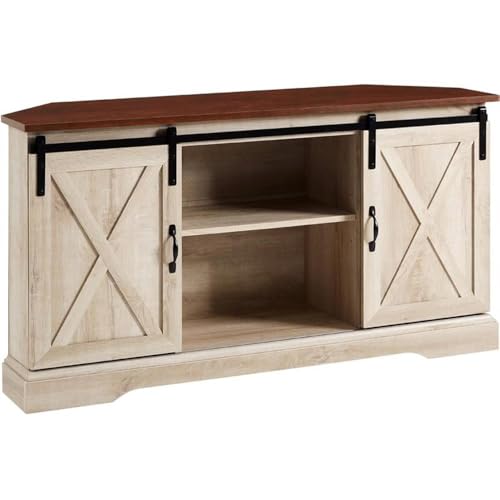
The enclosed-storage example in this article: grooved barn-style doors and cabinets that make clutter vanish. Its pros and cons are the category’s in miniature — wonderful hiding, deliberate ventilation required.
Best for: Rooms wanting enclosed, personality-led storage for a mainstream setup.
Not suited for: Heat-heavy cinema builds needing fully open bays.
WE Furniture Sliding Door TV Stand — mid-tier flexible pick
The flexible-access example: doors that glide rather than swing, a low wide stance, a daily choice of what shows. Its trade-offs are tracks to dust and shelved rather than drawered storage.
Best for: Modern rooms and wall-mounted screens where flexible access matters.
Not suited for: Households needing drawers, and toddler homes where sliding doors invite play.
Simpli Home Warmington TV Media Stand — premium solid-wood pick
The longevity example: solid timber that can be repaired and refinished, in furniture proportion. Its cons are the premium cons of the category — mass, commitment and tier.
Best for: Settled rooms buying for a decade, where repairability counts.
Not suited for: Frequent movers; its weight anchors moving day too.
Bush Furniture Salinas TV Stand — entry-to-mid practical pick
The value example: divided storage and forgiving finishes at the tier where the pros most clearly outnumber the cons for ordinary use.
Best for: First-console households and hard-working family rooms.
Not suited for: Statement seekers and deep-gear cinema builds.
The Environmental and Longevity Ledger
A pros-and-cons account that ignores lifespan is incomplete, because furniture’s costs and benefits both compound over time. On the pro side, a console is among the most durable purchases in a home: it has no upholstery to wear, no mechanism to fail beyond hinges and runners, and a role that survives every technology cycle, since heat and clutter are permanent even when ports are not. A solid-wood console is effectively permanent furniture — repairable, refinishable, hand-downable — and even a well-kept flat-pack piece serves far longer than the electronics it houses. Longevity is the quiet multiplier on every pro in this article.
On the con side, the same permanence becomes disposal weight when a household buys carelessly: a wide console that disappoints is a wide console that must be moved, sold or landfilled, and flat-pack construction at the lowest quality levels is notoriously hard to rehome or recycle. The environmental reading and the personal reading converge on the same advice this article has given throughout: buy once, buy by measurement, buy construction over photograph. The greenest console is the one that is never replaced, and the cheapest too — the two ledgers agree more often than shoppers expect.
Accessibility and Aging-in-Place: A Pro and Con Nobody Lists
Here is a dimension the listings never mention and households eventually do. On the pro side, a console puts the entire system at reachable, seated-friendly heights: remotes and media in drawers that open toward a seated person, controls on devices at a level that does not demand floor-level crouching, cables managed so that no one — including an older adult with a vacuum or a grandchild on a visit — trips across a dark room. A wide, stable, anchored piece is also, frankly, furniture that does not wobble when a hand leans on it, and that steadiness is a household safety property well beyond the tip-over question.
On the con side, the lowest shelves and deepest cabinets ask for kneeling and reaching that aging knees and backs negotiate poorly, and heavy flat-pack assembly is genuinely exclusionary work for a single older buyer. The balanced reading: households furnishing for the long term should weight drawer-forward designs, mid-height storage and professional assembly help into their pros column planning, rather than discovering the ergonomics a decade in. It is a small section in this article and, for the households it concerns, one of the most useful — which is rather the definition of an honest cons list.
Renters, Landlords and the Anchoring Negotiation
The pros-and-cons balance shifts in rented homes in one specific way worth isolating: the category’s greatest pro — the anchored safety platform — depends on wall fixings that a lease may restrict. That does not move anchoring into the cons column; it moves the conversation earlier. Most landlords, approached openly about child-safety strapping with small, fillable fixings, approve it, because the alternative is an unanchored television in their property. Where approval is genuinely impossible, the honest cons grow teeth: choose the widest, lowest piece, load it low, strap the television to the console itself as its maker directs, and keep climbing access physically away — while recording, in the household’s own ledger, that the safety pro has been partially spent and should be fully bought at the next home.
Renters should also weigh a con the settled rarely feel: the exit cost. A console’s departure from a rental is a logistics event — a second pair of hands, a vehicle that fits it, a buyer or a new wall measured in advance. None of this forbids the purchase; all of it belongs in the balance before the purchase, which is where this article has insisted every con belongs. A con discovered at delivery is a grievance; a con priced in at decision is a choice, and households are entitled to make either with their eyes open.
Scoring the Balance for Your Household
Close the argument with arithmetic of your own, because pros and cons only become a decision when a household weights them. Give each pro and con in this article a personal weight — decisive, relevant or irrelevant — based on your device count, your children, your room’s horizon, your heat load and your moving history. Most households find that two or three items carry nearly all the weight: for families, safety and containment; for gamers, heat and drawers; for minimalists, the single con of furniture without a job; for the settled and style-led, presentation and longevity. When the heavily weighted items line up on one side, the long tail of small items on the other side is noise, and the decision is already made.
If the heavy items genuinely split — say, a family household in a one-year rental with a hot cinema habit — the split itself is the answer’s shape: buy at an entry tier, in an open-leaning design, with the least invasive approved anchoring, and treat the piece as a bridge to the settled purchase. Compromise purchases fail when they pretend to be final; they succeed when they are designed as bridges. That is the last refinement this balance sheet offers: not just which side wins, but what the winning purchase should look like when both sides scored.
The Guest Test and the Photograph Test
Two informal tests expose pros and cons that specifications hide. The guest test: a visitor entering your living room for the first time reads the TV wall in three seconds, and what they read is either furniture or equipment. The console passes this test by design — doors closed, system vanished, a composed wall with a screen in it — and the passing is a real, recurring social pleasure that owners mention with surprising warmth. The stand and the exposed setup fail it in proportion to their device count, not their quality. Households that entertain, that host family holidays, that simply enjoy being thought of as people whose homes are calm, should log the guest test as a genuine pro rather than a vanity.
The photograph test is the guest test’s stricter sibling: the console is the piece of furniture most likely to appear in your family’s photographs for a decade, as the backdrop to birthdays, holidays and ordinary evenings on the sofa. In those photographs its pros compound — the tidy wall, the styled surface, the room looking like the family’s intentions — and its cons fossilize: the cluttered open shelf, the cable drape, the too-narrow piece under a wide screen, preserved at every celebration. No buyer should purchase for photographs; every buyer should know that furniture at the focal wall is purchased into them, and choose the backdrop their family’s archive deserves.
Noise: The Pro and Con That Arrives at Night
Consoles interact with sound in both directions, and the night reveals it. On the pro side, a well-chosen console quiets a system: components seated firmly on mass, doors that close without play, a back panel fitted tight — the furniture contributes silence, and in a quiet house at low volume that silence is part of the program’s quality. Enclosed cabinets even soften the small mechanical sounds of disc drives and fans for listeners seated nearby, a modest acoustic kindness that open furniture cannot offer.
On the con side, the same enclosure can become an instrument: a cabinet cavity that resonates under a subwoofer’s energy, a door that buzzes at one particular frequency in one particular soundtrack, a shelf that drums when a games console’s fans spin up under load and couple into the panel beneath them. These are not defects so much as acoustics asking to be managed — isolation pads under components, a felt strip on a door’s meeting edge, a cable moved off a sounding board — but they belong on the cons ledger because they arrive unannounced, at night, during the quiet scene, in households that were promised only the pros. The balanced buyer budgets an evening of rattle-hunting in the first week and, having hunted, usually retires the con permanently.
The Technology Churn Test
Furniture categories are usually judged against households; this one must also be judged against the velocity of the technology it houses, because few categories serve masters that change this fast. Screens grow, sources consolidate into sticks and then expand again into consoles, audio swings between soundbars and receivers and back. The console’s pro in this churn is its abstraction: it stores heat-producing boxes of roughly familiar shapes behind doors and in bays, a job description written in physics rather than ports, and physics is stable. A console bought in the soundbar era serves the receiver era without noticing the transition, provided its bays were honestly dimensioned.
The con is the mirror image: any console feature welded to a specific technology moment — a dock, a cutout pattern, a bay sized to one generation’s box — begins aging the day it is installed. The buying defense is to prefer consoles whose interiors are generic volume, adjustable shelving and honest clearance over consoles whose interiors are sculpted to a device list, and to treat every technology-specific feature as a small, dated loan against the furniture’s decade. Households that churn technology fastest should weight this con highest and buy the most abstract interior on their shortlist; households with stable systems can safely ignore it, which is itself a useful sorting.
Revisiting the Balance After a Year of Ownership
The fairest pros-and-cons article admits that its own ledger has a time dimension, so close with the revision owners actually make at the first anniversary. The pros that grow: storage, whose value compounds as the household’s overflow finds the console instead of the floor; presentation, which is re-earned at every gathering; and the safety platform, whose value is precisely that nothing happened — the straps unthought-about, the television unmoved, the children unharmed in the specific way the installation was built to prevent. The pros that shrink: the styling novelty, which fades into the room’s background hum, as all successful furniture should.
The cons that shrink: assembly and moving effort, which time converts from grievance to anecdote; the footprint, which the room’s life simply grows around. The cons that persist if unmanaged: dust on the top, heat behind the wrong door — the two standing duties, still asking their small weekly and seasonal tributes. And the con that, unmanaged, grows: none, if the duties are kept, which is the ledger’s final shape. A category whose pros compound, whose cons decay or hold at a light tax, and whose catastrophic failure modes are all preventable at installation — that is a category whose balance, for the households it fits, is not close. The closeness was only ever in the measuring, and the measuring was always yours to do.
One More Balance: Effort Now Versus Friction Forever
Underneath every itemized pro and con in this article sits a single exchange that may be the truest way to state the category’s balance: a media console concentrates effort at the beginning — measuring, assembling, anchoring, wiring, planning air — in exchange for removing friction from every evening that follows. A bare setup does the opposite, costing nothing at the beginning and taxing every evening a little: the hunted remote, the visible tangle, the door-less clutter, the unanchored unease nobody names. Households are not choosing between effort and no effort; they are choosing when to spend it, and at what exchange rate.
That framing explains the otherwise puzzling intensity of owners on both sides. Console owners defend a purchase whose costs they have already paid and whose dividends arrive nightly; stand households defend a lightness whose tax is too small, most evenings, to notice. Both are rational. The article’s work has been to make the exchange visible before it is chosen — because the one genuinely irrational outcome is choosing the nightly tax by accident, in a household that would happily have paid the afternoon. Measure, decide which currency your household prefers, and the pros and cons will have done their only real job.
The Balance, Restated for the Skimmer
For the reader who arrived at the end first, as readers do: the pros are order, presentation, safety, storage, style and longevity; the cons are footprint, heat duty, moving effort and commitment; the pros belong to households with systems, children and settled rooms; the cons belong to minimalists, movers and the undecided. The installation decides the safety, the measuring decides everything else, and the category rewards the households that do both with a decade of evenings that simply work. That is the whole balance, and the rest of this article — all of it — is the evidence.
What This Balance Sheet Cannot Decide for You
An honest pros-and-cons article ends by declaring its own limits, and they are three. It cannot weigh your household’s values: the family that prizes a calm, composed room and the family that prizes a light, changeable one are both right, and they will read this same ledger to opposite conclusions with this article’s blessing. It cannot price your horizon: a year and a decade are both legitimate plans, and the ledger’s items change weight between them more than any argument here can fix in advance. And it cannot install anything: the single largest variable in the entire balance — whether the safety pro is real or theoretical — is decided not in these pages but at your wall, with straps in hand, on installation day.
What the ledger can do, and has tried to do at full length, is ensure that whichever side your household lands on, it lands there with the real items counted: the heat and the hiding, the footprint and the calm, the afternoon of effort and the years of evenings. Pros and cons are not a verdict machine; they are a lamp. Carry it into the listings, the showroom and your own taped floor outline, and the decision it lights will be yours in the only sense that matters — informed, weighted, and owned. That is all any balance sheet has ever honestly offered, and it is enough.
The Neighbors’ Verdict: Noise Through the Wall
One stakeholder never appears in pros-and-cons accounts, and in apartments and terraced homes they vote nightly: the neighbors. On the pro side, a console is a considerate object — components seated on mass rather than on resonant floors, subwoofers more often placed deliberately, doors and drawers that close with furniture softness rather than equipment clatter, and a system whose cables and boxes are contained instead of sprawled toward the shared wall’s sockets. A well-installed console household is, measurably in the only currency that matters at midnight, a quieter neighbor than a floor-stacked system household.
On the con side, the console can become a sounding board against a party wall: a long cabinet coupled to the wall by its anchoring and its load can conduct bass energy with an enthusiasm no one ordered, and the subwoofer exiled to the console’s side may find the one floor spot that drums into next door. The mitigations are the familiar ones — isolation under speakers and subwoofer, the piece pulled a breath from the wall where the design allows, levels governed after dark — and they belong on the balance sheet because neighborliness, like safety, is a property of installations rather than purchases. Add it to the ledger: in attached homes, the console’s acoustic manners are a pro when managed and a con when ignored, which by now will surprise no reader of this article.
A Reader’s Shortcut Through the Ledger
For the reader weighing a decision tonight rather than studying one: count your devices, look at your children, glance at your lease or your settled floor plan, and feel — honestly — whether the cable spill behind your screen bothers you at the level of daily irritation or merely of principle. Devices above two, children in the room, a settled home and a spill that genuinely irks: the pros have already won, and your remaining work is measurement, not deliberation. Devices at one, no children, a short horizon and a spill you had not noticed until this article mentioned it: the cons have won just as cleanly, and your remaining work is a good stand, well anchored. The middle cases are the only ones that need the full ledger — and they have it, above, in full.
The Ledger’s Small Print
Every balance sheet has small print, and this one’s reads as follows. The pros assume a console honestly built and properly installed; the cons assume a household that has measured before buying. Swap those assumptions and the ledger inverts, which is not a flaw in the accounting but its central finding. Keep the assumptions, and the balance printed above is the balance your household will actually live with — which is all a pros-and-cons article, however long, can honestly promise anyone.
Closing Note
One consideration, small in the ledger and large in the living, deserves the article’s final paragraph: gratitude is a poor reason to keep furniture and a worse one to buy it, yet households routinely do both around this category — keeping the wrong console because it was a gift, buying the impressive one because guests are coming. The balance sheet in these pages recognizes no such currencies. It counts devices and drawers, heat and horizons, straps and square feet. Let the decision be made in those honest units, and let gifts and guests alike be answered with the same calm sentence: the room was measured, the choice was weighed, and the wall is exactly as the household intended it. Few purchases can say as much, on either side of any ledger.
Living With the Trade-Offs: A Week-by-Week Reality Check for a Media Console
A pros-and-cons list is a snapshot, but living with a media console is a film, and this section follows the trade-offs across the first weeks when novelty fades and routine takes over. In week one, most owners notice the headline advantage of a media console constantly, because every use is a comparison with whatever came before it, while the headline drawback feels minor simply because it is still new. If you want a concrete listing check, take a name already shortlisted in this guide, such as Walker Edison Modern Farmhouse TV Stand, WE Furniture Sliding Door TV Stand and Simpli Home Warmington TV Media Stand, and verify that exact media console listing against the measurements and compatibility questions above, field by field, rather than trusting the headline description alone. Plan the storage home for the media console before it arrives, naming the exact cupboard, corner, shelf, hook or stretch of floor, because a product without a home migrates around the house and slowly becomes the clutter it was bought to reduce.
Consider the cleaning rhythm honestly: a media console that needs attention after every use suits a household that enjoys small rituals, and frustrates a household that wants to finish a job and walk away, so match the upkeep to the temperament, not the intention. Watch for edge cases in your own home: the pet that investigates everything, the child who treats every new object as furniture, the guest who uses force where you use familiarity, and the weather, light or season that changes how a media console behaves. For troubleshooting, start with the boring causes first: power, water, fit, blockage, alignment, a full container, a loose connection or a setting changed by the last person who used the media console, because boring causes account for most apparent failures. By week three the pattern usually reverses: the advantage becomes invisible background, part of how the room or routine simply works now, while any recurring friction with the media console — a awkward reach, a fiddly clean, a storage squeeze — is the thing you feel on every single use.
Check the floor, wall, ground or surface the media console will meet, since level, texture, moisture and finish decide more about everyday performance in living room furniture settings than most shoppers expect when they are comparing listings on a screen. Test the media console in the first week under deliberately ordinary conditions rather than saving it for a special occasion, so that any problem surfaces while returning, exchanging or adjusting your setup is still simple. Photograph your setup once the media console is working well — the position, settings, arrangement or layout you settled on — so that after a move, a deep clean or a seasonal break you can recreate the arrangement that worked instead of rediscovering it. That reversal is the real test for a media console: ask whether the drawback you are weighing is a one-time cost, paid at setup or purchase, or a per-use cost that you will pay hundreds of times a year without ever getting used to it.
Read the manual’s warnings page for the media console even if you read nothing else, because that page is a compressed list of every way the product has ever been misused, and it tells you exactly which of your own habits needs adjusting. When something about the media console disappoints, change one variable at a time — position, setting, timing, load, accessory or technique — and give the change a fair trial, because changing three things at once leaves you with a better or worse result and no idea why. If you already own a media console, run the same week-by-week check backwards and note which drawback you have genuinely stopped noticing and which one still earns a small sigh, because that sigh is the most honest review you will ever read. If a problem with the media console repeats in the same spot or the same stage of the job, treat the pattern as the clue — patterns point to setup, surface or technique, while random problems point more often to the individual unit.
Share the checklist result with anyone who shares the space, since a media console chosen by one person and resented by another rarely survives, however sensible the purchase looked on paper. Keep a short note of what you adjusted on the media console during the first month, even just a line on your phone, since those notes turn vague impressions into a setup you can repeat, share or troubleshoot months later.
Frequently Asked Questions
What is the biggest disadvantage of a media console?
For most households, the footprint-and-commitment pairing: a wide, deep piece claims the best wall and fixes the room’s layout around the television, and moving it — or moving house with it — is a two-person project. The most technical disadvantage is heat management, since closed cabinets and hot electronics conflict by nature. Both disadvantages are knowable before purchase: tape the outline on the floor, and plan every hot component’s open home on paper. A disadvantage you have measured is a choice; one you discover at delivery is a grievance.
Are media consoles safe around children?
A properly installed media console is the safest mainstream furniture choice for a TV wall, and an improperly installed one is not safe at all — the installation is the difference. Anchor the console to the wall with the supplied straps or brackets, secure the television to the wall or console as directed, keep the screen fully supported, store heavy items low, and enforce no climbing on drawers or shelves with only one drawer open at a time. Follow that list and the console removes the tip-over hazard; skip it and the furniture merely rearranges the risk.
Do media consoles make electronics overheat?
Only when the electronics are sealed in. A receiver or games console in a closed, unvented cabinet will run hot, throttle or shut down; the same device in an open bay, behind mesh, or in a cabinet with an open back and clearance runs as its maker intended. The console category offers both arrangements, so overheating is a selection error, not a category flaw. Choose the layout around your hottest component, check the bay by hand after a long session, and treat a hot cabinet as a problem to fix that week, not a quirk to live with.
Is a media console better than a TV stand?
Better at storage, cable management, presentation and anchored safety; worse at lightness, moving and price of commitment. If your system is a television and nothing else, the stand’s simplicity is genuinely better. If your system includes devices, clutter, children or a room whose look matters, the console’s advantages compound daily. The honest answer is that ‘better’ belongs to households, not products — which is why this series stages the full head-to-head separately rather than pretending the question has one answer.
How long do media consoles last?
It depends on construction more than category. A solid-wood console, maintained and occasionally refinished, is decade-plus furniture that can outlast several televisions. A well-built veneered flat-pack piece serves many years when its joints are tight, its edges are treated gently and it is not moved often — moving is what ages flat-pack fastest. The practical buying clue is mass and hardware quality: heavier panels, metal runners and confident joinery predict longevity better than any finish name. Buy the construction, and the years follow.
Can I reduce the dust problem on top of a media console?
Partly, and the rest is routine. Keep the top surface mostly clear — every object is a dust outline waiting to happen — and choose a soundbar placement that leaves the surface wipeable in one pass. A microfiber cloth stored in the console itself turns the weekly wipe into a thirty-second habit, and a small bias light behind the television makes remaining dust less visible in the dark while softening screen contrast. You will never win the dust war on the room’s most static-friendly surface; you can make it a skirmish instead of a siege.


