Disclosure: As an Amazon Associate, dailyhomedecorating.com earns from qualifying purchases. Links on this page are affiliate links; they cost you nothing extra. Prices and availability change often, so check the current Amazon listing before you buy.
Reading garden hose reviews as a pile of individual opinions will mislead you, so garden hose reviews are best used the way this article uses them: looking for patterns that repeat across many owners, seasons and gardens, and separating those patterns from one-off luck, misuse and mismatched expectations. Below you will find what owners consistently praise, what they consistently curse, mini-reviews of four prose-only models worth shortlisting, and a method for reading any review page with a cooler head. The safety thread runs throughout: release the pressure before disconnecting, keep the hose off walkways so nobody trips, and drain it fully before freezing weather so ice cannot split it.
Key Takeaways
- Trust patterns across many reviews, not single glowing or furious verdicts.
- Praise clusters around flexibility, fittings that do not leak and hoses that coil willingly.
- Complaints cluster around kinking, weight, and early leaks at budget couplings.
- Many negative reviews describe a mismatch, wrong length, wrong type, wrong job, not a broken product.
- A hose that survives two winters in reviews is a stronger signal than any first-week impression.
- Models here are prose-only, with pick slots where verified listings will later sit.
In this guide
How to Read Garden Hose Reviews Without Being Fooled
Start with the failures, and sort them by cause. A review saying the hose split in its first frost, stored full outdoors, tells you about winter, not about the hose. A review saying it never reached the far bed tells you the buyer guessed the length. The reviews that matter are the ones describing the hose’s own behaviour under fair use: kinking at ordinary bends, couplings weeping from new, jackets stiffening within a season, or, on the positive side, a hose still coiling sweetly in its third year. Weight your reading toward owners whose garden sounds like yours, similar route length, similar jobs, similar climate, and toward reviews written after months rather than days. Finally, notice what reviewers stop mentioning: when long-term owners talk about their gardens instead of their hose, the hose is doing its job.
Where you live should tilt your hose choice in specific, predictable ways. Strong sun argues for ultraviolet-resistant materials and, even more, for storage out of direct light. Real winters argue for flexibility in the cold and for a hose you can drain completely without a fight, plus the discipline to do it. Coastal air argues for brass or similarly corrosion-resistant fittings over plated budget metal. Dry climates reward flow and root-level delivery, while humid ones reward drainage and airy storage against algae and mildew. Even water supply plays a role: gritty well water argues for cleanable screens and simple, robust fittings. The universal advice, measure your route, respect the fittings, store with care, holds everywhere, but the emphasis shifts, and a buyer who knows their local emphasis will read every review more shrewdly, discounting praise for features their climate makes irrelevant and hunting for the qualities their weather will actually test.
What Owners Consistently Praise
Across the traditional hose class, praise repeats around a few themes. Flexibility earns the warmest words, especially from gardeners who water in cool mornings and previously wrestled a stiff vinyl hose. Fittings come next: owners remember, and reward, couplings that sealed first time and stayed sealed. Coiling behaviour is the third theme, the daily pleasure of a hose that lies flat, winds evenly and does not twist against the hands. Durability praise arrives later and quieter, in the two-year and three-year updates, and it is worth more than all the first impressions combined, because a hose is a seasons-long purchase being judged, too often, on a single afternoon.
Diameter decides how much water the hose can deliver, and it matters more than most packaging suggests. A wider bore moves more water in the same time, which you feel immediately when filling a large watering can, running a sprinkler across a broad lawn or washing down a patio. A narrower bore feels lighter and is perfectly adequate for hand watering beds and pots, but it can leave a sprinkler looking tired at the end of a long run. The trade-off is weight and stiffness: wider hoses carry more water inside them, so a full wide hose is noticeably heavier to drag and to coil. Match the diameter to your hungriest task, not your easiest one. If sprinklers, soaker lines or frequent car washing are part of your routine, choose the wider, flow-friendly end of the range and accept the extra heft. If your watering is mostly a nozzle in one hand and a coffee in the other, a slimmer hose will feel friendlier every single day. Also check that your nozzles, wands and quick-connect fittings match the hose ends you buy, because a mismatch discovered at the faucet on a hot afternoon is a special kind of frustration.
What Owners Consistently Complain About
The complaint patterns are just as consistent. Kinking leads, usually traced to stiff materials, sharp faucet bends or twisted storage rather than to any single defect. Leaks at the faucet follow, and experienced readers will recognise most as washer stories wearing a disguise. Weight complaints come disproportionately from buyers of long rubber hoses who underestimated a full hose’s heft, which is a matching failure, not a manufacturing one. The genuinely damning patterns are different: jackets cracking within a season under normal storage, couplings failing on many units in the same way, and bulging sections. Learn to separate the damning from the mismatched and review pages become honest documents.
Almost every gardener has a relationship with kinks, and it is rarely a happy one. Kinks happen where a hose is forced around a tight radius while full and heavy, and they tend to recur at the same places because the hose develops a memory of how it is stored and pulled. Construction matters: reinforced jackets and flexible hybrid materials resist folding flat at a bend far better than thin, basic vinyl, especially in cool weather when materials stiffen. Technique matters just as much. Unroll the hose fully before turning the water on, walk it out along your route, and avoid pulling it around sharp masonry corners under tension. When you put it away, coil in generous loops, always in the same rotational direction, so you are not twisting against the hose’s natural set. A kink that appears in the same spot every session is diagnostic information: something in your route or storage is asking for a bend the hose cannot give, and changing the reel position, adding a guide at the corner or choosing a more flexible replacement will fix the cause rather than the symptom.
Certain mistakes repeat so reliably that naming them is half the cure. The first is choosing the cheapest hose for a hard-working garden and then replacing it repeatedly, a false economy that also fills the shed with dead hoses. The second is guessing the length, which produces either a hose that cannot reach the far bed or a monster coil nobody wants to move. The third is judging only the jacket and ignoring the couplings, even though fittings are where leaks, drips and connection misery actually live. The fourth is having no storage plan, so the hose spends its life in a twisted, sunlit pile that shortens its life and trips the household. The fifth is forgetting the accessories: a great hose with a poor nozzle still waters badly. The sixth is leaving the old hose connected and full through winter, then acting surprised by the spring split. Measure the route, respect the fittings, plan the storage, drain before frost, and you have quietly avoided nearly the entire catalogue of garden hose regret.
Mini-Reviews: Four Models, Judged on Fit
The four models below are the cluster’s shortlist, presented prose-only behind pick slot markers. Read each verdict as a fit statement, the household it serves and the household it will frustrate, which is the only honest currency of any review.
Flexzilla HFZG550YW Garden Hose
The Flexzilla HFZG550YW is a flexible hybrid-polymer hose built around everyday handling. In this cluster it is treated as a prose-only pick: no purchase link is published until its listing has been verified, so judge it here on fit rather than on a button. Its natural home is with gardeners who coil and uncoil daily and want a hose that stays flexible in cool weather. Positioned in the premium tier, it asks you to pay for construction and handling rather than for novelty, and it earns that position when its strengths line up with your longest route and your heaviest regular task. Owner-pattern summary: praised for staying flexible and coiling cleanly; complaints, when they come, usually concern buyers expecting heavy-duty toughness from a handling-first design.
Best for: gardeners who coil and uncoil daily and want a hose that stays flexible in cool weather. Not suited for: buyers whose main need is the exact opposite of its design, for example the lightest possible carry when this is a heavy-duty hose, or maximum toughness when this is a lightweight one. Strengths in daily use are consistent handling, fittings that feel secure at the faucet and behaviour you can predict from the first week. The honest trade-off is that no hose wins everywhere: weight, flexibility, toughness and storage bulk pull against each other, and this model simply chooses its side of that argument clearly. Check price on Amazon listings and retailer pages at the time you shop, compare the exact length and diameter you need, and confirm the fitting style matches your faucet and accessories before ordering.
Continental Premium Garden Hose
The Continental Premium is a traditional rubber hose in the classic workhorse mould. In this cluster it is treated as a prose-only pick: no purchase link is published until its listing has been verified, so judge it here on fit rather than on a button. Its natural home is with gardeners with long routes, rough ground and no patience for delicate equipment. Positioned in the premium tier, it asks you to pay for construction and handling rather than for novelty, and it earns that position when its strengths line up with your longest route and your heaviest regular task. Owner-pattern summary: praised for toughness and longevity on demanding routes; complaints centre on weight, which is the known price of the rubber workhorse design.
Best for: gardeners with long routes, rough ground and no patience for delicate equipment. Not suited for: buyers whose main need is the exact opposite of its design, for example the lightest possible carry when this is a heavy-duty hose, or maximum toughness when this is a lightweight one. Strengths in daily use are consistent handling, fittings that feel secure at the faucet and behaviour you can predict from the first week. The honest trade-off is that no hose wins everywhere: weight, flexibility, toughness and storage bulk pull against each other, and this model simply chooses its side of that argument clearly. Check price on Amazon listings and retailer pages at the time you shop, compare the exact length and diameter you need, and confirm the fitting style matches your faucet and accessories before ordering.

Teknor Apex Zero-G Garden Hose
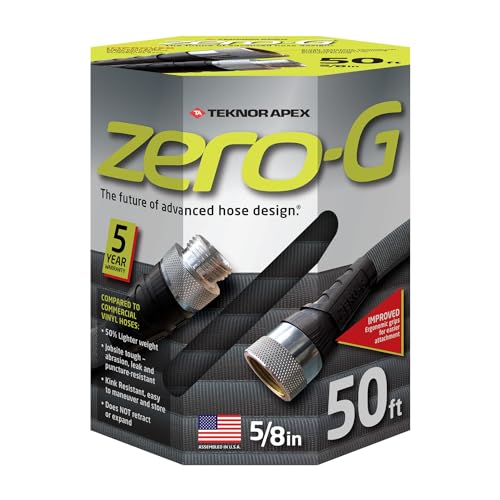
The Teknor Apex Zero-G is a lightweight hose designed to feel far easier to carry than a conventional rubber hose. In this cluster it is treated as a prose-only pick: no purchase link is published until its listing has been verified, so judge it here on fit rather than on a button. Its natural home is with gardeners who value light weight for frequent, shorter watering sessions. Positioned in the mid tier, it asks you to pay for construction and handling rather than for novelty, and it earns that position when its strengths line up with your longest route and your heaviest regular task. Owner-pattern summary: praised for light carry and easy storage in smaller gardens; complaints come from owners who stretched it into long, heavy sprinkler duty it was not shaped for.
Best for: gardeners who value light weight for frequent, shorter watering sessions. Not suited for: buyers whose main need is the exact opposite of its design, for example the lightest possible carry when this is a heavy-duty hose, or maximum toughness when this is a lightweight one. Strengths in daily use are consistent handling, fittings that feel secure at the faucet and behaviour you can predict from the first week. The honest trade-off is that no hose wins everywhere: weight, flexibility, toughness and storage bulk pull against each other, and this model simply chooses its side of that argument clearly. Check price on Amazon listings and retailer pages at the time you shop, compare the exact length and diameter you need, and confirm the fitting style matches your faucet and accessories before ordering.

Gilmour Flexogen Garden Hose
The Gilmour Flexogen is a reinforced all-purpose hose aimed at steady, general garden duty. In this cluster it is treated as a prose-only pick: no purchase link is published until its listing has been verified, so judge it here on fit rather than on a button. Its natural home is with households wanting one dependable hose for beds, lawn and patio work. Positioned in the mid tier, it asks you to pay for construction and handling rather than for novelty, and it earns that position when its strengths line up with your longest route and your heaviest regular task. Owner-pattern summary: praised as a steady all-rounder with few surprises; complaints are the ordinary ones of the class, washers and storage, rather than any recurring defect.
Best for: households wanting one dependable hose for beds, lawn and patio work. Not suited for: buyers whose main need is the exact opposite of its design, for example the lightest possible carry when this is a heavy-duty hose, or maximum toughness when this is a lightweight one. Strengths in daily use are consistent handling, fittings that feel secure at the faucet and behaviour you can predict from the first week. The honest trade-off is that no hose wins everywhere: weight, flexibility, toughness and storage bulk pull against each other, and this model simply chooses its side of that argument clearly. Check price on Amazon listings and retailer pages at the time you shop, compare the exact length and diameter you need, and confirm the fitting style matches your faucet and accessories before ordering.
Red Flags and Green Flags in Any Hose Listing
Green flags: construction described in concrete terms, fittings named by material, lengths and diameters offered in a sensible range, and a maker willing to discuss care, draining and storage. Red flags: miraculous claims with no construction detail, fittings described only by colour, no mention of washers or compatibility, and marketing that promises a hose will never kink, never leak and never age, because no hose in the history of gardens has kept those promises. Between the flags, trust the boring listings. In this product class, boring is what reliability looks like before you buy it.
Material is where durability, weight and price tier all meet. Traditional rubber hoses are the heavyweights: tough, resistant to kinking, happy to be dragged across driveways, and able to handle hot water in many cases, but genuinely heavy and rarely the cheapest option. Vinyl hoses sit at the opposite end: light, inexpensive and easy to coil, yet more prone to kinking in cold weather and quicker to show their age under harsh sun. Between those poles live reinforced hybrid and polymer designs that blend flexibility with strength, often staying pliable in cool weather while shrugging off the stiffness that makes cheap vinyl such a chore in spring and autumn. Drinking-water considerations belong in this conversation too: if you fill pet bowls, paddling pools or vegetable beds where the water matters to you, look for hoses whose makers describe them in plain language as suitable for that use, and flush the hose before filling anything, especially after it has sat warm in the sun. Whatever material you choose, remember that sunlight is the slow enemy of every hose, so a material that tolerates ultraviolet exposure, combined with shaded storage, stretches service life more than any single feature printed on a label.
Many hose problems are repairable, and knowing that changes how you buy and when you replace. A drip at the faucet is usually a washer, replaced in a minute for pennies. A leak at a damaged end can often be fixed by cutting the hose cleanly behind the damage and fitting a repair coupling, a job that needs a sharp knife, a screwdriver and care to cut square. A mid-hose puncture from a thorn or a mower can be bridged with a splice mender in the same way. What repair cannot fix is a jacket that has gone stiff and cracked along its length, a hose that kinks at a dozen memory points, or a bulging section that signals internal failure; those are retirement signs, and a bulge in particular should be retired promptly rather than nursed. Keep one repair kit in the shed and you extend the useful life of a sound hose by seasons. This is also an argument for buying a hose with standard fittings and a cut-friendly construction in the first place: repairability is a feature, even if it never appears in the headline on the box.
The Verdict the Patterns Support
Read as patterns, reviews of traditional garden hoses tell a coherent story. The class works: owners who match length, diameter and material to their garden, store the hose with basic care and keep washers fresh report years of unremarkable service, which is the goal. Owners who buy on price or guesswork report the same handful of frustrations, in the same order, every year. Your task as a reader is not to find a hose with no negative reviews, which does not exist, but to find the hose whose negative reviews describe problems your garden and habits will not create.
Choosing length well starts with a tape measure, not a guess. Stand at the faucet, walk your normal watering route to the farthest bed, tree or washing spot, and note the distance honestly, including the detours around the patio table and the corner of the shed. Buy for that route with modest slack. Too short is miserable in daily use: you end up stretching the hose, stressing both couplings and scuffing the jacket on edges, and you start leaving far plants thirsty because reaching them is a fight. Too long is a slower kind of mistake: the surplus lives in heavy loops that kink at the same tired spots, take longer to drain, and make a small storage corner feel impossible. If your property has two distinct zones, such as a front bed and a back vegetable patch on opposite sides of the house, two shorter hoses on two faucets, or one hose plus a portable reel you move between zones, usually beats a single marathon hose. Gardeners who expand beds year by year should also leave a little headroom, because the route you walk next spring is rarely shorter than the one you walk today.
How you store a garden hose quietly determines how many seasons it survives. Ultraviolet light, standing water and twisted storage are the three slow destroyers, and all three are avoidable with a reel, a hanger or a lidded pot in a shaded corner. Wind or coil the hose the same way each time, in broad loops that respect its natural curve, and it will unroll willingly instead of fighting you in spirals. Drain it as you coil: walk the length with the nozzle open, lifting sections so water runs out rather than sitting inside to grow stale and heavy. Store it off pathways, both for the hose’s sake and for everyone’s ankles, because a hose across a walkway is a trip hazard for guests, children and anyone carrying a tray with both hands. If your only storage is a sunny wall, a simple cover or a reel with a housing buys real protection. And when frost threatens, storage stops being tidiness and becomes survival: a drained hose brought under cover is a hose that greets spring ready to work.
A few safety habits separate relaxed watering from the avoidable accidents. Always release the pressure before you unscrew anything: shut the faucet, then trigger the nozzle until the flow dies, because the pressure stored in a full hose is enough to make a loose fitting jump and spray hard. Keep the hose out of walking lines whenever it is out, and coil it away promptly when you finish, since a hose lying across a path, a step or a driveway edge is an easy trip for anyone not expecting it, and a nasty fall for someone carrying something. Drain the hose before freezing weather rather than after it, because water expands as it turns to ice and a full hose can split along its length or crack its fittings in a single hard night. Check the first water out of a sun-baked hose before it touches skin, since it can come out hot. And keep the whole operation away from outdoor electrical points and power tools: water and electricity share a garden peacefully only when you keep them deliberately apart.
Water is the resource the hose delivers, so a thoughtful hose setup wastes less of it. Water deeply and less often rather than little and daily, which trains roots downward and reduces evaporation losses. Water early in the morning when you can, so less is lost to midday heat and wind, and direct water at the soil rather than the foliage, which is where the plant actually drinks and where disease finds less welcome. A hose in good repair is itself a conservation tool: every drip at a coupling is water delivered to a path instead of a plant. Soaker lines and careful hand watering put water at root level with minimal loss, while sprinklers deserve supervision and timers so they never run forgotten. Mulch over beds holds the moisture your hose delivers, multiplying the value of every watering. None of this requires a premium hose; it requires a sound hose, the right attachment and a little intention, which is quietly the most sustainable setup of all.
Why the Traditional Hose Endures
The garden hose has survived every attempt to replace it for a simple reason: it solves the whole problem with almost no infrastructure. Irrigation systems demand design, trenching and maintenance; watering cans demand labour; smart systems demand power, signals and subscriptions. A hose demands a faucet. That simplicity is also resilience: it works in a power cut, moves house in a car boot, adapts when beds move, and can be repaired with parts found in any hardware shop on earth. Its design has refined rather than changed, better jackets, better fittings, better storage, because the underlying idea was already right. When you weigh any modern alternative, including the expandable designs covered elsewhere in this cluster, the fair question is not whether it beats the hose at one trick, but whether it matches the hose across the whole job: reach, flow, toughness, repairability and indifference to infrastructure. Very few challengers do, which is why the traditional hose remains the default against which everything else is measured.
Plain-Language Glossary for Hose Shoppers
A few terms unlock every hose description you will ever read. The bore, or inner diameter, is the width of the water’s path and the main driver of flow. The jacket is the outer construction you see and drag, and its material decides toughness, weight and flexibility. The coupling is the threaded fitting at each end; the female coupling carries the washer that seals against the faucet. A leader hose is a short hose that takes the tight bend at the wall. Burst strength describes resistance to internal pressure, relevant if your supply runs high or a nozzle stays closed on a pressurised line. Kink resistance describes behaviour at bends, and memory describes how stubbornly a hose keeps the shape it was stored in. A soaker hose is a porous irrigation line, not a delivery hose. With those eight ideas in hand, product descriptions stop being marketing weather and become specifications you can compare calmly, which is the moment buying a hose gets easy.
Reading the Shelf: Translating Marketing Into Meaning
Hose packaging speaks a dialect worth translating before you buy. Claims about toughness usually refer to the jacket’s reinforcement, which matters, but say nothing about the fittings, which is where leaks live, so turn the box over and look at the couplings themselves. Claims about flexibility are best tested by your own hands in the shop: bend the hose into the radius your faucet corner demands and watch whether it creases. Claims about length need your tape measure’s verdict, not the shelf’s, because your route is the only length that counts. Descriptions of materials reward plain reading: rubber means heavy and durable, vinyl means light and basic, hybrid and reinforced mean an engineered middle. And any claim that a hose will never kink, never leak and never need care should be read as poetry rather than specification. The honest products describe construction, fittings and care in concrete terms, and they are easy to recognise once you know that boring, specific language is what reliability sounds like.
Troubleshooting: Matching the Symptom to the Cause
Most hose faults announce themselves clearly once you know the dictionary. A drip at the faucet means the washer, until proven otherwise. A drip at the nozzle end means that coupling’s washer or a cross-threaded connection. Weak flow with healthy pressure means a tax somewhere: a kink, a clogged screen, a partly closed valve or a run that is simply long and narrow. A spray pattern that pulses often means air in the line or a sprinkler asking more than the run can give. A hose that will not lie flat was stored twisted and needs patient recoiling in the opposite discipline. A jacket that feels stiff and looks pale has been sun-aged and is entering retirement. A bulge anywhere means stop: retire that hose before pressure makes the decision for you. Working through symptoms in this order, cheapest and most likely first, solves the overwhelming majority of hose problems without buying anything, and it turns the remaining problems into clear, justified purchases rather than guesses.
When a Second Hose Makes More Sense Than a Bigger One
Many hose problems are really one-hose problems. A property with beds at the front and vegetables at the back asks a single hose to be in two places, and the usual answer, one very long hose, creates the weight, kinking and storage burdens this article has described. Two modest hoses, one per zone or one per faucet, often water the same garden with less effort, less wear and better flow at each end. The second hose is also the natural home for specialisation: a soaker line that lives in the vegetable beds all season, an expandable hose that lives by the patio door, a short utility hose at a side faucet for buckets and bikes. Buying the second hose is also the moment to standardise fittings across the whole system, so every nozzle, timer and sprinkler fits everything. Judge the idea by your map, not by habit: if your watering naturally divides into two territories, your equipment probably should too, and the total cost is often lower than the single heroic hose it replaces.
Water Quality, Sediment and Your Hose
What flows through the hose shapes how it ages. Gritty water, common with well supplies and after mains work, collects in nozzle screens and washer seats, mimicking low pressure and causing drips that get blamed on fittings. The defence is routine: rinse screens whenever flow drops, flush the hose briefly at the start of a session after it has sat unused, and let the first water run onto a path rather than onto delicate seedlings if the hose has baked in the sun. Hard water leaves mineral crusts at couplings over seasons, which a gentle clean during the spring inspection removes before it distorts a seal. Algae growth inside a hose stored full and warm is the other quality issue, solved entirely by draining and shaded storage. None of this asks for special products; it asks for the same drain, flush and inspect rhythm that protects the jacket and fittings too. Water quality is simply one more reason the small habits in this article compound into years of trouble-free service.
A Season-by-Season Rhythm for Hose Owners
Spring is for inspection: reconnect the hose, seat a fresh washer, flush the line, and walk the route checking for winter damage and the drips that announce themselves immediately. Summer is for discipline: drain after hot days rather than leaving water baking inside, coil out of walkways during gatherings, and keep the hose shaded between sessions so the jacket ages slowly. Autumn is for decisions: repair the small faults while parts are easy to find, note whether the hose still matches a garden that has grown, and prepare the winter routine before the first forecast frost makes it urgent. Winter is for absence done properly: disconnected, drained, loosely coiled and under cover, with the faucet protected in cold climates. Gardeners who give the hose these four small appointments a year find that it simply never becomes a problem, which is the entire secret behind the hoses that last a decade. The rhythm also spreads the cost of ownership into minutes, instead of concentrating it into the one dramatic spring morning when a neglected hose fails in front of a queue of thirsty plants.
The Supporting Cast: Reels, Timers and Small Parts
A hose reaches its potential only with its supporting cast in place. The reel or hanger is the foundation, turning storage from a heap into a system and protecting the jacket from sun, feet and wheels. The faucet timer is the quiet achiever, converting deep watering from a memory test into an appointment the garden keeps even when you are busy or away. Quick-connect fittings are the convenience layer, making attachment swaps one-handed and encouraging you to use the right nozzle for each job instead of the one already attached. The leader hose is the unsung specialist, absorbing the sharp bend at the wall so the main hose starts its life straight. And the humblest members, spare washers, a repair mender and a spare nozzle screen, are the difference between a fault fixed in a minute and a session abandoned. Budget for the cast when you budget for the hose: in total ownership terms they are not extras, they are the mechanism by which a decent hose becomes a good system.
Planning the Route Like a Professional
Professionals who water for a living think in routes, and home gardeners benefit from stealing the habit. Walk your property and mark, mentally or on paper, the faucet, the zones in watering order, the corners where the hose must turn, and the obstacles it must not cross: thorn beds, sharp paving edges, driveways with traffic, steps where a hose becomes a hazard. Choose the storage point to serve the route’s start, not merely the wall with space on it. Notice where a hose guide at a corner would save the jacket a thousand abrasions, and where a second faucet or a splitter would shorten the whole system. Revisit the route when the garden changes, because new beds quietly lengthen it and last year’s perfect hose becomes this year’s short one. Ten minutes of route planning explains most of the difference between gardeners who fight their hose and gardeners who never think about it, and it costs nothing but attention.
Ergonomics: Making Watering Easier on the Body
Watering should not be the gardening job that hurts. Start with weight: drain the hose before dragging it any distance, because a full hose can weigh dramatically more than the same hose empty, and pull it in long straight runs rather than fighting it around corners under tension. A reel with a comfortable handle, or a wall hanger at waist height, removes the bending and wrestling from the start and end of every session. Wands deserve ergonomic respect too, since they let you water baskets and beds without reaching, stretching or holding a heavy pistol grip at arm’s length for minutes at a time. Grip the couplings with both hands when hands are cold or wet, choose fittings with wide collars you can turn without tools, and take the route that avoids lifting the hose over obstacles altogether. Gardeners with arthritis, recovering shoulders or simply long routes should treat these choices as the purchase itself, not as accessories, because the hose you can handle happily is the hose that actually gets used, and unused tools have no value at any price.
What Review Patterns Cannot Tell You
Patterns have limits, and honest reading admits them. Reviews cannot tell you how a hose will behave on your route, around your corners, under your water pressure, because those variables belong to your garden alone. They cannot fully separate a model year change from the model you will receive, nor a careless owner from a careless manufacturer in a single anecdote. What they can do, used as this article uses them, is narrow the field to designs whose recurring behaviour matches your recurring jobs, and flag the failures that repeat too often to be luck. The final test remains stubbornly local: your tape measure, your faucet, your storage corner and your hardest watering day. Let the patterns choose the shortlist, then let your garden choose from it, and the reviews will have done exactly the job they are good for, no more and no less.
Reading Garden Hose Reviews Against Your Own Space and Routine
A single review session can flatter or condemn a garden hose unfairly, so this section slows the judgement down and looks at what only repeated, ordinary use tends to reveal. Run the garden hose through your least favourite version of its job first, not the easiest demonstration: the awkward corner, the rushed weekday timing, the fuller load, the lower light, or whatever condition in your routine makes this category work hardest. Finish the longer check by looking at wear points rather than features: the hinge, seam, edge, wheel, latch, surface or joint on a garden hose that moves, flexes or gets handled most is where its second year is decided, whatever its first week felt like. Decide in advance what good enough looks like for the job the garden hose does in your home, because chasing a flawless result usually costs more time than the flaw itself, and most households are happier with a reliable ninety percent they actually repeat.
Watch for edge cases in your own home: the pet that investigates everything, the child who treats every new object as furniture, the guest who uses force where you use familiarity, and the weather, light or season that changes how a garden hose behaves. For troubleshooting, start with the boring causes first: power, water, fit, blockage, alignment, a full container, a loose connection or a setting changed by the last person who used the garden hose, because boring causes account for most apparent failures. Pay attention to the second and third use rather than the first, because the first use of a garden hose measures your learning curve while the later uses measure the product itself, and confusing those two is the commonest reviewing mistake. Share the checklist result with anyone who shares the space, since a garden hose chosen by one person and resented by another rarely survives, however sensible the purchase looked on paper.
Read the manual’s warnings page for the garden hose even if you read nothing else, because that page is a compressed list of every way the product has ever been misused, and it tells you exactly which of your own habits needs adjusting. When something about the garden hose disappoints, change one variable at a time — position, setting, timing, load, accessory or technique — and give the change a fair trial, because changing three things at once leaves you with a better or worse result and no idea why. Seasonal thinking helps more than expected: a garden hose bought in one season will meet different light, humidity, mud, heat, guests and routines in another, so judge its size, storage and upkeep against the hardest season it will face. Notice the small recovery moments: how the garden hose behaves when you pause mid-task, change your mind, need to move it, clean it sooner than planned, or hand it to someone in the household who has never used it before.
Use a simple decision checklist at the end: the garden hose fits the measured space, suits the real frequency of the job, matches the household’s cleaning temperament, has obtainable parts, and has a named storage home — five yeses make a confident order. Look at replacement parts and consumables for the garden hose while you are still comparing, confirming that the pieces most likely to wear, clog, tear, fade or get lost can actually be obtained without replacing the whole product. Consider the cleaning rhythm honestly: a garden hose that needs attention after every use suits a household that enjoys small rituals, and frustrates a household that wants to finish a job and walk away, so match the upkeep to the temperament, not the intention. Check the floor, wall, ground or surface the garden hose will meet, since level, texture, moisture and finish decide more about everyday performance in garden & lawn settings than most shoppers expect when they are comparing listings on a screen.
A well-judged garden hose explains itself to that second person without a lecture, with controls, grips, openings or adjustments that make sense on contact, and that intuitiveness is worth recording because guests, partners and teenagers will all test it. Photograph your setup once the garden hose is working well — the position, settings, arrangement or layout you settled on — so that after a move, a deep clean or a seasonal break you can recreate the arrangement that worked instead of rediscovering it. If a problem with the garden hose repeats in the same spot or the same stage of the job, treat the pattern as the clue — patterns point to setup, surface or technique, while random problems point more often to the individual unit. Measure before anything else, and measure the garden hose in its working state rather than its packed or folded state, because handles extend, lids open, cords trail, doors swing and users stand somewhere, and all of that belongs in the measurement.
Frequently Asked Questions
How many reviews should I read before choosing a hose?
Read enough to see patterns, usually a focused pass through recent reviews plus the most critical ones, rather than a marathon. You are looking for repetition: the same praise or the same failure appearing across different owners, gardens and seasons. Ten reviews that independently mention easy coiling tell you more than a hundred that merely repeat a headline claim, and three reports of the same coupling fault outweigh a page of first-day delight.
Why do so many negative hose reviews mention leaking at the faucet?
Because the faucet joint is the hardest-working seal in the system and its most common failure is a small rubber washer that costs almost nothing. Washers go missing in transit, sit unseated, flatten with age or collect grit, and the resulting drip gets blamed on the hose. Experienced owners check the washer before judging, which is why their reviews read so differently from first-time buyers’ accounts of the same product.
Are lightweight hoses reviewed worse than heavy ones?
They collect different complaints rather than worse ones. Lightweight designs are praised for carry and storage and criticised when owners press them into heavy sprinkler or long-route duty. Heavy rubber hoses are praised for toughness and criticised for the weight that creates it. Both patterns are really about matching: the reviews improve dramatically whenever the buyer’s hardest regular job matches the design’s intent, whatever the weight class.
What is the most trustworthy kind of hose review?
The long-term update. A review written or revised after one or two full seasons, ideally including a winter, tests exactly what a hose purchase is betting on: jacket ageing, fitting corrosion, kinking memory and survival of real storage. Treat first-week reviews as handling impressions only, and give the quiet, satisfied two-year update more weight than any number of unboxing reactions.
Do reviewers agree on the best length to buy?
They agree on the method rather than a number: measure the route from faucet to farthest watering point, following the path the hose travels, and add modest slack. Negative length reviews almost always trace to guessing, buying short to save money or buying very long just in case. Reviewers who measured rarely complain about length at all, which is itself one of the clearest patterns in the entire category.
Should I avoid a hose with any reports of kinking?
No, because every traditional hose kinks somewhere in someone’s garden, usually at a sharp faucet bend or in a twisted coil. Look instead at frequency and context: occasional kinks in cold weather are the class norm, while constant kinking in normal use, mentioned by many owners of the same model, signals a stiff or poorly reinforced design. Your own storage and routing habits will decide which end of that spectrum you experience.
Related Guides
garden hose review: the single-class deep dive garden hose buying guide garden hose pros and cons is a garden hose worth it garden hose nozzles for every spray job oscillating sprinklers for even lawn coverage watering cans for gentle container watering whether an expandable garden hose is worth it