Disclosure: As an Amazon Associate, dailyhomedecorating.com earns from qualifying purchases. Links on this page are affiliate links; they cost you nothing extra. Prices and availability change often, so check the current Amazon listing before you buy.
Choosing a garden hose sounds simple until the shelf offers a wall of coils that all promise easy watering, which is exactly why this garden hose buying guide exists: a garden hose is a daily-use tool, and the right one disappears into your routine while the wrong one kinks, leaks and fights you for years. This guide works through length, diameter, materials, fittings and storage in plain language, introduces four prose-only picks worth shortlisting, and finishes with setup, care and the safety habits that keep watering calm, including this rule: release the pressure before disconnecting, keep the hose off walkways so nobody trips, and drain it fully before freezing weather so ice cannot split it.
Key Takeaways
- Measure your real watering route before choosing a length, and add only modest slack.
- Diameter decides flow: wider serves sprinklers and long runs, narrower feels lighter for hand watering.
- Fittings matter as much as the jacket; solid brass couplings and fresh washers prevent most leaks.
- Match material to workload: rubber for toughness, vinyl for light duty, reinforced hybrids in between.
- Plan storage before buying: a reel, hanger or pot in shade doubles the life of any hose.
- Every pick in this guide is prose-only until its listing is verified, so no purchase links appear here.
In this guide
What a Garden Hose Does and the Main Types of Garden Hose
The Traditional Round Hose
The traditional hose is the backbone of most gardens: a constant-diameter tube in rubber, vinyl or a reinforced blend that feeds nozzles, sprinklers and soaker lines with predictable flow. It tolerates reels, holds its shape in storage and comes in the widest range of lengths and diameters. For a household buying one hose to do everything, this is almost always the right branch of the family, and it is the branch the picks in this guide belong to.
The Expandable Hose
Expandable hoses stretch under water pressure inside a fabric jacket and shrink dramatically when drained, which makes them the lightest, most compact option for patios and small gardens. The compromises are real: they need decent pressure to reach full length, they dislike dragging over rough or thorny ground, and they are a poor match for feeding large sprinklers. Many households keep one as a second hose rather than the main one.
Soaker and Coil Hoses
A soaker hose is an irrigation line disguised as a hose, weeping water slowly along its length into beds and rows, ideally under mulch. A coil hose springs back into a tight helix and serves potting benches, greenhouses and balconies over short distances, pulling gently against you as you stretch it. Both are excellent specialists and poor generalists, so treat them as additions to a traditional main hose rather than replacements for one.
Knowing the main hose types turns a confusing shelf into a short list. Traditional hoses, in rubber, vinyl or reinforced blends, hold a constant shape, deliver steady flow and suit permanent setups with reels and sprinklers. Expandable hoses use an inner tube that stretches under pressure inside a fabric jacket, shrinking back when drained; they are astonishingly light and compact, but they need pressure to reach full length and dislike being dragged over rough ground. Soaker hoses are porous along their length, weeping water slowly into beds, and they are a watering method as much as a hose type. Coiled hoses spring back into a tight helix, handy for patios and greenhouses over short distances, though they pull against you as you stretch them. Flat or lay-flat designs store like a ribbon and appear mostly in specialist or heavy-duty contexts. Most households end up with a traditional hose as the backbone, sometimes joined by a soaker for beds or a compact expandable for the patio, and that division of labour, each type doing the job it is shaped for, beats asking one hose to be everything.
Top Picks at a Glance
Four hoses earn a place on the shortlist, each with a clear badge and a clear job. All four are presented prose-only, with a pick slot marker where a verified listing will later sit, because no ASIN for this cluster could be confirmed with certainty in the verification pass for this guide.
Best Overall: Gilmour Flexogen Garden Hose, for balanced all-purpose duty. Best for Tough Jobs: Continental Premium Garden Hose, in the traditional rubber workhorse mould. Best for Easy Handling: Flexzilla HFZG550YW Garden Hose, built to stay flexible. Best Lightweight: Teknor Apex Zero-G Garden Hose, for gardeners who carry the hose often. Each is positioned qualitatively, in the mid to premium tiers, and the mini-reviews below explain who should choose which, and who should not.
Flexzilla HFZG550YW Garden Hose
The Flexzilla HFZG550YW is a flexible hybrid-polymer hose built around everyday handling. In this cluster it is treated as a prose-only pick: no purchase link is published until its listing has been verified, so judge it here on fit rather than on a button. Its natural home is with gardeners who coil and uncoil daily and want a hose that stays flexible in cool weather. Positioned in the premium tier, it asks you to pay for construction and handling rather than for novelty, and it earns that position when its strengths line up with your longest route and your heaviest regular task. Read it against your own route and storage: this pick rewards buyers whose routine matches its design brief, and it is deliberately not presented as the answer for every garden.
Best for: gardeners who coil and uncoil daily and want a hose that stays flexible in cool weather. Not suited for: buyers whose main need is the exact opposite of its design, for example the lightest possible carry when this is a heavy-duty hose, or maximum toughness when this is a lightweight one. Strengths in daily use are consistent handling, fittings that feel secure at the faucet and behaviour you can predict from the first week. The honest trade-off is that no hose wins everywhere: weight, flexibility, toughness and storage bulk pull against each other, and this model simply chooses its side of that argument clearly. Check price on Amazon listings and retailer pages at the time you shop, compare the exact length and diameter you need, and confirm the fitting style matches your faucet and accessories before ordering.
Continental Premium Garden Hose
The Continental Premium is a traditional rubber hose in the classic workhorse mould. In this cluster it is treated as a prose-only pick: no purchase link is published until its listing has been verified, so judge it here on fit rather than on a button. Its natural home is with gardeners with long routes, rough ground and no patience for delicate equipment. Positioned in the premium tier, it asks you to pay for construction and handling rather than for novelty, and it earns that position when its strengths line up with your longest route and your heaviest regular task. Read it against your own route and storage: this pick rewards buyers whose routine matches its design brief, and it is deliberately not presented as the answer for every garden.
Best for: gardeners with long routes, rough ground and no patience for delicate equipment. Not suited for: buyers whose main need is the exact opposite of its design, for example the lightest possible carry when this is a heavy-duty hose, or maximum toughness when this is a lightweight one. Strengths in daily use are consistent handling, fittings that feel secure at the faucet and behaviour you can predict from the first week. The honest trade-off is that no hose wins everywhere: weight, flexibility, toughness and storage bulk pull against each other, and this model simply chooses its side of that argument clearly. Check price on Amazon listings and retailer pages at the time you shop, compare the exact length and diameter you need, and confirm the fitting style matches your faucet and accessories before ordering.

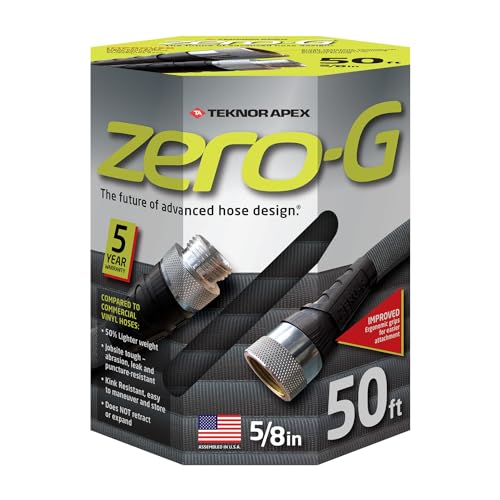
Teknor Apex Zero-G Garden Hose
The Teknor Apex Zero-G is a lightweight hose designed to feel far easier to carry than a conventional rubber hose. In this cluster it is treated as a prose-only pick: no purchase link is published until its listing has been verified, so judge it here on fit rather than on a button. Its natural home is with gardeners who value light weight for frequent, shorter watering sessions. Positioned in the mid tier, it asks you to pay for construction and handling rather than for novelty, and it earns that position when its strengths line up with your longest route and your heaviest regular task. Read it against your own route and storage: this pick rewards buyers whose routine matches its design brief, and it is deliberately not presented as the answer for every garden.
Best for: gardeners who value light weight for frequent, shorter watering sessions. Not suited for: buyers whose main need is the exact opposite of its design, for example the lightest possible carry when this is a heavy-duty hose, or maximum toughness when this is a lightweight one. Strengths in daily use are consistent handling, fittings that feel secure at the faucet and behaviour you can predict from the first week. The honest trade-off is that no hose wins everywhere: weight, flexibility, toughness and storage bulk pull against each other, and this model simply chooses its side of that argument clearly. Check price on Amazon listings and retailer pages at the time you shop, compare the exact length and diameter you need, and confirm the fitting style matches your faucet and accessories before ordering.

Gilmour Flexogen Garden Hose
The Gilmour Flexogen is a reinforced all-purpose hose aimed at steady, general garden duty. In this cluster it is treated as a prose-only pick: no purchase link is published until its listing has been verified, so judge it here on fit rather than on a button. Its natural home is with households wanting one dependable hose for beds, lawn and patio work. Positioned in the mid tier, it asks you to pay for construction and handling rather than for novelty, and it earns that position when its strengths line up with your longest route and your heaviest regular task. Read it against your own route and storage: this pick rewards buyers whose routine matches its design brief, and it is deliberately not presented as the answer for every garden.
Best for: households wanting one dependable hose for beds, lawn and patio work. Not suited for: buyers whose main need is the exact opposite of its design, for example the lightest possible carry when this is a heavy-duty hose, or maximum toughness when this is a lightweight one. Strengths in daily use are consistent handling, fittings that feel secure at the faucet and behaviour you can predict from the first week. The honest trade-off is that no hose wins everywhere: weight, flexibility, toughness and storage bulk pull against each other, and this model simply chooses its side of that argument clearly. Check price on Amazon listings and retailer pages at the time you shop, compare the exact length and diameter you need, and confirm the fitting style matches your faucet and accessories before ordering.
How Long a Garden Hose Do You Actually Need?
Length is the decision most buyers rush and most buyers regret. Measure before you shop: walk from the outdoor faucet to the farthest point you actually water, following the path the hose will travel around corners, beds and furniture rather than cutting straight across the lawn, then add a comfortable margin so you are never pulling the last stretch tight. A hose that only just reaches forces you to drag fittings across soil and puts constant strain on the coupling at the faucet, which is where leaks love to start. Going far longer than you need is not free either, because every extra coil is weight to carry, bulk to store and friction that quietly reduces the flow arriving at the nozzle. Households with a single faucet at the back of the house and beds on both sides often do better with one medium hose plus a shorter second hose kept near the front, rather than one very long hose wrestled around the whole property. Renters and small patios sit at the other extreme, where a compact hose that lives in a small pot or on a small reel keeps the space usable. Think in routes, not in numbers on a box: the right length is the one that reaches your real watering route with a little slack and no heroic tugging.
Which Diameter Gives You the Flow You Need?
Think of diameter as the width of the road your water travels on. More width means more flow, and flow is what makes sprinklers throw evenly, fills buckets quickly and keeps pressure steady when the run is long. Narrower hoses restrict that flow a little, which barely matters for gentle hand watering but shows up quickly when a sprinkler or a long soaker line is asking for volume. There is no free choice here: a wider hose full of water weighs more, coils into a bigger loop and asks more of your arms at the end of the day. Gardeners with raised beds and containers usually thrive with a lighter, narrower hose and a good nozzle. Gardeners watering lawns, washing vehicles or feeding irrigation lines usually thank themselves for choosing flow first. Before you buy, look at the fittings you already own, because nozzles, timers and splitters all assume standard threaded connections, and keeping everything in one fitting family makes seasonal setup a two-minute job instead of a hardware-store trip.
Rubber, Vinyl or Hybrid: Which Material Fits Your Garden?
Material is where durability, weight and price tier all meet. Traditional rubber hoses are the heavyweights: tough, resistant to kinking, happy to be dragged across driveways, and able to handle hot water in many cases, but genuinely heavy and rarely the cheapest option. Vinyl hoses sit at the opposite end: light, inexpensive and easy to coil, yet more prone to kinking in cold weather and quicker to show their age under harsh sun. Between those poles live reinforced hybrid and polymer designs that blend flexibility with strength, often staying pliable in cool weather while shrugging off the stiffness that makes cheap vinyl such a chore in spring and autumn. Drinking-water considerations belong in this conversation too: if you fill pet bowls, paddling pools or vegetable beds where the water matters to you, look for hoses whose makers describe them in plain language as suitable for that use, and flush the hose before filling anything, especially after it has sat warm in the sun. Whatever material you choose, remember that sunlight is the slow enemy of every hose, so a material that tolerates ultraviolet exposure, combined with shaded storage, stretches service life more than any single feature printed on a label.
Why Do Fittings Decide Whether a Hose Leaks?
The ends of the hose deserve as much scrutiny as the hose itself, because most leaks are born at the couplings, not in the middle of the run. Machined brass fittings are the dependable standard: heavy in the hand, slow to corrode and able to take years of threading onto faucets, nozzles and reels. Budget fittings made from thin metal or plain plastic ask for trouble in slow motion, bending out of round, cracking after a frost or seizing onto the faucet. Pay attention to grip as well: a wide, knurled or winged collar that you can turn with wet hands or light gloves saves real annoyance across a season of daily connections. Inside the female coupling sits a humble rubber washer, and that washer is the actual seal. Replace it when it flattens or cracks, seat it fully before connecting, and resist the urge to overtighten, which distorts the washer and makes the drip worse. If you swap attachments often, a consistent set of quality quick-connect fittings across your hose, nozzle and sprinkler turns every changeover into a click instead of a wrestling match.
How to Prioritise by Use Case
Abstract advice only goes so far, so it helps to test hose choices against recognisable households. The right answer changes completely with the size of the plot, the position of the faucet, the plants being watered and the person doing the carrying, which is why confident one-size recommendations should always be treated with suspicion. Work through the profiles that follow and notice which one makes you nod; that recognition is more valuable than any specification. Gardeners between profiles should weight the profile that matches their hardest regular job, because a hose is judged on its worst day, not its best. A small patio with ambitions, a big lawn with one faucet, a vegetable patch that drinks daily in August: each writes its own specification, and the sections after the profiles translate those specifications into concrete buying criteria you can take to any retailer.
The Patio and Container Gardener
Your watering is frequent, close and gentle, and your storage is on display. Prioritise light weight, tidy coiling and a wand that gives a soft shower. A mid-tier traditional hose in a modest length, or an expandable as a companion, serves you better than heavy-duty rubber you will resent moving daily.
The Family Lawn-and-Beds Gardener
You water in circuits, feed a sprinkler, rinse the patio and expect one hose to cope with all of it. Prioritise flow, kink resistance and fittings that stay sealed, in a reinforced mid-tier or premium hose long enough for the full circuit with slack to spare.
The Serious Vegetable Grower
Your beds drink deeply and often, and soaker lines may join the system. Prioritise flow, reach and couplings that hold through long, slow sessions, plus a timer at the faucet so deep watering never depends on your memory.
It helps to picture the actual households a hose serves. The balcony and patio gardener waters pots daily, in a small space where storage is visible and a heavy hose would dominate. The suburban lawn-and-beds gardener waters in circuits, dragging the hose around corners, feeding a sprinkler twice a week and expecting one hose to do everything. The serious vegetable grower runs water deeply and often, sometimes through soaker lines, and cares about flow, reach and fittings that stay sealed for long, slow sessions. The multi-task household adds car washing, patio rinsing and the occasional pool fill, and needs quick attachment changes and a jacket that tolerates driveways. Each of these households can buy a hose that is wrong for them while being genuinely good for someone else, which is why honest self-knowledge beats any ranking. Write down your three most frequent watering jobs before you shop, and judge every candidate against those jobs, in your garden, with your faucet position and your storage corner in mind.
First Setup and Care Essentials
The faucet end of the system deserves a moment of planning. Most outdoor faucets sit low and close to the wall, which forces the hose into an immediate sharp bend, exactly where kinks and fitting stress concentrate. A short leader hose, a few feet of flexible hose between the faucet and a reel or the main hose, absorbs that bend and makes connections easier, especially in winter gloves. A backflow preventer, required in many areas, keeps garden water from ever being drawn back toward the house supply, and should stay in place rather than being removed for convenience. If your household shares one faucet between the hose, a pressure washer and filling buckets, a simple two-way splitter with individual shut-offs ends the constant threading and unthreading that wears washers and tempers. Check the faucet itself each spring for drips that belong to the house plumbing, not the hose, and address those at the source. The best hose in the world cannot redeem a bad connection point, while a well-arranged faucet makes even a modest hose feel well engineered.
How you store a garden hose quietly determines how many seasons it survives. Ultraviolet light, standing water and twisted storage are the three slow destroyers, and all three are avoidable with a reel, a hanger or a lidded pot in a shaded corner. Wind or coil the hose the same way each time, in broad loops that respect its natural curve, and it will unroll willingly instead of fighting you in spirals. Drain it as you coil: walk the length with the nozzle open, lifting sections so water runs out rather than sitting inside to grow stale and heavy. Store it off pathways, both for the hose’s sake and for everyone’s ankles, because a hose across a walkway is a trip hazard for guests, children and anyone carrying a tray with both hands. If your only storage is a sunny wall, a simple cover or a reel with a housing buys real protection. And when frost threatens, storage stops being tidiness and becomes survival: a drained hose brought under cover is a hose that greets spring ready to work.
Routine care is short, seasonal and mostly about water and sunlight. Rinse the outside of the hose when it gets muddy, because grit ground into the jacket as you drag it acts like sandpaper over a season. Let the hose dry before long storage so mildew does not take hold in the coil. Inspect the couplings a few times a year: washers flatten, threads collect grit, and a thirty-second clean and a fresh washer prevent the slow drip that gardeners otherwise tolerate for months. Check the jacket for the early signs of trouble, such as pale, stiff patches from sun exposure, soft spots, or a crease that has turned white from repeated kinking, and plan replacement before a failure soaks a bed or a basement window well. Avoid dragging the hose over sharp edges, fresh concrete and thorny stems where you can route around them, and never use the hose itself as a rope for pulling, hanging or tying loads. Finally, keep a simple rhythm: drain after use in hot weather so the water inside does not bake the inner lining, coil the same way every time, and your hose will reward the small attention with years of unremarkable, reliable service.
Safety Habits Every Hose Owner Needs
Safe watering is mostly unglamorous habits done every time. Before you disconnect a hose or swap a nozzle, turn the water off at the faucet and then squeeze the nozzle to release the pressure still trapped in the line, because a pressurised hose can whip, spray your face or soak the person next to you when a fitting lets go. Route the hose where feet are not: across a path or a patio step it becomes a genuine tripping hazard, especially in the evening or when it hides in grass, so coil the surplus out of walkways and bring the hose in when guests, children or deliveries are expected. Be thoughtful about standing water as well; a hose left full in hot sun can deliver a first burst of surprisingly hot water, so run it briefly onto the ground before turning it on skin, pets or delicate seedlings. Keep electrical tools, extension leads and outdoor sockets away from your watering route, and never leave a pressurised hose unattended where a child could treat the nozzle as a toy. None of this is complicated, but the gardeners who do it automatically are the ones whose watering stays the relaxing ritual it is supposed to be.
Cold weather is the one opponent a hose cannot fight while full of water. Ice expands, and inside a sealed hose that expansion splits jackets and cracks couplings with quiet efficiency. The defence is a short autumn ritual: disconnect from the faucet so the faucet can drain too, open the nozzle, and walk the hose dry, lifting loops so no low section keeps a pocket of water. Coil it big and loose, store it under cover and out of the sun, and use the moment to swap tired washers and inspect for the small cracks that announce themselves as spring leaks. If a hose must stay outdoors in a mild climate, draining still matters, because even occasional frosts find the one night you forgot. Treat winter care as part of the purchase price of any hose, cheap or premium: the best-built hose in the world loses to ice, while an ordinary hose that is drained and sheltered every year routinely outlives fancier rivals left full on a wall.
Mistakes to Avoid
The most common buying mistakes are easy to list because gardeners make them in the same order every year. Buying by price alone puts a flimsy hose in a demanding garden, where it kinks, splits and gets replaced, costing more across three seasons than one sound hose would have. Buying far too much length creates a heavy, tangling burden that makes watering feel like labour. Ignoring the fittings saves a little money at the shelf and spends it again in washers, tape and leaks. Forgetting storage entirely, with no reel, hanger or pot planned, guarantees the hose lives in a sun-baked heap. Skipping the question of what the hose must actually do, sprinklers, soaker lines, car washing, gentle pot watering, leads to a diameter or material that fights the main job. And buying in a panic in spring, after the old hose has already failed, removes the chance to measure the route and compare calmly. Every one of these mistakes is avoidable with a tape measure, ten honest minutes thinking about your real routine, and a willingness to match the hose to the garden you have rather than the garden in the advertisement.
Think about hose pricing as buying seasons of service. The cheapest hoses are built to a price: thin walls, basic fittings, materials that stiffen and crack sooner, which can still be rational for a tiny, gentle garden or a temporary need. The middle of the market is the value heartland for most homes, offering reinforced jackets and metal fittings that survive real routines. The premium end buys rubber or advanced hybrid construction, excellent couplings and flexibility that persists in cold weather, and it makes sense exactly when the hose works hard and often. Whichever tier you choose, judge the whole setup cost: the hose, a nozzle you will enjoy using, storage that protects it and the small fittings that make connections painless. A mid-tier hose on a good reel, drained and shaded, will outserve a premium hose stored in a sunlit heap. Spend first on fit for your route and routine, then on construction, and let novelty features fight for whatever budget remains.
Climate quietly rewrites hose priorities. In hot, high-sun regions, ultraviolet resistance and shaded storage dominate, because sunlight is the primary aging force and a hose left on a sunny wall can grow stiff and pale within a few seasons. In cold regions, flexibility at low temperatures and disciplined draining matter most, since a hose that coils willingly on a frosty morning and empties fully before a freeze will outlast a tougher hose that does neither. Coastal gardeners should favour corrosion-resistant fittings, because salt air works on cheap metal relentlessly. Arid-region gardeners, watering deeply and infrequently, benefit from flow and from soaker setups that lose nothing to the air. Humid climates add algae and mildew to the list, rewarding hoses that drain fully and storage that lets air circulate. None of these adjustments changes the fundamentals of length, diameter and fittings; they change the emphasis. Read any recommendation, including the picks in this article, through your own climate first, because the best hose for a shaded northern garden and the best hose for a blazing southern patio are cousins, not twins.
A Season-by-Season Rhythm for Hose Owners
Spring is for inspection: reconnect the hose, seat a fresh washer, flush the line, and walk the route checking for winter damage and the drips that announce themselves immediately. Summer is for discipline: drain after hot days rather than leaving water baking inside, coil out of walkways during gatherings, and keep the hose shaded between sessions so the jacket ages slowly. Autumn is for decisions: repair the small faults while parts are easy to find, note whether the hose still matches a garden that has grown, and prepare the winter routine before the first forecast frost makes it urgent. Winter is for absence done properly: disconnected, drained, loosely coiled and under cover, with the faucet protected in cold climates. Gardeners who give the hose these four small appointments a year find that it simply never becomes a problem, which is the entire secret behind the hoses that last a decade. The rhythm also spreads the cost of ownership into minutes, instead of concentrating it into the one dramatic spring morning when a neglected hose fails in front of a queue of thirsty plants.
Ergonomics: Making Watering Easier on the Body
Watering should not be the gardening job that hurts. Start with weight: drain the hose before dragging it any distance, because a full hose can weigh dramatically more than the same hose empty, and pull it in long straight runs rather than fighting it around corners under tension. A reel with a comfortable handle, or a wall hanger at waist height, removes the bending and wrestling from the start and end of every session. Wands deserve ergonomic respect too, since they let you water baskets and beds without reaching, stretching or holding a heavy pistol grip at arm’s length for minutes at a time. Grip the couplings with both hands when hands are cold or wet, choose fittings with wide collars you can turn without tools, and take the route that avoids lifting the hose over obstacles altogether. Gardeners with arthritis, recovering shoulders or simply long routes should treat these choices as the purchase itself, not as accessories, because the hose you can handle happily is the hose that actually gets used, and unused tools have no value at any price.
Planning the Route Like a Professional
Professionals who water for a living think in routes, and home gardeners benefit from stealing the habit. Walk your property and mark, mentally or on paper, the faucet, the zones in watering order, the corners where the hose must turn, and the obstacles it must not cross: thorn beds, sharp paving edges, driveways with traffic, steps where a hose becomes a hazard. Choose the storage point to serve the route’s start, not merely the wall with space on it. Notice where a hose guide at a corner would save the jacket a thousand abrasions, and where a second faucet or a splitter would shorten the whole system. Revisit the route when the garden changes, because new beds quietly lengthen it and last year’s perfect hose becomes this year’s short one. Ten minutes of route planning explains most of the difference between gardeners who fight their hose and gardeners who never think about it, and it costs nothing but attention.
A Final Pre-Purchase Checklist
Before any hose leaves the shelf, run this list. Length: measured on the real route, with modest slack, not guessed. Diameter: chosen for your thirstiest job, sprinklers and soakers first. Material: matched to workload and climate, rubber for punishment, reinforced blends for most homes, light constructions for gentle duty. Fittings: solid in the hand, standard in thread, washer present and seated. Storage: a reel, hanger or pot already chosen and measured. Attachments: a nozzle or wand you will enjoy, plus spare washers from day one. Care: you know the drain, shade and winter routine and are willing to keep it. Safety: you will release pressure before disconnecting, keep the hose off walkways and drain it before frost. A hose that passes all eight checks is very unlikely to disappoint you, and a hose that fails two or more should stay on the shelf regardless of its discount, because the discount is temporary and the hose is not.
The Supporting Cast: Reels, Timers and Small Parts
A hose reaches its potential only with its supporting cast in place. The reel or hanger is the foundation, turning storage from a heap into a system and protecting the jacket from sun, feet and wheels. The faucet timer is the quiet achiever, converting deep watering from a memory test into an appointment the garden keeps even when you are busy or away. Quick-connect fittings are the convenience layer, making attachment swaps one-handed and encouraging you to use the right nozzle for each job instead of the one already attached. The leader hose is the unsung specialist, absorbing the sharp bend at the wall so the main hose starts its life straight. And the humblest members, spare washers, a repair mender and a spare nozzle screen, are the difference between a fault fixed in a minute and a session abandoned. Budget for the cast when you budget for the hose: in total ownership terms they are not extras, they are the mechanism by which a decent hose becomes a good system.
Plain-Language Glossary for Hose Shoppers
A few terms unlock every hose description you will ever read. The bore, or inner diameter, is the width of the water’s path and the main driver of flow. The jacket is the outer construction you see and drag, and its material decides toughness, weight and flexibility. The coupling is the threaded fitting at each end; the female coupling carries the washer that seals against the faucet. A leader hose is a short hose that takes the tight bend at the wall. Burst strength describes resistance to internal pressure, relevant if your supply runs high or a nozzle stays closed on a pressurised line. Kink resistance describes behaviour at bends, and memory describes how stubbornly a hose keeps the shape it was stored in. A soaker hose is a porous irrigation line, not a delivery hose. With those eight ideas in hand, product descriptions stop being marketing weather and become specifications you can compare calmly, which is the moment buying a hose gets easy.
A Pre-Purchase Measurement and Compatibility Audit for Your Garden Hose
Use this audit in the final ten minutes before you order a garden hose, because that is when most buying-guide advice stops being abstract and starts being a tape measure, a doorway and a return label you would rather not need. Write down three numbers for the garden hose you are considering: the footprint where it will sit or be stored, the largest dimension it reaches in normal use, and the clearance it needs so doors, drawers, lids, handles or moving parts can work without catching. Consider the cleaning rhythm honestly: a garden hose that needs attention after every use suits a household that enjoys small rituals, and frustrates a household that wants to finish a job and walk away, so match the upkeep to the temperament, not the intention. Seasonal thinking helps more than expected: a garden hose bought in one season will meet different light, humidity, mud, heat, guests and routines in another, so judge its size, storage and upkeep against the hardest season it will face.
Plan the storage home for the garden hose before it arrives, naming the exact cupboard, corner, shelf, hook or stretch of floor, because a product without a home migrates around the house and slowly becomes the clutter it was bought to reduce. Look at replacement parts and consumables for the garden hose while you are still comparing, confirming that the pieces most likely to wear, clog, tear, fade or get lost can actually be obtained without replacing the whole product. Photograph your setup once the garden hose is working well — the position, settings, arrangement or layout you settled on — so that after a move, a deep clean or a seasonal break you can recreate the arrangement that worked instead of rediscovering it. Compatibility is the second audit, and for a garden hose it means checking what it must work alongside: the surfaces, fittings, power or water access, storage and other pieces already in your garden & lawn setup that the new purchase has to cooperate with every day.
Finally, remember that the best garden hose for your home is the one whose size, habits and upkeep disappear into your routine, leaving only the result behind — a cleaner surface, a better-lit seat, a tidier shelf, an easier job — week after ordinary week. If you want a concrete listing check, take a name already shortlisted in this guide, such as Flexzilla HFZG550YW Garden Hose, Continental Premium Garden Hose and Teknor Apex Zero-G Garden Hose, and verify that exact garden hose listing against the measurements and compatibility questions above, field by field, rather than trusting the headline description alone. Keep the packaging of a larger garden hose until those first ordinary tests are done, flattened if space is tight, because re-boxing an awkward shape from scratch is the hidden difficulty inside many otherwise straightforward returns. If a problem with the garden hose repeats in the same spot or the same stage of the job, treat the pattern as the clue — patterns point to setup, surface or technique, while random problems point more often to the individual unit.
For troubleshooting, start with the boring causes first: power, water, fit, blockage, alignment, a full container, a loose connection or a setting changed by the last person who used the garden hose, because boring causes account for most apparent failures. If a listing for a garden hose leaves one of those compatibility questions unanswered, treat the gap itself as information and look for the answer in the manual, the dimension diagram or the question section rather than assuming the generous interpretation. Decide in advance what good enough looks like for the job the garden hose does in your home, because chasing a flawless result usually costs more time than the flaw itself, and most households are happier with a reliable ninety percent they actually repeat. Use a simple decision checklist at the end: the garden hose fits the measured space, suits the real frequency of the job, matches the household’s cleaning temperament, has obtainable parts, and has a named storage home — five yeses make a confident order.
Think about who else will use the garden hose and what they will do differently: shorter reach, less patience, stronger habits, no interest in the manual, and a tendency to leave things wherever they were last set down. Watch for edge cases in your own home: the pet that investigates everything, the child who treats every new object as furniture, the guest who uses force where you use familiarity, and the weather, light or season that changes how a garden hose behaves.
Frequently Asked Questions
How do I know what length of garden hose to buy?
Measure the route, not the straight line. Walk from your faucet to the farthest point you water, following the path the hose will actually take around beds, corners and furniture, then add a small margin so the hose is never stretched tight at full reach. Resist buying far more than the route needs, because surplus length adds weight, storage bulk and friction that reduces flow at the nozzle.
Does hose diameter really change how well a sprinkler works?
Yes, because diameter controls how much water the hose can deliver over a run. A wider bore sustains flow to a sprinkler at the end of a long hose, while a narrower bore can leave the same sprinkler underperforming even with healthy pressure at the faucet. If sprinklers, soaker lines or fast filling are central to your routine, choose diameter for flow first and accept the extra weight.
What is the best material for a garden hose?
There is no single best material, only a best match. Rubber is toughest and most kink-resistant but heavy. Vinyl is light and inexpensive but stiffens in cold weather and ages faster in sun. Reinforced hybrid designs sit between the two and suit most households. Match the material to your workload, your climate and how roughly the hose will be treated across a season.
Why does my new hose drip at the faucet?
Almost always the washer. Inside the female coupling sits a rubber washer that forms the actual seal, and if it is missing, unseated, flattened or gritty, the joint drips no matter how hard you tighten it. Turn the water off, release the pressure, reseat or replace the washer, and reconnect hand-tight with a small extra turn. Persistent dripping after a fresh washer points to damaged threads instead.
How should I store a garden hose to make it last?
Drain it, coil it in large even loops, and keep it off walkways in a shaded spot on a reel, hanger or in a storage pot. Standing water inside invites algae and adds weight, sunlight ages every jacket material, and a hose left across a path is a tripping hazard as well as a victim of feet and wheels. Before freezing weather, disconnect it, drain it fully and store it under cover.
Should I buy an expandable hose instead of a traditional one?
Only if lightness and compact storage outrank everything else in your routine. Expandable hoses are wonderful for patios and gentle pot watering, but they need pressure to reach full length, dislike rough dragging and feed large sprinklers poorly. Most households are better served by a traditional hose as the main tool, with an expandable as an optional second hose for light duty near the house.
Related Guides
garden hose review: one hose class in depth garden hose pros and cons, honestly weighed garden hose vs expandable garden hose is a garden hose worth it the best garden hoses roundup garden hose reels that keep storage tidy garden hose nozzles for every spray job the expandable garden hose buying guide