Disclosure: As an Amazon Associate, dailyhomedecorating.com earns from qualifying purchases. Links on this page are affiliate links; they cost you nothing extra. Prices and availability change often, so check the current Amazon listing before you buy.
This garden hose review takes one product class, the traditional garden hose, and puts it through the questions a season of real watering asks: garden hose handling on long routes, behaviour at the faucet, flow at the nozzle, and how the whole thing ages when storage and weather do their work. Four named models appear as prose-only picks for comparison, with no purchase links, because their listings could not be verified with certainty for this review. Safety runs through it all: release the pressure before disconnecting, keep the hose off walkways so nobody trips, and drain it fully before freezing weather so ice cannot split it.
Key Takeaways
- Verdict in short: a well-built traditional hose is the most useful water tool a garden can own.
- It suits households watering beds, lawns and patios from a fixed faucet, several times a week.
- It does not suit anyone who needs featherweight carry or shoebox storage; look at expandable designs instead.
- Fittings and washers, not the jacket, decide whether the first season is leak-free.
- Handling improves dramatically with a reel, a leader hose and consistent coiling.
- Prose-only review: every model named here is assessed on fit, with no verified purchase links.
In this guide
What a Garden Hose Is and Where It Fits
Knowing the main hose types turns a confusing shelf into a short list. Traditional hoses, in rubber, vinyl or reinforced blends, hold a constant shape, deliver steady flow and suit permanent setups with reels and sprinklers. Expandable hoses use an inner tube that stretches under pressure inside a fabric jacket, shrinking back when drained; they are astonishingly light and compact, but they need pressure to reach full length and dislike being dragged over rough ground. Soaker hoses are porous along their length, weeping water slowly into beds, and they are a watering method as much as a hose type. Coiled hoses spring back into a tight helix, handy for patios and greenhouses over short distances, though they pull against you as you stretch them. Flat or lay-flat designs store like a ribbon and appear mostly in specialist or heavy-duty contexts. Most households end up with a traditional hose as the backbone, sometimes joined by a soaker for beds or a compact expandable for the patio, and that division of labour, each type doing the job it is shaped for, beats asking one hose to be everything.
It helps to picture the actual households a hose serves. The balcony and patio gardener waters pots daily, in a small space where storage is visible and a heavy hose would dominate. The suburban lawn-and-beds gardener waters in circuits, dragging the hose around corners, feeding a sprinkler twice a week and expecting one hose to do everything. The serious vegetable grower runs water deeply and often, sometimes through soaker lines, and cares about flow, reach and fittings that stay sealed for long, slow sessions. The multi-task household adds car washing, patio rinsing and the occasional pool fill, and needs quick attachment changes and a jacket that tolerates driveways. Each of these households can buy a hose that is wrong for them while being genuinely good for someone else, which is why honest self-knowledge beats any ranking. Write down your three most frequent watering jobs before you shop, and judge every candidate against those jobs, in your garden, with your faucet position and your storage corner in mind.
Design, Build and Setup
Every hose material is a compromise you will feel in your hands. Rubber is the old workhorse: dense, kink-resistant and forgiving of rough ground, gravel and the occasional driven-over moment, at the cost of real weight that adds up over a long route. Vinyl is the lightweight budget traveller: easy to carry and coil, but it stiffens in the cold, kinks where it bends and ages faster when it lives in full sun. Reinforced and hybrid constructions try to take the middle road, wrapping a flexible core in a tougher jacket so the hose stays manageable without giving up as quickly. When you read product descriptions, translate the marketing into handling questions: Will this still coil on a cool morning? Can I drag it around a brick corner without wincing? Does the maker describe it as suitable for filling drinking containers, if that is part of my routine? And whatever the jacket is made of, treat ultraviolet light as a countdown timer: a hose stored in shade, or under a cover, simply outlasts an identical hose baked on a sunny wall, season after season.
The ends of the hose deserve as much scrutiny as the hose itself, because most leaks are born at the couplings, not in the middle of the run. Machined brass fittings are the dependable standard: heavy in the hand, slow to corrode and able to take years of threading onto faucets, nozzles and reels. Budget fittings made from thin metal or plain plastic ask for trouble in slow motion, bending out of round, cracking after a frost or seizing onto the faucet. Pay attention to grip as well: a wide, knurled or winged collar that you can turn with wet hands or light gloves saves real annoyance across a season of daily connections. Inside the female coupling sits a humble rubber washer, and that washer is the actual seal. Replace it when it flattens or cracks, seat it fully before connecting, and resist the urge to overtighten, which distorts the washer and makes the drip worse. If you swap attachments often, a consistent set of quality quick-connect fittings across your hose, nozzle and sprinkler turns every changeover into a click instead of a wrestling match.
Start every hose decision at the faucet, because that fixed point shapes everything downstream. Note where it sits: high or low, clear of obstructions or buried behind a shrub, near the beds or at the far end of the house from them. A faucet in an awkward corner argues for a leader hose or a reel positioned to give the main hose a gentle first curve instead of a kinked one. A household with one faucet and many jobs argues for a splitter and quick-connects. In regions with freezing winters, the faucet type matters too, and disconnecting the hose in autumn protects both the hose and the house plumbing behind the wall. Gardeners who plan this end of the system properly find that connection and disconnection, the moments where leaks and frustration concentrate, become thoughtless. It is unglamorous infrastructure, but it is the difference between a hose you use happily for years and one you fight every weekend.
Setup, done properly once, takes minutes and pays all season. Flush the hose briefly before first use to clear manufacturing dust. Seat the washer fully in the female coupling, connect hand-tight plus a small extra turn, unroll the hose completely along its route, and run the water to check every joint before the first real session. Fit the nozzle, test each spray pattern, and walk the route looking for the sharp bends where a guide, a repositioned reel or a leader hose would spare the jacket a daily kink. Finish by coiling the hose on its reel or hanger and noting where the surplus lives, because the storage position you choose on day one is the one you will use, or fight, for years.
Performance in Real Use
Hand Watering Beds and Containers
This is the hose’s home ground, and a good one disappears into the task. With a wand or a soft shower setting, you move plant to plant with the flow under your thumb, giving deep drinks where they are needed and skipping what the rain already served. The qualities that matter here are flexibility, because the hose must follow you around beds without crushing stems, and a jacket that does not kink each time you change direction. In testing terms, the pass mark is boredom: nothing snags, nothing leaks, nothing demands attention, and the watering takes exactly as long as the plants require and no longer.
Running Sprinklers and Soaker Lines
Sprinkler duty exposes weak hoses. Flow must survive the full run, the hose must lie where it is placed instead of curling the sprinkler off target, and couplings must hold a seal for an hour without weeping. A wider-bore hose in good condition passes comfortably; a long, narrow, kinked one produces the familiar sad arc and dry crescents. Soaker lines ask for patience rather than power, low and steady delivery, and here the hose’s job is simply to be a reliable supply line with a timer at the faucet doing the remembering.
Cleaning, Washing and Filling
On hard surfaces the hose becomes a cleaning tool: rinsing patios, washing the car, sluicing mud from boots and bikes, filling buckets and pools. The jet setting does the work, and the hose qualities that matter shift to fitting security, because attachments swap often, and to jacket toughness, because driveways and paving are abrasive hosts. A hose that lives this double life, gardener on weekdays, cleaner at weekends, earns its storage space in a way a single-purpose tool never quite does.
Dragging, Coiling and the End of the Day
Every session ends the same way, and this final act colours the whole review. A hose that coils willingly in large loops, drains as it winds and sits calmly on its reel leaves the gardener fresh. A hose that twists, fights and sprays its stored water over your shoes teaches you to dread watering itself. Weight is felt most here, with the water still inside, which is why draining as you coil is both a care habit and an ergonomic one. Judge any hose, including the picks below, by this last five minutes as much as by the first.
Flow and pressure confuse buyers because they feel like the same thing and are not. Pressure is the push in the line; flow is the volume that actually arrives. A long, narrow hose loses flow to friction along its length, so the sprinkler at the end performs below its promise even when the faucet pressure is healthy. Kinks, partly closed valves and clogged nozzle screens steal flow too, which is why a disappointing spray pattern is so often a hose or fitting problem rather than a sprinkler problem. Before blaming equipment, run a simple check: time how long the hose takes to fill a bucket of known size at the faucet, then repeat at the far end of the hose with your nozzle removed. The difference tells you what the run is costing you. Shortening the run, widening the bore, opening valves fully and clearing screens each give some of it back. Timers and splitters also take their share, so a garden running several zones from one faucet should expect gentler performance per zone. Understanding this one idea, that delivery at the nozzle is what counts, prevents more bad purchases than any other piece of hose knowledge.
Kinking is the everyday annoyance that separates a hose you like from a hose you curse. A kink forms where the hose bends sharply, usually at the same tired spots: right behind the faucet coupling, at the corner of a raised bed, or in the middle of a coil that was stored twisted. Good construction helps, through reinforcement that resists collapsing at bends, and so does behaviour. Pull the hose out in long, straight runs rather than dragging a coiled bundle across the garden and hoping it sorts itself out. When you coil for storage, use large, even loops in the same direction every time, which trains the hose to lie flat instead of spiralling. If a kink does form, do not yank it straight under pressure, because that crease is where the jacket weakens over time; walk to the bend, open it gently with your hands, and let the hose relax. Persistent kinking at the faucet end is often a sign the hose is being asked to turn too sharply the moment it leaves the tap, and a simple repositioning of the reel, or a short leader hose that takes the tight bend, can transform daily handling more than an upgrade to a pricier model.
Strengths and Trade-Offs
- Strength: genuine all-job versatility, from seedlings to sprinklers to car washing.
- Strength: repairable with standard washers and fittings, keeping a good hose in service for years.
- Strength: predictable flow and handling once length and diameter match the garden.
- Trade-off: real weight when full, especially in rubber and wide-bore designs.
- Trade-off: storage demands a reel, hanger or pot, plus the discipline to use it.
- Trade-off: weather exposure is constant, so draining and shade are permanent duties.
How It Compares: Four Models Worth Shortlisting
The four models below represent the traditional class at its main points of the compass: flexible hybrid, heavy rubber, lightweight design and reinforced all-rounder. Each sits behind a pick slot marker as a prose-only entry, so compare them on fit. Where an expandable alternative tempts you, the comparison section of our versus guide weighs that branch separately.
Flexzilla HFZG550YW Garden Hose
The Flexzilla HFZG550YW is a flexible hybrid-polymer hose built around everyday handling. In this cluster it is treated as a prose-only pick: no purchase link is published until its listing has been verified, so judge it here on fit rather than on a button. Its natural home is with gardeners who coil and uncoil daily and want a hose that stays flexible in cool weather. Positioned in the premium tier, it asks you to pay for construction and handling rather than for novelty, and it earns that position when its strengths line up with your longest route and your heaviest regular task. In review terms, this is the handling champion of the four: the one least likely to fight you on a cool morning or at the last coil of the day.
Best for: gardeners who coil and uncoil daily and want a hose that stays flexible in cool weather. Not suited for: buyers whose main need is the exact opposite of its design, for example the lightest possible carry when this is a heavy-duty hose, or maximum toughness when this is a lightweight one. Strengths in daily use are consistent handling, fittings that feel secure at the faucet and behaviour you can predict from the first week. The honest trade-off is that no hose wins everywhere: weight, flexibility, toughness and storage bulk pull against each other, and this model simply chooses its side of that argument clearly. Check price on Amazon listings and retailer pages at the time you shop, compare the exact length and diameter you need, and confirm the fitting style matches your faucet and accessories before ordering.
Continental Premium Garden Hose
The Continental Premium is a traditional rubber hose in the classic workhorse mould. In this cluster it is treated as a prose-only pick: no purchase link is published until its listing has been verified, so judge it here on fit rather than on a button. Its natural home is with gardeners with long routes, rough ground and no patience for delicate equipment. Positioned in the premium tier, it asks you to pay for construction and handling rather than for novelty, and it earns that position when its strengths line up with your longest route and your heaviest regular task. In review terms, this is the durability champion: the hose you buy when the route is long, the ground is rough and replacement is not in the plan.
Best for: gardeners with long routes, rough ground and no patience for delicate equipment. Not suited for: buyers whose main need is the exact opposite of its design, for example the lightest possible carry when this is a heavy-duty hose, or maximum toughness when this is a lightweight one. Strengths in daily use are consistent handling, fittings that feel secure at the faucet and behaviour you can predict from the first week. The honest trade-off is that no hose wins everywhere: weight, flexibility, toughness and storage bulk pull against each other, and this model simply chooses its side of that argument clearly. Check price on Amazon listings and retailer pages at the time you shop, compare the exact length and diameter you need, and confirm the fitting style matches your faucet and accessories before ordering.

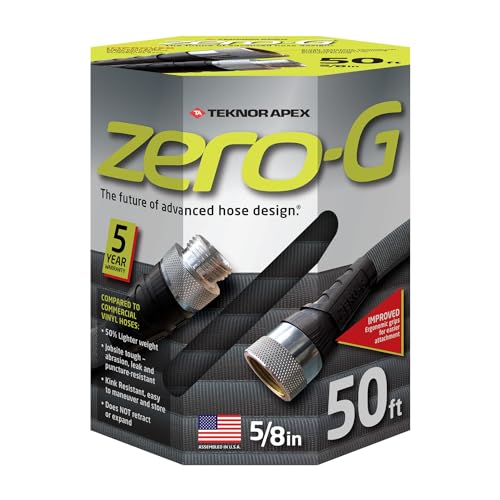
Teknor Apex Zero-G Garden Hose
The Teknor Apex Zero-G is a lightweight hose designed to feel far easier to carry than a conventional rubber hose. In this cluster it is treated as a prose-only pick: no purchase link is published until its listing has been verified, so judge it here on fit rather than on a button. Its natural home is with gardeners who value light weight for frequent, shorter watering sessions. Positioned in the mid tier, it asks you to pay for construction and handling rather than for novelty, and it earns that position when its strengths line up with your longest route and your heaviest regular task. In review terms, this is the comfort champion for smaller gardens: easy to carry, easy to store, and happiest in frequent, lighter sessions.
Best for: gardeners who value light weight for frequent, shorter watering sessions. Not suited for: buyers whose main need is the exact opposite of its design, for example the lightest possible carry when this is a heavy-duty hose, or maximum toughness when this is a lightweight one. Strengths in daily use are consistent handling, fittings that feel secure at the faucet and behaviour you can predict from the first week. The honest trade-off is that no hose wins everywhere: weight, flexibility, toughness and storage bulk pull against each other, and this model simply chooses its side of that argument clearly. Check price on Amazon listings and retailer pages at the time you shop, compare the exact length and diameter you need, and confirm the fitting style matches your faucet and accessories before ordering.

Gilmour Flexogen Garden Hose
The Gilmour Flexogen is a reinforced all-purpose hose aimed at steady, general garden duty. In this cluster it is treated as a prose-only pick: no purchase link is published until its listing has been verified, so judge it here on fit rather than on a button. Its natural home is with households wanting one dependable hose for beds, lawn and patio work. Positioned in the mid tier, it asks you to pay for construction and handling rather than for novelty, and it earns that position when its strengths line up with your longest route and your heaviest regular task. In review terms, this is the balanced all-rounder: unremarkable in the best sense, doing every ordinary job competently season after season.
Best for: households wanting one dependable hose for beds, lawn and patio work. Not suited for: buyers whose main need is the exact opposite of its design, for example the lightest possible carry when this is a heavy-duty hose, or maximum toughness when this is a lightweight one. Strengths in daily use are consistent handling, fittings that feel secure at the faucet and behaviour you can predict from the first week. The honest trade-off is that no hose wins everywhere: weight, flexibility, toughness and storage bulk pull against each other, and this model simply chooses its side of that argument clearly. Check price on Amazon listings and retailer pages at the time you shop, compare the exact length and diameter you need, and confirm the fitting style matches your faucet and accessories before ordering.
Who Should Buy It, and Who Should Skip It
Buy a traditional garden hose if you water several times a week, run a sprinkler or soaker line, wash outdoor things, or are simply tired of replacing flimsy hoses. Buy the better-built end of the class if your route is long or your ground is rough. Skip the traditional class, and look at expandable designs, if your storage is tiny, your strength is limited, or your watering is a few pots near the door. Skip the cheapest end of the class in almost all cases: the savings are small and the kinks, leaks and early replacement are not.
Think about hose pricing as buying seasons of service. The cheapest hoses are built to a price: thin walls, basic fittings, materials that stiffen and crack sooner, which can still be rational for a tiny, gentle garden or a temporary need. The middle of the market is the value heartland for most homes, offering reinforced jackets and metal fittings that survive real routines. The premium end buys rubber or advanced hybrid construction, excellent couplings and flexibility that persists in cold weather, and it makes sense exactly when the hose works hard and often. Whichever tier you choose, judge the whole setup cost: the hose, a nozzle you will enjoy using, storage that protects it and the small fittings that make connections painless. A mid-tier hose on a good reel, drained and shaded, will outserve a premium hose stored in a sunlit heap. Spend first on fit for your route and routine, then on construction, and let novelty features fight for whatever budget remains.
Setup, Care and Maintenance Essentials
Storage decides how long a hose stays pleasant to use. Left in a heap on the ground, a hose collects twists, bakes in the sun, grows slippery with algae on the outside and becomes a tripping hazard across any path it crosses. A reel, a wall-mounted hanger or a simple storage pot gives the hose a consistent home where it coils the same way every time, drains as it winds and stays off the walkway. Before you store it, even for a week, straighten the hose, open the nozzle and let the water run out; a hose stored full is heavier, kinks more readily and gives algae and mosquitoes a standing invitation. Keep the storage spot shaded where you can, because ultraviolet light ages every hose material, and keep it close to the faucet, because a hose that is easy to put away actually gets put away. Indoors versus outdoors is less important than dry, shaded and off the ground. Gardeners with small patios should treat storage as part of the purchase decision itself: measure the corner, the pot or the reel footprint before choosing a long, heavy hose that will dominate the space it was bought to serve.
A garden hose asks for very little maintenance, but it does ask consistently. Keep it clean on the outside, since embedded grit abrades the jacket every time the hose slides across paving. Keep it dry inside between uses where you can, because standing water encourages algae that can clog nozzles and make the first spray of the day smell like a pond. Look at the washers each season and replace them at the first sign of flattening or cracking; most mystery drips at the faucet are washer problems wearing a disguise. Run your hands along the jacket now and then, feeling for soft spots, bulges or stiff, faded sections, and treat a bulge as a retirement warning rather than a challenge. Route around sharp corners, lift the hose over thorny or abrasive edges when the detour is short, and never leave it pressurised in blazing sun for days, which stresses both jacket and fittings. Small, regular kindnesses compound: the hose that is drained, shaded and inspected is the hose that is simply never the problem.
Safe watering is mostly unglamorous habits done every time. Before you disconnect a hose or swap a nozzle, turn the water off at the faucet and then squeeze the nozzle to release the pressure still trapped in the line, because a pressurised hose can whip, spray your face or soak the person next to you when a fitting lets go. Route the hose where feet are not: across a path or a patio step it becomes a genuine tripping hazard, especially in the evening or when it hides in grass, so coil the surplus out of walkways and bring the hose in when guests, children or deliveries are expected. Be thoughtful about standing water as well; a hose left full in hot sun can deliver a first burst of surprisingly hot water, so run it briefly onto the ground before turning it on skin, pets or delicate seedlings. Keep electrical tools, extension leads and outdoor sockets away from your watering route, and never leave a pressurised hose unattended where a child could treat the nozzle as a toy. None of this is complicated, but the gardeners who do it automatically are the ones whose watering stays the relaxing ritual it is supposed to be.
Cold weather is the one opponent a hose cannot fight while full of water. Ice expands, and inside a sealed hose that expansion splits jackets and cracks couplings with quiet efficiency. The defence is a short autumn ritual: disconnect from the faucet so the faucet can drain too, open the nozzle, and walk the hose dry, lifting loops so no low section keeps a pocket of water. Coil it big and loose, store it under cover and out of the sun, and use the moment to swap tired washers and inspect for the small cracks that announce themselves as spring leaks. If a hose must stay outdoors in a mild climate, draining still matters, because even occasional frosts find the one night you forgot. Treat winter care as part of the purchase price of any hose, cheap or premium: the best-built hose in the world loses to ice, while an ordinary hose that is drained and sheltered every year routinely outlives fancier rivals left full on a wall.
Before you replace a hose, check whether the fault is actually in the hose. Faucet drips trace to washers far more often than to threads. A crushed or cracked end can be cut off and replaced with a repair fitting, restoring a long hose to full service at the cost of a few centimetres of length. A puncture in the middle takes a splice. These repairs are genuinely within home-gardener ability, and they are the reason experienced gardeners keep washers and a mender in the same box as the hose. The faults that end a hose’s life are different in kind: widespread stiffness and surface cracking from sun, a permanent set of kinks, soft or bulging sections, and repeated leaks at multiple points. Retire those without sentimentality, because a hose that fails under pressure while you are away from the faucet can flood a bed, a path or a window well. Buy with repair in mind, standard threads, honest materials, nothing sealed or exotic, and most faults become maintenance instead of purchases.
Final Verdict
The traditional garden hose earns its place as the garden’s default water tool not by being perfect but by being good at everything watering involves, and by failing, when it fails, in small repairable ways. Choose length by measurement, diameter by your thirstiest job, material by workload, and fittings by feel, then store it drained and shaded. Do that, and the hose reviewed here is the rare purchase that becomes less noticeable every year precisely because it works, which is the highest praise a tool can earn.
A Season-by-Season Rhythm for Hose Owners
Spring is for inspection: reconnect the hose, seat a fresh washer, flush the line, and walk the route checking for winter damage and the drips that announce themselves immediately. Summer is for discipline: drain after hot days rather than leaving water baking inside, coil out of walkways during gatherings, and keep the hose shaded between sessions so the jacket ages slowly. Autumn is for decisions: repair the small faults while parts are easy to find, note whether the hose still matches a garden that has grown, and prepare the winter routine before the first forecast frost makes it urgent. Winter is for absence done properly: disconnected, drained, loosely coiled and under cover, with the faucet protected in cold climates. Gardeners who give the hose these four small appointments a year find that it simply never becomes a problem, which is the entire secret behind the hoses that last a decade. The rhythm also spreads the cost of ownership into minutes, instead of concentrating it into the one dramatic spring morning when a neglected hose fails in front of a queue of thirsty plants.
Troubleshooting: Matching the Symptom to the Cause
Most hose faults announce themselves clearly once you know the dictionary. A drip at the faucet means the washer, until proven otherwise. A drip at the nozzle end means that coupling’s washer or a cross-threaded connection. Weak flow with healthy pressure means a tax somewhere: a kink, a clogged screen, a partly closed valve or a run that is simply long and narrow. A spray pattern that pulses often means air in the line or a sprinkler asking more than the run can give. A hose that will not lie flat was stored twisted and needs patient recoiling in the opposite discipline. A jacket that feels stiff and looks pale has been sun-aged and is entering retirement. A bulge anywhere means stop: retire that hose before pressure makes the decision for you. Working through symptoms in this order, cheapest and most likely first, solves the overwhelming majority of hose problems without buying anything, and it turns the remaining problems into clear, justified purchases rather than guesses.
Water Quality, Sediment and Your Hose
What flows through the hose shapes how it ages. Gritty water, common with well supplies and after mains work, collects in nozzle screens and washer seats, mimicking low pressure and causing drips that get blamed on fittings. The defence is routine: rinse screens whenever flow drops, flush the hose briefly at the start of a session after it has sat unused, and let the first water run onto a path rather than onto delicate seedlings if the hose has baked in the sun. Hard water leaves mineral crusts at couplings over seasons, which a gentle clean during the spring inspection removes before it distorts a seal. Algae growth inside a hose stored full and warm is the other quality issue, solved entirely by draining and shaded storage. None of this asks for special products; it asks for the same drain, flush and inspect rhythm that protects the jacket and fittings too. Water quality is simply one more reason the small habits in this article compound into years of trouble-free service.
Ergonomics: Making Watering Easier on the Body
Watering should not be the gardening job that hurts. Start with weight: drain the hose before dragging it any distance, because a full hose can weigh dramatically more than the same hose empty, and pull it in long straight runs rather than fighting it around corners under tension. A reel with a comfortable handle, or a wall hanger at waist height, removes the bending and wrestling from the start and end of every session. Wands deserve ergonomic respect too, since they let you water baskets and beds without reaching, stretching or holding a heavy pistol grip at arm’s length for minutes at a time. Grip the couplings with both hands when hands are cold or wet, choose fittings with wide collars you can turn without tools, and take the route that avoids lifting the hose over obstacles altogether. Gardeners with arthritis, recovering shoulders or simply long routes should treat these choices as the purchase itself, not as accessories, because the hose you can handle happily is the hose that actually gets used, and unused tools have no value at any price.
Planning the Route Like a Professional
Professionals who water for a living think in routes, and home gardeners benefit from stealing the habit. Walk your property and mark, mentally or on paper, the faucet, the zones in watering order, the corners where the hose must turn, and the obstacles it must not cross: thorn beds, sharp paving edges, driveways with traffic, steps where a hose becomes a hazard. Choose the storage point to serve the route’s start, not merely the wall with space on it. Notice where a hose guide at a corner would save the jacket a thousand abrasions, and where a second faucet or a splitter would shorten the whole system. Revisit the route when the garden changes, because new beds quietly lengthen it and last year’s perfect hose becomes this year’s short one. Ten minutes of route planning explains most of the difference between gardeners who fight their hose and gardeners who never think about it, and it costs nothing but attention.
Why the Traditional Hose Endures
The garden hose has survived every attempt to replace it for a simple reason: it solves the whole problem with almost no infrastructure. Irrigation systems demand design, trenching and maintenance; watering cans demand labour; smart systems demand power, signals and subscriptions. A hose demands a faucet. That simplicity is also resilience: it works in a power cut, moves house in a car boot, adapts when beds move, and can be repaired with parts found in any hardware shop on earth. Its design has refined rather than changed, better jackets, better fittings, better storage, because the underlying idea was already right. When you weigh any modern alternative, including the expandable designs covered elsewhere in this cluster, the fair question is not whether it beats the hose at one trick, but whether it matches the hose across the whole job: reach, flow, toughness, repairability and indifference to infrastructure. Very few challengers do, which is why the traditional hose remains the default against which everything else is measured.
One More Test Before You Decide
Before any purchase, borrow the experience cheaply: stand at your faucet with your current hose, or a neighbour’s, and perform your hardest watering job while paying deliberate attention to your hands, your back and your temper. Note where the hose kinks, where it drags, where the flow fades and how the coiling feels at the end. That ten-minute audit, on your own route, is worth more than any specification, and it converts this review’s general verdict into your garden’s specific one.
What a Longer, Slower Check Reveals About This Garden Hose
A single review session can flatter or condemn a garden hose unfairly, so this section slows the judgement down and looks at what only repeated, ordinary use tends to reveal. Run the garden hose through your least favourite version of its job first, not the easiest demonstration: the awkward corner, the rushed weekday timing, the fuller load, the lower light, or whatever condition in your routine makes this category work hardest. Use a simple decision checklist at the end: the garden hose fits the measured space, suits the real frequency of the job, matches the household’s cleaning temperament, has obtainable parts, and has a named storage home — five yeses make a confident order. Look at replacement parts and consumables for the garden hose while you are still comparing, confirming that the pieces most likely to wear, clog, tear, fade or get lost can actually be obtained without replacing the whole product.
Finally, remember that the best garden hose for your home is the one whose size, habits and upkeep disappear into your routine, leaving only the result behind — a cleaner surface, a better-lit seat, a tidier shelf, an easier job — week after ordinary week. Test the garden hose in the first week under deliberately ordinary conditions rather than saving it for a special occasion, so that any problem surfaces while returning, exchanging or adjusting your setup is still simple. If you want a concrete listing check, take a name already shortlisted in this guide, such as Flexzilla HFZG550YW Garden Hose, Continental Premium Garden Hose and Teknor Apex Zero-G Garden Hose, and verify that exact garden hose listing against the measurements and compatibility questions above, field by field, rather than trusting the headline description alone. Check the floor, wall, ground or surface the garden hose will meet, since level, texture, moisture and finish decide more about everyday performance in garden & lawn settings than most shoppers expect when they are comparing listings on a screen.
Measure before anything else, and measure the garden hose in its working state rather than its packed or folded state, because handles extend, lids open, cords trail, doors swing and users stand somewhere, and all of that belongs in the measurement. Plan the storage home for the garden hose before it arrives, naming the exact cupboard, corner, shelf, hook or stretch of floor, because a product without a home migrates around the house and slowly becomes the clutter it was bought to reduce. Think about who else will use the garden hose and what they will do differently: shorter reach, less patience, stronger habits, no interest in the manual, and a tendency to leave things wherever they were last set down. Keep a short note of what you adjusted on the garden hose during the first month, even just a line on your phone, since those notes turn vague impressions into a setup you can repeat, share or troubleshoot months later.
When something about the garden hose disappoints, change one variable at a time — position, setting, timing, load, accessory or technique — and give the change a fair trial, because changing three things at once leaves you with a better or worse result and no idea why. Watch for edge cases in your own home: the pet that investigates everything, the child who treats every new object as furniture, the guest who uses force where you use familiarity, and the weather, light or season that changes how a garden hose behaves. Decide in advance what good enough looks like for the job the garden hose does in your home, because chasing a flawless result usually costs more time than the flaw itself, and most households are happier with a reliable ninety percent they actually repeat. Notice the small recovery moments: how the garden hose behaves when you pause mid-task, change your mind, need to move it, clean it sooner than planned, or hand it to someone in the household who has never used it before.
If a problem with the garden hose repeats in the same spot or the same stage of the job, treat the pattern as the clue — patterns point to setup, surface or technique, while random problems point more often to the individual unit. Finish the longer check by looking at wear points rather than features: the hinge, seam, edge, wheel, latch, surface or joint on a garden hose that moves, flexes or gets handled most is where its second year is decided, whatever its first week felt like.
Frequently Asked Questions
Is a traditional garden hose better than an expandable one?
For most gardens, yes, as the main hose. A traditional hose delivers steadier flow, feeds sprinklers properly, tolerates dragging and rough ground, and lasts longer. An expandable hose wins on weight and storage size and makes an excellent second hose for patios and pots. The honest answer depends on your hardest job: if that job is a sprinkler on a long run, traditional wins; if it is watering pots beside the door, expandable may serve you better.
How can I tell a well-built hose from a poor one in a shop?
Pick it up and look at the ends. Solid, weighty brass couplings, a jacket that bends without creasing sharply, and a hose that uncoils without a permanent spiral are good signs. Featherweight fittings, a jacket that kinks at a gentle bend in the shop, and vague descriptions of the construction are warnings. Also check that the washer is present and seated in the female coupling before you leave.
Why does the flow at my nozzle feel weak?
Work through the taxes on flow: a long or narrow hose, kinks along the run, partly closed valves, a timer or splitter in the line, and a clogged screen in the nozzle itself. A bucket test, timing a fill at the faucet and then at the end of the hose, tells you whether the run or the attachment is at fault. Fix the actual bottleneck instead of replacing parts at random.
How often should I replace the washer in the coupling?
Inspect it each season and replace it whenever it looks flattened, cracked or perished, or whenever a drip appears at the faucet that tightening does not cure. Washers are among the cheapest parts in the garden and cause a large share of all hose leaks, so keeping spares with the hose turns the most common fault into a one-minute, no-cost fix during any session.
Can a garden hose be left outside all year?
It can, but it will age faster, and in freezing climates leaving it connected and full risks a split hose and even damage to the faucet and house plumbing. The better routine is to disconnect before hard frost, drain the hose fully, coil it loosely and store it under cover. In mild climates, draining and shaded storage still extend life noticeably, because sunlight and standing water age a hose in every season.
What should I do the first time I use a new hose?
Flush it briefly to clear any residue, check the washer is seated, connect hand-tight plus a small extra turn, and unroll it fully along your route before turning the water on. Test every joint for drips, try each nozzle pattern, and note any sharp bend where a reel position change or a short leader hose would help. Then coil it onto its storage exactly as you intend to every time, starting the habit on day one.
Related Guides
garden hose buying guide garden hose reviews: patterns across owners garden hose pros and cons garden hose vs expandable garden hose the best garden hoses roundup garden hose reels that keep storage tidy expandable garden hose review


