Disclosure: As an Amazon Associate, dailyhomedecorating.com earns from qualifying purchases. Links on this page are affiliate links; they cost you nothing extra. Prices and availability change often, so check the current Amazon listing before you buy.
Are food storage bags worth it? Worth it if you store food with any regularity; questionable only if you almost never do — and this article will help you tell which household yours is before you spend anything. Short answer: yes — for any household that freezes, marinates, portions or packs food with any regularity, food storage bags repay their modest cost in saved food, saved space and saved time, and they do it weekly. They are not worth it as an unquestioned habit: bags bought in the wrong grade, the wrong sizes or the wrong material for your household leak value in small amounts forever, and premium versions of the format — vacuum systems, silicone sets — are worth it only for the specific jobs that justify them. This article works through what you actually get, what it really costs beyond money, who the value lands for, and the checklist that settles the question for your kitchen.
Key Takeaways
- Worth it if: you freeze, batch cook, buy in bulk, marinate, or pack lunches — the savings in food waste alone cover the bags.
- Not worth it if: bags would duplicate a container system that already handles your storage, or premium gear would sit unused.
- The value of a bag is measured in the food it saves, which is almost always worth more than the bag.
- Reusable and vacuum versions are worth it only when their specific job — daily reuse, months of freezing — is genuinely yours.
- The cheapest way to make bags worth more is technique: air out, seal checked, label on.
- Check price on Amazon when stocking up, since pack configurations change often.
What You Actually Get When You Buy Food Storage Bags
Start with the most concrete return: food that survives. Every household throws away food it intended to eat — the freezer-burned meat, the half onion that desiccated, the leftovers that went anonymous and then suspicious. Bags attack each of those losses directly. Freezer-grade film and an air-pressed seal keep frozen food in good condition for weeks to months; a bag wrapped around a cut onion or a wedge of cheese keeps the fridge from drying it out; a dated, labelled bag turns leftovers from a gamble into a plan. The arithmetic is lopsided in the bags’ favour: a single rescued portion of meat or a single saved batch of soup is worth more than a whole box of the bags that saved it, and most households rescue that much in the first fortnight.
Second, you get space, and space in a kitchen is money by another name. Flat-frozen bags file upright in a freezer that would otherwise hold a third as much in tubs; bags mould around the fridge’s awkward leftovers instead of demanding shelf geometry. Households have deferred buying a second freezer — a large purchase and a running cost — purely by converting their freezing to flat bags, and small kitchens gain a working margin that no other cheap purchase provides. Third, you get time and ease in the weekly rituals: bulk shops portioned in minutes, marinades that need a fraction of the liquid, lunches packed at speed, a freezer that can be inventoried at a glance because everything in it is flat, transparent and labelled. It is worth pausing on the space point for households that have never frozen flat, because the transformation is the most visible proof of value the format offers. A freezer organised as a file of flat, labelled bags can be inventoried in seconds, thaws individual portions in minutes under water, and wastes almost no volume on air — three benefits that compound daily and that visitors genuinely notice, which is why flat-frozen freezers feature in so many organised-kitchen photographs. Fourth, you get flexibility across the whole category’s range — the same drawer holds the sandwich bag for today’s lunch, the gallon bag for tonight’s marinade and the freezer bag for the month’s meat — a breadth no single container set matches at anything like the cost.
Finally, you get the option value of the format’s branches. The household that starts with disposables can add reusables for the daily rhythm and a vacuum system if bulk buying grows, each step building on the same habits of air removal, sealing and labelling. Few kitchen purchases scale with a household’s life that gracefully, from a student’s single box to a family’s full system, which is part of why the worth-it answer stays yes across such different kitchens — a breadth we also found in food storage bags reviews.
There is one more subtle return worth naming, because it decides borderline cases: bags make other kitchen investments work harder. A slow cooker earns more when its output freezes in portions. A bulk-club membership earns more when its quantities can be divided safely. A garden earns more when its glut can be stored before it spoils. In each case the bag drawer is the cheap enabling layer under an expensive habit, and judging it in isolation understates its worth — the correct unit of analysis is the system it completes. This is also why the worth-it question so often feels lopsided to experienced cooks: they are not really evaluating a box of bags, they are evaluating the whole cooking economy the bags make possible, and that economy is worth a great deal.
In this guide
The Real Costs Beyond Money
Worth-it questions are usually lost on the non-money costs, so here they are in full. Space: modest but real — a working stock of two or three sizes, plus reusables that are bulkier than film, wants a drawer or a cupboard section, and a vacuum machine wants a footprint that small kitchens feel. Maintenance: disposables charge nothing; reusables charge a wash-and-dry cycle after every use, forever, and the charge is collected in the currency households run out of first — evening energy. Learning curve: small but nonzero; the air-removal technique, the seal check, the labelling habit and the freezer horizons all have to be learned once, and the households that skip the learning pay for it in the format’s failure modes. Attention: a bag system asks for thirty seconds of care at each use — track wiped, air pressed, date written — and returns its value only when that attention is actually paid.
There is also the environmental cost, which many households count as real even though it never appears on a receipt. Disposable bags are single-use plastic; a heavy user generates a visible stream of it. The honest accounting, set out in food storage bags pros and cons, weighs that stream against the food waste the bags prevent — and food waste is the heavyweight in that ledger — but a household that counts plastic heavily can shift much of its bag use to reusables and keep the worth-it answer intact, because the format’s value never depended on the disposable material specifically. And there is the failure cost: the rare but real occasions when a seal lets go over a marinade or a freezer bag splits, costing a clean-up and occasionally a meal. Priced in honestly, these costs dent the value; they do not overturn it for any household that uses bags weekly.
One cost deserves a sentence of its own because households consistently underestimate it in advance and overestimate it in practice: the labelling habit. Writing three words and a date feels, in prospect, like bureaucracy; in practice it becomes as automatic as closing the fridge door, usually within the first week, and it is the single habit that most separates the households whose freezers save them money from those whose freezers merely store their guilt. If you take the trial described later in this article, watch this habit specifically — the week it becomes automatic is the week the system’s value locks in.
The Value Equation, Stated in Words Instead of Numbers
Guides like this one do not print prices, because pack prices and configurations change constantly — but the worth-it equation can be stated exactly without them. On the value side: the food rescued from spoilage, valued at what you paid for it; the storage space gained, valued at what extra appliances or a larger home would cost to replace it; and the time saved in portioning, packing and inventorying, valued at whatever your evenings are worth. On the cost side: the bags themselves, which are among the cheapest lines in a grocery shop; the minutes of washing if you run reusables; and the drawer space. For any household that freezes or portions weekly, the first item on the value side — rescued food — exceeds the entire cost side on its own, usually within the first month. That is the whole equation, and it is why the worth-it answer is so robust across households: it does not depend on optimistic assumptions about space or time, only on the mundane fact that food costs more than film.
The equation also shows exactly where the answer flips. If the rescued-food term is near zero — because you rarely store food long enough to spoil — the value side collapses to convenience, and convenience alone may not justify a stocked system. If the washing term is large — a big household, no dishwasher, reusables for everything — the cost side grows until a mostly-disposable allocation wins. And if the space term is negative, as it can be for a vacuum machine in a tiny kitchen, the premium branch fails even when its food term is strong. Worth-it is not a property of the product; it is the output of your household’s four numbers, which is why this article keeps returning you to your own week rather than to any universal verdict. Our food storage bags review supplies the product evidence; your week supplies the numbers.
How the Answer Changes Over Time
A household’s worth-it answer is not settled once. It moves with life, and recognising the movements prevents both under-buying and drawer clutter. The answer strengthens when a household starts batch cooking, takes up a warehouse-club membership, plants a garden, or welcomes a baby — each of which multiplies portioning, freezing and packing. It strengthens again when a child starts school and the lunch economy begins, and when an older relative’s needs bring bulk cooking into the house. It weakens when cooking shrinks to one, when a household moves to daily fresh shopping, or when a container system genuinely absorbs the storage load. It also changes within the year: the same kitchen that barely touches bags in a fresh summer week lives in them during the holiday freeze-and-feast cycle.
The practical consequence is to buy the system in the order life demands it, and to let each stage prove itself before funding the next. The box of freezer bags comes first and teaches you your sizes. The reusable set comes when the daily cycle is visible. The vacuum machine comes when the freezer starts defeating zip bags — and not before, because a machine bought a life-stage early is the category’s most expensive form of clutter. Households that sequence this way find the worth-it answer is yes at every stage, because each purchase was pulled by a job that already existed. Households that buy the final system on day one often conclude the format was oversold, when in fact only the timing was wrong.
Three Households, Three Verdicts
Consider first a couple who took up batch cooking to survive a new baby’s first year. They freeze twelve portions a week, thaw one-handed, and label everything because sleep deprivation makes memory unreliable. For them bags are not worth it in some marginal sense — they are infrastructure, and the rescued-food term of their equation is the difference between home cooking and expensive takeaway on the exhausted evenings. Their verdict is the strongest yes this article can give. Consider second a retired cook in a small flat, shopping daily at a market street, freezing almost nothing, whose fridge holds two days of beautiful fresh food. Her bag use is a handful a month for the cheese ends and the occasional half lemon. Bags are worth it for her too — but the worth is concentrated in a single small box, and a stocked system or a silicone set would be money spent on a life she does not live. Her verdict is a small, precise yes. Consider third a keen home cook who bought the full premium arrangement speculatively: machine, rolls, silicone in four sizes — and whose cooking settled, a year later, into fresh weeknight meals with a fortnightly roast. Half the system idles. His verdict on the premium branches is no, and on the basic box an unqualified yes, and the distance between those two answers inside one kitchen is the entire argument of this article: worth-it lives at the level of the job, not the category.
Who Food Storage Bags Pay Off For
The batch cooker and bulk buyer. This is the clearest yes in the article. Your whole cooking economy runs on dividing large quantities into stored portions, and bags are the cheapest, fastest, most space-efficient way to do it. The food you rescue from freezer burn in a single season pays for years of bags; the freezer space you gain may defer a second appliance. If any household should never ask this question twice, it is yours.
The lunch-packing family. Daily lunches multiply small savings into large ones: bags portion snacks, protect sandwiches, organise the fridge’s small items and — in reusable form — quietly remove a daily disposable habit. The payoff arrives as a calmer morning routine as much as a financial one, and the children in such households often end up running the system themselves, sliders and all, which is value no spreadsheet captures.
The small-kitchen cook. When storage space is the binding constraint, the bag’s collapse-around-food geometry is worth more than its price many times over. A freezer that files flat bags holds a real pantry’s worth of food in a space that would otherwise hold a few tubs and a lot of air. For this household the question is not really whether bags are worth it — it is what else could possibly do the job in the same cubic inches, and the honest answer is nothing at the price.
The gardener and the seasonal cook. A harvest arrives in a rush and must be frozen within days. Bags — vacuum for the long keepers, freezer zips for the rest — are how a glut becomes a winter’s supply instead of a compost donation. The value concentrates into a few weeks a year and is enormous within them.
Who Should Skip Them — or Buy Much Less
The container-complete kitchen. If your storage is already handled by a container system that genuinely covers your fridge and freezer, and your cooking involves little marinating, portioning or freezing, bags add a drawer of duplication. Buy one box of freezer bags for the occasional job and let the question rest.
The fresh-daily cook. Households that shop daily, cook from scratch and freeze almost nothing simply do not generate the jobs bags exist for. A handful of bags for the rare leftover is plenty; a stocked bag drawer is a subscription to a service you do not use.
The premium-curious. The clearest not-worth-it in this article is not the humble box — it is the premium gear bought on aspiration. A vacuum machine for a freezer that turns over in a fortnight, or a silicone set for a household that will not wash it, converts a genuinely valuable format into shelf decoration. Skip the premium until a real, repeated job asks for it by name; the basic format will tell you when, by starting to fail at the job in question — food outlasting zip bags in the freezer is the vacuum system’s job application, written in freezer burn.
The minimalist. A related case: the cook who keeps a deliberately tiny kitchen and experiences every additional system as clutter. For this household the worth-it calculus includes a real clutter cost that other kitchens shrug off, and the right answer is often the smallest possible footprint of the format — one size of freezer bag, nothing else — held to a strict standard: if a month passes without the box being opened, it leaves. Minimalism and bags are compatible, but only at the format’s most disciplined dosage.
The Strengths and Trade-Offs of Owning Them
Strengths
- Food savings: the format pays for itself in rescued food, typically within the first few weeks of use.
- Space multiplication: flat freezing and collapse-around-food storage expand a small kitchen’s real capacity.
- Versatility per penny: one drawer covers lunches, leftovers, marinades, portions and freezing across every cuisine.
Trade-offs
- Ongoing habit cost: disposables are a perpetual small purchase; reusables are a perpetual small chore.
- Discipline dependence: value leaks away through unpressed air, unchecked seals and unlabelled bags.
- Plastic footprint: the disposable stream is real, and reducing it takes deliberate allocation to reusables.
Alternatives to Consider Before You Decide
The main alternative is a rigid container system, and for some kitchens it is the right lead format: dry pantry goods, fragile items, reheating in the vessel and the longest dry storage all belong to containers, and a household whose storage is mostly those jobs may find bags a supporting purchase only. The representative choice, if you go container-led, is a set of airtight canisters for the pantry backbone — the approach detailed in our companion guides — with bags retained for the freezer and the marinades. Wraps and foil form the second alternative: unbeatable for moulding around odd shapes and for short covering jobs, weaker on seals, liquids and storage duration. Doing nothing — relying on original packaging — is the third alternative and the weakest: manufacturer packaging is built for transport, not for the weeks after opening, and the food losses it permits quietly exceed the cost of any bag system.
Within the bag format itself, the alternative worth naming is upgrading the branch rather than abandoning the format. If disposables’ waste is what makes you hesitate, the reusable branch answers it:

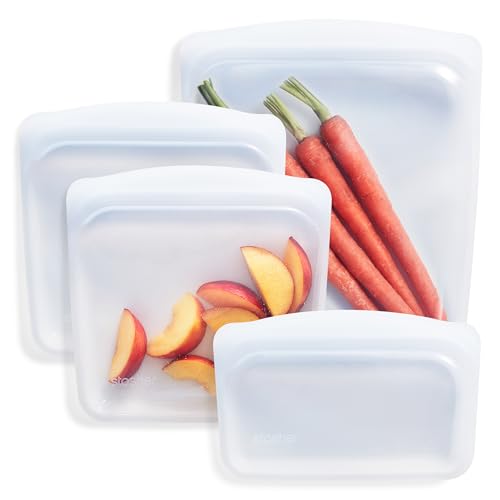
Stasher Silicone Bags — the upgrade that answers the waste objection
A durable silicone set carries the daily fridge, lunch and leftover load for years, is dishwasher-cleaned, and reheats in the bag. It is worth its premium precisely for households whose objection to bags is disposability itself — and not worth it for households whose objection is effort, since it converts a purchase into a routine.
Ziploc Gallon Freezer Bags — the basic format at its best
If the question is whether the plain disposable format earns its place, this is its strongest case: a double-zip, freezer-grade bag whose seal reliability and film quality make the food-saving arithmetic work week after week. Most households that conclude bags are worth it are, concretely, concluding that this box is.
How to Get the Most Value If You Buy
Value in this category is technique-sensitive, so the returns compound for households that adopt five habits. Press the air out — every time, by hand, roll or water displacement — because air is the difference between the bag’s promise and its performance. Freeze flat and file upright, so the freezer stays dense, fast-freezing and legible. Label with contents and date without exception; an unlabelled bag is value deferred to a guessing game. Match the bag to the job’s grade and size, so you never pay freezer prices for a sandwich or lose a roast to a storage-grade film. And allocate by risk: reusables for the safe daily cycle, disposables for raw and messy, vacuum for the archive — the allocation that keeps both the waste and the food losses at their minimum simultaneously. Households that run these habits report the format’s value as obvious; households that skip them often conclude, wrongly, that the bags were the problem. The step-by-step version of this system is in how to choose food storage bags. One further value habit deserves emphasis because it is free: review the freezer monthly. Ten minutes of rotating stock, eating the oldest bags and noting what is running low converts the freezer from a deepening archive of good intentions into a working pantry — and it is during that review that the household actually sees the money the system has saved, laid out in labelled rows. Worth-it stops being an argument at that moment and becomes an observation.
The Hidden Returns Nobody Puts in the Adverts
Beyond the headline equation sit returns that households mention only after living with a system. The first is decision relief: a labelled, filed freezer answers the question of what is for dinner in ten seconds, and a portioned fridge removes the small daily friction of dividing, wrapping and improvising storage for every leftover. The second is cooking confidence: cooks attempt bigger, cheaper, more ambitious food — the whole brisket, the market glut of tomatoes, the double batch of sauce — when they trust the storage waiting for it, and that confidence quietly improves both the household’s meals and its food budget. The third is hospitality: the household with a stocked freezer can feed unexpected guests from portions, and the cook who marinates in bags can scale a recipe for a crowd without a shelf of bowls. The fourth is calmer shopping: buying in bulk stops being a gamble when division and freezing are routine, so the household captures bulk value it previously left on the table out of storage anxiety.
None of these returns appears on a box, and none of them is mystical. They are the compound interest of a storage system that works, and they explain a pattern worth noting: households rarely abandon bags once a system is established, even households that began as sceptics. The format’s retention is itself evidence in the worth-it trial — products that do not pay their way do not get restocked for decades, and the humble food storage bag has been restocked, in one form or another, for generations. Technologies with genuine substitutes available — and bags have many, from containers to wraps to doing nothing — do not survive on habit alone; they survive because the weekly ledger, kept honestly by millions of households, keeps coming out in their favour. That survival is not proof, but it is evidence, and it points the same way as every other line of this article.
What Would Have to Be True for the Answer to Be No
A fair worth-it article should state the conditions of its own defeat. The answer becomes no, for the basic format, if a household genuinely stores almost nothing: no freezing beyond ice, no leftovers that survive the night, no lunches packed, no bulk divided. Such households exist — the daily-market cook, the restaurant professional who eats at work — and for them a bag system is a drawer of good intentions. The answer also becomes no if the household’s storage failures are actually caused by something bags cannot fix: a fridge that does not hold temperature, a shopping habit that buys beyond any storage’s capacity, or a labelling refusal so complete that stored food is never identified in time. In those kitchens the honest advice is to fix the cause first; bags bought into a broken system will be blamed for its failures.
For the premium branches the defeat conditions are narrower and more common, which is why this article separates them. Vacuum is defeated by short storage horizons. Silicone is defeated by an absent washing habit. Large-count buying is defeated by small usage. In each case the product is fine and the fit is wrong — and fit, unlike quality, can be assessed in advance with the checklist below, which is exactly what it is for. Readers who want the underlying product comparisons before deciding can find them in food storage bags buying guide, and the storage furniture that completes a calm kitchen in best closet organizer shelves.
Worth It, Branch by Branch
Because the format has branches with very different economics, here is the verdict disaggregated. Disposable freezer bags: worth it for virtually every household that freezes at all — the cheapest insurance in the kitchen, with the waste caveat answered by allocating them to the jobs that need them. Disposable storage and sandwich bags: worth it in small counts for lunches and fridge overflow, and the first place a household should cut if it wants to reduce plastic, since reusables cover these jobs most easily. Slider bags: worth it wherever hands are wet, cold or weak — a small premium for a closure that removes the category’s most common failure, and genuinely accessibility equipment for some cooks. PEVA reusables: worth it for lunch-and-snack households within a single school term of use, provided expectations about lifespan are modest. Silicone reusables: worth it for daily users with a dishwasher, on a horizon of years; not worth it as a speculative gesture. Vacuum systems: worth it exactly when storage is measured in months or shopping in bulk, and the most commonly mis-bought branch when bought on enthusiasm alone. Store-brand basics: worth it for dry and fridge duty in most kitchens, with the freezer workhorse the one place the name-brand consistency earns its keep.
Notice that every branch’s verdict is conditional on the same variable — the match between the product and a real, recurring job in your kitchen. That is not evasion; it is the actual structure of value in a category this cheap and this varied. The households that get the worth-it answer wrong almost never bought a bad product. They bought a good product for a job they did not have, or declined a cheap product for a job they had every week. The checklist that follows is designed to surface your real jobs before any money moves, and the rest of this cluster — the food storage bags pros and cons ledger and the buying guide — exists to help you act on what it tells you.
The Decision Checklist
Answer yes or no, honestly, for your household. One: do you freeze food for more than a few days at least twice a month? Two: do you buy any food in bulk and divide it? Three: do you marinate, batch cook or meal-prep? Four: do you pack lunches or snacks to leave the house? Five: is fridge or freezer space tight enough that you have ever played storage Tetris? Six: have you thrown away freezer-burned or dried-out food in the past few months? Seven: will someone wash reusable bags the same day, if you buy them? Read your answers as a portrait rather than a score, too: the pattern of yeses tells you which branch of the format your value sits in — freezing yeses point to freezer grade and possibly vacuum, packing yeses point to reusables and sliders, space yeses point to the flat-filing system — so the checklist doubles as a shopping list once the verdict is in. Score it plainly: three or more yes answers among the first six means food storage bags are worth it for you, full stop — buy the core sizes in freezer grade and start. Yes on seven as well means add reusables to the system. Mostly no answers means buy a single modest box for the occasional job and spend the money where your kitchen actually lives. And whatever the score, let the premium branches wait until a repeated job asks for them — that patience is the difference between a system that is worth it and a drawer that merely cost it.
The Opportunity Cost Question, Asked Fairly
Every purchase competes with another use of the same money and space, so a complete worth-it analysis asks what you would do instead. The money in a bag system is small enough that the honest competitor is not another appliance — it is the ongoing cost of the food waste itself, priced in thrown-away portions, repeat purchases of spoiled ingredients, and takeaway meals ordered when the freezer held nothing usable. Against that competitor, bags win for any storing household. The space competition is more interesting: a bag drawer competes with a container shelf, and in small kitchens that contest is real. The resolution most small kitchens reach — bags for the cold and wet work, a compact container set for the dry — fits both into less space than either format needs to cover all jobs alone, because each is used only where its geometry wins. The attention competition is the subtlest: a bag system asks for small, frequent acts of care, while a container system asks for washing and stacking of heavier items. Households differ in which attention they have; the checklist below is partly a way of discovering yours before the drawer does it for you.
There is also a timing opportunity cost in delaying. Every month a storing household runs without a decent bag system, it pays the format’s absence in spoiled food and cramped freezing — a quiet, unitemised subscription to waste. That is why this article’s advice is sequenced the way it is: the cheap core first, immediately, because its value starts the day it arrives; the premium branches later, when their jobs have proven themselves, because their value depends on a fit that only time can confirm. Asked fairly, then, the opportunity question does not weaken the yes — it sharpens it into a yes with an order of operations.
The One-Month Trial That Settles It for Your Kitchen
If the checklist leaves you undecided, run the trial this article recommends to every borderline household, because it converts opinion into evidence for the price of one box. Buy one box of freezer-grade bags in your likely hero size — gallon for freezers, quart for fridge households — plus a marker. For one month, use them with full technique: air pressed out, seals checked, everything labelled and dated, flat freezing for anything liquid or portioned. Keep a note on the fridge door of every item the bags rescue — the portion that would previously have been binned, the leftover that got eaten because it was labelled, the bulk buy divided instead of wasted. At month’s end, read the note. In our experience of this category, the rescued list settles the question more persuasively than any article, including this one: households either see a page of saved food and restock without debate, or see three entries and know, with evidence, that their kitchen genuinely does not need the system. Either outcome is a success, because the question was answered by your kitchen rather than by a stranger’s verdict — and the trial’s total cost, if the answer is no, is one mostly-used box of bags.
Extend the same trial logic upward if the basic format proves itself. The reusable question gets a one-term trial with an affordable set. The vacuum question gets answered not by a trial — the machine is too large a step — but by watching your freezer: if food repeatedly outlives your zip bags’ honest horizon, the trial has already happened, in the form of the freezer-burned evidence, and the machine’s worth is no longer speculative. This staged, evidence-first approach is the through-line of the whole cluster, from food storage bags reviews to the buying guide, because in a category this cheap, your own data is the best reviewer you will ever hire.
Final Word
So: are food storage bags worth it? For the great majority of kitchens, yes — not as a slogan, but as an accounting result that survives honest scrutiny of the costs, including the non-money ones this article has insisted on listing. The format rescues food worth more than itself, multiplies small storage spaces, and underpins the batch-cooking and bulk-buying economies that define modern home kitchens. Its failures are failures of fit and technique, both of which are knowable in advance and cheap to correct. Buy the core format for the jobs you actually have, run it with the five habits, let the premium branches earn their invitations, and the question will not need asking again — your freezer, filed flat and labelled, will answer it every time you open the door.
A closing note on certainty: this article’s yes is not a guarantee about any single box, because individual products vary and the reviews in this cluster name the ones whose seals and films justify the trust the system places in them. Worth-it is a property of a format used well, with decent products, in a kitchen whose jobs match. Secure those three conditions — decent products, decent technique, real jobs — and the verdict has been the same in kitchen after kitchen, which is as close to certainty as honest advice in this category gets.
Earning Its Keep: The Long View on Owning a Food Storage Bags
Whether a food storage bags is worth it is rarely settled on the day it arrives, so this section judges value across ordinary weeks of ownership: how often it is used, what it replaces, what it costs in space and upkeep, and the point at which it has quietly paid for its place in the home.
Start With Your Space and Your Routine
Photograph the food storage bags as delivered, before assembly or first use, so that any later question about condition, parts or finish can be answered from evidence rather than memory. Storage is part of ownership, so decide now where the food storage bags, its accessories and its seasonal extras will go when they are not in use, and measure that space too. Guests notice different things than owners do, so if the food storage bags will be used by visitors, test it from a fresh user’s point of view, without the habits you have already built around it. Where the food storage bags has moving parts, work them through their full range during your first checks, listening and feeling for roughness that a photograph cannot show.
If you already own something that does part of the food storage bags’s job, judge the newcomer only on the improvement it adds, since paying twice for the same capability is where value usually leaks away. Start by writing down the job the food storage bags has to do in your home, in one plain sentence, before you look at another listing, because a clear job statement turns a long shortlist into a short one. Apply the same checks to each shortlisted example, whether that is the Stasher Silicone Bags; the Ziploc Gallon Freezer Bags, because consistent testing is what makes the differences between models visible. Look for the detail photographs in the listing, not just the wide shots, and zoom in on edges, joints, fasteners, controls and finishes, which is where build quality usually shows itself first.
Consider the busiest version of the day, not the calmest one, and ask whether the food storage bags still works when people are hurrying, carrying things or sharing the same space. Small problems are easiest to solve in order: check position first, then adjustment, then cleaning, and only then conclude that the food storage bags itself is at fault. When something about the food storage bags starts to annoy you, note whether the cause is the product itself, its position, or the way it is being used, since each cause has a different and usually cheaper fix. Decide in advance which single feature you would refuse to compromise on, and let that one priority settle ties between otherwise similar food storage bags choices.
When Small Problems Appear
Keep the fittings, spare parts and instructions that come with the food storage bags together in one labelled place, because the part you need in a year is always the one that was put somewhere safe. Count the hidden costs of owning the food storage bags as part of the worth question: the space it occupies, the accessories it needs, the cleaning it demands and the storage it takes when idle. Households with children or pets put different demands on a food storage bags than the listing photographs suggest, so judge edges, stability and cleanability against your real household, not a styled one. Ask how the food storage bags will be cleaned on an ordinary week, with the products and time you actually have, not with a special routine you are unlikely to keep up.
A food storage bags that fits on paper can still fail in daily use if a doorway, a corner, a cupboard door or a walkway cuts into the space it needs, so trace the full path from delivery to final position. When you compare delivery options for a food storage bags, factor in where the item will be left and who will move it to its final spot, since the last few metres are where damage and strained backs happen. Measure the space where the food storage bags will live, including the clearance needed to use it, move around it and clean behind or beneath it, and keep those numbers beside you while you compare options. Write down the three tasks you will do most often with the food storage bags and score each shortlisted option against those tasks alone, ignoring features you are unlikely to touch.
Keep the care routine simple enough to repeat: a food storage bags that needs ten minutes of attention weekly will usually get it, while one that needs an hour monthly often gets none.
A Short Decision Checklist
- How the food storage bags will be cleaned in an ordinary week
- The main job the food storage bags must do, written in one sentence
- Delivery path, from the door to the final position
- What your current arrangement does well that the food storage bags must not lose
- Who will use the food storage bags most, and any limits they have
- Where the food storage bags and its accessories will be stored when not in use
- Packaging kept until the food storage bags has passed its first trial in place
- What your current arrangement does badly that the food storage bags must fix
Taken together, these checks take only a little time, yet they answer the questions that decide whether the food storage bags suits your home, your household and your routine, and they do so before money changes hands rather than after.
Frequently Asked Questions: Are Food Storage Bags Worth It?
Are food storage bags worth it for a small household?
Yes, usually more so than for a large one. Small households buy small quantities that spoil in part — half an onion, a wedge of cheese, two chicken breasts from a pack of four — and bags are precisely the tool that rescues the remainder. A single person who freezes portions also gains the ability to cook once and eat three times, which is where the format’s value concentrates at small scale.
Are reusable food storage bags worth the extra cost?
They are worth it if they will be used daily and washed reliably: a silicone bag’s cost divides across years of service until it undercuts disposables, and a PEVA set pays back across a season of lunches. They are not worth it if they will sit unwashed or unused — an idle premium reusable is the worst value in the category. Test the habit with an affordable set first if you are unsure.
Is a vacuum sealer and its bags worth it?
For households that freeze food for months or buy meat and produce in bulk, yes — the food it saves from freezer burn repays the system, and the storage quality is unmatched. For households whose freezer turns over in weeks, no: a good freezer zip bag with the air pressed out does the job at a fraction of the commitment. The deciding variable is storage duration, not enthusiasm.
Do food storage bags actually save money?
They save food, which is where the money is. The bags themselves are among the cheapest items in a kitchen; the meat, cheese, produce and leftovers they protect are not. A household that rescues even a few portions a month from the bin comes out ahead, before counting the space and time benefits. The savings shrink only when bags are misused — wrong grade, wrong size, no air removal — which is a technique issue, not a format flaw.
Are food storage bags worth it environmentally?
Judged on the full ledger, generally yes. Disposable bags carry a plastic cost, but spoiled food carries a far larger environmental cost, and bags prevent spoilage. The strongest position combines both: prevent food waste with bags, and cut the plastic by allocating daily, safe jobs to reusables. A household that does both can hold the worth-it answer on environmental grounds as comfortably as on financial ones.
When are food storage bags not worth it?
When the jobs do not exist: households that rarely freeze, marinate, portion or pack gain little beyond a single modest box. And premium versions are not worth it speculatively — vacuum systems and silicone sets earn their place only when a repeated, specific job demands them. Buy the basic format for real jobs, and let upgrades be pulled by need rather than pushed by marketing.
Related reading: food storage bags buying guide · food storage bags vs reusable silicone bags · best mini fridges · best storage baskets · best under bed storage


