Disclosure: As an Amazon Associate, dailyhomedecorating.com earns from qualifying purchases. Links on this page are affiliate links; they cost you nothing extra. Prices and availability change often, so check the current Amazon listing before you buy.
These food storage bags pros and cons are written for the reader who is tired of one-sided takes. Food storage bags are neither the plastic villain of one argument nor the flawless kitchen hero of another; they are a format with genuine, structural advantages and genuine, structural drawbacks, and both sides follow from the same design: a thin, flexible, sealable pouch. Everything good about them — the space they save, the air they exclude, the portions they make effortless — comes from that thinness and flexibility, and everything frustrating about them — the seal that can fail, the waste they can generate, the protection they cannot offer — comes from exactly the same place. This article lays out the pros with the evidence for each, the cons with equal honesty, and then translates the balance into decisions for different kitchens — because the right question is never whether bags are good or bad, but whether their particular trade-offs fit your particular week.
Quick verdict. Food storage bags suit households that freeze, marinate, portion and pack — which is most households — provided the bags are matched to their jobs and the hygiene rules are respected. They suit least the households expecting one format to replace every container, and anyone unwilling to think about seals, air and labels. The balance of this article: the pros are about capability, the cons are about discipline and waste, and capability usually wins where discipline is present. Read the two columns as a matched pair rather than a contest — almost every pro below has a corresponding con that is simply the same property viewed from the other side, and recognising the pairs is the fastest route to knowing whether this format fits your kitchen.
Key Takeaways
- The core pro: bags collapse around food, saving space and excluding air better than rigid formats.
- The core con: disposables create single-use waste, and reusables demand washing discipline.
- Seal dependence cuts both ways — a bag’s greatest convenience and its greatest fragility are the same feature.
- Freezer burn is a technique problem more than a product problem; bags reward air removal.
- Bags complement containers rather than replacing them; the strongest kitchens use both.
- Check price on Amazon for current pack options when you decide to stock up.
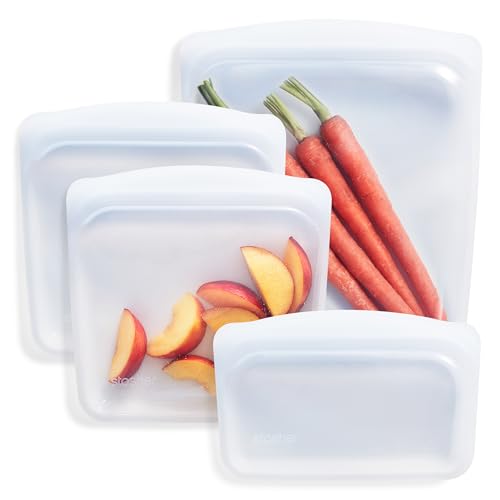
The Pros of Food Storage Bags
Pro: They use space like nothing else in the kitchen
A bag takes the shape of its contents. A cup of soup in a bag is a flat, file-able envelope; the same soup in a container is a cylinder of mostly air once you have eaten half. Across a whole freezer this compounds dramatically — flat-frozen bags stack and file with almost no wasted volume, which is why a modest freezer can hold a month of batch cooking in bags and a week of it in tubs. The same logic works in the fridge, where bags mould into the gaps between jars and bottles, and in a lunchbox, where a bag weighs nothing and conforms to whatever space remains. For small kitchens especially, this is not a minor convenience; it is the difference between a storage system that fits the home and one that fights it.
Pro: They exclude air, and air is the enemy
Staleness, freezer burn and oxidation all need air. A rigid container traps a fixed volume of it above the food no matter how little food remains; a bag can be pressed, rolled or vacuumed until the film touches the food almost everywhere. That contact is why bagged food keeps its surface moisture and flavour better than the same food in a half-empty tub, and why the vacuum variant of the format — which removes air mechanically — extends freezer life further than any other home method. The pro is not magic; it is geometry. The format that can expel its own atmosphere starts every storage job ahead.
Pro: Marinating and portioning are built for the format
A bag wraps marinade around food, so a small amount of liquid does the work of a bowlful, and turning the bag redistributes it without utensils or mess. Portioning is equally native: bulk meat, produce or dough divides into meal-size bags in minutes, each labelled, each thawing independently. These are not edge cases — they are weekly jobs in most kitchens — and no other storage format performs them as quickly, as cheaply or with as little washing up. Meal-prep culture, batch cooking and warehouse-club shopping all run on this pro.
Pro: They are cheap, light and everywhere
Per use, a disposable bag is among the cheapest objects in the kitchen, and even the premium reusable end of the category costs little against the food it protects. Bags are sold everywhere, weigh nothing, travel anywhere, and ask for no storage infrastructure beyond a drawer. That accessibility matters: a storage system people can replenish at any shop, lend to a neighbour, or pack for a trip without thought is a system that actually gets used, and a system that gets used beats a theoretically superior system that sits in a cupboard. The format’s cheapness also makes experimentation cheap — trying a new size or type costs almost nothing, which is how households find their fit.
Pro: Visibility and labelling keep food honest
Most bags are transparent, and freezer bags carry write-on areas, so contents and dates are visible at a glance. That sounds trivial until it is compared with the opaque tub of mystery leftovers or the foil-wrapped parcel of unknown age. Visibility is a food-waste feature: food that can be seen and dated gets eaten; food that hides gets thrown away. In a well-run bag system, the freezer reads like a filing cabinet — flat, labelled, dated — and the weekly shop can be planned against what is actually there.
Pro: The reusable branch keeps improving the format
The category is not standing still. Silicone bags brought heat tolerance, dishwasher care and multi-year life to a format that was once purely disposable; lightweight PEVA reusables brought the familiar zip-bag experience into washable form; vacuum rolls eliminated size waste. The pros of the classic format — space, air exclusion, portioning — survive intact in these branches, while the classic format’s biggest con, single use, is directly addressed. A category whose weaknesses are being engineered away while its strengths persist is a category in good health, a point our food storage bags review documents product by product.
Pro: Portion control comes free with the format
A quieter pro, but one many households feel in their budget and their waistlines: bags are portioning instruments. Bulk food divided at the point of storage becomes single meals by default, which removes the daily negotiation of how much to thaw, cook or pack. Snacks decanted into single servings stop being an open family-size bag on the counter. Freezer portions thaw one at a time instead of committing a whole joint to a Tuesday. None of this requires willpower at the moment of eating, because the decision was made once, calmly, at the point of packing — the most reliable kind of portion control there is, and a benefit no rigid container replicates as naturally, since containers invite refilling to their own size rather than the meal’s.
In this guide
The Cons of Food Storage Bags
Con: Disposable bags are single-use plastic
The most obvious con deserves first place and no softening. A household that portions, marinates and packs daily can use hundreds of disposable bags a year, each for minutes to months, each persisting far longer as waste than it ever did as storage. Recycling routes for clean film exist through store drop-off schemes in some areas, but much of it is not recycled in practice. The honest mitigations are behavioural: reusables for the safe, high-frequency jobs; disposables reserved for raw meat, long freezes and travel; and sizes matched to contents so film is not wasted on air. The con is real, but it is a con of degree and habit, not an absolute — and it must be weighed against the food waste bags prevent, which carries its own heavy footprint.
Con: Everything depends on a seal
A container’s lid is a mechanism; a bag’s seal is a hope backed by friction. Press seals fail when the track is wet, greasy or crumb-fouled; sliders can crack; pinch-locks can pop under pressure; even vacuum welds can hide a slow leak from a wrinkled fold. Every failure mode is silent — the bag does not announce that it has stopped protecting the food — so the cost arrives later as a leak, a smell or a freezer-burned surface. Better designs reduce the risk substantially, and technique reduces it further, but the structural truth remains: the format’s convenience and its fragility are the same thin line of closure, and no purchase removes the need for a five-second check.
Con: Bags do not protect against crushing, pests or time
A bag is a membrane, not armour. Crisps, crackers, ripe fruit and anything fragile will be damaged in a bag under load; dry goods in bags are open invitations to pantry pests over long spans; and even the best zip bag only slows freezer burn rather than defeating it across a season. Households that ask bags to do a container’s jobs — the long dry store, the protective shell — will be disappointed in ways that are not the product’s fault. The format’s cons here are really boundary markers: bags are the flexible layer of a storage system, and a system still needs its rigid backbone for the pantry and its heavy protection for the long haul, which is why our food storage bags buying guide recommends the two formats together.
Con: Reusables shift the cost from money to effort
The reusable branch solves the waste con and immediately introduces an effort con. Every reusable must be washed and — the step that actually matters — dried fully, propped open, after every use. That is a small task performed hundreds of times, and its failure is not neutral: a damp-stored reusable becomes unhygienic, and a household that will not maintain the rhythm ends up with the worst of both formats, premium bags in the cupboard and disposables in use anyway. Silicone’s dishwasher compatibility softens this con more than any other feature in the category, which is precisely why it anchors the premium end.
Con: The raw-meat rule limits reuse where it is most tempting
The bags a household uses most heavily — portioning raw meat and chicken — are exactly the bags that must never be washed and reused in disposable form, for sound cross-contamination reasons. This frustrates the frugal instinct and surprises people who assumed all bags could simply be rinsed. It also shapes the economics: the highest-volume job in many kitchens stays disposable by necessity, so a fully reusable kitchen is not an available option, only a mostly reusable one. Any honest pros-and-cons account has to carry this limit plainly, because advice that glosses over it is not frugal — it is unsafe.
Con: Heat is mostly off limits
Standard disposable bags cannot cook, reheat or take a water bath; they are storage-only, and using them with heat they were not designed for is a genuine misuse. Silicone and rated vacuum bags carve out exceptions, but the default assumption for the format is cold and ambient duty. Households whose cooking style leans on reheating portions in their storage vessel will find containers more convenient, and should count this con at full weight — it is a daily friction, not a rare one.
Con: The category’s choice overload is real
A final, practical con: the shelf itself. Dozens of sizes, grades, closures and material claims, with the genuinely important distinctions — freezer grade versus storage grade, textured versus smooth vacuum film — stated in the smallest print, means the format regularly fails people before they reach the kitchen. Buyers freeze in sandwich bags, buy smooth film for a channelled machine, or stock four sizes and use one, not from carelessness but because the category communicates badly. This page and its companions exist partly as the antidote, but the con belongs in the ledger: a format this simple should not require a guide, and the fact that it benefits from one is a mark against how it is sold.
What the Trade-Offs Mean for You
For the freezer-led household — batch cooking, bulk buying, garden produce — the pros dominate decisively: space, air exclusion and portioning are exactly your needs, and the cons are managed by choosing vacuum for the archive and disposables for the raw work. For the lunch-and-leftover household, the balance still favours bags, but the reusable branch carries the argument: the waste con is answered by PEVA and silicone, and the effort con is answered by an honest look at your sink habits before you buy. For the pantry-led household storing dry goods for months, the cons win more often — bags should be the supporting format there, with containers in the lead. For the small kitchen, the space pro is so strong that bags usually anchor the system even where their cons are felt. And for the household that travels, camps or packs food to go, the weight and conformity pros are close to unanswerable. The full decision walk-through lives in are food storage bags worth it; this page’s job is to make sure you walk into it knowing both columns by heart.
Two further profiles sharpen the point. The student or first-flat cook, cooking small quantities with a tiny fridge and a tighter budget, should weight the price and space pros heavily and the waste con lightly — at low volumes the absolute waste is small, and a modest box of freezer-grade zips plus one silicone bag for leftovers covers nearly everything. The zero-waste-committed household should weight the columns in the opposite direction and accept the effort con at full price: silicone for the cold work, PEVA for the dry, containers for the pantry, and disposables admitted only for the raw-meat jobs where safety leaves no alternative. Both profiles are behaving rationally; they simply hold different values, and the pros-and-cons format serves them precisely because it refuses to collapse those values into a single score.
Food Storage Bags in Context: Two Alternatives
Against rigid containers, bags win on space, air exclusion, marinating and price, and lose on crush protection, pest resistance, reheating and the long dry store. Against wraps and foil, bags win on sealing, liquids and reusability of the system, and lose on moulding to odd shapes and on the wrap’s zero-washing simplicity. Neither alternative dominates; each covers a band of jobs. The kitchens that feel organised are almost never single-format kitchens — they are kitchens where bags handle the cold, the wet and the portioned, containers handle the dry, the fragile and the reheated, and wraps handle the odd-shaped remainder. Judging bags against that division of labour, rather than against an impossible all-jobs standard, is what makes their pros and cons come out so clearly in their favour for most homes — a comparison we run head-to-head for the bag family itself in food storage bags vs reusable silicone bags.
The Pros and Cons by Material
The balance shifts with material, and a household choosing its side of this debate should know how. Polyethylene disposables hold the strongest convenience pros — price, availability, zero care — and the strongest waste con. Their seal con is moderate in double-track form and severe in the cheapest single-track form, which is why the generic end of this material disappoints so many first-time buyers. PEVA reusables soften the waste con considerably and add a mild effort con; their protection pros are the format’s standard ones, while their durability is the weakest of the reusables, so their value pro depends on modest expectations honestly set. Silicone holds the strongest durability and heat pros in the category and the mildest long-run waste con, balanced by the strongest upfront-cost con and a drawer-bulk con that small kitchens feel. Vacuum laminate holds the single most powerful pro in this article — storage duration — and pairs it with the system con: a machine, minutes per bag, and film that is single-use by design. There is no material without a con column; there are only materials whose cons your household will barely notice. That, in the end, is the selection principle this whole page reduces to.
Three Representative Products, and How the Balance Lands on Each
Ziploc Gallon Freezer Bags
The disposable benchmark embodies the classic balance: excellent space, air and portioning pros; a seal that rewards care; and the full single-use con carried openly. For a household whose bag work is mostly freezing and marinating, its pros land weekly and its main con is the price of admission. Check price on Amazon for current box counts if it becomes your standard.

Stasher Silicone Bags
The silicone benchmark flips the balance: the waste con nearly vanishes across years of use, heat joins the pro column, and the cons migrate to upfront cost, bulk and washing discipline. For a household with a dishwasher and a leftovers rhythm, it is the strongest net position in this article; for a household without the washing habit, it is the weakest, because an unused premium reusable is all con and no pro.

FoodSaver Vacuum Seal Bags
The vacuum system holds the most lopsided balance: an unmatched duration pro against system cons of cost, space and effort. It is the easiest product here to judge, because the question is singular — does your food spend months in the freezer? If yes, its pros overwhelm; if no, its cons stand alone with nothing to answer them.
Where the Pros Are Oversold — and Where the Cons Are Exaggerated
Honest balance requires auditing both columns against the claims made for them elsewhere. Start with the oversold pros. “Airtight” is the most abused word in the category: a zip bag is air-resistant with good technique, not airtight in the way a welded vacuum bag is, and any freshness claim built on the word should be discounted accordingly. “Freezer protection for a year” on a zip bag is the second oversell; the realistic horizon is weeks to a few months, and the gap between claim and reality is where freezer-burned disappointments are born. The third oversell is the space claim applied to liquids in rigid meal-prep routines — bags do save space, but a household reheating portions daily may find containers’ stackability worth more than bags’ conformity, and the pro should not be quoted without that context.
Now the exaggerated cons. The claim that any plastic bag use is environmentally indefensible ignores the food-waste ledger entirely, and food waste is the heavyweight in that ledger: the resources inside a wasted joint of meat exceed those of the bag many times over, so a bag that prevents the waste is a net environmental positive in the honest accounting. The claim that reusables are unhygienic is equally overstated — a silicone bag through a dishwasher is as clean as any plate in the same load, and the hygiene risk lives in neglected drying, not in the concept. The claim that bags are flimsy compared with containers ignores that they are asked to do different work; judged on their own jobs — the marinade, the portion, the flat freeze — they are not the weak option but the only practical one. A balanced reader should hold both audits at once: discount the marketing pros, discount the absolutist cons, and what remains is the true, useful balance this article has tried to state.
A Year in a Kitchen That Uses Bags Well
Abstract balances become concrete across a year. In January the freezer holds flat, labelled bags of holiday leftovers and sale meat, filed upright, and the household eats from it confidently because every bag carries a date — the visibility pro, paying out. In spring the marinades begin, and the portioning pro carries barbecue season: chicken in freezer bags with the marinade already in, thawing and flavouring in one step. Summer tests the cons — picnic leaks punish any seal closed carelessly, and the household learns the double-bag rule for anything liquid that travels. The garden glut of late summer is where the vacuum system, if owned, justifies itself in a fortnight, and where zip-bag households learn their format’s honest horizon by eating the oldest bags first.
Autumn is the school-lunch season, when the reusable branch does its quiet work: PEVA bags cycling daily, silicone carrying the soups, disposables appearing only for the raw and the messy. The effort con is felt on the tired evenings — and survived, because the dishwasher carries most of it. Winter returns to the freezer, and the year’s last lesson is rotation: the household that labelled and filed in January eats well in December, while the bags at the very back, the ones nobody dated, are the year’s small, avoidable waste. Across the whole year the pattern is the article in miniature: the pros arrive on schedule wherever the jobs match the format, the cons appear exactly where discipline lapsed, and the difference between a household that loves its bags and one that curses them is rarely the products. It is the handful of habits — air out, seal checked, label on, raw rules kept — that this page has repeated because they are, genuinely, the whole game. Readers building the rest of a calm kitchen around that system will find the same job-first logic in best closet organizer shelves.
The Balance, Food by Food
Because the trade-offs land differently on different foods, here is the balance worked through the items households actually store. For raw meat portions, the pros — portioning, flat freezing, marinade contact — are at their strongest and the reuse con is absolute: disposable or vacuum, once, and the discussion ends. For cooked leftovers, the balance tilts reusable: the food is safe to handle, the cycle is daily, and silicone’s heat tolerance adds a pro no disposable can match, since the storage vessel becomes the reheating vessel. For produce, the balance is gentle either way — bags protect well, reusables wash easily, and the main con is the temptation to seal delicate items so tightly they bruise or sweat, which a little headspace answers. For dry snacks and lunch items, the waste con weighs heaviest because the stakes are lowest: a snack does not need a fresh disposable, and this is where PEVA reusables post their clearest win. For liquids, the seal con weighs heaviest: soups and stocks punish every closure weakness, and the balance favours silicone’s pinch-lock or a double zip used with the bowl-under rule. For long-stored bulk foods, the duration pro of vacuum outweighs every con on its side of the ledger, provided the household eats what it freezes — a vacuum bag of food thrown away uneaten in a year is the one outcome worse than freezer burn.
Reading down that list, a rule of thumb emerges that this article has been circling: the higher the food’s value and the longer its storage, the more the pros dominate; the lower the stakes and the shorter the cycle, the more the waste and effort cons deserve the deciding vote. Households that apply the rule food by food, rather than declaring one format the winner for everything, end up with the hybrid drawer this page keeps recommending — not as a compromise, but as the correct answer to six different questions that were never really one question.
The Effort Ledger: What Each Side Really Costs You Weekly
Money aside — this site does not print prices in guides like this, and pack costs shift constantly — every format charges in minutes and attention, and the ledger is worth stating plainly. Disposables charge almost nothing per use: seconds to seal, nothing to wash, a small recurring cost in restocking and in the low-grade guilt some households attach to the bin. Their hidden charge is vigilance: the seal check, the air press, the label, performed every time, because the format forgives nothing. Reusables charge the wash-and-dry cycle: a minute or two per bag, a drying spot permanently occupied, and the management of a rotation so a clean bag exists when needed. Their hidden charge is the lapse — the week the rhythm breaks and the bags sit unwashed, which is when households drift back to disposables and the reusable investment idles. Vacuum charges in sessions: nothing for weeks, then a focused half-hour of portioning and sealing when a bulk shop lands, plus machine storage and the occasional fiddly seal on wet food. Its hidden charge is planning — vacuum households shop and freeze in events, not dribbles.
None of these ledgers is heavy. All of them are real. The pros-and-cons framing that matters is not the one in advertisements — it is this one, matched against the shape of your week. A household with a dishwasher and a nightly tidy will barely feel the reusable charge. A household that cooks in Sunday batches will barely feel the vacuum charge. A household in a busy season of life may rationally choose the disposable charge and spend its scarce attention elsewhere, and this article’s honest verdict is that such a choice, made knowingly, is not a failure of the format debate but the correct answer to it. The follow-up question — what all of this is worth, in total — is the subject of are food storage bags worth it, which takes the balances stated here and turns them into a decision.
The Balance for Different People in the Same Kitchen
Kitchens are shared, and the pros and cons distribute unevenly across the people in them. For the household’s main cook, the portioning and marinating pros dominate, and the seal con is a professional annoyance they manage by habit. For the person who washes up, the ledger reverses: disposables are all pro, reusables are a daily con measured in minutes at the sink — which is why reusable purchases made without consulting the washing-up person so often fail by February. For children packing their own lunches, sliders and lightweight reusables carry the day: press seals are a genuine dexterity barrier for small hands, and a bag a child cannot close is a con that outweighs every material consideration. For older cooks and anyone with arthritis or reduced grip, the same point applies with more weight — the slider and the pinch-lock are accessibility features wearing ordinary packaging, and their pro column should be scored accordingly. For the household member who does the shopping, the cons appear as restocking rhythm and the pros as the calm of a drawer that always has the right size. A purchase that scores the balance for only one of these people will be relitigated at the counter every week; the durable systems are the ones where every person’s dominant con has been answered by some part of the mix — disposables for the washer-up’s worst jobs, sliders for the small and stiff hands, reusables where the cook’s rhythm supports them.
The Whole Balance on One Page
For the reader who wants the argument compressed before deciding: choose bags over containers when the job is cold, wet, portioned or space-critical; choose containers when the job is dry, long, fragile or reheated in its vessel. Choose disposables when the job is raw, messy or rare; choose reusables when the job is safe, frequent and washable; choose vacuum when the job is measured in months. Expect bags to save space and exclude air brilliantly, and expect them to demand seal care, air discipline and honest labelling in return. Expect the waste con to shrink exactly as far as your reusable allocation honestly extends, and no further. That is the entire pros-and-cons position of this page, and everything else here is evidence for it.
One more compression, for the shopper standing in the aisle: the best bag is the one whose cons you will not feel. If you will not feel the washing, buy silicone and enjoy a decade of pros. If you will not feel the single use — because your jobs are raw, frozen and occasional — buy the double-zip freezer bag and enjoy its reliability. If you will not feel the machine sessions because your shopping already happens in bulk events, buy the vacuum system and enjoy the longest pros in the category. And if you are not yet sure which cons you feel, buy the small, cheap experiments first — a budget reusable set, one box of sliders — because in this category the tuition is low and the self-knowledge is the valuable part, as our food storage bags reviews also concludes from the product side.
How to Buy Smart, Given the Cons
Buying smart in this category means buying against the cons, one by one. Against the seal con: choose double tracks, sliders or pinch-locks from makers with consistent manufacturing, and water-test a new box before trusting it. Against the waste con: split your stock by risk — reusables for the safe high-frequency jobs, disposables only where hygiene or duration demands them. Against the protection con: keep the pantry in containers and let bags do the cold work they are good at. Against the effort con: if you buy reusables, buy the washing system with them — dishwasher-safe silicone where possible, a drying spot always. Against the size-waste con: stock two core sizes deeply and the rest shallowly, guided by a fortnight’s tally of real use, as how to choose food storage bags walks through step by step. None of this costs much; all of it converts the category’s structural weaknesses into managed, minor ones.
Setup and Care That Reduce the Cons
Most cons shrink under good routine. Freezer burn shrinks with air discipline: press or roll air out, freeze flat, respect each type’s horizon, and vacuum the long-term items. Leaks shrink with seal discipline: dry tracks, full-length presses, marinade bags resting in bowls, liquids double-bagged for travel. The hygiene risks shrink with bright lines: no reusing disposables that held raw meat, poultry or seafood; reusables washed hot and dried fully, stored open; everything labelled and dated so age is never a guess. The waste con shrinks with honest allocation — the right bag for the job rather than the nearest bag — and with sizes that fit, so film is spent on food, not air. Even the crushing con shrinks with placement: bags filed flat in the freezer rather than buried under roasts, and fragile items given the container they obviously need. Care cannot repeal the format’s physics, but it decides whether you experience the pros at full strength and the cons at their mildest.
Two care habits deserve singling out because they repay so disproportionately. The first is the five-second water test on any new product: fill, seal, invert, squeeze over the sink. It converts the seal con from a lurking risk into a known quantity before food is involved, and it takes less time than reading the box did. The second is the monthly reusable inspection: seals pressed, film held to the light, tired bags demoted to dry duty before they can fail over something wet. Between them, these habits neutralise the majority of the failure stories that fill the negative end of this category’s reputation — a remarkable return on perhaps ten minutes a month, and the strongest evidence for this page’s recurring claim that the cons of food storage bags are mostly cons of omission, while their pros are built into the format itself.
Bottom Line
Food storage bags earn their drawer in most kitchens: their pros — space, air exclusion, portioning, price, visibility — are structural and daily, while their cons — waste, seal dependence, limited protection, care demands — are real but manageable with the routines above. The households that regret bags are usually those that bought them against the wrong jobs or skipped the small disciplines; the households that love them matched format to work and kept the hygiene lines bright. Decide which household you are, check price on Amazon for the types that fit, and let the rest of your storage — baskets in the cupboards like those in best storage baskets, containers in the pantry — cover the jobs bags were never meant to do.
If this page has a single sentence to leave with you, it is this: bags fail people at the extremes — asked to do every job, or bought with no system around them — and serve people superbly in the middle, matched to the cold, wet, portioned work they were born for. The pros are the format’s nature; the cons are mostly the price of ignoring that nature. Respect the boundary between the two, and the balance lands in your favour on almost every week of the year. Keep this page’s two columns in mind the next time you restock: buy the format whose cons your household will genuinely not feel, in the sizes your meals actually come in, and the pros — which are considerable, daily and structural — will take care of themselves.
Beyond the Summary: How the Food Storage Bags Trade-Offs Play Out at Home
Advantages and disadvantages read differently once an item is in daily use, so this section weighs the food storage bags the way a household experiences it over months rather than minutes. It focuses on the frictions, workarounds and quiet benefits that decide whether the balance stays positive.
Start With Your Space and Your Routine
Photograph the food storage bags as delivered, before assembly or first use, so that any later question about condition, parts or finish can be answered from evidence rather than memory. Dust, moisture, sunlight and heat each age Food Storage & Organization items in different ways, so match the finish and material of the food storage bags to the conditions of the room or outdoor spot it will occupy. The best food storage bags for a rented home may differ from the best for an owned one, because fixings, marks and alterations carry different consequences in each case. Households with children or pets put different demands on a food storage bags than the listing photographs suggest, so judge edges, stability and cleanability against your real household, not a styled one.
The strongest argument for a food storage bags is usually a boring one, such as suiting the space exactly or being easy to keep clean, while the strongest argument against it is often an everyday friction rather than a dramatic flaw. Check the dimensions given in the listing against your own measurements rather than relying on the room name in a photograph, since staged photos routinely make Food Storage & Organization pieces look smaller than they are. Apply the same checks to each shortlisted example, whether that is the Ziploc Gallon Freezer Bags; the Stasher Silicone Bags; the FoodSaver Vacuum Seal Bags, because consistent testing is what makes the differences between models visible. If two options look nearly identical, compare the parts you will touch every day, since those contact points decide whether a food storage bags feels solid or flimsy after the novelty wears off.
A food storage bags that fits on paper can still fail in daily use if a doorway, a corner, a cupboard door or a walkway cuts into the space it needs, so trace the full path from delivery to final position. If the listing offers accessories for the food storage bags, decide which ones solve a problem you already have, and set aside the ones that only solve problems the listing itself invented. Keep a short note of the questions each listing leaves unanswered, and treat a seller who answers them clearly as a better prospect than one who repeats general claims. Where the food storage bags has moving parts, work them through their full range during your first checks, listening and feeling for roughness that a photograph cannot show.
When Small Problems Appear
Set the assembled food storage bags up fully before deciding it is wrong for the space, since partly built or badly positioned pieces often look worse than they will once finished and levelled. If a disadvantage of the food storage bags would appear daily and its advantage only occasionally, the honest balance tips against it for most households, however appealing the advantage looks in a listing. Colour and finish samples in listings are taken under controlled light, so expect the food storage bags to look different at home and favour options that sit comfortably with the tones already in the room. Compare how each option handles the in-between moments, such as being half full, partly open, moved aside or used in a hurry, because daily life happens mostly in those moments.
Think about the end of the food storage bags’s life with you as well, including whether it could move to another room, be passed on, or be stored without damage when your needs change. Guests notice different things than owners do, so if the food storage bags will be used by visitors, test it from a fresh user’s point of view, without the habits you have already built around it. If the food storage bags will be seen every day, its proportions matter as much as its function, so hold the listing dimensions up against a familiar piece nearby to judge the visual weight honestly. Storage is part of ownership, so decide now where the food storage bags, its accessories and its seasonal extras will go when they are not in use, and measure that space too.
When something about the food storage bags starts to annoy you, note whether the cause is the product itself, its position, or the way it is being used, since each cause has a different and usually cheaper fix. A fair pros-and-cons judgement needs a time horizon, so weigh the food storage bags twice: once for the first month, when convenience and appearance dominate, and once for the second year, when durability and upkeep decide whether it was a good buy. A slight wobble, a stiff action or a small misalignment on day one rarely improves on its own, so address it during setup while adjustments are still easy to make. Take a photograph of the space before you order and mark the intended position of the food storage bags on it, then revisit that photo whenever a listing tempts you toward a larger or different style.
A Short Decision Checklist
- The material and finish, matched to light, moisture and wear in its spot
- How the food storage bags will be cleaned in an ordinary week
- The measured space, including clearance to use and clean around the food storage bags
- What your current arrangement does badly that the food storage bags must fix
- Assembly needs, tools required and whether help is needed
- The one feature you will not compromise on
- Where the food storage bags and its accessories will be stored when not in use
- Delivery path, from the door to the final position
Taken together, these checks take only a little time, yet they answer the questions that decide whether the food storage bags suits your home, your household and your routine, and they do so before money changes hands rather than after.
Frequently Asked Questions About Food Storage Bags Pros and Cons
What is the biggest advantage of food storage bags?
Space efficiency combined with air exclusion. A bag collapses around its contents, so a freezer or fridge holds far more than it would with rigid containers, and pressing the air out slows the freezer burn and staleness that air causes. Marinating and portioning — jobs bags do better than any other format — run a close second, and for batch-cooking households they may be the advantage that matters most day to day.
What is the biggest disadvantage of food storage bags?
For disposables, single-use plastic waste; for the format as a whole, dependence on a seal that can fail silently. Both are manageable — reusables cover the high-frequency safe jobs, and double seals plus good technique make failures rare — but neither disappears entirely. Any account of this category that omits either con is selling something.
Are food storage bags bad for the environment?
They carry a real cost in plastic, which reusables and careful allocation can cut substantially. The fuller picture includes the food waste bags prevent: spoiled food has a much larger environmental footprint than the bag that would have saved it. The defensible position is to prevent food waste first, use reusables where they are genuinely maintained, and reserve disposables for raw, messy and long-storage jobs.
Do food storage bags keep food fresh as well as containers?
For cold storage, often better, because bags exclude the headspace air that a half-empty container traps. For long dry storage, crushing protection and reheating, containers are better. The two formats are complements: bags for the fridge, freezer, marinades and portions; containers for the pantry backbone, fragile items and anything reheated in its vessel.
Can reusable bags fully replace disposable ones?
Not safely or completely. Raw meat, poultry and seafood portioning should stay disposable (or vacuum), because disposable bags that held them must never be washed and reused, and scrubbing reusables after raw meat is a burden most households will not sustain. A mostly-reusable system — reusables for lunches, produce and leftovers, disposables for the raw and the long freeze — is the realistic optimum.
How do I reduce freezer burn when using bags?
Remove air, use freezer-grade film, freeze flat and respect time horizons. Press or roll the air out before sealing (or use water displacement), choose freezer bags rather than storage bags, and for storage beyond a few months move to vacuum sealing, which removes nearly all the air. Labelling with dates keeps rotation honest, so nothing outlives its bag’s protection.
Related reading: food storage bags buying guide · food storage bags reviews · best mini fridges · best under bed storage


