Disclosure: As an Amazon Associate, dailyhomedecorating.com earns from qualifying purchases. Links on this page are affiliate links; they cost you nothing extra. Prices and availability change often, so check the current Amazon listing before you buy.
This entryway bench review takes the most common design on the market — the cushioned shoe-storage bench, a padded seat over open shoe shelving in a wood-and-frame construction — and puts it through the questions that decide whether it earns its place in a real home. How does it feel to sit on twice a day? Does the storage match the shoe collection a household actually owns? How does it cope with wet boots, grit, children, and the slow loosening that afflicts flat-pack furniture? And who should buy this format, and who should choose something else entirely? The short answer: for a family entry of average size, this is the most balanced bench design sold today, provided you assemble it carefully, tighten it properly, and keep the shoe collection edited to what the shelves hold.
Key Takeaways and Verdict
- The cushioned shoe-storage bench is the best all-round entryway format: a comfortable seat, instant open shoe storage, and a footprint that fits most halls.
- Comfort is genuinely good for its purpose — the two-minute shoe change — thanks to the padded seat, though it is a perch, not lounge seating.
- Open shelves are the design’s practical engine: visible, ventilated, and effortless enough that households actually use them.
- Build quality varies widely within the format; braced frames and firmly tightened fixings separate the five-year benches from the five-month ones.
- It suits families, dog owners, and average entries; it does not suit formal halls that need concealment, or very narrow entries that fail the walkway test.
- Verdict: buy this format first unless your home specifically demands hidden storage or a hall tree’s hooks.
Who it suits: households of two to five people using one main door, with a moderate shoe collection and a wall that passes the seated-walkway test. Who should skip it: anyone whose entry is primarily a formal reception space, anyone with a very large door-side shoe collection and no closet rotation, and anyone whose main clutter problem is coats — this bench has no hooks, and pretending otherwise leads to coats draped over the seat, which defeats it.
In this guide
Entryway Bench Review: What This Design Is and Where It Fits
The design under review is the market’s centre of gravity. A rectangular frame, usually in engineered wood, solid timber, or a mix of timber and metal, carries a padded seat — foam under fabric or faux leather — at a height intended for sitting while you deal with footwear. Beneath the seat, one or two open shelves, sometimes slatted, sometimes solid, hold the household’s everyday shoes. Some versions add a small drawer, a side magazine slot, or a lower rack angled for boots, but the core proposition never changes: sit here, and your shoes live directly underneath you.
It fits in the market between the bare seat bench, which stores nothing, and the hall tree, which stores everything at the cost of size and anchoring. It fits in the home between the shoe cabinet, which hides more but seats no one, and the console table, which styles the hall but solves no shoe problem. That middle position explains its popularity, and also its reviews problem: because it promises everything moderately, buyers sometimes judge it against the specialist it is not. Judged as what it is — a daily seat with daily shoe storage for an average household — it is a strong design. Judged as a formal hall’s showpiece or a boot room’s workhorse, it is merely adequate, and the sections below separate those verdicts carefully.
Positioning within the format is qualitative. Entry-tier versions use lighter boards, thinner cushioning, and simpler finishes, and are best understood as light-duty or first-flat furniture. Mid-tier versions — the heart of this review — add frame bracing, better fabrics, and finishes that tolerate wiping. Premium versions bring solid timbers, joinery, and upholstery that can be cleaned and eventually recovered. The design’s strengths and weaknesses appear at every tier; the tiers mostly decide how long they take to show.
Design, Build and Setup
The seat is the part you will judge daily, so start there. The cushion on typical mid-tier examples is firm rather than plush, which is correct for the job: you sit upright, lean forward to your feet, and stand again, and a soft, deep cushion would fight all three movements. Upholstery is usually a woven fabric or a leather-look material; the leather-look versions wipe clean fastest after wet trousers and muddy paws, while woven fabrics feel warmer and hide scuffs in their texture. Stitching quality is a fair proxy for the whole piece — even, tight seams at the cushion corners suggest the same care went into joints you cannot see.
The frame tells the durability story. Look for stretchers or bracing between the legs, a seat supported across its span rather than only at the corners, and shelves that are fixed to the frame rather than resting on pegs. In use, a well-braced example feels like one object when you sit and shift; a poorly braced one announces itself with a small sideways give that owners describe as a wobble, and wobble is not a cosmetic flaw — it is the mechanism by which fixings work loose and joints wear. Seating should always follow the manufacturer’s own guidance for the specific model; within that guidance, braced mid-tier designs handle the daily family routine — adults and children sitting, shifting, and occasionally landing heavily — with composure, while the lightest decorative versions are honestly occasional seats and should be bought as such.
Setup is a one-person job of moderate patience for most versions of this design. The sequence in the manufacturer’s instructions matters more than speed: build the frame square before fully tightening, tighten screws firmly and evenly as directed, and check the bench for rocking on a hard floor before placing it, adjusting or shimming a leg rather than accepting a rock that will loosen joints over time. Then — the step almost everyone skips — re-tighten every fixing after the first couple of weeks of use. New joints settle; a bench re-tightened once in its youth stays rigid for years, and one never re-tightened begins the slow creak that owners blame on the product rather than the skipped ten minutes. Place a mat inside the door and, in wet months, a boot tray alongside, and the bench’s finishes will thank you every winter.
Performance in Real Use
The Morning Rush
Weekday mornings are the bench’s examination, and this design passes it well. One adult can sit to lace shoes while a child uses the other end, because the seat is long enough in typical versions for the two-person shuffle, and the open shelves mean nobody is opening anything with full hands and a closing front door. Shoes come off the shelf in the order they were left, which sounds trivial until you have experienced the alternative — the archaeological dig through a shoe pile for a matching pair at eight in the morning. The cushion earns its keep here too: it is simply a pleasanter place to spend the shoe-changing minute than a bare board, especially in winter, and small pleasantnesses at the day’s pinch points are what furniture is for.
Wet Weather and Mud Season
Rain tests the design’s one structural weakness: open shelves display and store shoes, but they do not contain water. Wet footwear on a solid shelf drips onto the shoes below or pools on the shelf itself; slatted versions let water fall through to the floor or a tray beneath, which is the better arrangement in wet climates. In practice, households pair this bench with a boot tray for the worst footwear and reserve the shelves for shoes that are merely damp, and that partnership works well. The cushion needs a thought in wet weather too — a throw over it during the muddiest months, or a wipeable upholstery choice at purchase, prevents the slow tide-marking that makes fabric benches look tired. Finishes on the frame cope well with splashes provided they are wiped rather than left, a habit the bench’s owners generally acquire because the bench is where they sit to deal with the weather anyway.
Children, Dogs, and Daily Abuse
Children treat an entryway bench as furniture, gymnasium, and stage in rotation, and this design tolerates the first two and discourages the third mostly by being uninteresting to climb — low, stable, and without the tempting hooks of a hall tree. Stability is the key safety quality here: a low bench with a wide, braced base does not tip, and its risks are the ordinary furniture ones of corners and trapped fingers in any drawer variants. Dogs are harder on the cushion than on anything else; a washable throw in paw season is the standard owner solution. Grit is the slow enemy — it accumulates on shelves and grinds into finishes under shoe soles — and the design’s open construction at least makes the grit visible and quick to sweep, unlike enclosed benches where it builds unseen.
Storage Capacity in Practice
The shelves hold what they hold, and the honest measure is pairs in regular use, not the theoretical maximum with shoes nested and stacked. For most households the working pattern becomes two pairs per person at the door — everyday and weather — with the rest in a closet, and within that pattern this design’s capacity is comfortable rather than tight. Where it strains is the household that treats the door as its entire shoe wardrobe: shelves overflow, pairs migrate to the floor beside the bench, and the system fails in the familiar way. That is a capacity-planning failure rather than a design flaw, and the cure — rotation — is covered in the care section. Accessories need a plan of their own: a basket on the seat’s end for gloves and leads works, provided everyone accepts that the basket, not the whole seat, is the landing zone.
Strengths and Trade-Offs
Strengths:
- Balanced design: seat, storage, and footprint in the proportions most households actually need.
- Open shelving that gets used — no lids or doors between tired people and tidiness — and ventilates damp shoes.
- Cushioned comfort that makes the daily shoe-changing minute genuinely pleasant, in all seasons.
Trade-offs:
- Shoes are on display, which formal halls and tidy-minded owners may not accept.
- Capacity is finite; households must rotate footwear or overflow returns.
- Build quality varies sharply across the format, so the specific model’s bracing and fixings decide its lifespan.
How It Compares
Against the closed storage bench, this design wins on speed, ventilation, and price of effort, and loses on appearance and concealment. Against the hall tree, it wins on size, simplicity, and having no anchoring obligation, and loses on coats — the hall tree remains the answer where there is no closet. Against a shoe cabinet plus separate stool, it wins on footprint and cohesion, and loses on maximum hidden capacity. The comparison picks below mark the main alternatives; each is described in prose, and you should check the current listing for the exact specification before deciding.
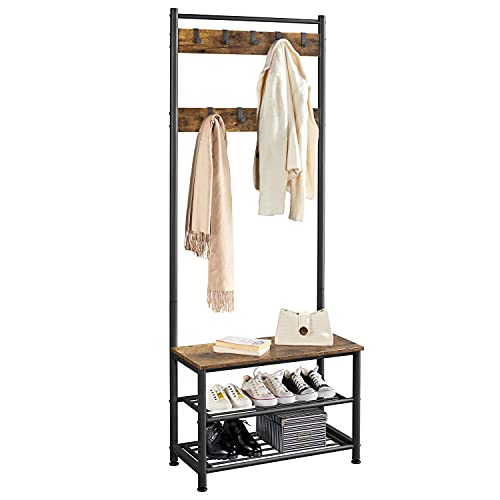
VASAGLE Shoe Storage Bench — The Reviewed Format
The representative of the design under review: cushioned seat, open shelves, compact frame. Choose it for the balanced brief — family door, moderate shoes, average hall — and judge the specific listing on bracing, fabric, and finish as the build section describes.
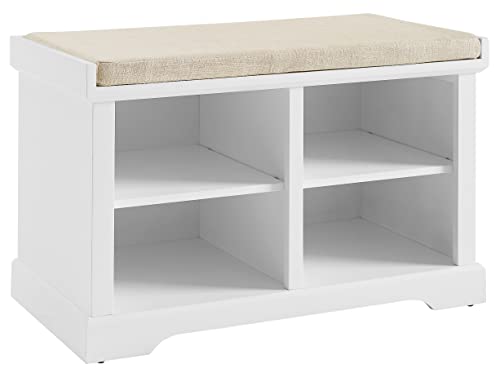
Linon Storage Bench — The Concealed Alternative
For the formal hall, the closed storage bench hides everything this design displays. The trade is access speed and ventilation, and the right buyer is the one whose first impression matters more than their fastest exit.

Yaheetech Entryway Bench with Shoe Rack — The Capacity Alternative
Where shoe count and coats overwhelm the reviewed design, rack-and-hook formats take over — with the anchoring duty that tall designs carry. Fit the manufacturer’s anti-tip hardware during assembly and load the lower hooks with the heaviest bags.
Who Should Buy It and Who Should Skip It
Buy this design if your household changes shoes at one main door, if your shoe count at that door fits a two-pairs-per-person discipline, if your hall passes the seated-walkway test, and if you value a seat that is pleasant rather than merely present. Families with school-age children are the design’s natural owners, as are dog owners who sit to towel paws and anyone whose older relatives visit often enough that a stable seat by the door is a quiet kindness. First-flat buyers benefit too: the format is movable, multi-purpose, and can follow its owners to a larger home as a bedroom or hallway piece later.
Skip it if your entry is a formal reception space where displayed trainers would genuinely bother you every day — the closed bench exists for you. Skip it if coats are your main clutter, because a hookless bench will collect them on its seat and fail at both jobs. Skip it if your hall fails the walkway test with any bench in it; no design review outranks a tape measure. And skip the lightest, most decorative versions of the format if your household is heavy in every sense — boisterous children, large adults, daily use — and choose instead the braced, everyday versions sold for exactly that life, following the maker’s guidance on seating use for the model you pick.
Before buying, run this short checklist. Measure the wall, the depth, and the door swing. Count the shoes that will live on the shelves, honestly, in the wettest month. Decide the cushion fabric against your weather and your animals. Read the construction description for bracing and fixed shelving. Read the assembly instructions if published, and plan the re-tightening appointment with yourself. Confirm the finish against the mud reality of your door. A design this common rewards the buyer who checks, because the difference between its best and worst examples is larger than the difference between entirely different furniture types — a point the wider comparison in entryway bench reviews across the main designs makes across the whole category.
Setup, Care and Maintenance Essentials
Setup follows the pattern this review has emphasised: assemble square, tighten screws firmly and evenly per the manufacturer’s instructions, eliminate any rocking before use, and re-tighten after the first weeks as joints settle. Position the bench so the door clears it fully, keep it off direct radiator heat where you can, and put the mat-and-tray system in place on day one rather than after the first muddy week teaches you why.
Care divides into weekly, seasonal, and annual habits. Weekly: sweep grit from the shelves, shake out or vacuum the cushion, and wipe splash marks from the frame before they set. Seasonal: rotate the shoe collection as the weather turns, wash or replace the paw-season throw, air the shelves and cushion on a dry day, and swap the basket contents — gloves and leads in autumn, hats and sun gear in spring. Annual: work along every fixing with the appropriate tool and tighten anything that has eased, check cushion seams and shelf fixings, and touch in finish wear at the edges where bags and keys land. None of this is onerous, and all of it is the difference between the bench that still feels solid in year five and the one that creaks in year two. For the decision framework behind this purchase, see how to choose an entryway bench and the balanced ledger in entryway bench pros and cons.
Final Verdict
The cushioned shoe-storage bench is popular because it deserves to be. It takes the two jobs every entry has — sitting and shoes — and does both well in a footprint most homes can spare, at a level of comfort that makes the daily routine measurably pleasanter. Its weaknesses are honest ones: it shows your shoes, it holds a finite number of them, and its build quality depends on choosing a braced example and assembling it like you mean it. None of those weaknesses is hidden, and all of them are manageable by the households this design suits. Buy it for a family door with a measured wall and a rotating shoe collection, keep the seat clear and the fixings tight, and it will repay you twice a day, every day, for years. If your home instead demands concealment, capacity, or coats, the alternatives above are not lesser choices — they are the same good judgement pointed at a different problem, and the entryway bench buying guide will help you pick between them, while is an entryway bench worth it settles whether any bench belongs in your home at all.
Scoring the design as a whole, in the qualitative terms this review has used throughout: comfort for its purpose, excellent; storage logic, excellent within its capacity; build consistency across the market, variable and buyer-beware; durability of a well-chosen example, very good; adaptability across homes and across a lifetime of moves, outstanding. That last quality is the one rivals rarely match, and it tips the final assessment. This is not merely the safest first bench to buy; it is the bench most likely to still be serving somewhere in your home a decade from now, long after the entry that prompted its purchase has been rearranged around it.
Comfort in Depth: The Ergonomics of a Two-Minute Seat
Because this bench exists to be sat on briefly, its comfort is a specific, testable thing rather than a general impression. The relevant posture is upright, feet flat, leaning forward to reach laces and straps, then standing without using your hands if possible. A seat height that suits that cycle lets your feet rest flat with knees comfortably bent; too low and standing becomes a heave, especially for older users and anyone with stiff joints, while too high leaves shorter legs dangling and makes the lean-forward unstable. The depth that suits it supports the thigh without pressing behind the knee when you perch toward the front edge, which is where most people actually sit while changing shoes. This is why the review keeps returning to a simple test: compare the listed seat height with a dining or kitchen chair in your home that you already find easy for putting on shoes, and favour benches close to that reference.
The cushion’s firmness plays into the same cycle. A firm pad keeps you perched at working height and makes standing easy; a very soft one lets you sink, which feels luxurious for a moment and then makes every subsequent movement — leaning, twisting to reach a heel, standing with a bag in one hand — slightly harder. For the entry’s purpose, firm is functional, and the pleasant surprise for many buyers is how comfortable a firm, well-shaped cushion feels in daily use compared with the sagging softness of an old armchair. Edge comfort matters too: a cushion with a hard frame edge beneath thin padding will announce itself through trousers within a week, so padding that wraps the seat’s front edge is a detail worth seeking in photographs and descriptions.
Two-person use deserves its own note, because the school-and-work morning routinely puts an adult and a child, or two children, on the bench at once. The qualities that matter then are length, obviously, but also the frame’s behaviour under uneven, shifting loads — weight landing at one end while the other end is empty, then swapping. A braced frame takes this without creaking or racking; an unbraced one twists slightly each time, and that twist is the long-term enemy of every joint in the piece. When you sit on a display model or first assemble your own, sit at the very end and shift your weight deliberately. The bench’s answer in that moment predicts its fifth year better than any other single test in this review.
Durability Over Years, Not Weeks
Most bench assessments stop at the first impression, so this review follows the design further into its life. The first year is kind to almost every example: finishes are intact, fixings hold their factory-and-assembly tightness after the settling re-check, and cushions keep their shape. The second and third years separate the tiers. On lighter examples, the predictable wear points appear — finish thinning where shoe heels catch the lower frame, cushion compression where the household’s heaviest member always sits, shelf surfaces scratched by grit that was never swept. None of these is fatal, and all of them are slowed by the care rhythm described earlier, but they mark the difference between furniture ageing gracefully and furniture merely ageing.
On braced mid-tier and premium examples, the same years look different: the frame stays silent, finishes wear to a patina rather than a wound, and the cushion — the one genuinely consumable component — can be re-covered or replaced without touching the structure. That replaceability is an underrated durability feature of this design in general. The seat pad, the throw, the basket, even the shelves’ protective mats can all be renewed individually, so the bench’s life is set by its frame, and a good frame’s life is long. When comparing examples, then, spend your scrutiny on the skeleton — bracing, fixings, seat support — and treat the soft parts as serviceable items. It is the same logic as buying a car for its chassis and accepting that tyres wear, and it leads buyers to better benches than finish-first judging ever does.
One more long-term behaviour deserves recording: this design migrates. Owners report, and common sense predicts, that a bench bought for a first flat’s door ends up at the foot of a bed in a later home, or in a child’s room, or by a garden door. The format’s plain proportions and mixed functions make it unusually reusable, which flatters its lifetime value considerably. A purchase that can be demoted gracefully through three rooms is a different economic object from one that only works in a single spot, and it is part of why this review recommends the format with confidence even to buyers whose current entry is imperfect for it — provided, always, that the walkway test passes where it will first serve.
Styling the Reviewed Bench Without Killing Its Function
A bench this practical can still look deliberate, and the styling that works respects the seat’s job. The cushion is the style carrier: its fabric colour sets the entry’s tone, and a mid-tone with texture forgives marks while coordinating with most hallway palettes. A folded throw at one end adds softness and serves muddy-season duty, provided it lives at the end and not across the sitting span. Above the bench, a mirror is the classic partner — it bounces the entry’s limited light, gives departing household members a final check, and visually doubles the bench’s presence without touching its footprint. A row of hooks above, if coats must be handled, should be a separate rail fixed properly to the wall rather than an invitation to drape coats over the seat.
Below and around, styling is really organisation wearing its best clothes. Shoes arranged by owner along the shelves look intentional; a small tray or basket corral for keys at the bench’s end reads as a styling choice while doing systems work; a runner beneath defines the zone and protects the floor, and its pattern hides the grit that the entry will inevitably produce between cleanings. The styling mistake is the one this review has warned about in other language: decorating the seat itself with cushions and objects until nobody sits on it. A bench styled into uselessness is worse than an unstyled bench, because it occupies the entry’s best wall while performing none of the entry’s work. Style the wall, style the floor, keep the seat for sitting, and this plain, capable design will look like it was chosen by someone who understands both — because it was.
Value, Assessed Qualitatively
Value in this category is best judged by cost-per-use over the bench’s life, described in words rather than figures. A bench used twice daily by several people accumulates thousands of sittings over a few years, so even the premium tier’s higher commitment spreads thin across an enormous count of small services — a seat, a stored pair, a calmer morning. The mid tier is where value concentrates for most households: enough frame and finish to survive the routine, without paying for heirloom joinery at a door that mostly sees family. The entry tier’s value is real but narrower — a first flat, a guest door, a rental where the bench may be left behind — and it evaporates if the light construction is asked to do a family’s daily work, because replacement is the most expensive outcome of all. Judge the tier against the job, keep the packaging until the bench is built and sat on, and the value question mostly answers itself. The full category context, including the formats this design beat and lost to in the comparison above, sits in the entryway bench buying guide, and the worth-it verdict for hesitant households is in is an entryway bench worth it.
How the Design Handles Different Households: A Field Guide
For the household with a baby and a toddler, this bench quietly becomes mission control. A parent can sit with a child on each side in sequence, the shelves hold the small shoes that otherwise vanish under sofas, and the cushion survives the era of spills provided the throw strategy is adopted early. The bench’s height suits the perpetual crouching economy of small children, giving adults a seat at the altitude where the work is. For the household with teenagers, the bench’s test is capacity and indifference: more and larger shoes, dropped sports bags, and a general teenage belief that storage systems are for other people. Open shelves survive this better than any closed format, because the effort of compliance is at its minimum — a shoe kicked roughly toward the shelf often lands on it, which is more than can be said for a lidded compartment.
For multigenerational households, the bench earns a different kind of praise. A grandparent who visits weekly, or lives in the home, gains a stable, familiar seat at the exact point where balance is most challenged — bending, tugging at a heel, standing with a coat half on. The firm cushion and the frame’s rigidity matter more in this household than any styling question, and the buying checklist should be read with that priority: bracing first, seat height matched to the least flexible user, and placement that leaves room for a walking aid beside the bench. For the single occupant of a small flat, finally, the bench is a boundary-maker, the piece that declares where outdoors ends. It holds the one person’s two or three pairs, offers the seat for the parcel-and-keys juggle, and keeps the living space beyond it unmistakably a home rather than a hallway with a sofa. The same design, four households, four different virtues — that breadth is the deepest reason this format leads its category.
What This Review Did Not Forgive
Honesty requires naming the format’s persistent faults, the ones no tier fully escapes. The open shelves’ display of footwear is a real aesthetic cost, and no arrangement of a large collection looks like anything but a large collection. The cushion, however well chosen, is a fabric surface living at the wettest, grittiest threshold of the house, and it will record that life over the years in a way a wooden seat never does. The format’s middle position — neither the cabinet’s capacity nor the hall tree’s completeness — means households at either extreme will feel its compromise daily. And the design’s very popularity has flooded the market with lookalike examples whose frames do not deserve the format’s good name, which is why this review has insisted, perhaps to the point of repetition, on bracing, fixings, and the sit-at-the-end test. A buyer who applies those tests gets the design this review praised. A buyer who shops by photograph alone may get its silhouette without its substance, and no review can protect them further than this warning.
Assembly Day, Walked Through Slowly
Because this design’s lifespan is decided disproportionately on assembly day, the review closes its practical coverage with the process itself, slowed down. Begin by unpacking everything on a clear floor near the bench’s final position, and check every panel and fixing against the parts list before a single screw turns; discovering a missing component after the frame is half built is the classic flat-pack misery, and it is entirely avoidable in the first five minutes. Identify the floor the bench will live on and, if it is hard, plan felt protection under the legs from the start rather than after the first scratch. Build the frame loosely first, in the manufacturer’s sequence, keeping every joint aligned and the whole piece square — measure the diagonals if the design allows it, because a frame assembled slightly out of square will rock forever and resist every later attempt at tightening.
Only when the frame stands square should the fixings be fully tightened, working around the piece evenly so no single joint is stressed into alignment by force. Fit the shelves, check that they sit fixed and level, and attach the cushion or seat exactly as directed. Then perform the review’s two tests before the bench meets a single shoe: the sit-and-shift test at each end of the seat, listening and feeling for movement, and the rock test on the hardest floor available. Any movement found now is information, not failure — it points at the fixing or leg that needs attention while attention is still easy. Finally, position the bench, verify the door’s full swing clears it, lay the mat and tray, and write a note in your calendar a fortnight out: re-tighten every fixing. That note, honoured, is worth more to the bench’s fifth year than any upgrade you could have bought instead, and it is the last piece of advice this review insists on before its verdict stands as written.
Variants Within the Format, and Which to Prefer
The reviewed design has siblings worth distinguishing, because choosing between them is the last decision most buyers face. The drawer variant replaces part of the open shelving with one or two drawers, gaining a home for gloves, keys, and leads at the cost of shoe capacity and a little access speed. It suits households whose accessory clutter rivals their shoe clutter, and it asks for the drawer runners to be judged as carefully as the frame — a drawer that sticks will be a drawer that stays open, spilling its contents into the walkway’s edge. The boot-height variant raises or removes the lower shelf to accommodate tall footwear, and it is the right choice in genuinely rural or snowy households, where standard shelf spacing exiles boots to the floor beside the bench and recreates the pile in its most visible form.
The narrow variant, built for tight halls, trims depth above all and keeps the format’s logic in a slimmer body; it is the version that passes walkway tests its standard sibling fails, at the cost of a perch that feels less generous and shelves that hold shoes at a slight angle of compromise. The corner variant, L-shaped or angled, exists for the entries whose usable wall turns a corner, and it can be the difference between a system and no system in an awkward alcove. None of these variants changes the review’s core judgements — bracing, assembly discipline, rotation, and the maker’s seating guidance apply identically to all — but matching the variant to the household’s specific complication is the difference between a bench that is merely good and one that feels designed for the door it serves. When in doubt between two variants, choose the one that solves the problem you can name in a sentence; decorative differences fade within a month, while the named problem would have greeted you at the door every day.
A Second Look After the First Impression: Testing Entryway Bench Against Real Routines
This section exists to look again after the first impression has faded, because the qualities that sell a product in the first hour are rarely the ones that decide whether it is still liked in month three. It adds a layer that a feature list cannot give you, grounded in the living room furniture context this entryway bench will actually live in. Where this guide names examples such as VASAGLE Shoe Storage Bench, Linon Storage Bench, Yaheetech Entryway Bench with Shoe Rack, use them as test cases for the checks below rather than as shortcuts past them.
One more angle is worth your time: the second-order costs. A entryway bench changes what happens around it. It can demand a different cleaning product, a new storage habit, a moved piece of furniture, a rearranged cupboard or a standing arrangement with the people you live with. List those knock-on effects before you buy and decide whether you accept them as part of the deal. Sometimes the answer is an easy yes, and the entryway bench earns its place by improving the whole routine around it. Sometimes the honest answer is that the supporting changes are the real project, and the purchase should wait until you are ready for them. Either answer is useful; the only bad outcome is discovering the knock-on effects by accident, one irritation at a time, after the decision can no longer be revisited.
It also helps to separate the problems a entryway bench can solve from the problems it merely moves. If the underlying difficulty is space, the answer may be a smaller format or a different location rather than a more elaborate model. If the difficulty is time, look for the option that removes steps rather than the one that performs each step slightly better. If the difficulty is that several people want different things, a compromise design that everyone rates as good enough will usually outlast a specialist design that one person loves and everyone else avoids. Naming the real problem in one sentence, out loud, before you order, is a surprisingly powerful filter, and many shoppers find that the sentence itself points at a different entryway bench than the one they started out researching.
Start with the unglamorous measurements. For a entryway bench, the numbers that decide satisfaction are rarely the headline ones in a listing; they are doorway width, turning space on the stairs, floor clearance and the distance to the nearest table or lamp. Write the real dimensions of your space down, including the awkward constraints you normally work around without thinking, and hold every contender up against that sheet rather than against a showroom photograph. Then walk the route the entryway bench will take on delivery day and during normal use. A choice that fits on paper but fights you every time it is moved, opened, cleaned or stored will lose its shine quickly, however strong its other qualities look in a comparison table.
Next, rehearse the week, not the ideal day. Picture the entryway bench inside movie nights, reading sessions, guests staying longer than planned and children treating every edge as a climbing frame. Most disappointment comes from buying for the best-case scenario: the tidy version of the household, the motivated version of yourself, the weather or the guest list you hope for rather than the one you usually get. If the entryway bench only makes sense when everything goes to plan, it is the wrong size, the wrong format or the wrong purchase for now. If it still looks useful on the tired, rushed, slightly chaotic version of the day, it has passed the most honest test there is, and the remaining questions are about detail rather than direction.
Pay close attention to the recurring friction points, because they compound. With a entryway bench, owners tend to run into fabric marking, cushions softening unevenly and legs scratching the floor when the piece gets dragged instead of lifted. None of these is dramatic on its own, and that is exactly why they get underestimated at buying time. Ask how the design you are considering handles each one: can the wearing part be replaced, can the awkward part be reached without tools, does the job take two minutes or twenty. A entryway bench that makes its own upkeep easy gets maintained; one that makes upkeep a project gets neglected, and neglected products perform badly in ways that then get blamed on the original purchase.
Use the listings as a checklist rather than as entertainment. For each entryway bench you shortlist, note the exact variant, the included parts, what is sold separately, and which photographs show the item in a setting like yours rather than in a studio. If a model named elsewhere in this guide catches your eye, treat it as a worked example for this process: run it through the same measurements, the same weekly rehearsal and the same friction list before letting familiarity turn into preference. Consistency is the whole trick. Shoppers go wrong not by choosing the objectively weaker entryway bench, but by judging one contender on features, the next on looks and the third on a single enthusiastic anecdote.
Think about who else has a vote. A entryway bench is usually shared, moved, cleaned or complained about by more than one person, and the second user’s priorities are often the ones that surface after the return window closes. Check height, weight, reach, noise, heat, sharp edges or sheer visual presence, whichever apply, against the smallest, oldest or least enthusiastic person who will live with it. If you are buying for a household that includes children, pets, elderly relatives or lodgers, run the clumsy scenario too: the spill, the knock, the curious tug, the door left open. A robust entryway bench choice survives other people; a fragile one only survives its buyer.
Consider the edge cases that sit just outside normal use, because a entryway bench will meet all of them eventually. The unusually large load, the unusually small task, the day you are in a hurry, the day something else in the room is broken and this has to cover for it. Versatility is not about a long feature list; it is about behaving predictably when conditions are imperfect.
Frequently Asked Questions
Is a cushioned shoe bench sturdy enough for daily family use?
The braced, everyday versions of this design are built for exactly that routine, provided assembly is done properly — frame square, screws tightened firmly and evenly as the manufacturer directs, and fixings re-checked after the first weeks. Always follow the maker’s own guidance on seating use for the specific model, and treat the lightest decorative versions as occasional seating rather than the family’s daily perch. A practical sign of an everyday build is the frame’s behaviour under the sit-at-the-end test described in this review: a bench that stays silent and rigid with weight at its very edge is telling you its joints and bracing are up to the routine, while one that creaks or gives on day one will not improve with use.
How many pairs of shoes does this type of bench hold?
It depends on the model’s shelf layout and your shoe sizes, but the workable pattern for most households is about two pairs per person at the door — one everyday pair and one weather pair — with the rest of the collection in a closet. Households that try to store their entire shoe wardrobe at the door will overflow any bench of this size, whatever the shelf count. If your count is borderline, measure your most-used pairs lined up together and compare that row’s length with the shelf length in the listing; shoes are the one part of this purchase you can measure exactly, in advance, with objects you already own, and five minutes with a tape measure against your own footwear settles a question that guesswork leaves open.
Does the cushion cope with wet weather and dogs?
Wipeable upholstery copes best; woven fabrics cope with help. A washable throw over the cushion during the muddiest months protects it from wet trousers and paws, and spot-cleaning per the maker’s care guidance handles the rest. If your door is a working mud entrance year-round, consider the same design with a leather-look cushion or a plain wooden seat you can cushion seasonally. Dog owners in particular find the routine settles quickly: sit, towel the dog on the mat, hang the towel on a hook beside the bench, and the cushion stays out of the story entirely — one more example of this design succeeding through the small system built around it rather than through any single feature of its own.
Why does my bench wobble slightly, and can it be fixed?
A slight wobble usually means fixings have settled or were never fully tightened, or the bench is rocking on an uneven floor. Work along every screw and bolt and tighten evenly as instructed, check the bench on a hard, level surface, and shim a leg if the floor is the culprit. Benches tightened at assembly and re-tightened after settling typically stay rigid; a persistent wobble after that suggests a joint problem worth raising with the seller.
Is this design better than a hall tree?
It is better where space is limited, where a closet already handles coats, and where you want no anchoring obligation. A hall tree is better where there is no entry closet and coats, bags, and hats all need homes, provided you anchor it to the wall as the manufacturer directs. The two designs answer different briefs; the right question is which brief your entry actually has.
What should I check in the listing before ordering this bench?
Check the assembled dimensions against your measured wall and door swing, the shelf layout against your counted shoes, the cushion fabric against your weather and animals, and the construction description for frame bracing and fixed shelving. Read the assembly instructions if they are linked, follow the maker’s seating guidance, and keep the packaging until the bench is built and sat on.
Related Guides
family-sized entryway benches · entryway runners that partner this bench · console tables for the same hall