Disclosure: As an Amazon Associate, dailyhomedecorating.com earns from qualifying purchases. Links on this page are affiliate links; they cost you nothing extra. Prices and availability change often, so check the current Amazon listing before you buy.
These entryway bench reviews cover the five design families that dominate the market, assessed side by side on the same criteria: how the seat feels in daily use, how the storage matches real shoe collections, how the build survives family life, and which homes each design genuinely suits. Entryway bench reviews are only useful when they admit that there is no single winner — there is a winner for the family mudroom, another for the formal hall, another for the flat with no closet — so this page is organised by verdict rather than by ranking. Read the design that matches your door, check its trade-offs honestly, and use the comparison table to confirm that no other family answers your brief better before you commit.
How These Entryway Bench Reviews Were Assessed
Every design family here was judged against the same routine: the weekday morning departure, the wet-weather arrival, the child’s shoe change, the older relative’s visit, and the slow test of grit, drips, and loosening joints across seasons. Seat comfort was judged for the two-minute working sit — upright, leaning forward, standing unaided — rather than for lounging. Storage was judged against counted, realistic shoe collections, not theoretical maxima. Build was judged on frame bracing, fixing quality, and how a piece behaves when weight lands unevenly at one end of the seat. Seating suitability is described qualitatively and always defers to each manufacturer’s own guidance for its specific models; designs sold as everyday family benches are assessed as such, and light decorative pieces are assessed as the occasional seats they are.
Two principles run through every verdict. First, the system matters as much as the object: a bench with a mat, a boot tray, and a rotation habit outperforms a finer bench without them. Second, fit outranks quality in the abstract: the best-made bench in the wrong format for your door will satisfy you less than a modest bench in the right format. Keep both principles in mind and the reviews below will read as a matching exercise, which is what good furniture buying actually is.
A word about what these reviews deliberately do not do. They do not rank the families by a single score, because the families answer different briefs and a single ladder would crown the wrong winner for most homes. They do not quote fixed performance figures for individual models, because seating suitability, dimensions, and construction vary by model and are stated by each manufacturer in its own listing, which is where you should confirm them. And they do not pretend that a representative product exhausts its family: within every family here, making ranges from light and decorative to braced and everyday, and the family verdict describes the design’s character while the specific model you buy decides its lifespan. Read the family reviews for direction, then interrogate the individual listing — its dimensions, its construction description, its assembly instructions, and its maker’s guidance — with the questions each review supplies. That two-step method, family then model, is how these reviews were written and how they are meant to be used.
In this guide
The Designs at a Glance
| Design family | Seat | Storage style | Best for | Watch out for |
|---|---|---|---|---|
| Cushioned shoe bench | Padded, comfortable | Open shelves | Most family entries | Shoes on display |
| Closed storage bench | Solid or padded | Hidden compartment or drawers | Formal, guest-facing halls | Slower access, less ventilation |
| Hall tree bench | Solid or padded | Shelves, cubbies, hooks | Homes with no entry closet | Size; must be wall-anchored |
| Cabinet-style bench | Solid, furniture-like | Mixed cubbies and drawers | Entries opening into living rooms | Finishes need more care |
| Compact storage bench | Padded or solid | Hidden, small capacity | Small flats and studios | Limited shoe capacity |
The table compresses; the reviews below explain. Each design gets the same treatment — what it does well, where it strains, and the household it serves — followed by a representative product slot so you can connect the family verdict to a purchasable example. All products are described in prose; check the current listing for the exact configuration, finish, and dimensions of any model you consider.
Review: The Cushioned Shoe Bench
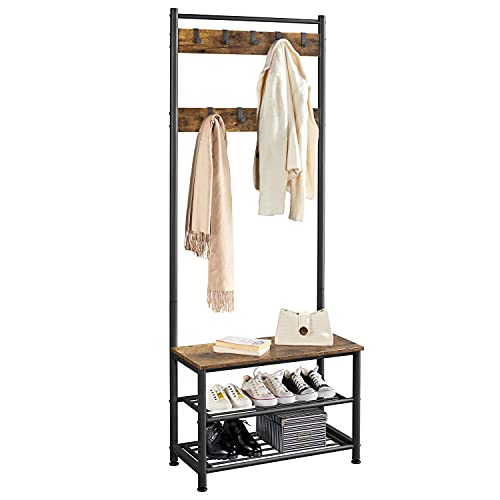
VASAGLE Shoe Storage Bench — Representative of the Family
This is the market’s default design and, for most households, the right starting point. The padded seat makes the daily shoe change genuinely pleasant; the open shelves below are the storage format households actually use, because nothing — no lid, no door — stands between a tired arrival and putting shoes away. Ventilation comes free with the openness, which matters for damp footwear, and the footprint stays modest enough for average halls. In daily testing terms, it handles the morning rush for a family with composure: two sitters can share the seat’s length in the usual configuration, shoes are visible and grabbable, and the whole routine compresses into the bench’s small zone.
Its strains are the family’s known ones. The shoes are on show, permanently, and a large or muddy collection will look like exactly what it is. Capacity is finite and enforces the two-pairs-per-person rotation that not every household will run. Build quality across this family varies more than in any other, because the format’s popularity has attracted every level of making; the braced examples are five-year furniture, the flimsiest are a season’s compromise, and the difference is readable in the construction description and in the sit-at-the-end test the moment the piece is assembled. Best for: families, dog owners, average entries, first-time bench buyers. Not for: formal halls, very large shoe collections without rotation, or buyers unwilling to choose carefully within the family.
Review: The Closed Storage Bench
Linon Storage Bench — Representative of the Family
The closed storage bench is the formal hall’s answer, and its review begins with its defining virtue: from the doorway, you see furniture, not footwear. A lift-up seat or a bank of drawers swallows hats, gloves, scarves, leads, and the visual noise of family life, leaving a composed surface that can carry a cushion, a plant on a side table beside it, and the household’s best first impression. In homes where the entry doubles as the reception room — where guests are greeted, coats are taken, and the evening begins — that composure is not vanity; it is the room doing its social job.
The costs are access and air. A lift-up seat cannot be opened while someone sits on it, which inserts a small choreography into the morning routine; drawers ease that but hold less and organise small things rather than shoes. Enclosed compartments ventilate poorly, so this family stores accessories and seasonal gear better than damp daily shoes, and households that ignore that distinction meet the stale-air problem within a season. The seat itself, often solid or thinly padded, perches rather than cushions. Best for: guest-facing halls, formal interiors, accessory-heavy clutter, households disciplined enough to use lids and drawers. Not for: wet-boot households wanting daily shoes inside, or anyone whose family will vote against the lid with their behaviour. Pair it with a small open rack or tray for the day’s shoes and its weaknesses shrink considerably — a partnership the verdicts return to often.
Review: The Hall Tree Bench

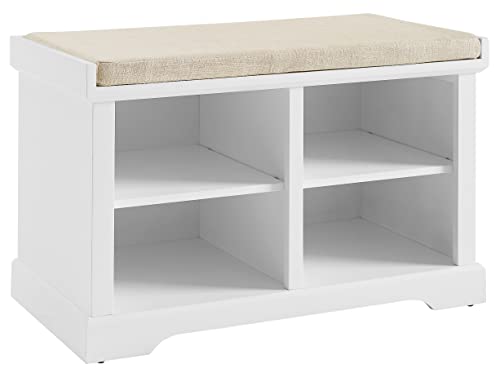
Yaheetech Entryway Bench with Shoe Rack — Representative of the Family
The hall tree is the maximalist answer: bench, shoe storage, coat hooks, and often a top shelf in a single tall unit, and for the home with no entry closet it is close to transformative. Everything that used to live on the banister, the stair newel, and the floor gains a hook or a shelf at the door itself. Families with several children rate this family highest of all, because the coat problem — which benches alone cannot solve — is finally inside the same system as the shoe problem. Capacity is the headline, and in raw organisational terms no other family competes.
The obligations are equally headline-sized. A hall tree is the largest piece in this review by footprint and by visual mass, and in a small or low hall it can loom. Assembly is the longest of any family here. Above all, a tall, hook-loaded unit must be anchored to the wall with the manufacturer’s anti-tip hardware, fitted during assembly into fixings right for the wall, with the heaviest bags kept on lower hooks; a child tugging a coat from a top hook is exactly the load case the anchor exists for. Skipping that step disqualifies the purchase — choose a low bench and a separate fixed rail instead. Best for: closet-less homes, large families, mudrooms with the wall to spare. Not for: small halls, renters who cannot fix to walls, or anyone who will not anchor. Judged on its own terms — total organisation per wall — it is the strongest design in this review; judged carelessly, it is the easiest to buy wrong. One refinement separates the good hall-tree installations from the great ones: zoning. Give each household member a hook column and a shelf territory of their own, labelled by habit if not by name, and the unit stays ordered because everyone can see where their things belong and, just as importantly, where everyone else’s do not.
Review: The Cabinet-Style Bench

Bush Furniture Entryway Storage Bench — Representative of the Family
Traditional furniture makers build benches that read as cabinetry: framed panels, proper hardware, finishes coordinated with living-room collections. The review case for this family is about what happens when the entry is not a separate room at all but the edge of the living space, as in open-plan homes and cottages where the front door opens near the sofa. There, a utilitarian rack-and-cushion bench can look like equipment left in the wrong room, while a cabinet-style bench simply looks like the furniture it is, holding the household’s entry kit in cubbies, drawers, or a lift-top without visual apology.
The trade-offs are care and flexibility. Finer finishes ask for the boot tray, the wipe-down habit, and a little distance from the wettest traffic; this is not the bench for a working farmhouse door in February. Storage layouts vary from genuinely useful to merely present, so the internal arrangement deserves the same scrutiny as the exterior — measure the cubbies against your shoes, not the photograph’s. Assembly and weight sit at the furniture end of the scale too. Best for: open-plan entries, traditional interiors, households buying a long-term piece. Not for: mud-heavy routines, tight budgets of effort, or renters who move often. Within its brief it is the most satisfying family here to live with, because it never asks the room to forgive it.
Review: The Compact Storage Bench
DHP Storage Bench — Representative of the Family
The compact storage bench exists for the homes the other families cannot enter: the studio where the door opens into the living area, the flat with an alcove instead of a hall, the narrow terrace where depth is rationed in centimetres of patience. Its review is a study in priorities. It gives a seat, hides a modest amount of clutter, and keeps its footprint shallow enough to pass the walkway tests that eliminate its larger relatives. In a small home, that combination performs a trick beyond storage: it manufactures an entry, a psychological threshold where outdoor things stop, in a floor plan that never provided one.
Capacity is the honest limitation — this family holds a single person’s or a couple’s door-side essentials, not a family’s footwear archive — and enclosed storage brings the familiar ventilation caveat, so daily shoes often live in a slim tray beneath or beside it. Comfort is adequate rather than generous. But the correct comparison for a compact bench is not the family-sized designs it cannot match; it is the nothing that would otherwise occupy its place. Against nothing, it wins every category that matters. Best for: studios, small flats, single occupants, couples with a rotation habit. Not for: families, large shoe collections, or anyone whose space actually fits a bigger design — in which case the cushioned shoe bench above is the better buy. Small-space layouts that work are gathered in entryway benches for small apartments. One more virtue deserves recording before we leave this family: the compact bench is the most likely of all five to be carried into the next home and the next, because small, useful furniture always finds a wall. Buyers in transitional housing — first flats, temporary postings, homes between homes — get a piece that keeps solving the threshold problem wherever it lands, which quietly makes its value the hardest in this review to beat.
Entryway Bench Reviews: Which Design for Which Home?
The Family Home With One Hard-Working Door
Choose the cushioned shoe bench, or the hall tree if coats have nowhere else to live. The family’s deciding factors are behavioural: open storage that children will use, a seat that survives the morning scrum, finishes that forgive. Between the two, the closet question decides — coats homeless means hall tree, anchored; coats housed means the simpler, smaller bench and a calmer wall.
The Formal Hall and the Frequent Host
Choose the closed storage bench or the cabinet-style bench, and partner it with discreet daily-shoe handling at a secondary door if the house has one. Appearance leads here, legitimately, because the room’s job is reception. Accept slower access as the price, store accessories inside, and keep the seat styled but sittable — a bench guests may perch on is worth two they may only admire.
The Small Flat and the Studio
Choose the compact storage bench, sized by depth first, and let it manufacture your entry. If even its footprint fails the walkway test, the honest answer is no bench: hooks, a boot tray, and a key shelf, with the stairs or a kitchen stool covering the sitting job. The reviews’ most repeated sentence applies here in full — no design outranks a tape measure.
The Rural and Working Household
Choose capacity and washability: a hall tree or a robust open shoe bench in finishes that shrug off water, with shelf spacing checked against tall boots and a deep boot tray alongside. Pretty finishes and pale cushions are the wrong spend at a working door; bracing, ventilation, and room for the season’s footwear are the right ones. Site the hard-working bench at the door the household actually uses, which is often the back door, and let the front door keep something simpler.
Buying Notes That Apply to Every Design Here
Measure before browsing: wall length, spare depth, door swing, and the seated-walkway test with a chair standing in for the bench. Count shoes at the door in the wettest month, not the tidiest. Match seat height to a chair you already find easy for shoe-changing. Read construction descriptions for bracing and fixed shelving, and read the assembly instructions where published — they reveal build honesty faster than photography. Follow each manufacturer’s own seating guidance for the model you choose; everyday family designs are built and sold for the daily routine, while light decorative pieces are occasional seats, and confusing the two is the commonest route to a broken bench and a unfair review.
Assembly is part of the product. Build square, tighten screws firmly and evenly as directed, eliminate rocking before use, and re-tighten after the first weeks as joints settle. Anchor tall designs during assembly with the supplied anti-tip hardware and wall-appropriate fixings, and keep heavy bags on lower hooks. Keep packaging until the bench is built and sat on, and photograph any transit damage before assembly rather than after. These habits, dull as they sound, are the difference between the reviews households write in year three and the ones they write in month three. For the full decision framework, the cluster’s entryway bench buying guide and step-by-step guide to choosing go deeper, while entryway bench pros and cons keeps the honest ledger and the single-design deep review takes the leading family apart piece by piece.
One further note applies to delivery and returns, which reviewers mention more often than manufacturers do. Benches are bulky, and the family’s larger members — hall trees and cabinet-style pieces especially — arrive in boxes that need a clear route from the door to the assembly space, which is sometimes the very entry the bench will occupy. Measure that route too, including any tight turn at the stairs, and plan where the packaging will go while you build. If the piece must be returned, it will need that packaging intact and the bench at least partly disassembled, which is a second reason the keep-the-box advice in these reviews is practical rather than fussy. None of this belongs in a glossy verdict, but all of it belongs in a useful one, and households that plan the unglamorous logistics report the whole purchase as calmer — a small, fitting preview of the calm the bench itself is bought to create.
Care and Keeping, Across All Five Families
The care rhythm is shared even though the designs differ. Weekly, sweep grit from shelves and floors beneath — grit is the universal finish-killer at a threshold — and wipe splash marks before they set. Seasonally, rotate the shoe collection so capacity never silently overflows, wash throws and cushion covers per their care guidance, air enclosed compartments on a dry day, and swap basket contents between cold-weather and warm-weather kit. Twice a year, work along every fixing — frame screws, shelf fixings, hinge screws, hook screws, and the wall anchor on tall units — and tighten anything that has eased. That short round, kept faithfully, is why some benches in every family here still feel new in year five while identical models, neglected, creak in year two. Furniture at a door lives a hard life; these habits are how it lives a long one anyway.
Comfort Compared: Sitting on All Five
Seat comfort separates these families more than their photographs suggest. The cushioned shoe bench leads, because its pad is designed for the exact posture the entry demands and because its seat height, in typical examples, matches the dining-chair reference most people find easy. The compact storage bench follows closely in miniature — same logic, slightly less generosity. The cabinet-style bench sits like the furniture it is: firm, upright, entirely adequate for the shoe change, less inviting for a lingering sit with a coffee while waiting for a taxi. The closed storage bench varies most, from properly padded lift-top examples to solid lids that perch rather than seat, so within this family the specific model’s seat deserves individual scrutiny. The hall tree’s seat is usually the plainest of the five — the family’s budget of attention went to hooks and capacity — though it gains a back panel to lean against in some designs, which partially compensates during longer waits.
Two-sitter behaviour also differs. The longer families — cushioned shoe bench, hall tree, cabinet-style — absorb the adult-and-child morning shuffle without negotiation. The compact bench seats one comfortably and two only in affectionate emergencies, which is fine for its intended households and a genuine limitation for any family tempted to stretch it beyond its brief. Across all five, the standing-up test matters as much as the sitting test: a seat that lets an older relative rise without pushing off their knees with both hands is doing quiet accessibility work, and families with such relatives should weight it heavily, whatever the family’s other virtues.
Storage Compared in Practice, Not on Paper
Storage claims collapse fastest in real use, so these reviews translate them into routines. The hall tree stores the most categories — shoes, coats, bags, hats — and therefore wins the paper comparison outright. But the cushioned shoe bench stores the most-used category, daily shoes, in the most usable way, and in many homes that single category is ninety percent of the actual problem. The cabinet-style bench stores a moderate amount with the best manners, concealing it behind doors and drawers that make the entry presentable at a glance. The closed storage bench stores accessories superbly and shoes conditionally, as its ventilation caveat keeps repeating. The compact bench stores least and, for its households, enough — the discipline of a small home is that the door-side collection stays edited because there is nowhere for it not to.
The practical test we applied to each family was the Friday-evening state: after a full week, with no special tidying, does the entry still work? Designs pass that test when their storage matches the household’s friction tolerance — open formats in busy families, closed formats in disciplined or guest-facing ones — and fail it when the match is wrong, regardless of nominal capacity. It is the single most transferable insight in these reviews: shop for the Friday-evening state, not the Sunday-morning photograph, and choose the family whose storage your household will still be using, happily, when the novelty has worn off and the weather has turned.
Durability and Value Compared
Durability across these families follows construction more than category, but patterns exist. Cabinet-style benches, built as furniture, tend to age slowest and repair best; their finishes can be touched in, their hardware replaced, their drawers re-runnered. Hall trees carry the most joints and the most leverage — a tall frame works its fixings harder — so their durability depends most on assembly discipline and the anchor, which stabilises the whole structure as a side benefit. Cushioned shoe benches live or die by frame bracing, with cushions as the renewable component. Closed storage benches add hinges and lids to the wear list; a lift-top’s hinges, checked in the twice-yearly round, are the difference between a decade of service and a lid that drifts sideways by year three. Compact benches, lightly built for light briefs, last exactly as long as their brief is respected.
Value, stated qualitatively as this cluster states it throughout, concentrates in the mid tiers of every family: enough making to survive the routine, without heirloom pricing at a working door. The exception is the cabinet-style family in a forever home, where furniture-grade making at the most-seen threshold of the house justifies itself across decades. The false economy, in every family, is the lightest version bought for the heaviest job; the false extravagance is the heaviest version bought for a job a simpler family does identically. Match family to brief, tier to traffic, and the value takes care of itself — which is, in the end, the conclusion all five reviews independently reach.
A Note on Finishes, Compared Across the Families
Finish behaviour at a wet, gritty threshold deserves its own comparison because it drives year-three satisfaction quietly. Painted finishes across the families refresh a hall and can be repainted when they tire — an advantage unique to them — but show chips at the knocked corners if the underlying making is light. Natural and stained timber finishes hide scuffs in their grain and can be touched in locally, ageing toward patina. Metal-framed elements, commonest in the shoe-bench and hall-tree families, shrug off water entirely and ask only to be wiped. Upholstery, where present, is the finish with the shortest natural life at a door, which is why the reviews favour it in replaceable cushion form over fixed upholstery wherever a choice exists. None of these finishes is best in the abstract; each is best for a climate, a household’s mud level, and an owner’s appetite for the small maintenance rituals described in the care section. Choose the finish for the door you have, in the weather you actually get, and the families will all perform closer to their best than their worst.
Also Reviewed: The Simple Seat Bench
No survey of these families is complete without the design that stores nothing at all. The simple seat bench — legs, a top, and an honest silence about storage — earns its place in these reviews because a meaningful minority of entries need exactly it: homes with a shoe cabinet or closet already at the door, whose only lack is somewhere to sit. Judged as storage it scores zero and does not care; judged as a seat it is often the most comfortable and certainly the most movable option here, sliding aside for cleaning, for a delivery, for the Christmas tree’s annual negotiation with the hallway. Its footprint is the slimmest of any family, its assembly the simplest, and its second life in other rooms the easiest. The verdict is narrow and complete: if your entry’s storage is solved and your sitting is not, this is your bench, and the more substantial families in this review would only duplicate what your home already has. If your storage is not solved, the simple seat will watch your shoe pile grow with perfect, useless elegance — choose accordingly, with the shoe count, not the photograph, as your guide.
Seasonal Performance, Compared
Winter separates these families more honestly than any showroom can. The hall tree comes into its own when coats multiply and grow heavy, provided its hooks were loaded with the heaviest items low and its anchor was fitted in autumn rather than remembered in January. The cushioned shoe bench handles winter well with its boot tray partnership, though shelf spacing exiles tall boots in standard configurations and the cushion asks for its protective throw. The closed storage bench stores the season’s hats and gloves beautifully and the season’s wet boots badly, a split personality its owners learn to route around by keeping boots out and accessories in. The cabinet-style bench asks the most winter care — wet things kept off fine finishes — and repays it by keeping the reception-room standard through the worst months. The compact bench simply fills: winter kit is bulky, small storage is finite, and its households learn the seasonal rotation earliest because they must.
Summer reverses several verdicts mildly. Open families breathe and shine; the shoe bench’s shelves hold the sandal rotation without complaint. Closed families need their airing habit most when warm damp air meets enclosed compartments. The hall tree’s hooks empty enough to look sparse, which some owners solve with the summer hats and bags that migrate there naturally. None of this changes any family’s fundamental verdict, but it refines the buying advice: choose for your worst season, because a bench that survives February in your climate will find August easy, while the reverse has never once been true.
What Owners Commonly Change After Buying
Across all five families, the post-purchase adjustments repeat so reliably that intending buyers can simply make them in advance. First, a boot tray appears, whatever the original plan — the tray is the universal admission that water management was underestimated. Second, a basket or tray for keys and gloves colonises one end of the seat, formalising the landing zone that bags and pockets demanded. Third, the shoe rotation begins, usually after the first overflow, and usually described afterwards as the change that made the system work. Fourth, on tall units, the anchor gets fitted late by the minority who skipped it — always after a wobble or a near-miss rather than before, which these reviews mention in the hope of moving that particular appointment earlier. Fifth, cushions gain throws and shelves gain mats, small protections that cost little and preserve finishes. A buyer who plans all five adjustments on day one starts where experienced owners arrive in month three, and their bench’s Friday-evening state shows it.
How to Read Other Reviews of These Benches Critically
Because you will read beyond this page, it helps to know how bench reviews mislead. The commonest distortion is the photograph problem: benches staged in entries far larger than yours, with three pairs of immaculate shoes, teaching your eye a scale and a tidiness your home will not reproduce. Translate every image by the door in it, and every capacity claim by your own counted shoes lined up on your own floor. The second distortion is the honeymoon problem: assessments written in the first week, before grit, settling fixings, and the Friday-evening state have had their say. Weight the reviews that mention re-tightening, seasonal rotation, and year-two finishes; those writers have actually lived with the piece. The third distortion is the single-household problem: a bench condemned by a family of six with a boot room’s traffic may be perfect for a couple, and vice versa, so extract the reviewer’s household from their verdict before importing the verdict into yours.
The fourth distortion is subtler — the assembly confound. A striking share of negative bench assessments describe wobble, misalignment, and early looseness, which are as often assembly outcomes as product qualities. Reviews that describe careful assembly and still report movement are damning; reviews that never mention assembly are merely uninformative, and the distinction matters when a well-priced bench accumulates a suspicious wobble reputation. Read for bracing, fixings, and the settling re-check, and you will be reading the variables that actually decide these products’ lives.
The Shortlist, Stated Plainly
After all five families and their variants, the shortlist this review defends is short indeed. For the typical family door: the cushioned shoe bench, mid tier, braced, with a wipeable or throw-protected cushion. For the closet-less home: the hall tree, anchored on assembly day, loaded low. For the formal or open-plan entry: the cabinet-style bench if the budget of care exists, the closed storage bench if concealment matters more than ceremony. For the small flat: the compact storage bench, depth measured twice. For the entry whose storage already exists: the simple seat, bought without apology. Every other choice is a variation on one of those five sentences, and a buyer who can say which sentence describes their home has done the hardest part of this purchase before spending anything at all. The cluster’s remaining pieces support that moment: the complete buying guide for criteria, the worth-it verdict for hesitation, and the pros and cons ledger for the honest balance sheet.
Accessibility, Compared Honestly
Entries are where mobility difficulties meet furniture first, so these reviews assessed each family for the users who plan around balance, grip, and seated tasks. The qualities that help are consistent: a seat height that allows feet-flat sitting and unaided standing for the least flexible regular user, a frame that does not move when weight is taken on one side during standing, a clear floor approach so a walking aid can be placed beside the sitter, and storage reachable from the seated position so nobody must bend to the floor for daily shoes. The cushioned shoe bench and the cabinet-style bench, in their sturdier examples, meet that list most completely; the hall tree adds the complication that its most useful hooks may sit above a comfortable seated reach, which argues for loading its lower hooks with the daily items of the user who needs them most. The compact bench’s smaller seat and the closed bench’s lid choreography ask more of balance and patience, and households buying for accessibility should test those specific interactions — sitting, reaching the storage, standing — rather than assuming any bench serves equally. None of this replaces individual judgement or professional advice where mobility is a medical matter; it simply records that, within a furniture category, the differences are real, they are testable in a showroom or on assembly day, and they matter more to daily independence than any finish ever will.
The Reviewers’ Final Word
Five families, six counting the simple seat, and the pattern that survives every comparison in this article is that entryway benches fail by mismatch far more often than by manufacture. The cushioned shoe bench in a formal hall, the hall tree in a small flat, the compact in a family of six, the closed bench under a household of lid-refusers — each is a decent product in a wrong home, accumulating the kind of reviews that blame the object for the match. Conversely, the glowing long-term assessments share a boring secret: a measured wall, a counted shoe collection, an honest account of the household’s habits, and an assembly afternoon done properly, anchor and all. If these reviews have a single instruction to leave with you, it is to spend your effort in that order — home first, habits second, product third — and to let the families above fall into their natural places behind those facts. Do that, and whichever design you choose will review well in the only venue that finally matters, which is your own hallway, on a wet Friday, in February, with everyone’s shoes where they belong.
How to Read Entryway Bench Listings Without Being Misled by Headlines
This section exists to look again after the first impression has faded, because the qualities that sell a product in the first hour are rarely the ones that decide whether it is still liked in month three. It adds a layer that a feature list cannot give you, grounded in the living room furniture context this entryway bench will actually live in. Where this guide names examples such as VASAGLE Shoe Storage Bench, Linon Storage Bench, Yaheetech Entryway Bench with Shoe Rack, use them as test cases for the checks below rather than as shortcuts past them.
Pay close attention to the recurring friction points, because they compound. With a entryway bench, owners tend to run into fabric marking, cushions softening unevenly and legs scratching the floor when the piece gets dragged instead of lifted. None of these is dramatic on its own, and that is exactly why they get underestimated at buying time. Ask how the design you are considering handles each one: can the wearing part be replaced, can the awkward part be reached without tools, does the job take two minutes or twenty. A entryway bench that makes its own upkeep easy gets maintained; one that makes upkeep a project gets neglected, and neglected products perform badly in ways that then get blamed on the original purchase.
Use the listings as a checklist rather than as entertainment. For each entryway bench you shortlist, note the exact variant, the included parts, what is sold separately, and which photographs show the item in a setting like yours rather than in a studio. If a model named elsewhere in this guide catches your eye, treat it as a worked example for this process: run it through the same measurements, the same weekly rehearsal and the same friction list before letting familiarity turn into preference. Consistency is the whole trick. Shoppers go wrong not by choosing the objectively weaker entryway bench, but by judging one contender on features, the next on looks and the third on a single enthusiastic anecdote.
Think about who else has a vote. A entryway bench is usually shared, moved, cleaned or complained about by more than one person, and the second user’s priorities are often the ones that surface after the return window closes. Check height, weight, reach, noise, heat, sharp edges or sheer visual presence, whichever apply, against the smallest, oldest or least enthusiastic person who will live with it. If you are buying for a household that includes children, pets, elderly relatives or lodgers, run the clumsy scenario too: the spill, the knock, the curious tug, the door left open. A robust entryway bench choice survives other people; a fragile one only survives its buyer.
Consider the edge cases that sit just outside normal use, because a entryway bench will meet all of them eventually. The unusually large load, the unusually small task, the day you are in a hurry, the day something else in the room is broken and this has to cover for it. Versatility is not about a long feature list; it is about behaving predictably when conditions are imperfect. Where a design offers settings, modes, attachments or configurations, ask what each one is actually for in your home, and be suspicious of flexibility you cannot attach to a real occasion. One well-judged configuration used weekly beats five clever ones used once, and the honest entryway bench for your home is the one whose strengths line up with your most frequent edge case, not your rarest.
Build a simple decision checklist and score it in writing. Five lines are enough: fit in the space, fit with the routine, ease of cleaning or upkeep, quality of the parts that move or wear, and how the entryway bench will be stored or will look when it is not the centre of attention. Score each contender quickly, then look only at the lowest scores, because purchases are usually ruined by their weakest point rather than saved by their strongest. If two options tie, choose the one whose weakness is cheapest or easiest to live with. This sounds mechanical, and it is meant to: a written checklist is the best defence against the very human habit of falling for the last photograph you looked at.
Finally, plan the first fortnight. Decide where the entryway bench will live from day one, what it replaces, what accessory or companion it needs straight away and what small job you will use to learn its habits while returning it is still simple. Keep the packaging until that learning period is over, note anything that surprises you, and deal with a mismatch early rather than adapting yourself around a poor fit for years. The households that end up happiest with a entryway bench are rarely the ones that researched longest; they are the ones that checked fit honestly, bought for the ordinary week, and paid attention during the first days instead of assuming the decision ended at checkout.
One more angle is worth your time: the second-order costs. A entryway bench changes what happens around it. It can demand a different cleaning product, a new storage habit, a moved piece of furniture, a rearranged cupboard or a standing arrangement with the people you live with. List those knock-on effects before you buy and decide whether you accept them as part of the deal. Sometimes the answer is an easy yes, and the entryway bench earns its place by improving the whole routine around it. Sometimes the honest answer is that the supporting changes are the real project, and the purchase should wait until you are ready for them. Either answer is useful; the only bad outcome is discovering the knock-on effects by accident, one irritation at a time, after the decision can no longer be revisited.
Frequently Asked Questions
Which entryway bench design is best overall?
For the average family entry, the cushioned shoe bench earns the overall verdict: the most comfortable seat, the storage format households actually use, and a footprint most halls can spare. It is not the best design for every home — formal halls do better with closed or cabinet-style benches, closet-less homes with a hall tree, and small flats with a compact — but it is the right default from which to argue your way to a specialist. Argue with evidence, though: a closet audit, a shoe count, and a walkway measurement are the three facts that legitimately move a household off the default, and taste alone, indulged against those facts, is how the mismatches catalogued in these reviews begin.
Are hall tree benches worth the extra size?
They are worth it precisely when the entry has no closet and coats, bags, and hats currently live on banisters and chairs, because no other design solves sitting, shoes, and coats in one footprint. They are not worth it where a closet already does the coat job, or where the hall is small. Either way, the anchoring obligation is part of the deal: fit the manufacturer’s anti-tip hardware during assembly, or choose a different design.
How do I know if a bench is sturdy enough?
Read the construction description for frame bracing and fixed shelving, follow the manufacturer’s own guidance on seating use for the specific model, and test the assembled piece by sitting at the very end of the seat and shifting your weight — a sturdy bench stays silent and rigid. Everyday family designs are built for that routine; light decorative pieces are occasional seats and should be bought, and judged, as such.
Open shelves or closed storage — which do reviewers favour?
For daily footwear, open shelves, because they are effortless and ventilated, and effortlessness is what makes a household use storage. For appearance and accessories, closed storage, because it conceals and protects. Many of the happiest setups in these reviews are partnerships: open shoe storage for the daily pairs, closed compartments or baskets for everything else, whether in one hybrid bench or two cooperating pieces.
What is the most common buying mistake across all designs?
Buying by photograph and storage capacity while skipping the measurements — wall, depth, door swing, and the seated walkway — and skipping the honest shoe count. The second most common is neglecting assembly discipline: fixings left merely snug, the settling re-tighten never done, and tall units left unanchored. Both mistakes are entirely avoidable, and avoiding them matters more than which of these five families you choose.
Can one bench serve a home for many years?
Yes, and the pattern is consistent across families: a braced design, assembled square and tight, re-tightened after settling and checked twice a year, with finishes protected by a mat and boot tray, serves for many years and often migrates to other rooms later in its life. The frame decides the lifespan; cushions, throws, and baskets are serviceable parts that can be renewed without replacing the bench. Owners who keep that rhythm report the bench becoming invisible in the best way — a piece so woven into the household’s arrivals and departures that its service is only noticed on the rare day it is moved for cleaning and everyone queues, briefly baffled, at a door that has forgotten how to work without it.
Related Guides
is an entryway bench worth it · hallway rugs beneath the bench · entryway runner rugs for long halls