Disclosure: As an Amazon Associate, dailyhomedecorating.com earns from qualifying purchases. Links on this page are affiliate links; they cost you nothing extra. Prices and availability change often, so check the current Amazon listing before you buy.
Learning how to choose a compost bin is mostly learning how to read your own household: what it cooks, what its garden produces, where a bin can live, and whose hands will wash, carry and turn it. The products themselves divide into a small number of types — countertop caddies for collecting scraps, outdoor static bins and tumblers for processing them — and the differences that matter are not features but fits. This guide teaches the choosing as a method. It starts with the background every buyer needs, walks through the decision as a sequence of steps with the real detail in each, introduces a short gear list matched to the steps, names the mistakes that produce the category’s familiar disappointments, offers professional habits that cost nothing, and finishes with worked examples — three households, three different right answers — so you can test the method against your own kitchen and garden before spending anything.
Key Takeaways
- Choose the collection half and the processing half separately: a caddy for the kitchen, a bin or tumbler for the garden.
- Your emptying rhythm chooses your caddy — daily points to a simple washable design, every few days points to a charcoal-filtered one.
- Your dominant input chooses your processor — steady kitchen scraps suit a tumbler, bulky garden waste suits a static bin.
- Hygiene is the deciding criterion: sealed lids, washable interiors and a filter routine are what keep a system sweet.
- Check the rules where you live, and name the person who will run the system, before you buy anything.
What You Need to Know Before Comparing
Composting is a managed biological process, and a bin is the equipment that creates its conditions: containment, air, moisture and a balanced diet. The diet divides into greens and browns, and every choosing decision in this guide eventually refers back to them. Greens are the wet, nitrogen-rich inputs — fruit and vegetable scraps, coffee grounds, fresh grass and plant clippings. Browns are the dry, carbon-rich structure — fallen leaves, straw, shredded plain paper and cardboard, wood chips. A working pile holds visibly more browns than greens, feels as damp as a wrung-out sponge, and smells earthy. Too many greens and it compacts, excludes air and sours; too many browns and it sits inert. No bin automates that balance, which is why choosing a compost bin is really choosing how much of the balancing, turning and washing work you want the equipment to organise for you — and why the honest assessment of your own household in the steps below matters more than any product comparison.
The second piece of background is the two-job structure. Collection happens where food is prepared, several times a day, and its enemies are smell and fruit flies; the weapons are a sealing lid, a charcoal filter where scraps wait for days, regular washing that removes the biofilm which is the true source of odour, and a layer of shredded paper over wet additions. Processing happens outdoors, over weeks and seasons, and its enemies are imbalance, waterlogging and neglect; the weapons are browns, air and time. Some households need only collection, because a municipal scheme processes for them. Most home composters need both jobs equipped. A short exclusion list governs both: meat, bones, dairy and anything cooked in oil or fat never enter a residential system, because they smell, attract pests and decompose badly at household scale — they belong in schemes built to handle them. Finally, siting is regulated in places: some municipalities govern how close an outdoor bin may sit to boundaries or water, some neighbourhoods restrict visible bins, and renters may need permission. Check the rules where you live at the start of the choosing process, not after delivery, because a legal constraint discovered late invalidates otherwise perfect choices.
In this guide
The Four Variables Every Choice Is Really About
Underneath the seven steps, every compost bin decision is a setting of four variables, and it helps to see them plainly because product marketing tends to blur them. The first variable is time: how long material waits in the caddy, how long a batch takes outdoors, how often a human visits each stage. Time is bought and sold in this category more than any feature — filtration buys waiting time in the kitchen, turning buys processing speed in the garden, capacity buys tolerance for irregular visits. The second variable is containment: how completely the system seals its contents away from the household’s nose, eyes and wildlife. Containment is what makes composting possible in small, overlooked, rented and design-conscious homes, and it is bought with lids, filters, drums and discipline. The third variable is volume: the honest throughput of your waste stream at its peak, which decides whether the system breathes easily or overflows at exactly the moments — holidays, harvests, clear-outs — when the household can least attend to it. The fourth variable is effort: whose hands, how often, how heavy, in what posture, in what weather. Every product in the category is a particular compromise among these four, and every disappointed owner can name the variable they failed to price: the beautiful caddy with no containment time, the capacious drum whose effort defeated its operator, the tidy tumbler drowned by an autumn it had no volume for. Run the seven steps with these four words in mind — time, containment, volume, effort — and the right specification tends to state itself before you look at a single product, which is exactly how choosing should work.
It is worth seeing, too, how the variables trade against each other, because the trades explain the category’s shapes. A tumbler trades volume for containment and pace: the sealed drum that excludes rodents and speeds kitchen scraps is the same drum that cannot accept a hedge. A static bin trades containment and pace for volume and low effort: the open, capacious pile that swallows autumn asks almost nothing weekly and finishes whenever it finishes. A filtered caddy trades a consumable — the charcoal, replaced forever — for time: days of neutral storage that a simple caddy cannot offer. An integrated station trades money and commitment for the containment of the whole waste routine in one piece of furniture. None of these trades is a defect; each is a product telling you which household it was designed for. The choosing skill this guide is really teaching is translation: turn your audit into the four variables, then read each product as an answer to them, and the marketing falls away, leaving a short list of designs whose trades match the trades your household is happy to make. Households that choose this way rarely return compost equipment, and when they upgrade, they upgrade along a variable — more volume, less effort — rather than starting again.
How To Choose A Compost Bin in Seven Steps
Step One: Audit Your Waste Stream for a Week
Do not choose from memory; memory flatters. For one ordinary week, notice what actually leaves your kitchen and garden toward the bin. How much of it is fresh preparation waste — peelings, cores, trimmings, coffee grounds — which is ideal compost fuel? How much is cooked leftovers, meat, dairy and oily food, which a home system cannot accept and which therefore points you toward a collection scheme for that stream? How bulky is the garden’s contribution, and how seasonal — a steady trickle of clippings, or autumn avalanches of leaves and hedge material? The audit produces your specification: your dominant input, your peak input, and the proportion of your waste a home bin can honestly take. Households are routinely surprised in both directions — the from-scratch cook discovers a tumbler’s worth of weekly greens, the takeaway-leaning household discovers its compostable stream is too thin to run a pile — and both surprises are cheaper in a notebook than in a purchase. Write the audit down; every later step refers to it.
Step Two: Decide Whether You Need Collection, Processing, or Both
With the audit in hand, the structural decision is simple. If a municipal or community organics scheme serves your home and accepts the streams your audit found, you may need only the collection half: a caddy, chosen on hygiene, feeding the scheme. If no scheme exists, or you want the finished compost for your own garden, you need processing — and then you almost certainly need collection too, because the alternative to a caddy is an open bowl (fruit flies within days in warm weather) or constant trips outside with handfuls of peelings. The rare exception is the kitchen that opens directly onto the garden steps from the bin. Decide the halves separately because they are chosen by different criteria and often bought at different tiers: most households should put the larger share of the budget outdoors, where the working parts and the weather are, and treat the caddy as a modest, replaceable accessory — unless the kitchen is on show all day, in which case the caddy’s appearance legitimately becomes a primary criterion and integrated designs enter the frame.
Step Three: Match the Caddy to Your Emptying Rhythm
The caddy decision is a calendar decision. Honestly estimate how often scraps will travel from your counter to their destination — not in the enthusiastic first week, but in the ordinary tenth week, in winter, when it is raining. Daily or near-daily emptying points to a simple, washable caddy whose virtues are a lid that behaves during cooking and an interior that rinses clean in seconds; filtration adds little at that rhythm. Emptying every few days points to a filtered design: a sealing lid with a charcoal stage to absorb the gases of a waiting load, and a body — stainless steel is the benchmark — that tolerates proper hot soapy washing indefinitely and absorbs no odours itself. Whichever school you choose, apply the same physical checks: the lid must seal with a closure you can feel, the interior must have no corners a cloth cannot reach, the whole thing must be carriable full and one-handed, and its capacity must fill at roughly your emptying pace — too small means mid-recipe trips, too large means scraps outstaying their welcome. If your kitchen sorts several waste streams at one point and has the floor space, consider whether an integrated station would serve the whole routine better than a standalone caddy.
Step Four: Match the Processor to Your Dominant Input
The outdoor decision follows the audit’s dominant input. A steady stream of kitchen scraps and light clippings points to a tumbler: a sealed rotating drum that turns the load for air, excludes rodents, looks tidy in overlooked gardens, and processes kitchen material at the fastest pace home equipment offers. Within tumblers, choose dual chambers if your input is continuous — one side finishing while the other fills — and accept a compact single-chamber drum only if space is tight and you can run honest batches, holding fresh scraps while a batch finishes. Bulky, seasonal garden waste points to a static bin: capacious, forgiving, continuous at the top and finished at the base, asking little beyond occasional forking and patience across seasons. Mixed streams point, as they do in many established gardens, to both in time: the tumbler for the kitchen’s steady flow, the static bin for the garden’s surges. Judge tumblers on turning effort with a full wet load, door width for harvest, and frame and latch quality; judge static bins on lid soundness, harvest access and sheer capacity bought for the autumn peak rather than the average week.
Step Five: Site It Before You Buy It
Choose the exact spot for the outdoor unit now, while changing your mind is free. The spot needs to be level; on soil if the unit is a static bin, so organisms can colonise the pile and liquid can drain; within reach of water for moisture management; close enough to the kitchen door that the trip survives February; considerate of neighbours’ windows and seating, because a well-run bin smells earthy but consideration is cheap; and legal — check the rules where you live for setbacks from boundaries, watercourses and dwellings, check any neighbourhood or housing-association conditions, and get a landlord’s agreement if you rent. Reject frost pockets, flood-prone corners and spots in permanent deep shade, all of which slow or sour a pile for reasons that later masquerade as product faults. Then measure the spot and let it veto products: a dual-chamber drum needs its rotation clearance and a stable base, a static bin needs its harvest room, and both need a path a person carrying a caddy or a barrow can actually walk in the wet. Buyers who site first almost never return equipment; buyers who site after delivery sometimes cannot use what they bought at all.
Step Six: Name the Operator and Choose for Their Hands
Every system in this guide is run by a person, and the choosing is not finished until that person is named and the equipment is matched to them. Who empties and washes the caddy? Who turns the drum or forks the pile, carries the harvest, keeps the browns store stocked? If the work is shared, every operator must be able to perform every step. Match the equipment accordingly: favour light, frequent actions — a tumbler’s turns — over heavy, occasional ones for operators with limited strength, and check turning height and handle positions against the actual person, not the average one. Favour lids, latches and hatches that work one-handed or with a gentle push. Be honest about squeamishness too: a sealed drum and a filtered caddy exist precisely for operators who will run a contained system happily and an open one not at all, and choosing containment for such an operator is not indulgence but engineering. A system matched to its operator gets operated; a system matched to an imaginary operator gets abandoned, and the difference shows within a season.
Step Seven: Budget for the System, Not Just the Bin
The final step is to price the whole working system in qualitative tiers before choosing where your money lands. The bins themselves are the headline, but the system includes a browns supply and a dry place to store it, charcoal filters on a recurring cycle if your caddy is filtered, a trug or barrow for harvest, perhaps a simple sieve for finishing, and a kitchen supply of shredded paper for the caddy layer habit. None of it is exotic, and together it typically matters more to outcomes than the step between one bin tier and the next — which is why experienced buyers fund the kit first and let the bins be honest mid-tier workhorses, rather than buying a premium drum and running it without browns. Allocate by job: the processor carries the largest share because it works outdoors under load for years; the caddy is funded for hygiene quality — seal, filter, washability — rather than decoration, unless the kitchen-display argument applies; and a small reserve is kept for the second-season additions most households eventually want, from a leaf store to a second chamber’s worth of capacity. Then buy once, set up within days, and run the first month deliberately.
Gear for This Guide
Four representative products cover the choices the steps produce. Each is presented prose-first, in the slot where its verified purchase link will sit at publishing, and each maps to a step above: the caddies to Step Three’s rhythm decision, the tumblers to Step Four’s input decision.

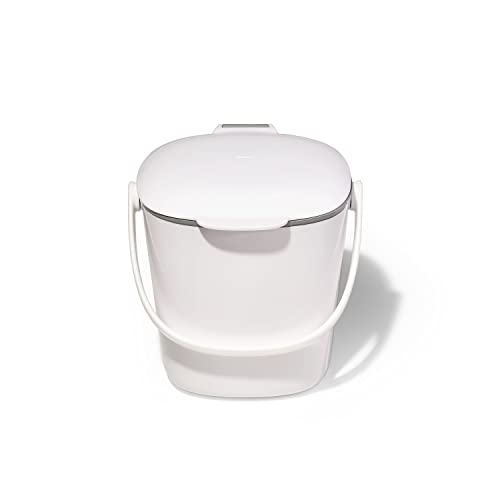
For the Daily Rhythm: OXO Good Grips Compost Bin
If Step Three’s honest answer is daily emptying, this is the caddy the method selects: a stay-open lid that suits one-handed cooking, a smooth interior that rinses and washes without fuss, and no filtration to maintain because the rhythm does the work. Its tier is mid and its demands are minimal, which is exactly right for an accessory that should disappear into the routine. Pair it with any processor, or with a collection scheme alone. Best for: daily cooks. Not suited for: households whose scraps wait several days.

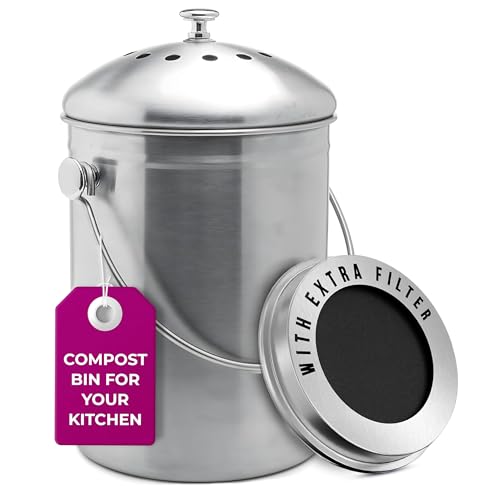
For the Slower Rhythm: EPICA Stainless Steel Compost Bin
If Step Three’s answer is every few days, the method selects filtration and steel: a sealing lid with a charcoal filter stage, and a body that supports indefinite hot soapy washing without absorbing odours. Remember the filter is a consumable — calendar its replacement at purchase, not at first smell. Best for: multi-day holding in a working kitchen. Not suited for: minimal counters or daily emptiers who would not use the filtration they paid for.
For Continuous Kitchen Input: FCMP Outdoor Tumbler
If Step Four’s audit shows a steady kitchen stream, the dual-chamber format is the method’s default, and the FCMP is its reference design at a mid tier: one chamber finishing, one filling, a sealed drum, turning instead of forking. Confirm Step Five’s site and Step Six’s turner before ordering, and assemble carefully on a level base. Best for: families composting continuously. Not suited for: bulky garden waste or fill-and-forget intentions.
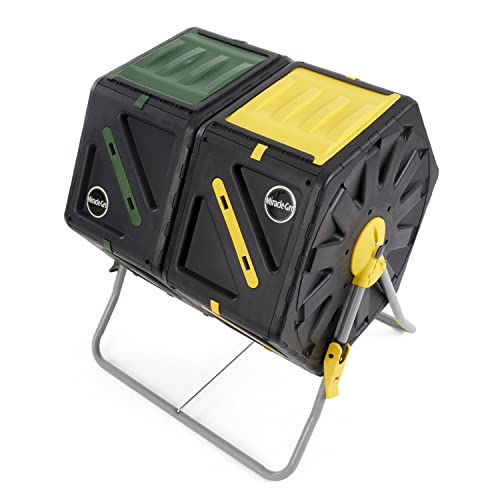
For Tight Spaces: Miracle-Gro Tumbler
If Step Five’s site is a patio corner and the audit’s volumes are modest, the compact single-chamber drum is the method’s small-space answer, with its condition stated plainly: batches, not continuous flow, and a holding plan for scraps while a batch finishes. Many owners later add static capacity and keep this drum for kitchen material. Best for: small gardens and beginners. Not suited for: volume or continuous input.
Common Mistakes
The mistakes that produce this category’s disappointments are few, repeated and avoidable. Choosing from the photograph rather than the audit buys capacity for an imaginary garden and features for an imaginary routine. Buying the caddy for looks and the processor for price inverts the budget logic — hygiene quality indoors and build quality outdoors are where money works. Ignoring the rhythm question buys an unfiltered caddy for a weekly emptier, the single most common mismatch, or filtration for a daily emptier who will never benefit from it. Skipping the siting step discovers rules, slopes and neighbours after delivery. Forgetting the operator buys a drum whose full-load turning defeats the person meant to turn it. Underfunding the system — no browns store, no filter replacements, no harvest trug — starves good equipment of its working supplies. And the operational mistakes mirror the buying ones: feeding greens alone until the pile slumps and sours, letting the caddy become storage instead of a staging post, forgetting the charcoal filter exists, and adding meat, dairy or oily food just once, importing smell and pests that outlast the addition. The balanced ledger behind several of these is set out in compost bin pros and cons.
Pro Tips
Professionals and seasoned gardeners share a handful of habits that cost nothing and decide outcomes. Keep a small container of shredded paper beside the caddy and layer it over every wet addition; it absorbs moisture, blocks fruit flies and pre-loads the carbon balance. Store browns dry and close to the outdoor unit, because balance postponed for want of material is balance abandoned. Chop or shred large inputs — particle size is the cheapest accelerant in composting. Judge moisture by hand, not by schedule: the wrung-out-sponge test at every turning keeps both drought and swamp away. Tie turning and the caddy’s proper wash to existing weekly events so the habits survive motivation. Bury fresh kitchen scraps in the centre of a static pile rather than leaving them on the surface, where they draw flies. Keep the exclusion list posted inside a cupboard door until every cook in the house knows it by heart. And harvest generously and often once material is finished; a system that visibly produces is a system the household keeps feeding. The product-level evidence for these habits is reviewed in compost bin reviews.
A Short Field Test Before You Commit
If the steps leave you between two configurations, run a one-month field test with improvised equipment before spending on either, because composting is one of the few categories where a rehearsal is nearly free and unusually informative. Use any lidded container as a stand-in caddy and run the real routine: scrape into it, layer shredded paper over wet additions, empty it on your candidate rhythm, rinse it at every emptying and wash it properly each week. Use a corner of the garden, a borrowed bin or even a sturdy open pile on soil as the stand-in processor, feeding it your audited stream in balanced layers. The rehearsal will answer the questions no review can answer for you. Is your rhythm really daily, or did the caddy sit for four days by the third week? Did the shredded-paper habit stick? Who actually carried the scraps out, and did they mind? Did the pile’s balance hold with the browns your household can actually source? Did the neighbours, the dog or the local rules object to anything? At the end of the month you will know your time, containment, volume and effort settings from experience rather than optimism, and the purchase that follows will be a confirmation instead of a guess. Households that rehearse almost never buy the wrong system; households that buy on a spring Saturday and improvise afterwards are the ones whose bins appear, barely used, in second-hand listings by autumn. The month costs nothing but attention, and it is the highest-value step in this entire guide for the genuinely undecided.
Choosing for Special Situations
Four situations bend the standard method, and each deserves a direct answer. Renters should weight reversibility above all: a caddy feeding a collection scheme changes nothing about the property, and even an outdoor tumbler is a freestanding object that leaves with you — but get the landlord’s agreement before siting anything outdoors, keep the system sealed and tidy enough to survive an inspection, and favour designs that move easily. Balcony households should treat the balcony as a kitchen annex rather than a garden: the realistic system is a sealed, filtered caddy indoors feeding a collection scheme, because a processing unit on a small balcony concentrates every containment problem at the household’s own window and the neighbours’ — and in many buildings the rules where you live, or the lease itself, will settle the question before preference does. Cold-climate households should buy capacity and patience together: a larger chamber or bin that can hold a winter’s slow accumulation, insulation in the form of a deep browns layer, and a caddy routine that survives the temptation to let scraps wait indoors because the trip outside is bitter. Large and multi-generational households should plan for the operator problem at scale: several cooks means the exclusion list and the washing routine must be taught like household rules, caddy capacity should match the biggest cooking day rather than the average one, and dual chambers outdoors stop being a preference and become the only configuration that matches a continuous, generous stream. In each case the seven steps still run — audit, structure, rhythm, input, site, operator, budget — but the situation moves one step to the front of the queue and lets it dominate, which is the correct use of a method: not as a ritual, but as a checklist whose order follows the household.
When to Add a Second Unit — and When Not To
Most mature compost systems were not bought in one order, and knowing the legitimate triggers for expansion helps you choose a first unit that can grow. Add processing capacity when the existing unit is genuinely full of working material across a whole season — not during one autumn weekend, which a browns bank and patience can absorb. Add a second chamber’s worth of tumbling when fresh scraps are repeatedly waiting for a finishing batch, because that queue, not enthusiasm, is the signal. Add a static bin when the garden’s bulky stream is overwhelming a drum that was bought for kitchen material; demote the drum to the kitchen role rather than replacing it. Add a second caddy only when two genuine prep stations exist in the kitchen’s geography. Do not add anything in the first month, however well it is going, because first-month volumes are enthusiasm volumes and the system’s true size reveals itself across a full turn of seasons. Chosen this way, expansion is the method continuing to work: each addition answers a measured queue, and the fleet that results — caddy, drum, static bin, browns store — looks less like a collection of purchases and more like what it is, a small piece of household infrastructure that grew at the speed of evidence.
The Hygiene Checklist That Overrides Every Other Feature
One section of this guide deserves to outrank the steps themselves, because it decides whether the chosen system is still in use a year later. Whatever you buy, run this hygiene checklist against it and let any failure veto the purchase. Can the caddy’s lid be closed, every time, with one hand, and does it actually seal? Can every interior surface be reached by a cloth or brush, with no seam, texture or corner where residue can shelter? Can the lid assembly — and the charcoal filter housing, where fitted — be taken to the sink and washed as thoroughly as the body? Is the filter a common, sourceable format, and have you already decided the calendar rhythm on which it will be replaced? Can the outdoor unit be opened fully — for loading, for turning, for harvesting, and for the occasional thorough clean-out when a batch goes wrong? Does the whole system have a home for its browns, dry and within arm’s reach of where they are added? These questions sound mundane beside capacity and design, and they are the difference between the composting of the brochures and the composting of real kitchens. The biology behind them is unforgiving but simple: odour comes from biofilm and anaerobic pockets, fruit flies come from exposed fermenting surfaces, and both are controlled by sealing, washing, drying and balancing — four verbs, no products. Choose equipment that makes those four verbs easy, and the system will smell like a garden. Choose equipment that obstructs any of them, and no tier, brand or feature will rescue the experience. That is why this guide returns to hygiene in every section, why the gear list above is chosen for washability as much as for format, and why the field test rehearses the washing routine rather than the shopping. Get hygiene right and composting becomes a background habit of the house; get it wrong and it becomes a smell with a purchase history.
Worked Examples
The family of five with a vegetable garden. Their audit shows a heavy daily stream of preparation scraps and coffee grounds, a garden producing clippings steadily and leaves in autumn, and two adults sharing the work. Step Two gives them both halves. Step Three: the caddy empties daily into the garden, so a simple washable design suffices — but cooking happens in bursts at weekends, so they choose the filtered EPICA for margin and accept the filter routine. Step Four: the steady kitchen stream selects a dual-chamber tumbler, the FCMP, while the autumn leaves go to a stored browns bank and, in year two, a simple static bin for bulk. Step Five sites the tumbler by the back door on a level base; Step Six confirms both adults can turn it comfortably; Step Seven funds the browns store and a harvest trug before any tier upgrades. The method’s output for this household is a system, not a bin — and it works because each element was chosen against a measured fact.
The couple in a townhouse with a small yard and a collection scheme. Their audit shows modest fresh cooking, a meaningful share of cooked leftovers the scheme accepts, and no real garden demand for finished compost. Step Two is decisive: collection only. Step Three becomes the whole purchase — their rhythm is twice a week to the scheme’s caddy point, so filtration matters, and the EPICA’s sealed, filtered holding wins over daily-rhythm designs; counter space is measured first, and the bin is sited away from the oven’s heat. Steps Four and Five fall away, which the method counts as a success rather than an omission: they have bought exactly the half of the system their household needs, at hygiene quality, and nothing else. If a future garden changes the audit, the caddy remains in service and only the processing half is added.
The keen gardener with a large, overlooked plot. Their audit is garden-led: modest kitchen scraps, large seasonal volumes of prunings, clippings and leaves, neighbours close on both sides, and one operator — the gardener — with a strong back and strong opinions. Step Four dominates: capacity and forgiveness point to a static bin as the main processor, sited on soil at Step Five after checking the rules where they live about boundary placement, with a second static bay planned for autumn. The tumbler question is answered by the neighbours: a sealed drum would be tidier, but the volumes rule it out as the main unit, so it enters only as a possible later addition for kitchen material. Step Three selects the caddy purely on washability — the OXO’s rinse-and-go design — because it will be emptied daily in gardening season. Step Seven funds capacity and a serious browns store. Three households, three audits, three different right answers — that spread is the method working as intended, and it is why this guide teaches steps rather than naming a winner. The value test behind all three is in is a compost bin worth it, and the criteria in depth are in the compost bin buying guide.
The Method in One Paragraph
If you read nothing else, choose like this. Audit a week of your real waste. Decide whether a scheme processes for you or you process at home. Let your emptying rhythm pick the caddy — simple and washable for daily, sealed and charcoal-filtered for slower — and let your dominant input pick the processor — tumbler for steady kitchen scraps, dual-chamber for continuous flow, static bin for bulky garden volume. Site the outdoor unit legally and conveniently before ordering, match every moving part to the hands that will operate it, and fund the browns store, filters and harvest kit alongside the bins. Then rehearse for a month if you are undecided, buy once, and run the first month deliberately: lid closed, paper layered, caddy washed, pile balanced, exclusion list absolute. That paragraph, honestly executed, will land you within one product of the perfect choice for your household — and in this category, one product away, with the right routine, is indistinguishable from perfect. Keep the audit you started with, because it becomes the baseline against which the system’s first season is judged, and revisit it when the household changes — a new garden, a new cook, a new home — since the right compost bin is only ever right for a particular household at a particular address, and the method, unlike the product, never needs replacing. When the audit, the site and the operator all point the same way, stop researching and buy: the remaining differences between good products are smaller than the difference a single well-run season makes.
Measuring and Checking Before You Order: A Pre-Purchase Walkthrough for a Compost Bin
This section exists to turn the advice into a sequence you can follow with a tape measure, a phone for notes, and ten unhurried minutes before you commit. It adds a layer that a feature list cannot give you, grounded in the garden & lawn context this compost bin will actually live in. Where this guide names examples such as OXO Good Grips Compost Bin, EPICA Stainless Steel Compost Bin, FCMP Outdoor Tumbler, use them as test cases for the checks below rather than as shortcuts past them.
Finally, plan the first fortnight. Decide where the compost bin will live from day one, what it replaces, what accessory or companion it needs straight away and what small job you will use to learn its habits while returning it is still simple. Keep the packaging until that learning period is over, note anything that surprises you, and deal with a mismatch early rather than adapting yourself around a poor fit for years. The households that end up happiest with a compost bin are rarely the ones that researched longest; they are the ones that checked fit honestly, bought for the ordinary week, and paid attention during the first days instead of assuming the decision ended at checkout.
One more angle is worth your time: the second-order costs. A compost bin changes what happens around it. It can demand a different cleaning product, a new storage habit, a moved piece of furniture, a rearranged cupboard or a standing arrangement with the people you live with. List those knock-on effects before you buy and decide whether you accept them as part of the deal. Sometimes the answer is an easy yes, and the compost bin earns its place by improving the whole routine around it. Sometimes the honest answer is that the supporting changes are the real project, and the purchase should wait until you are ready for them. Either answer is useful; the only bad outcome is discovering the knock-on effects by accident, one irritation at a time, after the decision can no longer be revisited.
It also helps to separate the problems a compost bin can solve from the problems it merely moves. If the underlying difficulty is space, the answer may be a smaller format or a different location rather than a more elaborate model. If the difficulty is time, look for the option that removes steps rather than the one that performs each step slightly better. If the difficulty is that several people want different things, a compromise design that everyone rates as good enough will usually outlast a specialist design that one person loves and everyone else avoids. Naming the real problem in one sentence, out loud, before you order, is a surprisingly powerful filter, and many shoppers find that the sentence itself points at a different compost bin than the one they started out researching.
Start with the unglamorous measurements. For a compost bin, the numbers that decide satisfaction are rarely the headline ones in a listing; they are gate width, path slope, storage in a shed that is already full and how far the work really is from the nearest tap or socket. Write the real dimensions of your space down, including the awkward constraints you normally work around without thinking, and hold every contender up against that sheet rather than against a showroom photograph. Then walk the route the compost bin will take on delivery day and during normal use. A choice that fits on paper but fights you every time it is moved, opened, cleaned or stored will lose its shine quickly, however strong its other qualities look in a comparison table.
Next, rehearse the week, not the ideal day. Picture the compost bin inside a Saturday catch-up after two weeks of growth, a quick tidy before visitors, and the wet week when everything is heavier and muddier. Most disappointment comes from buying for the best-case scenario: the tidy version of the household, the motivated version of yourself, the weather or the guest list you hope for rather than the one you usually get. If the compost bin only makes sense when everything goes to plan, it is the wrong size, the wrong format or the wrong purchase for now. If it still looks useful on the tired, rushed, slightly chaotic version of the day, it has passed the most honest test there is, and the remaining questions are about detail rather than direction.
Pay close attention to the recurring friction points, because they compound. With a compost bin, owners tend to run into blades, lines and fittings wearing quietly, parts clogging mid-job, and instructions that assume a flat, empty garden that nobody actually has. None of these is dramatic on its own, and that is exactly why they get underestimated at buying time. Ask how the design you are considering handles each one: can the wearing part be replaced, can the awkward part be reached without tools, does the job take two minutes or twenty. A compost bin that makes its own upkeep easy gets maintained; one that makes upkeep a project gets neglected, and neglected products perform badly in ways that then get blamed on the original purchase.
Use the listings as a checklist rather than as entertainment. For each compost bin you shortlist, note the exact variant, the included parts, what is sold separately, and which photographs show the item in a setting like yours rather than in a studio. If a model named elsewhere in this guide catches your eye, treat it as a worked example for this process: run it through the same measurements, the same weekly rehearsal and the same friction list before letting familiarity turn into preference. Consistency is the whole trick. Shoppers go wrong not by choosing the objectively weaker compost bin, but by judging one contender on features, the next on looks and the third on a single enthusiastic anecdote.
Frequently Asked Questions
What is the first thing to decide when choosing a compost bin?
Whether you need collection, processing, or both. Audit your waste stream for a week, check whether a municipal scheme can do your processing, and let those two facts set the structure before any product is considered. Households that start with products buy features; households that start with the audit buy fit. The caddy decision then follows your emptying rhythm, and the processor decision follows your dominant input — steady kitchen scraps toward a tumbler, bulky garden waste toward a static bin, continuous input toward dual chambers.
How do I choose between a tumbler and a static bin?
By input and temperament. A tumbler suits a steady stream of kitchen scraps and light clippings, rewards frequent turning and balanced feeding, excludes rodents and looks tidy in overlooked gardens, but works in batches and cannot swallow seasonal bulk. A static bin suits bulky garden material in volume, accepts everything compostable continuously, and asks for little beyond patience and occasional forking, but works slowly and exposes the pile more to weather. Gardeners with both streams often end with both units, each doing the job it is shaped for.
Do I need a charcoal filter in a countertop compost bin?
Only if your emptying rhythm runs to several days. A charcoal filter absorbs the gases that build up in stored scraps, and for multi-day holding it is the difference between a neutral kitchen and a noticeable one. Daily emptiers gain little from filtration and are better served by a simple, easily washed caddy. If you do choose a filtered design, treat the filter as a consumable with a calendar replacement, because a spent filter silently removes the benefit you paid for — and keep the washing routine regardless, since filters manage gas, not biofilm.
What size compost bin should I choose?
Size to rhythm and peak, not to averages. A caddy should fill at roughly the pace of your trips to the outdoor unit or collection point: smaller than your pace and you are carrying scraps mid-recipe; larger and scraps outstay the lid and filter. A processor should be sized for your peak input — the autumn clear-out, the hedge weekend — rather than the average week, because peaks are when systems overflow and get abandoned. When torn between two sizes, the larger usually ages better outdoors, while on the countertop the smaller, emptied oftener, usually smells better.
Where should I put a compost bin, and are there rules?
On level ground, on soil for a static bin, within reach of water, a short trip from the kitchen door, and in a spot considerate of neighbours. Avoid frost pockets, flooding corners and permanent deep shade. Rules genuinely vary: some municipalities regulate distance from boundaries, watercourses or dwellings, some neighbourhoods restrict visible bins, and renters may need a landlord’s agreement — so check the rules where you live before buying, and let the confirmed site veto products that do not fit it. A sealed tumbler satisfies the widest range of situations.
What must never go in a compost bin?
Meat, bones, fish, dairy and anything cooked in oil or fat — in any residential caddy, tumbler or static bin, without exceptions. They decompose slowly, smell strongly and attract the pests that give composting a bad name; municipal schemes with industrial processes are the right destination for them. Also exclude pet waste from meat-eating animals, coal ash and glossy coated paper. The reliable inputs are fruit and vegetable scraps, coffee grounds, eggshells, plain paper and cardboard shredded, leaves, straw and untreated garden material — with browns kept visibly ahead of greens.
Related Guides
The rest of this cluster applies the method from different angles: the compost bin buying guide for criteria in depth, compost bin reviews for the shortlist compared, and our compost bin review for the deep dive. Read them in that order if you are starting cold — criteria first, comparisons second, verdicts last — because a buyer who meets the products before the method tends to fall for a design, while a buyer who meets the method first tends to choose a system, and systems are what survive contact with a real household’s year. In the garden your chosen system will serve, see the best compost bins on this site, raised garden beds, garden hose reels for tidy watering near the bin and gardening tool sets for turning and harvest.