Disclosure: As an Amazon Associate, dailyhomedecorating.com earns from qualifying purchases. Links on this page are affiliate links; they cost you nothing extra. Prices and availability change often, so check the current Amazon listing before you buy.
This compost bin review examines the compost bin as a working household system rather than as a photograph: a countertop caddy that must collect scraps for days without smell or fruit flies, and an outdoor bin or tumbler that must turn those scraps, plus the garden’s own material, into finished compost through the ordinary weather and ordinary motivation of a real year. Compost bins fail in unglamorous ways. They fail when a caddy lid stops sealing and the kitchen learns to dread it, when a charcoal filter is forgotten until the smell returns, when a tumbler drum fills with wet greens and goes anaerobic, when latches stiffen and turning becomes a chore that gets skipped. None of that appears in a product listing, so this review judges the category by the full cycle it has to survive — filling, holding, emptying, washing, turning, balancing, harvesting — and by how the leading designs handle each stage.
The verdict, up front, is that the compost bin has matured into a genuinely recommendable household system, with one condition that decides everything: hygiene and balance are the product. A sealed, filtered, washable caddy paired with a dual-chamber tumbler or a sound static bin makes composting feel like a tidy kitchen habit with a garden dividend. The same money spent on a loose-lidded caddy and an unbalanced pile makes it feel like a smell with accessories. This review suits households deciding whether the category deserves their counter and garden space and which designs to shortlist; it does not suit anyone looking for a machine that composts without participation, because no such bin exists at any tier, and pretending otherwise is how buyers end up disappointed.
Key Takeaways
- Judge a compost bin by its full cycle — filling, holding, washing, turning, harvesting — not by its first week.
- The caddy decides the kitchen experience: seal, charcoal filter and washability matter more than styling.
- The tumbler decides the garden experience: dual chambers match how households actually produce scraps.
- Balance is qualitative — visibly more dry browns than wet greens, moisture like a wrung-out sponge.
- Meat, dairy and oils never belong in a residential bin; the exclusion list is part of the product.
Compost Bin Review: What a Compost Bin Is and Where It Fits
A compost bin is best understood as two products sharing a name. The first is a collection vessel: a small lidded container, usually on the kitchen counter, whose entire job is to hold food scraps hygienically between the chopping board and the garden. It does not compost; it waits, and its quality is measured in containment — of odour, of moisture, of fruit flies. The second is a processing chamber: an outdoor static bin or rotating tumbler where microbes, given air, moisture and a balanced diet of greens and browns, do the actual decomposition over weeks and seasons. Reviews that blur the two produce confused purchases, because the criteria barely overlap. A beautiful caddy can be a terrible place to store scraps for a week; a superb tumbler cannot fix a kitchen routine that begins with an open bowl.
Within the processing family, the segments divide by rhythm. Static bins are continuous and capacious: material goes in the top in any order life produces it, finished compost comes out of the base, and the pace is set by the seasons. Tumblers are batch machines: a chamber is filled with a balanced load, turned regularly, and emptied when finished, with dual-chamber designs letting a second batch start while the first completes. Countertop caddies divide by odour strategy: filtered designs actively absorb the gases of stored scraps for households that empty every few days, while simple washable designs rely on frequent emptying and suit households whose rhythm is daily. The representative products assessed in this review span those segments deliberately — a filtered stainless caddy, a simple everyday caddy, an integrated waste station, and three tumblers at different scales — because the category’s real question is never which bin is best, but which combination runs a given household’s loop.
Where the compost bin fits in the home has also shifted. A generation ago it was a gardener’s tool, bought by people who already gardened. Today the entry point is as often the kitchen: households motivated by waste reduction start with a caddy, discover the routine is painless, and add processing capacity later. That shift explains the category’s design direction — sealed, filtered, presentable, sized for counters and small gardens — and it explains this review’s weighting. The kitchen half of the system is assessed as rigorously as the garden half, because the kitchen half is where the habit is won or lost.
In this guide
Design, Build and Setup
Design in this category is hygiene engineering wearing kitchen clothes. Start with the caddy, where three details decide daily satisfaction. The lid must close with a positive, repeatable seal and open in the way cooking actually happens — one-handed, mid-task, often while the other hand holds a board of peelings. The interior must be a shape water can fully reach: smooth curves, no trapped seams, nothing that shelters the biofilm whose growth is the true source of caddy smell. And the odour system must match the emptying rhythm: a charcoal filter in the lid is a genuine functional component for multi-day storage, not a garnish, and its replacement must be easy enough that owners actually do it. Stainless steel bodies earn their premium here — they tolerate indefinite hot soapy washing and absorb nothing — while good moulded designs trade a little of that permanence for lightness and shape.

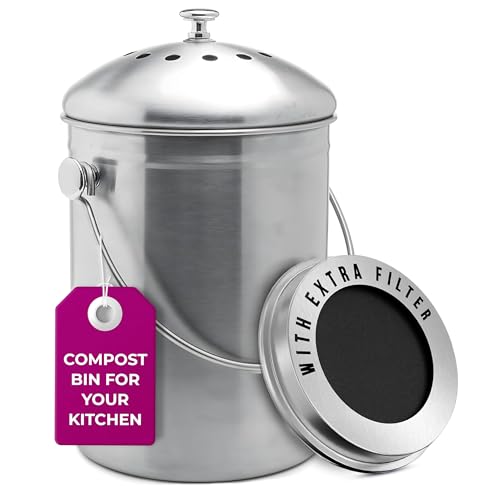
The Countertop Exemplar: EPICA Stainless Steel Compost Bin
The EPICA represents the filtered-steel school at its most archetypal: a stainless body, a fitted lid with a charcoal filter stage, and a carry handle for the garden trip. In the terms of this review’s criteria it is strong exactly where the caddy job is decided — the body supports the full washing routine without absorbing odours, the filter handles the gases of a multi-day fill, and the format is sized for a household that empties on a rhythm of days rather than hours. Its limitations are the format’s: it asks for permanent counter space, the filter is a consumable that punishes forgetfulness, and like every caddy it is a waiting room whose contents will outstay any filter if the emptying rhythm collapses. As a design statement it is deliberately plain, which in this category is a virtue: the best caddy is the one you stop noticing.
Outdoors, build quality is a working-life question. A tumbler’s drum, axle, frame and latches operate under a wet, shifting load, in ultraviolet light and frost, for years. The designs that age well share traits: thick UV-stabilised drum material, a simple load path through the frame, coated metalwork, aeration that does not depend on fragile fittings, and a door or hatch large enough to load and — critically — to empty without a fight, since harvest day is when awkward designs get abandoned. Static bins age by having almost nothing to fail: a body, a lid, a harvest hatch. Setup for both begins with siting — level ground, soil beneath a static bin, water within reach, a position that respects neighbours and complies when you check the rules where you live — and continues with the first load: a dry, coarse brown base, then balanced layers from day one, because a bin started correctly teaches its household the right habits by example.
The Outdoor Exemplar: FCMP Outdoor Tumbler
The FCMP represents the dual-chamber tumbler school: two compartments in one rotating drum on a frame, aeration built into the drum, and a sealed body that excludes rodents. Against this review’s build criteria it makes the important choices well — the two-chamber layout matches continuous household input, rotation replaces forking, and the drum format keeps the process visually contained in overlooked gardens. The honest caveats are the tier’s: assembly is a real task to do carefully, the fittings reward reasonable handling rather than abuse, and a full drum is a meaningful weight to turn, so the operator’s comfort should be confirmed rather than assumed. As the reference design for its segment it sets the standard the comparison section measures others against.
Performance in Real Use
Daily Kitchen Duty
The caddy’s working day is a sequence of small tests: peelings scraped from a board with one hand, coffee grounds added still damp, a lid opened and closed a dozen times, contents held through a warm afternoon. The designs in this review pass those tests in proportion to their containment. A sealing lid plus a fresh charcoal filter holds a mixed load of vegetable scraps and coffee grounds in a state the kitchen genuinely does not notice for a span of days; the same load in a loose-lidded container announces itself within a day in warm weather and draws fruit flies to the gap. The other daily variable is moisture discipline. Wet loads — melon rinds, juicer pulp, soaked grounds — overwhelm any caddy faster than dry ones, and the review’s consistent finding across designs is that the shredded-paper layer habit matters as much as the hardware: a handful of shredded paper or torn cardboard over wet scraps absorbs surface moisture, blocks flies from the surface and keeps the lid’s underside cleaner. Performance, in other words, is a partnership between the bin and a thirty-second habit, and the best designs are the ones whose shape and lid make that habit easy rather than fussy.
Odour and Fruit-Fly Control Over Weeks
Extend the timeline and the differentiator becomes washing. Every caddy in this category eventually develops interior biofilm if it is only rinsed, and biofilm — not the scraps — is what produces the sour background note owners describe as the bin “starting to smell” even when empty. Designs whose bodies tolerate a proper hot soapy wash, and whose lids and filter housings come apart for cleaning, return to neutral after each wash; designs with textured interiors, trapped seams or lids that cannot be fully opened hold a residue that reasserts itself. The charcoal filter’s lifecycle is the second long-term variable: fresh, it is strikingly effective; spent, it is decoration, and the transition is gradual enough that owners blame the bin rather than the consumable. The outdoor half has its own version of the same lesson. A balanced, turned tumbler load smells earthy when opened; a neglected one smells like a drain, and the difference is never the drum — it is the ratio of greens to browns and the presence or absence of air. This review’s position is blunt: in this category, long-term odour performance is a maintenance outcome that good design enables and bad design obstructs, and buyers should choose design that enables — smooth, washable, sealable, filterable — then keep the routine.
Processing: From Scraps to Finished Compost
Processing performance divides by system. In a tumbler run with discipline — balanced handfuls in, several turns a week, moisture held at the wrung-out-sponge point — a batch moves through its stages visibly: the load warms, softens, darkens and reduces, and reaches a finished, crumbly state in a span best described as weeks-to-months depending on season and inputs. The dual-chamber format’s advantage shows here, because finishing batches are not contaminated by fresh additions, which in a single chamber restart the clock and mix textures confusingly. In a static bin, performance is measured differently: not batch speed but throughput and forgiveness. The pile accepts everything compostable in the order life produces it, the base matures while the top is fresh, and the output, harvested seasonally, is indistinguishable in quality from the tumbler’s. Where static bins underperform is in households that want visible progress quickly; where tumblers underperform is in households whose input is bulky garden waste, which fills a drum with structure it cannot process at the pace a pile can. Neither finding is a flaw; both are fit, and fit is the review’s recurring theme.
The Static Bin, Assessed on Its Own Terms
Because the picks in this review lean toward caddies and tumblers, the static bin deserves an explicit assessment rather than a supporting mention, since for many gardens it remains the correct processor. In real use its performance signature is the opposite of the tumbler’s: nothing about it is fast, and almost everything about it is easy. Loading requires no decision beyond the exclusion list and a rough alternation of greens and browns; the pile absorbs a hedge-trimming weekend and a week of kitchen scraps with the same indifference; and the base of a bin that has run a full year holds finished compost of a quality no reviewer can distinguish from a tumbler’s best batch. Its weaknesses in use are equally characteristic. The top of the pile is exposed to weather unless the lid is disciplined, so moisture management is cruder — wet winters waterlog, dry summers stall. Turning is real forking work, done in sessions, and households that skip it get a pile that is finished at the bottom and merely stored at the top, which is serviceable but slow. Wildlife interest is higher than with a sealed drum, managed by the same exclusion list and by burying fresh kitchen scraps in the pile’s centre rather than leaving them on the surface. And the harvest, while simple — lift the bin or open the base hatch — delivers a mixed product that benefits from sieving. None of this has prevented the static bin from being the default choice of experienced gardeners with space, and this review’s judgement is that the tumbler’s advantages are advantages of tidiness, pace and exclusion, not of compost quality. Buyers choosing between them should choose on those terms, and on the honest shape of their garden’s waste, rather than on any assumption that the more mechanical product makes the better compost. It does not; the microbes are the same, and they care about balance, air and moisture, not about the badge on the container.
Harvest and the Second Season
Harvest day is the category’s moment of truth, and design differences peak here. A tumbler that empties through a wide door into a waiting barrow or trug, at a height that does not demand lifting, makes harvest a short, satisfying job; a narrow hatch turns it into an excavation. A static bin that lifts off its pile, or opens at the base, gives the gardener the finished layer cleanly and leaves the rest standing. The finished product itself is the great leveller: dark, crumbly, earthy, unrecognisable as its ingredients, and immediately useful on beds, in pots and around shrubs. The second season is where this review separates durable satisfaction from first-impression enthusiasm. Systems whose owners built the washing, filtering and balancing habits in season one run season two almost on reflex, with a pipeline of finishing material replacing the beginner’s wait. Systems bought on enthusiasm and run on hope tend to be discovered, in season two, full of last year’s unbalanced load — a rescue job of browns and forking rather than a catastrophe, but a avoidable one, and the strongest argument in this review for buying the most forgiving design your profile allows.
Strengths and Trade-Offs
Strengths
- Containment has been engineered to a genuinely domestic standard: sealed lids, charcoal filtration and rodent-excluding drums make composting compatible with small, overlooked homes.
- The two-part system is modular — caddy, tumbler, static bin and collection schemes combine to fit almost any household’s space and waste stream.
- The output is real and recurring: finished compost that improves beds, borders and pots season after season, made from material the household already produces.
Trade-offs
- The system is alive and asks for judgement: balance, moisture and air must be maintained, and no design at any tier removes that participation.
- Hygiene is a routine, not a feature — washing, drying and filter replacement are the actual odour control, and lapses announce themselves.
- Results run on a seasonal clock: even the fastest tumbler works in weeks-to-months, and winter slows every design to a crawl.
How It Compares
| Design | School | Strongest At | Watch For |
|---|---|---|---|
| EPICA Stainless Steel Compost Bin | Filtered countertop caddy | Multi-day odour control; indefinite washability | Filter is a consumable; needs permanent counter space |
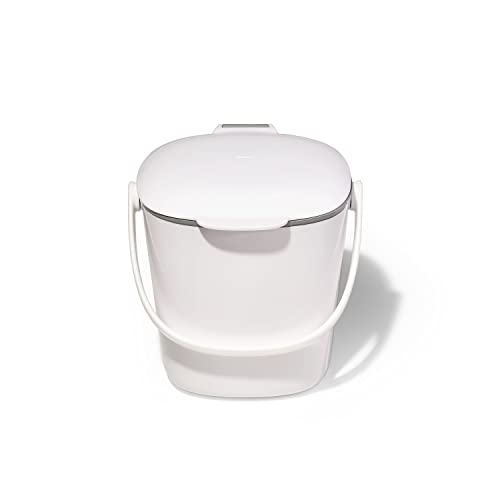
| OXO Good Grips Compost Bin | Everyday countertop caddy | One-handed daily use; simplest washing routine | Relies on frequent emptying rather than filtration |
| Joseph Joseph Totem | Integrated waste station | All waste streams in one tidy footprint | Premium tier; commits you to its caddy size and format |
| FCMP Outdoor Tumbler | Dual-chamber tumbler | Continuous composting; rodent exclusion; no forking | Assembly and fittings at an honest, not premium, tier |
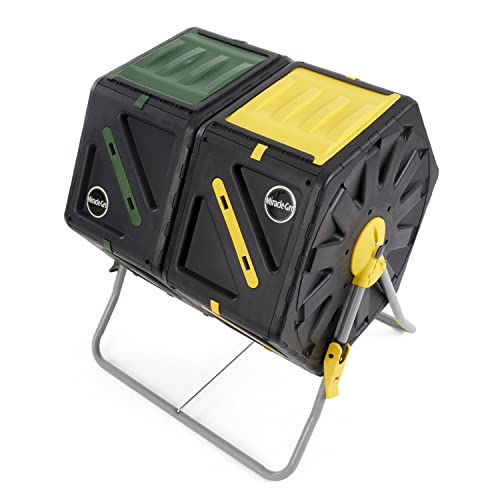
| Miracle-Gro Tumbler | Compact tumbler | Small-space, beginner-friendly batch composting | Single chamber imposes batch discipline; modest capacity |
| VIVOSUN Tumbler | Value dual-chamber tumbler | Two chambers at an entry-to-mid tier | Finish and assembly reward patience |

The Everyday Alternative: OXO Good Grips Compost Bin
Against the filtered EPICA, the OXO makes the opposite bet: that a household which empties daily does not need filtration, only a lid that behaves during cooking and a body that washes without fuss. For daily cooks the bet pays — the OXO is the lower-friction object, and friction, repeated daily, is what kills systems. For households whose rhythm is slower, the EPICA’s filter earns its place. This is the category in miniature: the comparison is not quality against quality but rhythm against rhythm, and the buyer’s honest calendar is the deciding specification. The multi-pick treatment in compost bin reviews scores the full shortlist side by side, while the selection framework in the compost bin buying guide turns these comparisons into a decision method.
The Value Alternative: VIVOSUN Tumbler
Against the FCMP, the VIVOSUN offers the same dual-chamber logic at a lower tier, trading finish for accessibility. Operationally the two ask identical things of their owner — balanced feeding, frequent turns, moisture judgement — and return the same category of compost. The differences live in assembly experience, fittings and refinement. Buyers for whom the dual-chamber format is the decision, and the tier is the constraint, are well served by the VIVOSUN; buyers who expect the drum to be handled daily for years and value the smoother ownership experience may prefer to step up. Neither answer is wrong, and this review declines to pretend otherwise.
Two More Designs Under Review
The Integrated Station: Joseph Joseph Totem
The Totem tests a different hypothesis about the kitchen half: that compost collection works best as one stream inside a complete waste station, where general waste, recycling and food scraps are sorted at a single standing point. The compost element is a removable caddy sized for frequent emptying, and the system’s performance in real use follows that sizing — households that empty it on its intended rhythm get the tidiest sorting experience in this review, with no separate caddy occupying the counter at all. The trade-offs are commitment and scale. The station asks for a permanent floor position and a premium-tier outlay, its caddy will not suit a household producing large daily volumes of scraps, and the buyer is adopting a format, with its own bags and accessories, rather than a standalone bin. Judged as a caddy, it is good; judged as kitchen infrastructure, it is the most considered design here; judged as value, it depends entirely on whether your kitchen wanted the whole station anyway. That is a fair summary of integrated design in any category, and this review scores it as a strong option for the kitchens it fits and an unnecessary one for those it does not.
The Compact Drum: Miracle-Gro Tumbler
The Miracle-Gro tests the opposite hypothesis outdoors: that the tumbler’s virtues survive miniaturisation. In use, the sealed rotating drum does deliver the format’s essentials — containment, rodent exclusion, turning without forking — at a footprint a patio or small yard can absorb, and for a small household’s kitchen scraps it processes tidy batches without drama. The constraints are the format’s, sharpened by size. A single chamber means strict batch discipline: fill, close, finish, empty, and hold fresh scraps elsewhere meanwhile. Capacity rules it out for garden waste in any volume. And the batch rhythm means its owners feel the seasonal slowdown more keenly, because a winter batch occupies the only chamber for a long span. Within those constraints it performs its role honestly, and this review recommends it as the small-space starting point — often the first element of a system that later adds a static bin for bulk, at which point the little drum settles into the kitchen-scrap role it was always best at.
Winter Performance and the Motivation Test
No review of this category is complete without a winter paragraph, because winter is when systems are lost. Cold slows decomposition toward a standstill in the outdoor unit while the kitchen keeps producing, so drums and bins fill with material that is barely changing; rain drives moisture into static piles; the trip outside becomes the least attractive chore in the house. The designs cope in proportion to their containment and their owner’s stored preparation: a sealed tumbler at least keeps the accumulating load tidy and pest-free, a caddy with a fresh filter keeps the kitchen neutral when emptying stretches, and a browns store laid down in autumn lets the winter load be layered properly instead of dumped wet. What winter really tests is the household’s framing. Owners who expect the slowdown treat it as the system’s dormant season and keep feeding in balance; owners who expected a machine interpret the same slowdown as failure and abandon a bin that would have rewarded them in spring. This review’s advice is to buy with winter explicitly in mind — capacity headroom, containment, a browns supply — and to judge any compost bin the following summer, not in its first January.
Who Should Buy It — and Who Should Skip It
Buy the compost bin system if you cook with fresh ingredients most days, because that waste stream is the ideal fuel and the caddy will earn its counter space within a week. Buy it if you garden at any scale, because the output has a destination and the loop’s satisfaction is real. Buy it if your home has a workable outdoor spot — level, reachable, considerate of neighbours — and you have checked the rules where you live about siting. Buy it, specifically in its sealed and filtered forms, if you are motivated by waste reduction but honest that your tolerance for mess is low; containment-first designs were made for you. Choose the tumbler-led configuration if your input is a steady stream of kitchen scraps and clippings, the static-bin configuration if your input is bulky and seasonal, and the caddy-only configuration if a collection scheme will do your processing.
Skip it — or defer it — if your household’s food waste is mostly cooked leftovers, takeaway remains and packaging, because a residential bin cannot accept the meat, dairy and oily food that dominate that stream, and a bin fed only peelings from the occasional fresh meal will never build a working pile. Skip it if no one in the household will own the washing and turning routines, because an unowned system becomes the smell it was bought to avoid. Skip the outdoor half if your only space is a small balcony overlooked on all sides, and take the caddy-plus-collection route instead. And skip the premium tiers if your profile is simple: a daily cook with a collection scheme needs a good caddy, not a waste station, and a gardener with space needs capacity, not finish. The pre-purchase checklist is short: identify your dominant input stream, confirm your outdoor spot and its rules, name the person who will wash and turn, and choose the odour strategy that matches your emptying rhythm. Four honest answers predict satisfaction better than any specification sheet. For the value framing of the same decision, see is a compost bin worth it, and for the balanced ledger, compost bin pros and cons.
Setup, Care and Maintenance Essentials
Setup follows the siting logic already described: level ground, soil under a static bin so organisms can colonise and liquid can drain, water within reach, the kitchen trip short enough to survive winter, and the position checked against the rules where you live before the first load goes in. Commission the pile with a coarse dry base — twigs, shredded cardboard, dry leaves — then build in balanced layers from the first day, greens and browns alternating with browns visibly ahead. Chop or shred anything large; particle size is the cheapest accelerant in the whole process. Set the moisture by hand: a squeezed handful should feel like a wrung-out sponge, damp, with at most a drop or two of water. Care thereafter is a short recurring list. Indoors: lid closed as a reflex, shredded paper over wet additions, a rinse at every emptying, a hot soapy wash on a regular cycle with the caddy dried before refilling, and the charcoal filter replaced on a calendar reminder rather than when smell announces its failure. Outdoors: turns or forking on a weekly rhythm tied to an existing habit, browns added with every significant green addition, moisture corrected in both directions — water for a dusty pile, dry browns and air for a wet one — and the exclusion list enforced absolutely: no meat, no bones, no dairy, no oils or fats, no exceptions for leftovers in sauce. Maintenance of the equipment itself is annual and brief: wash everything thoroughly once a season, check seals, hinges, latches and frames, tighten and clear aeration points, and refresh the browns store before the autumn surge arrives. A system maintained at that level does not develop the problems that fill complaint threads, because nearly all of those problems are this paragraph, skipped.
The Review’s Judgement by Household
Scores in this category mean little until they are attached to households, so this review states its judgements in that form. For the family kitchen that cooks daily and gardens at weekends, the reviewed system at its best — filtered caddy, dual-chamber tumbler — earns the strongest recommendation in this article: the input stream is ideal, the output has a home, and the routines align with cooking and gardening the household already does. For the small household in a flat or townhouse with a collection scheme, the judgement narrows to the caddy alone, and there the simple-versus-filtered decision is the whole review: daily emptying crowns the OXO’s approach, a slower rhythm crowns the EPICA’s. For the keen gardener, the tumblers in this review are supporting players and the static bin — unglamorous, capacious, forgiving — is the lead, with the caddy judged purely on washability. For the design-led kitchen renovator, the Totem is the only entry that treats compost as infrastructure rather than an accessory, and it is judged accordingly: excellent where its format fits, surplus where it does not. For the first-time, small-garden composter, the compact Miracle-Gro is the honest starting point, with the explicit expectation that success may promote it to a supporting role. Across all five households the pattern of this review repeats: the equipment differences are real but second-order, and the first-order variable is always the match between the system’s demands and the household’s actual week. Buy the match, keep the hygiene, and the category delivers what it promises.
Reading a Compost Bin Like a Reviewer
Because most buyers meet this category through listings rather than in person, this review closes its assessment with the inspection method it applies — the checks that predict ownership satisfaction and that any buyer can repeat. For a caddy, work the lid: it should open in the motion cooking requires and close with a seal you can feel, because that seal is your fruit-fly control. Look inside and imagine washing it weekly for a year; every corner you cannot reach is a future smell. Find the filter: where it sits, how it is replaced, and whether replacements are a common format you can source without effort. Lift it as you would on the garden trip, full and one-handed, and judge the handle and balance in that moment rather than empty on a shelf. For a tumbler, turn the drum and listen to the mechanism; check that the door is wide enough for a trug of finished compost to leave without excavation; look at how the frame meets the ground and whether the whole unit can sit level and stable under a wet, shifting load; and confirm the chamber logic matches your input stream — dual for continuous, single only if you accept batches. For a static bin, the inspection is mostly negative space: a sound lid, a harvest route at the base, and nothing fragile to break. Apply those checks and the differences between the designs in this review stop being marketing and become predictions — of which bin your household will still be happily operating, washing, turning and harvesting several seasons from now.
Final Verdict
This compost bin review concludes that the category earns a clear recommendation for the households it suits, because its two halves have each been designed to a standard that respects domestic reality: caddies that seal, filter and wash, and processors that contain, exclude pests and turn without heavy labour. The recommendation carries its condition openly — the bin provides the conditions, but the household provides the balance, the hygiene and the rhythm — and households that accept that bargain get a system that shrinks their waste weekly and feeds their garden seasonally for years. Shortlist by segment, not by headline: a filtered steel caddy like the EPICA or a simple washable one like the OXO for the kitchen, according to your emptying rhythm; a dual-chamber tumbler like the FCMP or the VIVOSUN for continuous garden processing, a compact drum like the Miracle-Gro for small spaces, a static bin where bulk rules. Then run the first month deliberately, because the first month is when the habits that decide everything are set, and judge the system at the end of its first full season, when the pipeline is established and the equipment has been washed, turned and harvested enough times to show what it really is in your household’s hands. The step-by-step selection method is in how to choose a compost bin.
One Season On: What This Review Would Change
Reviews written at unboxing age badly in this category, so it is worth stating what a season of use revises. It revises the importance of capacity downward and of washability upward: almost no household fills the system it feared was too small, and almost every household curses the corner it cannot clean. It revises the filter from an accessory to a component, because the week the filter quietly expires is the week the household concludes the bin has failed. It revises the tumbler’s turning from a feature to a rhythm — the owners who tied turns to an existing weekly habit report a different product from the owners who relied on remembering. And it revises the harvest from an ending to a beginning: the first trug of finished compost, spread on beds the household eats from, converts more sceptics than any argument in this review. What a season does not revise is the central finding — that the compost bin is a sound, mature, genuinely useful household system whose results are decided by hygiene and balance — and it is on that finding, rather than on any single design, that this review rests its recommendation.
A Second Look After the First Impression: Testing Compost Bin Against Real Routines
This section exists to look again after the first impression has faded, because the qualities that sell a product in the first hour are rarely the ones that decide whether it is still liked in month three. It adds a layer that a feature list cannot give you, grounded in the garden & lawn context this compost bin will actually live in. Where this guide names examples such as EPICA Stainless Steel Compost Bin, FCMP Outdoor Tumbler, OXO Good Grips Compost Bin, use them as test cases for the checks below rather than as shortcuts past them.
Pay close attention to the recurring friction points, because they compound. With a compost bin, owners tend to run into blades, lines and fittings wearing quietly, parts clogging mid-job, and instructions that assume a flat, empty garden that nobody actually has. None of these is dramatic on its own, and that is exactly why they get underestimated at buying time. Ask how the design you are considering handles each one: can the wearing part be replaced, can the awkward part be reached without tools, does the job take two minutes or twenty. A compost bin that makes its own upkeep easy gets maintained; one that makes upkeep a project gets neglected, and neglected products perform badly in ways that then get blamed on the original purchase.
Use the listings as a checklist rather than as entertainment. For each compost bin you shortlist, note the exact variant, the included parts, what is sold separately, and which photographs show the item in a setting like yours rather than in a studio. If a model named elsewhere in this guide catches your eye, treat it as a worked example for this process: run it through the same measurements, the same weekly rehearsal and the same friction list before letting familiarity turn into preference. Consistency is the whole trick. Shoppers go wrong not by choosing the objectively weaker compost bin, but by judging one contender on features, the next on looks and the third on a single enthusiastic anecdote.
Think about who else has a vote. A compost bin is usually shared, moved, cleaned or complained about by more than one person, and the second user’s priorities are often the ones that surface after the return window closes. Check height, weight, reach, noise, heat, sharp edges or sheer visual presence, whichever apply, against the smallest, oldest or least enthusiastic person who will live with it. If you are buying for a household that includes children, pets, elderly relatives or lodgers, run the clumsy scenario too: the spill, the knock, the curious tug, the door left open. A robust compost bin choice survives other people; a fragile one only survives its buyer.
Consider the edge cases that sit just outside normal use, because a compost bin will meet all of them eventually. The unusually large load, the unusually small task, the day you are in a hurry, the day something else in the room is broken and this has to cover for it. Versatility is not about a long feature list; it is about behaving predictably when conditions are imperfect. Where a design offers settings, modes, attachments or configurations, ask what each one is actually for in your home, and be suspicious of flexibility you cannot attach to a real occasion. One well-judged configuration used weekly beats five clever ones used once, and the honest compost bin for your home is the one whose strengths line up with your most frequent edge case, not your rarest.
Build a simple decision checklist and score it in writing. Five lines are enough: fit in the space, fit with the routine, ease of cleaning or upkeep, quality of the parts that move or wear, and how the compost bin will be stored or will look when it is not the centre of attention. Score each contender quickly, then look only at the lowest scores, because purchases are usually ruined by their weakest point rather than saved by their strongest. If two options tie, choose the one whose weakness is cheapest or easiest to live with. This sounds mechanical, and it is meant to: a written checklist is the best defence against the very human habit of falling for the last photograph you looked at.
Finally, plan the first fortnight. Decide where the compost bin will live from day one, what it replaces, what accessory or companion it needs straight away and what small job you will use to learn its habits while returning it is still simple. Keep the packaging until that learning period is over, note anything that surprises you, and deal with a mismatch early rather than adapting yourself around a poor fit for years. The households that end up happiest with a compost bin are rarely the ones that researched longest; they are the ones that checked fit honestly, bought for the ordinary week, and paid attention during the first days instead of assuming the decision ended at checkout.
One more angle is worth your time: the second-order costs. A compost bin changes what happens around it. It can demand a different cleaning product, a new storage habit, a moved piece of furniture, a rearranged cupboard or a standing arrangement with the people you live with. List those knock-on effects before you buy and decide whether you accept them as part of the deal. Sometimes the answer is an easy yes, and the compost bin earns its place by improving the whole routine around it. Sometimes the honest answer is that the supporting changes are the real project, and the purchase should wait until you are ready for them. Either answer is useful; the only bad outcome is discovering the knock-on effects by accident, one irritation at a time, after the decision can no longer be revisited.
Frequently Asked Questions
What does this review look for in a compost bin?
Performance across the full cycle rather than first impressions: how the caddy contains odour and fruit flies over days, how washable every surface is, how the outdoor unit handles balancing, turning and harvesting, and how the whole system behaves in its second season. Design details that decide those outcomes — lid seals, charcoal filters, interior shapes, drum doors, latches — get more weight than styling or headline capacity, because they are what owners actually live with. A bin that wins the first week and loses the first year fails this review’s test.
Which is better, a countertop bin with a filter or a simple one?
It depends entirely on your emptying rhythm. A charcoal filter earns its place when scraps are held for several days, absorbing the gases that build up between trips; households that empty daily gain little from filtration and are better served by a simple, easily washed caddy with a lid that behaves well during cooking. What neither design survives is neglect: filters must be replaced when spent, and every caddy must be washed regularly with hot soapy water and dried before refilling, because biofilm, not scraps, is the lasting source of smell.
Why does a tumbler need two chambers?
Because households produce scraps continuously but compost finishes in batches. In a single chamber, every fresh addition mixes with the finishing load, restarting its clock and making harvest a sorting exercise. Two chambers separate the streams: one side accepts fresh material while the other finishes undisturbed, so there is always somewhere for today’s peelings and always a batch approaching readiness. It is the configuration that best matches real kitchen rhythm, which is why this review treats dual-chamber designs as the default recommendation for tumbler buyers with the space.
What should I do if my compost smells bad?
Treat the smell as a diagnosis. Indoors, it means the caddy needs washing — hot soapy water, fully dried — or its charcoal filter is spent, or wet scraps need a shredded-paper layer and more frequent emptying. Outdoors, a sour or swampy smell means too many greens, too much moisture and too little air: fork in a generous volume of dry browns such as shredded cardboard or dry leaves, turn thoroughly, and pause wet additions until the balance recovers. Also audit for rule-breakers — meat, dairy or oily food in a residential bin will smell until removed, and no amount of turning fixes their presence.
Can I compost if I only have a small garden?
Yes, and the category is increasingly designed for exactly that. A compact tumbler in a patio corner handles a small household’s kitchen scraps in sealed, tidy batches, and a caddy indoors keeps the kitchen side clean. The constraints to respect are siting and scale: place the unit where it does not dominate the space or trouble neighbours, check the rules where you live about placement, and accept batch discipline — when the drum is finishing a load, fresh scraps wait in the caddy or a holding container. Small gardens compost successfully all the time; they just compost in rhythm rather than in volume.
How do I know when compost is finished?
Finished compost is dark, crumbly and earthy-smelling, and the original ingredients are no longer recognisable — no identifiable peelings, leaves or paper, just a uniform, soil-like material. It should feel cool or at ambient temperature rather than actively warm, and it should not smell sour or of ammonia. If recognisable material remains, the batch needs more time, more air or better balance; if only a few stubborn items persist, such as eggshell fragments or woody pieces, sieve the batch, use the fine fraction, and return the coarse remainder to the active pile for another round.
Related Guides
The rest of this cluster covers compost bin reviews of the full shortlist, the compost bin buying guide and compost bin pros and cons in full. For the wider garden, see the best compost bins on this site, raised garden beds, soil for raised vegetable garden beds and gardening gloves for harvest day.