Disclosure: As an Amazon Associate, dailyhomedecorating.com earns from qualifying purchases. Links on this page are affiliate links; they cost you nothing extra. Prices and availability change often, so check the current Amazon listing before you buy.
A chandelier buying guide exists because chandeliers are the easiest light in the house to buy wrong and the hardest to return gracefully. The fixture is large, wired in, often assembled crystal by crystal or bead by bead on a ladder, and chosen mostly from photographs that hide the two things that decide whether it works: its true scale in your room and the quality of its light once the sun goes down. Get those two things right and a chandelier becomes the piece visitors remember and the light you live under happily for a decade. Get them wrong and you own an expensive ceiling ornament you apologise for. This guide walks through the whole decision in the order it should be made: what a chandelier actually does in a room, the main types and what each is really for, the sizing and hanging maths that cannot be guessed, the bulb and dimming choices that decide the light’s character, and the ceiling and wiring realities that quietly rule some options out before style even enters the conversation. Product picks appear throughout as prose recommendations positioned by tier — entry, mid or premium — because the right way to use them is as worked examples of each type, not as a shopping list detached from your room’s measurements.
Key Takeaways
- Size is decided by arithmetic, not taste: add the room’s length and width in feet and treat the sum, in inches, as your starting diameter.
- A chandelier is a room’s centrepiece and one of its main light sources at once; judge candidates on both jobs, never on looks alone.
- Hanging height is a rule, not a preference: roughly thirty to thirty-six inches above a dining table, and at least seven feet of clearance over open floor.
- Bulb choice and dimming decide the light you actually live with; the frame is the part you look at, the bulbs are the part you see by.
- Your ceiling box, ceiling height and slope rule options in or out before style does — check them first and save yourself a return.
- Buy the type that matches the room’s architecture and furniture first, then choose the specific model inside that type.
In this guide
What a Chandelier Does and the Main Types
A chandelier does two jobs simultaneously, and most buying mistakes come from evaluating only one of them. The first job is optical: it is a multi-source light fixture hung at the visual centre of a room, which means it spreads light from several points at once, softening shadows in a way a single ceiling light never can, and it usually serves as the room’s primary ambient source in the evening. The second job is architectural: it anchors the room. A chandelier gives the eye a centre, defines the zone beneath it — the table, the seating group, the entry — and sets the formality of the whole space more decisively than any rug or paint colour. A room with the right chandelier feels composed; a room with a timid, undersized one feels unfinished no matter how good the furniture is. When you shop, hold both jobs in mind for every candidate: ask what its light will do at nine in the evening, and ask what its silhouette will do at noon.
Crystal Chandeliers
The crystal chandelier is the original form and still the benchmark for sparkle. Rows of cut-glass or crystal drops and beads catch the light from the bulbs inside the frame and scatter it, which is why a crystal fixture seems to glow rather than merely shine. Traditional versions arrange the drops on a tiered metal frame with candle-style bulbs; contemporary versions — raindrop designs, rectangular frames for dining tables, drum surrounds — keep the refraction and drop the formality. Crystal suits dining rooms and entryways where a moment of theatre is welcome, and it flatters rooms with other reflective notes: mirrors, glass, polished metals. Its honest costs are weight, assembly time, and cleaning — hundreds of individual pieces collect dust and eventually want washing. The worked example later in this guide, the Saint Mossi raindrop design, shows the modern end of the family: the sparkle without the palace.
Farmhouse and Wood-Bead Chandeliers
The farmhouse family trades sparkle for texture. Frames are wood, distressed metal, rope or rattan, and the signature member is the wood-bead chandelier, where strands of beads drape from a central frame and soften the light into something warm and diffuse. These fixtures suit the rooms most people actually live in now — open-plan kitchens, casual dining spaces, bedrooms with linen and timber — because they read as furniture rather than jewellery. They are generally lighter than crystal, forgiving of imperfect ceilings, and kind to low-formality decorating. Their limits are real: the style is strongly flavoured, so it dates faster than plainer forms, and bead strands in kitchens accumulate cooking film that needs patient wiping. The MRHYSWD wood-bead design reviewed below is the type specimen — pretty, warm and unmistakably of its style, which is exactly the point and exactly the risk.
Modern, Sputnik and Geometric Chandeliers
Modern chandeliers treat the fixture as sculpture: radiating rods with bulbs at their tips in the sputnik manner, rings and halos, geometric cages, linear bars. The light is often more directional and the shadows more graphic than with crystal, which suits contemporary rooms with clean lines and makes a deliberate statement over a dining table or in a double-height entry. Bulbs are usually exposed, so bulb choice becomes a design decision as much as a lighting one — filament-style LED bulbs are the natural partner. The family’s weakness is glare: bare bulbs at eye level across a dining table can be dazzling if the fixture is hung too low or run without a dimmer. The Hamilton Hills designs in this guide sit here — metal, geometry and intent — and they reward buyers who plan the dimming as carefully as the purchase.
Traditional Candle-Style Chandeliers
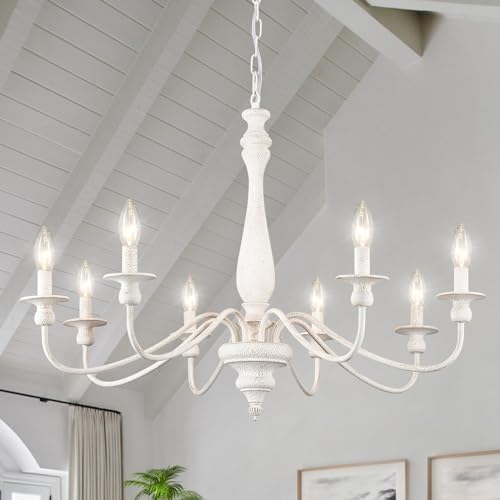
The candle-style chandelier keeps the pre-electric silhouette: curved arms, candle tubes, flame-tip bulbs, often in bronze, brass or black metal, sometimes with small shades. It is the most architectural of the families, the one that belongs in rooms with crown moulding, panelled walls, older houses and furniture with turned legs. Done well it looks inevitable, as if the house was built around it. Done in the wrong room it looks like a costume. Candle-style fixtures are usually open and relatively light for their size, and their many small bulbs give the soft, shadow-gentle light the form was designed for. The XILICON crystal design below bridges this family and the crystal one — candle arms dressed with drops — which is why it suits transitional rooms that sit between classic and contemporary.
Drum and Shaded Chandeliers
A drum chandelier wraps the light source in a fabric or metal shade shaped like a shallow cylinder. The shade does three useful things: it hides the bulbs, kills glare, and throws light up and down rather than sideways, which flatters faces at a table and ceilings above. Drums are the diplomat of the category — they sit comfortably in modern, transitional and softened traditional rooms, and they are the easiest chandelier to live with in a bedroom or living room where the fixture is seen from below at close range. The trade is drama: a drum rarely stops a visitor mid-sentence, and fabric shades in kitchens need degreasing attention. For renters of their own taste — people who want the room to feel finished rather than theatrical — the drum is frequently the correct answer that the crystal photographs argue them out of.
Linear and Multi-Light Chandeliers
Linear chandeliers stretch the form along one axis: a bar, a row of pendants on a shared canopy, or a rectangular frame. They exist for rectangular problems — long dining tables, kitchen islands, conference-style seating — where a round fixture lights the middle and abandons the ends. A linear fixture over a long table evens the light along its whole length and mirrors the table’s geometry, which is why designers reach for it instinctively in those rooms. The sizing rule changes accordingly: judge length against the table, aiming for a fixture that covers roughly half to two-thirds of the table’s length without crowding its ends. Linear designs are the one family where two smaller fixtures are a genuine alternative — a pair of identical chandeliers over a very long table reads as deliberate and lights beautifully — and the comparison is worth making before you commit to a single large piece.
Top Picks at a Glance
Six fixtures recur through this guide as worked examples, one for each major family, each positioned by tier rather than price because listings change constantly — check price on Amazon for the current figure on any of them. The badges name the job each does best.
| Pick | Badge | Type | Tier | Best room |
|---|---|---|---|---|
| Saint Mossi Modern K9 Crystal Raindrop Chandelier | Best Overall | Contemporary crystal | Mid | Dining room, entryway |
| MRHYSWD Farmhouse Wood Bead Chandelier | Best for Farmhouse Rooms | Wood bead | Entry to mid | Casual dining, bedroom |
| Hamilton Hills Sputnik-Style Chandelier | Best Modern Statement | Geometric metal | Mid | Contemporary dining, living |
| XILICON Crystal Chandelier | Best Traditional | Candle-arm crystal | Mid | Formal dining, foyer |
| VINLUZ Modern Crystal Chandelier | Best Contemporary Value | Modern crystal | Entry to mid | Dining room, bedroom |
| GANEED Crystal Chandelier | Best Entry Tier | Crystal | Entry | Small dining, apartment |
Read the table as a map of the category rather than a ranking. The Saint Mossi earns Best Overall because the raindrop pattern delivers the crystal effect in a form that fits the widest range of real rooms; the GANEED earns its place at the opposite end by making the same basic effect available to a small apartment dining corner. Between them, every pick is the right answer to a specific room. The mini-reviews later in this guide give each one its honest paragraph, including who should walk past it.
How Big Should a Chandelier Be?
Diameter first. The standard starting rule: measure the room’s length and width in feet, add them together, and read the sum as inches of diameter. A twelve-by-sixteen-foot dining room suggests a fixture around twenty-eight inches across. Treat that number as the centre of a range rather than a command — a visually heavy fixture (dense crystal, a solid drum) can come down an inch or two, an airy one (open candle arms, thin rods) can go up — but stray far from it and the room will tell you. Undersizing is the epidemic error: buyers fear overwhelming the room, choose small, and end up with a fixture that reads as an apology. When torn between two sizes, the larger is usually right, because a chandelier’s job includes presence.
Over a table, the rule changes its reference: the fixture should be roughly half to two-thirds the table’s width, and comfortably narrower than the table so no one rises into it and the table’s edge stays lit. For a rectangular table, match a round fixture to the width or choose a linear fixture matched to the length. Height of the fixture itself matters in tall rooms — a two-tier design fills vertical space that a single shallow tier leaves empty — and in low rooms the opposite: a wide, shallow fixture gives presence without eating headroom. Finally, measure your doors and stairwell before ordering anything large and pre-assembled; the most beautiful chandelier in the category is the one that can physically reach the room.
How Much Light Do You Actually Need?
Count bulbs, then think in layers. A chandelier with six to twelve small bulbs is a substantial light source, but its light is ambient — spread wide, soft, and rarely sufficient alone for tasks. Plan the room in layers: the chandelier for ambient glow, something else — recessed lights, sconces, lamps, under-cabinet strips in a kitchen — for task and accent. Rooms that rely on the chandelier alone end up either glaring at full power or murky at social power, with nothing in between. This is also why the number of bulbs is a practical specification and not a vanity metric: more bulbs at lower individual output give smoother, more shadowless light than few bulbs driven hard, and they dim more gracefully.
Brightness should be judged on the bulbs you will actually install, since most chandeliers are sold without bulbs or with placeholders. Candelabra-base LED bulbs vary widely in output; a set chosen carelessly can leave a grand fixture glowing like a nightlight, or turn a dining room into an operating theatre. Choose the set deliberately, in a warm colour temperature for dining and living spaces — the warm end of the range flatters food, wood and faces — and buy one spare set at the same time so a replacement two years later matches its siblings exactly. The fuller method for choosing, sizing and hanging is laid out step by step in how to choose a chandelier, which this guide’s criteria sections summarise.
Which Bulb and Dimming Setup Is Right?
Dimming is not an accessory for a chandelier; it is half the product. A chandelier’s natural states are bright for setting a table or cleaning, and low for eating and talking, and only a dimmer travels between them. If your room has a plain switch, plan the dimmer as part of the purchase — an LED-compatible dimmer matched to your bulbs, installed at the same time as the fixture, ideally by the same hands. Bulb and dimmer compatibility is the category’s most common technical disappointment: mismatched pairs flicker, buzz, or refuse to dim below a sullen glow. Buy bulbs that state dimmability plainly, from the same production family, and test the full set on the dimmer before the ladder goes away.
Base types are the other quiet decision. Candelabra bases dominate traditional and crystal designs, small globe and filament bulbs dominate modern ones, and a few fixtures use integrated LED modules instead of replaceable bulbs. Integrated designs are slim and simple but commit you: when the module eventually fades or fails, the repair is a part order or a new fixture, not a bulb swap. Replaceable-bulb fixtures ask slightly more of you at purchase and repay it for decades. This guide’s bias is firmly with replaceable bulbs for any fixture you intend to keep, and the picks above follow it.
How Low Should It Hang?
Over a dining table, the bottom of the fixture should sit roughly thirty to thirty-six inches above the tabletop — low enough to feel connected to the table and to keep the light on the food and faces, high enough that sightlines across the table stay open and nobody’s head is threatened when they stand. Taller ceilings take the higher end of the range. Over open floor — an entryway, a living room centre — the rule is clearance: at least seven feet from floor to fixture bottom, more where tall people pass with arms raised or where a door swings beneath. In a two-storey foyer, the fixture should hang so its centre sits around the height of the second-floor landing, visible through the door and from the stairs without looming over the ground floor.
Chain and rod lengths are how you get there, and adjustability is a feature to verify before buying, not assume. Most chandeliers arrive with more chain than a standard ceiling needs and expect you to remove links; a few are fixed-length and punish miscalculation. Sloped ceilings need a fixture whose canopy and suspension tolerate an angle, or an adapter that does. Measure from ceiling to the intended bottom of the fixture, subtract the fixture’s own height, and what remains is the suspension length you need — then confirm the product supplies it. The physical work itself, including the electrical safety sequence, is covered in how to install chandelier; read it before deciding whether your installation is a DIY afternoon or an electrician’s visit.
What Does Your Ceiling Allow?
Every chandelier hangs from an electrical box in the ceiling, and that box — not the fixture’s mounting hardware — carries the weight. Standard boxes in older homes were often fitted for a light ceiling fixture and may not be rated for a heavy chandelier; fixture-rated boxes, braced where the fixture is heavy, are the requirement, and upgrading the box is a normal, inexpensive part of a serious installation. Weight concentrates risk: a large crystal fixture can weigh as much as a small child, and it hangs over the table where your family eats. Treat the box question as non-negotiable, and treat any doubt as an electrician question. The detailed limits and the brace decision are spelled out in the installation guide linked above.
Ceiling height and construction shape the rest. Eight-foot ceilings want shallow fixtures and short suspensions; nine feet and above open the full catalogue. Plaster, concrete and ceiling joists all change the mounting conversation. And renters should note the honest boundary: a hardwired chandelier is a landlord conversation and usually an electrician job, which is why apartment buyers often do best with a lighter fixture installed professionally and removed cleanly later — several of the smaller picks in this guide exist in exactly that niche, a point the apartment-focused roundup at best chandelier for apartments develops with sized options.
How to Prioritise by Use Case
The Dining Room Host
Your fixture lives over the table and works hardest at dinner-party brightness and dinner-party dimness in the same evening. Prioritise, in order: correct size against the table, smooth dimming with bulbs chosen for warm light, and a silhouette that photographs as the room’s centrepiece because your guests will see it that way. Crystal and candle-style designs earn their keep here; the Saint Mossi pattern is the contemporary route, the XILICON the traditional one. Skip delicate micro-bead designs if your household includes enthusiastic table-clearing and chair-stacking; choose a fixture whose underside — the view your seated guests actually get — is finished and pretty.
The Entryway Impression-Maker
The foyer fixture is seen for ninety seconds at a time, from below, often through a doorway and sometimes from a staircase, and it sets the house’s first impression out of all proportion to its cost. Prioritise silhouette and sparkle over task light, size generously — entries forgive grandeur that dining rooms do not — and check the view from the stairs as carefully as from the door. Two-storey entries are the one place a genuinely large, tiered fixture is almost always right. Bedrooms and entries share a taste for drama at low practical stakes, which is why the bedroom-sized options gathered at best chandelier for bedrooms overlap so much with good foyer choices.
The Bedroom Softener
A bedroom chandelier replaces a harsh central ceiling light with something that makes the room feel like a retreat. Prioritise low glare — shaded, beaded or frosted designs over bare-bulb geometry — a dimmer you can reach without getting out of bed, and a size keyed to the bed rather than the room: centred over the bed’s foot half, wide enough to register, shallow enough for the ceiling. Wood bead and drum designs dominate this use for good reason. The honest hesitation belongs to light sleepers in low rooms: if the ceiling is eight feet and the bed is tall, a beautiful semi-flush fixture may serve you better than a hanging one, and the trade-offs are weighed frankly in chandelier pros and cons.
The Apartment Upgrader
Your constraints are real: a landlord, a ceiling box of unknown rating, a dining corner rather than a dining room, and a future move. Prioritise light weight, modest diameter, professional installation you can reverse, and a style that will travel to the next home. Entry-tier crystal and compact modern designs — the GANEED pattern — exist precisely for you. Keep every part, cap the wires properly when you leave, and photograph the original fixture before touching anything. The value question for renters is sharper than for owners, and it is argued properly in is a chandelier worth it.
The Picks in Detail
Saint Mossi Modern K9 Crystal Raindrop Chandelier — Best Overall
Strands of crystal drops fall at varied lengths from a rectangular frame, imitating rain frozen mid-fall, and the effect over a dining table is the category’s best party trick at a mid-tier position: genuine crystal refraction with a contemporary outline that suits modern and transitional rooms equally. The rectangular form matches dining tables better than round crystal ever did. Assembly is the honest cost — the drops hang individually and the patient hour on a step stool is part of the purchase. Best for: dining rooms and entries in contemporary or transitional homes. Not suited for: anyone who wants to unbox and hang in twenty minutes, or a low-ceiling room where its fall of drops crowds the table. Strengths: real sparkle, table-friendly shape, broad style range. Trade-offs: assembly time, dusting, and a look that commits the room to a little glamour.

MRHYSWD Farmhouse Wood Bead Chandelier — Best for Farmhouse Rooms
Draped strands of wooden beads soften both the light and the room, and this design has become the reference for the style because its proportions suit real dining spaces rather than showroom sets. It hangs relatively light for its presence, which eases the ceiling-box question, and its glow through the beads is the warmest in this guide. Best for: farmhouse, coastal and boho rooms; casual dining; bedrooms wanting texture. Not suited for: formal rooms, committed modernists, or anyone who will tire of a strong style accent — bead chandeliers are a flavour, and flavours date. Strengths: warmth, texture, forgiving weight. Trade-offs: style specificity, and beads that ask for patient dusting strand by strand.
Hamilton Hills Sputnik-Style Chandelier — Best Modern Statement
Radiating metal rods tipped with bulbs: the sputnik pattern turns the fixture into the room’s sculpture and its light into a graphic event. Hamilton Hills’ version is the mid-tier reference for the form, finished in the metallic tones that pair with contemporary dining furniture. Exposed bulbs make filament-style LEDs part of the design, and a dimmer is effectively mandatory — at full brightness across a table, bare bulbs glare. Best for: contemporary and mid-century rooms, confident decorators, living rooms as much as dining rooms. Not suited for: low ceilings, glare-sensitive households, or traditional architecture it would argue with. Strengths: presence, directional light, design longevity within modern schemes. Trade-offs: glare management and a silhouette some households will find spiky rather than elegant. More modern options are compared in best chandelier for modern homes.
XILICON Crystal Chandelier — Best Traditional
Candle arms dressed with crystal drops: the XILICON pattern is the transitional bridge between the candle family and the crystal family, formal enough for a panelled dining room, soft enough for a house that mixes periods. Its many small lights give the shadow-gentle illumination traditional rooms are designed around, and the open frame keeps its weight moderate for its size. Best for: formal and transitional dining rooms, foyers with classic detailing. Not suited for: stark modern interiors, or buyers wanting a fixture that disappears — this one is meant to be looked at. Strengths: classic presence, gentle light, moderate weight. Trade-offs: crystal cleaning, and a formality that must match the room to look right.

VINLUZ Modern Crystal Chandelier — Best Contemporary Value
VINLUZ builds crystal into cleaner, more compact frames than the traditional makers, and the result is the contemporary crystal effect at an entry-to-mid position: enough drops for real refraction, in sizes that suit ordinary dining rooms and larger bedrooms. It is the pick for buyers who want the Saint Mossi idea with a smaller footprint and a gentler commitment. Best for: first-chandelier buyers, dining rooms of modest size, bedrooms. Not suited for: grand entries needing genuine scale, or perfectionists about crystal grade at this tier. Strengths: effect per size, versatile styling, approachable tier. Trade-offs: less presence in big rooms, and the same crystal assembly-and-dusting tax as its larger rivals.
GANEED Crystal Chandelier — Best Entry Tier
The entry-tier crystal pattern, honestly executed: a compact frame, a satisfying fall of drops, and the essential chandelier experience — sparkle, centre, ceremony — in sizes that suit apartment dining corners and small rooms. It will not be mistaken for a premium fixture at close range, and it does not need to be; at its position it competes with the flush ceiling light it replaces, and it wins that comparison easily. Best for: apartments, first homes, small dining spaces, guest bedrooms. Not suited for: large rooms, heirloom expectations, or anyone whose eye goes straight to finish quality. Strengths: accessibility, compact sizes, real crystal effect. Trade-offs: finish and crystal quality a step below the mid tier, and scale that big rooms will expose.
First Setup and Care Essentials
Setup begins before the box opens: confirm the ceiling box is fixture-rated, decide the hanging height with the arithmetic above, and assemble everything assembleable at ground level — arms, frames, and on crystal designs as many drops as the design allows — because every minute of assembly done on a table is a minute not done overhead. Hang the frame, wire it, test the light before fitting the final decorative elements, and only then finish the drops or beads. Keep the instructions and a few spare drops or beads; manufacturers’ small parts have a way of mattering in year six.
Care is mostly dust management. Crystal wants a periodic gentle clean — a microfibre glove, or a spray cleaner applied to a cloth rather than the fixture, working drop by drop; beads want a vacuum brush and patience; metal wants a dry cloth and no abrasives. Bulbs should be replaced as a matched set when colour consistency matters. Once a year, with power off, check that chain links, canopy screws and arm fittings remain snug — vibration and thermal cycles loosen hardware slowly. The full comparison of owning one against its nearest rival, the pendant, is in chandelier vs pendant light, and the single-product deep dive is in chandelier review.
Mistakes to Avoid
The recurring errors, in order of frequency. Buying by photograph without measuring, then discovering scale at the top of a ladder. Hanging over a table by eye instead of by the thirty-to-thirty-six-inch rule. Skipping the dimmer and living with a fixture that is only ever too bright. Ignoring the ceiling box because the old fixture was light. Choosing bulbs as an afterthought and blaming the fixture for cold, weak light. Forgetting the view from below — the angle every seated guest and every person in bed actually sees. And buying a strongly flavoured style for a room that has not committed to that flavour, then decorating around a fixture you resent. Every one of these is avoidable with the checks in this guide, which is the entire argument for reading a buying guide before the fixture arrives rather than after.
Budgeting by Tier, in Words
Because listings change constantly, this guide positions picks by tier rather than price, and the tiers mean specific things in this category. Entry tier buys the form and the effect: correct silhouette, genuine sparkle or texture at conversational distance, lighter materials and simpler finishes, entirely adequate for apartments, first homes and secondary rooms. Mid tier buys material honesty — better crystal, sturdier frames, finishes that survive a decade of cleaning — plus the sizes and adjustability that real dining rooms and entries demand; most households should expect to land here for a main-room fixture. Premium tier buys craft: hand-finished metal, high-grade crystal in quantity, design names, and the kind of weight that makes the ceiling-box conversation serious. The premium premium is real but diminishing; the jump from entry to mid changes what you own every day, while the jump from mid to premium mostly changes what a connoisseur notices. Whichever tier you choose, hold back part of the budget for the unglamorous companions: bulbs chosen as a set, a proper dimmer, possibly a braced box, and possibly an electrician. A mid-tier chandelier fully and correctly installed beats a premium one dangling from an unrated box on a plain switch, every single evening.
Materials and Finishes: What You Are Really Choosing
Two chandeliers of identical silhouette can sit at very different tiers, and the difference is almost always material and finish. Crystal divides into grades: true lead crystal at the top, with the weight and refraction to prove it; quality glass crystal in the middle, which delivers most of the sparkle; and acrylic or resin imitations at the entry end, which read convincingly from across a room and less convincingly from the chair beneath. There is no dishonour in the lower grades — a small apartment fixture in glass or good acrylic is a rational purchase — but know which you are holding, because care differs: acrylic scratches under abrasive cleaning that glass would shrug off, and its lightness, while kind to ceiling boxes, also means it swings and chimes in a draught where crystal hangs still.
Metal frames divide similarly. Solid brass and steel with a properly applied finish — brushed, polished, antiqued or matte — age gracefully and can be cleaned for decades. Thin stamped metal with a surface coating can look identical in photographs and betray itself in five years at the edges, where the coating thins and the base metal shows. You cannot fully judge this from a listing, which is why this guide’s picks favour makers with an established record in the category; finish failure is the complaint that appears in year three, long after the return window closes. Wood and bead designs ask a different question: whether the beads are real wood, with its slight irregularity and warmth, or moulded substitutes — both can look right, but real wood tolerates a household’s humidity swings better and ages into its colour rather than out of it.
Finish choice also has a room logic worth stating plainly. Match the chandelier’s metal to the room’s existing hardware family — door handles, cabinet pulls, curtain rods — or deliberately contrast it as the room’s single accent; the unhappy middle is a near-match that looks like a mistake. Warm metals flatter warm rooms and traditional furniture; matte black is the great mediator, working in modern and farmhouse rooms alike and hiding dust better than polished finishes; chrome and polished nickel belong to cool, contemporary schemes and show every fingerprint during installation. Decide the finish after the type and size, but before the specific model, because it eliminates half the catalogue at a stroke.
A Room-by-Room Quick Reference
Dining room: fixture diameter about half to two-thirds the table width, bottom thirty to thirty-six inches above the table, dimmer mandatory, crystal, candle-style, drum or linear families all in play. Living room: centre the fixture on the seating group rather than the room if the two differ, keep seven feet of clearance beneath, and favour designs whose light spreads sideways — drum and open-arm patterns — over downlight-heavy ones. Entryway: size generously, hang for the view through the door, and in a two-storey foyer let the fixture’s centre sit near landing height. Bedroom: centre over the bed, prioritise low glare and reachable dimming, bead and drum patterns first. Kitchen: over an island, think linear or a matched pair; over a breakfast table, treat it as a small dining room; everywhere in a kitchen, prefer wipeable metal and glass over fabric and bead, because cooking film is patient and thorough.
One cross-room rule deserves emphasis because it is so often learned late: buy the chandelier after the furniture, not before. The table’s width sets the dining fixture’s size, the bed sets the bedroom fixture’s centre, the seating group sets the living room’s. A chandelier bought early, in the abstract, is a guess; bought last, against measured furniture in a finished room, it is a decision. If you are furnishing from scratch, let the chandelier be the final purchase in the room — the piece that completes a composition you can already see.
Measuring, Matching and Checking: The Chandelier Decision Worksheet
Most of the groundwork for choosing a chandelier is covered above, so this section turns to the stage where orders are actually placed: verifying fit, reading listings critically and checking the practical details that photographs tend to hide. Work through it with your measurements and your shortlist in front of you.
Start With Your Space and Your Routine
Keep the care routine simple enough to repeat: a chandelier that needs ten minutes of attention weekly will usually get it, while one that needs an hour monthly often gets none. Check the dimensions given in the listing against your own measurements rather than relying on the room name in a photograph, since staged photos routinely make Home Decor & Lighting pieces look smaller than they are. Dust, moisture, sunlight and heat each age Home Decor & Lighting items in different ways, so match the finish and material of the chandelier to the conditions of the room or outdoor spot it will occupy. Where the chandelier meets the floor, the wall or another surface, check what protects both sides, because scuffs and marks in those contact zones are the most common early complaint.
In a buying guide the order of decisions matters, so settle size and placement for the chandelier first, materials and build second, and style last, when the practical questions can no longer be changed by a prettier photograph. Ask how the chandelier will be cleaned on an ordinary week, with the products and time you actually have, not with a special routine you are unlikely to keep up. Apply the same checks to each shortlisted example, whether that is the GANEED Crystal Chandelier; the XILICON Crystal Chandelier; the VINLUZ Modern Crystal Chandelier, because consistent testing is what makes the differences between models visible. Beware of choosing a chandelier for a rare occasion, such as a large gathering once a year, if that choice makes everyday use worse for the other fifty-one weeks.
When Small Problems Appear
Where the chandelier has a surface you will set things on, lean on, or load, consider the heaviest realistic load in your household rather than the lightest display load in the photos. A return is easiest when you have kept the packaging until you are sure, so give the chandelier a fair trial period in its real position before you break down boxes and dispose of padding. Think about the end of the chandelier’s life with you as well, including whether it could move to another room, be passed on, or be stored without damage when your needs change. Equally, list what your old chandelier did well, because replacements sometimes quietly lose a virtue you relied on, such as a size, a shape or a simplicity the new model has redesigned away.
If two options look nearly identical, compare the parts you will touch every day, since those contact points decide whether a chandelier feels solid or flimsy after the novelty wears off. A useful buying habit is to read the questions other shoppers have asked about the chandelier, because those questions often expose the exact ambiguities the main description glosses over. Households with children or pets put different demands on a chandelier than the listing photographs suggest, so judge edges, stability and cleanability against your real household, not a styled one. Small problems are easiest to solve in order: check position first, then adjustment, then cleaning, and only then conclude that the chandelier itself is at fault.
Take a photograph of the space before you order and mark the intended position of the chandelier on it, then revisit that photo whenever a listing tempts you toward a larger or different style. Plan where the packaging and any old item being replaced will go on delivery day, a small step that prevents a rushed, careless first setup of the new chandelier. Look for the detail photographs in the listing, not just the wide shots, and zoom in on edges, joints, fasteners, controls and finishes, which is where build quality usually shows itself first. If a part of the chandelier can be replaced, refreshed or re-covered separately, that option can extend its useful life well beyond the point where a sealed design would be thrown out.
A Short Decision Checklist
- The main job the chandelier must do, written in one sentence
- Where the chandelier and its accessories will be stored when not in use
- Packaging kept until the chandelier has passed its first trial in place
- What your current arrangement does badly that the chandelier must fix
- The measured space, including clearance to use and clean around the chandelier
- Who will use the chandelier most, and any limits they have
- Assembly needs, tools required and whether help is needed
- The material and finish, matched to light, moisture and wear in its spot
Taken together, these checks take only a little time, yet they answer the questions that decide whether the chandelier suits your home, your household and your routine, and they do so before money changes hands rather than after.
Frequently Asked Questions
What size chandelier do I need for a 12-foot-wide dining room?
Add the room’s length and width in feet and read the total as inches: a twelve-by-sixteen room points to roughly a twenty-eight-inch fixture. Then check it against the table — the chandelier should span about half to two-thirds of the table’s width. If the two rules disagree, the table rule wins in a dining room, because the fixture’s job is to crown the table. When caught between two sizes, choose the larger; undersizing is the far more common regret, and an airy open design can go a size up more safely than a dense crystal one.
Can a chandelier be the only light in a room?
It can, and in small dining rooms and bedrooms it often is, but layered light is better wherever the room allows it. A chandelier gives ambient light — wide and soft — and rooms used for reading, cooking or working want a task layer as well. If the chandelier must serve alone, choose a design with more bulbs rather than fewer, fit quality dimmable bulbs, and put it on a dimmer so its single source can at least change mood. Entryways and dining rooms forgive a single source most readily; kitchens and living rooms forgive it least.
Do chandeliers use a lot of electricity?
With LED bulbs, remarkably little — a many-bulb chandelier fitted with modern LED candelabra bulbs draws about what one old incandescent bulb once did, while giving far more light. The fixture itself consumes nothing; only the bulbs draw power, which is another argument for replaceable-bulb designs where you control the technology. Running costs should not decide the purchase. The real costs of a chandelier are the purchase tier, installation, and cleaning time, and they are weighed honestly in the worth-it analysis linked earlier in this guide.
How heavy is too heavy for my ceiling?
The limit is set by your ceiling box and its support, not by the ceiling surface. Fixtures beyond a modest weight require a fixture-rated box, and heavier ones require a braced box rated for the load; older homes often have boxes fitted for a light fixture only. Because the rating is stamped on the box and the box is hidden until the old fixture comes down, treat weight as an installation-day discovery you plan for: choose the fixture you love, then have the box verified — and upgraded if needed — before hanging. Any doubt at all makes it an electrician’s job, full stop.
Are chandeliers out of style?
The form is centuries old and has survived every interior fashion by changing its clothes: crystal tiers, candle arms, bead drapes, metal sputniks and fabric drums are all the same idea — a branched, central, multi-source light — restyled. What dates is a specific flavour bought at its peak for a room that does not share it. Choose the family that matches your architecture and furniture, in honest materials, and the fixture will outlast several redecorations of the room around it. The surveys of current models in chandelier reviews show how wide the present range runs.
Can I install a chandelier myself?
A like-for-like replacement — same location, existing fixture-rated box, standard wiring — is within reach of a careful homeowner who follows the full safety sequence: breaker off, power verified with a tester, weight supported, connections made properly. Anything beyond that — a new location, a doubtful or unrated box, heavy crystal, unfamiliar wiring — belongs to a licensed electrician, and the cost is modest against the risk. The step-by-step, including the safety block in full, is in the installation guide linked in the hanging-height section above.
Chandelier Buying Guide: The Bottom Line
A chandelier rewards the buyer who treats it as two purchases at once: a piece of architecture that must be sized to the room by arithmetic, and a light source that must be planned in bulbs, layers and dimming. Decide the family from your room’s style, the diameter from its measurements, the hanging height from the rules, and the specific model last of all — inside those decisions, the six picks in this guide cover the category’s main families honestly at their tiers. Do the unglamorous checks — the ceiling box, the suspension length, the dimmer’s compatibility — with the same care as the glamorous ones, and the fixture you hang will be the fixture the room was missing rather than the fixture the room must forgive. If you are still torn between a chandelier and its closest alternative for the same ceiling position, the head-to-head in chandelier vs pendant light settles the question room by room.


