Disclosure: As an Amazon Associate, dailyhomedecorating.com earns from qualifying purchases. Links on this page are affiliate links; they cost you nothing extra. Prices and availability change often, so check the current Amazon listing before you buy.
Weighing chandelier pros and cons honestly means resisting both the showroom photograph and the horror story. A chandelier is neither the effortless upgrade of the catalogue nor the dust-gathering burden of the sceptic’s telling; it is a specific bundle of real advantages and real costs, and whether the bundle suits you depends on your ceiling, your room, your tolerance for maintenance and the length of time you plan to stay. The quick verdict: a chandelier suits owners with a room that deserves a centre — a dining room used weekly, an entryway that greets, a bedroom being turned into a retreat — who will size it properly, dim it properly and clean it occasionally. It does not suit low ceilings, short tenancies, or households that experience any maintenance as an insult. Everything below separates the genuine pros from the marketing ones and the genuine cons from the myths, so the decision rests on your facts rather than on either sales pitch.
Key Takeaways
- The core pro is double: no other fixture gives a room both a visual centre and soft, multi-source ambient light in one purchase.
- The core con is also double: installation is a real project with a real safety dimension, and upkeep — dusting hundreds of small parts — never fully goes away.
- Most famous cons are conditional, not absolute: weight matters if your ceiling box is unrated, glare matters if you skip the dimmer, cost matters most at the premium tier.
- Most pros are conditional too: the drama only lands if the size is right, and the light quality only arrives if the bulbs are chosen well.
- The trade-off resolves differently by room — dining rooms and entries tilt strongly pro; low-ceiling bedrooms and rentals tilt con.
In this guide
The Pros
It Gives the Room a Centre Nothing Else Can
Furniture arranges itself around a chandelier whether you plan it or not. The fixture marks the room’s visual middle, tells the eye where the composition sits, and lends every object beneath it a sense of placement. This is the pro that survives every style change: crystal, bead, drum and sputnik designs all perform it. Rooms without a centre often feel restless in a way owners cannot name — the furniture is good, the colours are right, and yet the space reads as a collection rather than a room. A chandelier is the single purchase that most reliably cures that condition, which is why interior designers hang the light before finalising anything else in a formal space. No lamp, rug or artwork anchors a ceiling-height volume the way a branched fixture at its centre does.
Multi-Source Light Is Genuinely Kinder Light
Six to twelve small sources spread across a frame produce light that a single bright source cannot imitate: shadows soften because light arrives from several directions, faces at a table are lit evenly rather than from one harsh point, and the room’s corners receive their share. This is not a subtle laboratory difference; it is the reason candlelit rooms flattered everyone for centuries, and the chandelier is the electric heir of that arrangement. Paired with a dimmer, the same fixture covers the full evening — bright for setting and clearing, low for eating and talking — with a smoothness that single-source ceiling lights, however modern, struggle to match. For rooms where people gather and linger, this quality of light is the strongest practical argument in the category.
It Raises the Perceived Value of the Whole Room
A well-chosen chandelier makes the furniture beneath it look more expensive, the paint richer and the room more considered — an effect estate agents exploit when they describe a dining room as having “a statement light”. The mechanism is partly the fixture’s own quality and partly the signal it sends: a household that sized, hung and dimmed a chandelier properly is a household that finished the room, and visitors read the finish as value. Among lighting purchases, few return so much perceived worth per decision, because the fixture is seen in every photograph of the room, at every gathering, from the doorway and from every seat. Even an entry-tier crystal design lifts a small dining corner out of the ordinary, which is why the category remains the default first upgrade in dining spaces.
The Range of Styles Is Enormous and Mature
Whatever your architecture, the category has spent centuries preparing your fixture: tiered crystal for the traditional house, candle arms for the period property, wood beads for the farmhouse, fabric drums for the transitional compromise, metal geometry for the contemporary flat. This maturity has practical consequences beyond taste — sizing conventions are settled, replacement parts and matching bulbs are standard, installers know the forms, and every tier from entry to premium is populated. A buyer is never pioneering. Compare the risk profile of a fashionable novelty fixture with no service ecosystem: the chandelier’s long history is itself a consumer advantage, visible in everything from the standardisation of candelabra bulbs to the fact that any electrician can hang one blindfolded.
It Is a Durable, Repairable, Long-Life Purchase
A chandelier has no software, no battery, no sealed engine of planned obsolescence. Its moving parts number zero. A frame in honest metal, fitted with replaceable bulbs, can serve for decades with nothing but cleaning and the occasional tightened fitting; the bulbs — the only consumable — are standard, cheap and swappable in minutes, and each new bulb generation (LED being the current one) upgrades the fixture without replacing it. In a house filling with devices that expire, the chandelier’s permanence is a genuine pro: buy once, buy at the tier your room deserves, and the purchase amortises across a decade of evenings. This durability is also why the secondhand and heirloom market in quality chandeliers exists at all.
It Works Hard in Several Rooms, Not One
The same category serves the dining room’s ceremony, the entryway’s first impression, the bedroom’s softness and the living room’s composition — and a fixture can migrate between them as a household’s life changes. The dining chandelier of one decade becomes the bedroom chandelier of the next; the entry piece moves to a smaller house’s dining room. Few furnishings offer that portability of purpose. The category’s versatility also means skills transfer: once you have sized, hung and maintained one chandelier, every subsequent room’s decision is easier, and the sizing and hanging knowledge in how to choose a chandelier applies unchanged from room to room.
It Accepts Modern Control Without Changing Its Character
A chandelier’s age is in its silhouette, not its switching. On a smart dimmer or with smart bulbs, the most traditional candle-arm fixture gains scheduling, scenes and voice control while looking exactly as it did in a previous century — a combination few furnishings offer. This matters practically: the entryway chandelier that lights your arrival on a timer, the dining fixture that dims to a stored dinner scene at a word, the bedroom light that fades up gently in the morning. The pro is easy to overlook in a category sold on photographs, but in daily life the control layer is where a chandelier stops being a period piece and becomes part of the house’s working systems, with its ceremony intact.
The Cons
Installation Is a Project, Not an Errand
Honesty begins here. A chandelier must be wired into the ceiling, supported by a box rated for its weight, hung at a measured height, and — in crystal and bead designs — substantially assembled in place. For a like-for-like swap on a sound box, a careful homeowner can do it; for anything heavier, newer or more doubtful, an electrician enters the budget and the calendar. Compare the pendant or the lamp, which ask almost nothing. The installation con is not a reason to refuse a chandelier, but it is a reason to plan one: bought casually on a Saturday morning, it can still be in its box at Christmas. The full scope of the job, safety sequence included, is set out in how to install chandelier, and reading it before purchase is the difference between a project and a surprise.
Weight Concentrates Risk in the Ceiling Box
A large crystal chandelier can weigh as much as a small child, suspended over the table where your family eats, held by a box that in many older homes was fitted for a featherweight ceiling light. The con is not the weight itself — braced, fixture-rated boxes exist precisely to carry it — but the discovery process: the box’s rating is invisible until the old fixture comes down, and the upgrade, while inexpensive, adds a step that casual buyers never budgeted. Households unwilling to verify the box have no business with a heavy fixture, and this guide treats that as a hard boundary rather than a preference. Light and mid-weight designs soften the issue considerably, which is a real argument for bead, drum and open-arm patterns in older houses.
Cleaning Is Forever
Hundreds of crystal drops, dozens of bead strands, candle tubes and arms — every chandelier is a dust-collecting structure hung in the one place dust is hardest to reach. The sparkle that justifies crystal is precisely what dust dulls, so the category’s signature effect decays on a schedule of months unless someone climbs up with a cloth. The task is not hard; it is tedious, overhead, and recurring for the life of the fixture. Households differ honestly here: some find the twice-yearly ritual satisfying, others will let the fixture go grey and resent it. Bead designs hide dust longer than crystal; metal and drum designs clean fastest. But no chandelier is maintenance-free, and pretending otherwise in a buying decision is how fixtures end up hated. The mitigations in the care section below reduce the burden; they do not abolish it.
It Punishes Low Ceilings and Small Rooms
The category’s virtues need vertical room to exist. On an eight-foot ceiling over open floor, a hanging fixture steals headroom and looms; in a small room, a chandelier sized by the standard rule can crowd the space it was meant to crown. Shallow and flush-leaning designs soften the problem, and over a table the clearance arithmetic still works on low ceilings — but the honest statement is that some rooms are simply not chandelier rooms, and forcing one in converts every pro into its opposite: the centre becomes an obstacle, the glow becomes glare at eye level, the statement becomes clutter. The discipline of skipping is part of the category’s wisdom, and the alternatives table below exists for exactly those rooms.
Style Commitment Is Real, and Flavours Date
A chandelier is the most visible object in its room and among the least convenient to change, so its style is a commitment measured in years. Strongly flavoured designs — the wood-bead look at the height of its fashion, an aggressively geometric sputnik — can date a room as tastes move, and replacing the fixture means another installation project, not a trip to a shop. Timelessness is unevenly distributed across the category: plain candle arms, simple drums and classic crystal tiers have survived centuries of fashion, while this decade’s signature silhouette carries this decade’s expiry risk. Buyers who redecorate often, or who are furnishing a home they expect to sell into a different taste market, should weight this con heavily and lean classic.
The True Cost Is a Bundle, Not a Price Tag
The fixture’s listing is the beginning: add a matched set of quality bulbs, an LED-compatible dimmer, possibly a braced box, possibly an electrician, and the assembly time of a crystal design measured in hours of your own life. None of these is large alone; together they routinely surprise buyers who budgeted for the box alone, and the surprise curdles into resentment of a fixture that deserved better planning. The bundle also has a tail — cleaning time, replacement bulbs bought as matched sets — that cheaper lighting avoids. None of this makes a chandelier bad value; the full accounting is done in is a chandelier worth it. It makes the category one where the honest buyer budgets for the installation and the ecosystem, not just the object.
Glare and Bad Bulbs Can Ruin the Light
The multi-source advantage inverts when the sources are bare, bright and at eye level: exposed-bulb designs hung too low, or any design fitted with cold, harsh bulbs, produce the dazzling, shadow-riddled light that gives chandeliers a bad name in restaurants. The con is really about the ecosystem again — the fixture cannot protect you from your bulb choices, and because bulbs are sold separately and chosen in a hurry, this failure is common. It is also entirely curable after the fact with warmer, dimmable bulbs and a dimmer, which is why this guide files glare under “cons you can engineer away” — but a buyer who will not spend the thought should choose shaded or beaded designs that forgive bulb sins by construction.
Tall Rooms Multiply Every Maintenance Task
Every con in this list has a height multiplier. In a two-storey foyer — the chandelier’s most glorious setting — cleaning requires a tall ladder or a hired hand, a bulb change becomes an expedition, and the annual fitting check is a project with its own risk assessment. The fixture that looks most effortless is the one whose upkeep is least effortless, and buyers of grand entries should price that honestly: either a long-handled routine you genuinely will perform, a cleaning service that includes the fixture, or a simpler design whose neglect shows less. Sparkle at height is a subscription paid in ladder time.
What the Trade-Offs Mean for You
For the dining-room household that eats together weekly and entertains monthly, the pros dominate almost insultingly: the centre, the flattering light and the room’s perceived value are all in daily use, while the cons — one installation, periodic dusting — are amortised across thousands of evenings. Buy at the mid tier, dim it properly, and the trade is not close. For the entryway, the same logic holds with even less resistance, because a foyer fixture is barely used as a light at all; it is pure centre and impression, and its cons reduce to installation and the occasional dusting of a fixture nobody touches.
For the bedroom, the balance narrows. The softness pro is real and the ceremony of a chandelier over a bed is the room’s whole point — but low ceilings, glare at pillow height and the dimmer’s reach all press from the con side. The households that succeed here choose forgiving designs — beads, drums, frosted glass — and treat the dimmer control as part of the bed’s furniture. The bedroom-sized options at best chandelier for bedrooms are chosen with exactly those constraints in mind. For the living room, the question is whether the room has a natural centre to crown; seating arranged around a rug and a view usually does, seating arranged around a television sometimes does not, and a chandelier competing with a screen for the room’s focus satisfies neither master.
For renters and short-tenancy households, the cons assemble into a genuine case: installation cost and reversal, a landlord’s permission, a box of unknown rating, and a fixture whose benefits accrue to a home you will leave. The counter is a light, compact fixture professionally installed and taken with you — entry-tier designs exist for this life — but the honest default for a tenancy under two years is a beautiful lamp, not a hardwired centrepiece. For owners of low-ceilinged homes, the verdict is design-dependent: over tables, chandeliers still work; over open floor, the semi-flush relative usually serves better, and the comparison below shows where each belongs.
How a Chandelier Compares with the Alternatives
| Criterion | Chandelier | Pendant light | Flush / semi-flush light |
|---|---|---|---|
| Room centre and presence | Strongest — defines the room | Moderate — defines a spot | Weak — deliberately quiet |
| Ambient light quality | Multi-source, soft, wide | Focused, task-friendly pools | Even but often flat |
| Installation effort | Highest — box, weight, assembly | Moderate | Lowest |
| Low ceilings | Over tables only | Over tables and islands | Anywhere |
| Cleaning burden | Highest | Low | Lowest |
| Style range | Enormous | Large | Moderate |
The table’s lesson is that the alternatives do not beat the chandelier at its own game; they decline to play it. A pendant trades the room’s centre for a pool of light exactly where a task happens — over an island, a sink, a reading chair — and the full head-to-head is argued in chandelier vs pendant light. A flush light trades presence for headroom and humility. Households often need both trades in different rooms, which is why the mature question is never “chandelier or not” but “which rooms earn one”.
How to Buy Smart
Buying smart means spending your attention where the cons live. Verify the ceiling box before the fixture arrives, or choose a design light enough that the question relaxes — the wood-bead pattern below is the standing example of presence without mass. Size by the arithmetic in the buying guide, not by the photograph. Choose replaceable-bulb designs so the light’s technology can be renewed without renewing the fixture. Buy the dimmer and the bulbs as part of the same decision, matched to each other. And pick the style your architecture already speaks, so the fixture reads as belonging rather than as a bet on fashion. The complete framework is in chandelier buying guide; the three picks that follow show the principles at three different positions in the category.
Saint Mossi Modern K9 Crystal Raindrop Chandelier — the Sparkle, Modernised
The raindrop design keeps crystal’s core pro — genuine refraction, real ceremony — while dropping the traditional frame that commits a room to formality. Its cons are the family cons in concentrate: an assembly session measured in patience and a dusting schedule that matters. For a contemporary dining room it is the balanced choice: maximum pro, honestly priced cons. Check price on Amazon for the current listing, and budget the dimmer alongside it.

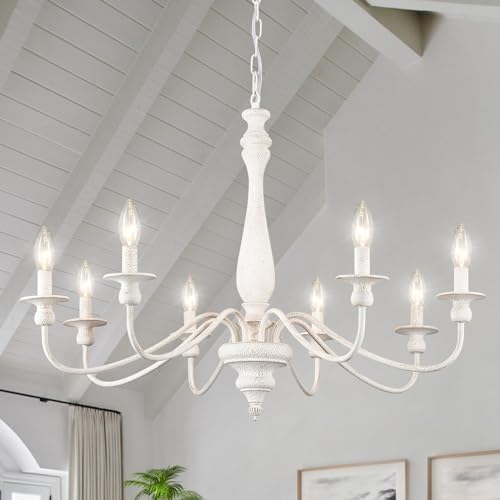
MRHYSWD Farmhouse Wood Bead Chandelier — Presence Without Weight
The bead design answers two cons directly: it is light for its size, easing the ceiling-box question, and its strands diffuse light so kindly that bulb sins are forgiven. Its own con is flavour — the farmhouse note is strong and will date as flavours do. In a casual dining room or bedroom that already speaks its language, it is the easiest chandelier in this guide to live with. Check price on Amazon, and note the style commitment as clearly as the tier.

VINLUZ Modern Crystal Chandelier — the Compact Contemporary
VINLUZ compresses the crystal idea into sizes that suit ordinary rooms and first purchases, which softens the cost con and the scale con together. It keeps the cleaning con — crystal is crystal — and adds a modest presence limit in large rooms. For a first chandelier, or a bedroom, it is the low-regret route into the category; the broader survey of current models sits in chandelier reviews.
Setup and Care That Reduce the Cons
Half the cons are decided on installation day. Assemble at ground level everything the design allows, so overhead work shrinks to hanging and wiring. Fit the dimmer at the same visit — retrofitting it later means reopening the whole question when motivation is lowest. Photograph the wiring before closing the canopy, label the breaker, and keep spare drops, beads and one matched spare bulb set in a labelled box; the fixture’s year-six self thanks you. Hang to the measured height, not the eyeballed one, and test the light at night before declaring the job done, because glare and dimness are evening facts invisible at noon.
Care, systematised, shrinks to a routine: a monthly pass with a long-handled duster for loose dust, a deeper clean twice a year — cloth and gentle cleaner for crystal, a vacuum brush for beads, a dry cloth for metal — and an annual power-off check of chain, canopy and arm fittings. Work a section at a time and support strands rather than letting them swing against each other. Households that adopt the routine report the burden as smaller than feared; households that wait for visible grey find the job has compounded. The con never vanishes, but it can be kept at the level of a household chore rather than an annual reckoning, and choosing cleanable designs — metal and glass over fabric and intricate beadwork in kitchens especially — is the first and largest reduction.
The Trade-Offs by Household Stage
The same fixture trades differently at different stages of a household’s life, and naming your stage sharpens the verdict. First-home buyers get the category’s best exchange rate: an entry or mid-tier chandelier transforms the room they will photograph, host in and remember, at the moment transformation matters most, and the installation skills learned transfer to every later home. The caution for this stage is overbuying flavour — the first home’s taste is still forming, and classic shapes survive its changes. Families with young children gain a fixture safely out of reach — a genuine, underrated pro over floor lamps that tip and table lamps that pull down — and lose on cleaning time, which is the scarcest resource in that household; simple metal and drum designs are the stage’s sweet spot. Downsizers moving to smaller, lower-ceilinged homes face the category’s hardest arithmetic and should be ruthless about scale: a beloved large fixture can crowd a smaller dining room into absurdity, and the honest options are a compact successor or a different room’s ceiling. Long-settled owners replacing a dated fixture hold the strongest hand of all — the box, wiring and dimmer already exist, the room’s size is known by heart — and for them the pros and cons reduce almost purely to style and cleaning, which is why replacement purchases are the category’s most satisfied ones.
Second homes and guest rooms deserve a sentence of their own: a chandelier in a room used monthly delivers its presence pro in concentrated doses — every arrival is an occasion — while its cleaning con compounds in absence, since dust accumulates whether or not anyone admires the result. Simple, wipeable designs again carry the day. And hosts who rent their homes to guests should weigh the fixture’s impression value against the reality that guests will not dim it thoughtfully, dust it ever, or report a loosening fitting; durability and simplicity outrank sparkle in that ledger.
The Pros and Cons by Fixture Family
The balance shifts noticeably by family, and a buyer who has decided “chandelier, yes” still has to decide which set of trade-offs to sign. Crystal maximises the centre-and-sparkle pros and the cleaning-and-weight cons simultaneously; it is the high-variance choice, glorious when maintained and right-sized, dreary when dusty and undersized. Wood bead inverts the emphasis: its light-quality pro is warmth rather than sparkle, its weight con nearly vanishes, and its distinctive con is stylistic — the flavour commitment discussed above. Drum designs hold the category’s most balanced hand: moderate presence, low glare, easy cleaning, modest weight — and a drama deficit that formal rooms notice. Sputnik and geometric metal designs pair the strongest modern presence with the sharpest glare risk, making the dimmer less an accessory than a condition of purchase. Candle-style traditional designs are the durability champions — open frames, standard parts, centuries of precedent — at the price of a formality that only some rooms can carry. None of these profiles is the best; each is the best answer to a different room’s question, which is why the family decision precedes the model decision in every sane buying process.
Energy, Bulbs and the Small Print
Running cost is the most over-feared con in the category and deserves a clear dismissal: a chandelier consumes only what its bulbs consume, and a full frame of modern LED candelabra bulbs draws a modest load while delivering generous light. The fixture imposes no standby draw, no transformer losses worth mentioning, no consumable beyond bulbs. The small print that does matter is subtler. Bulb quality varies enormously within the same base type — cheap bulbs render colours poorly, hum on dimmers, and fail early — so the bulb set is a purchase to make deliberately, ideally from one maker and one batch, with a spare set stored against the day a replacement must match. Integrated-LED fixtures remove bulb choice entirely, which reads as simplicity at purchase and as a constraint at year eight, when the module’s output has faded and the remedy is a part rather than a bulb. Heat, once a genuine chandelier con in the incandescent era, is now mostly historical with LED bulbs, though enclosed shades still deserve bulbs rated for them. None of this should steer the family decision; all of it should steer the bulb decision, which too many buyers leave to chance.
Four Myths, Corrected
Myth one: chandeliers are only for formal houses. The category’s farmhouse, bead and drum families were created by informal rooms demanding a centre; a bead chandelier over a kitchen table in a house with muddy boots by the door is not a contradiction but the current mainstream. Myth two: chandeliers are fragile. The frame is metal and glass, static and unmoving; what is fragile is a single drop during cleaning, which is why spares exist. A hung chandelier is among the least breakable objects in a house precisely because nobody touches it. Myth three: chandeliers belong to the past electrically. The wiring is the house’s standard circuit; the fixture is a passive load that any LED-era dimmer handles, and smart bulbs or a smart switch give a traditional frame fully modern control without altering its character. Myth four: a chandelier must match the room’s period exactly. Transitional design — the deliberate mixing of a classic fixture with contemporary furniture, or the reverse — is a legitimate, widely practised style, provided one element clearly leads. What fails is not mixing but indecision: several styles at equal volume, none in charge. Correcting these myths matters because they push buyers toward timid flush lights in rooms that were asking, plainly, for a centre.
Living With One: The First Year, Season by Season
The first month is the honeymoon, and it is mostly pro. The room looks finished in a way guests remark on without prompting; the evening light is noticeably kinder; the dimmer becomes a small daily pleasure. The risks of the month are discovery risks — a bulb in the set that runs hotter in colour than its siblings, a dimmer pairing that hums at low settings, a hanging height that looked right empty and feels low with the table dressed. All are cheap to fix in month one and annoying in month ten, which is why attentive owners treat the first weeks as a shakedown period: swap the odd bulb now, adjust the chain now, note the dimmer’s behaviour now.
By the first season change, the fixture has been used at every brightness and the household’s real pattern is visible. Dining households learn their two or three working scenes and stop thinking about the light, which is the pro working as designed — good infrastructure disappears. The first dust film arrives on the same schedule, earlier in homes with open windows, fireplaces or enthusiastic cooking, and the household learns which household it is: the kind that wipes the drops on a Saturday and enjoys the restored sparkle, or the kind that discovers it prefers the bead design’s forgiveness. Neither discovery is a failure; both are information, and they should steer the second fixture purchase more than any guide can.
The first deep clean, somewhere in the first year, is the con’s main examination. Done with a routine — section by section, cloth and gentle cleaner, the fixture supported and still — it takes an unhurried hour for a mid-size crystal design and leaves the room visibly brighter, a reward large enough that many owners convert to the routine willingly. Done after two years of neglect, it is a half-day penance that teaches the same lesson more expensively. The annual hardware check belongs in the same session: chain links, canopy screws, arm fittings, each confirmed snug with the power off. Owners who fold these into an existing seasonal ritual — the clock change, the holiday preparation — report that the chandelier’s upkeep stops registering as a category of its own.
By the end of the first year the verdict has usually settled into one of two stable states. In the success state, the fixture has disappeared into the household’s sense of home — noticed only when a visitor compliments it or when the owner, travelling, eats under a single harsh ceiling light and misses theirs. In the failure state, the fixture is a standing grievance: too small, too glaring, too dusty, too flavoured — and in nearly every such case the cause is traceable to a skipped step in this guide rather than to the category itself: the unmeasured size, the unrated box discovered late, the dimmer never fitted, the bulbs chosen by price alone. That traceability is, paradoxically, the most useful finding in this entire balance sheet. The chandelier’s cons are front-loaded and foreseeable; its pros are back-loaded and cumulative. Buyers who respect the front load collect the back load for years.
Weighing It in One Evening: A Practical Exercise
If the balance sheet above still leaves you undecided, run the physical test before running the financial one. On an ordinary evening, stand in the doorway of the room in question and answer five questions in order. First: does the room have a centre, or do your eyes wander for somewhere to land? A wandering gaze is the centre pro calling. Second: how does the current light treat faces at the table or in the chairs — evenly, or from one harsh point with shadows where eyes should be? Third: look up and measure honestly — what is the ceiling height, and is there seven feet of clearance where people walk, or a table where the clearance rule relaxes? Fourth: when did anyone last clean the current fixture, and how did that session feel? Your answer prices the cleaning con in your household’s real currency. Fifth: how long will you live with this room as it is? Under two years tilts the whole sheet toward restraint; beyond five, the pros’ compounding dominates.
Then do the arithmetic of attention. The cons ask for: one planned installation, one box verification, one dimmer decision, and a cleaning routine measured in minutes per month for simple designs or an hour a few times a year for crystal. The pros pay out: every evening, at every meal, at every arrival home, in every photograph of the room, for as long as the fixture hangs. Set side by side in those units — hours once, minutes monthly, against a benefit collected nightly — the exchange explains the category’s survival better than any aesthetic argument. Households that decline the chandelier after this exercise decline it for sound reasons: the ceiling forbids it, the tenancy forbids it, the temperament forbids it. Households that proceed, proceed with the conditions named, and those are the purchases that read, a year later, as obviously right.
Chandelier Pros and Cons: The Bottom Line
The chandelier’s pros are structural — centre, light quality, durability, value — and its cons are logistical — installation, weight verification, cleaning, commitment. Structural advantages compound over a decade of evenings; logistical costs are paid once or on a light schedule. That asymmetry is why the category endures, and why the honest answer for most owners of suitable rooms is yes, with conditions. The conditions are the whole game: right room, right size, verified box, dimmed light, chosen style. Meet them and the pros win decisively. Ignore them and the cons will introduce themselves one by one. The single-model examination of how these trade-offs play out in daily use is in chandelier review.
The Everyday Balance Sheet for a Chandelier: Gains, Costs and Frictions
Advantages and disadvantages read differently once an item is in daily use, so this section weighs the chandelier the way a household experiences it over months rather than minutes. It focuses on the frictions, workarounds and quiet benefits that decide whether the balance stays positive.
Start With Your Space and Your Routine
A good test is the two-week question: imagine the chandelier after a fortnight of ordinary use, with no special effort from you, and ask whether you would still choose it. Keep the fittings, spare parts and instructions that come with the chandelier together in one labelled place, because the part you need in a year is always the one that was put somewhere safe. If you shop with someone else, agree the must-haves together before looking, so that the chandelier you choose is a shared decision rather than one person’s compromise discovered later. Keep a short note of the questions each listing leaves unanswered, and treat a seller who answers them clearly as a better prospect than one who repeats general claims.
The trade-off test worth doing is substitution: name what else could occupy the same space, budget of attention and storage as the chandelier, and see whether the chandelier still wins the comparison. Plan where the packaging and any old item being replaced will go on delivery day, a small step that prevents a rushed, careless first setup of the new chandelier. Apply the same checks to each shortlisted example, whether that is the Saint Mossi Modern K9 Crystal Raindrop Chandelier; the MRHYSWD Farmhouse Wood Bead Chandelier; the VINLUZ Modern Crystal Chandelier, because consistent testing is what makes the differences between models visible. Take a photograph of the space before you order and mark the intended position of the chandelier on it, then revisit that photo whenever a listing tempts you toward a larger or different style.
When Small Problems Appear
Small problems are easiest to solve in order: check position first, then adjustment, then cleaning, and only then conclude that the chandelier itself is at fault. Measure the space where the chandelier will live, including the clearance needed to use it, move around it and clean behind or beneath it, and keep those numbers beside you while you compare options. Write down the three tasks you will do most often with the chandelier and score each shortlisted option against those tasks alone, ignoring features you are unlikely to touch. When something about the chandelier starts to annoy you, note whether the cause is the product itself, its position, or the way it is being used, since each cause has a different and usually cheaper fix.
When you compare delivery options for a chandelier, factor in where the item will be left and who will move it to its final spot, since the last few metres are where damage and strained backs happen. If a disadvantage of the chandelier would appear daily and its advantage only occasionally, the honest balance tips against it for most households, however appealing the advantage looks in a listing. Households with children or pets put different demands on a chandelier than the listing photographs suggest, so judge edges, stability and cleanability against your real household, not a styled one. If the listing offers accessories for the chandelier, decide which ones solve a problem you already have, and set aside the ones that only solve problems the listing itself invented.
Where the chandelier has moving parts, work them through their full range during your first checks, listening and feeling for roughness that a photograph cannot show. Think about the end of the chandelier’s life with you as well, including whether it could move to another room, be passed on, or be stored without damage when your needs change. A chandelier that fits on paper can still fail in daily use if a doorway, a corner, a cupboard door or a walkway cuts into the space it needs, so trace the full path from delivery to final position. If a part of the chandelier can be replaced, refreshed or re-covered separately, that option can extend its useful life well beyond the point where a sealed design would be thrown out.
A Short Decision Checklist
- How the chandelier will be cleaned in an ordinary week
- What your current arrangement does badly that the chandelier must fix
- Assembly needs, tools required and whether help is needed
- Where the chandelier and its accessories will be stored when not in use
- The main job the chandelier must do, written in one sentence
- Delivery path, from the door to the final position
- The measured space, including clearance to use and clean around the chandelier
- The material and finish, matched to light, moisture and wear in its spot
Taken together, these checks take only a little time, yet they answer the questions that decide whether the chandelier suits your home, your household and your routine, and they do so before money changes hands rather than after.
Frequently Asked Questions
What is the biggest disadvantage of a chandelier?
For most households, the combination of installation effort and cleaning — the two recurring logistics — outweighs any single drawback. Installation happens once but involves wiring, a weight-rated ceiling box and often an electrician; cleaning recurs forever and is the cost owners mention years later. Neither is a reason to refuse the category, but both should be planned rather than discovered. Buyers who choose lighter, simpler designs and set a dusting routine find the famous disadvantages shrink to ordinary household scale.
Do chandeliers make a room look smaller?
An oversized or low-hung one can; a correctly sized one does the opposite, because a defined centre organises the space around it and makes the room read as composed rather than cramped. The sizing rule — room length plus width in feet, read as inches of diameter — exists to keep the fixture in proportion, and shallow designs preserve headroom in smaller rooms. If your room is small and the ceiling low, choose a compact, airy pattern and hang it over furniture rather than open floor.
Are chandeliers hard to maintain compared with other lights?
Yes, honestly — they are the highest-maintenance common light fitting, because their decorative structure collects dust in places a cloth cannot reach casually. The gap is manageable: metal and drum designs clean in minutes, crystal and bead designs ask for a patient session a few times a year. Compare like with like, though — a pendant or flush light is easier, but it also delivers none of the chandelier’s presence. The question is whether your room’s gain justifies your routine, which is a household temperament question as much as a lighting one.
Can a chandelier work in a modern home?
Completely — the category’s modern families (sputnik and geometric metal, rings, linear bars, contemporary crystal) were designed for exactly those interiors, and a modern chandelier in a modern room reads as inevitable rather than ironic. The mismatch to avoid is a traditional tiered crystal piece in a stark minimalist space, where both the fixture and the room look wrong. Match family to architecture and the category has no era. Current modern examples are gathered at best chandelier for modern homes.
Is a chandelier a good idea in a rental?
Usually a cautious one. You need the landlord’s agreement, a ceiling box you can trust, professional installation you can reverse cleanly, and a tenancy long enough to enjoy the result. Light, compact fixtures travel to the next home and minimise every one of those frictions. For short tenancies, the same money in lamps and a great pendant-free setup usually serves better. If you do proceed, photograph everything before touching it and keep every original part.
Do chandeliers increase home value?
A well-chosen, well-installed chandelier improves how a dining room or entry photographs and feels during a viewing, which supports perceived value rather than appraised value — valuers rarely credit a light fitting line by line. Treat any value effect as a pleasant side benefit of a purchase made for your own evenings, not as the reason for it. The fixtures most likely to help are classic, correctly sized and neutral in finish; strongly flavoured designs can narrow a room’s appeal to buyers who share the taste.
Related Reading
If this balance sheet has settled the whether, the remaining questions are which and how. The which is answered by the category framework and the six worked examples in chandelier buying guide, and narrowed to a step-by-step decision in how to choose a chandelier. The how is the installation walkthrough already linked above, whose safety sequence deserves reading before any ladder is climbed. Households still circling the value question — not the balance of features but the worth of the whole enterprise against its full cost in money, time and attention — will find it argued directly, with a decision checklist, in the worth-it analysis. And if the honest conclusion of this page is that your room wants focused light rather than a centre, the pendant comparison shows what that alternative gives and what it quietly takes away.
One last word of method. Pros-and-cons lists flatten what ownership actually feels like, because the items are not equal in frequency: the cons arrive on a schedule you can read in this page, while the pros arrive every single evening without being asked. When you weigh your own list, weigh each item by how often it will visit you, not by how dramatic it sounds in print. That single correction — frequency over drama — is the difference between the households that choose well in this category and the households that choose timidly and live under a light they never loved.


