Disclosure: As an Amazon Associate, dailyhomedecorating.com earns from qualifying purchases. Links on this page are affiliate links; they cost you nothing extra. Prices and availability change often, so check the current Amazon listing before you buy.
This smart air sa600 review examines the room-sized flagship of the maker this cluster has already met in miniature — Smart Air, the company that built its name on published test data, plain-language specifications, and prices set as an argument with the rest of the industry. The SA600 is that argument at full scale: a dual-inlet purifier whose listing claims coverage of 2,400 square feet per hour, an H13 HEPA filter capturing 99.97 percent of particles at the standard test size, carbon filters and washable pre-filters on both flanks, and a noise span running from a bedroom-friendly hush to full working voice. Where its little sibling the QT3 served a bubble, the SA600 proposes to serve the rooms a family actually lives in — and to do it with its data on the table.
Smart Air’s founding story matters to this machine’s assessment, because the SA600 is unintelligible without it. The company began by publishing independent test results for purifiers it built in response to a smoggy city’s unaffordable air, and it has kept the habit: specifications stated in the open, performance claims phrased so they can be checked, and an educational voice that teaches buyers to interrogate every brand, including its own. A reviewer approaching the SA600 therefore has an unusual luxury — a maker that invites the audit — and an unusual duty, which is to conduct it anyway, because an invitation to trust is still a claim, and claims in this programme are examined rather than accepted.
The examination below proceeds in the programme’s usual order with the subject given its full hearing: the dual-inlet design and what it buys in a real room, the filter stack and its maintenance economy, the noise character across its range, and the households whose air it suits. Two verified Levoit alternatives — the Vital 200S and the Core 600S — are reviewed alongside, not as foils but as the market’s own benchmarks, because the SA600’s value only becomes visible against the polished, sensor-rich machines the mainstream offers at similar ambition. Readers of the QT3 review in this cluster will recognise the philosophy; here it is, grown to room size, with room-sized questions to answer.
All three machines were confirmed against their current Amazon listings for this guide, titles and official images included, and prices are left to those listings where they belong. What this page settles is the slower matter: whether the SA600’s engineering and economics hold up as the centrepiece of a home’s air care, how its maker’s honesty changes the ownership experience, and which households should choose the data-led upstart over the established names — or the established names over it, which this review will also say plainly where the evidence points that way.
Key takeaways
- Dual-inlet design with carbon filters and washable pre-filters on both sides.
- Listing claims 2,400 square feet per hour and H13 HEPA capture.
- Noise span from a low hush to full power suits bedrooms and living rooms alike.
- Smart Air’s distinction is published data and educational honesty.
- Levoit’s Vital 200S and Core 600S are the sensor-rich benchmarks to beat.
In this guide
Quick picks: Smart Air Sa600 Review
The quick list leads with the subject, then the two Levoit benchmarks in the order a shopper meets them: the Vital 200S, the smart sensor-equipped favourite of bedrooms and pet homes, and the Core 600S, the line’s large-room flagship with app and voice control. All three were verified for this guide. The detailed reviews follow, and the sections after them take up the questions the SA600 raises as a whole — the meaning of its coverage claim, the economics of its washable pre-filters, and the choice between data-led simplicity and sensor-led automation.
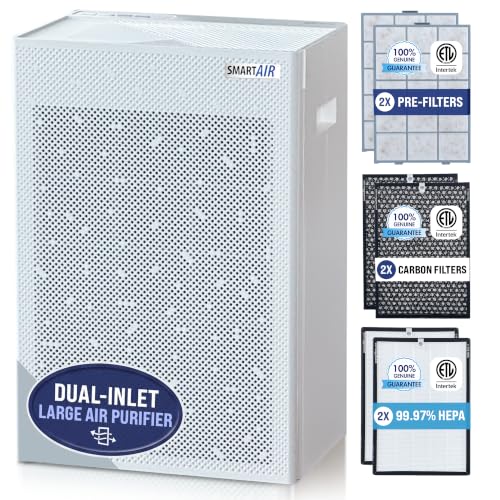
- Smart Air SA600 Air Purifier — the subject: a dual-inlet machine claiming 2,400 square feet per hour, with H13 HEPA, carbon filters, washable pre-filters, and a 24–53 dBA span. Check price on Amazon
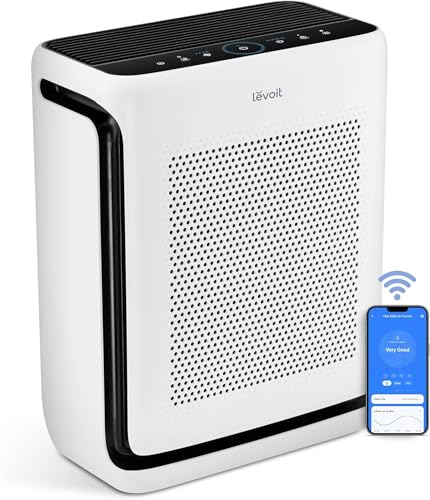
- LEVOIT Vital 200S-P Smart Air Purifier — Levoit’s smart large-room machine with an air quality monitor, AHAM verification, and a quiet HEPA sleep mode for pet homes. Check price on Amazon
- Levoit Core 600S-P Smart Air Purifier — the Core line’s flagship: AHAM-verified, app and Alexa controlled, rated by its maker for very large rooms, with smoke in its sights. Check price on Amazon
Three machines, three theories of trust: the SA600 says verify me, the Vital says watch me work, the Core 600S says let me handle it. The detailed sections below interrogate the subject’s theory in full — its coverage claim, its filter economy, its noise — because a maker that invites scrutiny deserves the courtesy of receiving it, and a buyer deserves to watch the scrutiny happen before spending flagship money on any of the three.
Smart Air Sa600 Review: the three machines in detail
The subject leads the reviews above and receives the longest hearing, as the keyword demands; its benchmarks are reviewed in the same format, because a flagship claim is only as good as the company it keeps. Everything after this section is about owning the SA600 well — and about the households for whom one of the benchmarks, honestly, is the better buy.

Smart Air SA600 Air Purifier
The subject — dual-inlet, data-led room purifier
The SA600’s design announces its thesis before a filter is discussed: it breathes from both sides. The dual-inlet layout doubles the intake face, feeding air through carbon filters and washable pre-filters on each flank into the H13 HEPA heart of the machine, and the practical consequence is a purifier that can move a large room’s air without the strained, single-mouthed roar of a conventional tower working at its limit. In a living room — the SA600’s natural station — that translates into the quality its owners remark on most: authority at moderate settings, the sense of a machine working well within itself while the room’s air turns over at a rate the occupants can feel in the room’s neutrality by evening.
The listing’s numbers deserve the respectful scrutiny its maker invites. Coverage of 2,400 square feet per hour is a throughput claim — the volume of air the machine can process, expressed as an area’s worth per hour — and read that way, rather than as a promise to govern a palace, it describes a genuinely high-capacity machine for ordinary large rooms, with the headroom to run below its maximum and still serve. The H13 HEPA designation places its media in the true-HEPA class, with the listing’s capture figure stated at the standard’s test size, and the noise span from 24 to 53 dBA tells the bedroom story honestly: a low end quiet enough for sleep, a top end that is a working voice rather than a whisper, with the useful range, as ever, in between.
What the specification cannot convey is the ownership texture, and here the SA600’s design choices compound pleasantly. Washable pre-filters on both inlets strip the coarse load — the pet hair, the household fluff, the kitchen’s drifting evidence — before it can tax the carbon and HEPA stages, which stretches the expensive filters’ lives and converts the machine’s routine care into a rinse rather than a purchase. For pet households, whose pre-filters elsewhere clog in weeks, that is not a detail but a doctrine. Add the maker’s educational materials and published data, and the SA600 emerges as the purifier for the household that wants to understand its own air — a machine that treats its owner as a colleague, which is the rarest feature in this entire programme.
At a glance
- Format: dual-inlet room purifier
- Listing claim: 2,400 sq. ft. per hour throughput
- Filter: H13 HEPA with carbon filters, washable pre-filters
- Noise span: 24–53 dBA, per the verified listing
- Intended homes: large rooms, pet households
Strengths
- Dual inlets give authority without strain
- Washable pre-filters slash the consumable burden
- Maker publishes data and teaches its owners
Trade-offs
- Fewer sensors and smarts than the Levoit benchmarks
- Top fan speed is a working voice, not a hush
- Design is functional rather than furniture-grade
Best for: a large living room or pet household that values data, capacity, and low running fuss.
Not suited for: a buyer who wants the purifier to sense, decide, and report by itself.

LEVOIT Vital 200S-P Smart Air Purifier
Verified benchmark — the sensor-rich bedroom favourite
The Vital 200S is the mainstream at its most polished, and the SA600 must be measured against it without flinching. Levoit’s machine brings what Smart Air’s does not: an air quality monitor that watches the room and reports it, AHAM verification of its performance claims, app-era smartness, and a sleep mode whose quiet the listing puts at the threshold of a bedroom’s night sounds. For the household that wants the purifier to notice the cooking spike and answer it, to dim itself for sleep and testify in the morning, the Vital is the complete contemporary article, and its popularity in bedrooms and pet homes is earned rather than marketed.
Its brief, per the listing, is the large room up to 1,875 square feet with a particular tenderness for the bedroom and the pet household — allergies, pet hair, and dander are its named enemies, and its washable pre-filter acknowledges the same coarse-load reality the SA600’s dual inlets address. The comparison between the two machines is therefore not capacity against incapacity but philosophy against philosophy: the Vital senses and automates, the SA600 opens its data and its flanks and trusts the owner. Both are honourable answers; they suit different households, and this review’s buying guide exists to tell those households apart.
Where the Vital wins, it wins on the daily texture of ownership in a smart home — the glanceable air quality readout, the schedule set once, the machine as a citizen of the app ecosystem. Where it concedes ground is the SA600’s home territory: raw intake architecture, pre-filter washability as a system rather than a feature, and a maker whose published data lets a sceptical owner verify the machine’s claims independently. A buyer choosing between them is choosing what kind of trust to extend — trust in automation, or trust in evidence — and there is no temperament-neutral answer, which is exactly why both machines deserve their places in this guide.
At a glance
- Format: smart tower purifier
- Maker rating: large rooms up to 1,875 sq. ft.
- Verification: AHAM VERIFIDE, per the listing
- Extras: air quality monitor, HEPA sleep mode
- Intended homes: bedrooms, pet households
Strengths
- Sensor and monitor make the room legible
- Sleep mode tuned for bedrooms
- Smart features suit app-run households
Trade-offs
- Automation is only as good as its sensors’ placement
- Filter ecosystem is a recurring purchase
- Less raw intake architecture than the subject
Best for: a smart-home bedroom or pet room that wants the purifier to watch and answer by itself.
Not suited for: a data purist who wants published tests over dashboards.

Levoit Core 600S-P Smart Air Purifier
Verified benchmark — Levoit’s large-room flagship
The Core 600S is Levoit’s flagship answer to the same large-room brief, and its listing is a catalogue of the mainstream’s virtues: a maker rating reaching to 2,933 square feet, AHAM verification, app and Alexa control with a remote for the sofa, an energy-efficient 3-in-1 filter, and a charge sheet — smoke, pet odour, dust — that names the large room’s enemies in order of drama. Against the SA600 it represents the fully-featured pole of the market: the machine that wants to be a smart appliance first and a filtration engine, however capable, second.
In a household already fluent in Levoit’s ecosystem — the app installed, the voice assistant on the shelf, perhaps a smaller Core in the bedroom — the 600S is the path of least resistance to a governed living room, and its sleep mode and scheduling make it a polite citizen of the evenings it serves. Its filter is a single, capacious 3-in-1 cartridge whose replacement is the line’s familiar calendar event, priced and stocked with the reliability that made Levoit’s catalogue the benchmark this programme keeps citing. None of that is a small thing; ecosystems are a form of support, and support is a form of performance over years.
The SA600’s counter-argument, stated fairly, is architectural and economic: dual inlets breathing through washable pre-filters ask less of the expensive media, and a maker publishing its data asks less of the buyer’s faith. The 600S’s counter to the counter is that most households do not read data and do use apps, and a machine that runs itself correctly beats a machine that must be understood. Both arguments are true, for different readers, and this review’s final section will not insult either by pretending otherwise — it will simply assign each machine to the household whose habits make its argument the operative one.
At a glance
- Format: smart large-room tower
- Maker rating: rooms up to 2,933 sq. ft.
- Verification: AHAM VERIFIDE, per the listing
- Controls: app, Alexa voice, remote control
- Filter: 3-in-1 cartridge, energy efficient design
Strengths
- Flagship capacity with full smart control
- Ecosystem depth and filter availability
- Sleep mode and scheduling for family evenings
Trade-offs
- Single-cartridge consumable on a calendar
- Automation layer is a subscription to an ecosystem
- Less transparent data culture than the subject’s maker
Best for: a Levoit-fluent household wanting its largest room governed by app and voice.
Not suited for: a buyer who wants washable pre-filtration and published test data.
Reading the coverage claim like an engineer
The SA600’s headline — 2,400 square feet per hour — is the kind of figure that misleads in both directions, and its maker’s own educational materials would insist on the reading this section gives it. It is a throughput: the machine can process, in an hour, a volume of air equal to that in a room of the stated area with ordinary ceilings. A purifier’s real job in a real room is to cycle that room’s air several times in the hours it matters, so the wise translation is not ‘this machine covers a ballroom’ but ‘this machine has the headroom to serve a large domestic room at moderate settings, with reserve for events’. Headroom, in purifiers, is the difference between a machine that coasts and one that strains, and coasting machines are quieter, longer-lived, and — the point owners forget — actually left running.
Set against the benchmarks’ ratings, the same translation discipline applies, and it dissolves most of the apparent arms race. Levoit’s figures for the Vital and the Core are room ratings in their own dialect; Smart Air’s is a throughput in its. Converted into the only currency that matters — how fast will this room’s air be clean, at a noise my household will tolerate, for the hours we occupy it — the three machines are closer than their headlines suggest, and the choice between them returns, properly, to philosophy, features, and filter economics. A buyer who has learned to perform that conversion has learned the SA600’s maker’s favourite lesson, and can shop the entire category with new immunity to its arithmetic theatre.
One more engineering note belongs here, because the dual inlets make it physical. A purifier’s delivered performance in a room depends on the air actually reaching its intakes, and a machine that breathes from two flanks is less easily throttled by the wall behind it or the furniture beside it than a single-faced tower in the same station. Placement still matters — the how-to section gives it its due — but the SA600’s architecture forgives the real rooms it will live in, with their sofas and their corners, more gracefully than most. Forgiveness, in a machine bought for a decade, is a specification too, and it rarely appears on a box.
The filter economy: washable first, expensive last
The SA600’s filter stack is arranged as an economic argument. At the front, washable pre-filters on both inlets take the coarse war — hair, fluff, the visible fraction of a home’s dust — and ask only for a rinse to return to duty. Behind them, carbon filters address the gaseous load, the cooking compounds and household odours that particle media cannot touch. At the heart, the H13 HEPA does the fine work that defines the category. The argument is that money should be spent at the heart rarely and at the front never, and across a pet household’s year — where a conventional machine’s single cartridge absorbs the whole war at once — that argument compounds into the SA600’s strongest ownership claim, stronger even than its maker’s data.
The benchmarks answer with ecosystems: Levoit’s cartridges are everywhere, priced in the open, and their replacement is a two-minute, tool-free ceremony that any household member can perform. That is a real economy too — the economy of zero friction — and households that value it should not be talked out of it by throughput figures. The honest summary is that the SA600 minimises the cost per year of filtration, while the Levoits minimise the effort per event of filtration, and the household’s own history — does it rinse things happily, or does it replace things happily? — is the ledger in which the choice should be made. Few buying guides will tell you that the dishwasher-versus-sink argument in your kitchen predicts your purifier satisfaction; this one just did, because it is true.
A word on the carbon stage, since kitchens decide purifiers. Carbon’s capacity is finite and its appetite is for the compounds of cooking, cleaning, and city air; in a home that fries nightly, the carbon stage is the stack’s hardest worker and its earliest exhaustion, whatever the HEPA’s calendar says. The SA600’s dual carbon filters spread that work across two faces, which is the architecture’s quiet answer to the kitchen question. Owners in fragrant households should still expect the carbon, not the HEPA, to set their replacement rhythm — a truth the maker’s educational voice would endorse, and one more reason this review keeps returning to the theme that in filtration, honesty about the consumable is the whole game.
Buying guide: data-led or sensor-led?
Decide what kind of trust you extend
Every flagship purifier asks for trust; they differ in what they offer as collateral. Smart Air offers data — published tests, stated methods, an invitation to verify — and asks the owner to remain a participant: placing, rinsing, setting, understanding. Levoit offers automation — sensors that watch, modes that respond, an app that reports — and asks the owner to delegate. Neither collateral is counterfeit, and the choice between them is a choice about the household’s own character that no review can make from outside. Buy the machine whose trust model matches the people who will live with it, and the specification sheets will fall into line behind that decision like well-trained evidence.
Size by events, not by floor plan alone
The large room’s specification is written by its worst hour, not its average one: the frying Friday, the smoky August week, the shedding season’s peak, the party with the door opening all evening. A machine sized to the average will spend its worst hours overwhelmed and its owner disappointed at exactly the moments the purchase was for. The SA600’s throughput headroom and the Core 600S’s flagship rating are both, read correctly, event insurance — and the Vital, a tier more intimate, is the right size for the large bedroom whose worst hour is merely a cat and a closed door. Let the calendar of your room’s dramas, honestly recalled, pick the tier.
Count the whole household in the noise budget
The SA600’s span from a low hush to a working voice is honest, and the household should budget it honestly: the setting a machine needs for a cooking event is not the setting anyone sleeps beside, and the daily pattern that satisfies everyone is the brisk hour and the gentle hold, in whichever room the machine serves. Light sleepers, shift workers, and the partner who reads in the living room while the other cooks are all stakeholders in this decision, and a flagship bought without their hearing in mind will be run at the setting the most sensitive stakeholder permits — which quietly re-sizes the machine to that setting’s output. Buy for the permitted setting, not the maximum, and the arithmetic of every rating in this guide changes in your favour.
Filters: price the decade, not the cartridge
Before choosing among these three, perform the decade exercise for each: the cartridge’s current price, its stated interval under your household’s load, the pre-filter labour or its absence, multiplied across ten years of the machine’s intended service. Add the friction honestly — the rinse you will or will not do, the order you will or will not forget — because friction is a cost with a currency of its own. The SA600 usually wins the money column and the Levoits the friction column, and the exercise’s value is that it makes the household watch itself choosing, which is the moment a decade-long purchase is actually decided.
How to run an SA600 household
Placement for a dual-inlet machine
Give the SA600 the station its architecture asks for: a position in the room’s main body where both flanks can breathe — clear of the wall behind by a honest margin, unblocked by the sofa’s back or the curtain’s fall, and central enough that the room’s air, which moves in slow currents toward heat and occupation, finds the intakes without a detour. In the open-plan rooms it suits best, that usually means the boundary between the kitchen’s output and the seating’s comfort, where the machine intercepts the day’s production on its way to the people. Commission it there for a week before judging; dual-inlet machines reward the considered station more than most, because they were designed for rooms rather than for corners.
Run it on the room’s rhythm, as this programme advises for every flagship: purposeful through the occupied and cooking hours, gentle through the night and the empty day, promoted without ceremony for events. The SA600’s authority at moderate settings is its gift — use it, rather than living at the extremes of its range, and both the noise budget and the filters’ lives will thank you in the currencies they keep.
The rinse, the check, and the calendar
The SA600’s service liturgy is the lightest in its class, and it should be kept with corresponding fidelity: vacuum or rinse the pre-filters when they visibly load — in a pet household, on a rhythm of weeks rather than months — and let that small act be the machine’s whole regular demand. Behind it, note the carbon and HEPA stages’ expected horizons from the maker’s guidance, set the calendar accordingly, and date the filters at fitting so the future can be read at a glance rather than reconstructed from memory.
Once a season, give the machine the fresh-air courtesy this programme recommends for monitors and purifiers alike: a check of its intakes’ seals, a wipe of its faces, and a moment’s attention to whether its voice has changed, because a new note in a familiar machine is information — a loading filter, a loosening panel, a bearing beginning its long goodbye. Machines that are listened to seasonally rarely surprise their owners annually, and the SA600, built for a decade’s service, deserves the small ceremony of being heard.
Mistakes SA600 buyers make
The first is the ballroom fallacy: reading the throughput headline as a room promise and stationing one SA600 to govern a whole floor, then judging it for the geography rather than for the arithmetic. The second is the sensor envy: buying the data-led machine and then resenting it for not watching the room by itself, a mismatch of trust models that the buying guide exists to prevent — the Vital was on the same shelf, and it was the right machine for that household. The third is pre-filter amnesia, the SA600’s specific sin: the rinse deferred until the great filters behind have eaten a season of coarse load, converting the line’s best economic idea into an ordinary one through simple neglect.
The fourth mistake is subtler and belongs to the maker’s own admirers: treating the published data as a substitute for the household’s own evidence. Smart Air’s numbers describe its machines in its tests; your room, your dog, and your frying pan will write their own edition, and the owner who runs the simple audit — a dusty event, a watched recovery, a monitor if one is at hand — owns a truth the PDFs cannot give. The maker, to its credit, teaches exactly that scepticism; the mistake is admiring the teaching without practising it, which is the one failure mode its philosophy cannot protect against.
The SA600 across the seasons of a real house
Spring asks the SA600 for its pollen shift: windows opening to a yellow world, the machine promoted through the day and forgiven its voice, because the alternative is the household breathing the season unfiltered. Its dual inlets earn their keep in these weeks, moving the big room’s air at the rate the season demands without the strained note of a lesser machine at its ceiling — and its washable pre-filters, rinsed of a visible spring coat, demonstrate the economy their design promised in the most legible way a filter can: in the sink, in the owner’s hands, costing nothing.
Summer is the smoke and cooking season, and the machine’s headroom becomes the household’s composure. A barbecue’s drift through the patio doors, a neighbour’s fire pit, the frying marathon of a family gathering — each is an event the SA600 was sized for, and its owner’s calm during them is the true product of the throughput headline, correctly read. Autumn then tests the carbon, as windows close and the kitchen’s output concentrates indoors, and winter tests the household’s faith in the whole arrangement, as the sealed house recirculates everything it produces. A flagship that has served four seasons without a cartridge purchase has made the SA600’s argument more eloquently than this review can, in the only court — the owner’s own accounts — where the argument was ever going to be settled.
That seasonal rhythm also exposes the machine’s one true dependency, which is not electricity but attention at long intervals. The household that rinses in spring, checks in autumn, and dates its filters at fitting will find the SA600 ageing like furniture — present, working, unremarkable. The household that does none of it will find, in year two, a machine indistinguishable from the neglected conventional purifiers it was bought to transcend. The difference between those futures is perhaps an hour a year, which is either the best bargain in this programme or a warning about how little stands between any flagship and ordinariness, depending on the reader’s temperament — and the SA600, true to its maker, would want the reader to decide with that hour honestly in view.
Smart Air in the wider argument about air
Zoom out from the machine and the SA600 is a position in an argument the whole industry is having with itself. One side holds that air care should be effortless and invisible — sensed, automated, app-mediated, its consumables arriving by subscription — and that the buyer’s attention is a cost to be engineered away. The other side, Smart Air’s, holds that attention is not a cost but a competence: that a household which understands its air will run any machine better, that published data respects the buyer, and that a washable pre-filter is a small declaration of independence from the consumable treadmill. The SA600 is the second position built in metal and media, and its commercial survival is a genuinely interesting experiment in whether competence can be sold as a feature.
This review’s verdict, given in its final section, is that for a definable household the experiment succeeds — and that the household is larger than the industry’s automation consensus assumes. It includes the engineers and the sceptics, certainly, but also the pet owners tired of cartridge bills, the cooks who want capacity without theatre, and the growing class of buyers who have owned one smart appliance too many and have begun, quietly, to prefer the kind that simply works and can be understood. The SA600 was designed for that class before it had a name, which is either luck or the reward of a maker that listened to its first customers in a smoggy city and never stopped hearing them.
Evidence in your own living room: the audit, SA600 edition
The maker’s published data will tell you what the SA600 did in a test chamber; the audit this programme keeps recommending tells you what it does in your chairs, with your dog, under your ceiling. Run it on the first dusty weekend: raise a visible load — a vacuumed rug, a shaken bedding change, a frying session with the doors open to the living room — and watch the room’s recovery on the working setting you actually intend to live with, timed against the same event with the machine off. The two recoveries, compared, are your machine’s true specification in your house, and they will calibrate your settings, your placement, and your expectations more honestly in one afternoon than a season of impressions.
Owners who perform the audit usually discover the finding this guide has predicted from the architecture: the moderate settings do more than their quietness suggests, because the dual inlets keep the intake honest even when the room’s furniture conspires against it, and the promoted setting is a genuine event tool rather than a louder version of the same. That discovery — the machine’s real voice, learned at home — is the moment the SA600 stops being a purchase and becomes infrastructure, and it is the moment its maker’s whole philosophy has been aiming at: an owner who knows, from evidence, what their air is doing and what their machine does about it.
What the first fortnight teaches
New SA600 households report a characteristic education in the first two weeks, and it is worth previewing so its lessons are recognised rather than missed. The first lesson is placement humility: the station that looked right on delivery day is rarely the station the room’s currents prefer, and a machine moved twice in its first fortnight is not being fussed over but commissioned. The second lesson is the setting surprise — the discovery that the household lives one notch lower than it expected, because capacity headroom means the moderate voice does the work the old machine needed its shout for. The third lesson is the pre-filter’s first rinse, which arrives sooner than the calendar suggested in any home with an animal, and which teaches the economy of the whole design in a single sinkful of evidence.
By the end of the fortnight the machine should have begun its long disappearance into the household’s background, and the owner should be left with the two artefacts of a successful commissioning: a setting they trust and a date in the calendar they can forget about until it arrives. Households that reach that state almost never return to the comparison pages, which is the market’s quiet way of recording satisfaction. Households still comparing at week three usually have a sizing or a trust-model question outstanding, and this guide’s buying section — not a different machine’s brochure — is where that question should be taken, because it was written for exactly that reader. Everyone else — the settled, the rinsed, the quietly breathing — has already got what they came for, and it is humming, gently, in the corner of the room where the air is cleanest. That corner, and the calm that radiates from it across a family’s evenings, is the SA600’s whole ambition — stated in its maker’s data, and confirmed, season by season, in the homes that run it as it asks to be run. Join those homes with your eyes open and your pre-filter rinsed, and the machine will keep its side of one of the fairest bargains in air care. Fair, in this industry, is not a small word, and the SA600 has earned it in the open, with its figures published and its flanks uncovered. Buy it in that same spirit — verified, understood, and placed with care — and the relationship between household and machine will be what its maker always intended: a collaboration, conducted in clean air, between adults. Collaborations of that quality are rare in the appliance world, and they tend to last — which, for a machine bought to serve a decade of family evenings, is the only verdict that finally counts. Let it be delivered, then, by your own living room across its first season — this review is content to rest its case on that evidence, and on the maker’s. Both, unusually for this industry, are available for inspection before the purchase rather than after it, which is the whole Smart Air story in a single sentence. Read it, test it, and then decide — the machine, its maker, and this review all ask for exactly that order of events, and for no other. Households that buy in that order rarely buy twice, and the SA600 — sized right, rinsed on rhythm, and run on evidence — is as good a reason as this programme has found for buying only once. Buy once, buy on evidence, and let the big room breathe — the rest of the household’s air can be arranged, in time, around the calm at its centre. That calm, maintained across a decade of ordinary evenings, is the return on the purchase that no specification sheet can quote and every owner recognises. Recognise it in prospect, and the choice among this guide’s three machines makes itself, in whichever direction your household’s character points. Point it at the SA600, and this review’s work — like the machine’s — is done. Both, it is hoped, will be judged by the same standard: the evidence.
Final recommendation
The SA600 is the flagship for the household that wants to understand its air: a dual-inlet machine with genuine capacity headroom, a filter economy built on washable first principles, and a maker whose published data and educational honesty make ownership feel like a collaboration rather than a subscription. For the large living room, the pet household, and the kitchen-led open plan, it earns this review’s warmest recommendation in its class — with the single condition that its owner will actually rinse a pre-filter and read a specification, because the machine’s whole design assumes an adult on the other end of the purchase.
Choose the Vital 200S instead if the room is a bedroom first and the household wants the purifier to sense and answer by itself; choose the Core 600S if the home already runs on Levoit’s app and voice and the largest room needs governing within that ecosystem. Those are not consolations but correct answers for their households, and this review gives them gladly. For the reader whose trust is earned by evidence and whose hands do not mind a rinse — the reader Smart Air has been writing for since its first published test — the SA600 is the machine that has been waiting, with its data on the table and both its flanks open, to be believed the hard way: by verification. Verify it, then — in your own room, on your own dusty afternoon — and let a machine that was built to be checked enjoy the rare pleasure of passing its examination in the only laboratory that will ever matter to it.
Frequently asked questions
What does 2,400 square feet per hour actually mean?
It is a throughput figure: in one hour the SA600 can process a volume of air equal to that contained in a room of 2,400 square feet with ordinary ceiling height. It does not mean the machine single-handedly purifies a house of that size to bedroom standards; it means it has the capacity headroom to cycle a normal large room’s air repeatedly at moderate settings, with reserve for cooking and smoke events. Read every brand’s headline through the same conversion — air changes per hour in your actual room, at a noise you will tolerate — and the category’s arithmetic theatre dissolves into comparable, purchasable facts. Keep that conversion habit for every future appliance claim you meet, and the SA600 will have improved your household’s shopping even if another machine wins this particular purchase.
Is H13 HEPA the same as true HEPA?
H13 is a grade within the HEPA family under the European classification, denoting very high capture efficiency at the most penetrating particle size, and the SA600’s listing pairs it with a 99.97 percent capture figure that matches the familiar true-HEPA threshold. For household purposes the practical meaning is that the media is in the genuine high-efficiency class rather than in the ‘HEPA-type’ penumbra of lesser filters. The remaining variables are the machine’s sealing — captured air must not leak around the media — and the filter’s freshness, which is why this guide spends as long on maintenance as on grades. A household upgrading from a ‘HEPA-type’ mini or desktop unit will feel the grade difference most on the dusty weeks, when the room’s recovery after a vacuum or a bedding change is measured in an hour’s patience rather than an evening’s.
How loud is the SA600 in a bedroom?
Its listed span runs from a low hush suited to sleep at the bottom of its range to a working voice at full power, and the honest bedroom pattern is the one this programme recommends for every flagship: a purposeful setting in the evening to clean the room, then the gentle end of the range for the night itself. A light sleeper should audition the machine’s middle settings with particular care, because those are the settings a bedroom actually lives at — the extremes of any purifier’s range are for events and auditions, not for Tuesdays. Shift workers sleeping by day should weight the low end of the range even more heavily, since daytime rooms are noisier and the machine may be their only negotiable sound — one more reason the evening-clean, night-gentle pattern suits this machine so well.
How often do the SA600’s filters need replacing?
The washable pre-filters are rinsed, not replaced, on a rhythm set by the household’s load — weeks in a pet home, longer in a calm one. The carbon and HEPA stages behind them are replaced on the maker’s stated horizons, which the listing and the manual carry and which this guide deliberately does not freeze into print, because intervals are revised and loads differ. The structural point survives every revision: by stripping the coarse load at a washable stage, the SA600 stretches its expensive stages’ lives beyond what a single-cartridge machine in the same room would manage, and that stretch is the core of its running-cost case. When the stages do fall due, buy them as a planned household purchase rather than an emergency one; a machine of this class deserves its consumables bought calmly, at the right variant, with the old set’s dates already recorded.
SA600 or Levoit: which is better for pets?
Both were built with pet households in view — the SA600 names pets in its listing, and the Vital 200S names pet hair and dander in its own — and the choice is the philosophy fork again. The SA600’s dual washable pre-filters are the stronger answer to the sheer volume of hair and fluff a shedding household produces, because that load is intercepted by water and a sink rather than by a cartridge’s capacity. The Vital’s sensor and sleep mode are the stronger answer for the bedroom where the pet sleeps and the household wants automation. Many pet homes, in the end, run the SA600 in the living volume and a Vital in the bedroom, which is not indecision but correct assignment. The same assignment logic, applied across this cluster’s reviews, is the closest thing the programme has to a philosophy of its own: one machine per brief, honestly sized, honestly kept — a doctrine the SA600’s maker would recognise as kin.
Does the SA600 have an air quality sensor or auto mode?
The SA600’s proposition is built on capacity, filtration architecture, and published data rather than on a sensor-led automation layer of the kind the Levoit benchmarks carry; its listing emphasises the dual inlets, the filter stack, and the noise span. Buyers for whom an auto mode that watches the room is a requirement should take that requirement seriously and shop the benchmarks, which exist for them. Buyers who prefer to set a machine by the room’s rhythm — and to know, from data, what the machine is doing — will find the SA600’s plainer contract the more honest one, and honesty, in this maker’s catalogue, is the feature everything else hangs from. Readers who want that honesty with a sensor’s convenience are not wrong to want it; they are simply shopping a different shelf, and the benchmarks in this guide are the shelf’s best addresses.