Disclosure: As an Amazon Associate, dailyhomedecorating.com earns from qualifying purchases. Links on this page are affiliate links; they cost you nothing extra. Prices and availability change often, so check the current Amazon listing before you buy.
Open almost any Winix air purifier listing and one branded term does most of the talking, which raises a fair question for anyone comparison-shopping: what is plasmawave technology, and is it a genuine cleaning method or a trademark in search of a meaning? PlasmaWave is Winix’s name for the ionization stage built into many of its air purifiers. Where a HEPA filter physically traps particles, PlasmaWave works electrically: the purifier generates positive and negative ions and releases them into the airstream, where, according to Winix, they interact with water vapor in the air to form hydroxyls — highly reactive molecules that attack pollutants such as viruses, bacteria, mold spores, odors, and gases at a molecular level, breaking them down rather than merely collecting them.
That is the manufacturer’s description, and this article will treat it with respect and with scrutiny in equal measure. You will learn how PlasmaWave is supposed to work step by step, how it differs from the ozone-generating devices it is often confused with, where it sits alongside the filters that do the heavy lifting in the same machines, which Winix models carry it, and how to use the PlasmaWave button intelligently if you own one. This page links to no products itself — the verified Winix model reviews elsewhere in this series carry the product picks — because the honest answer to “what is plasmawave technology” is an explanation, not a shopping list.
Key Takeaways
- PlasmaWave is Winix’s proprietary ionization technology, built into many Winix purifiers alongside a pre-filter, a carbon filter, and a true HEPA filter.
- It produces positive and negative ions that, in Winix’s description, form hydroxyls which neutralize airborne pollutants — bacteria, viruses, mold, odors, and some gases — at a molecular level.
- Winix positions PlasmaWave as creating no harmful ozone, distinguishing it from dedicated ozone generators, which are a different and riskier category entirely.
- PlasmaWave is a supplement, not a substitute: the HEPA filter in the same machine still does the measurable particle removal, and PlasmaWave can be switched off independently on Winix models that offer the control.
- Judge any Winix purifier first by its filters, room-size rating, and verified performance, and treat PlasmaWave as a supporting feature rather than the reason to buy.
In this guide
What Is PlasmaWave Technology, in Plain Terms?
Strip the branding away and PlasmaWave is a bipolar ionizer: a component that emits both positive and negative ions into the air leaving the purifier. Ions are simply molecules that carry an electrical charge because they have gained or lost an electron. Air in nature carries ions — after a thunderstorm, near waterfalls, anywhere energy is splitting and charging air molecules — and a long line of air-cleaning products has tried to bottle that freshness. Winix’s specific claim goes one step further than simple ionization. The company describes the positive and negative ions from PlasmaWave surrounding airborne particles and reacting with the hydrogen in water vapor and in the pollutants themselves to form hydroxyl radicals, written by chemists as OH. Hydroxyls are nature’s own atmospheric detergent; outdoors, they are a major way the sky cleanses itself of pollutants. In Winix’s account, the hydroxyls formed around a bacterium, virus, mold spore, or odor molecule steal hydrogen from it, damaging its structure and neutralizing it, and the process leaves behind water vapor.
Whether every step of that choreography happens at meaningful scale inside a living room is a question this article will return to in the limitations section, because honest evaluation matters more than a good story. What is not in dispute is the architecture: PlasmaWave is one stage in a multi-stage machine. A typical Winix purifier draws room air through a washable or replaceable pre-filter that catches hair and large dust, then through an activated carbon stage aimed at odors and gases, then through a true HEPA filter that captures fine particles down to the sizes that matter for pollen, dander, and smoke, and the PlasmaWave stage treats the air around that process with ions. When owners say a Winix “works,” most of what they are experiencing — visibly less dust, measurably cleaner air on a monitor, fewer lingering smells — is the filtration system doing documented, testable work, with PlasmaWave contributing its less easily isolated share on top.
How does PlasmaWave work, step by step?
Walking through the sequence slowly makes the technology easier to place. First, the fan pulls room air into the machine, and the filters do their mechanical and adsorptive work; this part is conventional and its results show up in standard clean-air delivery measurements. Second, the PlasmaWave module, powered whenever the feature is switched on, generates streams of positive and negative ions and releases them into the outgoing air. Third, those ions disperse into the room and, per the manufacturer’s model, cluster around airborne particles and microbes, where the ion chemistry produces hydroxyls at the particle’s surface. Fourth, the hydroxyls react with the pollutant — this is the “attacks at a molecular level” step — altering odor molecules, damaging the outer structures of microorganisms, and reacting with some gaseous pollutants. Fifth, the remnants are described as harmless by-products, principally water.
Two practical consequences follow from that sequence. One is that PlasmaWave is not confined to air that passes through the machine in the way a filter is; ions travel into the room, which is the basis for claims about treating pollutants on surfaces and in corners the airflow does not reach well. The other is that ions are short-lived and their concentration falls with distance, so whatever PlasmaWave does, it does most of it near the purifier, fading toward the far side of a large room. Both consequences are double-edged: reach beyond the filter is the promise, and dilution across a real room is the physics that tempers it.
PlasmaWave and the filter stack are a team, not rivals
Winix’s own design makes the hierarchy plain. Every PlasmaWave model still carries a full filter stack, and the filters carry the published room-size ratings. If PlasmaWave alone could clean a large room, the HEPA filter would be an ornament. Instead, think of the relationship the way you would think of a vacuum cleaner with a scented exhaust feature: the vacuum’s suction and filtration clean the floor, and the scent stage addresses something the main mechanism does not. PlasmaWave addresses categories filters handle imperfectly — certain gases, odors that slip past aging carbon, and microorganisms — while the filters address the particles that dominate most homes’ air problems. Buying the machine for the filter stack and appreciating PlasmaWave as a bonus is the proportionate way to shop.
Is PlasmaWave the same thing as an ozone generator?
No, and the distinction is the single most important safety point on this page. A dedicated ozone machine exists to flood a space with ozone gas, and as the companion explainer on what is an ozone machine details, that is a technology health agencies say does not belong in occupied rooms. Ionizers as a broad family have historically attracted a milder version of the same suspicion, because some ionization designs do emit ozone as a by-product of the high voltages involved. Winix addresses this head-on in its own materials: the company states that PlasmaWave creates no harmful ozone and that its purifiers are certified to California’s strict limits on ozone emissions from indoor air cleaners, a certification regime that exists precisely to separate acceptable ion-based products from ozone-spewing ones. Readers should hold two ideas at once: the manufacturer’s claim is specific, testable, and backed by a certification framework, and it is still wise to buy ion-based products only from brands that submit to that kind of emissions verification rather than from no-name devices with no certifications at all.
There is also a user-control difference that matters in daily life. On Winix models with a PlasmaWave button, the feature can be switched off while the fan and filters keep running, so a household that prefers filtration only — because a member is sensitive, because a pediatrician or pulmonologist advised caution, or simply because they like their appliances simple — can use the same machine as a pure filter purifier. A technology you can decline without replacing the appliance is a technology with a much smaller risk footprint, and that off switch is part of why PlasmaWave sits in a different conversation from ozone generation.
PlasmaWave vs HEPA vs carbon: what does each stage actually do?
| Stage | How it works | What it handles best | What it cannot do |
|---|---|---|---|
| Pre-filter | A mesh screen traps large debris as air enters | Pet hair, lint, large dust — and protecting the finer filters behind it | Anything fine; it is a bodyguard, not the main cleaner |
| Activated carbon filter | Gases adsorb onto a vast internal surface area of treated carbon | Cooking odors, pet smells, smoke odor, many household chemical vapors | Particles; and carbon saturates over time, after which odors pass through |
| True HEPA filter | A dense fiber mat captures fine particles as air passes through | Pollen, dust mite debris, pet dander, mold spores, smoke particles | Gases and odors; it also cannot reach air that never circulates through the machine |
| PlasmaWave | Bipolar ions form hydroxyls that react with pollutants in the air beyond the machine | Per Winix: bacteria, viruses, mold, odors and chemical vapors at a molecular level, including some air the filters never process | It does not physically remove dust or pollen from the room the way filtration does, and its independent effect is hard to isolate in home conditions |
Read the table as a division of labor and most purchasing confusion dissolves. If your problem is visible dust and seasonal pollen, the HEPA stage is your answer and the background in what is a HEPA filter and the HEPA H13 explainer elsewhere on this site will help you compare grades. If your problem is smell — a litter box corner, a kitchen that holds last night’s frying — carbon capacity matters most, and best air purifiers for odors compares machines on that basis. PlasmaWave enters as the stage aimed at the leftovers: the airborne microbes and vapors, treated chemically rather than mechanically. Questions about viruses specifically deserve the careful treatment in do HEPA filters remove viruses, which separates what filtration demonstrably does from what any technology should promise.
Which Winix purifiers have PlasmaWave?
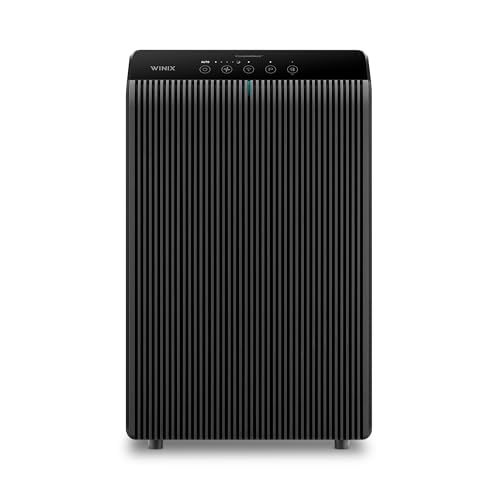
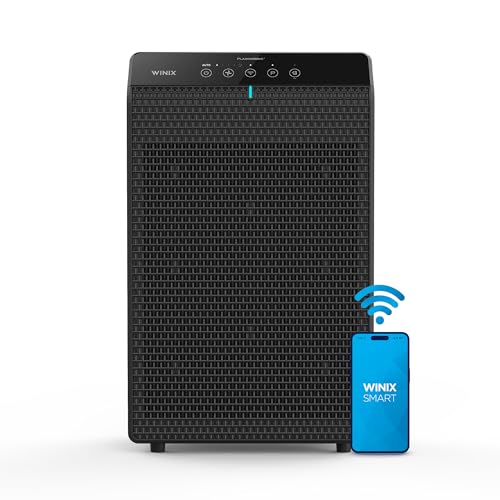
PlasmaWave has been Winix’s signature technology across several generations of its tower purifiers, which is why the model names in this series will feel like a family tree. The long-running 5300-2 built the reputation: a large-room tower with the classic filter arrangement and PlasmaWave, reviewed on its own terms in Winix 5300-2 review. Its sibling, the 5500-2, aimed at the same large rooms with a heavier emphasis on odor control, and its story is told in Winix 5500-2 review. The current generation carries the line forward with connected features: the 5510, presented by Winix as a new generation of the 5500-2 with app support, is covered in Winix 5510 review; the 5520 adds an air quality monitor to the formula, as Winix 5520 review explains; and the 5530 pairs the same filtration philosophy with app control, reviewed in Winix 5530 review. At the compact end, the small-room A231 and its close sibling the A230 bring PlasmaWave thinking to bedrooms and desks, the subject of Winix A231 review. Across all of them the PlasmaWave concept stays constant while filters, sensors, and controls evolve around it — which is itself a clue about the technology’s role: it is the brand’s constant, not any single model’s headline act.
What are the honest limitations of PlasmaWave?
A guide that only repeated the brochure would be failing you, so here is the scrutiny promised in the introduction. First, independent verification: filter performance is easy to test in a chamber and is covered by standardized ratings, while the hydroxyl mechanism’s contribution inside a furnished, ventilated, real-world room is genuinely difficult to isolate, and PlasmaWave’s benefits are correspondingly harder to confirm with a home air monitor than the HEPA stage’s benefits, which show up clearly as particle counts fall. Second, ions do not remove anything from the room by themselves; particles that are charged but never drawn through the filter may settle onto surfaces, which relocates dust rather than eliminating it, one more reason the filter stack matters. Third, reactive chemistry in air is indiscriminate in principle: hydroxyls react with what they meet, and while Winix’s design and certifications address by-product concerns, households that are chemically sensitive or that include people with significant respiratory conditions should discuss any ion-emitting appliance with their clinician and can simply use the off switch. Fourth, PlasmaWave is not a response to an active problem like visible mold growth, a gas leak, or a carbon-monoxide concern; those need remediation, ventilation, and alarms, not ionization. None of this makes PlasmaWave a fiction. It makes it what the evidence supports calling it: a supplementary technology from a reputable manufacturer, riding on top of a filtration system that carries the measurable load.
How should you evaluate any ionization claim, not just Winix’s?
The buying-guide skill this article can teach you transfers to every brand that bolts an ionizer, plasma module, or bipolar stage onto a purifier, because the evaluation questions are always the same. Start with the filters: is there a true HEPA filter, how much carbon by weight or by honest description, and what room size is the machine rated for under a recognized clean-air delivery standard? A purifier whose marketing is ninety percent ionization and ten percent filtration has its priorities backwards. Next, look for emissions certification: in the United States, California’s air-cleaner regulation and its list of certified models is the practical benchmark for ozone safety, and a brand that cannot point to it is asking for trust it has not earned. Then check the controls: can the ionization stage be switched off independently? That single feature tells you the manufacturer expects the technology to be a choice, and it protects you if a household member dislikes it. Consider sensor quality too, since auto modes across the industry lean on particle sensors of varying honesty. Finally, price the consumables: filters are the lifetime cost of any purifier, PlasmaWave or not, and a cheap machine with expensive, short-lived filters is a subscription in disguise. Run those five checks and PlasmaWave takes its proper place in a decision — a genuine feature, from a brand with certifications, on machines whose filters justify the purchase with or without it.
How do you set up and run a PlasmaWave purifier day to day?
Placement first
Give the machine breathing room: a tower purifier wants clearance around its intakes and outlet rather than a corner burial behind a sofa, and it belongs in the room where the problem lives — the bedroom during allergy season, the living room near the litter box, not the hallway as a compromise that serves neither. Keep it away from direct obstruction by curtains, and if the model has an air quality sensor, remember the sensor judges the air near the machine, so a unit exiled to a dead corner will report a fiction in both directions.
The PlasmaWave button, used deliberately
Most owners can leave PlasmaWave on as the manufacturer intends; it is designed for continuous use alongside the fan. The deliberate exceptions are worth knowing. If anyone in the home notices irritation they associate with the machine, switch PlasmaWave off for a week and compare — the purifier remains fully useful as a filter-only device, and you have run a clean experiment. If you are running the purifier in a very small, sealed room such as a nursery, filtration-only operation is a reasonable conservative choice to discuss with your pediatrician. And if your model lacks a separate PlasmaWave control, the fan’s own settings still govern everything that matters most.
Filters and sensors: the maintenance that actually decides performance
Wash or vacuum the pre-filter on the schedule the manual sets, because a clogged pre-filter starves everything downstream. Replace the HEPA and carbon stages as a set when the indicator calls for it — in the Winix line these are typically bundled as a single matched filter pack per model family, and stretching a saturated carbon stage is the classic reason owners conclude a purifier “stopped working” when really its odor stage simply filled up. Wipe the particle sensor lens gently if your model exposes one, since a dust-filmed sensor makes auto mode lazy. And run the machine more than you think: purifiers clean the air that passes through them over hours, so the household pattern that works is low-and-constant in occupied rooms, with a turbo burst after cooking, cleaning, or a pet incident, rather than heroic weekend sessions. Readers optimizing for sleep should cross-check noise behavior against best quiet air purifiers, and anyone furnishing a bedroom first should start from best air purifiers for a bedroom before narrowing to a brand.
What mistakes do people make with PlasmaWave purifiers?
The commonest mistake is buying the technology instead of the machine: choosing a model for its PlasmaWave badge while ignoring that its filters are undersized for the room, then blaming ionization when dust persists. The second is switching PlasmaWave on and the fan nearly off, expecting ions alone to clean a room they cannot circulate through; the fan is the engine and ions are a passenger. The third is neglecting filter replacement because “the plasma part doesn’t wear out,” when in fact the HEPA and carbon stages are quietly expiring on schedule. The fourth is expecting any purifier to fix a source problem — a moldy wall cavity, a smoking habit indoors, a damp basement — rather than treating the air while the source is properly addressed. The fifth is assuming PlasmaWave makes a purifier safe to run as a sanitizing device in a sickroom in place of ventilation and ordinary hygiene; it is a comfort and air-quality appliance, and it should be used and described that way. Avoid those five and a PlasmaWave machine will do for you exactly what it honestly can, which for most households is plenty.
Where do hydroxyls come from in nature, and why does Winix invoke them?
To judge the PlasmaWave story fairly, it helps to know that hydroxyl radicals are not a marketing invention; atmospheric chemists genuinely call them the detergent of the troposphere. Sunlight acting on ozone and water vapor in outdoor air produces hydroxyls continuously, and those hydroxyls begin the breakdown of methane, carbon monoxide, and a long list of pollutants, which is a major reason the outdoor atmosphere does not simply accumulate everything humanity emits. The concentrations involved outdoors are tiny and the reactions happen across an entire sky, but the chemistry is real and well documented. Winix’s design goal is to borrow that chemistry indoors: if positive and negative ions can be made to generate hydroxyls at the surface of a bacterium or an odor molecule inside a room, then a purifier gains a mechanism that works on pollutants as chemistry rather than as cargo.
The honest caveat is one of scale and setting. The sky is an enormous, sunlit reactor; a living room is a small, dim one, and the purifier is a modest ion source competing with ventilation, surfaces, and every other sink that consumes ions and radicals. That does not make the mechanism imaginary — ion-driven chemistry demonstrably happens — but it does mean the size of the effect in a real home is an empirical question that is much harder to pin down than a filter’s capture rate, and it is why this guide keeps returning to the same proportion: filtration is the verified foundation, PlasmaWave is the plausible supplement. Readers who enjoy this kind of mechanism-versus-measurement distinction will find the same thinking applied to filtration claims in indoor air quality statistics, which looks at what indoor air actually contains and why source control outranks every appliance.
How has PlasmaWave changed across Winix generations?
PlasmaWave itself has been the constant in Winix’s line for years, and what has evolved around it tells you where the industry thinks the real improvements live. The earlier towers — the 5300-2 and 5500-2 generation — paired PlasmaWave with straightforward controls: fan speeds, a timer, a PlasmaWave button, and a filter-change indicator, in a tall tower format with a washable pre-filter and a bundled carbon-plus-HEPA replacement pack. Those machines built Winix’s reputation on value: serious filtration and the ionization stage at prices below the prestige brands. The newer generation represented by the 5510, 5520, and 5530 keeps the same essential recipe and modernizes everything around it — air quality sensors that drive a more responsive auto mode, a numeric or color-coded display of the air’s condition on the models so equipped, and app control with scheduling and filter-life tracking on the connected models. The compact A230-series machines miniaturize the same ideas for bedrooms.
Notice what did not change: the filter-first architecture, the PlasmaWave stage, and the off switch. When a manufacturer iterates for a decade and keeps a feature in every generation while improving sensors and controls around it, the reasonable reading is that the feature is a valued brand signature rather than a breakthrough in progress. Shoppers cross-grading between generations should therefore spend their attention on the things that demonstrably differ — filter pack design and price, sensor quality, noise at sleep speeds, app reliability — and treat PlasmaWave as present and equal on both sides of the comparison.
PlasmaWave at work: the household jobs people actually assign it
Wildfire and tobacco smoke events
Smoke is a mixed problem: fine particles that a HEPA filter captures well, plus a lingering odor load that lives in gases and in what has settled on fabrics. During smoke events the correct purifier behavior is high fan, closed windows, and patience, with the HEPA stage doing the measurable work as a particle monitor confirms. PlasmaWave’s claimed contribution sits on the odor and microbe side of the event, and owners often report the room smelling fresher than filtration alone achieves; whether that is the hydroxyl chemistry, the carbon stage, or both, the practical routine is unchanged, and no ionization feature converts a purifier into protection against heavy smoke exposure outdoors.
Pet households
Dander is a particle and belongs to the HEPA filter; pet odor is a gas problem shared between the carbon stage and whatever PlasmaWave adds. The pet-specific failure mode is the pre-filter: hair loads it quickly, and a hair-matted pre-filter silently throttles the whole machine, PlasmaWave included, because the fan cannot move design airflow. Pet owners get more from a monthly pre-filter rinse than from any feature debate, a point the pet-focused comparisons in best air purifiers for homes with pets make from the sizing side.
Allergy season
Pollen is where expectations need the firmest handling. Pollen grains and the finer allergen fragments are particles; they are captured when room air passes through the HEPA filter, and no ion stage changes the arithmetic that a closed bedroom with a correctly sized purifier running all night is the intervention that sufferers actually feel. PlasmaWave neither helps nor hinders that arithmetic. Allergy households should buy on room coverage, sleep-speed noise, and filter cost, and be politely deaf to any suggestion that an ionization badge substitutes for coverage.
Cooking-heavy kitchens and open plans
Cooking produces a burst of particles and a longer tail of odor, and open-plan homes spread both. The purifier routine that works is a turbo burst during and after cooking, then a return to low continuous running; the range hood, vented outdoors if you have one, remains the primary tool. Here the carbon stage saturates fastest, and PlasmaWave’s role, if any, is in the tail — the difference between a kitchen that smells neutral by bedtime and one still faintly announcing dinner. Households where cooking odor is the main complaint should weight carbon capacity heavily in any purchase, whatever the ionization branding.
What does PlasmaWave cost you to run?
Running costs for any Winix tower come from three places: electricity for the fan, replacement filter packs, and time. The ionization stage itself draws negligible power next to the fan motor; the honest electricity conversation is about fan speeds, and like most modern purifiers these machines sip power on the low settings meant for continuous use and draw meaningfully more on turbo, which is an argument for the low-and-constant pattern rather than against the appliance. Filter packs are the real budget line, typically replaced as a matched set on roughly an annual rhythm in ordinary homes, faster where smoke or heavy pet load saturates the carbon sooner. PlasmaWave adds no consumable of its own — there is no ion cartridge to buy — which is one of its cleaner advantages over technologies that meter out a replaceable emitter or bulb. When you compare a Winix against rivals, compare three-year filter costs, not sticker prices, and PlasmaWave will correctly vanish from the arithmetic: it is the rare feature that costs nothing to keep.
How does PlasmaWave compare with other brands’ air-treatment technologies?
Winix is not the only manufacturer with a named air-treatment stage, and the comparison clarifies what PlasmaWave is by showing what it is not. Sharp’s Plasmacluster is the closest cousin: another bipolar ion system, in that case marketed around ions released to inactivate airborne microbes, with a similar evidentiary profile of plausible mechanism and hard-to-isolate home effect. Dyson’s approach to gases runs through filtration — large carbon and catalytic stages — rather than ionization, betting the whole product on what passes through the machine. Blueair’s HEPASilent design uses ionization differently, charging particles inside the unit so a less dense filter can capture them at lower noise, which is ionization in service of filtration rather than as a room treatment. Photocatalytic and ultraviolet stages, used by various brands, aim light-driven chemistry at microbes and gases, with their own dependence on contact time and airflow. Laid side by side, the industry’s honest center of gravity is unmistakable: every serious brand builds on mechanical filtration, and the named technologies compete as supplements with different philosophies. PlasmaWave’s philosophy — release bipolar ions into the room and let hydroxyl chemistry work beyond the box — is among the more ambitious supplement claims, which is precisely why it deserves both the explanation and the proportion this article has given it.
How do you read a Winix listing without being misled?
Product pages for PlasmaWave models compress a lot of persuasion into a small space, so here is a reading order that keeps the important facts in front. Find the room-size figure first and note the basis: Winix quotes coverage for one hour of cleaning in its current listings, which describes a faster air-change rate than the slower multi-hour figures some brands use, so compare like with like across brands rather than headline against headline. Find the filter description second and translate it: a washable pre-filter, a carbon stage whose form matters (a coated sheet saturates faster than a deep granular bed), and a true HEPA element are the substance of the machine. Third, locate the sensor and control story — particle sensor, odor sensor, auto mode, sleep mode, app — because those decide daily satisfaction more than any treatment stage. Fourth, find the PlasmaWave claim and file it where this article has taught you to file it: a certified, switchable supplement. Fifth, price the replacement filter pack and its rated life, and multiply out three years. A listing read in that order cannot really mislead you, because each persuasive element lands in its proper tier — and you will notice that the PlasmaWave paragraph, read fifth instead of first, reads as what it is: an interesting technology on a machine you have already judged on its merits.
A short verdict framework for PlasmaWave shoppers
If your shortlist is all Winix, PlasmaWave cancels out of the decision entirely, since the models share it; choose by room size, noise, sensors, and filter economics, using the model reviews linked throughout this guide. If your shortlist crosses brands, give PlasmaWave the weight of a tiebreaker: a genuine, certified, no-consumable feature that may add odor and microbe benefits beyond filtration, worth something real but not worth a weaker filter, a smaller coverage rating, or a pricier filter pack on the other side of the ledger. If anyone in your home has significant respiratory illness, route the decision through their clinician and lean on the off switch. And if a seller — of any brand — presents an ionization stage as a reason to skip filtration, ventilation, or source control, you have learned the most valuable lesson this technology can teach: how to recognize the moment a supplement is being sold as a system.
Three myths about PlasmaWave worth retiring
Myth one: PlasmaWave means the purifier needs no filter changes. The opposite is true — the technology’s presence changes nothing about the HEPA and carbon stages’ finite lives, and a Winix run on expired filters is a fan with an ionizer attached, delivering the supplement while the foundation crumbles. Myth two: the ions scrub the whole house. Ions dilute and decay with distance and time; a tower in the living room is treating the living room’s air, most strongly near the machine, and bedrooms behind closed doors need their own filtration, which is why whole-home strategies in best whole home air purifiers are built from multiple filter units or ducted systems rather than from any single room technology. Myth three: because PlasmaWave is electrical rather than chemical, it must be either completely harmless or secretly dangerous, depending on the storyteller. The grown-up position is the one regulators take: emissions from certified devices are limited and tested, the feature can be switched off, and households with medical concerns should individualize the decision with a clinician. Technologies deserve neither worship nor fear; they deserve specifications.
PlasmaWave in the bedroom: the sleep question
Bedrooms are where purifiers earn their keep — eight continuous hours in one room — and where PlasmaWave questions concentrate, because the machine sits closest to the sleeper for the longest stretch. Winix’s sleep modes across the line dim displays and drop the fan to its quietest setting, and the PlasmaWave stage makes no sound of its own, so acoustically the feature is invisible. The decisions that matter at the bedside are the familiar ones: is the unit sized so its quiet speed still turns the room’s air over adequately, is the display truly dark or merely dim, and does the household want the ion stage running overnight? For most owners the answer is an untroubled yes, on a certified machine, with the filters doing the work they can verify on a monitor each morning. For a household managing asthma, the clinician conversation plus the off switch covers the caution without surrendering the purifier. Either way, the bedroom exposes the truth of the whole technology debate: what improves sleep is cleaner air delivered quietly all night, and that is a filtration achievement to which PlasmaWave is, at most, a supporting credit in the program.
Why does ionization keep coming back? A short history
Ion-based air cleaning has been declared the future roughly once a decade for half a century, and understanding the cycle explains both PlasmaWave’s appeal and the skepticism that greets it. Early room ionizers promised mountain-fresh air from charged particles alone; many worked poorly as cleaners, some emitted ozone freely, and regulators and disappointed owners pushed the category to the margins. Each revival since has been more disciplined: ions paired with real filters, emissions certified, claims narrowed. Winix’s PlasmaWave belongs to this mature generation — ionization demoted from miracle to supporting stage, wrapped around a conventional, testable filtration core. That demotion is not a failure of the technology; it is the technology finding its honest size. The pattern to carry into any store is that the closer an ion product’s marketing stays to its filters, the more trustworthy the product tends to be, and Winix’s own materials, which lead with filtration architecture and room ratings, sit at the trustworthy end of their category’s habits.
PlasmaWave and the gases filters miss: VOCs in real homes
The strongest theoretical case for a chemistry-based stage is the class of pollutants filters handle worst: volatile organic compounds and other gases that pass through HEPA media untouched and challenge carbon beds that are thin, old, or overwhelmed. Real homes generate these constantly — paints and adhesives after a renovation, new furniture off-gassing, cleaning products, cooking by-products — and the first-line responses are ventilation and time, with carbon as the appliance answer. Winix’s PlasmaWave claims are aimed squarely at this gap, describing hydroxyl attack on chemical vapors and gases. A homeowner mid-renovation should still sequence the defenses correctly: ventilate aggressively, keep the purifier’s carbon fresh, let materials cure, and regard PlasmaWave as the third layer rather than the plan. Where the technology may quietly justify itself is the long tail of ordinary life — the faint, mixed, low-level vapor background of a furnished home that no single filter stage fully erases — and on that modest, plausible claim, rather than on any dramatic one, a fair evaluation of PlasmaWave can comfortably rest.
What would a fair home test of PlasmaWave look like?
Owners who enjoy evidence can run a more honest experiment than the usual sniff test, and designing it teaches the technology’s real contours. You need a particle monitor, a purifier with a PlasmaWave switch, and patience. For the filtration baseline, run the machine filters-only in a closed room for several days of ordinary living and watch how quickly particle counts fall after a disturbance — a vacuuming, a door left open to a dusty hallway — and how low they settle overnight. That curve belongs to the fan and HEPA filter, and it will be satisfyingly repeatable. Then repeat the week with PlasmaWave enabled, same room, same habits. Particle curves will look essentially identical, because ions do not change the filter’s arithmetic, and any honest test should concede that upfront. Where differences might appear is the slower, softer evidence: how the room smells on entry after a closed weekend, whether cooking odors clear by morning rather than by noon, whether the air reads as fresher to a visitor who does not know which week it is. Blind the sniff test if you can — have someone else flip the switch — because expectation is a powerful air freshener. Most owners who run this experiment land where this article lands: filtration verified, PlasmaWave unproven but plausible on odors, and no reason to resent a feature that costs nothing to run and can be switched off the day it stops pleasing you. That is a fair test, and a fair verdict, for a supplementary technology.
Does PlasmaWave change how you should size or place the purifier?
It does not, and resisting that implication is a small but real consumer skill. Sizing guidance for any purifier — Winix included — is built on the fan-and-filter system’s clean air delivery against the room’s volume, and the ionization stage adds no rated capacity on top of that figure. A PlasmaWave tower rated for a large room is rated for that room because its filters and fan can cycle the air, not because its ions roam further than a smaller model’s. Place it by filtration logic too: intakes unobstructed, air free to circulate, the unit in the room where people spend the hours rather than in a corridor asked to serve three rooms through doorways. Owners sometimes imagine the ion output drifting down hallways and around corners like a scent; ions are not a scent, they are short-lived charges that neutralize on the first surfaces and particles they meet, which in practice means the room the machine sits in. Size by the filter, place by the airflow, and let PlasmaWave be the extra it is — the moment a shopper starts sizing by the ion stage, they have bought the supplement and forgotten the system, and their dusty far corner will eventually explain the difference.
Frequently Asked Questions About PlasmaWave Technology
Does PlasmaWave replace the HEPA filter in a Winix purifier?
No. PlasmaWave and the HEPA filter do different jobs: the filter physically captures the particles that dominate indoor air complaints, and PlasmaWave adds an ionization stage aimed at pollutants filters handle less completely. Winix designs the two to work together, rates the machine’s room coverage on its filtration, and gives many models a control to run filters-only. If a PlasmaWave model ever needed its filter removed to function, that would be a different and lesser product.
Is PlasmaWave safe to run around children and pets?
Winix states that PlasmaWave produces no harmful ozone and sells its purifiers under California’s emissions certification for indoor air cleaners, which is the strongest practical assurance available in this category. That said, households vary: anyone with significant asthma or respiratory illness should raise any new air appliance with their clinician, and the independent off switch on Winix models means a cautious household loses nothing by running filtration only. Treat the technology as certified and optional, which is exactly how it is built.
Can I turn PlasmaWave off and still use the purifier?
On Winix models equipped with a PlasmaWave button, yes — the fan, filters, sensors, and auto mode continue to work with the ionization stage disabled. This is a genuinely useful feature for sensitive households and for anyone troubleshooting whether a perceived irritation tracks with the ionizer or with something else in the room. Check the specific model’s controls before buying if the off switch matters to you, since control layouts vary across generations.
Does PlasmaWave remove odors by itself?
Odor duty in a Winix purifier is shared: the activated carbon stage adsorbs odor gases as air passes through, and PlasmaWave’s hydroxyl chemistry is claimed to break down odor molecules beyond the machine as well. In practice, households notice odor improvement most when the carbon is fresh, which is why a purifier that “used to handle the litter box” and no longer does usually needs a filter change, not a technology upgrade.
How is PlasmaWave different from a standard ionizer?
A basic ionizer typically emits ions of one polarity to charge particles so they settle out of the air, which relocates dust to surfaces and can, in poorly designed units, generate unwanted ozone. PlasmaWave is a bipolar system — both positive and negative ions — whose stated mechanism is the formation of hydroxyls that neutralize pollutants chemically, integrated into a full filtration appliance and sold under ozone-emissions certification. The distinctions are real, though they do not exempt PlasmaWave from the general rule that filtration does the verifiable heavy lifting.
Which Winix should I buy if PlasmaWave is what interests me?
Buy the filtration and the room fit first, and let PlasmaWave come along. Large rooms point to the current big towers compared across the Winix 5510, 5520, and 5530 reviews in this series; smaller bedrooms point to the compact end of the line. In every case the PlasmaWave stage is the same idea, so the decision rightly turns on filters, noise, controls, and running costs.
The bottom line on PlasmaWave
So, what is plasmawave technology? It is Winix’s bipolar ionization stage: a certified, switchable supplement that aims hydroxyl chemistry at the pollutants a filter cannot reach, riding inside purifiers whose HEPA and carbon stages do the measurable work. Understood that way — neither magic nor marketing fiction — it earns its place on the feature list without distorting your decision. Choose a Winix the way you would choose any purifier, by filters, fit, and running costs, and PlasmaWave will be what it should have been all along: a pleasant bonus on a sound machine.
A final practical note: if you already own a Winix and have never touched the PlasmaWave control, you are in the majority, and the machine has almost certainly been running the feature since the day you plugged it in — which means your lived experience of the purifier already includes whatever PlasmaWave contributes, for better or for subtler. The experiment worth running is the reverse one described earlier: a week with the stage switched off, filters only, and an honest comparison of the room’s smell and feel at the door each morning. Whatever you conclude, you will own the conclusion, and you will understand your appliance better than any brochure could arrange.
There is a broader shopping lesson folded inside this one technology, and it is worth stating plainly before you go.
Modern appliances increasingly arrive wrapped in a named, trademarked process — a wave, a cluster, a shield, a sense — and the names are designed to be un-googlable into any independent verdict, because each belongs to exactly one brand. The defense is always the same set of questions, the ones this article applied to PlasmaWave: What does the underlying mechanism actually do? What part of the job is still done by the boring, standardized, testable components? Is the feature certified against the risks its family is known for? Can it be switched off? And does it consume anything you must keep buying? A technology that survives those questions, as PlasmaWave largely does, can be welcomed without illusions. A technology that dissolves under them was never a feature at all — it was a label looking for a machine to ride on. You now know which kind PlasmaWave is, and, just as usefully, you know how to interrogate the next trademarked wave that breaks over a product page near you.