Disclosure: As an Amazon Associate, dailyhomedecorating.com earns from qualifying purchases. Links on this page are affiliate links; they cost you nothing extra. Prices and availability change often, so check the current Amazon listing before you buy.
Levoit’s desktop generation survives in two small machines, and this levoit lv h128 review covers the more personable of them: the LV-H128, an AHAM-verified desktop purifier with an aroma pad — a detail no current Core model offers — sized for the desk, the nightstand and the nursery shelf. Its modern rival is the Core Mini, the family’s current personal-space standard, and the comparison between them is genuinely interesting: the Mini is the better appliance by the modern measures, while the H128 carries two heirlooms — verified desktop delivery from an older school, and the scent pad — that a certain kind of owner values out of proportion to their size. This review arbitrates between the heirloom and the standard for the small rooms and smaller surfaces both machines serve.
The aroma pad, taken seriously
Scent is the home’s most argued-over sense, and the H128’s aroma pad is a small diplomatic instrument: a few drops of the household’s chosen oil, diffused gently by the machine’s own airflow, in the room the machine is already cleaning. The purist objects that a purifier should remove odours rather than add them, and the objection is coherent — the pad is removable, and the machine filters identically without it — but the households that use the pad are not confused about the distinction. They are scenting a cleaned room, deliberately, the way a cook seasons a finished dish; the bedroom that smells faintly of cedar by choice is a different domestic statement from the bedroom that smells of nothing by filtration, and the H128 is the family’s only current instrument of the first statement. This review takes the pad seriously because its owners do — and because the alternative framing, in which scent is a contaminant to be governed away, is a philosophy the carbon articles in this cluster serve better. The H128’s parish is the personal room that wants a signature.

Levoit LV-H128 — the scented desktop
Best for the personal room that wants filtration with a signature
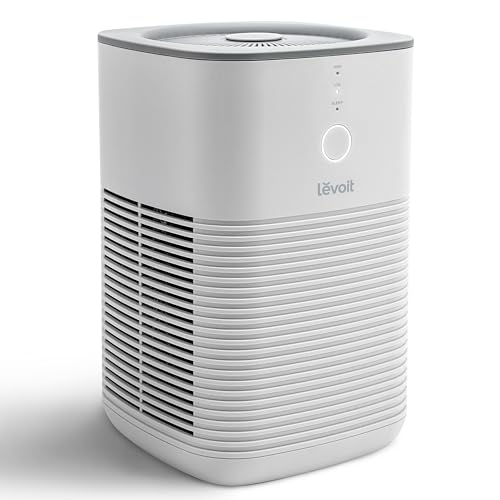
The listing’s specification: desktop purification, AHAM verification, and the aroma pad. Its scale is the personal parish — the desk’s weather, the nightstand’s corner, the nursery shelf’s small climate — and within that parish its delivery is verified in a way the unbadged desktop novelties never are. The pad’s drops last an evening or a day depending on the oil and the fan, the ritual of refreshing them becomes part of the room’s evening liturgy for the households that adopt it, and the machine’s small footprint leaves the desk’s working acres free.
- Model: LV-H128
- Verification: AHAM VERIFIDE, per its listing
- Feature: aroma pad for essential oils
- Parish: desktop and nightstand scale
- Filtration: genuine replaceable filter
Strengths
- The family’s only scented filtration, done properly.
- Verified delivery at desktop scale.
- A footprint the smallest desk forgives.
Trade-offs
- No sensor, no app, no automation.
- The parish is personal; the bedroom’s whole weather outruns it.
- The pad is a pleasure, not a purification stage.
Best for: desks, nightstands and nursery shelves that want a signature scent. Not suited for: whole-bedroom governance — the Core 200S’s parish.

Levoit Core Mini-P — the modern personal standard
Best for unscented personal air at the family’s current design
The Mini’s full review in this cluster is its case; here it is the H128’s modern counterweight: quieter manners, the current cartridge architecture, the same personal parish, and no pad. A buyer choosing between them is choosing an era and an extra — the Mini is the safer default for the purely filtration-minded, the H128 the deliberate choice for the scent-minded — and the review’s honesty requires saying that the default is the default for good reasons: it is the machine the family currently designs around. The H128 persists because its extra is one the current line, for all its sensors, simply does not sell.
- Model: Core Mini-P
- Coverage: up to 178 sq ft claimed
- Filtration: 3-in-1 cartridge with carbon
- Noise: 25 dB sleep mode, per its listing
- Extras: none — filtration only
Strengths
- The current design, supported and stocked.
- Bedroom manners at desktop scale.
- The family’s personal-space default, deservedly.
Trade-offs
- No aroma provision of any kind.
- No AHAM badge on its listing.
- Equally manual, equally personal in scale.
Best for: the filtration-only desk or nightstand. Not suited for: the signature-scent room, which is the H128’s surviving parish.

Levoit LV-H132 — the sibling with the night light
Best for the desktop that wants a glow instead of a scent
The other survivor of the desktop generation, reviewed in full beside this article: AHAM-verified like the H128, with an optional night light where its sibling keeps the aroma pad. The pair divide the personal room’s small luxuries between them — scent or glow — and a household choosing within the generation is choosing which sense the machine may address beyond the air itself. Both are honest extras, honestly labelled, and the cluster’s two reviews treat them as the genuine, if modest, philosophy they are.
- Model: LV-H132
- Verification: AHAM VERIFIDE, per its listing
- Feature: optional night light
- Parish: desktop and nightstand scale
- Filtration: genuine replaceable filter
Strengths
- Verified desktop delivery with a gentle light.
- The nursery’s and landing’s small-hours friend.
- The generation’s other honest luxury.
Trade-offs
- No scent provision.
- Equally manual, equally personal in scale.
- The light is optional because some rooms refuse it.
Best for: nightstand and nursery duty where a glow helps. Not suited for: the scented room — its sibling’s parish.
In this guide
A desk, a scent, a season
October installs the H128 on a writer’s desk, and the machine’s small liturgy assembles itself: the morning’s first act is the fan, the evening’s is two drops of cedar on the pad, and between them the desk’s parish — paper dust, the radiator’s first heat, the window’s traffic — is governed at the scale the work actually happens at. November brings a cold to the household and the pad takes eucalyptus for a week, a use the review reports as comfort rather than as therapy, in keeping with this site’s framing. December’s verdict from the desk’s owner is the H128’s whole case in one sentence: it is the only machine in the house that is greeted rather than merely used. Greeting is not a specification. It is, across a decade of evenings, a considerable portion of what a personal appliance is for.
Final word
The LV-H128 is the desktop generation’s scented survivor: verified, small, manual, and possessed of the family’s only aroma pad. Buy it for the personal room that wants a signature; buy the Mini for the personal room that wants only filtration; buy its sibling for the room that wants a glow. The luxuries are small because the parish is small — and within the parish, they are the whole difference between a machine that serves a room and a machine that belongs to it.
Scent, governed: the household rules
Because the pad is a pleasure, it attracts rules the way pleasures do, and the H128’s households converge on a short code. Keep the scent inside the room it serves — the pad’s parish is personal, and a scented hallway is a diplomacy incident. Use drops, not floods; the pad rewards restraint with evenings rather than hours. Change the scent with the season or not at all, but never layer two — the pad is a soloist. Keep oils off the filter itself; the pad exists precisely so the stages stay clean. And retire the scent entirely when a guest, a newborn’s first weeks, or a household member’s preference asks it — the machine filters on, identically, which is the code’s foundation: the signature is always optional, and the air never is.
The greeted machine
Greeting is a category of domestic success that specification sheets cannot record, and the H128’s record is full of it: the desk’s owner touches the dial the way one touches a kettle’s handle, with the familiarity of a rite. The cluster’s larger machines are respected, consulted, even trusted — the Eleva is trusted, the 600S is respected — but the little scented desktop is the one that is liked, and liking, sustained across a decade of evenings, is not a trivial engineering outcome. It is what the pad, the footprint and the manual dial compose when a household adopts them: an appliance small enough to be a companion. Companionship will never appear in a comparison table. It appears, instead, in the replacement decision — the H128’s owners, when the filter’s economics are debated, replace the filter. The review rests a surprising amount of its recommendation on that sentence.
Charm, audited
The review has praised the machine’s charm at length, and its duty now is to audit the charm’s price, which is paid in the modern currencies: no sensor to catch the cooking hour, no app to govern from the sofa, no display to narrate the room. The H128’s owner governs by hand and by habit, and the evenings when the habit lapses are evenings the parish goes ungoverned in a way the smart rungs would have prevented. That is the honest debit, and it is why the review’s recommendation carries its border in every section: the scented room’s owner accepts the manual covenant with open eyes, or the household climbs. Charm bought with open eyes is a delight. Charm bought as a substitute for governance is a debt — and the distinction, here as everywhere in this cluster, is the review’s real subject.
The aroma pad in practice: dosing, placement and restraint
The pad is this machine’s whole personality, and it rewards a lighter hand than new owners expect. Two or three drops of a fragrance oil on the pad is a full dose for a desk-sized parish; six drops does not make the room smell twice as designed, it makes the machine’s immediate neighbourhood smell like the inside of a soap shop and the rest of the room smell of nothing but effort. The pad sits in the machine’s airstream, so the scent it releases is carried on the same current that delivers the cleaned air — which means placement steers the scent as much as the dose does. A machine on the desk’s left, blowing across the workspace, perfumes the work; the same machine in the corner behind the door perfumes the corner. Owners who complain the feature is weak have usually placed the machine where its air goes to die, and owners who complain it is overwhelming have usually dosed for a ballroom.
Restraint has a second, practical ground: the pad is a consumable with a memory. A pad saturated in a heavy oil carries that oil’s ghost into the next scent, and a pad dosed daily at full strength becomes, within a season, a small archive of every fragrance the desk has hosted, none of them quite themselves. The household rules this article recommends are simple — dose lightly, let a scent finish before replacing it, keep one pad for the household’s signature scent and a second for experiments, and wash or replace a pad when its archive starts arguing with its present. Treated so, the feature stays what it was designed to be: a signature, not a fog.
Which oils belong on the pad, and which do not
The pad accepts fragrance oils and essential oils, and the distinction matters less than two other properties: viscosity and residue. Thin oils that evaporate cleanly are the pad’s natural diet. Thick carrier-heavy blends sit in the fibres, oxidise slowly, and leave the pad sticky and the airstream faintly stale — the scent equivalent of a pan that was never properly washed. Anything not intended for the air at all — cooking extracts, perfume decanted from a bottle, the dregs of a reed diffuser — belongs nowhere near the machine, not because the machine is fragile but because the desk’s occupant will be breathing the experiment at close range for hours, and close range is unforgiving of improvisation.
Households with birds, or with cats whose grooming turns air into diet, should treat scent as a separate question from the machine and take the cautious path their veterinarian would advise; this review’s subject is a purifier that can carry scent, not an instruction that every household should scent it. The machine runs perfectly well with a dry pad — a configuration this article will return to, because for a significant minority of its owners the pad’s best use turns out to be occasional: for guests, for the first evening of a season, for the afternoon a wet dog has been in the house. A feature used occasionally and deliberately keeps its charm in a way a feature left permanently on cannot.
The desk audit: what a personal purifier can and cannot do at arm’s length
Personal-scale machines attract a particular scepticism — that a small box cannot meaningfully clean anything — and the honest answer is a matter of geometry rather than faith. A desktop purifier does not clean a room the way a floor machine does; it cleans a current. Placed on the desk with its outlet toward the occupant, it establishes a stream of filtered air across the breathing zone of the person sitting in it, and within that stream its effect is real and perceptible: the dust that would have crossed the desk crosses a filter first. Step outside the stream — across the room, behind the door — and the machine’s writ fades to the room’s general background, which it improves only slowly and partially. Owners who understand the current model are satisfied with this machine for years. Owners who expected a room machine in a desk machine’s body are disappointed within the week, and the disappointment is a sizing error, not a product failure.
The audit has a second half, about what the current carries besides cleanliness. At arm’s length, the machine’s sound is part of the workspace: on its low speed a soft broadband hush that most desk workers stop hearing within a day and many come to use as a masking layer against household noise. Its scent, when the pad is dosed, is delivered at the same arm’s length, which is why the dosing section above preaches restraint — the desk is the one parish where the machine’s every quality is experienced undiluted. Judge this machine at the desk, in the chair, during a working hour. Judged anywhere else, it is being marked on the wrong examination.
Filters for the H128: cadence, sourcing and the dry-pad configuration
A desktop machine’s filter lives a harder life per cubic centimetre than a floor machine’s, because the same desk dust that a large cartridge spreads across a broad pleat pack concentrates in a small one. In a working study — paper, fabric, a window that opens onto a street — expect the filter’s honest life to run shorter than the box’s optimism, and judge it by the machine’s own evidence: a sweetish tiredness in the outlet air, a fan working audibly harder at the same setting, dust returning to the desk’s surfaces sooner after cleaning than it did in the filter’s youth. The replacement is a small cartridge, changed in a minute without tools, and its sourcing follows the rule this cluster applies to every discontinued-adjacent model: buy the maker’s own cartridge, matched to the model by name, from a listing that shows the cartridge itself rather than a family’s worth of allegedly compatible machines.
The dry-pad configuration deserves its own paragraph because it is, for many owners, the machine’s mature form. Run without oil, the pad is simply part of the intake path, and the machine is a plain, verified personal purifier with an unusually charming past. Owners arrive at the dry configuration by several roads — a partner who dislikes scent, a baby in the house, a scenting enthusiasm that burned bright for a season — and the machine accommodates all of them without sulking, which is more than can be said for dedicated scent appliances. The review’s verdict on the pad is therefore double: it is the reason to choose this machine over its plainer rivals, and it is a reason that survives being retired, because the filtration underneath it was honestly specified from the start.
The nursery shelf, with the cautions stated plainly
This machine is bought for nurseries often enough that the use deserves direct treatment rather than a passing mention. As a purifier, a small verified machine on a shelf — out of reach, cord managed, drawing the room’s air across its filter through the night — is a sensible parish for it, and its low speed is quiet enough for a sleeping child in a way that larger machines’ low speeds often are not. The scent feature is where the caution belongs, and this article states it without embroidery: a nursery is not the place for fragrance experimentation, the pad in a nursery should run dry or not be installed, and any household that wants scent in a baby’s room should be having that conversation with its clinician rather than with a review. The machine loses nothing by the restriction — in the nursery its virtues are the filtration, the hush and the small footprint, in that order.
Placement on the shelf has one further rule, borrowed from the tower article elsewhere in this cluster and miniaturised: give the intake its clearance. A machine pushed back against the wall between a stack of picture books and a lamp is filtering the shelf’s microclimate, not the room’s. A hand’s breadth on the intake sides, the outlet aimed into the room rather than along the wall, and the cord routed where no small hand will ever test it — those three arrangements turn a decorative placement into a working one, and they cost nothing but the minute they take.
Travelling with a personal purifier: hotels, rentals and the machine as luggage
A machine this size acquires a second career as luggage, and the practice is common enough among its owners to deserve an honest assessment. In its favour: hotel rooms and holiday rentals are exactly the uncontrolled air a sensitive sleeper suffers in — unknown carpets, unknown cleaning regimes, a ventilation system with its own history — and a personal purifier on the nightstand establishes the same breathing-zone current there that it does at home, in the hours when it matters most. Against: it is one more object to pack, its filter spends its life on foreign dust at an accelerated rate, and a machine dropped in transit can develop the fan noises this cluster’s keeping guides teach owners to diagnose. The owners who travel with it happily are those for whom sleep quality on the road is a known problem with a known price; for everyone else it is a charming idea that survives exactly one trip.
If it travels, it travels in hand luggage or packed in the centre of soft clothes, with the pad removed and bagged — a dosed pad in a suitcase will scent the entire wardrobe with complete impartiality, a lesson its owners tend to learn once. At the destination it goes on the nightstand, outlet toward the pillow, and its filter gets a vacuum and a note in the household log when it comes home, because a fortnight of hotel carpet is a month of home desk in the cartridge’s accounting. Treated as an instrument rather than a comfort object, it earns its place in the bag; treated as a talisman, it is merely freight.
The H128 against the Core Mini, at the length the choice deserves
The pick blocks above introduced the Core Mini as this machine’s modern rival; the comparison deserves more room, because it is the actual decision most readers of this review are making. Begin with what is shared: both are verified personal-scale machines from the same maker, both are manual in temperament rather than app-governed, both are sized for the desk and the nightstand, and both take a small cartridge on a similar cadence. The differences are three, and they are all about personality. The H128 scents; the Mini, in its current form, carries a fragrance sponge of its own in some variants — a detail worth checking on the listing, since the lines have been converging — but the H128’s pad is the more deliberate implementation, placed and dosed as a feature rather than an accessory. The Mini is the current model, with a living supply chain and a maker’s full attention; the H128 is the elder, bought now as much for its character as its coverage. And the Mini’s design language is the family’s present tense — it matches the Core machines a household may already own — where the H128 is visibly of its own generation.
The decision rule this article offers is therefore not about performance, where the two are close enough that the desk will not know the difference, but about intent. Buy the Mini if the purchase is infrastructure: a machine to be fed cartridges and forgotten, in a house standardising on the current range. Buy the H128 if the purchase is partly an object — if the scent ritual, the greeted room, the small ceremony of the morning dose are things the reader actually wants in their day. Infrastructure ages into invisibility; objects age into affection or into irritation, and the reader is the only reliable judge of which of those two futures a scented desk machine has in their particular house.
Guests, and the machine as a small act of hospitality
The guest room is the parish where the scented machine’s virtues align most completely, and it is worth describing why, because the alignment is instructive about the whole category. A guest room is used in bursts, judged in first impressions, and forgiven almost anything except a stale smell. A small purifier that has run for the afternoon before a guest arrives has done the room’s air a measurable kindness; the same machine with two drops of something clean and green on its pad has done the room’s welcome a kindness of a different order, and guests register the second far more consciously than the first. Hosts who keep an H128 for this duty report the same discovery this article’s earlier sections made at the desk: the scent is a signature, and a guest room with a signature reads as a room that was prepared, which is the whole substance of hospitality in a single impression.
The discipline is in the timing. Scent dosed an hour before arrival and then left to the machine’s low speed greets; scent dosed at the door as the guest enters overwhelms, because the pad’s first hour is its strongest and the guest meets it at full voice in a small room. The experienced host’s sequence — machine on at the afternoon’s start, pad dosed lightly, door closed for the hour, then the machine left running at its quietest through the visit — is a small liturgy of its own, and it generalises: this is a machine that rewards being thought about an hour ahead, in every parish it serves.
Cleaning the small machine: a ten-minute protocol
Desktop machines live in the dustiest stratum of the room — the desk’s own weather of paper fibres, skin, fabric lint and whatever the keyboard sheds — and their intakes show it sooner than a floor machine’s do. The protocol is short enough to do while a kettle boils. Unplug the machine and take it to a surface that can be wiped. Vacuum the intake grille with the brush attachment, working with the grille’s grain rather than across it. Open the filter bay and lift the cartridge out by its tab; vacuum the bay’s interior and the cartridge’s outer face — the pre-filter surface — with the same brush, gently, since the pleats beneath are not a surface to be scrubbed. Wipe the housing with a barely damp cloth, paying attention to the top surface, where a desktop machine collects the room’s fallout like a shelf. Wash the aroma pad if it is being rested, or replace it if its archive has become argumentative, as the dosing section put it. Reassemble, and note the date somewhere the household keeps such dates.
Two prohibitions complete the protocol. No water inside the machine, ever — the damp cloth stays on the housing’s outside, and a cartridge is never rinsed, whatever a forum suggests; a rinsed desktop cartridge dries unevenly, smells of the attempt for weeks, and filters worse than the dirty one it replaced. And no compressed air blasted into the pleats, which can tear the media invisibly and convert a loaded filter into a bypass with good public relations. The ten minutes, done monthly in a dusty study and quarterly in a cleaner one, are the entire maintenance covenant of this machine — a covenant light enough that keeping it is a pleasure rather than a discipline, which is precisely why its owners, alone among this cluster’s congregations, so rarely fall behind.
A scent wardrobe: rotating fragrances without muddying them
Owners who take the pad seriously tend to accumulate oils, and the accumulation creates its own small discipline, because a pad is not a neutral stage — it remembers. The wardrobe method that works is borrowed from how perfumers handle blotters: group the scents by family, and let a pad belong to a family rather than to a single oil. A citrus-and-herb pad can move between lemon, basil and grapefruit across a season without any of them reading as contaminated, because the family’s ghost is harmonious with each new arrival. A woody pad — cedar, sandalwood, the coniferous oils — deepens with its archive rather than muddying. What fails is the promiscuous pad, dosed with vanilla on Monday and eucalyptus on Friday, which by the month’s end smells of a drawer in a chemist’s shop: everything, therefore nothing.
The practical wardrobe is small: two pads in rotation cover most households — one bright, one warm — with a third kept dry for the scent-free weeks that every household eventually wants. Label the pads’ storage jars with a strip of tape and a pencil, store them away from the machine so their ghosts do not perfume the intake between uses, and replace a pad when its family resemblance has thickened into a single indistinct note. The whole apparatus costs almost nothing, and it converts the machine’s most frivolous feature into a small, well-kept practice — which is, this article has argued from its first sections, the difference between a signature and a fog.
The H128 as a gift: who it suits, who it puzzles
Small, characterful appliances are given as gifts more often than their makers probably intend, and this one divides its recipients with unusual precision. It suits the person whose desk is a place they curate — the home worker with the arranged shelf, the student in the small room, the friend who has mentioned, in passing, that their study smells of the dog. For those recipients it lands as a considered object: useful daily, pleasant to own, and personal in a way a larger machine cannot be. It puzzles the recipient who did not know their air needed attention, for whom any purifier arrives as a gentle accusation, and it genuinely burdens the recipient with fragrance sensitivities, for whom the pad — however optional — makes the gift a negotiation rather than a pleasure.
The giver’s courtesies are three. Include a spare cartridge, because a gift whose first consumable arrives as a bill in six months is a subscription in disguise. Dose nothing before wrapping it: the recipient’s first scent should be their own choice, or their own decision to run it dry. And give it with the desk audit from this article attached in spirit — the honest framing that it serves a breathing zone, not a ballroom — because a gift whose expectations are set correctly is used for years, and a gift expected to perform miracles is in a cupboard by spring. Judged by those rules, the H128 is one of the safer appliance gifts in this cluster’s whole survey, precisely because its ambitions are modest and its charm is immediate.
Sound at the desk: working, calling and recording with a machine at arm’s length
The desk is the one parish where a purifier’s voice is a professional matter, because the desk is where the household’s calls and recordings happen. On its lowest speed the H128’s hush sits below the threshold of most laptop microphones at normal distances — a metre of separation and the fan is, to the far end of a call, simply not there. At its higher speeds it enters the recording as a broadband wash, not unpleasant in itself but unmistakably a machine, and the working rule for anyone who records is the one radio producers use for every room noise: the machine goes off or to its lowest for the take, and back up after, because no listener should have to share the desk. Video calls are more forgiving — the modern noise-suppression in the common platforms eats fan noise for breakfast — but they eat it at a small cost to the voice’s own edges, which the fastidious will notice in their own recordings even if their colleagues never do.
For the ordinary working day, the calculus runs the other way: the low-speed hush is a masking asset in a house with thin walls and a school-age population, flattening the peaks of household noise into a steadier background against which concentration is easier to hold. Owners who work from home full-time are this machine’s most loyal constituency for exactly that compound reason — the cleaned current and the flattened soundscape arriving from the same small box. It is a benefit no specification sheet lists and no floor machine at the room’s far end can deliver at the same strength, because masking, like scent, is an arm’s-length phenomenon.
When the small machine is the wrong purchase
This review has praised its subject within its parish; the parish’s borders deserve the same clarity. The H128 is the wrong purchase for a bedroom whose sleeper expects whole-room purification through the night — that is a Core 200S’s parish, and no desk machine’s current covers a bed properly unless the bed is improbably close to the desk. It is the wrong purchase for a household whose problem is a smoker, a wood stove or a serious mould history, all of which are loads for full-size machines with full-size carbon, addressed elsewhere in this cluster. It is the wrong purchase, finally, for a reader who wants the machine to decide things — there is no sensor, no auto mode worth the name, no app; the H128 is governed by its owner’s hand and habits, and a reader who has skimmed this review hoping otherwise should buy the Mini’s smarter rivals instead.
Within the borders, though, the machine’s case is unusually complete: verified filtration at personal scale, a scent feature implemented with more care than the category usually manages, a maintenance covenant measured in minutes per quarter, and a character that has kept it in production in its owners’ affections long after plainer contemporaries were replaced. Small machines are bought on charm and kept on competence. This one, the record suggests, is kept.
Second-hand H128s: a small machine’s particular checks
Because it is small, giftable and long-lived, this machine circulates second-hand in unusual numbers, and a used one can be an excellent buy — the design has few failure modes, and none of them hide well. The checks are a five-minute sequence. Run every speed and listen at the top one: a small fan at full speed is honest about its bearings, and any rattle at that pitch is a machine that has been dropped, which is the used desktop purifier’s characteristic injury. Open the bay and look at the cartridge’s state and the bay’s cleanliness; a machine whose bay is filthy has been owned by someone whose maintenance habits will also have governed the fan’s diet of dust. Check the pad and its tray — a pad saturated in some stranger’s signature scent is a replacement item, priced into the negotiation without embarrassment. And confirm the controls respond crisply, since a small machine’s membrane buttons are its other wear point.
Priced as a shell with a spent cartridge — the honest basis this cluster recommends for every used purifier — a sound H128 is worth its modest asking prices, and a dropped or rattling one is worth nothing at any price, because its one moving part is the machine. The new owner should begin with a fresh cartridge, a washed or new pad, and the ten-minute clean from this article’s protocol, after which the machine’s history stops mattering: a personal purifier’s whole past is in its consumables, and its consumables are replaceable in a minute.
The signature, reconsidered: what a house scent actually does
It is worth closing the substantive part of this review by taking the machine’s defining feature as seriously as its owners do, because the scented desk turns out to be a small lesson in how households actually use air. A signature scent is not decoration; it is punctuation. It marks the start of the working day when the machine goes on, the arrival of guests when the pad is dosed an hour ahead, the turn of a season when the wardrobe rotates from cedar to citrus. The households that keep this machine longest are the ones that let the scent do that punctuating work — sparingly, deliberately, on occasions — rather than running it as a constant background that the nose edits out within a week. A constant scent is information the brain discards; a scent that changes state is information it keeps.
That is the deepest reason this small, elder machine survives in a range of cleverer ones. The Core machines govern air; this one also marks time, and marking time is a service households did not know they wanted from an appliance until an appliance offered it in a form this gentle. Buy it for the filtration, which is verified and honest. Keep it for the punctuation, which is neither — it is better than honest; it is kind. The questions below are the practical residue, and the links that follow them lead to the rest of the small-room range, every member of which this machine now sits among as the characterful elder: scented, manual, and entirely itself.
One desk, one winter: the machine in a single life
To fix the abstractions, consider one owner: a translator working from a spare room in a northern city, with a radiator that dries the air, a window that faces a bus route, and a cat whose favourite chair is the one nearest the desk. The H128 arrived in October, was dosed — too heavily, as everyone’s first week goes — with a cedar oil, and was re-dosed correctly by November at two drops, on the mornings when the translation was difficult and the ritual of starting mattered. Through the winter it ran dry for the cat’s sake during the day and scented for the last working hour, a distinction its owner arrived at without any article’s help, and its cartridge, changed in March, had the grey, even loading of a filter that had worked a full season against street dust and radiator weather.
Nothing in that account is dramatic, and that is its evidentiary value. The machine did not transform the room, defeat the bus route or mediate the cat. It cleaned a current of air across a desk, marked the day’s beginning and end with a small ceremony, and asked for ten minutes of cleaning and one cartridge in exchange. Multiplied across the thousands of desks where its siblings sit, that modest exchange is the whole case for the personal purifier as a category — and this model’s particular grace, the scented pad, is what turns the exchange from a utility into a practice. Practices are kept. Utilities are replaced. The H128, on the evidence of its long survival, is a practice.
A final practical note on pads
Pads are the one consumable this machine’s owners improvise, cutting fragrance mats to size when the original is spent. The improvisation works if the substitute is thin, unscented to start with, and free of loose fibres the intake could draw in; a pad that sheds into the airstream has inverted the machine’s purpose. When in doubt, the maker’s own pads are cheap enough that the saving is rarely worth the experiment.
Frequently asked questions
How long does a scent on the H128’s aroma pad actually last?
Expect an evening’s noticeable presence rather than a week’s, and plan the ritual accordingly. A few drops on the small pad perfume the little machine’s output clearly for the first hours, then fade across a day or two of running as the volatile top of the oil leaves and the pad dries. Owners who want a scented bedtime routine do best adding the drops shortly before the hour they care about, not at breakfast. Between different oils, a rested or rinsed pad keeps yesterday’s lavender from haunting today’s citrus. The fading is not a defect to chase with ever-larger doses — saturation just moves the smell from pleasant to medicinal and shortens nothing but the owner’s patience with the whole feature.
Where does an H128 earn its place in a flat that already owns a bigger purifier?
In the room the big machine cannot reach without leaving its own post: the bathroom that steams and smells, the hallway niche by the shoe rack, the spare-room desk used twice a week. A full-size purifier governs its room superbly and does nothing for the small, doored, intermittently used spaces where stale air actually concentrates in a small flat. The H128’s desktop footprint lets it live permanently in one of those pockets, on a shelf or counter, freshening a zone too small to justify anything larger. Think of it as the household’s outpost rather than a junior member of the fleet — judged on its pocket, it is exactly sized; judged as a living-room machine, it was never auditioning.
Does the aroma pad affect filtration?
No — the pad sits in the airflow as a scenting accessory, removable at will, and the machine’s verified filtration proceeds identically with it empty or absent. Use only the pad for oils, never the filter itself, and the stages’ lives are unaffected. The scent is the room’s garnish; the filtration is its substance, and the design keeps the two in their places.
LV-H128 or Core Mini?
The era-and-extra choice from the pick blocks: the Mini is the current design and the filtration-only default; the H128 is the verified elder with the scent pad. For a desk that wants only clean air, take the Mini. For the room that wants a signature, the H128 is the family’s only instrument — which is why its review exists beside the Mini’s.
What oils can the pad use?
The household’s chosen essential oils, in drops, on the pad alone. Quality varies and the listing’s guidance governs; the review adds only the households’ code from the section above — restraint, seasonality, and instant retirement when anyone in the room prefers the air unscented.
Is it big enough for a bedroom?
For the sleeper’s immediate corner, as the Mini serves it — the nightstand parish. For the bedroom’s whole weather, no desktop machine in this cluster suffices, and the Core 200S’s review is the correct address. Buy the H128 for the surface it stands on and it will not disappoint; buy it for the room and it will.
Does it have a timer or auto mode?
Neither — it is a manual machine of its generation, governed by its dial and the household’s habits. Households that want the room sensed and the fan governed should climb to the smart rungs; households content to govern a desk themselves will find the manual covenant, as this cluster keeps finding, entirely liveable.
What is this review’s one-line verdict?
The scented desktop: verified, personal, and possessed of the family’s only aroma pad — for the room that wants its clean air signed. Every other desktop brief in the cluster belongs to the Mini or to this machine’s glowing sibling.
Is the H128 being discontinued?
It is a survivor of an older generation, and the honest counsel is the one this cluster gives for all elders: it is listed and supported today, its filters are orderable today, and a household buying it should do so for the machine it is rather than for a roadmap. The Mini is the line’s future; the H128 is its present-tense charm, and charm bought knowingly is a fair transaction.
A note on nurseries
The nursery shelf is one of the H128’s natural posts — small room, personal scale, a parent’s wish for governed air at cot distance — and the scent code applies there with double force: the pad retires for the newborn’s first season as a matter of household policy, and the machine’s filtration serves on alone. Charm, in a nursery, is scheduled for later.