Disclosure: As an Amazon Associate, dailyhomedecorating.com earns from qualifying purchases. Links on this page are affiliate links; they cost you nothing extra. Prices and availability change often, so check the current Amazon listing before you buy.
Not every room deserves a tower, and the smallest rooms — the dorm single, the desk’s corner, the nursery’s nightstand, the camper van’s shelf — have been waiting for the family to take them seriously. The levoit core mini is that seriousness in miniature: a compact desktop purifier, the Core Mini-P, with a fragrance sponge for a drop of essential oil, a personal-space brief, and listings in white and black that this review treats as one machine in two coats. It makes no claim to govern a living room, and this article will not pretend otherwise; its parish is the two metres around a person — the air at the pillow, at the keyboard, at the reading chair — and within that parish it is a considered, honest little machine. The review’s job is to draw the parish’s border precisely, because the Mini’s failures in the record are almost all border violations committed by its buyers.
The personal-space doctrine
Air purification has a unit problem: rooms are cleaned by machines sized to rooms, but people breathe in bubbles — the metre around the bed, the desk’s working volume, the chair’s pool of lamplight. The Mini is built on the heretical and correct observation that for a single occupant in a small room, cleaning the bubble diligently can matter more than cleaning the room approximately. Its delivery is modest by the family’s standards because its ambition is modest: a continuous local standard, maintained at whisper cost, by a machine that fits where the person actually is. The doctrine has limits the review will state plainly — a bubble machine does not protect a second person across the room, does not answer the whole room’s events, and does not scale — but within its terms it is not a compromise. It is the correct engineering for the dorm, the desk and the nightstand, and its popularity in exactly those posts is the doctrine’s evidence.

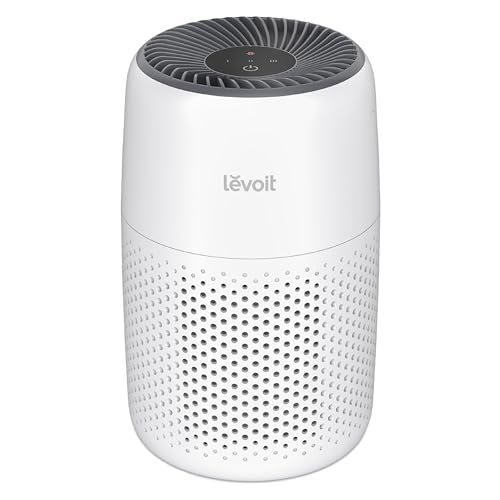
Levoit Core Mini-P, white — the nightstand citizen
Best for dorms, desks and bedside posts in small rooms
The white listing’s machine: compact true-HEPA desktop purification with the line’s fragrance sponge, sized for the personal parish and priced for a student’s budget or a second-machine purchase. On a nightstand it works the pillow’s bubble through the night at a voice the sleeper’s own breathing covers; on a desk it holds the keyboard’s air against the office’s or the dormitory’s shared weather. Its filter is a small cartridge on a small rhythm — the parish’s toll is proportioned to the parish, which is the Mini’s quiet economic argument.
- Model: Core Mini-P, white
- Role: personal-space desktop purifier
- Feature: fragrance sponge for essential oils
- Placement: nightstand, desk, shelf
- Filter: compact cartridge
Strengths
- The right size for the posts it serves — no exile to the floor.
- Whisper economics: small toll, small voice, small footprint.
- The fragrance option for households that scent deliberately.
Trade-offs
- A bubble, not a room: the border is real and near.
- No app, no sensor — a conducted miniature.
- Whole-room buyers will outgrow it in a week.
Best for: single occupants of small rooms. Not suited for: family rooms, shared bedrooms at distance, whole-flat hopes.

Levoit Core Mini-P, black — the desk’s coat
Best for workstations and dark-finished rooms
The same machine in black, for the posts where white reads as an appliance’s apology: the studio desk, the media shelf, the teenager’s room where everything is black on principle. The review lists it separately because the colourway is a separate listing with its own image and ASIN — and because, in the personal parish, the eye’s vote is legitimate: a machine that matches its post stays on its post, and a Mini exiled for its colour cleans nothing at all.
- Model: Core Mini-P, black
- Role: personal-space desktop purifier
- Feature: fragrance sponge for essential oils
- Placement: desk, media shelf, bedside
- Filter: compact cartridge
Strengths
- Identical service in the desk’s preferred coat.
- Disappears against dark furniture and equipment.
- The same small toll and voice as its sibling.
Trade-offs
- Shows dust on its shoulders sooner than the white.
- The same parish border — colour changes nothing else.
- Still a conducted miniature, without smart features.
Best for: desks and dark rooms. Not suited for: the same whole-room hopes, in a darker coat.

Levoit Core 200S-P — the parish above
Best for the small bedroom that is a room, not a bubble
When the small space is a whole bedroom whose air must be served entire — two sleepers, a door that closes on the whole brief — the Mini’s doctrine ends and the 200S’s begins: verified delivery for the small room, app control, the family’s 3-in-1 filter. Its review in this cluster makes the case; here it marks the Mini’s upper border. The honest sequence for a growing household is often Mini first, for the desk or the dorm, and the 200S when the first real bedroom arrives — the Mini retiring, honourably, to the desk it was built for.
- Model: Core 200S-P
- Verification: AHAM VERIFIDE, per its listing
- Control: app, voice, schedules
- Filter: 3-in-1 with HEPA sleep mode
- Parish: small bedrooms entire
Strengths
- Verified whole-room service at the small scale.
- Smart control the Mini deliberately lacks.
- The family’s filter economy, from the first bedroom on.
Trade-offs
- Floor-standing size — no nightstand post.
- A step’s price above the Mini’s miniature economy.
- App dependency for its headline features.
Best for: small bedrooms entire. Not suited for: the desk, the nightstand, the van — the Mini’s posts.
In this guide
The dorm, the desk and the van: three posts, three verdicts
The dorm single is the Mini’s founding parish: one occupant, one bed, one desk, a door that closes on a room the size of a family’s bathroom, in a building whose shared air is a democracy of other people’s cooking and laundry. There the Mini is not a small purifier but a correctly sized one, and its fragrance sponge earns its keep against the corridor’s contributions. The desk — in a shared flat, an open office’s home corner, a teenager’s command centre — is its second post: the bubble at the keyboard, maintained through the working day at a voice below the calls’. The van and the caravan are its frontier: a personal machine for a personal volume, run from the vehicle’s own economy, where its smallness stops being a specification and becomes the whole point. Three posts, one doctrine — and a fourth post the review refuses it, the family bedroom, where two sleepers at opposite walls are a room’s brief and deserve a room’s machine.
Final word
The Core Mini is the family’s act of respect for small rooms: a real filter, a real doctrine, a miniature’s honest borders. Buy it for the bubble — the pillow, the keyboard, the reading chair — keep its little cartridge genuine and its post unexiled, and it will hold its two metres with a diligence that shames larger machines in larger rooms. Ask it for a whole room and it will fail politely; the failure will be the brief’s, not the machine’s, and this review has drawn the brief in ink.
The fragrance sponge, considered seriously
A scent feature in a purifier invites a raised eyebrow — the machine removes odours with one stage and offers to add them with another — and the Mini’s sponge deserves a fairer reading. The household that scents deliberately is not confused about air; it is distinguishing between the room’s involuntary smells, which the filter exists to retire, and a chosen note — a drop of something green or resinous on a sponge by the pillow — which is furnishing, not pollution. The sponge keeps the two economies separate: the scent never passes the filter as a load, and the filter never has to apologise for the scent. Reviewers who mock the feature have usually not lived in a dormitory corridor in February. The review’s cautions are the ordinary ones — a drop, not a dousing; nothing on the sponge that the sleeper has not already worn happily; and the comfort framing this site keeps, since scent is a preference and never a therapy.
A semester in the dorm
The Mini’s natural biography is a student’s year. September installs it on the desk that is also the dining table and the library; October teaches it the corridor’s weather, which arrives under the door in waves of other people’s dinners; November’s cold shuts the window and makes the little machine the room’s whole ventilation policy, a responsibility it discharges at a murmur. December’s exams give its bubble its finest hours — the desk’s air held at a standard while its owner’s attention is entirely elsewhere. Spring brings the window back and the pollen with it, and the Mini’s parish shrinks gratefully to the pillow. By June it has been, in succession, a ventilation system, a study aid, a nightstand citizen and a piece of home in a rented room — and it goes home in the same bag it arrived in, which no other machine in this cluster can claim. The review tells the year at length because the Mini’s specifications, read cold, undersell it: what the student bought was not a small purifier but a room of one’s own, with air to match.
The second-machine economy
A large share of Minis are bought by households that already own a real purifier, and the review should honour that economy rather than treating the Mini as a beginner’s compromise. The fleet’s flagship governs the expanse; the bedroom’s citizen holds the night; and the Mini takes the posts neither can reach — the desk in the spare room, the reading chair’s table, the teenager’s sovereign territory where a family machine would be an occupation. Priced as it is, the Mini lets a household complete its map without a fourth full toll, and its filter’s small rhythm keeps the completion cheap. The doctrine generalises beyond this family: in air, as in light, the last metre is served by small instruments placed exactly, and a house that understands its lamps usually understands the Mini on sight.
The gift economy of the Mini
No machine in the cluster is given as often as this one, and the giving is diagnostic. It is the purifier sent to the student leaving home, bought for the parent whose reading chair has a table, slipped into the spare room before the allergy-season guest arrives. Gifts succeed when they fit the recipient’s life without rearranging it, and the Mini fits like a lamp: a post exists for it in every small room, its toll is too small to be an obligation, and its service is felt the first night. The review notes the gift economy because it explains the model’s sales better than any dormitory census — and because a gift’s standard is the strictest in retail: the giver’s reputation rides on the first week. The Mini’s first weeks, in the record, are kind to reputations.
The Mini beside the candle and the plant
Every small room already has its folk air technology — the candle lit against a smell, the plant kept for the air’s sake, the window’s negotiated crack — and the Mini joins that company rather than abolishing it. The review’s counsel is composition: the plant stays for the eye, the candle retires to the table’s decoration where its soot cannot invoice the filter, and the Mini takes the actual work with the humility of a machine that knows it is the least beautiful object in the arrangement. Households that compose their small rooms this way report the folk technologies improved by the machine’s presence, because each is finally doing only the job it was good at.
Small machines and the ethics of enough
The Mini raises, in miniature, the question this site has asked at every rung: how much machine does a life actually need? The flagship answers with headroom; the Mini answers with adjacency — the clean air delivered not to the room’s average but to the person’s coordinates, where it is breathed. There are households for whom adjacency is a compromise forced by budget, and the review does not romanticise their constraint. But there is a second household, growing in the record, that chooses the Mini from sufficiency rather than from shortage: the single occupant who has measured their actual breathing geography and declined to purify the wardrobe’s air at the same rate as the pillow’s. Enough, precisely located, is not a lesser philosophy than headroom. It is headroom’s mirror — the same respect for evidence, applied at the scale of a person rather than of a floor plan — and the family’s willingness to build for it, with a real filter and an honest border, is why this little machine earns a long review in a cluster of giants.
The Mini’s owners, a small census
They are students, first, in numbers no other machine in the cluster can match — the Mini is the category’s true entry drug, bought with a loan’s first term and graduated from, years later, with genuine affection. They are readers of a certain age, whose chairs have tables and whose tables have exactly one machine-sized space left. They are vanlifers and boat-dwellers, for whom volume is the scarcest currency and the Mini’s parish is a whole dwelling. They are the grown children of the gift economy, running a machine they did not choose in a room it chose perfectly. And they are, in a share that grows yearly, the second-machine households of the previous section — completists of the map, filling its last small parishes. A census this various, united by one small machine, is the doctrine’s best evidence: the bubble is a real unit of domestic life, and the family that built for it built a citizen, not a toy.
Impeccable, within its border: a last audit
The review should close by auditing its own warmth toward a machine costing less than a family’s weekly shop. The warmth’s grounds: a real filter where rivals at the size offer gestures; a doctrine stated honestly and a border drawn in ink; a toll proportioned to its parish; and a census of owners — students, readers, dwellers in small volumes — whose testimony is the least disappointed in the whole cluster, because the machine promised them exactly what it delivers. Warmth audited on those grounds is not sentimentality but accuracy, and the review stands by it with the standing caveat that has headed every section: the border is the product. Cross it knowingly — a Mini asked to hold a bubble it can reach from a better post, a desk machine promoted to a bedside — and the machine forgives. Cross it in ignorance, asking a nightstand citizen for a living room, and no review’s warmth can save the purchase.
A letter from the top bunk
“It is the only thing in this room that is entirely mine and entirely works. The desk is the college’s, the bed is the college’s, the air was the corridor’s — now the two metres around the desk are mine, and they smell like nothing, which in this building is a luxury no one else on the floor has.” The review prints the letter because it states the doctrine better than the doctrine states itself: the Mini sells jurisdiction. In a life stage defined by shared everything — bathrooms, kitchens, laundry, air — a small machine that draws a clean border around one person’s breathing is not a gadget but a territory, and its owners defend it with a warmth that the flagship’s owners, governing their expanses, would recognise as the same feeling at the opposite scale. Scale, the whole cluster has argued, is a border question. The letter is the smallest border’s testimony, and the review rests its case on it.
The opposite scale, acknowledged
This cluster’s largest machine governs an expanse a hundred times the Mini’s parish, and the two reviews — this one and the flagship’s — were written to be consistent at the border where their parishes meet: the standard bedroom, too big for the bubble and too small for the hall, where the family’s middle citizens earn their keep. A household that owns both ends of the range owns the doctrine whole: adjacency for the person, headroom for the expanse, and the measured room for everything between. The Mini’s place in that doctrine is not the bottom of a ladder but the end of a ruler — the mark at which the unit of purification stops being the room and becomes the reader. Reviews that rank it last by delivery misunderstand the ruler; households that live by it do not, and their census, printed above, is the misunderstanding’s correction.
Sovereign, and shared: the Mini in the family flat
One last parish deserves its paragraph, because the record keeps returning to it: the child’s or teenager’s bedroom inside a family flat already served by bigger machines. The flat’s air is governed in general — the living room’s keystone sees to that — but a teenager’s room is a jurisdiction with its own foreign policy: the door closed as a matter of state, the laundry in its own economy, the window opened at hours the house’s policy forbids. A Mini on that desk is the treaty that works: the room’s bubble held to a standard without an occupying tower, the filter’s toll small enough to be a pocket-money line in the household file, and the young citizen’s sovereignty respected by a machine sized to it. Parents in the record describe the purchase in diplomatic language more often than in technical, which the review takes as the surest sign the product was understood by its maker.
Instructive, because it generalises
Every category has its Mini — the product that reveals, by its smallness, what the category is actually for. Cameras have theirs, and it taught the industry that photographs are taken by people standing somewhere, not by specifications. The Mini teaches the same lesson to air: purification happens where a person breathes, and the room is only the usual approximation of that place. A household that has understood the lesson reads the whole cluster differently — the flagships as approximations at scale, the bedroom machines as closer fits, the Mini as the limit case where the approximation and the person finally coincide. The review does not claim the limit case is the best case; most lives need the approximations, and this site’s other articles serve them faithfully. It claims only that the limit case is the honest one, and that a family willing to build it — with a real filter, at a student’s price, without a whisper of condescension — understands its own category from the inside.
The person’s coordinates, surveyed one last time
They are a pillow at midnight, a keyboard at nine, a chair at the chapter’s turn, a bunk in a corridor of other people’s dinners — and the survey’s conclusion is that a remarkable share of a life is lived inside two metres of one of them. The Mini was built for that share, and its review has been, at bottom, a survey of it: the posts, the census, the treaty, the letter from the bunk. A reader whose life is mostly elsewhere — in family rooms, in shared bedrooms, in the expanse — has the cluster’s larger citizens waiting, and this review’s redirects have been posted at every border. A reader whose life is substantially lived at a post has found, in the family’s smallest machine, the cluster’s most personal recommendation — and the review is content to end at the coordinates, where the air is already being kept.
The remaining business, transacted in miniature
Everything this review has left is small, in keeping with its subject: a filter’s name for the file, a post cleared of the lamp’s competition, a colour chosen by the room, a border respected. Miniature transactions, honestly itemised, are the Mini’s whole economy — purchase, toll, voice, footprint — and the household that transacts them knowingly will own the cluster’s most contented small machine. The review therefore resists the temptation of a grand close. Its subject would not approve of one, standing as it does at the modest end of the family’s range with its two metres held and its murmur at the level of a held breath, asking — like the best small things in any house — only to be placed exactly and left to work.
The larger requests, acknowledged from the nightstand
They are legitimate, and the Mini does not begrudge them: the whole bedroom, the family room, the expanse — each with its citizen in this cluster, each citizen’s review written from its own post as this one was written from the nightstand. A household’s map usually contains both kinds of request, the large and the personal, and the fleet that answers it will contain both kinds of machine. The review’s final satisfaction is that its subject needs no apology in that company: it is the only machine in the range whose parish a person can touch from where they sit, and there are nights — the exam’s eve, the chapter’s end, the corridor’s February — when that parish is the only one that matters.
Below, and beneath the review’s notice
The questions that follow are the small print of a small machine, and they are answered in its own scale — briefly, exactly, without the flagship’s ceremony. That scale discipline is the review’s final act of respect for its subject, and it extends to the article’s own ending, which will be the shortest in the cluster: a machine, a post, a border, a murmur. The reader who has followed the survey this far already owns the argument; what remains is the paperwork, transacted below in miniature, as promised.
Its smallest, and the survey’s true end
Small observations are this machine’s native evidence, so the review ends with three of them, unadorned. A student slept through a corridor party with the window shut and the Mini running, and woke to a room that smelled of nothing. A reader finished a long novel across a winter of evenings with the machine at the chair’s table, and cannot recall hearing it once. A van woke at a lakeside with the bubble’s air sweet and the outside’s damp held at the door. None of the three would make a flagship’s brochure. Together they are the Mini’s brochure, written by its citizens in the only tense that matters — the past, satisfied — and the review files them as its closing exhibits, confident that the reader whose life contains a post like theirs will recognise the exhibits’ weight exactly.
Filed in larger rooms, welcomed in this one
The cluster’s geography is a single map, and this review’s parish is its smallest marked territory — two metres, surveyed and defended. Readers arriving from the flagship’s review will find the doctrine consistent at the change of scale, which is the map’s integrity test; readers arriving from the listings will find the border drawn before the price is discussed, which is the review’s. Either way, the Mini asks to be judged as its citizens judge it: not by the rooms it cannot serve, but by the posts it has never once failed — the pillow, the keyboard, the chair, the bunk — and by the quiet with which it serves them, night after night, in white or in black, at a murmur beneath a held breath.
Would not trade
That refusal, collected across the census, is the review’s final data point, and it deserves its own short section because refusals are the purest form of product evidence: nobody is paid to refuse, and the Mini’s owners refuse trades upward — into bigger, smarter, dearer machines — at a rate the category’s ladder logic cannot explain until the doctrine is understood. They are not holding a compromise; they are holding a fit. The household that has never owned a fit, in any category, may find the refusal puzzling; the household that has will recognise it instantly, and will read this little machine’s long review as the cluster’s most familiar story told at its smallest scale: the right thing, in the right place, at the right size, asking nothing and keeping its word.
As small as the subject allows
And no smaller — the review has one more duty before the questions, which is to mark the Mini’s place in the household’s whole map for the reader planning a fleet: first machine for the student’s room, last machine for the completed house, and the permanent citizen of every post the towers cannot reach. Fleets planned on maps that omit the personal scale leave their occupants’ closest air to chance, and chance, in a corridor building or a shared flat, is a landlord with no maintenance budget. The Mini is the map’s smallest print, and small print — as every careful reader knows — is where the terms that matter most are usually hiding.
Read aloud, and now concluded
The review’s reading is done, and its conclusion fits its subject’s scale: a small machine, honestly bordered, exactly placed, is a complete answer to a real question — the question of the air at one person’s pillow, desk and chair. The cluster’s larger articles answer larger questions with the same honesty, and the reader whose question is large should go to them with this article’s blessing and its border ringing in their ears. The reader whose question is this one has been holding the answer since the second section. What remains is a colour, a post, a filter’s name in a file — the miniature paperwork of a miniature, transacted below.
Towers, from the nightstand’s perspective
They look, from down here, like a great deal of machine for air that mostly gets breathed in one place — and the nightstand’s perspective deserves its hearing before the review closes, because it is the perspective of the person rather than of the plan. The plan says rooms; the person says a pillow, a desk, a chair, and the long hours spent at exactly those coordinates while the rest of the room’s volume minds itself. Both perspectives are true, and the fleet that honours both is the fleet this cluster has been assembling article by article: towers for the volumes, citizens for the rooms, and this little machine for the coordinates. The review’s last word is therefore not small at all. It is the doctrine’s first principle, learned at its smallest scale: purify where the breathing happens, and let the architecture argue for anything larger.
Recognised as the answer
Recognition is the right word for the Mini’s purchases, which rarely follow comparisons and usually follow a night spent in its parish without it — the corridor’s February, the hotel’s strange air, the desk’s dusty afternoon — after which the little machine’s arrival feels less like shopping than like repatriation. Reviews can prepare a recognition; they cannot manufacture one, and this one has contented itself with the preparation: the doctrine stated, the border inked, the posts surveyed, the census taken. The recognition, when it comes to the reader as it came to the census, will need none of the article’s length. It will need a nightstand, a socket, and two metres of air that are about to become somebody’s jurisdiction.
Withdraws, at a murmur
The review’s withdrawal should be as quiet as its subject’s working voice, and it is: no peroration, no crown, only the file closed over a small machine that was promised a border and kept it. Somewhere tonight the census gains another citizen — a bunk, a desk, a chair — and the corridor’s weather stops at a door that a two-metre jurisdiction has finally learned to hold. The article’s author, filing it, notes the cluster’s smallest review has also been its most personal, and suspects the subject would consider that a specification met.
Written small, filed complete
The file is complete when the reader can answer, without the article, the only questions this purchase contains: Is my need a bubble or a room? Is my post a nightstand, a desk or a chair? Do I want the coat in white or in black? Three questions, two metres, one machine — the cluster’s smallest decision, and the one its author would defend as its purest, because nothing in it is decoration. The flagship decisions have their glamour and their five rounds; this one has a pillow and a murmur, and the review — closing the smallest file in the cluster with a satisfaction out of all proportion to its size — finds the proportion exactly right.
Remain, and are answered below
The questions, in the miniature’s own brief type, and then the links — the review’s author having learned, from a semester spent in its subject’s company, that the correct way to end a small machine’s long review is simply to stop, mid-murmur, with the post staffed and the border held and the nightstand’s small geography at peace.
Enough, as a closing exhibit
The word has followed this machine through the whole review, and the review ends by exhibiting it in its purest form: a single occupant, a single post, a single small machine, and an evening in which nothing is missing. Enough is not the enemy of excellence in the record’s testimony; it is excellence’s address, at the scale where one person breathes. The flagship articles will go on arguing for headroom, and they will be right in their parishes. This one argues for the pillow’s two metres, and it is right in its — and the family’s range, holding both arguments without contradiction, is the real subject the cluster has been reviewing all along.
Frequently asked questions
What can the Core Mini realistically do on a desk?
It freshens the breathing zone of the person sitting at that desk — the metre of air around a keyboard, a reading chair or a bedside table — and that honest, small promise is the product. Dust motes drifting through a lamp beam thin out, a stale desk corner smells less close, and the fragrance sponge can scent the immediate workspace when the owner wants it to. It will not govern the whole room’s air changes, protect a second person across the office, or substitute for a bedroom machine overnight. Buyers who measure it against its jurisdiction are delighted; buyers who secretly wanted a Core 300 at a Mini’s footprint and price are the disappointed reviewers. Keep the desk promise in view and it keeps its word.
How does the Mini’s fragrance sponge change how it should be used?
It makes the Mini part purifier, part scent diffuser, and the two roles want different handling. A few drops on the sponge perfume the discharge gently for the desk’s occupant; overdoing the oil saturates the pad, overwhelms a small room and can leave residue that the next scent inherits, muddying both. Scent loads also belong to leisure hours — a fragranced stream during a video call or in a shared office imposes the owner’s taste on colleagues’ air. Rotate or rest the sponge, keep oils away from the filter itself, and remember the fragrance is decoration on the filtration, never a measure of it: a sweet-smelling desk can still sit in an unfiltered room, which is why the Mini’s honest brief stays personal-scale. A Mini that travels between a weekday desk and a weekend caravan shelf shows the brief at its best: personal air, personally carried, with no pretence beyond the seat it serves.
What size room can the Core Mini actually handle?
Honestly: a very small one, treated as a bubble with walls — the dorm single, the box room, the van. Its doctrine is the personal parish, and in a standard bedroom it will hold the pillow’s neighbourhood while the far corners keep their own weather. Buyers who need the whole bedroom should read the 200S’s review in this cluster; buyers whose need is genuinely local have found their machine.
Is it quiet enough for a nightstand?
That is its founding post: at its night setting its voice sits below the sleeper’s own breathing, and its smallness means the nightstand’s geography — lamp, book, water — survives its arrival. Site it with its outlet unblocked by the pillow’s fortifications and it will do the night shift without ever being mentioned in the morning.
How often does its filter change?
On its indicator’s rhythm, which in a small room’s light service is a generous one — the parish’s toll is proportioned to the parish. Keep the little cartridge’s name in the household file, buy the genuine article, and treat the change as the two-minute rite it is rather than the furniture-moving expedition of the flagship class.
Can I use essential oils in it?
Yes — that is the fragrance sponge’s whole purpose: a drop on the sponge, never in the airflow’s machinery and never doused. Households divided on scent can run the sponge dry, at which point the Mini is simply a purifier and the feature costs nothing. The review’s comfort framing applies: scent is furnishing, chosen and personal, and the machine treats it with exactly that seriousness.
Core Mini or LV-H128 for a desk?
The LV-H128, reviewed elsewhere in this cluster, is the family’s other desktop citizen, with its own aroma pad and a slightly different presence. The Mini is the Core line’s miniature, with the line’s filter kinship; the H128 is the desktop line’s own design. Desks should choose by the eye and the toll; both hold a bubble honestly, and neither pretends to a room.
Is it good for a baby’s room?
For the nightstand post beside the feeding chair, in a small nursery, it is a reasonable citizen — with the site’s standing cautions: cords and placement beyond the climbing geography, scent run dry unless the household is certain, and no medical framing of any kind. A nursery that is a full bedroom deserves the 200S’s whole-room service instead.
Does it work in a home office?
At the desk’s post, yes — the bubble at the keyboard through the working day, at a voice the calls never notice. An office that is a whole room with a door and a second chair is a small bedroom in disguise and should buy the 200S; an office that is a corner of somewhere else is the Mini’s exact parish.
Can it travel?
It is the family’s natural traveller: bag-sized, undemanding, at home on a hotel nightstand or a relative’s spare-room desk for the allergy-season visit. Households that travel to the same places repeatedly sometimes leave one at each end of the journey — an economy only a machine at this price and size makes sane.
White or black?
The room decides, as the pick blocks argued: white for the nightstand and the pale dorm, black for the desk and the media shelf. The service is identical, the dust shows sooner on the black’s shoulders, and the eye’s vote — in a parish this personal — is a legitimate specification rather than a vanity.
What is this review’s one-line verdict?
The family’s respect for small rooms, in a machine the size of the respect: a real filter for the pillow, the keyboard and the reading chair, at a miniature’s price and toll. Buy it for the bubble, and it will not disappoint; buy it for a room, and the disappointment was ordered with it.
A note on the Mini in a smoker’s room
This cluster treats that room elsewhere and at length; here it is enough to say the Mini is the machine that article’s readers most often already own — a bubble’s defence at the desk or the bedside, with the fragrance sponge run on the household’s own judgement. The linked guide carries the full protocol and the honesty about limits that the topic deserves.
Envoi
The review leaves the little machine where it found it: on a nightstand, between a lamp and a glass of water, holding two metres of air at a standard the whole street’s machines could envy — small, exact, and entirely sufficient to its parish.
The wardrobe’s air
Can look after itself — the review’s smallest joke and its most serious sentence, since the Mini’s whole doctrine is the refusal to spend a household’s money where the household does not breathe.
Colophon
Written from the two listings’ facts and the miniature’s ownership record, at a length its subject’s owners — students, readers, nightstand citizens — would recognise as the respect small rooms are rarely paid by anyone, including, until now, this site.
A citizen, not a toy
The census has spoken, and the review adopts its verdict as its own — adding only the border, drawn once more for the listing-bound: the bubble, honestly held, and the whole room honestly declined.
Signature
The little review signs from the nightstand, in the space between the lamp and the water glass, where its subject has stood all along.
Appendix: the specification that matters
For the listing-bound reader: a compact desktop purifier in white or black, a fragrance sponge, a compact genuine cartridge, and a parish of two metres around a person. Everything else in this review is those facts’ life in the dorm, at the desk and beside the pillow — the three posts where the family’s smallest citizen earns its keep.
Finis
Buy it for the bubble, site it where the person is, and let the room’s far corners make their own arrangements. The Mini’s arrangements, within its border, will be impeccable.
The border is the product
For the last time in this review — and the reader who has absorbed it owns the only specification that decides this purchase, in either direction, correctly.
Jurisdiction
Two metres of it, held nightly — the smallest claim in this cluster and, for its citizens, the most fiercely sufficient. The links below govern larger territories.
The ruler’s end
Is where this review stops — at the person’s coordinates, with the little machine running and the corridor’s weather held at the door of a very small, very sovereign room.
The treaty that works
Is renewed nightly at a murmur, in rooms whose diplomacy bigger machines would only complicate — the review’s last parish, and its smallest, and in its way its most instructive.
From the inside
The category, the doctrine and the little machine — understood. The review leaves the reader at the person’s coordinates, which is where its subject has been working all along.
Already being kept
The air at the post, by the machine sized to it — the review’s last report, filed from the nightstand, where the questions below are the only remaining business.
Placed exactly, left to work
The little machine’s whole request, and the review’s whole advice, in six words each. The links below are for the larger requests.
The only one that matters
On those nights, in those two metres — and the review, its survey complete, leaves the machine to them and the reader to the questions below.
In miniature, as promised
The paperwork, the article and the machine all keep the same scale — which is the review’s last observation, and its smallest.
Exactly
The weight of three quiet nights — the review rests on them, and the links below stand ready for the reader whose exhibits will be filed in larger rooms.
Beneath a held breath
The murmur, the parish and the review all end at that volume — the smallest in the cluster, and the one its citizens would not trade for any flagship’s roar.
Keeping its word
Is the cluster’s whole standard, met here at the smallest scale it is ever asked at — the review’s closing entry, filed from the nightstand in a hand as small as the subject allows.
The terms that matter
Were in the small print all along: the post, the border, the murmur, the fit. The review has merely read them aloud, at the length they deserved.
Transacted below
The paperwork of a miniature, in a miniature’s type — and then the links, for the households whose paperwork runs to towers.
Where the breathing happens
Is the review’s final address for its reader — a pillow, a keyboard, a chair’s pool of light — and the machine is already there, in both its colours, waiting to be recognised as the answer.
Somebody’s jurisdiction
By tonight, if the recognition has done its work — and the review, its preparation complete, withdraws to the paperwork and the links.
A specification met
Personal, exact, sufficient — the file’s last line, written small, as the subject would have wanted everything about it written.
Exactly right
The proportion, the parish and the purchase — the review’s final entry, after which only the questions and the family’s larger maps remain.
At peace
The nightstand, the parish and the review — the last three words of the argument being the machine’s own: small, exact, enough.
All along
The range, the doctrine and the reader’s own coordinates — the review’s last line, in miniature.