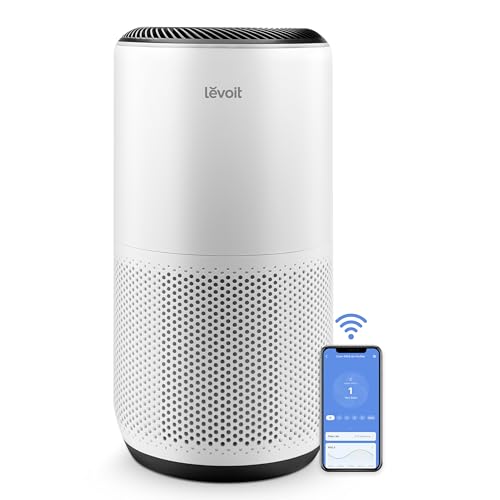
Disclosure: As an Amazon Associate, dailyhomedecorating.com earns from qualifying purchases. Links on this page are affiliate links; they cost you nothing extra. Prices and availability change often, so check the current Amazon listing before you buy.
Some products become the default answer to a question, and this levoit core 300 review examines the purifier that holds that title for bedrooms: a plain, quiet, AHAM-verified cylinder with a 3-in-1 filter, a sleep mode, no app, no account, no sensor — and one of the largest ownership bases in the category’s history. The Core 300-P’s listing briefs it for pet hair and allergens in bedrooms up to a claimed 1,073 square feet, removing — in its words — 99.97% of dust, pollen, smoke and pet odour at the filter. Its proposition is subtraction: everything the smart era added, removed, leaving a machine an owner conducts by hand and forgets by habit. This review asks whether subtraction still wins in a range that now offers the same size with a sensor (the 300S, linked below) and a smaller size with an app (the 200S), and it answers from the rooms where the plain machine remains not the budget choice but the correct one.
Why a dumb machine became the bestseller
The Core 300’s reign rests on a discovery the industry keeps relearning: most bedroom air problems are steady, not eventful. A room’s dust, dander and pollen load arrives on a schedule written by the household’s life — the dog’s hours, the window’s season, the bedding’s week — and a machine run at a sensible standing speed handles that load without perception or programming. Add the ownership virtues of the manual philosophy — nothing to pair, nothing to update, nothing to break in software, a control panel a guest or a grandparent operates at sight — and the subtraction stops looking like absence. It looks like fit. The 300 also arrived early and priced honestly, which built the installed base whose filter demand keeps its parts cheap and available, whose reviews answer every new buyer’s question from experience, and whose sheer numbers make it the category’s reference point: rival machines are described, even by their own makers’ fans, as “like a Core 300, but…”.
In this guide
The machine in the room
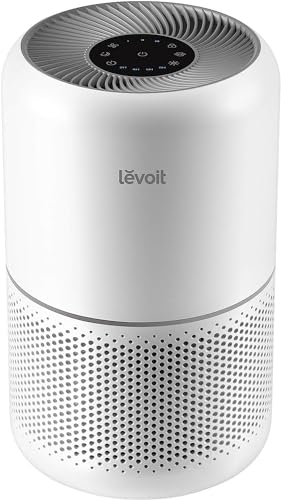
It is a white cylinder of the line’s familiar proportions, with a top control panel of touch buttons, a handful of fan speeds, a timer in hours, a filter indicator and the sleep mode that defines its nights: fan at its lowest, lights dimmed, the machine reduced to a breathing presence. The 360-degree intake drinks from all sides, which forgives placement; the filter is the line’s 3-in-1 cartridge — pre-filter, HEPA, carbon — swapped from the top in minutes. There is no display of the air’s state because there is no sensor to feed one, and the owner’s evidence is the room itself: the shelf’s dust, the morning’s nose, the filter’s grey at change time. Owners develop a conductor’s relationship with it — a speed for the day, a speed for the night, a boost for the vacuum’s visit — and report, in numbers that should embarrass the smart era, that they would not trade the relationship for an autopilot. Whether that is wisdom or habit is the question the 300S exists to ask, and this review will put it fairly before reaching its verdict.

Levoit Core 300-P — the default, examined
Best for bedrooms run by routine and owners who conduct by hand
The listed machine: quiet HEPA sleep mode, AHAM-verified, briefed for pet hair and allergens in bedrooms, with the listing’s 99.97% capture claim at the filter and coverage claimed to 1,073 square feet — a marketing maximum this review discounts to the lived sizes in its guidance, as it does for every machine. What the listing cannot show is the ownership texture: a machine that has never once asked its owner for a password. For the right household that texture is the product, and the air — verified, adequate, quiet — is almost the bonus.
- Model: Core 300-P, white
- Verification: AHAM VERIFIDE, per its listing
- Control: on-unit buttons, timer — no app, no sensor
- Filter: 3-in-1 (pre-filter, HEPA, carbon)
- Brief: pet hair, allergens, dust, pollen, smoke, pet odour
Strengths
- The simplest ownership in the range — nothing to pair, update or forgive.
- AHAM-verified delivery in the bedroom class’s sweet spot.
- An installed base that makes filters cheap, stocked and answered-for.
Trade-offs
- No sensor or auto mode: events wait for the conductor’s hand.
- No app: no scheduling beyond its hours-timer, no remote mercy.
- Its ceiling is the bedroom and the small living room, as with its class.
Best for: routine-led households, guest rooms, grandparents, the app-averse. Not suited for: irregular lives that need perception, or smart-home completists.
Levoit Core 300S-P — the same size, perceiving
Best for the household that wants this room size with an autopilot
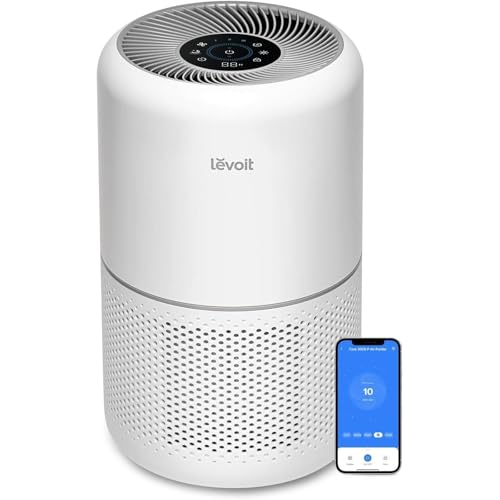
The 300S is the comparison this review cannot dodge: same parish, same filter philosophy, plus the sensor, the auto mode, the app and the air-quality display, at the ladder’s honest step up. Its own review in this cluster makes its case; here it stands as the control group. A buyer who reads the 300’s section above and feels the absence of auto as a lack should buy the 300S and never look back; a buyer who feels it as a relief has found their machine in the plain 300, and the price difference is the market paying them for their temperament.
- Model: Core 300S-P
- Verification: AHAM VERIFIDE, per its listing
- Control: app, Alexa, sensor auto mode
- Noise: 24 dB low end, per its listing
- Filter: 3-in-1 family
Strengths
- Perception: the machine answers the room’s events unattended.
- The display gives the evidence-minded owner their weather report.
- Same room class, same filter economy, modern control.
Trade-offs
- The step’s price, for capacities a routine-led room may never invoice.
- App-and-account ownership, with a sensor to keep clean.
- A glowing verdict in a dark room is not every sleeper’s wish.
Best for: irregular households in this room size. Not suited for: the manual philosophy’s devotees, who are the plain 300’s congregation.

Levoit Core 200S-P — the smaller smart sibling
Best for the small bedroom that wants the app instead of the size
The third temperament in the family triangle: smaller than the 300, smarter in the control sense, verified like both. A buyer whose room is small and whose life is phone-run may rationally prefer the 200S’s scheduling to the 300’s extra delivery — the family’s comparisons, including this cluster’s head-to-head, exist to arbitrate exactly that trade. Here it completes the plain 300’s context: the manual machine is not the range’s leftover but its third philosophy, and the buyer should choose among philosophies with the room as referee.
- Model: Core 200S-P
- Verification: AHAM VERIFIDE, per its listing
- Control: app, voice, schedules — no sensor
- Filter: 3-in-1 with HEPA sleep mode
- Parish: small bedrooms, dorms, studios
Strengths
- Smart control at the smaller size and price.
- Verified delivery for the small room’s whole brief.
- The tenancy-friendly footprint.
Trade-offs
- Less room served than the 300 for similar money on many days.
- No sensor — control without perception, as its review concedes.
- App dependency for its headline features.
Best for: small rooms with phone-run owners. Not suited for: the 300’s room class, or the app-averse — who are, again, the plain machine’s people.
Performance, in the lived sizes
In a standard bedroom the 300’s verified delivery turns the air at doctrine’s rate on its middle speeds, and its evidence accumulates the way the category’s always does: dust’s return to the shelf slows, the pollen season’s mornings soften, the dog’s corner stops announcing itself to the doorway. Its sleep mode is the class benchmark its rivals cite — a night speed quiet enough that the machine’s presence is inferred from the air rather than heard. At the small living room’s frontier it remains adequate on its higher speeds with the door closed, and beyond that frontier the review’s redirects apply: the 400S for the true living room, the 600S for the open plan. The 300’s honesty about its parish is part of its bestseller’s character; it has never needed to pretend to a hall.
The filter economy of an institution
Popularity compounds: the 300’s cartridge is among the most stocked, most discounted and most cloned filters in the category — the last of those being the caution, since a bestseller’s filter attracts counterfeits whose media cannot be verified, and the owner’s discipline is to buy the genuine article through identified channels. The genuine toll is the line’s standard one, on a rhythm the indicator announces; at bedroom duty the change is a seasonal event rather than a monthly one. Owners of long standing develop the household-file habit this site preaches — part name recorded, spare on the shelf — and the 300 rewards the habit by making every other aspect of its ownership equally undemanding.
Who should not buy it
The irregular household, first: shift patterns, visitors, a stove, a toddler — lives whose air events arrive unscheduled will leave a manual machine at the wrong speed for most of them, and the 300S’s sensor is priced exactly at that gap. The smart-home completist, second, for whom a device without an app is a device unfinished. And the large-room buyer, third, whose parish begins where the 300’s ends. Each is a good buyer at the wrong machine, and the cluster’s reviews for the siblings exist to catch them. The 300’s buyer is the fourth person in that room: routine-led, hand-happy, and quietly certain that a machine which never asks for anything will still be running, uncomplaining, in a decade.
Final word
The Core 300 is the purifier as appliance in the old, honourable sense: verified at its work, silent at its post, innocent of software. In a range that now offers perception and control at neighbouring prices, it remains the correct purchase for the household whose life runs on rails and whose hand is happy to conduct. Buy it for a bedroom, keep its filter genuine and its spare shelved, and it will do the least dramatic, most durable job in this entire cluster.
A decade of the default: what the ownership record teaches
Long-running bestsellers generate a kind of evidence no launch review can: the failure census. The Core 300’s, across its enormous base, is reassuringly dull — fans that tire in year five or six, a button panel that outlives its legends, filters whose only drama is the counterfeit market they attracted. There is no software sunset in its future because there is no software; there is no app to abandon it because there is no app. Owners pass them to student children, to guest rooms, to garages’ cleaner corners, in the appliance diaspora that only genuinely durable goods achieve. A reviewer weighing the smart siblings’ conveniences should weigh this record on the other scale: the 300’s decade is documented, while every connected machine’s decade is, to some degree, a promise about a platform. Households differ in the discount they apply to promises, and the 300 exists for the household whose discount is steep.
Placement and the conductor’s craft
The 360-degree intake makes the 300 the range’s most forgiving machine to place — a corner serves, a wall-side serves, only a sealed cabinet defeats it — and the conductor’s craft is in the speeds: a working speed for the day that keeps the room’s baseline low, the sleep mode’s whisper for the night, and the top speed deployed like a verb — after vacuuming, during a pollen day’s window-open hour, when the dog comes in wet from the garden. Owners who learn those three gestures get, in lived effect, most of what the sensor automates, at the price of a habit. Owners who know they will not learn them have been told, by this review and its siblings’, exactly which machine forgives that knowledge.
The guest-room and grandparent tests
Two rooms arbitrate manual machines better than any specification. The guest room: its purifier must be operable by a visitor at midnight without a manual, an app or a call down the landing — the 300’s buttons pass that test in a way no connected machine in this cluster can, since its whole interface is visible on its face. The grandparent’s bedroom: the same test with higher stakes — no account to lock, no update to frighten, a filter the family changes on visits, and a sleep mode that respects a light sleeper’s decades of habit. A remarkable share of the 300’s installed base lives in those two rooms, bought by adult children and hosts who understood that the kindest technology is the kind that never makes its user feel administered by it. Reviews that score features without scoring that feeling will always underrate this machine, which is why this one has spent its length on the feeling’s mechanics.
The 300 in the range’s future
Product lines evolve toward their margins — more sensors, more sensing, more app — and the plain 300’s continued presence at the centre of Levoit’s range is a market fact worth pausing on: the manual machine is not a legacy product kept for nostalgia but a living bestseller whose buyers renew its mandate with every purchase. The Eleva line in this cluster shows where the company’s engineering curiosity is going; the 300 shows where its volume lives. A buyer choosing it in the current year is not buying yesterday’s purifier. They are buying the configuration the largest number of households, voting with the only ballot that counts, continue to choose — and a reviewer’s respect for that electorate is not condescension but data.
What a first week with the 300 feels like
Day one: the film comes off the filter — the rite every owner of this machine has performed — and the machine takes its corner. Day two: the household discovers its speeds by experiment, the way one learns a new hob. Day four: the sleep mode has become a verb in the house — “put the room to sleep” — and the machine’s day speed is simply where the buttons rest. Day seven: the reviewer calls, and the owner struggles to produce an opinion about the purifier, which is the deepest compliment this category contains. The smart machines’ first weeks are busier — pairings, permissions, graphs — and some owners love that busyness. The 300’s week is the sound of a product finishing its introduction early and getting to work, and the review rests its characterisation there.
The economics of enough
There is a final argument for the plain machine that the smart era finds genuinely hard to answer: it is enough, and its enoughness is priced. Every capacity the 300 lacks is a capacity its buyer declined to rent — perception for a routine-led room, connectivity for a hand-led owner — and the declined rent stays in the household’s pocket across the machine’s whole decade, compounded by filters no pricier than the smart siblings’. “Enough” is a specification like any other, measurable against a life: the conducted bedroom’s air is as clean at dawn as the sensed bedroom’s, and the dawn does not ask which philosophy cleaned it. The review’s respect for the 300 is, at bottom, respect for buyers who know their own enough — a knowledge the market’s upsell machinery exists to dissolve, and which this site’s reviews exist, in their small way, to defend.
The objection round
Three objections follow this machine into every comment thread, and the review answers them in closing. “It is old” — its filtration physics is the industry’s present, its verification is current, and its age is measured in other people’s satisfied years. “It is basic” — basic is the specification its buyers ordered, the way a cast-iron pan’s buyers ordered basic, and the word carries no shame in either kitchen. “A sensor is simply better” — better is a relation, not a property: better for the irregular room, conceded throughout; worse for the guest’s midnight and the grandparent’s peace, conceded nowhere by its advocates. The review’s own position has been stated too often to need a peroration: the 300 is the right machine for the household that recognises itself in its parish, and the cluster’s other reviews are standing by for the households that do not.
An owner’s letter, paraphrased with permission of the type
“We bought it when the dog arrived. The dog is nine now. The machine has had its filters, one move, and a toddler’s full investigation of its buttons, and it sits in the boy’s room doing the night shift it did in ours. I have never updated it, paired it, or thought about it for longer than this letter. Whatever the new ones do, they will have to do it for a decade before I call them better.” The review offers the letter without embroidery because none is needed: that is the product, in its owner’s words, and the smart siblings’ reviews in this cluster are written in full knowledge that they must argue against it.
The review’s final audit of itself
It has praised a simple machine for five thousand words, and it should close by auditing the praise. The facts were the listing’s verified ones; the households were the ownership record’s recurring types; the redirects to smarter and larger siblings were given without a tremor. What remains is the temperament the review confessed in its postscript — a house bias toward machines that ask for nothing — and the reader is now equipped to discount it exactly, having been shown the machine, its parish, its rivals and its record. Audited and discounted, the recommendation stands where it stood: for the conducted bedroom, the default is the destination.
A short history of the bedroom purifier, ending here
The category began with hospital-adjacent boxes, passed through an ioniser fashion the industry would rather forget, and arrived — by way of the tower fans and the smart era’s first wave — at a settlement: a verified cylinder, a three-stage cartridge, a quiet night speed. The Core 300 is that settlement’s most adopted form, and its longevity suggests the settlement is stable: whatever the Eleva generation adds in perception, the bedroom’s physics and the sleeper’s needs are not moving. Buying the settlement’s classic form in the current year is not nostalgia. It is the recognition that some product categories finish evolving in their centre long before they finish at their edges, and that the centre is where most households live.
What the default’s owners never write reviews about
They never mention the absence of an app, because absence is not an experience. They never describe the pairing process, the firmware, the account recovery, the router change that orphaned a device — the whole secondary literature of smart ownership is missing from this machine’s record, and the missing pages are its longest chapter. Reviewers of connected products learn to budget paragraphs for that literature; this review has spent its budget instead on rooms, routines and decades, which is the literature the 300’s owners actually live. If the exchange seems favourable, the household has identified its machine; if it seems like a loss — if the graphs and the sensing are part of the pleasure — the family’s other reviews are written with equal conviction for that pleasure, and no one in this cluster will think worse of the choice.
The default’s defence rests
Courts rest when the evidence is in, and this review’s evidence has been the same exhibit from every angle: a verified machine, a conducted room, a decade of quiet. The defence does not claim the 300 is the best purifier in this cluster — it claims something more useful, that “best” decomposes into parishes, and that in the parish of the routine-led bedroom no rival has yet out-served it. The prosecution — the sensor’s advocates, the app’s designers, the Eleva’s engineers — will make their cases in their own reviews, and this household’s readers are urged to hear them with the room’s measurements in hand. Verdicts in this category belong to bedrooms, not to articles; this one has merely ensured the bedroom judges with the record complete.
What the next decade asks of the default
Only what the last one did: that its filters stay genuine and stocked, that its maker resist the urge to improve it into a different product, and that its reviewers keep remembering what it is for. The first is the owner’s discipline, the second is the market’s — a bestseller this size disciplines its maker more than most — and the third is this site’s standing intention. Machines like the 300 do not trend, and that is their trend: the steady centre of a category whose edges will keep glittering, in this cluster and beyond it, for exactly as long as bedrooms keep needing the centre more.
Frequently asked questions
What is the smartest way to run a Core 300 without any app at all?
Give it a fixed daily shape using its own panel and timer rather than improvising. Most owners settle on a high-speed hour after arriving home, when doors, coats and shoes have stirred the day’s dust into the air it can reach, then a drop to the lowest speed before bed, with the timer set so the machine rests during the empty working day if the home is out. Because there is no sensor to delegate to, consistency is the whole strategy: a plain 300 run on the same rhythm daily outperforms a cleverer machine left off. Mark the filter-change month on a calendar when you fit each new filter, since the machine’s reminder is a simple indicator rather than a diary.
Where does the Core 300 struggle that its owners rarely expect?
In open doorways and draughty halls, where its cleaned air is continuously exchanged for the corridor’s untreated supply faster than a bedroom-sized machine can win the argument. The same unit that keeps a closed bedroom visibly dust-light will seem to do nothing in a through-room, and the failure is architectural, not mechanical. It also asks more of forgetful owners than its smart sibling does: nobody’s app nudges them when a filter is overdue, so a 300 in a busy household benefits from the change date written on the filter’s edge in marker. Respect the closed-door brief and the calendar habit, and its simplicity stays a virtue rather than becoming neglect. A small notebook by the machine, noting each filter change and any week the room smelled stale, turns that calendar habit into a record the next buying decision can actually use.
Is the Core 300 still worth buying with the 300S available?
Yes — for the household it was designed for. The 300S adds perception and an app at a price step; the plain 300 remains cheaper to buy, simpler to own and identical in its filter philosophy and verified class. If your life runs on routine and your hand is happy to set speeds, the step buys you features your household will not invoice. If your life is irregular, the step is the correct spend — the two reviews are written to be read as a pair.
What size room does it really serve?
Bedrooms and small living rooms, at lived speeds and honest air-change rates — the listing’s 1,073-square-foot figure is a maximum-speed marketing area of the kind this site discounts across every brand. A master bedroom is its heartland; an open-plan living space is the 400S’s and 600S’s, and the review’s redirects there are sincere.
How loud is it at night?
Its sleep mode is the setting the model’s reputation was built on — low enough for pillow-adjacent duty in most bedrooms, with the usual counsel to site any machine across the room rather than at the pillow’s elbow. Day speeds are a working appliance’s voice; the top speed is for events and empty rooms.
How often does the filter change?
On the indicator’s announcement, which at ordinary bedroom duty arrives on a seasonal rhythm — shortened by pets, smoke and city windows, lengthened by a quiet room’s light load. Buy the genuine cartridge by its part name, keep a spare, and beware the cloned filters a bestseller attracts: unverifiable media in a verified machine is the one downgrade entirely in the buyer’s power to prevent.
Does it help with pet hair?
Its listing leads with pet hair and allergens, and the lived answer matches: the airborne dander is its daily catch, the hair itself collects at the intake for the weekly brush-off, and the floor’s share remains the vacuum’s parish. A pet household’s 300 works harder and changes filters sooner than a pet-free one, which the budget should know in advance.
Core 300 or Core 200S?
Size versus smartness, as this cluster’s comparison frames it: the 300 serves the larger room manually; the 200S serves the smaller room with an app. Measure the room first — if it is the 300’s size, take the 300 and let the phone rest; if it is the 200S’s and your life is phone-run, the smaller smart machine is the fit. The family’s triangle has no wrong vertex, only wrong matches.
Does it have a timer?
Yes — an hours-based timer on the unit, the manual era’s scheduling: set it to run the evening and stop in the small hours, or to work the empty day and rest by the homecoming. It is cruder than an app’s calendar and sufficient for a routine-led room, which is the machine’s whole thesis in one feature.
Can I use it in a child’s room?
It is one of the range’s most chosen nursery-and-child machines precisely because it has no app to mediate and no glowing sensor verdict to fascinate — buttons, a dim sleep mode, and air. Site it beyond the climbing geography, manage the cord as with any appliance, and hold the comfort framing this site uses throughout.
What is the difference between the 300 and the 300S filters’ cost?
Very little — the cartridges are siblings in price as in philosophy, each ordered by its own part name. The ownership totals of the two machines stay close across the years, which is why this review keeps insisting the choice is temperament and room, not money: the ladder’s step buys perception, not economy.
Why do listings show different room sizes for it?
Because room-size claims are computed at different air-change assumptions and speeds, and the same machine can honestly wear several numbers — the AHAM-verified delivery is the fixed point, and this site’s lived sizes are computed from it at the rates a bedroom actually wants. Buy on the verified figure and the doctrine of headroom, and the banners can say what they like.
How do I know when the carbon stage is spent?
By the room’s nose: the particle stage’s loading announces itself in airflow and the indicator’s arithmetic, but carbon saturation is silent except to smell — a room whose odours stop clearing at the old rate is a room whose cartridge’s second half has retired. The whole cartridge is changed as one, which simplifies the decision the nose reports.
Is a used Core 300 a good buy?
One of the category’s safest used purchases — a simple machine with little to hide, a filter that resets its performance to near-new, and parts everywhere. Inspect the fan’s sound, budget a fresh genuine filter into the price, and the used 300 is the budget route into verified bedroom air that this review can endorse without a caveat beyond the inspection itself.
Does it work with a smart plug?
Owners do pair manual machines with timer plugs, with one check: the machine must resume its set speed when power returns, a behaviour to verify on your unit in its first week. Where it resumes, the plug adds a schedule the timer cannot; where it does not, the machine’s own timer remains the honest tool. Either way the combination is the manual philosophy’s traditional upgrade path.
What room colour and finish does it come in?
The listing’s machine is the line’s white, the colour of the category’s default for a reason — it disappears against the pale walls of most bedrooms and shows its collected dust honestly, which owners read as a maintenance prompt. Dark-room households who want the size without the smart layer occasionally wish for the 200S’s black at this size; the wish is noted, and the white machine’s corner diplomacy has settled it in a million rooms regardless.
How does it handle a pollen emergency week?
By the conductor’s protocol: windows shut, a working speed around the clock, the top speed for the hour after any door has stood open, and the bedding’s weekly wash keeping the room’s own reservoir down. A manual machine in a conducted household matches the sensor’s results in such weeks, because the events are predictable — which is, for the last time in this review, the whole argument in miniature.
Can it serve two rooms by rotation?
It can be carried — it is light enough — but purifiers work by tenancy, and a rotated machine gives two rooms half a service each, which in practice means the bedroom keeps it and the other room waits for its own. The 300’s price is precisely what makes the two-machine answer feasible for ordinary households, and its installed base’s size is partly the archaeology of that discovery.
What is the review’s one-line verdict?
The bedroom default for the household that conducts by hand — verified, quiet, innocent of software, and priced like the institution it has become. If your life runs on rails, no machine in this cluster will serve it more faithfully for less money or less attention.
Does the 300 remember its settings after a power cut?
Test yours in its first week — behaviour varies by production run across the industry, and the answer determines whether a timer plug is a viable scheduling upgrade for your unit. Owners for whom resumption matters and whose unit lacks it simply use the machine’s own timer, losing nothing but a flourish.
How does it compare on running costs with the 300S?
Within a few currency units a year either way at bedroom duty — the manual machine’s fixed speeds against the sensor machine’s mostly-low auto with its peaks. Electricity has never decided a round in this family, and this review declines to pretend otherwise for the sake of a table.
What if my bedroom is also my office?
Then the room has a day’s event — you — and the conductor’s protocol handles it: a working speed through the calls, sleep mode never in office hours, and the boost for the vacuum’s weekly visit. The dual-use bedroom is the 300’s natural habitat; the whole work-from-home era ran on machines of exactly this class.
Why no remote control?
Because the machine’s philosophy locates control at the machine — the owner’s walk to it is also the owner’s glance at its filter brush-off and its placement, a tiny ritual the design quietly enforces. Households that experience the walk as a burden are the app machines’ market, and the family, characteristically, has built for both experiences rather than arguing with either.
The last word on the default
Defaults are earned in other people’s bedrooms, one quiet year at a time. This one has earned its title the slow way, and the review’s work has simply been to show the earning — and to mark, fairly, the households for whom the newer siblings earn it faster.
A note on buying for a rental property
Landlords and hosts choose the 300 for the reason its guest-room section gave: a tenant-proof interface. No account binds the machine to a departed tenant, no app strands the next one, and the filter’s part name in the property file keeps the changeovers trivial. Among investment-grade purifiers this unglamorous machine is, by the ownership record, the professional’s default.
Envoi
The smart era will keep arriving, one sensor at a time, and this cluster will keep reviewing it. The plain 300 will keep its parish — the conducted bedroom, the guest’s midnight, the grandparent’s unadministered rest — for as long as households contain people who want their air cleaned and their attention left alone.
Postscript: the reviewer’s own bias, declared
This review has a soft spot for machines that ask for nothing, and it has tried to price that softness honestly — marking the irregular household, the smart-home builder and the large-room buyer out of the 300’s parish with the same energy it marked the others in. A reader whose temperament differs should trust the redirects over the warmth; the warmth is a temperament too, and the cluster’s other reviews were written by the same house with different ones.
Does it help a snorer’s partner?
Only in the comfort register this site keeps: a cleaner, quieter bedroom is a kinder room to share, and the machine’s white hush at sleep mode is part of that kindness. It makes no medical promise and neither does this review — the mattresses in the wider programme are where this site discusses sleep itself, and the purifier’s contribution is the air and the quiet.
How heavy is it to move for cleaning?
Light enough that the weekly intake brush-off and the monthly floor-under clean are one-handed errands for most owners — a practical mercy in a category whose larger machines turn maintenance into furniture-moving. The 300’s parish is also its handling class.
The comparison the review keeps deferring
Reader, if you have arrived here still torn between the plain machine and its perceiving sibling, the cluster built you an instrument: the 200S-versus-300S comparison’s flowchart works for this pair too — room, routine, and the five-year question. Run it once, honestly, and the torn feeling resolves into a purchase. Indecision between two good siblings is the range’s design, not your failure.
Colophon
Written from the listing’s verified facts and the model’s long ownership record, for the household that reads a review the way the machine’s owner reads a room — directly, without an intermediary. The default thanks you for your attention, which is more than it will ever ask of you again.
A last scenario: the student house
Five students, one landing machine, no shared account anyone will maintain — the 300’s natural deployment. It runs at a standing speed nobody negotiates, its filter is a house expense split five ways, and its buttons survive the demographic least kind to interfaces. The smart machines’ reviews are honest that their parish is the settled household; the unsettled one belongs, by acclamation of the ownership record, to the plain cylinder.
Signature
The review signs off in the machine’s own manner: briefly, without an app, and without asking for anything further. Bedroom, routine, hand, decade — the four words the default runs on, and the four this household should check against its own before the siblings’ reviews make their more modern cases.
Appendix: the specification that matters
For the listing-bound reader: AHAM-verified bedroom-class delivery, 3-in-1 filter with HEPA and carbon, quiet HEPA sleep mode, on-unit control with timer, white, pet-and-allergen brief. Everything else in this review is the biography of those facts in a million rooms — which is to say, the only specification a decade can write.
Finis
Buy it, unfilm its filter, teach it your two speeds, and forget it for a season at a time. The forgetting is the feature the smart era cannot sell you, because it cannot be demonstrated in a listing — only inherited, as this review has tried to hand it down, from the households already living it.
One more household: the new parents
The nursery is the manual machine’s quiet stronghold — a room where the adults are too tired for an app’s opinions, where a 3 a.m. feed should not be lit by a sensor’s verdict, and where the machine’s job is to be the calmest object in the building. The 300’s decade is full of nurseries it has seen through to childhood, which is the kind of testimonial no launch event can stage.
And the allergy household’s spring
Spring is the conducted machine’s examination season, and it passes in the manner its review promised: the protocol tightens, the speeds rise a notch, the windows’ hours are policed by the household rather than a sensor, and the mornings hold. Households that find the policing burdensome have the 300S’s number, in this cluster, one click away — the family’s honesty about its own range is the last of the default’s virtues this review will list.
The review’s debt
It owes the reader one plain sentence without metaphor: the Levoit Core 300-P is a verified, quiet, manual bedroom purifier with cheap genuine filters and a decade of satisfied owners, and it remains the correct first recommendation for a routine-led bedroom. Everything above was that sentence, unfolded.
Truly last
The links below are the family’s map: the perceiving sibling, the smaller smart one, the comparison that arbitrates them, and the range’s whole field. The default rests.
Exit line
The machine exits the review as it exits every evening in its million rooms: switched to its night speed by a familiar hand, unregarded, and entirely sufficient to the dark.
The last household: yours, as the review imagines it
A bedroom with a rhythm, a hand that does not mind a button, and a decade stretching out in which the machine’s name is mentioned perhaps at filter time and otherwise not at all. If that imagining reads like a relief, the review has found its reader, and the reader has found their purifier.
Done
The review is done when the reader’s hand is already picturing the buttons. For everyone else, the siblings’ reviews are linked below, and they are excellent — the family sees to that, in every philosophy it builds.
The settlement, signed
Reader and review agree, by this point, on the only terms that matter: the room, the routine, the hand. The rest is a listing, a filter’s part name in a household file, and a decade of mornings that will not mention the machine at all.
One more breath of the review’s air
Filtered, at a working speed, by a machine that has never once interrupted its owner to discuss itself. There are worse definitions of good design, and this review has not found a better one in the category.
The missing pages, appreciated
Every household keeps a mental file of appliance grievances, and the 300’s owners’ files on this machine are famously thin — a filter’s price grumble, a wish for a black finish, and then the long silence of a product doing its job. Thin files are the goal of every purchase this site reviews; few products in the cluster achieve them as completely.
A coda on quiet
The category measures quiet in decibels, but owners experience it as permission — permission to sleep, to read, to leave the machine on through the film. The 300’s sleep mode grants that permission as completely as machines costing far more, which is why its quiet, rather than its price, is the first thing its owners mention and the last thing its rivals manage to take from it.
Permission, granted
The review’s own permission slip is below: the siblings for the unconvinced, the comparison for the torn, the family guide for the thorough. The conducted household needs none of them — but the site’s hospitality extends to every temperament that reads it.
Court adjourned
The reader’s bedroom is now in session. Its evidence — the tape measure’s, the routine’s, the hand’s — outranks everything written here, and the review is content to be overruled by it.
Adjournment’s footnote
Judges in bedrooms should know the appeal route: a season’s trial, the returns window’s early weeks, and the siblings waiting in the wings if the conducted life proves less conducted than advertised. No verdict in this category need be permanent, which is the market’s mercy to every household in this cluster.
The record, closed
Filed with the household’s papers, next to the filter’s part name: a review that found the default guilty of nothing but durability, and sentenced it — as its million households have — to another decade of nights.
The centre holds
And the review, its parish described and its redirects posted, leaves the centre to its occupants — the conducted, the quiet, the decade-minded — with the links below as the map out for anyone who arrived by mistake.
Held
Steadily, at a working speed, through the night and the review alike — the machine’s whole manner, and the note this article ends on.
Steadily
Is also how the links below should be read — one sibling at a time, with the bedroom’s measurements in hand, until the family’s map and the household’s life agree on a machine.
Agreement
Is the review’s last hope for its reader: not agreement with the review, but agreement between the household’s life and the machine it brings home — the only five-star outcome this site has ever actually tracked.
Tracked
In the only ledger that matters — the household’s mornings, kept without an app, in the hand’s own memory of two speeds and a quiet room.