Disclosure: As an Amazon Associate, dailyhomedecorating.com earns from qualifying purchases. Links on this page are affiliate links; they cost you nothing extra. Prices and availability change often, so check the current Amazon listing before you buy.
Anyone asking how to get weed smell out of your car has usually already tried the two things that do not work: an air freshener, which marries the smell to a pine tree and produces the unmistakable perfume of a cover-up, and a drive with the windows down, which airs the cabin’s volume while leaving the smell’s true home — the fabrics, the headliner, the seat foam, the vents — untouched. Cannabis odour is stubborn for physical reasons this article will explain, and removable for the same reasons: it lives in specific reservoirs inside the car, and a systematic pass through those reservoirs, in the right order, with the right chemistry, takes it out rather than painting over it. The method below is the detailer’s method, scaled to a driveway: empty and clean the hard surfaces, extract the soft ones, treat the ventilation system, then give the cabin a long adsorptive finish with activated charcoal — two verified charcoal products are linked for that final stage — and the patience to let time and air do their share.
A note on scope before the work: this article is about odour removal from a vehicle, full stop. It assumes the smell arrived by smoking in the car, by transporting material, or by inheriting a car from someone who did — the method is the same in all three cases, because the reservoirs do not care how they were filled.

Why cannabis smell is so persistent in a car
The smell is a mixture of volatile compounds — terpenes and the products of combustion — that behave like any smoke load: they travel on the air, condense on cool surfaces, and soak into porous materials, from which they re-emit for days to months. A car is nearly a worst case for such a load. Its cabin is small, so concentrations during smoking are high. Its interior is a museum of absorbent materials — cloth seats and their foam, carpet and its padding, a fabric headliner overhead that sits directly in the smoke’s rising path. And its ventilation system is a loop: the same ducts that deliver air draw cabin air back through themselves in recirculation mode, coating their inner surfaces and the cabin filter with the load, so the car can perfume itself afresh every time the fan runs. Add heat — a car parked in sun becomes an oven that bakes the reservoirs and drives their contents back into the air — and the smell’s reputation for immortality is explained. Every step of the method that follows is aimed at one of those reservoirs, in the order that keeps earlier work from being undone by later discoveries.
In this guide
Step one: empty, and clean the hard evidence
Remove everything that is not bolted down: mats, boot contents, door-pocket archaeology, the lot, because odour hides in objects as well as in the car. Ash and resin are the smell’s concentrated form, so the ashtray, the cupholders and every seam where ash settles get emptied, vacuumed and wiped, not merely emptied. Vacuum the entire cabin slowly with a crevice tool — seats’ seams, under the seats, the parcel shelf, the boot’s corners — because the vacuum is removing source material, not tidiness. Then wipe every hard surface with a proper interior cleaner or a dilute all-purpose cleaner: dash, console, door cards, wheel, stalks, seatbelts’ webbing wiped along its length, and the glass, inside, twice — the film on the inside of the windscreen is condensed smoke, and it is both a smell reservoir and the reason the glass never looks clean. Leather and vinyl get their own cleaner and conditioner after the general pass, because their pores hold the load and their care products are not interchangeable with the dash’s.
Step two: the soft reservoirs — seats, carpet, headliner
This is the step that decides the outcome, and it is extraction, not spraying. Cloth seats and carpet should be shampooed with a hot-water extractor — hired, borrowed or in its inexpensive home form — because the load lives down in the foam and the padding, and only water carried in and vacuumed out in volume reaches it. Work in sections, overlap the passes, and extract until the returning water runs visibly cleaner; then do the mats separately, outside the car, where they can be soaked, scrubbed and dried in the sun. An enzyme-based odour eliminator, applied to the fabrics after extraction and left to dwell as its directions require, attacks the organic residue that water alone leaves; the pet-odour shelf of the cleaning aisle is where the effective ones live, and this site’s carpet guidance covers their chemistry in depth. The headliner is the delicate exception: it is fabric glued to foam board, and soaking it dissolves the glue and buys a sagging ceiling, so it gets a light misting of the enzyme product and a gentle blot, never a drenching, and its share of the smell is accepted as the slowest to leave.
Let the car dry completely — doors open, a fan if the weather allows, a full day if the climate demands it — before judging the result or closing it up, because a damp cabin grows a second smell to replace the first, and because odour judgement on a wet interior is worthless. Only when the fabrics are dry does the household discover how much of the problem was the reservoirs and how much remains for the next steps.
Step three: the ventilation system and the cabin filter
Replace the cabin air filter. It is inexpensive, it is the system’s own reservoir, and no cleaning of it is worth the labour against a fresh one; the old filter’s smell, held up to the nose, will explain why the car re-perfumed itself every morning. With the new filter in, run the fan on fresh-air intake — not recirculation — while you treat the ducts: an automotive vent-and-duct odour treatment, used exactly as its maker directs, or a careful pass of the enzyme spray into the intake at the base of the windscreen with the fan drawing it through. Then air the car with the fan running and the windows open. For the following weeks, prefer fresh-air mode over recirculation while driving, so the system spends its hours diluting rather than re-concentrating what remains.
Step four: the adsorptive finish — charcoal, time and air
With the sources cleaned, the remaining smell is the reservoirs’ slow re-emission, and the tool for it is adsorption over time. Activated charcoal — the same material this site explains in its filter guides — placed in quantity around the cabin and boot absorbs the volatile compounds as they leave the fabrics, instead of letting them re-settle. Quantity and patience are the whole specification: several bags, distributed under the seats and in the boot rather than in a decorative pile on the dash, left in place for weeks, while the car is aired whenever it is parked somewhere safe to leave it open. Sunlight helps the fabrics give up their load faster — a car aired in the sun with the charcoal inside is running the release-and-capture cycle at its quickest — and the bags themselves are replaced or retired on the saturation logic all carbon obeys, which the linked products’ section below makes concrete.

Bamboo Charcoal Air Purifying Bags, 12 Pack — the distributed finish
Best for placing adsorption everywhere the smell lives
This twelve-pack of bamboo charcoal bags — mixed sizes in the listing, from small pouches to larger ones — suits the method’s geography: a bag under each seat, one in each footwell’s corner, two in the boot, and the rest rotated through the cabin across the following weeks. The listing pitches them at cars, closets, basements and pet areas, which is the correct company for the job. Their virtue is distribution: adsorption works on the air that reaches it, and twelve small sources of surface beat one large one sitting on the dashboard admiring itself.
- Material: bamboo activated charcoal
- Pack: 12 bags, mixed sizes per its listing
- Role: passive odour adsorption across the cabin and boot
- Fragrance: none — adsorption, not masking
Strengths
- Enough bags to place at every reservoir rather than at one showcase position.
- Fragrance-free, so the result smells of nothing rather than of effort.
- The smaller bags serve shoes, gym kit and the glovebox after the car is cured.
Trade-offs
- Passive and slow by design — they finish a cleaned car; they cannot clean a dirty one.
- Capacity is finite; a heavy load will spend a pack across the season of airing.
- Sun “recharging” extends them modestly at best — plan on replacement for a serious job.
Best for: the finishing stage of the full method, and for maintenance after a one-off incident. Not suited for: being the whole method — no bag absorbs a smell out of unwashed seat foam.
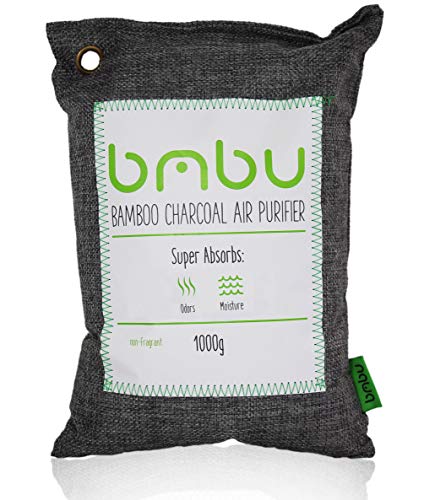
1000g Large Bamboo Charcoal Bag — the heavy single unit
Best for the boot, the SUV and the long soak
The alternative geometry: a single one-kilogram bag of activated bamboo charcoal, whose listing aims it squarely at vehicles — cars, SUVs, trucks, campers — and at moisture as well as odour. A kilogram of carbon in one place is a serious adsorptive mass, and its best use in this method is the boot or the rear footwell of a larger vehicle, left in place for the whole airing season as the cabin’s deep reserve while smaller bags work the front. It is also the choice for a car that must sit closed — a second car, a stored vehicle — where distribution matters less than total capacity.
- Material: activated bamboo charcoal, 1000g
- Form: single large bag
- Role: high-capacity adsorption for boot or rear cabin
- Listing brief: vehicles, RVs, closets and storage
Strengths
- A kilogram of carbon is a real capacity, not a gesture — it works for a season.
- One object to place, move and eventually replace; no herd of pouches to track.
- Its moisture appetite helps a car that also suffers damp and mustiness.
Trade-offs
- One location only — the front footwells get what the air carries to the back.
- Too large for a small car’s cabin to house gracefully while driving.
- Same saturation law as all carbon: when it is spent, it is spent.
Best for: boots, SUVs, stored cars and the long tail of a heavy smell. Not suited for: being the only carbon in a small car, where distributed small bags reach more air.
What about ozone generators, bombs and other heavy artillery?
The car-odour world sells escalation, and some of it works, with cautions that deserve printing in the same size as the claims. Odour-eliminator “bombs” and foggers distribute a deodorising aerosol through the cabin and the vents; they are a reasonable middle step for a moderate smell, used exactly as directed with the car aired thoroughly afterward, and they fail, like everything else, when they are asked to substitute for extraction of the fabrics. Ozone generators are the strongest tool and the one this article treats with the most reserve: ozone does destroy odour molecules, and detailers use it, but it also degrades rubber and interior materials with repeated or prolonged exposure, it must never be run in an occupied space, and the car must be aired until no ozone smell remains before anyone rides in it. For a household car, ozone is the last resort after the method above has been given its weeks — and professional detailers, who own the equipment and the judgement, are the safer hands for it. Chlorine-dioxide treatments sit in the same professional category. The pattern across all of them: chemistry can finish what cleaning started, and cannot replace it.
How long the whole job takes, honestly
The active work is a long afternoon: an hour of emptying, vacuuming and hard surfaces; an hour or two of extraction and drying setup; half an hour of vents, filter and glass. The passive work is the honest part of the answer — days of drying, then weeks of charcoal and airing while the reservoirs finish giving up their load at a rate heat and ventilation set. A light incident, a single journey with the windows’ worth of exposure, may clear in the active afternoon alone. A car smoked in daily for a year should be judged at the month, not the weekend, and its owner should expect the smell’s ghost on hot days until the headliner and the seat foam have fully served their sentence. Anyone selling a faster total cure for a heavy load is selling the air freshener again, in a more expensive bottle.
Keeping it out: the after-protocol
A cleaned car re-acquires the smell at exactly the rate it is re-exposed, so the lasting half of the method is behavioural. No smoking in the car is the whole rule for the determined, and for households where that rule will not hold, the mitigations are honest ones: windows down while it happens and for the drive after, the fan on fresh intake, ash and material out of the car the same day rather than resident in the door pocket, and the charcoal bags kept in place permanently as a standing capture for the small loads of ordinary life. Transporting material rather than smoking it calls for sealed, smell-proof containment in the boot — the cabin’s reservoirs cannot absorb what never reaches the cabin’s air. And a car being prepared for sale deserves the full method plus time, because a buyer’s nose on a hot day is the most sensitive instrument in this entire article, and it will find the headliner’s share if the seller’s schedule tried to skip it.
Common mistakes in car odour removal
Masking instead of removing is the founding error — every scented product applied to an uncleaned cabin builds the infamous layered smell that announces the cover-up. The second is spraying the fabrics with an odour eliminator and calling it extraction; surface chemistry on a deep reservoir is a letter sent to the wrong address. Third is drenching the headliner and buying a sagging roof lining as the price of enthusiasm. Fourth is forgetting the cabin filter, so the car re-doses itself at every start. Fifth is judging the result on a cool morning and declaring victory before the first hot afternoon’s audit. Sixth is sealing the car up damp after extraction and growing mildew as the sequel. Each is a step skipped, and the method above is simply the steps in an order that prevents them.
Final word
Weed smell in a car is not a curse; it is an inventory — ash in the seams, film on the glass, load in the foam, residue in the vents — and inventories can be emptied. Clean the hard evidence, extract the soft reservoirs, renew the filter, and then let charcoal and moving air conduct the long negotiation with what remains. Give the method its afternoon and its weeks, and the car will smell of nothing in particular, which is the only odour a car is supposed to have.
Leather interiors, convertibles and other special cases
Leather and vinyl
Leather holds less of the load than cloth foam does — one of its genuine virtues — but holds it in the finish and the stitching’s seams, and it punishes improvisation. Clean it with a dedicated leather cleaner worked into the seams with a soft brush, condition it afterward because cleaning strips the oils the hide needs, and expect the smell to leave leather faster than any other surface in the car. Vinyl behaves like a hard surface with pores: the general interior cleaner, patience in the seams, and no solvents that the maker does not bless. What neither material forgives is the extractor’s soaking or the household bleach some desperate owner eventually reaches for; both end in a retrim bill.
Convertibles and sunroofs
A convertible’s fabric roof is a headliner with weather duties, and it takes the same gentle law: no soaking, a light enzyme mist, blotting, and long airing with the roof up in the sun so the fabric gives up its load to moving air. The compensating blessing is ventilation — no car airs like a convertible with its top down on a country road, and an hour of that is worth a day of a saloon’s cracked windows. Sunroof cars should check the drain channels and the shade panel, both of which collect the cabin’s rising smoke film and both of which are forgotten in most cleans.
The car that only transported, never hosted
A boot that carried material in unsealed bags can smell like a car that was smoked in, because the boot’s carpet and the cabin share air through the rear seat’s gaps in most cars. The method concentrates accordingly: boot carpet extracted or, in many cars, lifted out and washed on the driveway; the spare-wheel well vacuumed and wiped, since it is the boot’s sump for everything; the rear seat’s back face treated as a reservoir in its own right. Sealed containment for future transport is the whole prevention, and it is absolute — a genuinely smell-proof container in the boot makes this entire article unnecessary for the next journey.
The professional detail: what you are paying for
A professional odour-removal detail is this article’s method with better equipment and worse news: a stronger extractor, a steamer for the seams and vents, ozone or chlorine-dioxide for the finish, and a bill that reflects the hours. It is worth its price in three situations — a car being sold, where the buyer’s nose sets the value; a car whose load is a year or more of daily smoking, where the headliner’s share alone justifies the steamer; and a household whose time is worth more than the detail costs, which is a legitimate arithmetic and not a failure of character. Ask any detailer what their process actually includes before booking: the ones who describe extraction, filter replacement and a finishing treatment are selling the method; the ones who describe only a bomb and a fragrance are selling the afternoon version at the week’s price.
Vinegar, coffee grounds and the folk shelf, assessed
Folk remedies deserve their audit, because some of them are chemistry wearing an apron. A bowl of vinegar left overnight in the cabin genuinely helps a light smell — acetic acid vapour neutralises some alkaline odour compounds and the vinegar’s own smell leaves with the airing — and it is a respectable first night for a mild incident. Coffee grounds adsorb a little and perfume a lot, which makes them a mask with good public relations. Newspaper crumpled into footwells absorbs moisture more than odour. Sliced apples and onions belong to folklore entirely. The pattern is the article’s recurring one: the folk shelf treats the cabin’s air for a night, while the reservoirs keep their own counsel for a month — use the bowl of vinegar by all means, as the overture, and let extraction and charcoal play the opera.
The cabin air filter: the reservoir most cleanings forget
Behind the glovebox of most cars sits a cabin air filter that every breath of the ventilation system passes through, and in a car that has been smoked in, that filter is not a bystander — it is a reservoir. Months of smoke have loaded its pleats with the same compounds the rest of this guide chases across the upholstery, and it re-releases them every time the fan runs, which is why a car can pass a static sniff test in the morning and smell again by the time the heater has run for ten minutes. Replacing it is neither expensive nor difficult: on most models it is a glovebox-out, two-clip job that a first-timer finishes in fifteen minutes with a video open on the passenger seat. Do it near the end of the deep clean rather than the beginning, so the new filter is not immediately loaded by the dust and vapour the cleaning itself stirs up, and choose a charcoal-impregnated replacement where one exists for your model — the carbon layer gives the new filter a modest adsorbing capacity of its own for whatever trace the rest of the work leaves behind.
Ozone generators: the heavy tool, with its conditions stated plainly
Ozone treatment is the one intervention that genuinely reaches the places this guide’s other methods cannot — inside ducting, behind trim, into foam — because ozone is a gas and goes everywhere air goes, oxidising odour compounds on contact. It is also the intervention most often mis-sold and misused, so its conditions belong in the record. No person or animal breathes the car during treatment or until it has been thoroughly aired afterwards; ozone is a respiratory irritant in its own right, and the treated car must stand open until the sharp, electric smell of the gas itself has fully cleared. Rubber seals, wiring insulation and some plastics degrade with repeated heavy exposure, which is why ozone is a once-per-crisis tool and not a monthly ritual. Run times are measured in tens of minutes, not overnight, whatever the rental listing suggests. Used once, correctly, on a car whose soft surfaces have already been cleaned, it is the legitimate final pass. Used instead of cleaning, it perfumes a dirty car with a more dangerous gas and the smell returns from the reservoirs the ozone never emptied.
Leather, cloth and the two different problems they pose
Cloth upholstery holds smoke the way this guide has described throughout — deep in foam and fibre, released slowly, answered by extraction and time. Leather is a different problem with a different geography. The smoke sits on and just under the finished surface rather than deep within it, which makes leather the faster of the two to bring back: a thorough clean with a dedicated leather cleaner, worked into seams and perforations where residue concentrates, followed by a conditioner to replace what the cleaning strips, addresses most of what a leather interior holds. The traps are the perforations in ventilated seats, which behave like cloth in miniature and need the extractor’s attention, and the headliner, which is cloth in nearly every car regardless of what the seats are covered in — the single most common reason a leather car still smells after its seats have been declared finished. Judge the two materials by different clocks: leather in days, cloth in weeks, and the headliner on the cloth clock always.
Keeping it out: the protocol for a car that must stay clean
Some readers of this guide are not restoring a car but defending one — a lease approaching its return, a car borrowed from family, a vehicle that doubles as a work car where the smell has professional consequences. The defensive protocol is shorter than the cure because it works on a smell that has not yet taken up residence. Nothing is smoked with the windows closed and the ventilation on recirculate, the two settings that pump smoke into the ducting and filter; ash and material leave the car the same day rather than seasoning in a cup holder; a charcoal bag lives in the car permanently rather than arriving as an apology; and fabrics that have absorbed an evening — a jacket, a blanket — go indoors to be washed rather than spending the week on the back seat quietly re-seeding the interior. None of this is onerous, and all of it is cheaper than the deep clean by exactly the margin this guide’s length suggests.
Frequently asked questions
How long does it take to get weed smell out of a car?
The active cleaning takes an afternoon. The smell’s full departure takes days for a light incident and several weeks for a car smoked in regularly, because the seat foam and headliner release their stored load slowly and the charcoal-and-airing stage works at that pace. Judge the result on a hot day with the car closed up beforehand — that is the audit that tells the truth.
Will an air freshener or odour bomb fix it?
No. Fresheners mask, and masking over an uncleaned cabin produces the layered cover-up smell that is worse than either scent alone. Fogger bombs are a legitimate middle step after extraction, not a substitute for it. Removal lives in the reservoirs — fabrics, foam, filter, vents — and only cleaning and adsorption reach them.
Does baking soda work on car seats?
As a mild, patient absorbent on surfaces, it helps a little: sprinkled generously on dry cloth seats and carpet, left overnight and vacuumed out thoroughly, it takes a share of the surface odour. It does not reach the foam’s deep load, and it must be completely vacuumed out or it becomes its own residue problem. Treat it as an adjunct to extraction, not an alternative.
Should I use an ozone generator?
Only as a last resort, unoccupied, briefly, and with long airing afterward — or preferably in a professional detailer’s hands. Ozone destroys odour molecules effectively but also attacks rubber and interior materials with overuse and is a respiratory hazard in an enclosed space. The extraction-and-charcoal method cures most cars without it.
The smell comes back when the heater or AC runs. Why?
Because the ventilation system is a reservoir: the cabin filter and the duct surfaces hold the load and release it into the airflow. Replace the cabin filter — cleaning it is a false economy — treat the ducts as directed in this article, and run the fan on fresh-air intake rather than recirculation while the car finishes clearing.
How do I get the smell out before selling the car?
Run the full method, then add time: a fortnight of charcoal and regular airing after the active clean, with the car parked in sun when possible to drive the reservoirs’ release into the charcoal rather than into the buyer’s test drive. Check the result yourself on a hot afternoon after the car has sat closed. If a ghost remains, a professional detail with ozone is the honest final step, and it is cheaper than the discount a smelly car negotiates against itself.
Can the smell be in the engine or exhaust?
No — the smell’s reservoirs are all in the cabin and its ventilation loop. What owners sometimes read as the car smelling from outside is the cabin’s air leaving through the door seals on a hot day, or their own clothes and hair carrying the cabin with them. If a car smells of smoke at the front, near the bonnet, look for the mundane causes — a leaf-and-debris load in the scuttle panel where the ventilation intake draws, which is worth clearing as part of the vent step in any case.
How do I clean the seatbelts properly?
Pull each belt fully out, clip it so it cannot retract, and wipe the webbing along its length with a cloth dampened with interior cleaner or a mild fabric solution, then let it dry fully extended before releasing it. A damp belt retracted into its housing is a mildew appointment. Belts are forgotten reservoirs — they sit against clothing and across the cabin’s air for every mile — and a thorough belt pass is one of the details that separates a car that smells cleaned from a car that smells clean.
Will the smell fail an inspection or affect insurance?
Odour alone is not an inspection item in ordinary roadworthiness regimes, and it is not an insurable event. Its real-world consequences are commercial and social: resale value, a rental or lease-return assessment where cleaning charges for smoke odour are a standard line, and the impressions of passengers. Lease and rental agreements are the documents to check if the car is not yours — their cleaning clauses are written by people who know exactly how long this smell takes to remove.
How can I tell if the smell is really gone?
Use the hot-closed-car test, and use someone else’s nose. Leave the car closed in the sun for several hours, then have a person who has not been living with the smell open the door and judge the first breath — the owner’s nose adapts to their own car exactly as it adapts to their own house, and the fresh witness is the only calibrated instrument available. If the first breath is neutral, the method has finished; if it carries the ghost, the charcoal stage gets another fortnight and the test is repeated.
What order should I do the steps in if I only have one day?
Empty and vacuum first, hard surfaces and glass second, extraction third, and the drying running while you replace the cabin filter and treat the vents; charcoal in last, into a dry car, at the end of the day. The order’s logic is that no step re-dirties an earlier one — extraction after the glass would film the glass again, charcoal into a wet car spends itself on moisture — and a single day used in this sequence achieves everything except the patience, which the following weeks supply on their own.
Does steam cleaning help?
Yes, in its place: steam lifts the load from seams, vents, switchgear surrounds and the seat fabrics’ surface, and it sanitises as it goes, which is why detailers reach for it. Its limits are the headliner’s glue, electronics that should not be steamed directly, and depth — steam is a surface and seam tool, while the foam’s deep reservoir still wants extraction’s volume of water. Used together, steam for the details and extraction for the depths, they are the professional pairing this article’s method imitates at driveway scale.
My car smells again after rain or humidity. Is that normal?
It is the reservoirs’ known behaviour: moisture in the cabin’s air helps release what the fabrics still hold, and a humid week can make a nearly cured car smell briefly relapsed. It is not a sign the cleaning failed — it is the load’s level being reported honestly — and the answer is the same charcoal-and-airing stage, continued, with the car’s interior kept dry. If the smell after rain is musty rather than cannabis-sweet, suspect water ingress — a blocked sunroof drain, a door seal — because that is a different problem wearing the same weather.
Can I just replace the cabin filter and skip the rest?
You can, and the car will smell better for a week, because the filter was dosing the airflow. Then the fabrics’ load re-perfumes the new filter and the cabin together, and you will have bought a filter to learn the article’s thesis: the filter is a reservoir among reservoirs, and no single one of them is the smell. Replace it as step three of the method, where it belongs, and it stays fresh because the cabin around it has stopped feeding it.
How many charcoal bags does a car actually need?
Enough to sit at every reservoir: in practice four to six of the smaller bags distributed through the cabin plus capacity in the boot — which is why the twelve-pack in this article, used across both zones with spares for rotation, is sized to the job rather than to a gesture. A single decorative bag on the rear shelf is a talisman. Adsorption is a surface-area business, and the count follows the car’s volume and the load’s depth, not the manufacturer’s hope.
Is it worth removing the seats for cleaning?
For a heavy load, the honest answer is sometimes: the carpet beneath the seats and the seats’ own undersides are the least-reached reservoirs in the car, and extraction around bolted seats leaves a map of the seat rails in unwashed carpet. Owners comfortable with the work — and with the caution that seat bolts can carry airbag and seatbelt-pretensioner wiring that demands the battery be disconnected and the car’s own manual consulted — gain real access for their trouble. Everyone else should know the option exists, price it into a professional detail where it belongs, and not improvise around safety systems for the sake of an odour.
What if the smell is in a child seat or other removable item?
Treat the item outside the car by its own care label: covers off and washed where the label allows, the shell wiped, the straps cleaned only as the seat’s manufacturer directs — child-seat straps have their own strict rules about chemicals and soaking that outrank any odour advice, including this article’s. An item that cannot be cleaned to a parent’s satisfaction should be aired in the sun for days with charcoal in attendance, and replaced if the smell survives, because a child seat’s occupant did not choose the exposure.
Why does the smell seem stronger some days than others?
Temperature and humidity are the reservoirs’ volume controls. Heat drives the compounds out of the foam and fabric into the cabin air — a car closed in the sun is actively perfuming itself — while cool, dry weather lets the load sit quietly in its materials. This is why the hot-closed-car test is the honest audit, why summer is when half-cleaned cars confess, and why a method judged complete in January deserves a second judgement in July before anyone declares the matter closed forever.
Can a car’s smell be transferred from clothes and belongings?
Yes, and it is the commonest route for a car whose owner never smokes in it: jackets, bags and soft items that live in smoky rooms arrive loaded and share their burden with the seats they rest on. The fix is to launder or air the belongings as part of the method — cleaning the car while returning a loaded coat to it every morning is a circle, not a cure — and to give regular passengers’ habits the same honest audit as the driver’s.
Should I clean the car before or after a long trip?
Before, if the trip involves passengers whose opinion matters — and use the trip itself as the airing stage, since hours of fresh-intake driving move more air through the cabin and its ducts than a week of parked ventilation. The charcoal rides along and works the whole way. A trip taken in a half-cleaned car with the windows managed and the fan on fresh intake is not a delay to the method; it is the method’s longest single session, and cars have come home from such journeys effectively cured.
What is the single most skipped step?
The inside of the glass. Owners vacuum, shampoo and deodorise, then sit in the finished car wondering why the smell still feels present at face level — while the windscreen’s inner film, condensed from every smoky mile, sits inches from their nose holding its share. It costs ten minutes and a second clean cloth to remove, and it is the step whose omission most often sends an otherwise thorough clean back to the driveway for another round.
How do I stop the smell coming back from the boot?
Give the boot the cabin’s full respect: its carpet extracted or removed and washed, the spare-wheel well emptied, vacuumed and wiped, and a kilogram-scale charcoal bag — the large one in this article — resident there permanently if the boot regularly carries anything aromatic. Boots are cleaned last and least in most attempts, and because boot air migrates into the cabin through the seat backs and parcel shelf, a neglected boot can keep a cleaned cabin at half-mast indefinitely.
Are there any products I should avoid entirely?
Oil-based dressings applied heavily to “seal in” freshness — they seal the smell in instead, under a shine that makes later cleaning harder. Bleach anywhere in a cabin, for the upholstery’s sake and the metalwork’s. Loose powders left unvacuumed in the carpets, which migrate into the ventilation and the passengers. And any product whose promise is a stronger fragrance rather than a removal: in odour work, the arms race of scent against smell has one loser, and it is the person who has to sit in the car.
How often should the charcoal be replaced during the cure?
Judge by the hot-car test rather than the calendar: while the smell is still measurably falling week to week, the bags are working; when progress stalls with a ghost remaining, fresh carbon is the cheapest experiment available and usually the right one. In a heavy cure, expect the first set to be spent within the first month — they are absorbing the reservoirs’ richest release — and later sets to last far longer as the load thins. Bags retired from the car still serve in cupboards and shoe storage, where the remaining capacity is ample.
Does the method differ for cigarette smoke?
Barely. The reservoirs, the extraction, the filter and the charcoal are identical, because the physics of smoke in a small fabric-lined box does not consult the leaf. Cigarette loads are often deeper by sheer cigarette count and carry nicotine’s yellowing film on the glass and headliner, which argues for an extra glass pass and lower expectations for the headliner’s first month. Anyone who has cured one smoke has the complete skill set for the other.
What should I do about a car I have just bought that smells?
Negotiate first if the smell was not disclosed — it is a legitimate price conversation, since the cure costs a detail or a weekend — and then run the full method with the advantage that you have no habits to unlearn in this car. New owners have one extra resource: the car’s previous life is not theirs, so every reservoir can be attacked without sentiment, including replacing floor mats outright if extraction leaves them suspect, which for a purchased car is often the most cost-effective single act in the whole cure.
Can airing alone ever be enough?
For the lightest incidents — one journey, material carried briefly, a single occasion with the windows down — yes: a weekend of open doors in moving air, the glass wiped and the charcoal in place can clear what never had time to soak deep. The test is the same hot-closed-car audit. Airing fails exactly when the load has reached the foam, and the boundary between the two cases is measured in exposures, which is why the method’s full version exists for everything beyond the trivial.
How do I keep the car fresh once it is cured?
Keep two or three charcoal bags in permanent residence, replace the cabin filter on the car’s ordinary service rhythm rather than the odour emergency’s, and vacuum the cabin monthly — the reservoirs refill with ordinary life at a rate a small standing defence handles easily. The cured car needs maintenance, not vigilance: the same habits that keep any car pleasant, plus the knowledge of what to do in the first twenty-four hours after any future incident, when a light load is still an afternoon’s problem rather than a month’s.
What is the fastest defensible cure for a rental return or lease handback?
The full active method compressed into a day — empty, vacuum, hard surfaces, glass twice, extraction, filter — followed by every hour of airing the deadline allows and fresh charcoal for the final night, with no fragrance products anywhere in the sequence. Assessors know the cover-up smell on sight, so to speak, and a car that smells neutrally clean passes where a car that smells of effort gets the cleaning charge anyway. If the deadline is impossible, the honest negotiation about the charge is cheaper than the products some owners buy in panic at the airport.
Should I clean the headliner, and how do I avoid damaging it?
Yes, but treat it as the most delicate surface in the car. The headliner is a thin fabric bonded to foam, and soaking it or scrubbing hard can dissolve that bond and leave the material sagging in a way no cleaning will undo. Work with a lightly dampened cloth and a mild interior cleaner, blot rather than rub, and test your method on a small area above a rear pillar first. Support the panel with a flat hand from behind where you can, use as little liquid as the job allows, and let it dry with the doors open. Because smoke rises, the headliner often holds more odour than the seats do, so this gentle pass is worth doing, but a stained or already loose headliner is a job to hand to a detailer rather than learn on.
What should I do about a smell held in a child seat?
Take the seat out of the car and deal with it separately, following its own manufacturer’s instructions exactly. Most covers can be removed and washed by the method printed on their labels, while the harness straps usually must never be machine washed or soaked, because detergents and immersion can weaken the webbing that protects a child in a crash. Clean the shell with a damp cloth and mild soap, air the whole seat outdoors out of direct sun, and check the vehicle seat and seatbelt beneath it, which often hold the smell the child seat was blamed for. Never use an ozone generator or strong chemical spray on a child seat, and if the odour survives a proper wash of the cover, ask the manufacturer for guidance rather than experimenting.
Related reading on this site
how to smoke in your room without smelling it
how activated carbon filters work
how to remove pet urine smells from a carpet