Disclosure: As an Amazon Associate, dailyhomedecorating.com earns from qualifying purchases. Links on this page are affiliate links; they cost you nothing extra. Prices and availability change often, so check the current Amazon listing before you buy.
Humidifiers Vs Diffusers: The Quick Verdict
The humidifiers vs diffusers question sounds simple, and that is exactly why it causes so many disappointing purchases. Both devices sit on a nightstand, both make a soft plume of mist, both are sold in the same aisle and often in the same search results, and some products even combine the two jobs in a single tank. Yet they were designed to solve different problems. A humidifier exists to raise the moisture level of a whole room, measurably and for hours at a time. A diffuser exists to spread fragrance from essential oils through a space, using only a small amount of water as the carrier. If your skin, throat, sinuses, wooden furniture, or houseplants are suffering because indoor air is dry, a diffuser will not fix it, no matter how pleasant it smells. If your room already feels comfortable and you simply want it to smell like cedar, lavender, or eucalyptus when you walk in, a full-size humidifier is more machine, more cleaning, and more money than the job requires.
Here is the shortest honest verdict. Choose a humidifier when dryness itself is the problem: winter heating, desert climates, high altitude, cracked lips, dry eyes on waking, static shocks, a baby nursery that needs steady overnight moisture, or a room full of instruments and wood furniture that dislike dry air. Choose a diffuser when scent is the goal: a calmer-feeling evening routine, a fresher-smelling entryway, a home office that needs a lift in the afternoon, or a bedroom wind-down ritual where fragrance matters more than humidity. Choose both, or a humidifier with a small essential-oil tray, when you want real moisture first and a light scent second, and you understand that the scent from a large humidifier tank will always be gentler than the scent from a dedicated diffuser.
This guide compares the two categories criterion by criterion, with a verdict in every section, then walks through the specific models worth considering on each side. Every linked product below was verified against the manufacturer’s own listing data before it earned a link, and every pick is presented with its strengths, its trade-offs, and the household it suits best. There is also a practical section on placement, water, and cleaning, because the difference between a device you love and a device you abandon in a cupboard is almost always maintenance, not mist.
In this guide
Where To Buy And How The Picks Were Chosen
All of the linked picks in this article are sold through Amazon, and each link goes to the exact model named in its heading. Use the Check price on Amazon button under each review to see the current listing, the current configuration, and any included accessories before you buy, because bundles and colours change more often than the underlying machines do. If a model is shown in more than one size, buy the size named in the review rather than assuming the smallest or largest version behaves the same way; tank size changes run time, cleaning effort, and how often you will refill.
The picks were chosen to represent real decision points rather than to fill a quota. On the humidifier side, that means one large smart cool-mist model for whole-room and overnight work, one simpler mid-size top-fill model for a single bedroom, and one warm-mist model for households that prefer heated vapour and a filter-free design. On the diffuser side, that means one premium ceramic model bought as much for how it looks as how it scents, one very small and simple budget-style diffuser for a desk or small bedroom, and one larger 500 ml model with a remote for living rooms and longer sessions. Between those six machines, almost every reader of a humidifiers vs diffusers comparison will find the shape of the right answer, even if the final purchase is a close relative of one of them.
One more note on honesty: a growing number of humidifiers advertise an essential-oil tray or an aroma pad, and a growing number of diffusers advertise themselves as small humidifiers. Both claims contain a grain of truth and a larger grain of marketing. An aroma tray on a humidifier scents lightly and keeps oil out of the main tank, which is good design. A 100 ml or 300 ml diffuser does add a little moisture to the air immediately around it, but it cannot raise the humidity of a bedroom in any way you could measure with a hygrometer or feel on your skin. Judge each device by its primary job, and treat the secondary job as a bonus, never as the reason to buy.
At A Glance: Humidifiers And Diffusers Side By Side
| Criterion | Humidifier | Diffuser |
|---|---|---|
| Primary job | Raise room humidity | Spread essential-oil fragrance |
| Typical tank size | 1 to 6 litres or more | 90 to 500 millilitres |
| Typical run time | 10 to 60 hours per fill | 3 to 12 hours per fill |
| Effect on measured humidity | Clear and measurable | Negligible beyond the desk it sits on |
| Essential oils | Only in a separate tray or pad, never in the tank unless the maker allows it | Designed for oils in the water |
| Scent strength | Light and background | Noticeable and adjustable |
| Cleaning burden | Regular and non-negotiable | Light, mostly a rinse and a wipe |
| Best rooms | Bedrooms, nurseries, living rooms, plant rooms | Bedrooms, offices, bathrooms, entryways |
| Running costs | Filters or wicks on some types, descaling, distilled water for some homes | Essential oils themselves |
If you are also weighing a third appliance for the same shelf space, our comparison of air purifier vs humidifier explains why cleaning particles out of the air and adding moisture to it are separate jobs again, and why many dry, dusty homes end up wanting both.
Criterion One: Actually Fixing Dry Air
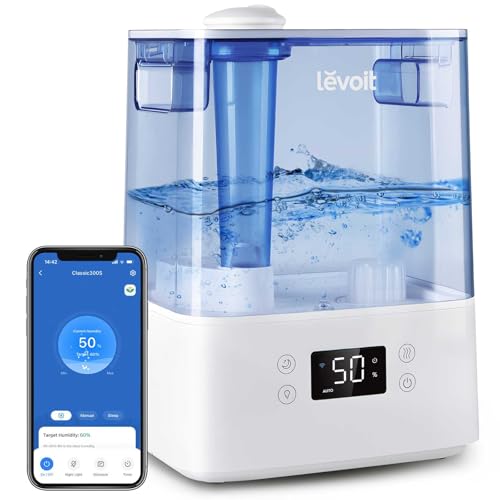
Verdict: the humidifier wins, and it is not close. Dry indoor air is a numbers problem. Comfortable indoor relative humidity is generally in the region of thirty to fifty percent, and a heated home in January can sit far below that for weeks. Closing that gap in a bedroom takes a sustained output of water vapour over the whole night, which is why humidifiers carry litre-sized tanks and publish run times in tens of hours. The Levoit Classic300S at the top of our humidifier picks carries a 6 litre tank rated for up to sixty hours of use, which means it can hold a bedroom at a steadier level through several nights without a refill. A diffuser with a 90 ml or even a 500 ml tank simply does not move enough water to change the room; it will finish its small reservoir scenting the air while the hygrometer on the wall does not move.
This matters because the symptoms people chase are dryness symptoms. Waking with a scratchy throat, a blocked or bloody nose, itchy skin, chapped lips, and contact lenses that feel gritty by evening are all classic signs of dry air, and none of them are fragrance problems. Adding a beautiful scent to dry air gives you beautifully scented dry air. If you recognise that list of symptoms, buy the humidifier first, run it for two weeks, and only then decide whether you still want a diffuser for scent. Many households find that once the dryness is gone, the urgency behind the diffuser purchase fades, and the diffuser becomes a pleasant extra bought calmly rather than a disappointing fix bought in hope.
The reverse mistake is rarer but real. A household that only wanted scent sometimes buys a large humidifier because it was promoted more heavily, then discovers the ongoing cleaning routine, the refills, and the counter space, all to achieve a faint background smell that a small diffuser would have delivered more strongly for a fraction of the effort. Match the machine to the problem you actually have today, not to the problem a product page suggests you might have.
Criterion Two: Scent, Mood, And The Evening Routine
Verdict: the diffuser wins clearly. A diffuser puts a few drops of essential oil into a small amount of water and disperses it as a fine, cool, scented mist, so the fragrance is concentrated, immediate, and easy to change from one evening to the next. The Vitruvi Stone diffuser in our picks uses a 90 ml tank and timed settings, and it is designed to scent a bedroom or office in short, deliberate sessions: on for the wind-down hour, off when you sleep. The ASAKUKI 500 ml model stretches that idea to a living room, with a remote control and longer sessions. A humidifier, by contrast, dilutes the same few drops across litres of water, or keeps the oil on a small tray away from the water entirely, so the result is a hint of scent rather than a feature of the room.
There is also a routine difference that matters more than specifications suggest. Diffusing is an event: you choose an oil, fill a small tank, and run the device for a defined part of the day. Humidifying is a background utility: you fill a large tank and the machine quietly manages the room while you think about other things. Households that enjoy rituals, seasonal scents, and a home that smells deliberately welcoming tend to love diffusers and use them daily. Households that want to set and forget tend to find diffuser sessions one more small chore, and get more lasting value from a humidifier with an aroma tray that adds a gentle scent without a separate device or a separate habit.
A word of care belongs in this section. Essential oils are concentrated plant extracts, and stronger is not automatically better. Use fewer drops than your enthusiasm suggests, ventilate rooms normally, keep sessions modest around babies, young children, and anyone who is pregnant or has a respiratory condition, and take particular care around pets, because some oils that smell wonderful to people are poorly tolerated by cats and birds in particular. If anyone in the home has asthma or a known fragrance sensitivity, talk to a clinician before making diffusing a daily habit, and never use scent as a substitute for fresh air, cleaning, or fixing the actual source of an odour.
Criterion Three: Cleaning, Water, And Ongoing Effort
Verdict: the diffuser is far easier to live with; the humidifier demands a routine and rewards it. Any device that holds standing water needs cleaning, but the scale differs. A diffuser’s small tank rinses in a minute, wipes dry with a cloth, and needs a slightly deeper clean when you change oil families or notice residue. A humidifier’s large tank, base, and mist outlet need regular washing, descaling in hard-water areas, and prompt attention if a film or odour develops, because the machine’s whole job is to aerosolise whatever is in its water into the room you breathe in. Ultrasonic humidifiers in hard-water homes can also leave a fine white dust on nearby surfaces, which is mineral content from tap water settling out; using distilled or demineralised water, where the maker recommends it, largely removes that problem at the cost of buying or making the water.
Evaporative humidifiers avoid white dust because a fan blows air through a wet wick rather than blasting droplets into the room, but they trade that advantage for wick filters that need replacing and can harbour odour if neglected. Warm-mist models such as the Vicks in our picks boil water into steam, which keeps the output itself simple and filter-free, but the heating element scales up in hard water and needs descaling, and a boiling appliance deserves extra respect in homes with curious toddlers. None of this is a reason to avoid a humidifier. It is a reason to buy one whose tank you can actually get a hand or a brush into, whose parts come apart without a fight, and whose cleaning routine you can picture yourself doing on a Sunday in February, not just on the enthusiastic first weekend.
Practical rule of thumb: empty and rinse a humidifier tank daily if you can, wash it properly at least weekly, descale as your water demands, and never top up old water indefinitely and call it fresh. For a diffuser, empty leftover water between sessions rather than re-misting yesterday’s oil, wipe the tank when you change scents, and give the ultrasonic plate a gentle clean as the maker directs. Devices that are cleaned stay quiet, smell clean, and last; devices that are not become the reason people conclude, wrongly, that the whole category does not work.
Criterion Four: Noise, Light, And Sleeping Next To One
Verdict: a draw, decided by the specific model rather than the category. Both categories use ultrasonic technology in many models, which is quiet by nature, and both can ruin a light sleeper’s night with a gurgle, a drip, or a bright status light that has no off switch. Humidifiers add two sleep considerations of their own: a large tank settling or refilling sounds as water moves, and, on evaporative models, a fan that some sleepers love as white noise and others cannot tolerate. The Levoit models in our picks publish quiet operation and sleep modes that dim displays, which is exactly the feature set to look for in a bedroom machine. Warm-mist models are typically very quiet in operation, with the occasional soft boiling sound, and they add a gentle warmth to the mist rather than cooling the room slightly.
Diffusers are usually the quieter and dimmer neighbours, but their lights are a design feature rather than an afterthought: colour-changing LEDs are delightful in a living room at seven in the evening and surprisingly assertive in a dark bedroom at three in the morning. The ASAKUKI model offers multiple light colours, so check that its light can be switched fully off, as it can on the version we list, before it earns a permanent nightstand place. The Vitruvi Stone takes the opposite design path, with a soft glow intended to look calm rather than colourful. Whichever category you choose, treat the first night as a trial: run the device where it will live, at the setting you will actually use, and judge the sound and light in the dark, not in a bright kitchen at noon.
Criterion Five: Cost Over A Year, Not Just On Day One
Verdict: the diffuser is cheaper to buy and to run; the humidifier costs more and solves a bigger problem. Comparing sticker prices alone misleads in both directions. A diffuser’s real running cost is essential oil, bought drop by drop, and a household that diffuses daily through winter will spend steadily on oils it loves while the device itself asks for almost nothing. A humidifier’s running costs depend on its type: filter-free ultrasonic and warm-mist models mostly ask for water, descaler, and your time; evaporative models ask for replacement wicks on a schedule; smart models ask for nothing extra but cost more on day one. Budget-tier framing helps here: treat a diffuser as a small appliance plus a consumable you enjoy, and a humidifier as a mid-sized appliance plus a cleaning routine you accept, and compare each against the value of the problem it solves rather than against each other.
Also count the cost of the wrong purchase, which is the most common cost in this category. A diffuser bought to cure dry air will be replaced by a humidifier within a season, and a humidifier bought only for scent will be abandoned, uncleaned, in a cupboard. The cheapest device is the one matched to the real job the first time, which is the entire point of a humidifiers vs diffusers comparison and the reason this article leads with verdicts instead of product cards.
The Humidifier Picks: For Rooms Where Dryness Is The Problem
The three humidifiers below cover the main shapes of the dry-air problem: a large smart model for serious, whole-bedroom or open-plan duty, a simpler mid-size model for one bedroom done well, and a warm-mist model for households that prefer steam and a filter-free path. Each one earned its place on tank size, cleaning access, and the clarity of its job, and each one is linked only because its exact model was verified.

Levoit Classic300S Smart Humidifier — Best For Serious Overnight Dryness
Badge: Top humidifier pick. The Classic300S is the machine to buy when dryness is not a mild annoyance but the defining feature of your winters. Its 6 litre top-fill tank is rated for up to sixty hours of running, which changes the experience of owning a humidifier: instead of a nightly refill ritual, you fill it, set a target humidity, and let the built-in sensor and app or voice control hold the room steady while you get on with your life. The top-fill design matters more than it sounds, because a tank you can fill under a tap without carrying a dripping base unit across the room is a tank you will actually keep full and clean.
- Type: Ultrasonic cool mist, smart
- Tank: 6 litres, top fill
- Run time: Up to 60 hours per fill
- Extras: Humidity sensor, app and voice control, essential-oil tray, sleep mode, night light
Strengths
- Huge tank and long run time make steady humidity genuinely achievable, not aspirational.
- Automatic humidity control prevents the over-humidified, clammy room that manual machines can create.
- Top-fill tank and a dedicated oil tray keep filling simple and oil out of the main water.
Trade-offs
- It is a large appliance that claims real nightstand or floor space.
- As an ultrasonic model in a hard-water home, it can leave white dust unless you use suitable water.
- Smart features are wasted if you simply want a dial and nothing else.
Best for: households with persistent winter dryness, larger bedrooms, nurseries on a steady routine, and anyone who wants set-and-forget humidity control. Not suited for: tiny rooms where a 6 litre machine is overkill, or buyers who dislike apps on principle.

Levoit 3L Cool Mist Humidifier — Best For One Bedroom, Done Simply
Badge: Best mid-size bedroom pick. This 3 litre Levoit is the calmer answer for a single bedroom, a nursery, or a plant corner. It is a top-fill ultrasonic cool-mist machine with a rotating nozzle, quiet operation, and an essential-oil function, sized for roughly a day of running rather than most of a week. That smaller footprint is a feature, not a compromise: it fits the nightstands the Classic300S overwhelms, it is easier to carry to the sink, and its simpler controls suit households that want moisture without managing an app.
- Type: Ultrasonic cool mist
- Tank: 3 litres, top fill
- Nozzle: 360-degree rotating
- Extras: Essential-oil diffuser function, quiet operation for bedrooms and nurseries
Strengths
- Right-sized for one room, with a tank that is easy to lift, fill, and wash.
- Quiet running and a rotating nozzle make it an easy bedroom neighbour.
- The built-in scent function gives light fragrance without a second device.
Trade-offs
- A 3 litre tank means more frequent refills than the large smart models.
- No automatic humidity targeting of the kind the Classic300S offers.
- One unit will not transform a whole open-plan floor.
Best for: single bedrooms, nurseries, renters, and plant owners who want dependable moisture in one defined space. Not suited for: large open-plan rooms or anyone who hates refilling any tank, ever.
Vicks Warm Mist Humidifier — Best For Warm Steam And No Filters
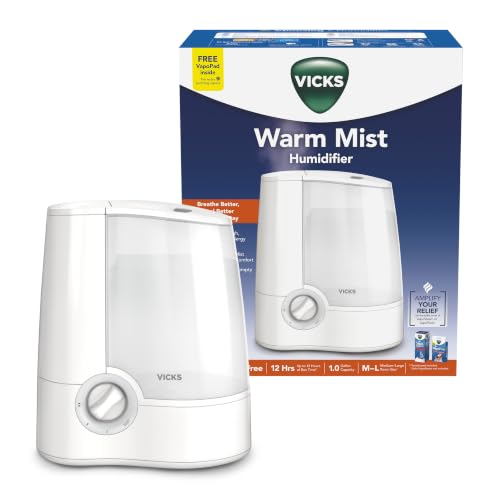
Badge: Best warm-mist pick. The Vicks Warm Mist takes the other technological road: instead of vibrating water into a cool plume, it heats water into a warm steam vapour, with a 1 gallon tank sized for medium to large rooms, automatic shut-off, and a filter-free design. Many households simply prefer how warm mist feels in a cold bedroom, and the boiling process keeps the output straightforward. It also accepts the brand’s scent accessories, which gives it a gentle fragrance option of its own, though, like every humidifier on this page, scent is its side job, not its purpose.
- Type: Warm mist (heated steam vapour)
- Tank: 1 gallon
- Design: Filter-free, auto shut-off
- Rooms: Medium to large rooms, including nurseries as the maker describes
Strengths
- Warm steam feels especially welcome in cold rooms and cold seasons.
- No wick or filter replacements to buy, track, or forget.
- Simple, proven design with automatic shut-off when the tank runs dry.
Trade-offs
- The heating element needs descaling in hard-water homes.
- A boiling appliance needs thoughtful placement away from small, curious hands.
- It uses more electricity than an ultrasonic cool-mist model doing similar work.
Best for: households that prefer warm vapour, dislike filter subscriptions, and want a simple machine for a medium or large bedroom. Not suited for: homes wanting the lowest possible energy use, or placement within a toddler’s easy reach.
The Diffuser Picks: For Rooms Where Scent Is The Point
The three diffusers below are deliberately different from one another, because diffuser buying is mostly about taste: how the object looks on your furniture, how long a session you want, and how much control you want over light and timing. All three are ultrasonic, all three shut off when the water runs low, and none of them should be bought to fix dry air.

Vitruvi Stone Diffuser — Best For Design-Led Homes
Badge: Best-looking diffuser pick. The Vitruvi Stone is the diffuser people buy when the device will live in sight, on a hall table, a desk, or a carefully arranged bedroom shelf. Its matte ceramic cover looks like an object rather than an appliance, while inside it runs a 90 ml tank with four and eight hour timer options, automatic shut-off, and a soft LED glow, with the maker describing coverage suited to spaces up to around five hundred square feet for scent. It scents in deliberate sessions rather than all-day marathons, which suits how most people actually enjoy fragrance at home.
- Type: Ultrasonic essential-oil diffuser, ceramic cover
- Tank: 90 ml
- Timers: 4 and 8 hour settings, auto shut-off
- Finish: White ceramic, soft LED glow
Strengths
- Genuinely attractive ceramic design that earns its place on display.
- Simple timed sessions match evening and workday scent routines.
- Compact footprint suits desks, shelves, and smaller bedrooms.
Trade-offs
- The 90 ml tank is for sessions, not for scenting a house all day unattended.
- You are paying a premium for design and materials.
- Like every diffuser here, it will not raise room humidity in any useful way.
Best for: design-conscious homes, gifts, desks, and anyone who scents in timed sessions. Not suited for: buyers wanting the largest possible tank or the lowest possible spend.

InnoGear 100 ml Essential Oil Diffuser — Best Small And Simple
Badge: Best compact pick. The InnoGear is the straightforward little diffuser that has introduced a great many households to scenting a room: 100 ml of water, a few drops of oil, up to around eight hours of intermittent-style running depending on mode, waterless automatic shut-off, and a choice of light colours or no light. It is small enough for a desk corner, a bathroom shelf, or a spare-room nightstand, and simple enough that guests can use it without a manual. If you are diffuser-curious and want to learn whether scent sessions suit your household before spending more, start at this scale.
- Type: Ultrasonic essential-oil diffuser
- Tank: 100 ml
- Run time: Up to about 8 hours depending on mode
- Extras: Waterless auto-off, multiple light options
Strengths
- Tiny footprint and very simple operation.
- Long session potential for its size, with automatic shut-off for peace of mind.
- Light can be used as a gentle night feature or switched to suit the room.
Trade-offs
- Scent reach is a small room, not an open-plan floor.
- Basic plastic construction lacks the furniture-grade feel of ceramic models.
- Frequent refills if you run it most of the day, every day.
Best for: first-time diffuser buyers, desks, bathrooms, and small bedrooms. Not suited for: large living rooms or anyone wanting a statement piece of decor.

ASAKUKI 500 ml Diffuser — Best For Larger Rooms And Longer Sessions
Badge: Best large-tank diffuser pick. The ASAKUKI scales the diffuser idea up: a 500 ml tank, a remote control, multiple mist and timer settings, and a bank of LED colour options, in a unit intended for bedrooms, living rooms, and offices where a 100 ml device would need constant attention. The remote sounds like a gimmick until the diffuser lives across the room on a shelf, at which point adjusting mist or light from the sofa becomes the feature you use daily. It remains, firmly, a scent device; its larger tank buys longer fragrance sessions, not meaningful humidity.
- Type: Ultrasonic essential-oil diffuser with remote
- Tank: 500 ml
- Controls: Remote control, timer and mist settings
- Extras: Multiple LED colours, quiet operation, auto shut-off
Strengths
- Large tank supports long, low-effort scent sessions in bigger rooms.
- Remote control makes shelf placement practical.
- Flexible light and timer settings adapt it from living room to bedroom.
Trade-offs
- Bigger and more conspicuous than the compact models.
- More settings than scent minimalists will ever touch.
- Still not a humidifier, despite the generous tank.
Best for: living rooms, open-plan spaces, and households that diffuse for hours at a time. Not suited for: tiny desks or anyone who wants scent in short, occasional bursts only.
Decision Guide: Answer Three Questions
Question one: is anyone in the room uncomfortable because the air is dry? Look for the physical evidence: dry skin, sore throats on waking, static, wilting plants, a hygrometer reading persistently low. If yes, the humidifier is the purchase, full stop, and the only remaining decision is size and mist type. Readers who want the full shortlist treatment should continue to the best humidifiers we tested, where the humidifier side of this comparison gets a dedicated roundup.
Question two: does the room feel fine but smell flat, stale, or uninspiring? Then the diffuser is the purchase, and the remaining decisions are tank size, looks, and light. Start small if you are unsure how often you will diffuse; upgrade in size or materials once the habit proves itself, because a diffuser you use three times a week in a small size beats a large one gathering dust.
Question three: do you honestly want both effects? Then sequence the purchases like an adult: humidifier first, because dryness affects sleep, skin, and the room itself, then either a dedicated diffuser for real scent sessions or a humidifier with an aroma tray if a gentle background scent will satisfy you. Households dealing with dust and particles as well as dryness should also read our explainer on what is a hepa filter and the balanced discussion in do hepa filters remove viruses, because air cleaning is a third, separate job that neither device in this article performs. For the wider picture of why indoor air deserves this attention at all, see indoor air quality statistics.
How To Use Each Device Well
For a humidifier, placement and routine decide everything. Set it on a stable, water-tolerant surface, elevated if the maker advises, away from direct contact with wood furniture and walls, and not blowing straight at bedding, books, or electronics. Run it with the bedroom door in its normal position, because a machine sized for a closed room will underperform in an open-plan through-route. Check humidity with an inexpensive hygrometer rather than by feel, aim for the comfortable middle range, and back the machine off if windows begin to mist heavily or the room feels clammy, because excess humidity invites its own problems, including mould. Empty, rinse, and refill regularly; wash weekly; descale when deposits appear; and store the machine only after it has been cleaned and fully dried.
For a diffuser, think in sessions and drops. Fill to the line, add a modest number of drops for the tank size, and run the device for the part of the day when scent adds something: the first hour at home, a bath, a work block, a wind-down. Empty the tank afterwards rather than re-running old water, wipe it when changing oil families, and keep a small rotation of oils you genuinely love instead of a cupboard of novelties. Keep diffusers out of reach of small children, store oils safely as you would any concentrated household product, and give pets a route out of a scented room so they can choose fresh air if they want it.
Common Mistakes That Waste Money
The first mistake is buying a diffuser to treat dryness, covered above but worth repeating because it is the single most common error in this category. The second is putting essential oil directly into a humidifier tank that was not designed for it; oil can damage plastics and seals and coat the ultrasonic plate, and the correct route is always a dedicated tray, pad, or a diffuser. The third is ignoring water quality, then blaming the machine for white dust or scale that your tap water supplied. The fourth is over-humidifying a small room with a large machine on its highest setting, then concluding that humidifiers make rooms feel damp; they do, when run without a target or a hygrometer. The fifth is neglecting cleaning until odour appears, at which point a thorough rescue clean is needed and enthusiasm for the whole project often dies with it. The sixth is scenting harder instead of smarter: more drops, longer sessions, and stronger oils, when the better answer is usually a cleaner tank, a better-placed device, and a scent the whole household actually agrees on.
Final Recommendation
If you remember one sentence from this humidifiers vs diffusers guide, make it this one: humidifiers manage water in the air, diffusers manage scent in the air, and happiness lies in buying the one whose job matches your problem. For dry rooms, start with the Levoit Classic300S for serious, set-and-forget humidity, the Levoit 3L for a simpler single bedroom, or the Vicks Warm Mist if warm steam and a filter-free design suit your home. For scent, choose the Vitruvi Stone for looks and timed sessions, the InnoGear for a small and simple start, or the ASAKUKI 500 ml for larger rooms and longer evenings. Buy one device, live with it for a fortnight, and let experience, rather than a product page, tell you whether the second device deserves a place in your home.
Room By Room, Season By Season: Where Each Device Earns Its Place
The bedroom is humidifier territory first. Sleep is when dry air does its worst work, because you breathe the same room air, through your mouth as often as not, for seven or eight unbroken hours, and you wake up wearing the results on your throat, skin, and sinuses. A correctly sized humidifier running quietly through the night, with its display dimmed and its target set sensibly, is one of the few small appliances that can change how a whole season of mornings feels. A diffuser in the same room is a supporting actor: lovely for the reading hour before sleep, ideally on a timer so the scent session ends as the night begins, rather than perfuming the small hours at full strength.
The living room is the diffuser’s strongest ground. It is where guests arrive, where the household gathers awake, and where scent is experienced socially rather than medically. A larger diffuser such as the ASAKUKI, placed where air circulates gently and run for the evening, sets a mood that a humidifier’s faint aroma tray cannot match. Humidity still matters in a living room with wood floors, leather, books, or a piano, but the case there is about protecting the room over months, and it is usually served by the same whole-home habits, or a larger humidifier placed discreetly, rather than by the scent device on the sideboard.
Home offices split the difference in an instructive way. Dryness shows up as tired eyes, scratchy voice on afternoon calls, and skin that feels tight by midday, all humidifier problems, and a compact cool-mist unit near, but not aimed at, your desk and equipment handles them well. Scent shows up as the three o’clock slump, and a small diffuser such as the InnoGear, run in a short session with a bright, clean oil, is a pleasant ritual that marks a break better than another coffee does. Many office workers end up owning both at desk scale, and using each for an hour or two at the point of the day when its job matters.
Seasonally, the pattern is predictable. Winter heating drives humidity down and pushes the humidifier to the front of the cupboard, running nightly for months, while the diffuser becomes a weekend and evening pleasure. Summer reverses the emphasis in many homes: humidity is adequate or excessive, the humidifier is cleaned, dried, and stored, and the diffuser carries on scenting bathrooms, entryways, and guest rooms through the social season. Shoulder seasons are when households make their mistakes, running a stored, uncleaned humidifier for one cold snap or diffusing heavily in a closed, unventilated house. Clean before you store, clean before you restart, and ventilate rooms as a habit, and both devices will serve for years instead of one disappointing winter.
Gifts, Guest Rooms and Other People’s Homes
Humidifiers and diffusers are both popular gifts, and they fail as gifts in opposite ways that are worth understanding before you buy one for somebody else. A diffuser is the safer present: it asks little of its owner, forgives irregular use, and delivers its effect, a scented room, immediately and visibly. Its risks are taste and sensitivity. Fragrance is personal, a scent one person finds calming another finds cloying, and some recipients, including many who are pregnant, who have migraines triggered by strong smells, or who simply dislike scented homes, will quietly never switch it on. If you give a diffuser, give it with a mild, widely liked oil and no expectation attached.
A humidifier is a more presumptuous gift, because it arrives with homework. It needs regular cleaning, a permanent position near a socket, and an owner who actually has a dry-air problem worth solving. Given to the right person, someone who has complained all winter about cracked lips, static shocks and a parched throat on waking, it can be genuinely thoughtful, especially if you include the first cleaning supplies and a realistic word about upkeep. Given to the wrong person, it becomes a bulky obligation that migrates to a cupboard by spring. The deciding question is not which device is better, but whether the recipient has described the problem the device solves, in their own words, unprompted.
Guest rooms expose the same logic inside your own home. A spare room used a few nights a year rarely justifies a plumbed routine of any kind, but it is exactly the room where a small diffuser earns its keep, making an aired, slightly stale space feel welcoming in the hour before guests arrive. A humidifier in a guest room makes sense only where guests stay for long stretches in the heating season, or where the room doubles as a nursery or a recovery space for a relative. Match the appliance to the room’s real pattern of use, not to the room you imagine when you picture the house at its best.
Water, Again: The Detail That Decides More Than the Brand
Ask long-term owners what separated the device they kept from the device they returned, and water comes up more often than features. Every humidifier and diffuser is a water appliance, and its daily character is set by three unglamorous questions. How easy is the tank or reservoir to fill at an ordinary sink? How easy is it to clean, including the corners and the small parts where residue builds? And what does your own tap water do inside it over a fortnight? A household with hard water that leaves scale on a kettle in a week will fight the same scale in any appliance that heats or atomises water, and should favour designs that open fully for cleaning, tolerate descaling, and do not hide narrow channels that can never be reached with a brush.
Diffusers sit at the forgiving end of this scale. Their reservoirs are small, the water is usually scented, and a quick rinse between oils plus a periodic wipe with a suitable cleaner keeps most models pleasant. Even so, a diffuser left with standing scented water for a week will smell stale when next used, and oils allowed to dry in a tank can leave a residue that taints every subsequent scent. The habit that keeps a diffuser delightful is tiny: empty it when you are done, rinse it when you change oils, and let it dry open rather than sealed.
Humidifiers demand the fuller version of the same discipline, scaled to a tank that may hold a day or more of water. The routine that works is the one described throughout this guide: fresh water regularly, a rinse most days the machine runs, a proper clean on a weekly rhythm during the season, and descaling matched to your water. Households deciding between the two devices should weigh this difference honestly, because it is the true long-term cost of the humidifier’s greater power. A diffuser asks for minutes a month. A humidifier asks for minutes a week. Both are fair prices for what each delivers, as long as you choose the one whose price you will actually keep paying.
Frequently Asked Questions
Can I run a diffuser all night instead of a humidifier?
You can run one, and many people enjoy the scent as part of an evening routine, but it will not do a humidifier’s job. Even a large diffuser releases a small fraction of the water vapour a humidifier delivers over a night, so the room’s humidity will barely move, and a dry-air problem will still be there in the morning. Intermittent settings, where the diffuser cycles on and off, are designed for scent, not moisture. If overnight dryness is the issue, choose the humidifier for the night and let the diffuser be what it is good at: a short, pleasant session in the evening before bed.
Which device is better for a home office?
It depends on what the working day feels like in that room. Offices in heated homes often run dry for long, sedentary hours, and a compact humidifier near the desk can make eyes, skin and throat noticeably more comfortable across a full day, provided it is cleaned on schedule and kept off the desk itself to avoid damp paperwork and electronics. A diffuser suits an office where the problem is atmosphere rather than dryness, and where scent will not disturb colleagues on calls or other household members through the wall. If you share the home while working, the humidifier is usually the more considerate choice, since its effect stays in the room and scent does not.
Can a diffuser work as a humidifier in a small bedroom?
Not in any way that matters. A diffuser moves a few hundred millilitres of water at most, scented, over many hours, which may feel pleasant nearby but will not raise a bedroom’s humidity to a level your skin, throat, or a hygrometer would register. If dryness is the problem, buy a humidifier sized for the room and treat any scent feature as a bonus.
Can I put essential oils in my humidifier?
Only where the maker designed for it: a separate aroma tray, a scent pad, or a model that explicitly allows oils. Oil poured into a main humidifier tank can damage components and void warranties, and it scents weakly anyway because the oil is diluted across litres of water. For strong, controlled scent, a diffuser is the right tool.
Which is better for a baby nursery, a humidifier or a diffuser?
For the dryness that commonly disturbs babies’ sleep, a clean, correctly sized cool-mist humidifier, placed safely out of reach and run to a sensible humidity target, is the usual choice. Scent is a different matter: many parents and clinicians prefer to keep fragranced products and essential-oil diffusing away from very young babies, so discuss diffusing with your paediatrician and default to plain moisture and fresh air in the early months.
Why does my ultrasonic humidifier leave white dust?
The dust is mineral content from hard tap water, carried out with the mist and settled on nearby surfaces. Using distilled or demineralised water where the maker recommends it, cleaning the tank and base regularly, and descaling on schedule will greatly reduce or remove the problem. Evaporative and warm-mist designs avoid the dust by their different mechanisms, at the cost of wicks or heating respectively.
How often should I clean a humidifier compared with a diffuser?
A humidifier deserves a rinse and fresh water daily where practical and a proper wash at least weekly, with descaling as your water demands, because it aerosolises its tank contents into your breathing zone for hours. A diffuser needs a rinse between sessions, a wipe when you change scents, and an occasional gentle clean of its plate and tank. Both routines are measured in minutes; both are skipped at the cost of odour and performance.
Is it sensible to own both a humidifier and a diffuser?
Yes, provided each has a real job. A common, happy arrangement is a humidifier managing bedroom humidity every night through winter and a diffuser scenting living spaces in sessions when the household is awake to enjoy it. Buy them in that order, dryness first, and you will know from experience how much scent, if any, your home still wants.