Where to buy
Judging the best outdoor security camera for home security under $300 means judging evidence, deterrence and failure modes — not gadgets. Check the latest price, availability and delivery on Amazon. Orders are placed on Amazon. We may earn a commission from qualifying purchases. Every pick below is a complete outdoor camera or a complete camera kit that can be bought on its own — check the listing carefully so the box, mount and any hub in the title match what the review describes.
- Best deterrence and tracking: Ring Floodlight Cam Wired Pro — Check on Amazon
- Best evidence per area, no plan needed: Wyze Cam Floodlight Pro — Check on Amazon
- Best protected archive: eufy Security eufyCam S330 (eufyCam 3) 2-Cam Kit — Check on Amazon
- Best watch over unwired approaches: Arlo Pro 5S 2K Spotlight Camera — Check on Amazon
- Best alert judgement: Google Nest Cam with Floodlight — Check on Amazon
- Best quiet sentinel for side doors: Blink Outdoor 4 Floodlight Camera — Check on Amazon
Read the full guide ↓
Disclosure: As an Amazon Associate, dailyhomedecorating.com earns from qualifying purchases. Links to Amazon on this page are affiliate links; they cost you nothing extra. Listing details such as price and availability change often, so check the current Amazon listing before you buy.
Judged as a gadget, an outdoor camera is a lens and an app. Judged as home security — the standard this guide applies — it is three things at once: a deterrent that changes a visitor’s calculation, a witness that produces footage someone else can act on, and a system that must still be working on the worst night of the year, not just the evening you installed it. The best outdoor security camera for home security under $300 is therefore not automatically the sharpest or the cleverest. It is the one whose light, detection, recording path and power supply hold together as a system. A camera that films beautifully but stops recording when a trial lapses is not a security device. A camera that records faithfully to a card a thief can pocket is a witness that can be stolen. This guide grades all six picks on the security job, in the open.
That grading reorders the familiar names. Deterrence hardware — real floodlights, a siren, visible presence — pulls the Ring and Wyze to the top, because most opportunistic crime is a decision made in seconds at the kerb, and light plus an announced camera changes it. Archive integrity pulls the eufy kit up with them: its recordings live on a hub inside the house, beyond the reach of anyone tampering with the camera itself. Detection accuracy keeps the Nest in serious contention despite modest resolution, because an alert system people trust is a system people respond to. And the battery picks, Arlo and Blink, earn their places covering the approaches wiring cannot reach — with honest notes about the plans and modules their recording depends on.
Honesty about limits is a security feature too, so here is this guide’s: no camera in this list can promise to prevent a crime, summon help by itself or see through fog, and none replaces locks, lighting and an alarm where those are warranted. What a well-chosen system does is raise the effort and the evidence: it makes your home the lit, watched, recorded option on the street, and it preserves what happened in a form you can hand to police or an insurer. Every review below states its pick’s subscription gate in its opening paragraphs — the Ring records nothing without its plan; the Arlo and Blink gate cloud recording and smart detection behind theirs; the Nest charges for memory, not detection; the eufy and Wyze record locally with no plan — because a security system whose terms surprise you has already failed once. For the general-purpose ranking of the same hardware, see Best Outdoor Security Camera Under $300.
In this guide
Quick Picks
Building a security layer rather than buying a gadget? Read this list top-down: it is ordered by how completely each system deters, witnesses and endures.
| Buyer type | Pick | Why it stands out | Link |
|---|---|---|---|
| Best deterrence and tracking | Ring Floodlight Cam Wired Pro | Radar path-tracking, powerful lights and a siren turn a passive camera into an active presence on the approach | Check on Amazon |
| Best evidence per area, no plan needed | Wyze Cam Floodlight Pro | 3,000 lumens and a 180° recorded view, stored on a card in the camera, so the evidence exists with no plan at all | Check on Amazon |
| Best protected archive | eufy Security eufyCam S330 (eufyCam 3) 2-Cam Kit | Two 4K viewpoints with recordings kept on a hub inside the house, where a intruder at the camera cannot reach them | Check on Amazon |
| Best watch over unwired approaches | Arlo Pro 5S 2K Spotlight Camera | 2K HDR watch over the approaches wiring cannot reach — gates, fences, outbuildings — with a spotlight and siren | Check on Amazon |
| Best alert judgement | Google Nest Cam with Floodlight | The most accurate free detection here: alerts that name the person, animal or vehicle, so real events stand out | Check on Amazon |
| Best quiet sentinel for side doors | Blink Outdoor 4 Floodlight Camera | A long-sleeping battery sentinel for the door nobody uses, which is precisely the door that needs one | Check on Amazon |
How we chose
Verification followed our standard method — manufacturer specifications, official support documentation and current Amazon listings, complete systems only — and then a security audit with five questions. Does it deter, with light, presence and sound? Does it detect accurately, distinguishing a person at your gate from weather and wildlife? Does it record survivably, somewhere a tamperer cannot take the evidence with the camera? Does it endure — power, weather and Wi-Fi — through the nights nobody is thinking about it? And can its footage actually be retrieved, reviewed and shared when you need it most?
All figures are maker figures: light outputs, battery intervals and weather ratings are the manufacturers’ published claims under their conditions, and we present them as comparison data, not guarantees. Security outcomes cannot be promised by any spec sheet, and this guide promises none. What it does promise is that every structural weakness we found — a plan gate, a stealable card, a module that cannot store locally, a battery that sleeps — is printed in the review it belongs to, because in a security purchase the weakness you know about is the one you can design around.
- Deterrence first: Light output, siren and visible presence were scored as security features, not conveniences. Four of the six picks can flood an approach with light the moment it is entered.
- Detection that discriminates: Person-level detection — and on the Ring, radar path tracking — separates a security alert from a weather report. Systems that alert for everything train owners to ignore everything.
- Survivable recording: Where footage lives was treated as a security property: cloud and in-home hub archives outlive the camera; a card in the camera does not, and we say so where it applies.
- Endurance over novelty: Hardwired power, honest battery planning and weather ratings were weighed as uptime. A security camera’s most important statistic is whether it was on.
- Retrieval under stress: We favoured systems whose footage a stressed owner can find, save and share in minutes — including being honest about which of those actions a lapsed plan removes.
No pick here is a monitored alarm and none phones the police by itself. The ranking therefore rewards the systems that best do the three jobs a camera can do — deter, witness, endure — and it demotes, openly, the ones whose recording quietly depends on a subscription the buyer might not keep.
The 6 best outdoor security cameras for home security under $300
Ring Floodlight Cam Wired Pro
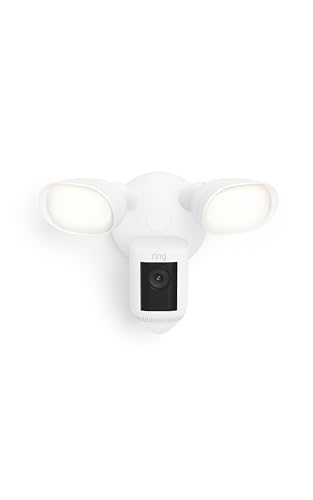
As a security instrument, the Ring Floodlight Cam Wired Pro is the most complete single fixture here. Its radar-based 3D Motion Detection does something no pixel-based rival matches: it tracks a visitor’s path across your property — Bird’s Eye View draws the route — so an alert tells you not just that something moved, but that someone crossed the drive, paused at the car and approached the door. That path intelligence, plus customisable zones drawn to your boundary rather than the street, is what separates a security alert from noise. Add two floodlight heads rated by Ring at 2,000 lumens, a remote siren, Retinal 2K video and always-awake hardwired power, and you have the strongest deter-and-witness combination that fits one junction box.
Its security weakness is contractual, and it is total: there is no local storage, and without a paid Ring plan the camera records nothing — no history to hand to police, no clip to send an insurer, no person or package alerts. A security buyer must therefore treat the plan as part of the system, permanently, the way an alarm owner treats monitoring. Let it lapse and your flagship becomes a live-view intercom. With the plan kept, the archive is genuinely survivable evidence: stored in the cloud, beyond the reach of anyone who attacks the camera itself, and shareable in minutes.
Operationally it is built for uptime: hardwired power with no battery to die in a cold snap, dual-band Wi-Fi for a cleaner link through an exterior wall, Audio+ talk clear enough to challenge a visitor from your phone, and lights that double as scheduled security lighting so the approach is never dark on a timer’s whim. Fit it over the main approach — drive, front path, garage — where deterrence and identification matter most, aim the radar zones to your boundary, and it does the security job as well as anything at this ceiling. Just sign the plan with your eyes open.
Who it suits: Households building a real security layer over the main approach, who want tracking, deterrence and a cloud archive, and who will keep the plan permanently.
- Radar path tracking shows the route a visitor took, not just a snapshot of motion
- 2,000-lumen lights (maker figure) and a siren deliver genuine, visible deterrence
- Cloud archive survives destruction or theft of the camera itself
- Hardwired uptime: no battery failure mode on the coldest night
Honest limitation: The archive exists only while the plan does. No plan, no recordings — the starkest dependency in this guide, and one a security buyer must accept deliberately or choose another system.
Choose it if you want the main approach deterred, tracked and archived, and you treat the plan as a permanent part of the system. Skip it if you want evidence that no subscription can switch off — the eufy and Wyze record locally by design. Check on Amazon
Wyze Cam Floodlight Pro
The Wyze Cam Floodlight Pro is the brute-force security answer, and brute force has real merit at 2 a.m. Three floodlight heads rated by Wyze at 3,000 lumens — the most light in this guide — erase the darkness a yard or drive depends on, while a 2.5K camera with a 180° view records the entire area from one fixture, no blind corner at the edges. Its on-device processing can trigger those lights for people and vehicles specifically, which is the correct deterrence logic: light that answers a person, not a moth. Crucially for a security buyer, it records to a microSD card in the camera with no plan required, so the evidence function cannot be switched off by a lapsed card payment.
The honest weaknesses are the other side of that design. The card lives in the camera, so a thief who takes the camera takes the archive — mitigate by mounting high and treating the Wyze as the deterrence layer whose job is to prevent the close approach in the first place. Without the optional Cam Plus plan, alerts arrive as thumbnails and person or package labels are off, though recordings continue; the plan adds cloud clips, which also answers the stolen-archive problem for those who want both belts and braces. The memory card itself is not included, and a security setup should budget a large, endurance-minded card from day one.
As a fixture it is unapologetically industrial: bulky, bright and obvious — which, for deterrence, is a feature. Wi-Fi is 2.4 GHz only, so the mounting point needs a solid signal, and the maker weather rating is a step below the eufy’s, though fine for eaves life. Position it over the largest, darkest approach — the rear yard, the side drive, the outbuilding frontage — where its width and wattage do what narrower, tidier cameras cannot. In a layered setup it is the anvil: the light and the wide witness that make the whole property feel watched.
Who it suits: Owners of large or dark approaches who want maximum deterrence and fee-free recording, mounted high as a visible security presence.
- Brightest deterrent light in the guide (maker figure) across three aimable heads
- 180° recorded view leaves no blind corner in a yard or drive
- Local card recording cannot be switched off by a lapsed subscription
- Person and vehicle light-triggering aims the deterrence at the right events
Honest limitation: The archive sits in the camera, so mount it out of reach; free alerts without Cam Plus are thumbnails only. The card is an extra purchase, and the fixture’s bulk is a look you either want or you do not.
Choose it if your priority is a lit, recorded, obviously defended main area, with recording that owes nothing to a plan. Skip it if you need the archive guaranteed safe from camera theft above all — the eufy’s in-home hub or a cloud plan answers that. Check on Amazon
eufy Security eufyCam S330 (eufyCam 3) 2-Cam Kit
The eufyCam S330 kit is the archive-integrity pick, and archive integrity is the security property buyers discover after the first incident elsewhere. Two 4K cameras watch two approaches — front and rear, drive and door — and every recording is stored on the HomeBase 3 inside your house. An intruder can attack a camera; he cannot take the footage, because the footage was never in the camera. The HomeBase also performs person and face recognition locally, so the smart layer works with no subscription, no cloud dependency and no footage leaving your home to be labelled. For a security buyer who thinks in failure modes, this architecture is the most reassuring in the guide.
Deterrence is its quieter suit. The cameras carry spotlights rather than true floodlights, so they announce themselves at close range rather than flooding a drive, and there is no siren on the scale of the Ring’s. The solar panels, meanwhile, are an endurance feature: on a sunny mount they stretch charging intervals to seasons, shrinking the flat-battery failure mode that quietly disables battery cameras — with the maker’s assumption of a few hours of sun a day stated plainly, and shaded mounts still needing occasional manual charging. The cameras carry the strongest weather rating here, maker-rated IP67.
Coverage planning is where the kit quietly wins: most homes are entered, approached or cased from two directions, and single-camera households watch one while assuming the other. The kit removes the assumption on day one. Its price moves with promotions and sits at the top of the tier, so confirm it is at or under your ceiling when you buy. Pair it with good locks and lighting and you have the most complete fee-free security layer at this level: two sharp viewpoints, an archive at home, and no contract standing between you and your own evidence.
Who it suits: Security-minded households that want two approaches covered and the archive kept inside the home, with no subscription anywhere in the system.
- Recordings live on an in-home hub a camera-tamperer cannot reach
- Two 4K cameras cover the two approaches most incidents actually use
- Person and face recognition run locally with no plan required
- Solar endurance shrinks the flat-battery failure mode on sunny mounts
Honest limitation: Deterrence is modest — spotlights, not floodlights — so pair it with lighting on the main approach. Shaded mounts blunt the solar benefit, and the kit price needs checking against the ceiling on buying day.
Choose it if you think like a security buyer: evidence survivability and two-direction coverage first, spectacle second. Skip it if your main approach needs floodlight-scale deterrence — lead with the Ring or Wyze and add viewpoints later. Check on Amazon
Arlo Pro 5S 2K Spotlight Camera
Every property has approaches the wiring cannot reach: the side gate, the fence line, the outbuilding, the far corner where a wired camera would need a trench. The Arlo Pro 5S 2K is the security answer for those places. Wire-free, with a 160° view that watches two walls from one corner, 2K HDR detail that holds up when you zoom into a face or a jacket logo, an integrated spotlight for colour night footage and a siren in a camera the size of a fist — it puts a real witness where the alternative is no witness at all. For a layered setup, that is often the highest-value camera in the system.
Its security terms need the clearest statement in this guide after the Ring’s. Cloud recording and the person, vehicle, animal and package detection live in the Arlo Secure plan; without it, you have live view and basic motion alerts, and nothing is saved. Local recording exists only through a compatible SmartHub bought separately, which does have one security virtue worth noting: like the eufy, it keeps the archive indoors, away from the camera. The security buyer therefore chooses deliberately — plan for cloud survivability, hub for in-home survivability — and rejects the third option, neither, which leaves the approach watched but unwitnessed.
Endurance is the battery camera’s eternal caveat, stated as a maker claim: battery life assumes typical event counts, and a busy gate in winter will call for charging far sooner than a quiet one. The swappable battery makes the chore short, a solar accessory can stretch it, and the app reports charge honestly if you let it. Mount the Arlo where its wide eye covers the approach a wired camera cannot, keep its recording path funded or hubbed, and it closes the gap in a security plan that every intruder’s route planner would otherwise find.
Who it suits: Households whose risk map includes unwired approaches — gates, fences, sheds, side paths — that still need a recording witness.
- Wire-free placement puts a witness exactly where wiring cannot go
- 160° view and 2K HDR detail serve identification at gate distances
- Spotlight, colour night vision and siren in one compact unit
- Optional SmartHub route keeps the archive indoors, like the eufy
Honest limitation: Recording requires the plan or the separate hub; with neither, the approach is watched but nothing is kept. Battery endurance is a maker claim that busy, cold viewpoints will test.
Choose it if your security gap is a specific unwired approach and you will fund the plan or fit the hub to close it properly. Skip it if you want the main approach covered — wired picks deter harder — or you refuse both plans and extra hubs on principle. Check on Amazon
Google Nest Cam with Floodlight
The Nest Cam with Floodlight contributes the security property the others struggle with: judgement. Its person, animal and vehicle detection runs on the device, free, so an alert at 3 a.m. arrives already telling you whether a person is on your drive or the neighbour’s cat is on its rounds. Security systems fail socially before they fail technically — owners mute the noisy ones — and the Nest’s free, accurate sorting is the strongest anti-muting technology in this guide. A short recent event window is included at no cost, enough to review an incident while it is fresh; the paid Nest Aware tier extends that memory to weeks and adds familiar faces.
As a witness it is competent rather than elite: 1080p HDR across a 130° view identifies well at door and path distances and softens sooner than the 2K and 4K picks across a wide drive. Its floodlights serve the camera and the doorstep honestly without rivalling the Wyze or Ring for area deterrence. There is no local storage: footage lives in Google’s cloud, which is survivable against camera theft but entirely dependent on your connection and your account standing — a trade the security buyer should make consciously.
Where the Nest earns its security place is the lived year: hardwired, so no battery failure mode; discreet, so it does not advertise itself as a target; and integrated with the Google Home routines many households use to make a house look occupied. Place it over the front door and path — the judgement zone, where knowing person from parcel from pet is the whole job — and pair it with a heavier deterrent on the drive if your risk map demands one. It is the thinking layer of a security setup, and thinking layers are rarer than bright ones.
Who it suits: Households that want trustworthy alerts above all — the system that cries wolf least — over the front door and path.
- Free on-device person, animal and vehicle detection keeps alerts meaningful
- Hardwired endurance with no battery failure mode
- Free recent-history window covers fresh incidents without a plan
- Discreet fixture integrates with Google Home occupancy routines
Honest limitation: 1080p detail trails the 2K and 4K picks at driveway range, and long memory needs Nest Aware. No local storage exists, so the archive is cloud-only.
Choose it if alert accuracy and a system your household will still listen to in month six matter most. Skip it if you need maximum identification range or an archive independent of any cloud. Check on Amazon
Blink Outdoor 4 Floodlight Camera
The Blink Outdoor 4 Floodlight Camera is the sentinel for the door nobody thinks about — the side entrance, the basement door, the garage pedestrian door — which is, not coincidentally, the door an intruder prefers. Its security logic is endurance: AA lithium batteries in the camera and D cells in the floodlight mount, with a maker claim of up to two years under default settings, mean this camera is still on duty long after fussier systems have been forgotten mid-chore. A modest 700-lumen floodlight, a 143° view and infrared night vision cover a doorway properly at doorway distances, and the whole system costs so little of the tier that it can be added where a flagship would never be justified.
Its terms, stated plainly: cloud recording and person detection require the Blink Subscription Plan; without it you keep live view, motion alerts and two-way talk but no saved cloud clips. Local storage is available in Blink’s range only through a different Sync Module with a USB drive — the Sync Module Core in this box cannot store clips — so a security buyer should buy the module that matches the intention, or keep the plan, and not discover the distinction after an incident. A sentinel that does not record is a doorbell that glows; set the recording path up properly and it is a witness.
Within those terms it does its one job well. It is small, unobtrusive and quick to fit, its alerts cover the quiet approaches that main cameras ignore, and its footage at close range is entirely adequate for the question a side door asks: who was that, and when? In a layered plan it is rarely the star and often the save — the camera that was watching the approach the flagship was not. Security is coverage of the unglamorous angles, and nothing here covers them more cheaply or with less upkeep.
Who it suits: Households completing a security layer over secondary doors and side approaches, valuing endurance and coverage over flagship detail.
- Exceptional battery endurance under the maker’s claim keeps the quiet doors watched
- Small, quick and inexpensive in the tier: justifiable on every secondary approach
- Floodlight and alerts sized correctly for doorways and side paths
- Grows across a property one affordable camera at a time
Honest limitation: Recording needs the plan or a different Sync Module than the one in the box — buy accordingly. Detail is doorway-grade, not driveway-grade, and 700 lumens is local light, not area light.
Choose it if you are closing the gaps — side doors, basement doors, garage doors — in an otherwise covered home. Skip it if this would be your only camera on a main approach, where the deterrence picks above earn their place. Check on Amazon
Comparison table
Read this table as a security audit: deterrence across the top, archive survivability down the side, and the subscription column as the fine print that decides both.
| Product | Video and view | Power | Storage and subscription | Link |
|---|---|---|---|---|
| Ring Floodlight Cam Wired Pro | Retinal 2K HDR video, 2,000-lumen floodlights, hardwired; 140° horizontal field of view | Hardwired (100-240V) or plug-in variant | Cloud only with a paid Ring plan; no local storage and no memory-card slot | Check on Amazon |
| Wyze Cam Floodlight Pro | 2.5K video, 3,000-lumen floodlights, 180° view; 180° field of view, the widest in this guide | Hardwired to an existing floodlight junction box | Local recording to a microSD card you supply (card not included), plus optional cloud recording through the paid Cam Plus plan | Check on Amazon |
| eufy Security eufyCam S330 (eufyCam 3) 2-Cam Kit | 4K video, integrated solar panel, HomeBase 3 local storage; 135° field of view per camera | Battery with an integrated solar panel | Local storage on the included HomeBase 3 (built-in memory, expandable with a user-supplied drive); recordings stay in your home, not on a rented server | Check on Amazon |
| Arlo Pro 5S 2K Spotlight Camera | 2K HDR video, 160° view, wire-free battery power; 160° diagonal field of view | Rechargeable battery, wire-free | Cloud recording sits in the paid Arlo Secure plan; local recording is only possible through a compatible Arlo SmartHub or base station bought separately | Check on Amazon |
| Google Nest Cam with Floodlight | 1080p HDR video, smart floodlight, wired power; 130° diagonal field of view for the camera | Hardwired to an existing floodlight junction box | Cloud-based through the Google Home app; there is no memory-card slot and no local hub storage | Check on Amazon |
| Blink Outdoor 4 Floodlight Camera | 1080p HD video, 700-lumen floodlight, battery power; 143° diagonal field of view | Battery powered: AA lithium cells in the camera and D cells in the floodlight mount | Cloud recording requires the Blink Subscription Plan. The Sync Module Core in this box does not take a USB drive, so local clip storage needs a different Sync Module bought separately | Check on Amazon |
How to choose the best outdoor security camera for home security under $300
Map approaches before you shop
Walk your property the way a stranger would: kerb to front door, street to side gate, lane to back door, fence to outbuilding. Every route a person can take to a door or window is an approach, and each approach wants a witness. Most homes have two that matter and one that is forgotten — usually a side or basement door. Assign the main approach your strongest deter-and-witness pick, the second approach a solid camera, and the forgotten door at least a sentinel. A plan drawn on this walk will outperform any amount of spec comparison, because cameras fail by absence more often than by quality.
Note the light and the wiring on the same walk. Approaches with an existing light fitting can take the wired deterrents; dark, unwired approaches need battery or solar witnesses, or new lighting considered as part of the security budget. The map, not the marketing, should assign each pick in this guide to its post.
Build in layers: deter, detect, record, retrieve
A sound camera setup answers four questions in order. What discourages the attempt? Light and visible presence — the floodlight picks. What notices the attempt accurately? Detection that names a person — every pick here, with the Nest’s free and the Ring’s radar-led. What preserves what happened? A recording path that survives the camera — cloud plans and in-home hubs — or at minimum records without depending on a subscription you might drop. And what can you actually hand over? Footage you can find, save and share in minutes, which is a plan feature on some systems and a local right on others. Test your chosen setup against all four, and fund whichever layer is missing before buying a second camera.
The commonest layer failure is the third: a household that deterred and detected beautifully and recorded nothing, because a trial lapsed or a module could not store. The second commonest is the fourth: footage that exists but cannot be retrieved because the plan that held it was cancelled during a move. Layers fail at their paperwork more often than at their lenses.
Choose the archive like an insurer
Ask where the footage is on the worst day: the day the camera is ripped off the wall. Cloud archives — Ring with its plan, Arlo with its plan, Nest with Aware, Blink with its plan — survive that day completely. In-home hub archives, the eufy pattern, survive it as long as the hub is indoors and unremarkable. Card-in-camera archives, the Wyze pattern, do not survive it, which is why card cameras should be mounted high and treated as deterrents first. None of these is the wrong answer; matching the answer to your actual risk is the job. A quiet close and a busy street have different worst days.
Retention length is the archive’s second question. Free windows are short; plans stretch them. If your incidents are discovered late — a holiday home checked monthly, a slow-leak dispute with a carrier — retention matters more than resolution, and it should be bought deliberately rather than discovered.
Plan for the outage and the winter
Security systems are tested by infrastructure, not intruders. In a power cut, wired cameras stop and battery cameras continue; in an internet outage, cloud cameras cannot upload while hub and card systems keep recording locally; in a cold snap, battery intervals shrink and always-on wired cameras earn their keep. No single pick here wins every failure mode, which is why layered households often mix: a wired deterrent on the main approach, a battery or solar witness elsewhere, an archive split between home and cloud. Under this ceiling you cannot buy all of it at once — but you can buy the first layer knowing which failure it covers.
Then maintain like it matters: a monthly glance at battery gauges and storage, a lens wipe each season, a walk-test after any storm that could have moved a mount. Security cameras fail silently, by drift and dust and quiet expiry. The households whose footage exists are the ones who looked, occasionally, on purpose.
Working with police, insurers and neighbours
Footage that actually helps
When an incident happens, the footage that helps is identified, timestamped and preserved. Save the original clip before doing anything else — on plan systems, download it before any renewal date can touch it; on local systems, copy it off the hub or card. Note the camera’s clock accuracy while you remember it, keep the wide shot that shows the approach as well as the close one that shows the face, and hand over files rather than screen-recordings where the system allows. Every pick in this guide can produce usable evidence when its recording path was set up properly; none can produce it retroactively. That asymmetry is the whole argument for reading subscription terms before an incident, not after one.
Neighbours are part of the system
Aim cameras at your own approaches, mask neighbouring windows and gardens, and tell the neighbours the cameras exist. A street where three houses watch their own frontages is a street that feels watched everywhere; a camera that films a neighbour’s garden is a dispute that ends with the camera moved or removed, and a gap in your coverage where it stood. The picks here all offer zones or masking. Use them like you live there — because the system’s permission to exist is partly social, and it can be withdrawn socially.
Common mistakes
- A deterrent that does not record: Lights and a siren change behaviour, but the incident that happens anyway needs footage. Never let a plan lapse turn your flagship into a live-view toy — on the Ring, that lapse removes recording entirely.
- The archive in the stolen camera: A memory card is evidence stored at the scene. If your main risk includes the camera being taken, choose a cloud plan or an in-home hub, and mount card cameras high regardless.
- Covering the front, forgetting the side: Intruders read coverage maps too. The side gate and the basement door are the classic gaps; a modest sentinel there outperforms a second flagship on the front.
- Alert fatigue, self-inflicted: Zones drawn to the street and sensitivity left at maximum teach you to ignore the system within a month. Tune until alerts mean something, then trust them.
- Assuming the trial is the product: Judge every cloud camera by its post-trial behaviour and price the plan across the years you will own it. The trial is the demo, not the deal.
- No walk-test, no maintenance: An untested camera is a hope with a lens. Walk the approaches after fitting, after storms and each season, and confirm the alert, the picture and the recording all still happen.
Final recommendation
- Main approach: Lead with the Ring Floodlight Cam Wired Pro over the drive or front path — tracking, light, siren and a cloud archive — with the plan kept as part of the system. Check on Amazon
- Archive at home: The eufyCam S330 kit covers two approaches and keeps every recording on a hub indoors, beyond a tamperer’s reach, with no plan. Check on Amazon
- Dark, wide area: The Wyze Cam Floodlight Pro floods it with light and records to its own card; mount it high and it is a formidable layer.
- Quiet doors: Add Blink sentinels to the side and basement doors, with their recording path — plan or the right module — set up properly.
Security is a system, not a SKU. Choose the archive you trust, deter the main approach properly, witness the quiet ones, and maintain the whole thing like the evidence it may one day be. At this ceiling, that discipline — more than any single specification — is what separates a defended home from a filmed one.
Frequently Asked Questions
Can an outdoor camera actually prevent burglary?
No camera can promise prevention, and this guide will not pretend otherwise. What visible light, a known camera and a siren do is raise the effort and the risk at the moment an opportunist chooses a target, and most opportunistic crime is exactly that kind of choice. The camera’s guaranteed job is the second one: to witness, accurately and survivably, so that what does happen is documented in a form police and insurers can use.
Where is the safest place for my recordings?
Safest means survivable. Cloud archives survive theft of the camera but depend on a kept subscription and your connection; the Ring, notably, records only while its plan is active. An in-home hub, like the eufy’s HomeBase, survives camera theft and subscription lapses alike but should sit somewhere unremarkable indoors. A card in the camera is the most exposed and should be paired with high mounting. Match the archive to the risk you actually face.
Do I need more than one camera for home security?
Most homes do. Incidents use the approach that is unwatched, and a single camera — however good — leaves the other doors to faith. The practical minimum for many houses is the main approach plus the side or rear door, which is why a two-camera kit and affordable sentinels feature in this guide. One excellent camera, well placed, still beats two careless ones; but coverage of the forgotten door is the highest-value second purchase in this category.
What should I do with footage after an incident?
Preserve the original first: download cloud clips before any plan date can affect them, and copy local clips off the hub or card before they are overwritten. Keep the wide approach shot and the close identification shot, note the time and any clock drift, and share files with police or your insurer rather than re-recorded screen captures. Retention windows differ by system and plan, so treat the first day as the deadline, not the first week.
Will a camera keep working in a power cut or internet outage?
Partially, and the pattern differs by design. Battery cameras keep watching through a power cut; wired ones stop with the house. In an internet outage, cloud cameras cannot upload, so their history gaps, while hub and card systems keep recording locally and show you the footage when service returns. No consumer camera here summons help by itself; for monitored response, a camera system complements an alarm rather than replacing it.
Are sirens and floodlights worth it, or just theatre?
They are the deterrence layer, and deterrence is the layer that works before anything happens. Light removes concealment, a siren announces attention, and both are most effective exactly where opportunists operate: at the approach, in the first seconds. They do not stop a determined intruder, which is why this guide pairs them with detection accuracy and survivable recording rather than selling them as a complete answer.


