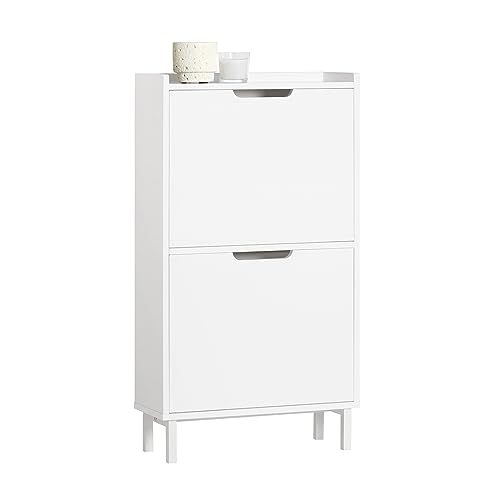
Where to buy
Check the latest price, availability and delivery on Amazon. Orders are placed on Amazon. We may earn a commission from qualifying purchases.
- Best overall for small spaces: Haotian Slim Shoe Cabinet with 2 Flip Drawers, FSR151 — Check on Amazon
- FUFU&GAGA Shoe Cabinet with 2 Flip Drawers — Check on Amazon
- BORNOON Shoe Cabinet with 2 Flip Drawers — Check on Amazon
- VASAGLE LIRY Collection Shoe Cabinet, 3-Tier with Hinged Doors — Check on Amazon
- Angel Sar Rattan Shoe Cabinet with 2 Flip Drawers — Check on Amazon
- HOMEFORT Shoe Storage Cabinet with 2 Flip Drawers — prose-only pick, see the review below for why
Read the full guide ↓
Disclosure: As an Amazon Associate, dailyhomedecorating.com earns from qualifying purchases. Links to Amazon on this page are affiliate links; they cost you nothing extra. Listing details such as price and availability change often, so check the current Amazon listing before you buy.
The best shoe cabinet for small spaces under $100 is a cabinet measured in inches rescued, not pairs stored. Small spaces are not just small apartments — they are the narrow hallway in a family house that four people and a dog must pass through, the landing at the top of the stairs, the under-stair wedge, the closet wall in a bedroom, the last thirty inches beside a back door. What unites them is that the space was not designed for furniture at all, and anything placed there is borrowing room from movement. An open rack in such a spot is a daily obstacle with shoes on it. A closed cabinet, chosen at the right depth, becomes something else: a flat, calm surface against the wall that happens to contain the footwear, narrowing the passage by inches you can spare instead of feet you cannot. The discipline of this category is depth — every pick below is judged first by how little of the room it takes, and only then by how much it holds.
This guide works through the under-$100 closed-cabinet field with a tape measure in hand. The leader is the slimmest verifiable cabinet in the budget, about seven and a half inches deep, in compact and tall versions that spend width or height depending on which your space can give. Behind it: a compact cabinet for the wall fragment beside a door, a divided slim cabinet for shared narrow halls, the one deeper door cabinet — included for closets and alcoves, the small spaces where depth exists and flat storage wins — a woven style pick for the small spaces that are also seen spaces, and a high-capacity farmhouse model covered prose-only because its price would not stay verifiably under $100. A placement tour later in the guide walks the classic small spaces one by one — hallway, landing, under-stair, closet, behind-door — and matches each to the format that survives it, because in small-space storage, placement is not the last decision. It is the first one.
In this guide
Quick Picks
Short on time, or comparing several options at once? Each row below names a small-space situation and the cabinet that suits it, with a link to the listing where one is available.
| Small-space situation | Pick | Why it stands out | Link |
|---|---|---|---|
| Best overall for small spaces | Haotian Slim Shoe Cabinet, FSR151 | About 7.5 inches deep — the slimmest closed cabinet in this budget | Check on Amazon |
| Best compact fragment-filler | FUFU&GAGA Shoe Cabinet with 2 Flip Drawers | 22.4 inches wide, removable tiers, low profile | Check on Amazon |
| Best shared narrow hall | BORNOON Shoe Cabinet with 2 Flip Drawers | Four compartments in a slim body — order in a tight passage | Check on Amazon |
| Best for closets and alcoves | VASAGLE LIRY Collection Shoe Cabinet | Hinged doors, flat shelves — depth used where depth exists | Check on Amazon |
| Best seen-space style | Angel Sar Rattan Shoe Cabinet | Rattan fronts on legs — the small space that is also a room | Check on Amazon |
| Most capacity on one wall | HOMEFORT Shoe Storage Cabinet | Layered drawers — covered prose-only, verify the live price | See review |
How These Picks Were Chosen
The standing filters apply: fully closed cabinets only — an open rack in a passage is an obstacle, not storage — real Amazon listings, and prices verified within the budget at research time, with one transparent prose-only exception. Check price on Amazon before ordering, since this category’s pricing moves. The small-space screening then applied a single ruthless ordering: external depth, then footprint shape, then everything else. Cabinets were sorted by the passage they leave behind in a standard 36-inch hallway — the ultra-slim leaves a genuinely walkable corridor, the standard slim leaves a workable one, and the one deep cabinet in the guide is recommended only where the space is a destination (closet, alcove, under-stair) rather than a route. Shape mattered next: tall-narrow formats that spend ceiling instead of floor outranked wide-low ones wherever both existed. Interior honesty was enforced throughout — maker pair counts were discounted to realistic planning figures, and shoe-size ceilings are stated in every review, because in a small space a cabinet that does not fit your shoes is not storage at all, just furniture in the way.
We did not use these cabinets ourselves. Dimensions and mechanisms are drawn from maker listings, instruction manuals and specification sheets, checked against retail coverage, and the placement advice reflects the measured geometry of the formats — drawer tip arcs, door swings, handle clearances — rather than impressions. Where a specification could not be verified, the review says so and plans around the gap instead of filling it.
The 6 Best Shoe Cabinets for Small Spaces Under $100
Haotian Slim Shoe Cabinet with 2 Flip Drawers, FSR151
Who it suits: Any space where depth is measured in single inches — narrow hallways, behind doors, landings, the wall beside a staircase.
The Haotian’s specification is its entire review, and it is a remarkable one: about 7.5 inches deep. No other closed cabinet in this budget — and few at any price — closes shoes into less depth. The format family offers the same shallow body in two shapes: a compact two-drawer at roughly 19.7 inches wide and 35.8 inches high, and a tall three-drawer at the same width and about 50.8 inches high. Small-space strategy chooses between them by which dimension the space can spend: width-poor, height-rich spots — landings, stair walls, the strip beside a door casing — take the tall version; low wall runs under windows or beside low furniture take the compact. The fronts are flat panels in white, black or grey, handles are hollowed cutouts that protrude nothing into the passage, the base is raised so cleaning passes beneath and a pair of slippers can live under the cabinet, and the interior shelf adjusts. Retail coverage written from real small homes puts the compact version’s realistic capacity at around six pairs and notes the drawers can stick slightly, wanting a braced hand — the honest texture of a mechanism working at the edge of shallowness. The steep tilt inside caps shoe sizes at small-to-average; that is the standing price of 7.5 inches, stated rather than hidden. Check price on Amazon; it sits at the accessible end of the budget.
Anchoring is part of this pick’s small-space story: a tall cabinet this shallow must be wall-fixed, and in the tight spots it serves, that fixing is also what lets it disappear — flat, flush, silent against the wall. Placed well, it is the only pick here that can stand in a working hallway without the hallway’s users ever negotiating with it, which is the entire definition of small-space success.
- About 7.5 inches deep — the slimmest closed storage in the guide, full stop.
- Compact and tall versions spend width or height as the space allows.
- Cutout handles and raised base keep passages and cleaning unobstructed.
Honest limitation: Around six pairs in compact form, a firm shoe-size ceiling, and drawers that can stick slightly — the physics of extreme shallowness.
Choose it if your space is a route people pass through. Skip it if the space is a closet where depth exists and flat storage would serve better.
FUFU&GAGA Shoe Cabinet with 2 Flip Drawers
Who it suits: The leftover wall fragment — beside a door, at a hallway’s end, under a window — roughly two feet wide and otherwise useless.
Every home has a fragment: a wall piece too small for real furniture, too visible to waste. At about 22.4 inches wide, 9.4 inches deep and 29.2 inches high, the FUFU&GAGA is dimensioned for exactly that fragment, and its low height is a small-space asset in its own right — it slips under windows, under stair slopes at the right point, and beneath wall-mounted anything without crowding. Inside, two flip drawers carry two tiers each, and the tiers remove: in small-space terms, that convertibility lets one cabinet serve flats in summer and, with a tier pulled, low boots in winter, instead of demanding a second storage spot the home does not have. The MDF’s waterproof finish suits the fragments near doors where weather enters. Realistic capacity is six to eight daily pairs, fit ceiling around a men’s size 10, in modern flat-front finishes. Check price on Amazon; mid-budget.
Its top, at under thirty inches, lands at the height small spaces can use — a landing surface where a tall cabinet would only loom. In a hallway end it becomes the key-and-mail point; under a window it stays below the sill line and the light. If your fragment is narrower than twenty-two inches, no cabinet in this guide fits it and the honest answer is the tall Haotian on a different wall; if the fragment is what we described, this is its furniture.
- 22.4-inch width and low height — built for leftover wall fragments.
- Removable tiers convert the interior between seasons.
- Waterproof-finished MDF for door-adjacent fragments.
Honest limitation: Six to eight pairs and a size-10-ish ceiling — a fragment cabinet, not a household hub.
Choose it if you have the classic two-foot fragment. Skip it if the fragment is imaginary and the real need is capacity.
BORNOON Shoe Cabinet with 2 Flip Drawers
Who it suits: Shared small spaces — a narrow hall serving several people — where the space is tight and the shoes are everyone’s.
A narrow hallway used by a whole household fails in a specific way: not lack of storage, but a communal pile compressed into the smallest possible area. The BORNOON brings order at slim scale — roughly nine and a half inches deep, flat fronts with hidden handles in white or black, and an interior divided into four compartments across two flip drawers. In a small space, division is a space-saving feature, not merely an organizational one: sorted shoes stack denser, are found without emptying a drawer onto the passage floor, and stay at the count the cabinet was sized for instead of metastasizing. The brand’s three-drawer sibling is its best-known model and was above this budget when checked; the two-drawer is the verified pick — check price on Amazon and confirm the variant, since the two listings look nearly identical.
Plan capacity as a shared rotation — roughly ten to twelve mixed pairs across the compartments — and note the fixed compartment widths suit mixed sizes better than uniformly large feet. In the tightest passages the white finish against a pale wall is the closest thing to invisibility this guide offers. The sorting system in full is covered in Best Shoe Cabinet For Families Under $100; here the BORNOON is the shared-hall pick.
- Four compartments bring order — and density — to shared narrow halls.
- Slim body, hidden handles, monochrome fronts that recede.
- Two-drawer version verified in budget; three-drawer was above it.
Honest limitation: Fixed compartment widths and rotation capacity — a system for the daily pairs of a shared home.
Choose it if several people share one tight passage. Skip it if the space is a closet — flat shelves use closet depth better.
VASAGLE LIRY Collection Shoe Cabinet, 3-Tier with Hinged Doors
Who it suits: The small spaces that are destinations, not routes — closets, alcoves, under-stair enclosures — where depth exists and should be spent on flat storage.
Small-space advice usually stops at slim, but some small spaces are deep: a closet is twenty-four inches of depth with a door on it, an under-stair cupboard is a wedge of volume, an alcove is a room-shaped dent. In those spaces, a slim flip cabinet wastes the very dimension the space has plenty of. The VASAGLE — about 13.8 inches deep, 31.5 inches wide, 27.6 inches high — is the pick that spends depth properly: hinged doors opening on three flat shelves, the upper shelf adjustable through five positions, shoes lying flat at full size, capacity an honest 9 to 12 pairs including the larger sizes flip drawers refuse. Inside a closet it behaves like built-in shelving with a finished front; in an alcove, its wide top becomes a surface the small room can use. An anti-tip kit and elevated base are included. Check price on Amazon; comfortably in budget.
The condition is absolute: never place it in a passage. Fourteen inches plus a swinging door in a 36-inch hallway is a daily collision, and no capacity justifies it. Judge your space by its type — route or destination — and this pick sorts itself. The apartment-specific version of the same judgment is worked through in Best Shoe Cabinet For Small Apartments Under $100.
- Flat adjustable shelves — full-size shoes stored normally in deep small spaces.
- Closet and alcove dimensions: wide, low, finished like built-ins.
- 9–12 honest pairs, anti-tip kit included.
Honest limitation: Deepest pick here with door swing — destinations only, never passages.
Choose it if your small space is a closet, alcove or under-stair volume. Skip it if people walk past the spot — slim is the law there.
Angel Sar Rattan Shoe Cabinet with 2 Flip Drawers
Who it suits: Small spaces that are also living spaces — the studio corner, the cottage entry, the landing you see from the sofa.
Some small spaces hide; others are on permanent display. For the displayed ones, the Angel Sar is the pick: natural rattan drawer fronts with slim golden handles, a body on metal legs, in natural, black or white — a woven, furniture-grade object that makes a small corner look composed rather than stored-in. The legs are a small-space feature beyond looks: the raised body reads lighter in a tight spot, and cleaning passes underneath without moving the cabinet. Function is two fold-down drawers at roughly three pairs each — about six pairs, a small rotation — with adjustable shelving in current listings, and the breathable weave quietly helps where shoes and living share air. Check price on Amazon; toward the premium end of this budget, buying the visible quality of the object.
Place it where it will be seen and not struck: rattan dislikes the knocks of a working passage, so the hallway’s traffic line belongs to the flat-front picks. As the seen-space member of a small-space system — this cabinet for the daily pairs in the room, the archive in a closet — it has no rival here. The styling case is made fully in Best Shoe Cabinet For Modern Homes Under $100.
- Rattan fronts and legs — a small space that looks decorated, not stored-in.
- Raised body reads light and cleans easily underneath.
- About six pairs — the seen rotation of a small-space system.
Honest limitation: Smallest capacity in the guide and a weave that dislikes knocks — for seen corners, not traffic lines.
Choose it if the small space is a room you look at. Skip it if the spot takes daily impacts or must hold a household.
HOMEFORT Shoe Storage Cabinet with 2 Flip Drawers
Who it suits: A single stretch of wall — about thirty inches — that must do all of a small home’s closed shoe storage, farmhouse style welcome.
The HOMEFORT appears prose-only, without a link, because its price sightings straddle the $100 line — inside it on retail trackers, above it on Amazon’s own category page — and this guide does not link on uncertainty. Verify the live listing; under $100, its small-space case is capacity per inch of width: two flip drawers with two internal layers each and adjustable or removable panels, a realistic mid-teens count of mixed pairs in a slim body on wood legs — the most daily storage the flip format offers, for the small home whose one wall must hold everything. The maker’s manual confirms the layered design; the flat top adds the landing surface small spaces always need. Assembled weight around 52 pounds keeps it planted once built.
Cautions: assembly is reported as the fiddliest here — in a small home, build in place — and the farmhouse finish is a visible commitment in a tight room. If the live price is over budget, the slim substitutes are the BORNOON for division and the Haotian for depth; the wider field is in Best Shoe Cabinet Under $100.
- Layered drawers — the flip format’s most capacity per wall inch.
- Adjustable panels fit the interior to the household’s actual shoes.
- Prose-only: price sightings conflict across the $100 line.
Honest limitation: Price instability and fiddly assembly; capacity claims still assume average sizes.
Choose it if the price is under $100 and one wall must do everything. Skip it if the price has drifted or the wall run is short.
Comparison Table
| Product | Space character | Best small-space use | Link |
|---|---|---|---|
| Haotian FSR151 | ~7.5 in deep; compact or tall | Passages, behind doors, landings | Check on Amazon |
| FUFU&GAGA 2 Flip | 22.4 in wide, low | Wall fragments, under windows | Check on Amazon |
| BORNOON 2 Flip | Slim, 4 compartments | Shared narrow halls | Check on Amazon |
| VASAGLE LIRY | ~13.8 in deep, hinged doors | Closets, alcoves, under-stair | Check on Amazon |
| Angel Sar Rattan | Slim, legged, ~6 pairs | Seen corners and studio entries | Check on Amazon |
| HOMEFORT 2 Flip | Slim, layered drawers | One-wall capacity — verify price | See review |
How to Choose the Best Shoe Cabinet for Small Spaces Under $100
- Classify the space first: route or destination. Routes — hallways, landings, passages — demand slim cabinets under ten inches deep. Destinations — closets, alcoves, under-stair volumes — can spend depth on flat storage. Most small-space failures are a destination cabinet bought for a route.
- Measure depth at the floor, with the baseboard. Baseboards and casings steal up to an inch that wall measurements miss, and slim cabinets live or die by that inch.
- Tape the footprint and the opening arc. Flip drawers tip toward you about a foot; hinged doors swing their full width. Live with the tape through a day of traffic before ordering.
- Spend the dimension you have. Height-rich spaces take tall cabinets; width-rich fragments take low wide ones; depth-rich closets take door cabinets. The right pick is the one whose shape matches the space’s surplus.
- Respect the shoe-size ceiling. Slim formats cap sizes — around average in the ultra-slim, around a men’s 10 in standard slim. Measure your largest daily pair and believe the result.
- Anchor shallow cabinets without exception. The shallower the cabinet, the more its stability is borrowed from the wall. Plan the fixing as part of placement, especially on landings and in stair-adjacent spots.
- Keep the rotation edited. Small-space cabinets hold this season’s daily pairs. The archive belongs in the deep spaces — closet tops, under-bed — where volume is free.
- Protect the floor line. In tight spots the cabinet meets every mop, vacuum and wet boot. Raised bases and waterproof finishes are small-space durability, not decoration.
A Placement Tour: Five Classic Small Spaces
The narrow hallway. A route, governed by passage width. The ultra-slim Haotian against the longest wall run, anchored, with the household’s daily pairs divided if the BORNOON’s compartments suit better at standard slim depth. Nothing deep, nothing swinging, ever.
Behind the front door. The wedge everyone forgets. It belongs to the 7.5-inch class alone, and only after the handle-arc test: open the door fully, mark where the handle travels, and confirm the cabinet front clears it and the drawers can still tip open with you standing in the gap.
The landing. A route that pauses. Landings tolerate a tall slim cabinet against the balustrade-opposite wall, where it serves the bedrooms’ overflow — but never where it narrows the stair’s exit line, and always anchored, because landings are where children run.
Under the stairs. A destination with a sloped ceiling — measure the height at the point the cabinet’s back edge will stand, not at the front. Low cabinets like the FUFU&GAGA and VASAGLE fit the slope’s usable band; the wedge behind them takes the archive boxes.
The closet wall. A destination with depth to burn. Here the door cabinet’s flat shelves outperform every flip format, and the closet’s own door hides the whole arrangement — the one small space where capacity, not slimness, is the correct god. The full under-$100 field, ranked without the small-space weighting, is in Best Shoe Cabinet Under $100.
Depth, Decoded: What Each Inch Costs and Buys
Because this guide is organized around depth, here is the full ledger in one place. At about seven and a half inches, a closed cabinet fits behind doors and in working passages, and pays for it with a steep storage tilt, a small-to-average shoe-size ceiling and single-digit capacity. At about nine and a half inches — the standard slim class — the tilt relaxes, average sizes sit comfortably, capacity climbs into the low teens for divided and layered models, and the cabinet still leaves a workable passage in a standard hallway; this is the depth most small spaces should default to when they can. At about fourteen inches, the format changes entirely: shoes lie flat on shelves, sizes stop mattering, boots-adjacent heights become possible on an adjusted shelf — and the cabinet stops being passage furniture altogether, becoming closet and alcove furniture instead. Read the ledger against your measured space and the choice usually makes itself. The errors happen when buyers shop the third row’s capacity with the first row’s hallway, or the first row’s slimness for a closet that had depth to spare. Neither cabinet is wrong; the pairing is.
Small Spaces Beyond the Entry: Closets, Bedrooms and Work Corners
Not every small-space shoe problem lives at the front door. The bedroom closet floor is the second classic site: a low door cabinet like the VASAGLE, standing inside a reach-in closet, converts the shoe pile under the hanging clothes into flat, visible, closed storage and frees the entry cabinet to hold only the daily pairs. The bedroom corner is the third: in homes where the entry is truly wall-less, a compact flip cabinet beside the wardrobe accepts the walk as the price of a living room without a shoe zone, and the routine works because the shoes’ owner passes the spot twice a day anyway. Work corners and garage-adjacent utility nooks form the fourth site — the place work boots and gym shoes actually shed — where a waterproof-finished compact cabinet keeps the occupational footwear out of the home’s living circulation entirely. The principle across all four sites is the one this guide opened with: place the cabinet where the shoes come off, at the depth that spot can spare, and let the front door keep only what the front door genuinely needs.
Ventilation, Odor and Moisture in Tight Storage
Closed storage in small spaces concentrates one problem open racks disperse: damp shoes in a sealed box. The management is simple and belongs in any small-space buyer’s plan. Never close wet shoes inside any cabinet in this guide — an hour on a tray by the door first, or overnight in the wet season — because the enclosed volume will hold the moisture against the cabinet’s panels and the shoes’ linings alike. Woven-front cabinets breathe passively and are the forgiving choice where shoes go in slightly damp despite intentions. For panel cabinets, a small cedar block or a sachet in each drawer keeps the interior fresh, and a monthly ten minutes with the drawers open during cleaning airs the whole system. In under-stair and closet placements, where the surrounding air is already still, this routine matters most. None of it requires products beyond a tray and a sachet; all of it is the difference between closed storage that smells like furniture and closed storage that smells like a locker room by its second season.
Two Slim Cabinets or One? The Small-Space System Question
Small spaces often need storage in two spots at once — daily pairs at the front door, work or gym shoes at the back — and buyers facing that pattern ask whether one larger cabinet or two slim ones serve better. The answer follows the behavior rule that runs through this guide: shoes are stored where they are removed, or they are not stored at all. Two slim cabinets, one at each removal point, outperform one capacious cabinet at the wrong door every time, because the second location’s pile never forms in the first place. The slim format is what makes the two-cabinet pattern affordable in space: two 9.4-inch cabinets in two spots narrow two passages slightly, while one 14-inch cabinet in a passage can break it entirely. Budget-wise the pattern also staggers well — buy the front-door cabinet now, add the second when the season or the household changes — and the divided models let each location carry its own internal order. The one pattern to avoid is the reverse: one slim cabinet bought for a deep closet, where its shallowness wastes the volume and its tilt punishes the sizes a closet would have stored flat. Match each spot its format, and the system, not any single cabinet, is what finally makes a small home feel uncluttered.
Assembly and Leveling in Tight Spots
Small-space cabinets are assembled in the spaces they will serve, which are precisely the spaces with no room to work — so plan the build like a procedure. Unpack in another room and carry panels in one at a time; a small space filled with packaging and a half-built cabinet is how panels get stepped on and scratched. Build the carcass on the floor where the cabinet will stand, because moving an assembled tall slim cabinet through a narrow doorway invites the twist that loosens every cam lock you just tightened. Level before you load: old houses and small cottages have floors that slope visibly over a cabinet’s width, and a slim cabinet on a sloping floor leans against its anchor with constant quiet pressure. Most models include adjustable feet or tolerate a folded shim; use them, then anchor, then load the bottom drawer first and the top last. Finally, operate every drawer five times before the shoes go in — a sticking flip mechanism found now is a five-minute adjustment, while the same mechanism found loaded, in a passage, on a work morning, is a warranty claim and a week of pile. Small spaces forgive nothing during assembly, and reward the methodical completely.
Common Buying Mistakes
- Buying a destination cabinet for a route — the deep door cabinet in the narrow hallway is the category’s classic daily collision.
- Measuring the wall at eye height and forgetting baseboards, casings and the door handle’s arc.
- Ignoring the opening arc: a flip drawer that cannot tip because a opposite wall is too close is a cabinet that cannot open.
- Believing headline pair counts in a space that needed fit, not volume.
- Leaving a shallow tall cabinet unanchored on a landing or in a stair-adjacent spot.
- Filling the small-space cabinet with the whole collection and recreating the obstruction it was bought to remove.
- Choosing the woven style pick for a traffic line, where knocks are daily.
- Ordering the lookalike over-budget variant of a slim pick in one careless click.
Final Recommendation
- Most small spaces: Haotian Slim Shoe Cabinet, FSR151 — tall version where height is the surplus.
- Wall fragments: FUFU&GAGA Shoe Cabinet with 2 Flip Drawers.
- Shared narrow halls: BORNOON Shoe Cabinet with 2 Flip Drawers.
- Closets and alcoves: VASAGLE LIRY Collection Shoe Cabinet.
- Seen corners: Angel Sar Rattan Shoe Cabinet.
- One-wall capacity, price permitting: HOMEFORT Shoe Storage Cabinet — verify the live price.
Classify your space before you shop: if people pass through it, the Haotian’s seven and a half inches is the answer and the only argument is compact versus tall. If the space is a fragment, the FUFU&GAGA was dimensioned for it; if it is shared, the BORNOON divides it; if it is deep, the VASAGLE spends the depth properly; if it is seen, the Angel Sar dresses it. Tape the footprint, test the arcs, anchor the result, and keep the rotation edited — in a small space, the best cabinet is the one you stop noticing, because the passage is clear and the shoes are simply, closedly, gone. Tighter budgets are covered honestly in Best Shoe Cabinet Under $50.
When a Cabinet Is Not Enough: Overflow Honesty
Some small-space shoe problems exceed any cabinet in this guide, and naming that boundary is part of honest guidance. If the household’s daily rotation alone runs past twenty pairs, if work boots and sports gear shed at the same door as dress shoes, or if the only available spot fails both the depth and the arc tests, a single closed cabinet will not civilize the space — it will become a full box beside a continuing pile. The working answers at that point are structural: a cabinet plus a closet rack dividing daily from archive, a cabinet at each of two doors, or a deliberate reduction of the fleet itself, which in a genuinely small home is sometimes the only storage product that works. None of that diminishes the picks above; it locates them. Within a rotation-sized problem — the great majority of small spaces — a correctly placed slim cabinet is a complete solution. Beyond it, buy the system, not a bigger hope.
Seasonal Swaps in Small Spaces
Small-space cabinets earn their keep twice a year, at the seasonal changeover, and the swap deserves a method. Empty the cabinet completely — the twice-yearly full emptying is also its deep clean and its honest audit. Outgoing shoes are cleaned, paired, and boxed to the archive location the same day; a pair that was not worn all season is a donation candidate, and the small home cannot afford sentimentality measured in cubic inches. Incoming shoes are checked against the cabinet’s size ceilings before they are assigned drawers, because the winter fleet is bulkier than the summer one and the cabinet that swallowed July will not swallow January at the same count. Reconfigure removable tiers and adjustable panels for the incoming season’s shapes — this is the moment those features justify themselves — and reset the rotation count to what the new configuration genuinely holds. Done in an hour, twice a year, the swap keeps a small-space cabinet permanently at the right fullness: full enough to be earning its inches, empty enough to close.
Small Spaces in Older Homes: Slopes, Baseboards and Charm
Older homes concentrate every small-space complication at once: floors that slope an inch across a room, baseboards six inches tall with decorative caps, door casings that project, and walls that are not quite plumb. Slim cabinets meet all of it, and the installation adjustments are worth stating. Measure depth from the baseboard’s cap, not the wall — in an old house that cap can steal three quarters of an inch the listing never budgeted for. Shim for the slope before anchoring, because a cabinet shimmed level and then anchored works with its fixings instead of against them. Expect a small shadow gap at the top of a tall cabinet against an out-of-plumb wall and treat it as the house’s character rather than the cabinet’s failure. And in homes where the entry is also the thermal front line — the door that drafts all winter — keep the cabinet off the direct line of the door’s swing and weather, where meltwater pools. None of these adjustments appears in a listing’s feature list, and all of them decide whether a small-space cabinet in an old house looks built-in or merely placed. The charm of old homes is precisely that nothing is standard; the cabinets in this guide, being simple boxes with adjustable feet and honest fixings, adapt to that better than any fitted alternative at this budget.
Frequently Asked Questions
What is the slimmest shoe cabinet available under $100?
The Haotian FSR151 class, at about 7.5 inches deep, is the slimmest fully closed cabinet we could verify in this budget — slimmer than the standard slim class at roughly 9.4 inches. That shallowness suits small-to-average shoe sizes and daily pairs; it is a depth record bought with capacity, and this guide treats it as such.
Can a shoe cabinet fit in a 36-inch hallway?
Yes, in the slim classes. A 7.5-inch cabinet leaves about 28 inches of passage; a 9.4-inch cabinet leaves about 26 — both workable for a residential hallway. A deep door cabinet at 13.8 inches plus swing does not belong in that hallway at all. Tape the line and walk it with bags before deciding.
Where else can a shoe cabinet go besides an entryway?
Landings, under-stair volumes, closet walls, bedroom corners and behind doors all work, matched by type: slim cabinets for routes and behind-door wedges, low cabinets under stair slopes, door cabinets where closet depth exists. The placement tour above matches each classic spot to its format.
Do flip drawers need space in front to open?
Yes — roughly a foot of clear floor for the drawer to tip toward you and for your knees as you use it. In the tightest spots, check the arc against the opposite wall or the front door’s swing. Hinged doors need more: their full width, swept clear.
How do I keep a small-space cabinet from tipping?
Anchor it. Shallow cabinets borrow their stability from the wall by design, and the taller and slimmer the cabinet, the more non-negotiable the fixing. Use the maker’s anti-tip kit where included, load the lowest drawer heaviest, and recheck the fixing after the first week as floors settle.
Can two slim cabinets work better than one wide one in a small home?
Often, yes. Two slim cabinets placed where shoes actually come off — front door and back door, or entry and bedroom — prevent piles at both locations, while one wide cabinet serves only its own spot and leaves the other to improvise. Slim formats also fit the fragments small homes actually offer, where a single wide cabinet fits none of them. The system question is covered in the two-cabinet section above; the short answer is that location beats capacity in small-space storage, and two right-sized cabinets are two correct locations.
What should I do with the space on top of a low cabinet in a small room?
Give it one job and edges. A tray that holds keys and mail turns the top into the room’s landing strip; a single plant or lamp turns it into decor. What it must not become is overflow shoe storage — the moment pairs live on top of a closed cabinet, the small space reads as unstorage again and the cabinet’s whole purpose dissolves. If the top keeps collecting shoes, the rotation is too big for the cabinet, and the fix is the archive box, not a bigger pile.
Is a tall or a low cabinet better for a small space?
Whichever spends your surplus dimension. Tall narrow cabinets suit height-rich, width-poor spots like landings and door-side strips. Low wide cabinets suit under-window runs, stair slopes and fragments where height is capped. Measure both dimensions of the actual spot; the space itself answers the question.


