Disclosure: As an Amazon Associate, dailyhomedecorating.com earns from qualifying purchases. Links on this page are affiliate links; they cost you nothing extra. Prices and availability change often, so check the current Amazon listing before you buy.
Choosing between zojirushi vs cuckoo is really choosing between two rice philosophies that grew up an ocean apart. Zojirushi, the Japanese maker famous for elephant-marked cookers and vacuum flasks, treats rice as a quiet daily ritual that should come out the same gentle way every single morning. CUCKOO, the Korean giant whose name mimics the bird its cookers announce themselves with, treats rice as a performance: faster cycles, higher pressure, more menus, and a machine that talks back. Neither philosophy is wrong. They simply reward different kitchens, and the five verified cookers in this comparison — two from Zojirushi, three from CUCKOO — show the split more clearly than any brand slogan could.
Here is the short version before the detail. If your household eats plain white or brown rice most days, values a cooker that disappears into the background, and plans to keep the same machine for a decade, the Zojirushi side of this page will feel like home. If you cook several grains, want dinner rice in well under half an hour, enjoy a cooker that can also handle porridge, baby food and steamed dishes, or simply like appliances with personality, the CUCKOO side makes the stronger case. Capacity matters too: the smallest machine here cooks three uncooked cups, the largest six, and picking the wrong size is the one mistake no amount of fuzzy logic can rescue.
Key Takeaways
- Zojirushi leans on mature fuzzy-logic control and superb keep-warm behaviour; CUCKOO leans on menu breadth, speed and, at the top end, induction pressure cooking.
- The Zojirushi Neuro Fuzzy NS-ZCC10 and Micom NS-TSC10 both cook five and a half uncooked cups, suiting households of three to six rice eaters.
- CUCKOO spans wider: the compact CR-0375FW for small households, the mid-size CR-0675FW for families, and the CRP-LHTR0609FW twin-pressure induction flagship for enthusiasts.
- Quick modes change weeknight cooking: CUCKOO quotes white rice in roughly twelve to twenty-eight minutes depending on model and mode, while Zojirushi prioritises texture over stopwatch times.
- Keep-warm quality, inner-pot coating care and counter footprint separate these machines more in daily life than headline features do.
- Buy for the rice you actually cook weekly, not the menu list you might explore twice a year.
In this guide
Quick Verdict: Which Brand Wins, and for Whom?
| Model | Brand | Capacity (uncooked) | Cooking style | Standout trait |
|---|---|---|---|---|
| Neuro Fuzzy NS-ZCC10 | Zojirushi | 5.5 cups | Fuzzy logic, conventional heat | Forgiving, consistent everyday rice |
| Micom NS-TSC10 | Zojirushi | 5.5 cups | Micom computerised heat | Broad menu set with steaming basket |
| CR-0375FW | CUCKOO | 3 cups | Micom fuzzy logic | Compact size, quick white rice |
| CR-0675FW | CUCKOO | 6 cups | Micom fuzzy logic | Family capacity, nine menus |
| CRP-LHTR0609FW | CUCKOO | 6 cups | Twin pressure induction | Fastest cycles, twenty-one menus, voice guide |
Read the table as a map rather than a league ladder. The two Zojirushi machines sit close together in spirit: same capacity class, same calm interface philosophy, differing mainly in menu breadth and extras. The three CUCKOO machines spread themselves across the whole market, from a countertop singleton’s cooker to a pressure-induction flagship that behaves almost like a different appliance category. That spread is itself a brand statement. CUCKOO wants a model at every kitchen size and ambition level; Zojirushi wants the one cooker you buy once and stop thinking about.
Where to buy is simple for all five: each model below links to its Amazon listing, where the current configuration, voltage and included accessories can be confirmed before ordering. Rice cookers are long-lived purchases, and listings occasionally bundle different inner pots or measuring accessories, so a minute spent reading the exact listing beats a month of mild regret. Every linked model here was verified against the manufacturer’s catalogue data before inclusion, and each carries its official product image beside its review section.
How Did We Compare These Two Rice Cooker Brands?
The comparison rests on the criteria that decide satisfaction after the novelty fades. First, cooking control: how each machine senses and adjusts heat during the cycle, because that invisible work is what separates fluffy, distinct grains from a gummy slab. Second, capacity honesty: uncooked cup ratings, cooked yields, and whether a cooker handles small half-batches gracefully or only performs at full load. Third, menu usefulness, judged by whether each setting changes time, temperature or pressure in a meaningful way rather than renaming the same cycle. Fourth, keep-warm behaviour across a realistic twelve-hour window, since many households cook once and graze. Fifth, cleaning reality: lid design, condensation management, pot coating and whether parts tolerate a dishwasher. Finally, footprint and noise, because a cooker lives on a counter and, in CUCKOO’s flagship case, occasionally speaks.
Brand background informs those criteria without replacing them. Zojirushi has built thermal and small-appliance expertise for over a century, and its rice cookers are known for conservative engineering: fewer headline features, carefully tuned thermal curves, and parts support that stretches for years. CUCKOO, founded in Korea in the late nineteen-seventies, became dominant at home by pushing pressure cooking and induction heating into everyday rice, then exported that confidence worldwide. Korean households often keep rice warm all day and expect assertive texture; Japanese households often prize subtlety and sweetness in short-grain rice. The machines below carry those expectations in their programming, which is why the same grain can taste noticeably different from each pot.
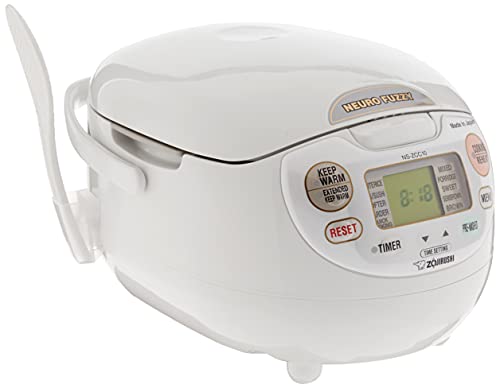
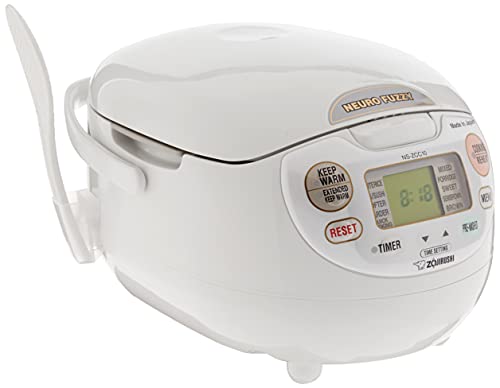
Zojirushi Neuro Fuzzy NS-ZCC10 — the Calm Benchmark
Badge: Best for set-and-forget daily rice
| Spec | Detail |
|---|---|
| Capacity | 5.5 cups uncooked, about 10 cups cooked |
| Control | Neuro Fuzzy logic with automatic keep-warm and delay timer |
| Inner pot | Nonstick, spherical-style pan for even heat circulation |
| Extras | Extended keep-warm, reheating cycle, retractable cord |
The Neuro Fuzzy is the cooker that built Zojirushi’s reputation in export markets, and its character shows in the first week of use. Load rice and water, press one button, and the machine quietly samples temperature as it cooks, nudging heat up or down so the grain absorbs water at its own pace. That patience produces the thing owners praise for years: separate, tender grains with a consistent texture from top to bottom of the pot, batch after batch, even when the person measuring the water was half asleep. It is notably forgiving of small measuring errors, which matters more in real kitchens than any laboratory specification.
Beyond plain rice, the menu covers the staples a Japanese-leaning household rotates through: white, brown, sushi-style, porridge and mixed rice among them. Brown rice takes its time here, as it should, emerging chewy rather than split. The keep-warm system is the quiet star; rice held for an evening stays moist instead of crusting at the edges, and the reheating cycle refreshes a held batch without drying the surface. The footprint is modest, the cord retracts, and the whole machine wipes down in seconds because the design avoids fussy crevices.
Strengths
- Exceptionally consistent results that forgive imperfect water measuring
- Keep-warm and reheat behaviour that protects a batch for hours
- Simple controls a guest or teenager can operate without instructions
Trade-offs
- No pressure or induction speed; quick cooking is not its party trick
- Menu list is shorter than CUCKOO rivals at similar capacity
- Conventional styling looks plain beside glossier competitors
Best for: households eating rice most days who want one dependable cooker for years. / Not suited for: cooks chasing the fastest possible cycle or a long menu list.

Zojirushi Micom NS-TSC10 — the Versatile Sibling
Badge: Best Zojirushi for mixed menus
| Spec | Detail |
|---|---|
| Capacity | 5.5 cups uncooked, 1.0 litre class |
| Control | Micom computerised cooking with LCD panel and delay timer |
| Inner pot | Nonstick pan with clear water-level markings |
| Extras | Steaming basket, interchangeable melody and beep alerts |
Where the Neuro Fuzzy specialises, the NS-TSC10 generalises gracefully. Its Micom brain runs a wider programme library — the Umami setting stretches the soaking and steaming phases to coax out sweetness, the slow-cook and steam functions turn the pot into a small second hob, and a cake setting exists for the household that enjoys such experiments. The included steaming basket means vegetables or dumplings can ride above the rice, finishing at the same moment, which quietly converts this from a rice cooker into a one-pot dinner station for two to four people.
Daily manners remain pure Zojirushi. The LCD is legible, the timer sets without a manual, and the machine signals completion with a melody that can be swapped for plain beeps if cheerfulness before coffee is unwelcome. Texture on standard white rice lands a touch softer than the Neuro Fuzzy’s, which some households prefer and others notice only in a side-by-side tasting. Brown and mixed grains cook thoroughly, and the slow-cook programme handles soups and stews at a gentle, unattended simmer that suits busy evenings.
Strengths
- Wide programme range including Umami, steam and slow cook
- Steaming basket enables complete one-pot meals
- Friendly LCD controls with a proper delay timer
Trade-offs
- Slightly softer default white-rice texture than the Neuro Fuzzy
- Still no pressure speed for last-minute rice emergencies
- More programmes mean a little more button learning up front
Best for: varied cooks who want rice plus steaming and slow cooking in one unit. / Not suited for: minimalists who only ever press a single white-rice button.

CUCKOO CR-0375FW — the Compact Overachiever
Badge: Best for one or two people
| Spec | Detail |
|---|---|
| Capacity | 3 cups uncooked, 6 cups cooked |
| Control | Micom fuzzy logic, nine cooking modes |
| Inner pot | Nonstick inner pot |
| Extras | Quick white rice in about 26 to 28 minutes, auto clean |
Small rice cookers are often stripped-down apologies, but the CR-0375FW is a full CUCKOO in miniature. Its nine modes cover white, brown, porridge and multi-grain cooking with the same fuzzy-logic adjustments the bigger models use, and its quick white programme answers the solo cook’s eternal question — can dinner be ready before impatience wins — with rice in roughly twenty-six to twenty-eight minutes. For a single person, a couple, a student room or an office kitchenette, that combination of small batch quality and speed is exactly the point.
Small batches are where this machine quietly embarrasses larger rivals. A single cup of rice in a six-cup cooker often cooks unevenly because the water layer sits too shallow; here the pot geometry suits modest quantities, so a weeknight cup for one emerges fluffy rather than scorched at the base. The auto-clean function runs a steam cycle that loosens starch film from the lid area, a thoughtful touch in a machine likely to live in a small space where deep cleaning is nobody’s hobby. Keep-warm is competent for an evening, though a cooker this size is really designed for cook, eat, and switch off.
Strengths
- Genuinely good one-cup batches that big cookers struggle with
- Quick mode delivers white rice in under half an hour
- Tiny footprint suits small counters, dorms and caravans
Trade-offs
- Six cooked cups will not feed a crowd or a big meal-prep session
- No pressure cooking at this size and tier
- Growing households will outgrow it quickly
Best for: singles, couples and small kitchens cooking rice a few times a week. / Not suited for: families or anyone batch-cooking for the freezer.

CUCKOO CR-0675FW — the Family All-Rounder
Badge: Best CUCKOO for most families
| Spec | Detail |
|---|---|
| Capacity | 6 cups uncooked, 12 cups cooked |
| Control | Micom fuzzy logic, nine menus |
| Inner pot | Nonstick inner pot |
| Extras | Quick rice mode, delay timer, keep-warm |
The CR-0675FW is the CUCKOO most families should look at first, because it pairs the brand’s energetic cooking style with the capacity a household of four to six actually consumes. Twelve cooked cups cover a family dinner with leftovers for fried rice tomorrow, and the nine menus handle the rotation most homes genuinely use: white, mixed grain, brown, porridge and a quick mode for the evenings when the rice was forgotten until the stir-fry was already in the pan. That quick mode, more than any brochure feature, is what owners end up valuing.
Texture is the CUCKOO signature: grains emerge with a slightly firmer, chewier bite than Zojirushi’s softer style, a profile Korean cooking prizes and many converts come to prefer, especially under saucy dishes where distinct grains hold their own. The cooker is also a confident porridge and congee maker, useful for breakfast households and convalescent cooking alike. Controls are busier than Zojirushi’s — more buttons, more modes — but the logic is consistent, and the machine remembers nothing it should not, so a grandparent can run the basic cycle without confronting the full menu tree.
Strengths
- Family-size capacity with a genuinely useful quick mode
- Firm, distinct grain texture that stands up to sauces
- Versatile menus covering porridge and mixed grains well
Trade-offs
- Busier control panel than the calm Zojirushi approach
- Chewier default texture may not suit sushi-rice purists
- Larger footprint than the five-and-a-half-cup rivals
Best for: families wanting speed, capacity and menu range in one machine. / Not suited for: cooks who prefer the softest, most delicate grain texture.

CUCKOO CRP-LHTR0609FW — the Pressure-Induction Flagship
Badge: Best for enthusiasts and fastest rice
| Spec | Detail |
|---|---|
| Capacity | 6 cups uncooked, 12 cups cooked |
| Control | Twin pressure induction heating, twenty-one menus |
| Inner pot | Nonstick inner pot, pressure-rated construction |
| Extras | Turbo rice in about 12 to 19 minutes, auto clean, voice guide, made in Korea |
This is CUCKOO showing everything it knows. Induction heating surrounds the pot with a magnetic field so the whole vessel becomes the heating element, eliminating the hot-spot gradient of base-plate designs, while twin pressure settings let the cook choose between softer and firmer results under pressure. The turbo programme produces white rice in roughly twelve to nineteen minutes — pressure-cooker speed with rice-cooker manners — and the full menu list of twenty-one entries stretches from GABA brown rice through porridge to slow-cooked dishes. A voice guide announces settings and completion, which sounds like a gimmick for exactly one day and then becomes the feature everyone mentions.
Pressure changes texture in ways worth understanding before paying flagship money. Pressurised rice absorbs water more completely, yielding grains that are plump, glossy and distinctly chewy, with a sweetness many people notice immediately in plain short-grain rice. Brown rice benefits most of all: pressure softens the bran layer that conventional cookers leave stubbornly firm, so whole grains emerge tender without an overnight soak. The trade is complexity — a locking lid, a pressure gasket to keep clean, more parts in the wash — and a presence on the counter that smaller kitchens will feel. This is a machine for people who care about rice the way espresso people care about espresso.
Strengths
- Fastest white rice here by a wide margin, with pressure texture to match
- Induction heating gives remarkably even results across the whole pot
- Twenty-one menus including GABA and high-heat options for enthusiasts
Trade-offs
- Premium tier positioning and the largest footprint in this comparison
- Pressure lid and gasket need more cleaning attention
- Voice guide and menu depth will be overkill for simple needs
Best for: rice enthusiasts, brown-rice devotees and impatient cooks with counter space. / Not suited for: minimalists, tiny kitchens or anyone who finds appliances should be silent.
Which Brand Cooks Better-Tasting Rice?
Taste splits along texture lines, and texture splits along national lines. Zojirushi’s programming pursues the Japanese ideal: grains that are tender, slightly yielding, with a delicate sweetness and a surface that clings just enough for chopsticks and sushi moulding. CUCKOO’s programming pursues the Korean ideal: grains with bounce and separation, a firmer bite, and a structure that survives being mixed with seasoned vegetables or drenched in stew. Neither machine produces bad rice; they produce different rice, and the honest way to choose is to ask which bowl you enjoyed more in restaurants. Diners who gravitate to Japanese set meals usually land on Zojirushi; diners raised on Korean barbecue spreads usually land on CUCKOO.
Grain choice interacts with brand choice in ways worth a moment. Short-grain Japonica shows the brands’ differences most clearly. Long-grain jasmine cooks well in both, emerging fragrant and separate, with CUCKOO’s quick mode being the deciding convenience. Brown rice separates them again: conventional fuzzy logic from either brand does a respectable job given time, but the pressure-induction CUCKOO flagship transforms brown rice texture in a way the others cannot match, while Zojirushi counters with patient cycles that develop flavour slowly. Basmati, with its need for restraint, suits the gentler Zojirushi programmes in most kitchens. The practical summary is that variety cooks should weigh the flagship heavily, while single-grain households should weigh daily texture preference above all.
What About Speed, Menus and Everyday Convenience?
On speed there is no contest at the top: pressure and induction beat conventional heating every time, and CUCKOO’s turbo figures — white rice somewhere between twelve and nineteen minutes on the flagship, under half an hour even on the baby of the range — reset what weeknight cooking can assume. Zojirushi’s answer is the delay timer used properly: rice loaded at breakfast, timed to finish at six, removes the need for speed entirely on organised days. The honest assessment is that planners win with Zojirushi and improvisers win with CUCKOO, and most households contain one of each, which is why this argument fills comment sections.
Menus deserve a sceptical eye. A programme earns its place only if it changes the cooking curve — GABA mode’s warm soaking phase, porridge mode’s anti-boil-over cycling, the flagship’s pressure choices — rather than renaming the standard cycle. By that test, both brands acquit themselves well: Zojirushi’s Umami and slow-cook settings do real work, and CUCKOO’s grain-specific modes adjust meaningfully. Convenience details accumulate quietly: detachable inner lids that rinse clean, condensation collectors that stop countertop puddles, cords that retract, and in CUCKOO’s case an auto-clean steam cycle. Judge these when comparing finalists, because they decide whether a cooker stays pleasant in year three.
How Do You Get the Best Results From Either Brand?
Technique travels across brands, and a few habits lift any of these machines. Rinse rice until the water runs mostly clear; surface starch is the main cause of gummy texture and boil-over foam, whatever the badge on the lid. Rest cooked rice for ten minutes with the lid closed before fluffing, because the grains finish steaming in their own moisture and the texture evens out noticeably. Fluff with a paddle using a cutting, folding motion rather than stirring, which breaks grains and releases more starch. Measure water with the pot’s own markings for the grain type selected, then adjust by a spoonful at a time over successive batches until the texture matches your preference — every household’s rice supply and taste differ slightly.
Storage and reheating habits matter as much as cooking. Keep-warm is a convenience for hours, not a storage strategy for days: transfer leftovers to a shallow container, refrigerate promptly, and reheat with a sprinkle of water under a covered lid in the microwave or with the cooker’s reheating cycle where fitted. For brown rice in a conventional model, an hour of pre-soaking in the pot before starting the cycle noticeably improves tenderness. For mixed grains and beans, rinse and sort, and expect the mixed programme to run long — that patience is the programme working as designed, not a fault. Finally, wipe the lid gasket and steam vent weekly; starch film build-up is the hidden cause of sour smells that owners often blame on the machine.
What Mistakes Do Buyers Make When Choosing Between Them?
The commonest error is buying capacity by cooked-cup marketing instead of uncooked reality, then discovering that a cooker run near-empty or overflowing both disappoints. Match uncooked capacity to your largest regular batch, remembering that rice roughly doubles. The second error is paying for pressure speed while cooking only on a timer, or paying for timer-friendly simplicity while improvising every dinner — know which cook you are. Third, shoppers overlook the inner pot: coatings last for years with a rice paddle and soft sponge, and months with metal spoons and scouring pads, so budget your habits honestly. Fourth, many buyers ignore counter depth and lid-opening height; a cooker that cannot open fully under a wall cabinet becomes a daily irritation. Fifth, some assume the two brands’ measuring cups are interchangeable with standard kitchen cups — cooker cups are smaller, and using the wrong one wrecks the water ratio more reliably than any brand difference.
Final Recommendation: Zojirushi or CUCKOO?
For the majority of households reading a decorating-and-home site rather than a rice forum, the decision resolves like this. Choose the Zojirushi Neuro Fuzzy if rice is a daily staple and you want the most forgiving, consistent, low-effort path to a good bowl, with the Micom NS-TSC10 as the pick when steaming and menu variety matter. Choose the CUCKOO CR-0675FW if family capacity and a quick mode will be used weekly, the CR-0375FW if your household is small, and the twin-pressure flagship if rice is a genuine enthusiasm and brown rice is a regular event. There is no wrong door here — only the door that matches your kitchen’s habits. Readers furnishing the rest of a calm, organised kitchen may also enjoy our guides to bedroom humidifiers for quiet nights and air purifiers sized for bedrooms, while anyone setting up a restful sleeping space from scratch should see mattress toppers that soften a firm bed and bedspreads and quilts for layered beds.
How Do the Two Brands Handle Keep-Warm and Leftovers?
Keep-warm separates these brands more subtly than cooking does, because both are good and their goodness takes different forms. Zojirushi built its reputation partly on holding rice gracefully: its regular and extended keep-warm modes manage temperature and moisture so that a batch cooked at noon still eats pleasantly at seven, with the reheating cycle restoring a just-cooked feel to the surface grains. Households that cook once for a grazing family — teenagers arriving at staggered hours, shift workers, grandparents who prefer small frequent meals — feel this advantage weekly. The Neuro Fuzzy in particular is the machine to pick if the pot spends as much time holding as cooking.
CUCKOO approaches holding from the pressure-cooker side. Its sealed lids retain moisture very effectively, and the flagship’s pressure keep-warm keeps grains plump rather than merely warm. The caution with any sealed, warm, moist environment is time discipline: rice held too long in any brand’s cooker eventually dries at the edges or develops a stale aroma, and food-safety guidance everywhere recommends refrigerating cooked rice promptly rather than treating the cooker as storage. In practice, both brands hold beautifully across a meal’s natural span of three to six hours; beyond that, the refrigerator and a reheating cycle serve better than any keep-warm mode ever designed. Choose Zojirushi if long holding is your pattern, CUCKOO if holding is brief and cooking speed rules your evenings.
What Should You Know About Cleaning and Long-Term Care?
Daily care takes two minutes in either camp: wash the inner pot with a soft sponge, rinse the detachable inner lid, empty the condensation collector, and leave the lid ajar so the interior dries fully. The differences appear over months. Zojirushi’s simpler lids and smooth interiors accumulate less starch film, and its non-pressure design means fewer seals to inspect. CUCKOO’s auto-clean steam cycle does real work loosening residue around the lid, but the flagship adds a pressure gasket and locking parts that reward a monthly removal, wash and careful reseating. Neglected gaskets are the number one cause of pressure cookers losing their seal and their temper.
Inner-pot coating care decides the machine’s lifespan more than any electronic component. Serve with the included paddle or a silicone spoon, never metal; wash by hand rather than trusting a dishwasher’s harsh detergents and rack abrasion; and avoid thermal shock by letting a hot pot cool before rinsing. When a coating eventually shows wear — food beginning to stick in a ring, visible scratches through to the metal — replace the pot rather than the cooker, and check that replacement availability before purchase, since both brands support their popular models well but older or regional variants can be slower to source. A cooker treated this way from either brand is a ten-year appliance, which reframes the purchase entirely: the question stops being which machine is cheaper and becomes which machine you want to live with for a decade.
Which Rice Types Favour Which Brand?
Short-grain white rice, the heartland of both makers, shows the philosophical split at its clearest: Zojirushi renders it tender and delicately cohesive, CUCKOO renders it bouncy and distinct, and the flagship’s pressure settings let you slide between softer and firmer results in a way no conventional cooker offers. Medium-grain rice for dishes like paella-style home cooking or rice salads behaves well in both, with CUCKOO’s separation suiting salads and Zojirushi’s cohesion suiting moulded presentations. Jasmine rice rewards restraint; both brands cook it fragrantly, and the main risk is excess water rather than brand choice.
Brown and mixed grains tilt CUCKOO’s way at the flagship level and stay even elsewhere. GABA mode, offered on the pressure model, holds brown rice warm for an extended soak before cooking, softening texture and changing the grain’s character in a way enthusiasts seek out deliberately. Wild rice blends, barley and bean mixtures need the long mixed cycles both brands provide, plus the discipline of not exceeding fill lines, since legumes expand enthusiastically. Sushi rice is Zojirushi’s home turf — its dedicated programme and softer finish season beautifully with vinegar dressing — while rice for frying the next day is arguably better from CUCKOO, whose firmer, drier-edged grains separate in the wok instead of clumping. Matching the brand to your two most-cooked grains settles most of what the menu lists argue about.
How Do Size, Noise and Counter Life Compare?
Physical life with these machines differs in small daily ways. The three-cup CUCKOO disappears into a corner and suits renters who move often; the five-and-a-half-cup Zojirushi pair occupy a moderate, tidy footprint with lids that open within standard cabinet clearance; the six-cup CUCKOO models, especially the flagship, are substantial pieces of kitchen architecture that deserve a permanent station. Measure your counter depth and the height under wall cabinets with the lid fully open before ordering any of them — a cooker that must be pulled forward to open will annoy you twice a day for years.
Noise is modest across the board: conventional models vent soft puffs of steam and click occasionally, while the pressure flagship adds the sounds of pressure building and releasing, plus its voice announcements. In an open-plan home where the kitchen borders a study or a sleeping baby’s room, Zojirushi’s near-silent operation is a genuine lifestyle advantage; in a busy family kitchen, CUCKOO’s audible progress reports are more feature than intrusion. Finish and styling follow the same split — Zojirushi’s white, rounded, appliance-classic look blends into traditional kitchens, while CUCKOO’s glossier designs hold their own in contemporary spaces. Readers planning a coordinated calm kitchen may find pairing ideas in sheets that keep a bedroom feeling restful and affordable sheet sets worth stocking.
Where Did Each Brand’s Philosophy Come From?
Understanding the two companies explains their machines better than any feature chart. Zojirushi began in Osaka in nineteen eighteen making vacuum bottles, and thermal mastery became its identity: hold temperature precisely, waste nothing, change slowly. When the company turned to rice cookers, it brought that patience with it, refining fuzzy logic — a control method that mimics a human cook’s adjustments — into the Neuro Fuzzy line that still anchors its range. The brand’s export success rests on owners who buy one cooker and evangelise for a decade, which is why Zojirushi changes designs reluctantly and supports models for years.
CUCKOO’s story runs through South Korea’s own rice culture, where a cooker is not an occasional appliance but the centre of the kitchen, expected to produce perfect rice three times a day and hold it ready between meals. Founded in nineteen seventy-eight, the company grew by attacking the hardest problems — pressure cooking for speed and texture, induction for evenness, voice guidance for busy cooks — and by treating the cooker as a designed object rather than a white box. Its rental and service culture at home pushed reliability hard, and its export models carry that engineering confidence. When you choose between these brands you are partly choosing which country’s daily rice ritual resembles your own household’s rhythm.
How Should You Decide, Step by Step?
Work through five questions in order and the right model usually names itself. First, how many people eat rice at your largest regular meal, and do you cook for leftovers deliberately? That fixes capacity: three uncooked cups for one or two people, five and a half to six for families. Second, how is dinner usually timed — planned in the morning or improvised at six? Planned favours Zojirushi’s timer-driven calm; improvised favours CUCKOO’s quick and turbo modes. Third, which two grains do you cook most? Brown-rice frequency pushes toward pressure; sushi and delicate short-grain push toward Zojirushi’s gentler curves.
Fourth, how much counter are you honestly willing to surrender, and does the lid open fully where the cooker will live? Measure, do not guess. Fifth, who else will operate the machine? A household with children, grandparents or lodgers benefits from Zojirushi’s minimal controls or CUCKOO’s voice-confirmed selections, depending on which kind of simplicity your people prefer. Score the five finalists against those five answers and the field narrows to one or two machines, at which point the remaining choice is texture preference — tender or bouncy — and that one your palate should decide at the first opportunity to taste both styles.
Head-to-Head Verdicts, Criterion by Criterion
Plain white rice, cooked unhurried
Given a full standard cycle and good short-grain rice, Zojirushi takes this round on refinement. The Neuro Fuzzy’s patient curve produces a bowl that tastes complete on its own, with nothing added — the test Japanese cooks apply most strictly. CUCKOO’s standard cycle is close behind and preferred by tasters who want chew, but when the rice itself is the dish, the gentler machine wins. Verdict: Zojirushi, narrowly, on delicacy.
White rice against the clock
Reversed completely. CUCKOO’s quick modes on the smaller models and the flagship’s turbo pressure cycle deliver respectable rice in a fraction of the standard time, and respectable is the right word — quick cycles trade a little refinement for a lot of minutes, and on a Tuesday that trade is correct. Zojirushi offers no equivalent rescue mode, relying instead on the timer. Verdict: CUCKOO, decisively, for improvised dinners.
Brown rice and whole grains
Pressure changes everything here. The flagship CUCKOO softens bran, shortens the cycle and produces brown rice that even white-rice loyalists eat happily, while its GABA programme serves the dedicated whole-grain cook. Zojirushi’s brown results are honest and flavourful but firmer and slower, improved by pre-soaking. The non-pressure CUCKOO models sit between the two camps. Verdict: CUCKOO flagship first, Zojirushi second for flavour purists with time.
Porridge, congee and breakfast grains
Both brands handle porridge well because both manage the boil-over problem that makes stovetop porridge a chore. CUCKOO’s menus name more breakfast preparations outright, reflecting Korean juk traditions, while Zojirushi’s porridge cycle is a quiet classic that produces a smooth, gentle result ideal for convalescent cooking and baby food. Steel-cut oats behave in either on the porridge setting at reduced fill. Verdict: a genuine draw, decided by which cuisine’s porridge you grew up with.
Ease for beginners and guests
Zojirushi’s two-button reality — choose menu, press start — makes it the cooker a babysitter can run. CUCKOO asks a little more learning, then repays it with voice confirmation on the flagship and quick modes a beginner quickly adopts. Households with rotating cooks should weight this criterion heavily, because the best cooker is the one everyone uses correctly. Verdict: Zojirushi for simplicity, CUCKOO close behind once the household learns its panel.
Long-term ownership and parts
Both brands support popular models with replacement pots, lids and gaskets, and both build machines that outlast trends. Zojirushi’s conservative design language means parts interchange across years of production; CUCKOO’s flagship complexity means its gasket and pressure parts deserve proactive spares in a heavy-use home. Either way, register the purchase, keep the manual, and note the model number somewhere durable. Verdict: even, with Zojirushi ahead on simplicity of upkeep and CUCKOO ahead on feature longevity.
What About the Rice Itself — Buying, Storing and Measuring?
The finest cooker cannot rescue stale or badly measured rice, so a short discipline pays off in both brands’ pots. Buy rice in quantities your household finishes within a few months, store it in a sealed container away from heat and odours, and treat the measuring cup that ships with the cooker as part of the machine — it is smaller than a standard kitchen cup, and the pot’s water lines are calibrated to it. Fill to the line that matches the programme selected, not the grain’s generic line, because brown and mixed settings expect more water than white. New-crop rice needs slightly less water than older stock; when a familiar batch suddenly cooks softer, suspect the harvest before suspecting the cooker.
Rinsing deserves its own sentence of emphasis because it decides texture more than brand does: swish, drain, repeat until the water loses its milkiness, then let the grains rest in their cooking water for twenty minutes before starting a conventional cycle if time allows. Pressure models forgive a skipped soak; conventional models repay it visibly. Salt does not belong in plain rice for either tradition’s table cooking — seasoning happens at the table or in the dish — but a small knob of butter or a strip of kombu in the pot is a legitimate household variation both machines handle happily. Treat these habits as the shared foundation, and the brand differences described above become the fine tuning rather than a rescue operation.
What Should You Check on the Listing Before Ordering?
Confirm five things on the Amazon listing of whichever finalist you choose. Voltage and plug must match your country’s supply, because both brands sell regional variants that look identical in photographs. Capacity should be stated in uncooked cups somewhere in the listing details; if only cooked yield is shouted, divide by two for the working figure. Check which inner pot and accessories are included — steaming basket, paddle, measuring cup — since bundles vary. Look for the manufacturer’s warranty terms for your region and the availability of replacement pots under the same model number. Finally, measure your counter space against the listed dimensions with the lid-open height included. Five minutes of this diligence prevents the only disappointments these well-made machines ever really cause.
A Week of Dinners: How Each Brand Fits Real Schedules
Picture a household that eats rice five nights a week in different forms. Monday is a planned curry night: rice loaded before work, timed to finish as the curry does — Zojirushi’s home ground, though CUCKOO’s timer does the same job. Tuesday collapses into a late meeting and a stir-fry assembled at speed; here CUCKOO’s quick mode or the flagship’s turbo cycle earns its keep outright. Wednesday is sushi bowls at home, where Zojirushi’s dedicated texture and gentle finish season best. Thursday is brown rice and grilled fish for a health-conscious reset — pressure CUCKOO territory, with Zojirushi asking for a soak and a longer cycle to reach tenderness. Friday is fried rice from Thursday’s leftovers, and firmer chilled grains from a CUCKOO pot separate in the pan beautifully.
No household lives at either extreme all week, which is why the middle models sell so steadily: the Zojirushi Micom covers Monday and Wednesday elegantly and manages Thursday with planning, while the CUCKOO CR-0675FW covers Tuesday and Friday brilliantly and handles Monday through its timer. The extremes — the Neuro Fuzzy’s calm mastery and the flagship’s pressure virtuosity — suit households whose weeks lean strongly one way. Read your own last fortnight of dinners honestly, count the planned against the improvised, and the tally will point at your brand more reliably than any single feature comparison can.
One Last Consideration: Gifting and Second Kitchens
These cookers are frequent gifts — for students leaving home, newlyweds, parents downsizing — and the brands gift differently. A Zojirushi suits a recipient who did not ask for a project: it works beautifully with minimal learning, and its calm design offends no kitchen. The compact CUCKOO suits a student or first-apartment cook who will relish the quick mode and forgive the busier panel. The flagship is a gift only for a known rice enthusiast; given to a casual cook it becomes an impressive cupboard monument. For second kitchens, holiday homes and office kitchenettes, the three-cup CUCKOO’s footprint and speed make it the natural traveller, while a retired family Zojirushi often begins a second career in exactly those spaces, still cooking reliably years after its successor took the main counter. Longevity, in the end, is the trait both brands genuinely share.
Frequently Asked Questions
Is fuzzy logic worth it over a basic one-button cooker?
For most households, yes. Fuzzy logic lets the cooker sense the pot’s temperature curve and adjust, which compensates for small measuring slips, cold water, and different rice ages. A basic cooker follows a fixed thermostat and produces more variable results, especially with brown or mixed grains. If you cook only small amounts of white rice and eat immediately, a basic machine can suffice, but the five models here show how much consistency the smarter control buys across a week of varied cooking.
Which brand is better for brown rice?
CUCKOO’s twin-pressure induction flagship has the clear edge, because pressure softens the bran layer and shortens what is otherwise a long cycle. Zojirushi’s conventional models cook good brown rice with patience and an optional pre-soak, and many people prefer the chewier result. If brown rice is an occasional side, either brand serves well; if it is your default grain several times a week, the pressure model justifies itself on texture and time alone.
How long do these cookers realistically last?
Both brands build for long service, and the limiting factor is usually the inner pot’s coating rather than the electronics. With gentle utensils and hand washing, a pot commonly serves for years before its surface tires; replacement pots and gaskets are the parts to check availability for when choosing between finalists. The machine kept on the counter and used daily also tends to outlast one stored in a cupboard, simply because seals and hinges prefer regular gentle use.
Can these cookers handle grains other than rice?
Yes, within their menus. Quinoa, millet, steel-cut oats and mixed grains all cook successfully on the porridge, mixed or brown settings, with water ratios adjusted from the rice markings and a little experimentation across the first batches. CUCKOO’s broader menu lists name more of these directly, while Zojirushi’s slow-cook and porridge programmes cover the same ground less explicitly. Avoid filling beyond the stated maximum for grains that foam, such as oats, and rinse quinoa thoroughly to remove its bitter coating.
Does the CUCKOO voice guide get annoying?
Opinions divide neatly by household. Many owners find spoken confirmation genuinely useful when their hands are wet or the kitchen is busy, and the flagship allows the voice to be adjusted or muted for those who do not. It is best treated as an accessibility feature with a novelty sheen: try it for a week before deciding, and remember that visiting guests will ask about it every single time without exception.
Is induction heating worth choosing over conventional fuzzy logic?
Induction heats the entire pot rather than a plate beneath it, so temperature stays uniform from centre to edge and responds faster to the controller’s adjustments. In plain eating terms the difference shows most in large batches and brown rice, where conventional pots can leave a gradient between the base and the top layer. For small daily batches of white rice the gap narrows considerably, which is why the flagship’s induction justifies itself to enthusiasts and whole-grain households first, and reads as a luxury rather than a necessity for everyone else.
Can either brand replace a slow cooker or steamer entirely?
Partly. The Zojirushi Micom’s slow-cook programme and steaming basket cover weeknight soups, stews and steamed vegetables comfortably for small households, and CUCKOO’s multi-cook settings handle similar ground. What neither replaces is a large slow cooker’s capacity for big joints or batch cooking, or a dedicated steamer’s tiers for a full dim-sum spread. Treat the cooker as the everyday instrument and keep specialist appliances only if their capacity genuinely gets used.
Which size should a household of four choose?
A five-and-a-half or six uncooked-cup model is the comfortable answer, covering family dinners of roughly ten to twelve cooked cups with headroom for guests, while still cooking a modest two-cup batch acceptably. Households of four who eat rice only a few times a week and never batch-cook can step down to the three-cup CUCKOO, but the larger machines are the safer long-term buy as appetites and households grow.
Whichever side of this comparison you land on, buy the cooker your household will use four times a week rather than the one that wins an argument about features. Rice rewards routine: the same grain, the same pot, small adjustments, and a machine whose habits you know by heart. Both brands honour that routine for years — Zojirushi with serenity, CUCKOO with energy — and a decade of good dinners will not remember which menu list was longer, only that the rice was right.