Disclosure: As an Amazon Associate, dailyhomedecorating.com earns from qualifying purchases. Links on this page are affiliate links; they cost you nothing extra. Prices and availability change often, so check the current Amazon listing before you buy.
This guide takes side table reviews seriously as a household decision rather than a decorative afterthought. A side table is the piece of furniture your hand uses most and your eye notices least, right up until it is the wrong height, wobbles under a mug, or offers nowhere to put anything down. What follows works through the real questions in order: fit beside your seat, stability in your household, materials you can live with, storage you will actually use, and the specific models worth considering, presented prose-first so you can judge the reasoning rather than a sales pitch.
Key Takeaways
- Measure against sofa arm height before buying; a height mismatch is the most common regret in this category.
- Keep heavy items low and anchor tall, narrow tables where children climb; furniture tip-over is a real hazard.
- Glass tops are beautiful and breakable; choose them honestly, for the right room, or choose a framed or solid top instead.
- Buy storage for the habits you actually have, not the tidier person you hope to become.
- Judge every model by fit, stability and care first, and by finish and styling second.
In this guide
Side Table Reviews: Verdict First
Taken together, the current field of side tables divides cleanly into honest workhorses and pretty liabilities, and the difference is rarely the finish in the photograph. The designs that earn their keep share three traits: a height that matches ordinary sofa arms, a base geometry that resists tipping, and a surface you can wipe without thinking. The designs that disappoint usually fail on one of those three while succeeding at looking wonderful in a listing. This round-up of reviews tests each representative model against real evenings, real lamps and real households.
What a Side Table Is and Where It Fits
Because this is one of the smallest and least expensive furniture decisions in a room, it is a safe place to take the one risk you have been avoiding. The bold finish, the sculptural shape, the material you love but would never commit to in a sofa: try it here, where it can be moved, swapped between rooms or replaced without pain. Many good rooms are built exactly this way, with calm large pieces and personality concentrated in the small ones. Just keep the risk honest; a daring shape that cannot hold a drink steadily or a daring finish that marks at the first mug is a lesson, not an accent.
Style works best when it is treated as a conversation with what is already in the room. A side table does not need to match the coffee table or the media unit exactly; in fact, an exact match can make a room feel like a showroom set rather than a home. What it does need is one point of connection: a shared wood tone, a repeated metal finish, a similar leg shape, or a period feeling held in common. Find that one thread and let everything else be itself. A room where the small pieces echo each other lightly looks collected and calm, while a room of unrelated statements looks restless no matter how nice each piece is alone.
Design, Build and Setup
It helps to separate the top material from the frame material, because they do different jobs. The top takes the spills, the heat rings, the dragged mugs and the daily wiping, so durability and cleanability matter most there. The frame takes the knocks, the vacuum bumps and the structural load, so strength and joint quality matter most there. Many of the most practical designs mix the two thoughtfully: an easy-clean top on a sturdy connected frame. When you read a listing, look past the headline material and ask what each part is made of, how the parts join, and what the maker suggests for cleaning, because those details predict your third year with the piece better than its first week.
Finish colour deserves the same practical eye. A very dark top shows dust and pale water rings quickly; a very pale top shows coffee and newsprint. Mid-tone wood finishes are the forgiving middle ground for most households, hiding the ordinary evidence of use between cleanings. If the table will sit beside a strong-coloured sofa, a neutral finish keeps the corner calm, while a deliberate contrast can turn a simple table into the accent the room was missing. Order with the room in front of you, ideally with a cushion or a paint swatch nearby, rather than trusting a screen colour remembered from another room.
Performance in Real Use
People shop for this piece with their eyes and then live with it through their hands, which is why the tape measure matters more than the product photo. Photographs flatten scale, and a table that looks perfectly proportioned beside a styled sofa in a listing can tower over a low modern sectional or disappear beside a high traditional arm. Measure the arm of your own seat, measure the space between the seat and the wall or the next piece, and write both numbers down before you browse. When the table arrives, that earlier measuring is the difference between a piece that feels made for the room and one you keep apologising for.
A useful habit is to mock the footprint up before ordering. Mark the outline on the floor with painter tape, put a box or a stack of books roughly at the height you are considering, and live beside it for an evening. You will quickly learn whether you reach for that spot naturally, whether the lamp you plan to put there would sit at a comfortable reading height, and whether the walkway past it still feels generous. This ten-minute rehearsal prevents the two classic mistakes: a table too wide for the gap, which makes the whole corner feel squeezed, and a table too narrow, which wobbles under ordinary use and holds almost nothing.
Strengths and Trade-Offs of the Class
- Strength: a small footprint that adds a working surface without rearranging the room.
- Strength: an enormous range of styles, so a genuine match for your seating exists.
- Strength: simple construction that is easy to assemble, move and repurpose between rooms.
- Trade-off: small surfaces saturate quickly once a lamp claims its share.
- Trade-off: tall, narrow silhouettes are inherently easier to tip than low, wide ones.
- Trade-off: entry-tier finishes mark more readily and reward coaster discipline.
Safety first: tip-over, glass and honest limits
Stability deserves blunt honesty. A tall, narrow table carrying a top-heavy load is an unstable table, full stop. The higher and narrower the piece, and the heavier what sits on top of it, the easier it is to tip when a child pulls up on it, a dog brushes past, or someone catches it with a hip. Keep heavy items low, on the bottom shelf or near the floor, and keep the top for light, everyday things. Where children climb, treat anchoring seriously: furniture tip-over is a real hazard, not a theoretical one, and a small bracket or strap to the wall is cheap insurance for a piece that a toddler can reach.
Glass tops need an honest conversation rather than a sales pitch. A glass top is genuinely lovely for light: it keeps a small room feeling open, shows a rug beneath it, and wipes clean in seconds. It is also glass. It can chip at an edge, it can crack under a sharp impact, and if it breaks it breaks in a way that demands immediate, careful clearing up. Tempered glass is designed to fail more safely than ordinary glass, but no honest guide should promise that a glass top cannot break. Households with boisterous children, large dogs or a habit of dropping heavy objects should weigh that plainly and may be happier with wood, metal or stone-look tops.
The Picks in Detail: Six Side Tables Worth a Closer Look
Each model below is assessed on the same terms: fit, steadiness, surface behaviour, storage sense and how it ages in an ordinary home.

Nathan James Side Table
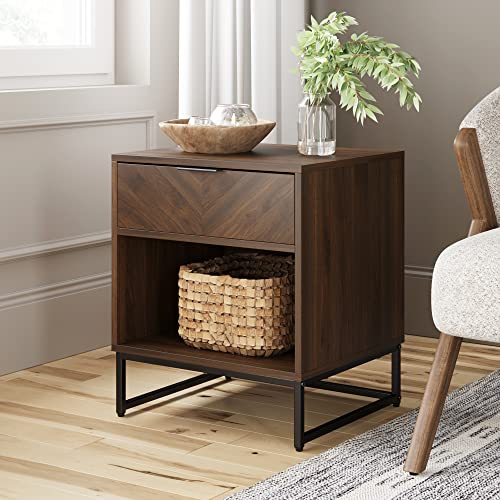
The Nathan James Side Table is a clean-lined accent piece in the modern farmhouse and Scandinavian direction, usually offered with a light wood-look finish and an open lower shelf. Treat it here as a prose guide to a real product family rather than a linked recommendation: check the current listing for the exact variant, finish and assembled size before you buy, and use the measuring and stability advice in this article as your filter.
A useful habit is to mock the footprint up before ordering. Mark the outline on the floor with painter tape, put a box or a stack of books roughly at the height you are considering, and live beside it for an evening. You will quickly learn whether you reach for that spot naturally, whether the lamp you plan to put there would sit at a comfortable reading height, and whether the walkway past it still feels generous. This ten-minute rehearsal prevents the two classic mistakes: a table too wide for the gap, which makes the whole corner feel squeezed, and a table too narrow, which wobbles under ordinary use and holds almost nothing.
Best for: readers who want a tidy modern corner with an open shelf for books. Not suited for: a household needing hidden storage for a large remote and cable collection.
Strengths: a clear design intention you can picture in a real room; a footprint in the compact class this category does best; a lower tier or shelf story that gives the surface room to breathe.
Trade-offs: variant names and finishes change over time, so confirm the exact version on the listing; like every table in this class it must be matched to your sofa arm height and kept honestly loaded, with heavy items low, to stay steady.
Convenience Concepts End Table
The Convenience Concepts End Table is a compact occasional table from a brand known for small-space furniture, typically built around a simple frame with a lower tier for remotes and books. Treat it here as a prose guide to a real product family rather than a linked recommendation: check the current listing for the exact variant, finish and assembled size before you buy, and use the measuring and stability advice in this article as your filter.
Finish colour deserves the same practical eye. A very dark top shows dust and pale water rings quickly; a very pale top shows coffee and newsprint. Mid-tone wood finishes are the forgiving middle ground for most households, hiding the ordinary evidence of use between cleanings. If the table will sit beside a strong-coloured sofa, a neutral finish keeps the corner calm, while a deliberate contrast can turn a simple table into the accent the room was missing. Order with the room in front of you, ideally with a cushion or a paint swatch nearby, rather than trusting a screen colour remembered from another room.
Best for: readers who want a compact footprint in a small living room or guest room. Not suited for: a tall seat whose arm sits well above standard occasional-table height.
Strengths: a clear design intention you can picture in a real room; a footprint in the compact class this category does best; a lower tier or shelf story that gives the surface room to breathe.
Trade-offs: variant names and finishes change over time, so confirm the exact version on the listing; like every table in this class it must be matched to your sofa arm height and kept honestly loaded, with heavy items low, to stay steady.
Kate and Laurel Side Table
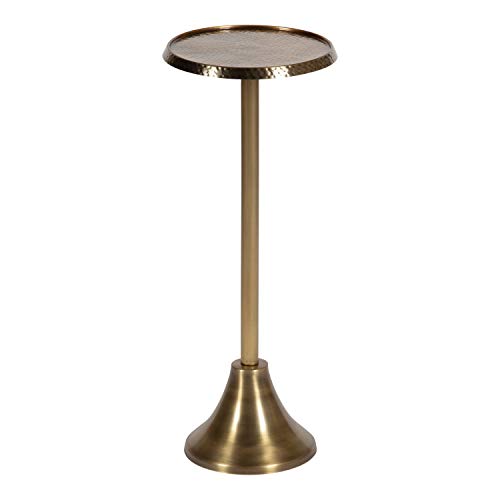
The Kate and Laurel Side Table is a more decorative accent table, the kind of design-led piece that is bought as much for how it looks beside a sofa as for the surface it provides. Treat it here as a prose guide to a real product family rather than a linked recommendation: check the current listing for the exact variant, finish and assembled size before you buy, and use the measuring and stability advice in this article as your filter.
Open shelves and closed storage behave differently in a room, beyond the simple question of capacity. An open lower shelf keeps books and a folded throw visible and reachable, and it makes the piece feel lighter, which suits small rooms. A drawer or a cabinet door hides visual noise and dust, which suits calm, minimal schemes and households that prefer everything behind a front. There is a dust trade either way: open shelves gather it visibly but wipe in seconds, while closed storage gathers it slowly and invisibly. Think, too, about access from a seated position; a shelf you can reach without standing is storage you will use, and one you cannot is decoration.
Best for: readers who want a decorative accent that earns its place visually as well as practically. Not suited for: a play-heavy family room where a decorative piece would take daily knocks.
Strengths: a clear design intention you can picture in a real room; a footprint in the compact class this category does best; a lower tier or shelf story that gives the surface room to breathe.
Trade-offs: variant names and finishes change over time, so confirm the exact version on the listing; like every table in this class it must be matched to your sofa arm height and kept honestly loaded, with heavy items low, to stay steady.

Furinno Side Table
The Furinno Side Table is an entry-tier flat-pack table aimed at first apartments, dorm rooms and spare rooms, valued for straightforward assembly and a very small footprint. Treat it here as a prose guide to a real product family rather than a linked recommendation: check the current listing for the exact variant, finish and assembled size before you buy, and use the measuring and stability advice in this article as your filter.
Scale is a style decision as much as a practical one. A chunky, blocky table beside a delicate-legged sofa overwhelms it; a spindly table beside a deep, rolled-arm sofa looks lost. Aim for a visual weight that sits comfortably with its neighbours, and use the table to correct the room where you can: a leggy, open design lightens a corner crowded with upholstery, while a solid, grounded design anchors a corner that feels floaty. Height plays into this too, since a table level with the sofa arm reads as part of the seating group, while one noticeably lower reads as an occasional extra, useful but visually separate.
Best for: readers who want a straightforward first-apartment table that assembles without drama. Not suited for: anyone expecting heirloom joinery at an entry tier.
Strengths: a clear design intention you can picture in a real room; a footprint in the compact class this category does best; a lower tier or shelf story that gives the surface room to breathe.
Trade-offs: variant names and finishes change over time, so confirm the exact version on the listing; like every table in this class it must be matched to your sofa arm height and kept honestly loaded, with heavy items low, to stay steady.
Simpli Home Side Table
The Simpli Home Side Table is a solid-wood-leaning table from a brand that positions itself a step above basic flat-pack, with a warmer, more traditional furniture feel. Treat it here as a prose guide to a real product family rather than a linked recommendation: check the current listing for the exact variant, finish and assembled size before you buy, and use the measuring and stability advice in this article as your filter.
Think about who shares the room before you decide how much stability you need. In a quiet reading corner used by one adult, a delicate pedestal design may serve for years without incident. In a family room where children climb, guests balance plates, and a vacuum cleaner bumps the legs weekly, the same design becomes a daily risk. Match the engineering to the household rather than to the photograph. Put the heaviest everyday object, often a lamp with a solid base or a stack of hardback books, low rather than high, and teach children early that this table is furniture, not a climbing frame.
Best for: readers who want a warmer, furniture-first feel beside a traditional sofa or armchair. Not suited for: a very tight gap where a solid, grounded silhouette would crowd the seat.
Strengths: a clear design intention you can picture in a real room; a footprint in the compact class this category does best; a lower tier or shelf story that gives the surface room to breathe.
Trade-offs: variant names and finishes change over time, so confirm the exact version on the listing; like every table in this class it must be matched to your sofa arm height and kept honestly loaded, with heavy items low, to stay steady.

VASAGLE Side Table
The VASAGLE Side Table is an industrial-style table mixing a wood-look top with a dark metal frame, often chosen for living rooms that already use that mixed-material language. Treat it here as a prose guide to a real product family rather than a linked recommendation: check the current listing for the exact variant, finish and assembled size before you buy, and use the measuring and stability advice in this article as your filter.
Care for this piece is mostly a handful of small habits repeated, rather than any heroic maintenance routine. Wipe spills when they happen instead of at the end of the week, use coasters as a default rather than a courtesy for guests, and lift objects instead of sliding them so grit underneath does not scratch the finish. Dust with a soft cloth, keep the table out of prolonged direct sun where you can, and check the feet and floor protectors occasionally, because a lost felt pad turns a harmless table into a floor-scratching one. None of this takes long; all of it is the difference between a table that looks tired in a year and one that looks settled for many.
Best for: readers who want an industrial note that pairs naturally with metal and wood elsewhere in the room. Not suited for: a soft, traditional scheme where dark metal would feel out of place.
Strengths: a clear design intention you can picture in a real room; a footprint in the compact class this category does best; a lower tier or shelf story that gives the surface room to breathe.
Trade-offs: variant names and finishes change over time, so confirm the exact version on the listing; like every table in this class it must be matched to your sofa arm height and kept honestly loaded, with heavy items low, to stay steady.
Who Should Buy One, and Who Should Skip It
Read listings forensically, the way you would read a contract you are about to sign. Look for the assembled dimensions rather than the box dimensions, the materials of each part rather than a single headline word, and the care instructions rather than the styling. Be wary of photographs that show the table beside unusually small furniture, a trick that makes modest pieces look generous. Reviews from other buyers are most useful when you read them for patterns about assembly, stability and finish, rather than for verdicts; one complaint is an anecdote, but the same complaint repeated is a description of the product.
Finally, think about the route the table takes into your life and, one day, out of it. Check how it is delivered and assembled, whether you have the tools and the half hour it needs, and whether it can be returned if the colour is wrong in your light. Consider whether it could serve in another room later, beside a bed or a reading chair, because a piece with a second life in it is a safer purchase than one that only works in exactly one spot. The households that buy furniture well are rarely the ones with the biggest budgets; they are the ones that asked these plain questions before, rather than after, the box arrived.
Setup, Care and Maintenance Essentials
Care for this piece is mostly a handful of small habits repeated, rather than any heroic maintenance routine. Wipe spills when they happen instead of at the end of the week, use coasters as a default rather than a courtesy for guests, and lift objects instead of sliding them so grit underneath does not scratch the finish. Dust with a soft cloth, keep the table out of prolonged direct sun where you can, and check the feet and floor protectors occasionally, because a lost felt pad turns a harmless table into a floor-scratching one. None of this takes long; all of it is the difference between a table that looks tired in a year and one that looks settled for many.
Moving the table deserves a mention, because small furniture gets dragged more than any other kind. Lift it, or at least lift the heavy end, rather than pulling it sideways across the floor by its top. Dragging racks the legs, loosens joints and can snap a slender leg at its fixing, and it grinds any trapped grit into your flooring. When you rearrange the room, empty the table first, carry it with two hands under the frame, and set it down gently in its new spot. It sounds fussy until you compare it with the cost of a broken leg or a scored floorboard, at which point it sounds like the cheapest advice in this entire guide.
Final Verdict
Buy the table that fits your measured seat, your real household and your actual habits, in the best build quality your tier allows, and this category will reward you every single evening. Buy from a photograph alone and it will punish you just as regularly. The models above give you a sound shortlist for either path; the measuring tape decides which one you take.
One More Consideration Before You Decide
Material choice is really a choice about maintenance and mood at the same time. Solid wood and good wood veneers bring warmth and can often be touched up when life marks them, but they ask for coasters and quick attention to spills. Painted and laminate finishes shrug off everyday messes and suit busy family rooms, though a deep chip can be harder to disguise. Metal frames add strength in a slim profile and pair naturally with industrial or modern rooms, while rattan, cane and woven textures soften a space and hide minor scuffs in their pattern. Choose for the life the table will lead, not only for the photograph you fell for.
It helps to separate the top material from the frame material, because they do different jobs. The top takes the spills, the heat rings, the dragged mugs and the daily wiping, so durability and cleanability matter most there. The frame takes the knocks, the vacuum bumps and the structural load, so strength and joint quality matter most there. Many of the most practical designs mix the two thoughtfully: an easy-clean top on a sturdy connected frame. When you read a listing, look past the headline material and ask what each part is made of, how the parts join, and what the maker suggests for cleaning, because those details predict your third year with the piece better than its first week.
One More Consideration Before You Decide (2)
Charging has quietly become a storage question in its own right. Phones, e-readers and earbuds all want to live beside the sofa, and the cables that feed them can make a beautiful corner look like a nest. A table with a shelf positioned to hold a small charging station, or simply enough depth to keep cables behind a book stack, solves the problem without any special features. If you plan to charge devices there, think about the nearest outlet before you choose the table, because a short cable stretched across a walkway is both ugly and a trip hazard. The best solution is usually boring: table near outlet, cables short and low, devices resting flat and cool.
Open shelves and closed storage behave differently in a room, beyond the simple question of capacity. An open lower shelf keeps books and a folded throw visible and reachable, and it makes the piece feel lighter, which suits small rooms. A drawer or a cabinet door hides visual noise and dust, which suits calm, minimal schemes and households that prefer everything behind a front. There is a dust trade either way: open shelves gather it visibly but wipe in seconds, while closed storage gathers it slowly and invisibly. Think, too, about access from a seated position; a shelf you can reach without standing is storage you will use, and one you cannot is decoration.
One More Consideration Before You Decide (3)
Style works best when it is treated as a conversation with what is already in the room. A side table does not need to match the coffee table or the media unit exactly; in fact, an exact match can make a room feel like a showroom set rather than a home. What it does need is one point of connection: a shared wood tone, a repeated metal finish, a similar leg shape, or a period feeling held in common. Find that one thread and let everything else be itself. A room where the small pieces echo each other lightly looks collected and calm, while a room of unrelated statements looks restless no matter how nice each piece is alone.
Because this is one of the smallest and least expensive furniture decisions in a room, it is a safe place to take the one risk you have been avoiding. The bold finish, the sculptural shape, the material you love but would never commit to in a sofa: try it here, where it can be moved, swapped between rooms or replaced without pain. Many good rooms are built exactly this way, with calm large pieces and personality concentrated in the small ones. Just keep the risk honest; a daring shape that cannot hold a drink steadily or a daring finish that marks at the first mug is a lesson, not an accent.
One More Consideration Before You Decide (4)
Stability deserves blunt honesty. A tall, narrow table carrying a top-heavy load is an unstable table, full stop. The higher and narrower the piece, and the heavier what sits on top of it, the easier it is to tip when a child pulls up on it, a dog brushes past, or someone catches it with a hip. Keep heavy items low, on the bottom shelf or near the floor, and keep the top for light, everyday things. Where children climb, treat anchoring seriously: furniture tip-over is a real hazard, not a theoretical one, and a small bracket or strap to the wall is cheap insurance for a piece that a toddler can reach.
Think about who shares the room before you decide how much stability you need. In a quiet reading corner used by one adult, a delicate pedestal design may serve for years without incident. In a family room where children climb, guests balance plates, and a vacuum cleaner bumps the legs weekly, the same design becomes a daily risk. Match the engineering to the household rather than to the photograph. Put the heaviest everyday object, often a lamp with a solid base or a stack of hardback books, low rather than high, and teach children early that this table is furniture, not a climbing frame.
One More Consideration Before You Decide (5)
There is also a middle path for households torn between openness and durability. A framed top, where glass sits inside a wood or metal border, protects the vulnerable edges and gives the eye a finished outline. A smoked or frosted finish hides smudges better than crystal-clear glass and softens the see-through effect some people find too stark. A lower glass shelf with a solid top reverses the risk, putting the fragile material where impacts are rare. None of these choices is the correct one in the abstract; each is a trade between light, maintenance and peace of mind, and the right answer depends on how the room is actually used.
Glass tops need an honest conversation rather than a sales pitch. A glass top is genuinely lovely for light: it keeps a small room feeling open, shows a rug beneath it, and wipes clean in seconds. It is also glass. It can chip at an edge, it can crack under a sharp impact, and if it breaks it breaks in a way that demands immediate, careful clearing up. Tempered glass is designed to fail more safely than ordinary glass, but no honest guide should promise that a glass top cannot break. Households with boisterous children, large dogs or a habit of dropping heavy objects should weigh that plainly and may be happier with wood, metal or stone-look tops.
One More Consideration Before You Decide (6)
Care for this piece is mostly a handful of small habits repeated, rather than any heroic maintenance routine. Wipe spills when they happen instead of at the end of the week, use coasters as a default rather than a courtesy for guests, and lift objects instead of sliding them so grit underneath does not scratch the finish. Dust with a soft cloth, keep the table out of prolonged direct sun where you can, and check the feet and floor protectors occasionally, because a lost felt pad turns a harmless table into a floor-scratching one. None of this takes long; all of it is the difference between a table that looks tired in a year and one that looks settled for many.
Once or twice a year, give the table the five-minute inspection that prevents small problems becoming permanent ones. Tighten any fasteners that have worked loose, especially on flat-pack designs where joints carry the structure. Look at the underside and the lower shelf, where dust and pet hair collect unnoticed. Check for the early signs of water damage on wood finishes, a pale ring or a lifted edge, because early attention with simple household methods often succeeds where late attention fails. If the piece has adjustable feet or glides, confirm they still sit level, since a table that has crept back into a wobble will keep loosening itself until it is levelled again.
One More Consideration Before You Decide (7)
The smartest way to shop for this piece is to write your constraints down before you look at a single design, because listings are built to make you forget them. Your list needs only a few lines: the height that matches your seat, the widest footprint your gap allows, the storage you will genuinely use, the material your household can live with, and the tier you intend to spend in, described honestly as entry, mid or premium. With that list in hand, most of the catalogue eliminates itself, and the remaining handful can be compared on quality rather than on photography. Shopping this way feels less romantic and works dramatically better.
Finally, think about the route the table takes into your life and, one day, out of it. Check how it is delivered and assembled, whether you have the tools and the half hour it needs, and whether it can be returned if the colour is wrong in your light. Consider whether it could serve in another room later, beside a bed or a reading chair, because a piece with a second life in it is a safer purchase than one that only works in exactly one spot. The households that buy furniture well are rarely the ones with the biggest budgets; they are the ones that asked these plain questions before, rather than after, the box arrived.
One More Consideration Before You Decide (8)
Height is the decision that quietly governs everything else, so start there before you look at finishes or storage. Sit on the sofa or chair the table will serve, rest your arm where it naturally falls, and measure from the floor to a point level with, or just below, that arm. A table that lands close to arm height lets you set down a drink without reaching up or stooping down, and that small ergonomic match is felt dozens of times a day. Measure against sofa arm height before buying, because the most common regret with this purchase is not colour or style but a table that arrives a hand too tall or a hand too short for the seat beside it.
A useful habit is to mock the footprint up before ordering. Mark the outline on the floor with painter tape, put a box or a stack of books roughly at the height you are considering, and live beside it for an evening. You will quickly learn whether you reach for that spot naturally, whether the lamp you plan to put there would sit at a comfortable reading height, and whether the walkway past it still feels generous. This ten-minute rehearsal prevents the two classic mistakes: a table too wide for the gap, which makes the whole corner feel squeezed, and a table too narrow, which wobbles under ordinary use and holds almost nothing.
Related Guides and Next Steps
best coffee tables for board games
best sofas and coffee tables for a formal living area
best lamps for sectional sofas
Reading Side Table Reviews Against Your Own Space and Routine
A single review session can flatter or condemn a side table unfairly, so this section slows the judgement down and looks at what only repeated, ordinary use tends to reveal. Run the side table through your least favourite version of its job first, not the easiest demonstration: the awkward corner, the rushed weekday timing, the fuller load, the lower light, or whatever condition in your routine makes this category work hardest. Finish the longer check by looking at wear points rather than features: the hinge, seam, edge, wheel, latch, surface or joint on a side table that moves, flexes or gets handled most is where its second year is decided, whatever its first week felt like. Keep a short note of what you adjusted on the side table during the first month, even just a line on your phone, since those notes turn vague impressions into a setup you can repeat, share or troubleshoot months later.
Keep the packaging of a larger side table until those first ordinary tests are done, flattened if space is tight, because re-boxing an awkward shape from scratch is the hidden difficulty inside many otherwise straightforward returns. Decide in advance what good enough looks like for the job the side table does in your home, because chasing a flawless result usually costs more time than the flaw itself, and most households are happier with a reliable ninety percent they actually repeat. Plan the storage home for the side table before it arrives, naming the exact cupboard, corner, shelf, hook or stretch of floor, because a product without a home migrates around the house and slowly becomes the clutter it was bought to reduce. Finally, remember that the best side table for your home is the one whose size, habits and upkeep disappear into your routine, leaving only the result behind — a cleaner surface, a better-lit seat, a tidier shelf, an easier job — week after ordinary week.
For troubleshooting, start with the boring causes first: power, water, fit, blockage, alignment, a full container, a loose connection or a setting changed by the last person who used the side table, because boring causes account for most apparent failures. Seasonal thinking helps more than expected: a side table bought in one season will meet different light, humidity, mud, heat, guests and routines in another, so judge its size, storage and upkeep against the hardest season it will face. Watch for edge cases in your own home: the pet that investigates everything, the child who treats every new object as furniture, the guest who uses force where you use familiarity, and the weather, light or season that changes how a side table behaves. Photograph your setup once the side table is working well — the position, settings, arrangement or layout you settled on — so that after a move, a deep clean or a seasonal break you can recreate the arrangement that worked instead of rediscovering it.
A well-judged side table explains itself to that second person without a lecture, with controls, grips, openings or adjustments that make sense on contact, and that intuitiveness is worth recording because guests, partners and teenagers will all test it. Consider the cleaning rhythm honestly: a side table that needs attention after every use suits a household that enjoys small rituals, and frustrates a household that wants to finish a job and walk away, so match the upkeep to the temperament, not the intention. Notice the small recovery moments: how the side table behaves when you pause mid-task, change your mind, need to move it, clean it sooner than planned, or hand it to someone in the household who has never used it before. If you want a concrete listing check, take a name already shortlisted in this guide, such as Nathan James Side Table, Convenience Concepts End Table and Kate and Laurel Side Table, and verify that exact side table listing against the measurements and compatibility questions above, field by field, rather than trusting the headline description alone.
Read the manual’s warnings page for the side table even if you read nothing else, because that page is a compressed list of every way the product has ever been misused, and it tells you exactly which of your own habits needs adjusting.
Frequently Asked Questions
How high should a side table be next to a sofa?
Level with, or just below, the arm of the seat it serves is the reliable target. Measure your own sofa arm from the floor while the cushions are in their normal, sat-in state, because a showroom measurement of an uncompressed seat can mislead you. A table near arm height lets you set down a drink, a book or a phone without reaching up or stooping, and it keeps a lamp at a comfortable height for reading. This single measurement prevents the most common regret with this purchase, so take it before you browse finishes.
Are side tables and end tables the same thing?
In everyday shopping, largely yes. The two names overlap heavily and many products are listed under both, with end table traditionally used for a table at the end of a sofa and side table used more loosely for a small table beside any seat, or even beside a bed. There is no enforced standard separating them, so shop by measurements, materials and stability rather than by the label. Our dedicated comparison article on this site works through the naming conventions, the typical placement differences and the size tendencies in full, honestly and without pretending the line is sharper than it is.
How do I stop a small table from wobbling?
Start by checking the floor rather than blaming the table, because many wobbles are an uneven floor meeting a rigid frame. Level the feet or add felt pads of slightly different thickness until all four contact points sit firmly. Then tighten every fastener, especially on flat-pack designs, and recheck after a week of use as joints settle. Keep heavy items low to lower the centre of gravity. If a table still flexes at the joints under a light sideways press, that is a build limitation rather than a setup problem, and it will not improve with age.
Is a glass top a good idea with children or pets?
Be honest with yourself about your household. Tempered glass is designed to break more safely than ordinary glass, but it can still chip or break under a sharp impact, and clearing broken glass with children or pets nearby is a stressful job. In a calm room a glass top is practical and easy to clean; beside a play sofa or under a climbing toddler, a wood, metal or framed top is usually the calmer choice. If you do choose glass, keep heavy objects off it, protect its edges, and place it away from the main traffic lane.
What should I put on a side table, and what should I keep off it?
Keep the top for the light, daily things: a drink on a coaster, the book you are actually reading, a phone, and perhaps a lamp with a steady base. Keep heavy items low, on a bottom shelf or off the table entirely, because a top-heavy load on a tall, narrow table is an invitation to tip. Avoid stretching charging cables across walkways, and leave some empty surface in reserve; a table filled edge to edge has nowhere for a guest mug to go, which is the moment drinks end up on the floor or the sofa arm.
Can a side table work as a nightstand?
Often, yes, and this is one of the most sensible second lives for the piece. The same qualities that serve a sofa, a surface near seat height, a shelf for books and a small footprint, serve a bed well, provided the height suits the mattress top rather than a sofa arm. Measure against the bed instead, keep the lamp proportionate, and be especially careful about stability in a room where people move around half asleep in the dark. A table that can move between living room and bedroom over its life is a better purchase than one locked to a single spot.


