Disclosure: As an Amazon Associate, dailyhomedecorating.com earns from qualifying purchases. Links on this page are affiliate links; they cost you nothing extra. Prices and availability change often, so check the current Amazon listing before you buy.
This qp pro review is, in part, an obituary — and it is better to say so in the first paragraph than to let a reader discover it after filling a basket. The QP Pro, Qingping’s original Air Monitor Pro, was the device that introduced many smart-home households to serious indoor air measurement: a handsome, sensor-rich meter covering particles, carbon dioxide, temperature, and humidity, with the polish of a product designed when Qingping was showing the world what it could do. When the listings for this guide were verified, the original Pro unit was not among them. What exists to buy today, verified and linked below, is its successor — the Qingping Air Quality Monitor Gen 2 — alongside the smaller Lite and two rival instruments.
An honest review of a fading product therefore has two jobs. The first is the historical one: to describe the QP Pro as it was, fairly, because thousands of them still sit on desks and shelves doing their work, because second-hand listings circulate, and because owners searching this term usually want to know whether their unit, or a used one, still makes sense. The second job is the practical one: to identify what a buyer who came looking for a QP Pro should actually purchase now, and to be explicit that the linked Qingping Gen 2 is the successor in the line — a different, newer model — and not the Pro itself under a fresh name.
That distinction matters more than it might seem, because the second-hand and marketplace trade in discontinued electronics runs on blurred identities. A buyer who believes they have found a new QP Pro may in fact be looking at old stock, a regional listing, or a successor wearing the family resemblance. This guide will keep the generations separate with deliberate care: the Pro discussed in prose, from its record; the Gen 2, the Lite, the Aranet4, and the Airthings View Plus reviewed as the verified, buyable present. Readers who own a Pro will find its assessment here; readers who want to buy will find the current shelf, labelled honestly.
What made the Pro matter, and what its successors inherit, is a philosophy of measurement: real sensors for the gases that matter, a display meant to be read across a room, and data that flows into the smart home rather than dying on the device. That philosophy is worth a review in its own right, because it explains the entire category’s shape today. The Pro may be leaving the shelves, but the way it taught households to watch their air is now the ordinary expectation — and the machines below are reviewed as its heirs, each carrying part of that inheritance in a different direction.
Key takeaways
- The original QP Pro unit could not be verified as a current listing, so it is reviewed in prose only.
- The linked Qingping Gen 2 is the Pro’s successor in the line — not the Pro itself.
- The Pro’s legacy is real CO2 and particle sensing with smart-home data flow.
- Owners of a working Pro have little reason to replace it; buyers should shop the successor shelf.
- Used Pro purchases hinge on sensor age and battery or power condition, not on the badge.
In this guide
Quick picks: Qp Pro Review
The quick list below contains only products with verified current listings, and the ordering is deliberate: the successor first, since it is the purchase most readers of this page should actually make, then the Lite as the line’s compact instrument, then the two rivals that cover the questions Qingping’s line does not — the Aranet4 for carbon dioxide purists and the View Plus for households whose census must include radon. The Pro itself appears in prose immediately after the list, in its own section, unlinked and clearly labelled as the past generation.
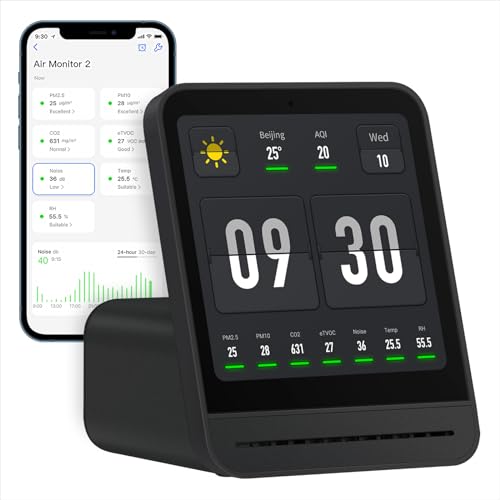
- Qingping Air Quality Monitor Gen 2 (the successor) — the current Qingping flagship and the Pro’s successor: PM2.5, CO2, PM10, noise, temperature, and humidity, with an alarm clock function. Check price on Amazon
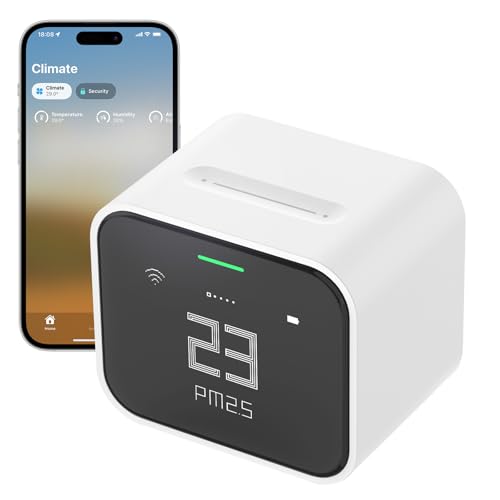
- Qingping Air Monitor Lite — the smaller Qingping: CO2, PM2.5, PM10, temperature, and humidity with HomeKit, for desks and secondary rooms. Check price on Amazon
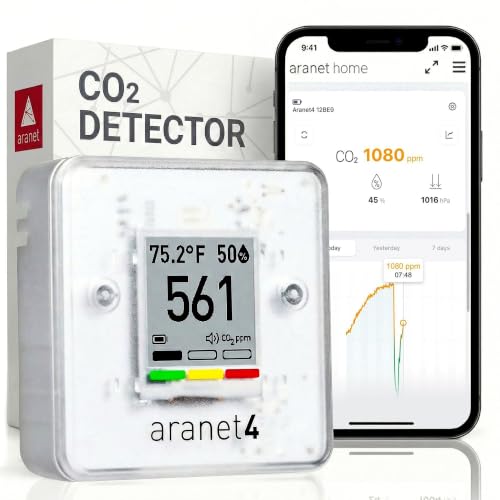
- Aranet4 Indoor Air Quality Monitor — the ventilation specialist: NDIR carbon dioxide, temperature, humidity, and pressure on an e-ink screen, with battery life in years. Check price on Amazon
- Airthings 2960 View Plus — the maximalist sentinel: radon, particles, CO2, VOCs, humidity, temperature, and pressure in one battery-powered unit. Check price on Amazon
- Qingping Air Monitor Pro — the QP Pro (prose only) — the original flagship, reviewed in full below from its record; no verified unit listing was available when this guide was prepared, so it carries no purchase link.
Read the quick list as a map of the present tense: the successor for the bedroom, the Lite for everywhere else, the Aranet4 for the freshness question, the View Plus for the full census. The Pro’s own section follows immediately, because its past tense still matters — to its owners, to the second-hand market, and to anyone who wants to understand why the present tense looks the way it does.
The QP Pro itself: the original, assessed from its record
The Qingping Air Monitor Pro arrived when home air monitoring was splitting into two tribes: cheap VOC gadgets that estimated everything and proved nothing, and laboratory-flavoured instruments that frightened ordinary households. The Pro threaded between them. It carried real sensing for the core quantities — particles in two sizes, carbon dioxide, temperature, humidity — in a designed object with a display worth reading, and it treated the smart home as its natural habitat rather than as an afterthought. For many households it was the first monitor that felt like a product instead of a project, and its reputation among early smart-home adopters was earned on exactly that ground.
In daily service, owners valued three things about it. The first was legibility: a screen that could be read across a room, presenting the air’s state as a glance rather than an interrogation. The second was honesty of sensing, particularly the carbon dioxide channel, whose traces taught a generation of owners the overnight-ventilation lesson that remains this category’s rite of passage. The third was integration — readings that flowed into the home’s systems and could be acted on by automations rather than merely admired. Strip any one of those away and the Pro would have been unremarkable; together they defined what a consumer monitor should be, and every successor in this guide, Qingping’s own included, is built inside that definition.
Its weaknesses were the era’s weaknesses. It was a creature of its ecosystem moment, and households outside that ecosystem found its charms harder to reach. It asked for mains power and a fixed station, so it witnessed one room’s air with great fidelity and the rest of the house not at all. And like all sensor instruments, it aged in ways its handsome shell concealed: sensors drift across years, and a Pro of advancing age should be believed in its patterns more than in its decimals — a caution that applies with full force to the second-hand market, where the Pro now mostly lives.
Should an owner replace a working Pro? On the evidence of its record, no — not for measurement’s sake. Its core channels remain the core channels; a healthy Pro still answers the bedroom and purifier questions as well as anything in this guide. Replacement makes sense when the unit falters, when its ecosystem support thins, when a household’s questions outgrow it — radon being the clearest such outgrowth — or when a second room needs witnessing and the Pro is promoted to make way for a successor by the bed. Should a non-owner buy one used? Only with eyes open: at a price that reflects sensor age, from a seller who can show it alive and reading, and with the Gen 2’s new price in the other hand as the discipline that keeps the gamble honest.
The successor shelf in detail
The four products below are the verified present: each confirmed against its current listing, image included, and each framed in its true relationship to the subject — successor, sibling, or rival. The Gen 2 leads, as the heir should, and it is labelled as the successor everywhere it appears in this guide, never as the Pro itself.

Qingping Air Quality Monitor Gen 2 (the successor)
Verified successor to the QP Pro — buy this instead
Let the labelling be exact, because this guide promised it would be: this is the Qingping Air Quality Monitor Gen 2, the successor model in the maker’s line, and it is not the QP Pro. A buyer who wants the Pro’s idea in a new, supported, warrantied box should buy this — but should buy it as what it is, a newer generation with its own design, its own feature balance, and its own bedside-oriented character, rather than as a relic reissued. Successors in this category are usually improvements in the ways that matter and departures in the ways that merely differ, and the Gen 2 follows that rule faithfully.
What it inherits is the core that made the Pro respected: particle sensing in two sizes, genuine carbon dioxide measurement, temperature, and humidity, presented for a smart home rather than trapped on a gadget. What it adds tells you where the maker thinks the category went: a noise channel, because the bedroom became the monitor’s home and the bedroom’s arguments are about sound as much as air; and an alarm clock function, because a device that wants the bedside must justify itself at waking as well as at sleeping. The Pro was a desk instrument that visited bedrooms; the Gen 2 is a bedroom instrument by design.
Living with the successor, the experience will feel familiar to any Pro owner in the ways that count — the evening particle spike from cooking registering down the hall, the carbon dioxide curve narrating the night, the data flowing onward into the home’s automations — and quietly better in the ways a generation brings: a more domesticated interface, a feature set tuned to where monitors actually live now. If your Pro has died, this is its heir, and the inheritance is genuine. If your Pro still works, the sections below will help you decide whether the heir offers you anything you lack, because for many owners the honest answer is: not yet.
At a glance
- Status: current successor model in the Qingping line
- Senses: fine and coarse particles, carbon dioxide, noise, temperature, humidity
- Added duty: alarm clock, as its listing describes
- Intended setting: bedroom and smart home
- Note: a distinct model from the original QP Pro
Strengths
- Carries the Pro’s core measurements into a supported model
- Noise channel suits the bedroom role monitors now serve
- New stock with a warranty, unlike used Pro listings
Trade-offs
- Not identical to the Pro — design and balance differ
- Bedroom-first features may not suit a desk or hallway
- Costs more than a used Pro gamble that might pay off
Best for: a buyer who came for a QP Pro and wants its modern, supported equivalent for the bedroom.
Not suited for: a collector set on the original Pro specifically, whatever its age.

Qingping Air Monitor Lite
Verified alternative — the line’s compact five-reading meter
Every flagship line needs its honest smaller sibling, and in Qingping’s range the Lite fills that role beside the Gen 2. It keeps the five measurements that constitute most households’ real questions — carbon dioxide, both particle sizes, temperature, humidity — and sheds the bedside theatre: no clock ambitions, no noise channel, just the readings on a clear display with HomeKit carrying them into an Apple home. Beside the memory of the Pro, the Lite reads as the line’s conscience: the reminder that measurement, not features, is the product.
Its natural deployments are the rooms a flagship monitor is too grand for: the study where a worker wants the CO2 truth without a bedside appliance, the nursery where a parent wants the particle story during a smoky week, the second bedroom that a rotating flagship never quite reaches. Households that begin with the Gen 2 by the bed commonly add a Lite for exactly these stations, and the pair together cover a home more sensibly than any single monitor at any tier, because air is local and two honest witnesses beat one elaborate one.
Against the Pro’s ghost, the Lite also makes an argument about time. The Pro was the fullest expression of its moment; the Lite is the expression of what the moment taught — that five true numbers, always visible, integrated with the home’s brain, outperform a longer channel list consulted in an app. A buyer choosing between a used Pro at a tempting figure and a new Lite at a similar one is choosing between the category’s past and its distilled present, and this guide’s money, for a working household rather than a collector, is on the present.
At a glance
- Senses: carbon dioxide plus both particle sizes, temperature, humidity
- Links: Wi-Fi, native to Apple HomeKit homes
- Form: the compact meter in the Qingping range
- Role: fixed sentinel for one room
- Support: current model with live listing
Strengths
- Five core readings without bedside extras to pay for
- HomeKit integration matches the line’s smart heritage
- Ideal second monitor for studies and nurseries
Trade-offs
- No noise channel or clock for bedside duty
- Mains-tethered, so it cannot roam the house
- Smaller presence may underwhelm flagship hunters
Best for: a second room, a study, or a buyer who wants Qingping measurement without flagship pricing.
Not suited for: the main bedroom if noise and alarm features are on the wish list.
Aranet4 Indoor Air Quality Monitor
Verified alternative — CO2 mastery, battery in years
The Aranet4 enters this guide as the control group — the instrument against which the whole Qingping philosophy can be measured. Where Qingping built generalists, Aranet built a specialist: carbon dioxide measured by a proper NDIR sensor, supported by temperature, humidity, and pressure, displayed on e-ink, and powered so frugally that the battery’s life is counted in years. It has no particle channel and wants none. Its question is singular and profound: how stale is the air in this room, and what would fresh air do to the people in it?
For a certain reader, that is the only question the QP Pro was ever really answering. The Pro’s particle traces were interesting, but its carbon dioxide curve was transformative — the graph that changed how a household ventilated its bedrooms and judged its office. The Aranet4 takes that one transformative measurement and perfects its delivery: portable enough to survey a school, an office floor, or every bedroom in a house across a single weekend, patient enough to be forgotten on a shelf for a year and still be testifying when you return to it.
The choice between the Aranet4 and the Qingping successor is therefore a choice of curiosity. If your household’s air questions are about dust, cooking, and purifier performance, particles matter and the Qingping line is your home. If your questions are about sleep quality, afternoon slumps, classroom headaches, and the invisible tide of rebreathed air, the specialist will serve you better than any generalist, the Pro’s honoured memory included. Neither answer dishonours the other; they are different sciences wearing similar plastic.
At a glance
- Senses: carbon dioxide by NDIR, with temperature, humidity, pressure
- Screen: e-ink, calm in any light
- Endurance: battery life counted in years by its maker
- Form: portable — surveys rooms in turn
- Role: ventilation specialist instrument
Strengths
- Finest CO2 delivery in this comparison
- Years of battery make it a true survey instrument
- Respected in schools and offices at scale
Trade-offs
- Blind to particles, smoke, and purifier work
- Single-discipline focus at a serious tier
- E-ink pace will not thrill live-dashboard fans
Best for: classrooms, offices, and sleep-focused households whose question is freshness above all.
Not suited for: purifier owners who need particle evidence to run their machines.

Airthings 2960 View Plus
Verified alternative — the full census, radon included
The View Plus is what the QP Pro’s philosophy becomes when it is pushed to its limit: if a household benefits from knowing its air, let it know everything — radon rising from the ground, particles from the street and the stove, carbon dioxide from its own lungs, the chemical whisper of VOCs from paints and products, and the temperature, humidity, and pressure that frame them all. Airthings, a maker whose founding subject was radon, builds the broadest consumer sentinel in this guide, battery-powered so it can stand wherever the census is needed.
Radon is the channel that justifies the breadth, and it deserves plain language. It is a naturally occurring radioactive gas that seeps into ground-contact rooms, varies enormously by geology and by house, and is taken seriously by public health authorities precisely because it is invisible, odourless, and cumulative. No Qingping, of any generation, measures it. A household in affected country that buys a monitor without radon has bought an excellent instrument that is blind to the one measurement with genuine long-term stakes, and that asymmetry should drive the choice for ground-floor and basement homes more than any feature comparison in this guide.
For everyone else, the View Plus is the connoisseur’s option: the fullest picture, the app-carried history, the battery freedom to migrate between the landing and the cellar as seasons and questions change. Its breadth asks for a thoughtful owner — one who will learn that radon is read in months, particles in hours, and VOCs with a sceptical eyebrow — but for that owner it replaces a shelf of single-purpose gadgets with one calm sentinel. The Pro’s heirs divide its inheritance; the View Plus, from another family entirely, shows what the inheritance looks like spent all at once.
At a glance
- Senses: radon first, then particles, CO2, VOCs, humidity, temperature, pressure
- Power: battery-fed, so it can stand anywhere
- Maker: Airthings, founded on radon measurement
- History: app records the long trends radon requires
- Role: whole-home sentinel in a single unit
Strengths
- Radon — the one channel with long-term health stakes
- Broadest single-device census in this guide
- Battery freedom suits landings, basements, halls
Trade-offs
- Highest tier in this comparison
- Breadth can bury a casual owner in data
- Meaning of several channels emerges slowly
Best for: ground-contact homes, especially in radon country, wanting one sentinel for everything.
Not suited for: a buyer whose questions are only about bedroom freshness and dust.
How a flagship becomes a successor: reading the generations
Product generations in this category do not advance the way phones do, with a leap each autumn. Sensors improve slowly, and the honest differences between a Pro and its successor are mostly about where the device lives and what the maker has learned about households. The Pro was designed when a monitor was a desk instrument for an enthusiast; the Gen 2 was designed after the category learned that monitors migrate to bedrooms, where they must keep time, mind noise, and behave like furniture. Reading the two side by side is reading the category’s own diary, and it is more instructive than any single specification in either box.
That diary has a practical moral for buyers of any discontinued favourite, in any category: the successor is rarely the same product warmed over, and shopping for it as if it were leads to a particular, avoidable disappointment. The Gen 2 will not be the Pro in your room; it will be the Pro’s idea, re-housed for the bedroom era. Buyers who understand that tend to be delighted. Buyers who wanted the past, shrink-wrapped, should be honest with themselves and go and hunt the past on the second-hand market, with the cautions this guide has laid out — because no successor, however faithful, can sell them yesterday.
There is a final, quieter lesson in the Pro’s trajectory, about support. A monitor is a long-lived, sensor-bearing object whose value depends on the maker’s continuing attention — firmware, app, ecosystem bridges. The moment a model leaves the current shelf, that attention begins, slowly, to be spent elsewhere. Nothing dramatic happens; the device simply stops becoming better, and then, across years, stops fitting the home around it. Buying the successor is, in large part, buying back that attention — and for an instrument whose whole job is to remain truthful inside a changing smart home, the attention is worth paying for.
Buying guide: shopping after a discontinuation
Price the used past against the new present
The discipline that protects every buyer in this situation is a single comparison: the used Pro’s price against the Gen 2’s new price, checked on the day, through the links in this guide. A used flagship at a small saving over its new successor is a bad trade dressed as a bargain, because the saving buys sensor age, an unknown history, and no warranty. A used Pro at a genuinely deep discount, demonstrably alive, is a rational gamble for a second room. The numbers move, so this guide prints none — but the comparison itself is the entire method, and skipping it is how discontinued products extract their tax from the nostalgic.
Interrogate a used unit like an instrument, not a gadget
If you do hunt the Pro second-hand, ask instrument questions. Can the seller show it reading, beside a window opened and closed, with the carbon dioxide trace responding as breath and fresh air dictate? How was it powered and stored, and for how long has it sat in a drawer — because sensors that sit in dust and damp age differently from sensors that work? Is its cable, its stand, its paperwork present? A seller who can answer is selling an instrument; a seller who cannot is selling a photograph, and the price should fall accordingly.
Decide whether your questions have outgrown the line
A discontinuation is also a prompt to re-ask the founding question: what do you want to know about your air? If the answer is unchanged — bedroom freshness, purifier truth, the five core readings — the successor shelf serves you, and the Gen 2 or the Lite will feel like coming home. If the answer has grown — a basement in radon country, a school-full of classrooms, an office whose afternoons sag — then the Pro’s passing is your cue to change families, to the View Plus’s census or the Aranet4’s mastery, without sentimentality. Products end; questions continue, and the questions are the senior partner in every purchase.
Ecosystem fit outlives any single model
The Pro’s generation taught the category that a monitor’s readings are worth most inside the home’s own systems, and that lesson should steer its replacement. An Apple household replacing a Pro should stay where its automations live — the Lite and its Qingping kin speak that language natively. A household that has changed ecosystems since the Pro was bought should treat the replacement as a migration, not a like-for-like swap, and choose the monitor its current home can actually hear. Hardware is replaced in an afternoon; the data habits built around it take a season, and they are the asset worth protecting.
How to live with a monitor: the successor-era routine
Give the new instrument the Pro’s old station — then question it
When a successor arrives, the temptation is to place it exactly where the Pro stood and compare traces like a suspicious auditor. Resist half of that impulse. Same station, yes, for a fortnight, because continuity of placement is what makes the new instrument’s testimony comparable to the old one’s. But compare to learn the new device’s character, not to convict it of differing; two honest instruments in the same room will rhyme rather than repeat, and the rhyme is the signal that both are healthy.
After the fortnight, let the successor migrate to where the household’s questions now live — which, for the Gen 2, is usually the bedside it was designed for — and let the older unit, if it survives, take the study or the spare room. A house with two monitors in honest stations knows more about its air than a house with one flagship in a place of honour, and the Pro’s own philosophy, carried faithfully, argues for exactly that demotion of any single device.
Build the three habits that make readings valuable
The first habit is the weekly glance with a memory: not the numbers themselves, but their direction across the week — the bedroom curve shallower since the door habit changed, the particle baseline lower since the purifier’s setting was promoted. The second habit is the seasonal survey, in which a monitor, or a borrowed hour of attention, visits the rooms it does not usually witness, because houses change with the seasons and a fixed sentinel cannot testify about a room it has never entered.
The third habit is the annual question, asked of the data and of the household together: what did we learn about our air this year, and what, if anything, deserves money or effort in response? Sometimes the answer is a vent, sometimes a purifier service, sometimes nothing at all — and the nothing, when it is evidence-based, is the monitor’s gift as surely as any purchase it provokes. Instruments earn their keep by the decisions they inform, including the decision to leave well alone.
Mistakes made when replacing a discontinued favourite
The first mistake is the tribute purchase: buying the successor at any price, on launch logic, to honour the old unit — when the old unit still works and the household’s questions have not changed. Sentiment is a poor procurement officer. The second mistake is the opposite, the false economy of the ageing bargain: a cheap used Pro whose sensors have drifted far enough to make its testimony misleading, which is worse than no testimony at all, because a household will ventilate, purify, and worry according to numbers that no longer describe its air.
The third mistake is subtler: assuming the new model must be set up as the old one was, in the same place, with the same automations, answering the same questions — when the household itself has moved on. Children have grown, a study has become a nursery, the office has gone hybrid. A replacement is the one natural moment to re-ask where the house’s air matters most, and households that seize it get a better system than the one they lost. The Pro, to its credit, would have wanted to be replaced thoughtfully rather than replicated blindly; its whole philosophy was attention, and attention begins with the placement of the instrument itself.
What the Pro’s story says about buying instruments
Zoom out from Qingping entirely, and the QP Pro’s arc — admired flagship, quiet discontinuation, successor with a different balance — is the standard biography of a good instrument in a maturing category. The early product defines the possibility; the market absorbs the definition; the maker moves the flagship’s virtues down and across the range, into smaller siblings and bedside successors, until the original’s distinct existence is no longer necessary. Owners sometimes read that arc as betrayal. It is closer to graduation: the Pro did not fail, it finished — it taught its category what to be, and the category, including its own maker’s current shelf, became it.
For buyers, the practical residue is a durable rule: in instrument categories, buy the philosophy in its current vessel, not the vessel in its past glory. The philosophy here — real sensors, legible display, data that flows into the home — is alive and purchasable today in every product linked in this guide. The vessel called QP Pro is history, honourable and instructive history, and this review has treated it as such: praised where praise was earned, cautioned where age demands caution, and left, finally, in prose — which is where the past belongs, and where it can do its owners no harm.
The Pro in the wider story of home sensing
It is worth pausing on how recently all of this became ordinary. Within living memory, knowing the carbon dioxide level of a bedroom required either professional equipment or a science project; the Pro’s generation put that knowledge on a shelf beside the alarm clock, priced for households, and phrased in numbers a tired parent could read at midnight. That democratisation is the real product the Pro sold, and its effects are still spreading — through classrooms that now monitor their air as a matter of routine, through offices that discovered their meeting rooms were soporific by measurement rather than by management style, through a general public literacy about ventilation that did not exist a decade ago.
The successor shelf in this guide is that democratisation’s second act: cheaper siblings, broader sentinels, specialists with years of battery, all of them unremarkable now precisely because the first act succeeded. A buyer choosing among them is not standing at a frontier; they are shopping in a settled market whose terms the Pro helped to write. That is a comfortable position, and it carries one obligation — to buy as the settled market deserves, on questions and evidence rather than on nostalgia or novelty, letting a discontinued flagship rest in honour while its philosophy does the household’s daily work in newer plastic.
There is a temptation, in a review like this one, to end the history with a sigh. Resist it. The instruments linked below are better placed in bedrooms, better supplied with support, and in the View Plus’s case broader in vision than the Pro ever attempted to be. The category did not lose its flagship; it dissolved the flagship into the range, which is what maturing categories do to their pioneers. The Pro’s owners should feel the particular pride of early adopters whose bet was proved right by everything that followed, including the fact that their device no longer needs to exist.
Keeping a Pro alive: care for the past generation
For the owners this review has repeatedly addressed — those keeping a Pro in service — a short liturgy of care extends its honest life. Keep its vents dusted, because optical particle sensors read through lenses that household film slowly clouds. Keep it out of steamy bathrooms and direct sun, both of which age sensors faster than time does. And once in a while, give it the fresh-air test: an hour beside an open window on a clean day, where its carbon dioxide reading should settle toward the outdoor baseline and its particle count should fall to the day’s floor. An instrument that passes that test is still an instrument; one that fails it has become an heirloom, and should be retired to the shelf of honour rather than believed.
That test deserves emphasis because it is the owner’s only real calibration ritual, and it converts the vague anxiety of sensor drift into a checkable fact. Pro owners who perform it seasonally will know, rather than guess, when their unit’s testimony stops deserving the household’s trust — and that knowledge, appropriately, is the most on-brand legacy a monitor can leave. The successor, when it comes, should be subjected to the same ritual from its first season, so that the household’s habit of verifying its instruments outlives any particular instrument, which is exactly as it should be. Households that adopt the ritual for the Pro will find they have quietly adopted the correct relationship with every sensor they will ever own: trust, verified seasonally, in writing on the calendar. It takes ten minutes a season and returns the one thing no successor can sell you: certainty about the instrument already in your hand, which for a healthy Pro is certainty well worth having.
A note on evidence and this review’s method
Because the subject of this review could not be linked, its method deserves a transparent paragraph. The Pro is assessed from its documented record — its maker’s specifications from its selling years, its established reputation among owners, and the category knowledge accumulated across this programme’s monitor reviews. The four linked products, by contrast, were each verified against a current listing before being written about, with titles and images drawn from that verification. Where this guide speaks of the present tense — prices excluded, as ever, because they move — it speaks from that checked shelf; where it speaks of the Pro, it speaks of history, and it has kept the two tenses visibly separate throughout, because confusing them is the one unforgivable sin in a review of a discontinued product. Readers who hold every review of legacy hardware to that standard will find the second-hand market a much safer place than its reputation suggests. The same standard protects buyers of the successor shelf, incidentally: a listing that names its model precisely, shows it alive, and prices it in the open is a listing that expects to be checked — and the four products linked in this guide were chosen, in part, because their listings survive exactly that checking without flinching. That is the company a discontinued flagship would want its heirs to keep, and on the evidence of this verification round, they keep it.
Final recommendation
If you own a QP Pro and it still reads honestly, keep it, place it well, and let this review be the reassurance that its core measurements remain the category’s core measurements. Spend nothing until it falters or your questions outgrow it. If you came to buy, buy the present: the Qingping Gen 2 as the Pro’s successor and heir for the bedroom, the Lite as the line’s distilled instrument for every other room, the Aranet4 if freshness is your whole enquiry, the View Plus if your census must include the ground’s own gas. Each is linked, verified, and framed as what it is.
And if the second-hand Pro still calls to you, answer with discipline: a seller who can show it alive, a price that respects its years, and the successor’s new figure open in another tab to keep the nostalgia honest. The QP Pro deserved its reputation, and reputations in this category are not inherited by listings or by plastic — they are re-earned, nightly, by instruments that tell the truth. The four machines linked above are where that truth is currently sold, and any of them will serve the household that the Pro taught to care about its air. That teaching, more than any unit still standing on any shelf, is the QP Pro’s durable contribution — and the measure by which its successors, reviewed here in its shadow, should themselves be judged in their turn. When their turn comes — and in this category it comes for everything — may they be reviewed with the same fairness, and may their owners keep them with the same loyalty, for exactly as long as their testimony stays true. Loyalty with verification, nostalgia with a price check, and a successor bought for the household you have now rather than the one you had — that is the whole of this review’s advice, and the Pro itself could ask for no better epitaph. Readers who came for a shopping link and stayed for a history have the successor shelf above, verified and waiting; readers who came for the history have, we hope, been served with the accuracy the old instrument itself would have demanded. Either way, the air in your rooms is still there to be measured, and the measuring — by an heir, a sibling, or a survivor — is what this page exists to encourage. Begin with the room you sleep in, as the Pro’s first owners did, and let the traces make their familiar, persuasive case. They have never yet failed to persuade a household that stayed to read them. Yours, in all likelihood, will be no exception to that quiet rule.
Frequently asked questions
Is the QP Pro discontinued?
It could not be verified as a current, purchasable listing when this guide was prepared — searches returned its successor generation and its smaller sibling rather than the Pro unit itself — which is the practical signature of a model being wound down or sold only through residual and regional channels. That is not a formal announcement, and stock has a way of resurfacing, but a buyer today should proceed on the basis that the Pro is the past generation and the Gen 2 is the current one, because that is how the market is actually arranged. Owners should not read that arrangement as a verdict on their unit: a model’s commercial sunset says nothing about the honesty of a healthy specimen still standing on a bedroom shelf, and many will testify for years yet.
Is the Qingping Gen 2 the same product as the QP Pro?
No, and this guide has been careful to label it as the successor rather than the same product. The Gen 2 carries forward the Pro’s core measurements — particles in two sizes, carbon dioxide, temperature, humidity — and adds a noise channel and an alarm clock function, in a design oriented to the bedside. Think of it as the line’s current flagship expression, not a reissue: a buyer gets a new, supported model shaped by what the maker learned from the Pro’s generation, which is a better purchase than a relic for almost every household, provided it is bought with clear eyes about the difference. Retailers and marketplace sellers do not always keep generations as separate as this guide does, so the buyer’s own clarity — checking the model name on the listing against the model intended — is the final safeguard, and it takes ten seconds.
My QP Pro still works. Should I upgrade to the Gen 2?
Not for measurement’s sake alone: a healthy Pro still answers the core questions — bedroom freshness, particle events, purifier performance — as well as the current shelf does. Upgrade when the Pro falters, when its place in your smart home frays, when you want the bedside-specific additions of noise sensing and the alarm function, or when a second room needs a monitor and a reshuffle makes the Gen 2 the natural new anchor. Until one of those is true, the Pro’s own philosophy argues for attention to your air rather than to your shopping basket. When the upgrade does come, keep the Pro if it still reads at all: a second station in a study or a child’s room extends the household’s knowledge more cheaply than any other purchase in this guide.
Is a used QP Pro a good buy?
It can be, under discipline: a demonstrably working unit, a seller who can show its readings responding to the room, and a price set well below the successor’s new figure to honour the sensor age and absent warranty you are accepting. It is a poor buy at near-successor money, or from a listing that offers a photograph and a hope. Remember that a monitor’s value is its truthfulness, and truthfulness is the one quality a second-hand listing cannot easily prove — which is why the discount must be real, and why this guide links the new shelf instead. A used Pro bought well also makes an unusually thoughtful gift for a technically minded relative — an instrument with a pedigree, introduced with its history explained, rather than a gadget whose story the giver cannot tell.
What did the QP Pro measure?
The core set that defined its generation: fine and coarse particles (PM2.5 and PM10), carbon dioxide, temperature, and humidity — the five readings that answer most households’ questions about freshness, dust, and comfort. It did not measure radon or the wider chemical census that the Airthings View Plus in this guide covers, and its carbon dioxide sensing, a genuine instrument channel rather than an estimate, was central to its reputation among owners who used it to fix their bedrooms’ overnight ventilation. That five-reading set remains the benchmark this guide applies to every successor and rival, which is the most practical compliment a review can pay a discontinued product: its definition of enough is still the definition in use.
Which buyable monitor is closest to the QP Pro experience?
The Qingping Gen 2, by descent: same maker’s philosophy, the same core measurements, extended for the bedroom era with noise sensing and a clock. The Lite is closest in spirit for readers who valued the Pro as a pure instrument, delivering the five core readings in their most distilled current form. Between those two Qingpings, the choice is furniture and features — bedside companion or plain meter — and either preserves the essential Pro experience of watching one’s own air, truthfully, in the home’s own systems. Readers who want that experience with the least possible fuss should note that the Lite, not the flagship, is the quickest route from box to testimony — a consideration that matters when the monitor is bought in response to a specific worry, such as a child’s cough or a smoky season already under way.