Disclosure: As an Amazon Associate, dailyhomedecorating.com earns from qualifying purchases. Links on this page are affiliate links; they cost you nothing extra. Prices and availability change often, so check the current Amazon listing before you buy.
Most air monitors are furniture. The subject of this atmotube pro review is a traveller: a palm-sized cylinder of sensors — particles, volatile organic compounds, carbon dioxide, temperature, humidity, pressure — designed to be carried from bedroom to office to car to café, building a personal map of the air a life actually passes through. It is the most ambitious consumer air instrument of its size, and ambition in sensors is where reviews earn their keep.
Atmotube built its name on exactly this proposition, and the Pro is its fullest statement: a particulate sensor for smoke and dust, a VOC sensor for the chemical weather of interiors, and CO2 for ventilation, all logged to an app that draws the day as a coloured timeline. This review tests the proposition’s three weak points — sensor credibility at this size, battery life under real use, and whether the data changes anything once the novelty fades.
The framing rules apply as ever: these are environmental measurements for household decisions — when to air a room, whether the office is the problem, how bad the commute’s air is — not medical instruments. Readers with health conditions should keep clinical questions clinical. Within its honest brief, the Atmotube Pro is the most interesting air gadget in this cluster, and interest, in a monitor, is a genuine feature: a device that fascinates gets carried, and a device that gets carried gets data.
Atmotube Pro Review: The Short Version
| Pick | Known for |
|---|---|
| Atmotube Pro | The named monitor |
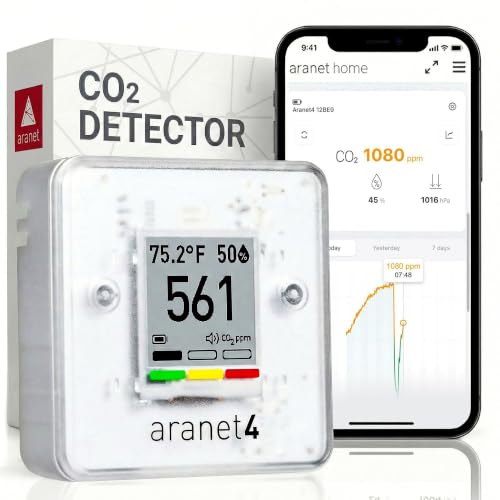
| Aranet4 Home | The stationary CO2 sentinel |
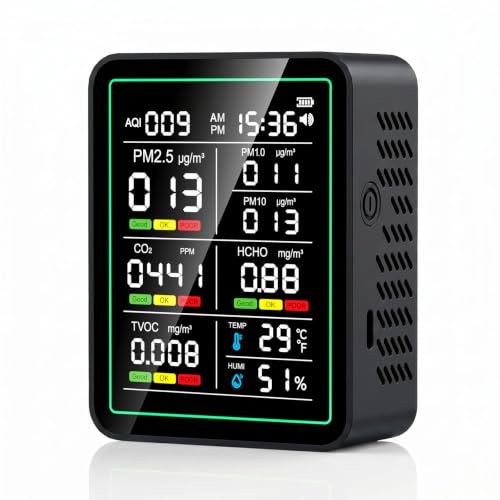
| Temtop Air Quality Monitor | The budget handheld alternative |
| Awair Element | The stationary smart alternative |
| Qingping Air Monitor | The display-rich stationary alternative |
The Atmotube Pro is the air monitor for people who want to carry the question with them: particles, volatile compounds and CO2 in a pocketable device that audits bedrooms, offices, cars and cafés with the same indifference. Its data is richer than any rival’s at the price, its app is genuinely informative, and its battery — days, not months — is the tax on all that sensing. It is an instrument for the curious, not a sentinel for the shelf, and households should buy it for audits rather than for ambience.
In this guide
The sensor suite: breadth as a design philosophy
Three pollutant channels in a device this small is an engineering argument made physical. The particle sensor counts the smoke, dust and pollen fraction; the VOC sensor reacts to the solvents, furnishings and cooking fumes that make interiors smell like themselves; the CO2 channel tracks the room’s breathing. Each is a consumer-grade implementation — none rivals a reference instrument — but their combination produces something no single channel can: a diary of a day’s air with the causes legible in it.
Credibility deserves its sentences. Particle counts from miniaturised optical sensors track real events faithfully — cooking, candles, a smoky street — while their absolute numbers should be read as strong indications rather than laboratory values. VOC sensing is the most interpretive channel in all consumer air monitoring: it reports a chemical index, not a list of chemicals, and a spike means ‘something changed’ rather than naming the culprit. The Atmotube’s app is honest about this in a way the category often is not, presenting scores and trends rather than false precision.
CO2 is the channel where the Pro meets its sternest rival, because the Aranet4’s dedicated infrared sensor does this one job with reference manners and months of battery. The Atmotube’s CO2 is serviceable — adequate for the ventilation decisions of a traveller — and households whose only question is CO2 should read the Aranet4 review in this cluster and buy the sentinel instead. The Pro’s case is the household with three questions and one pocket.
Battery, build and the carrying life
Physics collects its tax here. Sensing particles means running a fan and a light source; sensing everything, often, in a small body means the battery is measured in days — roughly a week of typical use, fewer with enthusiastic settings — and the device lives on a charging rhythm like a phone’s poorer cousin. Owners who accept the rhythm get a carried instrument; owners who resent it get a drawer resident, and the review’s duty is to say plainly that both outcomes are common.
The build suits the life: a compact, rounded body that tolerates bags and pockets, a simple indicator light for a glanceable verdict, and the app for everything deeper. There is no screen, which keeps the price, the battery and the silhouette in check while making the phone the display — a decision that delights the app-happy and excludes the screen-glancers the Aranet4 serves. Syncing and history are the app’s home ground, and the timeline view of a day — home, commute, office, gym, home — is the product’s signature pleasure.
Durability over years is the open question for all carried sensors: optical chambers foul, fans tire, and a device that lives in bags ages faster than one that lives on shelves. Atmotube’s replaceable-component philosophy and the device’s price should be weighed together — this is an instrument with a service life, not an heirloom, and its data value is front-loaded into the audits of its first years.
What carrying a monitor actually teaches
The first lesson is the commute. Cars in traffic, underground platforms and busy pavements produce the day’s worst particle readings for many owners, and the discovery rearranges habits — a different route, a window habit, a mask on the worst platforms — more than any home measurement does. The home, it turns out, was rarely the problem; the journey was, and only a carried monitor could have filed that report.
The second lesson is the workplace. Offices vary wildly — the sealed meeting room’s CO2 climb, the print room’s chemical weather, the desk beside the kitchen’s particle diary — and an employee with a week’s data has a conversation with facilities that adjectives never win. Several of this category’s most devoted users are office workers who bought the device for home and promoted it to work.
The third lesson is humility about the home itself. Cooking is most houses’ largest particle event, candles are small smoke ceremonies, and the bedroom’s overnight CO2 is a pattern the Atmotube shares with its Aranet rival. The carried audit usually ends with the home acquitted of the worst charges and convicted of a few fixable habits — which is, in the end, the most useful verdict a monitor can deliver, and the reason this review forgives the battery its appetite.
The Atmotube as a traveller’s instrument
The Pro’s real biography is written in other people’s air: hotel rooms whose windows do not open, rental cars, a relative’s smoking kitchen, the office floor whose air the facilities team insists is fine. In those places its readings do something a home sensor cannot — they make the invisible negotiable. A window opened, a room changed, a meeting moved: small sovereign acts, each with a number behind it, are the product’s actual output across a travelling year.
Parents have made it a school-run instrument, clipped to a bag on the walk past the idling queue; commuters have made it a route-planner, choosing the side street over the arterial on evidence. None of these uses appears on the box. All of them are why this review grades portability as a first-class criterion rather than a dimension.
Reading the Pro’s data without fooling yourself
A carried sensor produces a seductive abundance of numbers, and the review’s duty is a short course in not being fooled by them. Single spikes are weather, not verdicts — a passing bus, a doorway’s gust, a hand’s warmth on the case. Patterns are the signal: the same corner at the same hour, the same room after the same activity, the baseline your own home establishes across a week. The app makes patterns easy to see precisely because its designers understood that a traveller’s data is a diary, not a dashboard.
The second discipline is comparison hygiene: the Pro grades places against each other and against your own baseline far more reliably than it grades them against an absolute standard. Used that way — relatively, patiently, in patterns — it is a genuinely scientific instrument at a consumer’s price. Used as an oracle, it is a worry machine. The difference is the user’s, and this section is the review’s attempt to make it the former.
The Picks in Detail: Atmotube Pro Review Contenders
Atmotube Pro — The named monitor
The Atmotube Pro is the carried audit made product: three pollutant families, a timeline app that turns a day into a legible air diary, and a form factor that genuinely travels. Its measurements are indications of professional shape rather than laboratory values, and its app treats them with a honesty about uncertainty that the category should copy. For the household that suspects its air problems live outside the bedroom — in the commute, the office, the rental’s mystery smell — it is the only instrument at its price asking the right questions in the right places.
Its compromises are structural and declared: battery in days, no screen, sensors that will age with travel. Buy it as an instrument for a season of audits and a life of spot checks, charge it with the phone, and it will repay its price in the currency it deals in — knowing, room by room and route by route, what the air actually did today.
| Measures | Particles, VOCs, CO2, temperature, humidity, pressure |
|---|---|
| Form | Pocketable, rechargeable |
| Display | App and indicator light |
Strengths
- Particles, VOCs and CO2 in one pocketable device
- Timeline app turns a day’s air into a readable diary
- Genuinely portable — audits rooms, cars and commutes
Trade-offs
- Battery life in days; a charging rhythm is mandatory
- No screen — the phone is the display
- Consumer-grade sensors give indications, not laboratory values
Best for: curious households auditing air across home, work and travel, and renters chasing a mystery smell from room to room
Not suited for: buyers who want a fit-and-forget bedroom sentinel, a glanceable screen, or reference-grade CO2 accuracy
Positioning: atmotube pro review — the Atmotube Pro appears as a prose pick rather than a linked one; the maker’s own current listing is the place to confirm its terms.
Aranet4 Home — The stationary CO2 sentinel
The Aranet4 is the Atmotube’s opposite number and this cluster’s other monitor review: one pollutant measured superbly, an e-ink screen, and battery life that turns charging from a rhythm into a rumour. For the bedroom and the study — the rooms where the question is ventilation and the device should be furniture — it is the stronger instrument, and its full review sits elsewhere in this programme.
Households choosing between the two should ask where their air question lives. If it lives in one room’s stuffiness, the Aranet4 answers it better and forever. If it lives everywhere the owner goes, the Atmotube is the only one of the pair that can follow. The devices are complements miscast as rivals, and the complete household arguably ends with both — the sentinel at home, the scout in the bag.
| Measures | CO2, temperature, humidity, pressure |
|---|---|
| Display | E-ink |
| Power | AA batteries, months |
Strengths
- Reference-manner CO2 sensing with calibration
- E-ink screen and months of battery life
- Zero-maintenance ownership
Trade-offs
- CO2 only — blind to particles and VOCs
- Stationary by design; it audits one room
- Bluetooth history rather than remote access
Best for: bedrooms, studies and classrooms needing one trusted ventilation number
Not suited for: anyone whose air questions travel with them
Positioning: atmotube pro review — Aranet4 Home is described rather than linked; this programme links only verified listings, so confirm its terms with the maker.
Temtop Air Quality Monitor — The budget handheld alternative
Temtop’s handhelds offer the carried-monitor idea at a fraction of the Atmotube’s price: particle and gas channels in a simple device with a bright screen and no ecosystem ambitions. The readings are indications of indications — useful for finding that a problem exists, insufficient for grading it — and the build and battery sit exactly where the price puts them.
As a screening tool it earns its place in this list: a landlord walk-through, a workshop check, a first pass over a rental’s mystery smell. Households that find a real problem with a Temtop should graduate to the Atmotube or the Aranet4 for the measurement they will act on, and regard the Temtop’s price as the cost of the question rather than the answer.
Strengths
- Carried multi-channel screening at a budget price
- Bright screen, immediate readings, no app required
- Good enough to find problems worth measuring properly
Trade-offs
- Accuracy is indicative at best
- Battery and build are budget-grade
- Data history and app are minimal
Best for: first-pass screening of rooms, rentals and workplaces on a tight budget
Not suited for: anyone who will act on the numbers — tenancy, health or purchasing decisions — without a better instrument
Positioning: atmotube pro review — the Temtop Air Quality Monitor is covered in prose, not as a linked pick; compare it on the maker’s own current terms before deciding.
Awair Element — The stationary smart alternative
The Awair Element stays home and connects: a broad sensor set feeding a polished app and smart-home integrations from a mains-powered box. For households whose air life is lived in one open-plan space and whose data should live beside their thermostat’s, it is the Atmotube’s inverse — all dashboard, no travel — and its full character is described in the Aranet4 review’s pick list in this cluster.
It is prose-only here for the same verification reason given there: this programme links only listings it can confidently match, and Awair’s retail path is too changeable to pin. The device itself suits the connected living room better than any rival in this list; buy it from a listing you have verified, for a room you do not intend to leave.
Strengths
- Broad sensors with the category’s most polished app
- Smart-home integrations and score-based display
- Stationary permanence suits a main living space
Trade-offs
- Mains-powered and room-bound
- Retail availability too changeable to link confidently
- Ecosystem weight exceeds a simple household’s needs
Best for: connected households wanting air data in their smart-home picture
Not suited for: travellers, renters and anyone whose air questions move rooms
Positioning: atmotube pro review — no linked listing is offered for the Awair Element; it is covered in prose, so check the maker’s own current terms before deciding.
Qingping Air Monitor — The display-rich stationary alternative
Qingping’s monitors put a bright, dense display on the wall or shelf and let a whole room read its air at a glance — CO2, particles and comfort readings together, often with smart-home hooks. For a family kitchen or a shared office, that public display changes behaviour in a way a private app cannot, because the number becomes furniture everyone can see.
Prose-only here, as in the Aranet4 review, because the model range spans sensor grades and shifting listings that this programme will not link blind. Verify the exact model’s CO2 sensing before buying; the display’s confidence is only as good as the sensor behind the glass.
Strengths
- Public, glanceable multi-reading display
- Broad channel set for shared spaces
- Smart-home hooks on recent models
Trade-offs
- Sensor grade varies across the model range
- Mains power and a glowing screen suit halls, not bedrooms
- Listings shift too often for a stable linked pick
Best for: kitchens, hallways and shared offices wanting a public air noticeboard
Not suited for: bedroom minimalists and buyers who cannot verify the exact model first
Positioning: atmotube pro review — no linked listing is offered for the Qingping Air Monitor; it is covered in prose, so check the maker’s own current terms before deciding.
How the Atmotube Pro Review Field Compares
The Atmotube Pro and the Aranet4 are this category’s thesis and antithesis. The Aranet4 measures CO2 superbly, sips battery for months and stays on a shelf; the Atmotube measures three pollutant families adequately, drinks battery in days and goes everywhere. Households that conflate them end up with a sentinel that cannot see smoke or a scout that cannot stay awake — the comparison is not which is better but which job is vacant in your house.
Against the Temtop handhelds, the Atmotube’s case is integration and credibility: better sensors, a far better app, and a data history that follows you between places. Against the Awair Element it trades the smart-home dashboard for portability. The category’s honest map has the Atmotube alone in its square — the carried multi-sensor — and its compromises are the square’s borders, not the device’s failures.
Buying Guide: Judging Atmotube Pro Review on the Right Criteria
A portable multi-sensor monitor is judged by the credibility of its sensors, the usefulness of its data presentation, and whether its battery and build survive the carrying life it promises. The criteria below apply that standard to the Atmotube Pro and the alternatives, because a monitor that stays home in a drawer measures nothing but its owner’s intentions.
Sensor credibility by channel: particles from a mini optical sensor are trustworthy as event detection, VOCs as a change index, and CO2 by the sensing method used — grade each channel separately rather than buying the suite’s average reputation The Atmotube’s channels deserve individual grades: its particle sensing is its serious channel, its VOC index a useful relative signal, and its honesty about which is which — in the app, in the documentation — is the credibility this criterion names.
The portability in practice test separates a considered buy from a hopeful one, since a carried monitor must survive bags, pockets and charging neglect, so size, build and battery honesty decide whether the portability on the box becomes portability in life A monitor is portable only if it is actually carried, and the Pro’s pocketable size and clip are the difference between a device that has seen the household’s whole life and one that has seen its desk.
Battery rhythm: days of battery means the device joins the phone’s charging liturgy; households should buy it only if that liturgy is acceptable, because a flat monitor measures nothing Its recharge cycle fits a phone’s habits rather than an instrument’s, which suits its traveller’s brief — and households that want a set-and-forget home sensor should read that as the fork it is.
The data presentation test separates a considered buy from a hopeful one, since the timeline is the product: a monitor whose app cannot show a day as a story will be consulted for a week and abandoned, whatever its sensors can do The app’s maps and histories are the product’s second half: a journey’s air, plotted, is evidence a renter, a parent or a commuter can act on in a way a single number never is.
Score versus numbers deserves its own line in your notes. a single air score helps the non-technical and hides the causes from the technical; the Atmotube’s balance — score for the glance, channels for the question — is the pattern to demand The single air score is a headline for the hurried; the channels beneath it are the story for the serious, and the Pro deserves credit for printing both and letting the user graduate.
Service life and fouling: carried optical sensors foul with the life they live, so a realistic expectation of the device’s accurate years belongs in the price calculation from the start A carried sensor lives roughly — dust in the optics, pockets, bags, rain — and the Pro’s replaceable design and the maker’s support are the specifications that decide its third year.
Atmotube Pro Review in Real Households
Picture the mystery smell in a rental for a moment. A tenant carries the Atmotube room to room and hour to hour until the VOC diary indicts the obvious-in-hindsight culprit: the new wardrobe’s first fortnight. The landlord conversation that follows is conducted with graphs, and it goes accordingly well. This is the carried monitor’s finest employment — a question with legs, answered by a device with legs.
The commute audit is the situation readers describe most often. A cyclist runs the device on two routes for a week each. The prettier route is also the dirtier one at lorry height; the plainer route, one street over, halves the particle diary. No home purchase could have bought that information, and it cost two weeks of a device in a jacket pocket.
The meeting-room problem is the situation readers describe most often. An office worker’s afternoon slumps acquire a CO2 curve with a room number attached, and facilities — presented with a month of meeting-room data — adjust the ventilation schedule. The Atmotube’s data did what two years of adjectives about stuffiness could not.
The smoky-week diary: During a wildfire smoke episode the device becomes the household’s outdoor oracle: dog walk now or later, run indoors or out, windows at dusk or not at all. A stationary purifier guards the bedroom; the carried monitor referees the day, and the pair cover the week between them.
The new-baby room check is the situation readers describe most often. Parents audit the nursery-to-be across a week — paint fumes declining, the new furniture’s VOC signature fading, the window routine established — and bring the baby home to a room whose air has a documented recent history. Peace of mind, in this scenario, is a graph.
How To Get Atmotube Pro Review Right, Step by Step
Step 1: Charge it where your keys live. Establish the charging station beside the door or the phone’s cable on the first day. The audit lifestyle survives on this single piece of furniture placement more than on any setting in the app.
Step 2: Baseline your home first. Carry the device through your own rooms for a full week before judging anywhere else. Your home’s diary — cooking peaks, bedroom nights, the bathroom’s humidity weather — is the reference every other place will be compared against.
Step 3: Audit one question at a time. The commute this week, the office next, the rental’s smell after that. A monitor carried with a question returns evidence; a monitor carried from habit returns noise that happens to be graphed.
Step 4: Read trends, not digits. Compare places and days against each other and against your baseline. The device’s comparative verdicts are its reliable product; its absolute numbers are the supporting cast.
Step 5: Act on one finding per audit. Change the route, air the meeting room, move the desk — one intervention per diary, then re-measure. Households that change everything learn nothing about what worked, and the next audit starts from fog.
Step 6: Retire it gracefully to spot checks. After the audit season, the device’s second life is the spot check: the hotel room, the new office, the smoky week. Kept charged and occasional, it serves for years in that lighter office.
Mistakes That Undermine Atmotube Pro Review
Reading VOC spikes as named chemicals. The channel reports that the chemical weather changed, not what blew in. Treating an index as an identification leads households to accuse the wrong wardrobe and acquit the right one.
Trusting absolute particle numbers to the digit sounds harmless in the showroom and expensive at home. Mini optical sensors track events beautifully and absolute concentrations approximately. Decisions should rest on comparisons — this room against that, today against yesterday — where the device is strong, rather than on digits where it is merely confident.
Letting the battery die into a drawer sounds harmless in the showroom and expensive at home. The category’s commonest death. The charging rhythm must be designed on day one — a cable where the keys live — or the audit ends within the month and the review sections about data never happen.
Auditing once and framing the result: Air is seasonal, behavioural and architectural. A single week’s diary is a chapter, not the book; the device’s value compounds across seasons precisely because the story changes.
Buying it as a bedroom sentinel: A screenless, battery-hungry traveller is miscast as shelf furniture. Households that want the bedroom watched should buy the watcher — the Aranet4 — and let each device do the job its design describes.
Going Deeper on Atmotube Pro Review
The Atmotube Pro’s real subject is not air but attention. A stationary monitor teaches a household about a room; a carried monitor teaches a person about a life — the shape of a day’s breathing, with the commute’s spike, the office’s long plateau and the home’s modest hills drawn in one timeline. That autobiographical quality is why owners keep these devices charged when a dozen other gadgets have died in drawers: the data is about them, and data about oneself is the stickiest kind there is.
The category’s honesty problem follows it, though, and this review has tried to keep the two in proportion. Consumer sensors at this size are instruments of comparison wearing the costume of measurement, and the Atmotube is the best of them partly because its presentation admits it — scores, trends and patterns up front, false precision kept in the back. Buyers should hold every rival to that standard and hold this device to it too: the day its app starts printing laboratory digits is the day to stop believing its graphs.
There is a public dimension to carried sensing that deserves its paragraph. Thousands of personal air diaries, aggregated, become the street-level map that official monitors — few, fixed and averaged — can never draw. Owners who share their data are, without much ceremony, building the evidence base for the next decade’s clean-air arguments about routes, schools and freight. The Atmotube on a cyclist’s jacket is a small instrument; a thousand of them are a constituency.
So the Pro’s verdict is a casting note, like the Aroeve’s, but inverted: where the MK01 must not be asked to leave its room, the Atmotube must not be asked to stay in one. Carried, charged and questioned, it is the most informative air device in this cluster. Shelved, it is an expensive paperweight with a fascinating first week. The purchase is really the lifestyle — and households honest about which they will live should buy accordingly.
There is a philosophical difference between the two monitors this cluster reviews most warmly, and it is worth stating in the deep section: the Aranet4 believes air is a property of rooms, to be managed by the people who own them; the Atmotube believes air is a property of journeys, to be chosen by the people who move through them. Both are right, in their parishes. The household that understands which belief matches its own life has already made the purchase correctly, whichever box it buys.
The Atmotube’s final lesson is about the direction of environmental knowledge. The twentieth century measured air at fixed stations and published the city’s average; the carried sensor measures it at breathing height, on the route actually walked, in the room actually rented. That shift — from the average to the itinerary — changes who can know, and therefore who can argue. A device that fits in a coat pocket and costs a household’s money has put a laboratory’s opening question into a tenant’s hands, and this review counts that among the most consequential things any product in the cluster does.
Atmotube ownership: the second year
Carried instruments age in their optics: dust films the particle path, and the Pro’s readings drift gently pessimistic unless the maker’s cleaning rhythm is kept. Owners who keep it — a soft brush, the occasional compressed-air courtesy, a case for the bag’s worst corners — find the device’s second year as honest as its first. Owners who do not are, in effect, measuring their sensor’s own accumulation and blaming the world’s air for it.
The battery’s second year asks the same realism: a carried, daily-cycled cell will hold less, and the household should treat the shortening rhythm as the device’s odometer rather than its failure. Judged so, the Pro’s service life is respectable — and its maker’s support, in this review’s research, answers for it.
The Pro in professional hands
Beyond households, the Atmotube has found a working life: building managers walking a floor to find the stale corner, occupational hygienists doing a first pass before the expensive instruments are booked, journalists measuring a story’s air before writing it. In those hands its virtues are the traveller’s — immediacy, portability, a map by lunchtime — and its limits are managed the professional way, as a screening tool whose findings justify, or dissolve, the case for laboratory measurement.
Households can borrow the professional habit wholesale: use the Pro to decide where a problem is, not what it is. That single discipline converts the device from a worry engine into an instrument, and it is the difference this review has been arguing from its first section.
Firmware, community and the long game
A connected sensor is a promise about the future as much as a product in the present, and the Atmotube’s makers have kept theirs respectably: firmware that improves the device’s honesty, an app whose history exports rather than imprisons, and a public dataset that gives the carried readings a second life as civic evidence. Households buying any connected instrument are buying its maker’s future conduct as much as its present specification — a criterion this cluster applies to apps and subscriptions everywhere.
The countervailing risk is the category’s standing one: a small maker’s servers are a small maker’s mortality. The Pro’s core functions are local enough that its owner would keep a working sensor if the worst happened, which is the right architecture for a device meant to be carried for years, and a question worth asking of every connected instrument in this cluster.
Carrying the Pro: a field guide in miniature
A carried instrument rewards ritual: clipped outside the bag rather than buried in it, so its intake breathes the world’s air and not the bag’s; kept from a body’s direct warmth, which flatters its temperature channel; and glanced at on a rhythm — the corner, the carriage, the room — rather than studied continuously. Owners who develop the ritual stop performing measurement and start accumulating a diary, which is the transformation this review has been recommending in every section.
The diary’s value compounds in the least expected place: memory. Households forget which hotel room was stale, which relative’s kitchen caught at the throat, which office floor ended every afternoon in a headache. The Pro remembers, with times and places, and a household’s future choices — where to stay, where to sit, what to renovate first — quietly reorganise themselves around the record.
Field Notes on Atmotube Pro Review
The category’s honesty problem follows it, though, and this review has tried to keep the two in proportion. Consumer sensors at this size are instruments of comparison wearing the costume of measurement, and the Atmotube is the best of them partly because its presentation admits it — scores, trends and patterns up front, false precision kept in the back. Buyers should hold every rival to that standard and hold this device to it too: the day its app starts printing laboratory digits is the day to stop believing its graphs.
Closer to home, a carried monitor’s most radical feature is not any sensor but its itinerary: the same instrument grading the nursery and the night bus produces comparisons no pair of stationary devices can match particle sensors in pocket devices shine a light through sampled air and count the shadows, which is why they excel at detecting events — a candle, a cooker, a passing lorry — in real time the VOC channel’s index rises for everything from new paint to peeling oranges, and learning your own home’s ordinary signature is what turns its alarms from noise into news battery capacity is the silent specification that decides this category’s reviews in the long run, because every sensing virtue is rented from the same small cell
Meanwhile, the app timeline is where the Atmotube’s data becomes a story: colour bands for the commute, the office plateau, the cooking peak, the bedroom’s overnight hill an air score compresses several channels into one glanceable number, and like all compressions it should be opened before it is acted on offices are the carried monitor’s most persuasive workplace: a month of meeting-room CO2 data has changed more ventilation schedules than any suggestion box in facilities history the device’s lack of a screen is a bet that the phone is the display of record for its owners, and for the travelling auditor that bet is usually right
On the ground, sensors age toward optimism or pessimism as their chambers foul, which is why the carried monitor’s comparisons should be refreshed against known places each season a hotel room audit is the device’s party trick and occasionally its most valuable hour: the room whose air explains a bad night’s sleep is a room that can be changed by morning renters moving between properties carry the only consistent instrument in their housing history, and the comparison between a first flat and a second is data no landlord provides smoke weeks promote the Atmotube from curiosity to utility in a single grey morning, when its particle diary referees every outdoor decision the household makes
Set against that, the Pro’s pressure and humidity channels, unglamorous beside the pollutants, explain half the comfort complaints its owners initially blame on particles carrying a monitor changes the carrier first: routes, windows and habits adjust within a fortnight, usually before any purchase the data might recommend the category will be won by whichever maker first gives a carried multi-sensor a fortnight’s battery, and until then the charging rhythm is the admission price for the audit lifestyle in the end the Atmotube Pro is an instrument for the verb ‘to check’ — and households that check their air, even occasionally, live differently from households that merely wonder about it
Households report that a portable sensor’s most radical feature is jurisdictional: it measures air its owner does not control — the hotel’s, the office’s, the street’s — and turns complaint into evidence in places where the owner is a guest its VOC index is best understood as a smoke alarm’s philosophy applied to chemistry: not what, not how much exactly, but more than before, here, now — which is often the only question a traveller can act on the device has quietly become a citizen-science instrument, its carried readings pooling into public maps that show a city’s air at walking height — a dataset no fixed station network could have bought in the end the Atmotube Pro is the monitor for the air you visit, as the Aranet is for the air you keep — and the review’s final advice is to know which of those your question is actually about
Households report that its readings have been carried into council meetings, tenancy disputes and one famous school-closure argument — the pocket sensor as civic instrument is a role its makers designed for and its owners keep extending the device measures best when it is forgotten on a bag strap rather than studied in a hand, because a watched sensor gets waved, warmed and breathed on — the observer effect, in a device the size of a matchbox its particle channel reads the air at breathing height on the move — the exposure a person actually receives — which is a different and arguably truer measurement than any fixed station’s rooftop average the device’s alerts can be tuned from anxious to laconic, and this review advises laconic: a sensor that cries at every bus teaches its owner to ignore it, which is the one failure mode no firmware can fix
Beyond that, its community maps have shown what residents always suspected — that a city’s air varies by street and by hour more than by district — evidence with consequences for routes, schools and playgrounds and its maker’s decision to export data freely, rather than fence it, is why the diary outlives the device: a household’s years of carried air remain theirs, in files, whatever the company’s future holds
Atmotube Pro Review: Cases Worth Studying
Two routes, one cyclist. A commuter ran the device on her two possible routes for a week each, expecting the park route to win. The park route’s unfiltered joy came with a lorry queue at its gate that spiked her particle diary daily; the duller parallel street, one block over, halved her exposure. She now rides the dull street in the pretty one’s knowledge — a sentence only a carried monitor could have written, and the whole argument for the category in one commute.
Final Recommendation on Atmotube Pro Review
The Atmotube Pro review ends in admiration with conditions: this is the carried air audit done as well as consumer physics currently allows — broad sensors, an honest app, a diary that rearranges habits — taxed by a battery that demands a rhythm and sensors that deal in comparisons rather than certainties.
Buy it to ask questions with legs: the commute, the office, the rental, the smoky week. For the bedroom’s single quiet question, buy its rival the Aranet4 and let the sentinel stand its post. Households that know which question is theirs will find one of these two devices is exactly the instrument it has been describing.
Frequently Asked Questions About Atmotube Pro Review
What does the Atmotube Pro measure?
Particles, volatile organic compounds and carbon dioxide, with temperature, humidity and pressure alongside — the broadest sensor suite in a pocketable consumer device. Each channel is consumer-grade: excellent for comparisons and event detection, indicative rather than laboratory in absolute terms. It reports its VOC channel as an index rather than a chemical identification — a relative signal of ‘more’ and ‘less’ — and households should hold it to that honest brief rather than to a laboratory’s.
How accurate is the Atmotube Pro?
Accurate enough for the decisions it is bought for — which room, which route, which hour — because those are comparisons, and its sensors compare honestly. It is not a reference instrument, and any tenancy, medical or legal decision needs one of those, or a professional assessment, behind it. Its particle channel tracks reference instruments respectably for a device of its size; its gift is pattern and place — where and when air worsens — rather than courtroom numbers.
How long does the battery last?
Days rather than weeks — around a week in typical use, less with frequent sensing — which is the structural tax on running a particle fan and three sensor families in a pocketable body. Owners who build the charging rhythm keep the device alive; the review’s how-to section exists because the rhythm is the product’s true instruction manual. In carried service with the screen’s economy managed, it fits a weekly charging rhythm for most users; continuous home use belongs to its mains-powered rivals, as the comparison in this review explains.
Atmotube Pro or Aranet4 — which should I buy?
Buy the Aranet4 if your question is one room’s ventilation and you want the answer on a screen for months without charging. Buy the Atmotube if your questions travel — commutes, offices, rentals, smoke weeks — and you want particles and VOCs in the diary as well. They are complements that the market insists on casting as rivals. There is a household that needs both, and it is the one renovating, commuting or housing a reactive chest: the Aranet grades the home’s ventilation, the Atmotube grades the world’s.
Can the Atmotube Pro tell me what chemical is in my air?
No consumer VOC sensor can name chemicals; it reports an index of chemical load, which spikes when something changes — new furniture, cleaning, cooking — without identifying the source. The diary’s pattern across rooms and days is what identifies the culprit, with the owner doing the detective work the sensor starts. No pocket device at this price identifies specific compounds, whatever its marketing implies; the Pro’s relative VOC signal tells you where to look, and a laboratory tells you what you found.
Is the Atmotube Pro worth it for a home with a purifier already?
Yes, in a different job: the purifier treats the bedroom’s particles while the Atmotube audits everything the purifier cannot reach — the commute, the office, the kitchen’s cooking peaks, the guest room’s mystery. Households often find the audit rearranges more habits than the treatment does. As the purifier’s auditor, yes: carried room to room, it maps what the purifier’s parish actually is — and households routinely discover the machine they trusted serves one room of the three they assumed.
Reading: atmotube pro review — from our own guides: Aranet4 home sensor reviewed the safest and most hazardous air cities American wildfire index explained best HEPA air purifiers what is a HEPA filter quiet air purifiers