Disclosure: As an Amazon Associate, dailyhomedecorating.com earns from qualifying purchases. Links on this page are affiliate links; they cost you nothing extra. Prices and availability change often, so check the current Amazon listing before you buy.
Weighing up portable grill pros and cons honestly means resisting both the brochure version and the snob version. A portable grill is neither a toy nor a full replacement for a big cooker; it is a format with real, specific advantages and real, specific limitations, and which list matters more depends entirely on where and how often you cook. This guide works through both sides in detail, then translates them into buying and ownership advice.
The quick verdict: a portable grill suits mobile cooks, small households and small spaces, and it frustrates crowd caterers and anyone unwilling to keep up small but non-negotiable safety routines. If you will use it outdoors only, check propane connections, keep grease clean and let it cool before packing, the pros usually win. If those routines sound like chores you will skip, the cons are decisive.
Key Takeaways
- Biggest pro: real grilled food, almost anywhere outdoors.
- Biggest con: finite cooking area and simpler heat control.
- Ownership pros depend on routines: clean, checked and cooled grills behave beautifully.
- The format fails when it is asked to be a crowd cooker or an indoor appliance.
The Pros of a Portable Grill
Pro: It Goes Where the Occasion Is
Tailgating is the portable grill’s home turf, and it rewards planning. Arrive with food prepped, marinades in sealed containers on ice, and a realistic menu for the space and time you have: items that cook in a predictable window and hold well beat ambitious projects when kickoff is fixed. Set the grill on a stable surface in open air, away from vehicle exhaust paths, tents and the crowd flow, and keep the hot zone clear of wandering fans and pets. Cook in waves, keep raw and cooked food strictly separate, and watch cooler temperatures, because food sitting in warm sun is a food-safety problem long before it is a quality problem. Build cooling time into your departure plan: the grill must be cold before it goes back in the vehicle, full stop. Experienced tailgaters cook slightly earlier than feels necessary for exactly this reason. A portable grill used this way is not a compromise version of a home grill; it is the right tool doing the job it was designed for.
Pro: It Heats Fast and Sips Fuel
Propane is the fuel most portable grill buyers choose, and the reasons are practical: it lights at the push of a button, reaches cooking temperature quickly, adjusts up and down in seconds and shuts off just as fast when you are finished. Small disposable canisters make the system genuinely portable for picnics and short trips, while an adapter hose lets many models run from a larger refillable tank at home or at a long-stay campsite. The trade-offs are running cost per cook compared with bulk fuel, canisters that must be carried, stored and disposed of responsibly, and performance that can fade in very cold or very windy weather. Propane also cooks clean in the sense that there is no ash to dispose of and no charcoal dust in the car, which matters more than people expect after a few trips. For most beginners, renters and tailgaters, propane’s push-button convenience is the deciding factor, and it is a perfectly respectable one.
Pro: It Suits Small Households Perfectly
Cooking area is the specification buyers fixate on, and the honest way to think about it is in meals, not measurements. Ask how many people you cook for most often, and what you cook for them. A grill that handles burgers for a family in one batch behaves very differently from one that needs three batches while the first goes cold. Batch cooking is not a disaster; it is a rhythm many portable owners accept in exchange for a grill that fits in a small car and stores on a shelf. But if every cookout means batch after batch for a crowd, the portable format itself may be the wrong tool. Consider also the shape of the surface: wide and shallow suits burgers, dogs and vegetables, while deeper lids handle beer-can-style chickens, thick roasts and stacked items. Legs, latches and handles matter too, because a grill that is awkward to carry gets left behind, and the best portable grill is the one that actually travels with you.
Pro: It Stores in Real Homes
Storage is where portable grills quietly die. A grill put away dirty, damp or with a canister still connected deteriorates in a garage corner: grates rust, ignition contacts corrode and last season’s grease turns rancid. Clean and dry the grill before storage, disconnect the fuel, and store canisters separately, upright and outdoors or as local rules direct, never in a sealed hot space. A cover or a carry bag keeps dust and spiders out, and checking burner ports and vents for insect nests is a real spring ritual, because small blockages cause uneven flames and confusing performance. At a campsite or in an RV, store the cooled grill where it cannot tip during travel and where any residual grease cannot leak onto bedding or food supplies. Owners who give the grill ten minutes of attention at the end of a trip are rewarded with a grill that lights first time at the start of the next one, which is exactly when reliability matters most.
Pro: It Is Quick to Clean
Grate cleaning is easiest when it is a habit rather than a project. While the grate is still warm after cooking, or during the next preheat, scrape it with a suitable brush or scraper, taking care with coated grates that harsh tools can damage; follow the manufacturer’s guidance for your grate material rather than a generic rule. Burned-on residue that survives scraping usually surrenders to heat, time and a second scrape rather than force. At home, removable grates can soak in hot soapy water so carbon loosens without a fight. Avoid letting a portable grill travel with a filthy grate sealed inside: the residue hardens, attracts pests in storage and smokes bitterly at the next cook. A light wipe of high-heat oil on a clean, warm grate before cooking helps the next cleanup as much as the current release. Inspect brushes regularly and replace any brush with loose bristles, because a bristle left on a grate can end up in food, which is a genuine and avoidable injury risk.
Pro: It Can Be the Only Grill You Need
Small outdoor spaces are where portable grills earn their keep at home, but rules come first. Many apartment buildings, landlords and local fire codes restrict or ban grills on balconies, particularly charcoal and larger propane setups, so read your lease and local rules before spending anything. Where grills are allowed, a compact tabletop model on a stable, non-combustible stand, kept clear of railings, siding and stored items, is the responsible setup, and an electric model may be the only permitted option in stricter buildings. Smoke drifts to neighbours, so think about wind direction and timing with the same courtesy you would want extended to you. Never grill on a fire escape, never grill under a low overhang, and never bring the grill indoors when weather turns, because indoor use is the carbon monoxide scenario that must never happen. A portable used thoughtfully on a permitted balcony gives small-space households real grilled food without pretending the rules are optional.
In this guide
The Cons of a Portable Grill
Con: Cooking Area Runs Out
Cooking for guests on a portable grill is a logistics exercise with a delicious payoff. Choose a menu that batches gracefully: foods that can rest warm while the next round cooks, and at least one item that is served at room temperature so the table is never empty. Prep everything before the first item goes on, because a small grill gives the cook no free hands and no spare minutes. Set up a clear flow: raw food on one side, cooked food landing on a clean platter on the other, drinks and seating away from the hot zone, and children and pets entertained somewhere that is not beside the grill. Communicate timing cheerfully and cook slightly ahead of hunger rather than behind it. Dietary variety is easier than people fear: vegetables, skewers and grilled breads share the grate happily alongside meat, as long as utensils and zones respect cross-contact concerns for allergic guests. The host who planned the system gets to enjoy the gathering; the host who improvised it spends the evening apologising to it.
Con: Heat Control Is Simpler, and It Shows
Heat control separates a satisfying portable grill from a frustrating one. With a single burner and a small firebox, many portables run hot in the centre and cooler at the edges, which the smart cook treats as built-in zones rather than a flaw: sear over the hot centre, then move food outward to finish gently. Learn your own grill’s map by cooking something forgiving first, such as sausages or chicken thighs, and watching where colour develops fastest. Wind is the portable grill’s constant opponent, stealing heat and making one side cook faster, so position the grill sheltered where possible while keeping it safely clear of walls and overhangs. Preheating with the lid down matters more on small grills than large ones, because the grate itself is your heat reserve when cold food lands. Avoid the beginner habit of lifting the lid every minute to check progress; each lift dumps the heat a small grill can least afford to lose. Patience and a thermometer beat guesswork and hope.
Con: Weather Pushes It Around
Weather is a co-cook at every outdoor meal, and portable grills feel it more than big ones. Wind strips heat from small fireboxes and can push flames sideways, so shelter the grill sensibly in open air, never by moving it into a garage, tent or enclosed porch, which converts a cooking problem into a carbon monoxide danger. Rain cools lids and makes surfaces slippery, so allow longer preheats and keep fuel and matches dry. Cold weather thickens the challenge for propane, which loses pressure as temperatures drop, so keep spare canisters from getting chilled where practical and plan longer cooking times. Heat waves bring their own duties: hydration for the cook, shade for the cooler, and extra vigilance about how long food sits out. None of this should cancel many cookouts. It should change your timing, your menu and your expectations, and a cook who plans for the weather serves better food than a cook with a bigger grill who pretends the weather is not there.
Con: Fuel Logistics Are an Ongoing Errand
Charcoal is the traditionalist’s portable fuel, and its case rests on flavour and simplicity. A charcoal portable has no valves, regulators or ignition parts to fail, it can reach fierce searing heat, and it produces the smoke character that gas simply does not replicate. The costs are time and mess: lighting takes patience, temperature control is a skill learned through vent adjustment and coal arrangement rather than a dial, and every session ends with ash that must be cooled, doused and disposed of safely in metal only. Charcoal also demands more carried weight in fuel and more care with venue rules, because some parks and beaches restrict open charcoal fires while allowing contained gas grills. Buyers who cook for the ritual as much as the result tend to love charcoal portables and keep them for years. Buyers who want a quick weeknight grill on a small patio usually find the routine wears thin. Neither answer is wrong; the honest question is which routine fits your actual life.
Con: Cooling and Cleaning Cannot Be Rushed
The cookout is not finished when the food comes off. A portable grill stays dangerously hot long after the burner is off, and packing it into a vehicle while it is still warm risks burns, melted cargo liners and, in the worst case, fire inside a closed car. Let the grill cool fully before it goes anywhere near a boot, a storage bin or a tent vestibule. Close the propane valve at the canister first, let residual gas burn off as the manufacturer directs, then leave the lid open or vented so heat escapes faster. Test the exterior with the back of your hand held near, not on, the surface before lifting. Charcoal models demand even more patience: ash can hide live embers for many hours after the flames look dead. Plan your cooking time backwards from your departure time so cooling is never rushed, because most transport accidents happen when a group is in a hurry to leave a campsite, a beach or a stadium car park before the light fades.
Con: It Will Never Be an Indoor Appliance
Carbon monoxide is the first safety fact every portable grill owner has to respect, and it is not negotiable. A portable grill, whether it burns propane or charcoal, belongs outdoors only, in open air, every single time it is lit. Never use one in a garage, a tent, an RV, a screened or enclosed porch, or under a covered structure where exhaust can collect, because carbon monoxide is colourless and odourless and it kills quietly. The small size of these grills tempts people to treat them like kitchen appliances, and that is exactly the mistake to avoid. Set the grill outside, well away from open windows and doors so fumes cannot drift indoors, and keep it out there until it is completely cold. If anyone near a grill feels dizzy, nauseous or headachy, move everyone into fresh air immediately and treat the situation seriously. This rule also applies after cooking: a grill that is still warm is still producing risk, so it stays outside until it is cold to the touch.
What the Trade-Offs Mean for You
Camp cooking asks more of a portable grill than backyard cooking does. Fuel has to be carried in and waste carried out, water for cleaning may be limited, and weather changes the plan without asking permission. Choose menus that forgive timing, keep a backup meal that needs no cooking, and store food so wildlife cannot reach it. Fire rules at campsites change with conditions, and a contained gas grill is sometimes allowed when open fires and charcoal are not, so check the current rules for your specific site rather than assuming last year’s applied. Clean the grill promptly after cooking, because grease smells travel and attract animals at night, and store the cooled grill and all food waste securely. In bear country and even in ordinary raccoon country, a clean camp is a safe camp. The grill that serves campers best is the one that sets up fast in fading light, cooks predictably on limited fuel and cleans down to a wipe when water is precious.
Value in a portable grill is cost spread over years of actual use, and the honest variables are how often you will use it, how long it will last and what each outing saves or adds compared with the alternative. A household that grills at parks, campsites and tailgates all season extracts value quickly even from a premium model, while a bargain grill used twice and abandoned in a shed was expensive at any price. Running costs differ by fuel: charcoal is bought bag by bag, propane canisters are convenient but cost more per cook than bulk tank gas, and electricity is simplest of all where it is allowed. Factor in the accessories you genuinely need, replacement grates or parts over the years, and the storage space the grill occupies. The calculation also has a quality side: meals cooked outdoors, in good places with good people, have a worth that spreadsheets capture badly. Buy for the life you actually live, at the level of quality that life justifies.
Every portable grill has a learning curve, and planning for it prevents the discouragement that makes people quit on a good tool. The first cooks teach you where the hot spots are, how fast the grill recovers after the lid opens, and how its dial numbers translate into real heat. Start with forgiving foods: sausages, chicken thighs, burgers and sturdy vegetables tolerate timing errors while you calibrate. Take brief notes if you are the noting kind: what you cooked, roughly how long, what you would change. Within a handful of sessions, most owners move from vigilance to intuition, and the grill starts feeling like an extension of the kitchen rather than a special event. Invite patience with flare-ups, sticking and uneven batches early on; they are tuition, not verdicts on the equipment or the cook. The households that end up loving portable grilling are usually the ones that cooked through the awkward first month instead of judging the whole format by its first weekend.
How a Portable Grill Compares With the Alternatives
Electric portable grills occupy a narrow but genuinely useful niche. Where open flame is banned outright, on certain apartment balconies, in some campgrounds and at venues with strict fire rules, an electric model may be the only grilling option allowed, and a decent one browns food better than sceptics expect. The limits are equally real: you need a suitable outdoor outlet within cord reach, heat recovery after the lid opens is slower than gas, and the deep sear and smoke character of live fire are mostly out of reach. Electric models shine for small households cooking modest quantities where the alternative is no grill at all. They also remove fuel storage, leak checks and ash from the ownership routine entirely, which some buyers value highly. Read venue and building rules before buying any grill, because the best portable grill is the one you are actually permitted to use where you live and where you travel, and rules, not preferences, settle that question.
Two-zone cooking is the technique that unlocks a small grill. Even on a single-burner portable, you can build a hot side and a gentle side by banking charcoal to one side, by using the natural centre-to-edge gradient of a gas burner, or by keeping one area clear as a resting zone. Thick chicken pieces and sausages start over direct heat for colour, then slide to the gentle side to cook through without burning. Vegetables get the reverse treatment when they need softening before charring. The resting zone also saves you when a flare-up starts: food moves sideways to safety instead of coming off the grill entirely. Sauces and glazes belong in the final minutes only, because their sugars burn quickly over direct heat, and the gentle zone lets you glaze without scorching. Once two-zone thinking becomes habit, the size of the grill stops feeling like a limitation and starts feeling like a layout you understand and control.
How to Buy Smart If the Pros Win
Build quality shows up in the places buyers overlook in the showroom. Lid fit determines heat retention, so a lid that seats cleanly without wobble is worth more than decorative extras. Hinges, latches and leg mechanisms cycle hundreds of times in a portable’s life, and sloppy ones announce themselves early. Grate material affects both cooking and cleaning: heavier grates hold heat and mark food better, while lighter coated grates are easier to carry and clean but ask for gentler tools. Burner protection matters too, because dripping fat directly on a burner corrodes it and causes uneven flames over time. Look at how the grease is managed, whether trays are reachable without disassembly, and whether replacement parts and support exist for the model you are considering. A portable grill lives a harder life than a patio fixture: it is carried, loaded, unloaded, knocked and stored in sheds and boots. Buying the sturdier version of the format you want is rarely money wasted.
Ignition and controls decide how a grill feels on an ordinary Tuesday, not just on its best day. Push-button ignition that lights reliably saves the fumbling with matches over a gas burner, and a control knob with a genuinely usable low range matters for anything delicate. Many small grills run hotter than their dials suggest, so a model that can hold a gentle heat without constant lid-lifting widens what you can cook: fish, vegetables and reheating all benefit. Test the control range in your thinking by asking what the grill does badly in owner discussions you trust, not just what it does well in marketing. Wind guards, lid thermometers and side shelves are useful only when they survive travel; a thermometer is a rough guide rather than a precision instrument, and the instant-read probe remains the authority for doneness. Judge features by whether they will still be working, attached and clean after a season of being carried around, because portability taxes every accessory.
The right accessories extend a portable grill, and the wrong ones fill a drawer. The genuinely useful kit is short: long tongs, a sturdy spatula, an instant-read thermometer, heat-resistant gloves, a grate brush or scraper in good condition, a carry solution that fits your model and, for propane users, a spare canister so a meal never dies mid-cook. A flat griddle plate, where one fits your model, transforms breakfast cooking and delicate items, and a proper cover protects the grill in storage and transit. Buy accessories after a few cooks, when you know which problems you actually have, rather than bundling everything on day one. Under-grill mats earn their place on wooden decks, and a small side table or heat-proof stand solves the workspace shortage that plagues picnic setups. Skip novelty tools with one narrow job; portable cooking rewards a few versatile, well-made implements that pack small and clean easily. Everything you add has to travel, so every accessory should have to justify its seat in the car.
Models That Show Both Sides Clearly
These five models illustrate the balance argued above: each one’s strengths and compromises are easy to see once you know your own priorities. All are prose-only while verification is pending.
Weber Q 1200 Portable Gas Grill
Best for: tailgaters and small families who want a tabletop gas grill with a reputation for even, predictable cooking. Positioning: premium tier within this group of portables, described in words rather than numbers because current listings change often; check the current Amazon listing before you buy.
The Q 1200 is the model many buyers picture when they picture a portable gas grill: a cast-aluminium body and lid, a tabletop stance that suits a sturdy picnic table or stand, and push-button ignition that makes weeknight use realistic. In prose terms it sits at the premium end of this group, and owners tend to keep it for years rather than seasons.
A proper preheat is the cheapest performance upgrade in grilling. Give the grill time with the lid down until the grate is thoroughly hot, then brush or scrape the grate clean and oil the food, not the grate, for the most reliable release. Cold or lukewarm grates are the main reason food sticks, tears and leaves its best crust behind. During the preheat, set up your station completely: tongs, spatula, thermometer, platter for cooked food, paper towels and a drink for the cook, because a small grill cooks fast and there is no slack for running back to the kitchen mid-sear. Season food before it goes on rather than leaning over a hot grate with a shaker. Work in a deliberate order, placing items that need the longest first and delicate items last, and leave space between pieces so heat circulates and you can actually get a spatula underneath. Crowded food steams instead of searing, and steamed burgers are a sad outcome for equipment that was doing its job perfectly well.

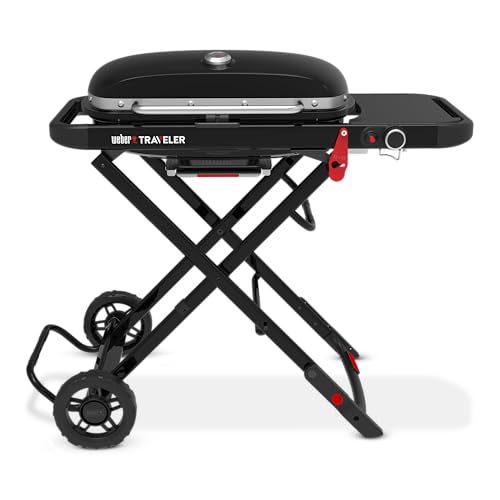
Weber Traveler Portable Gas Grill
Best for: campers and road-trippers who want a larger portable that folds onto its own wheeled cart. Positioning: premium tier within this group of portables, described in words rather than numbers because current listings change often; check the current Amazon listing before you buy.
The Traveler answers the carrying problem differently: it folds down for transport and stands on its own integrated cart at the site, so there is no hunt for a suitable table. It suits buyers who cook for a slightly bigger group away from home and who value a one-handed, tidy setup. It is the larger, more committed end of portable, and it asks for more storage room in return.
An instant-read thermometer is the accessory that changes outcomes more than any other, and it matters even more on a portable grill where heat is concentrated and cooking is fast. Colour lies: chicken can look golden while still underdone inside, and burgers can look grey while already past their best. Checking internal temperature removes the gamble, protects guests from undercooked food and protects good meat from being dried out by anxious overcooking. Insert the probe into the thickest part, away from bone, and remember that food continues to rise slightly in temperature while it rests. Resting itself is part of the method, not dead time: a few minutes on a warm platter lets juices redistribute, and on a portable setup the resting window is when vegetables or bread can take a quick turn over the remaining heat. Keep raw and cooked food on separate platters throughout, wash hands and utensils after handling raw meat, and refrigerate leftovers promptly rather than leaving them in the sun at a picnic table.

Coleman RoadTrip 285 Portable Stand-Up Propane Grill
Best for: tailgaters who want a stand-up grill with folding legs and interchangeable cooktop flexibility. Positioning: mid-range tier within this group of portables, described in words rather than numbers because current listings change often; check the current Amazon listing before you buy.
The RoadTrip 285 brings its own legs to the party, folding out into a stand-up grill that works on grass, gravel and car-park asphalt where no table exists. Its interchangeable cooking surfaces widen the menu beyond standard grates, which tailgaters who cook breakfast as well as burgers appreciate. It sits in the middle of this group on positioning, and its party trick is self-sufficiency: everything it needs to stand and cook travels with it.
Where the grill stands matters almost as much as how it cooks. Always set a portable grill on a stable, level, non-combustible surface, far enough from siding, deck railings, fences, overhangs and outdoor furniture that radiant heat and a stray flare-up cannot reach them. A wobbly camp table, a sloped tailgate or a plastic folding table are all poor choices: the grill can tip, hot grease can spill, and plastic softens under sustained heat. On a wooden deck, a proper grill mat underneath adds a layer of protection against drips and embers, and the grill should sit flat with all feet or legs firmly planted before the burner is lit. Check stability with a gentle push before you preheat, not after the grates are hot. Keep the area around the grill clear of paper plates, towels, lighter fluid bottles and anything else that does not need to be near open flame, and never leave the lit grill unattended while you go back inside for ingredients.
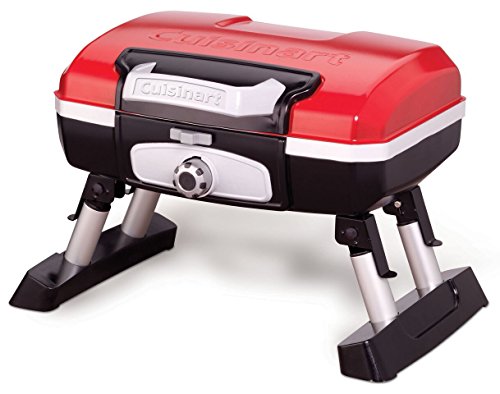
Cuisinart Petite Gourmet Portable Gas Grill
Best for: solo cooks, couples and apartment dwellers who want the smallest, lightest gas option for modest meals. Positioning: entry tier within this group of portables, described in words rather than numbers because current listings change often; check the current Amazon listing before you buy.
The Petite Gourmet, model CGG-180, is the compact conscience of this line-up: a briefcase-style tabletop grill that stores in small spaces and travels without drama. It cooks modest quantities honestly and asks little in return, which makes it a sensible first portable or a dedicated two-person grill. Buyers feeding a crowd should look elsewhere in this list; buyers feeding themselves well, often, will understand its appeal immediately.
Hot zones and small people do not mix, so set the rules before the grill is lit rather than after small hands wander close. Keep children and pets well back from the grill while it is hot and while it cools, and position the grill so it is not on the path between the play area and the food table. A portable grill at a picnic often sits at exactly toddler height on a low table, which makes supervision and placement more important, not less. Keep long utensils between you and the grates, turn pot handles and tool handles inward, and never carry hot food over the heads of seated guests. The cook should also think about their own clothing and hands: loose sleeves, dangling apron strings and bare-hand lid lifts cause ordinary, avoidable burns. Heat-resistant gloves help with grate adjustments and hot handles, and a dedicated clear surface next to the grill for raw food, separate from the cooked-food platter, keeps cross-contamination from joining the list of picnic problems.
Char-Broil Grill2Go X200 Portable Gas Grill
Best for: rough-road users who want a latching, road-ready tabletop grill built to be knocked about. Positioning: mid-range tier within this group of portables, described in words rather than numbers because current listings change often; check the current Amazon listing before you buy.
The Grill2Go X200 is built around travel toughness: a latching lid, sturdy handles and a design brief that assumes the grill will ride in vehicles and live outdoors at sites rather than pose on a patio. Its infrared-style cooking approach is aimed at even heat and fewer flare-ups, which suits cooks who have been burned, literally and figuratively, by fat fires on lesser portables. It is a working tool, and it reads as one.
Flavour on a portable grill comes from a handful of controllable sources. Maillard browning needs a hot, dry surface, so pat food dry and preheat properly. Smoke, on charcoal models, comes from the coals and any wood the maker approves; on gas models, it comes from vaporised drippings hitting hot surfaces, which is why a clean-but-seasoned grill tastes better than a filthy one or a sterile one. Marinades add surface flavour but burn when sugary, rubs build crust, and finishing touches like herb butter, citrus or a sauce applied off the fiercest heat let you layer flavour without scorching it. Resting keeps juices in the food instead of on the board. Salt timing matters: salting ahead for thick cuts, at the grill for thin ones, is a reliable simplification. None of these techniques belongs to big grills. All of them work on a portable, and together they explain why two people with identical equipment serve noticeably different dinners.
Setup and Care That Reduce the Cons
For propane models, the soapy-water leak check belongs in every single setup, not just the first one. Connections loosen in transport, hoses get knocked in a car boot, and seals age, so each time you connect a canister or a hose, brush soapy water over the joints and open the valve slowly. Growing bubbles mean gas is escaping: close the valve, disconnect, inspect the threads and the seal, and do not light the grill until the connection tests clean. Sniff, too: a strong gas smell at any point is a stop signal, not a light-it-anyway signal. Store canisters upright, outdoors and away from heat, never inside a hot vehicle for long periods and never indoors in quantity. When you disconnect, let the burner cool first, cap the canister if it has a cap, and keep it separate from the still-warm grill during the drive home. These habits take a minute or two, and they are the difference between a routine cookout and a preventable accident.
Below the grates is where portable grill cleaning really counts. Drip trays, grease cups and interior floors collect the fat that becomes tomorrow’s flare-up, so empty them after every few cooks at most, and before any trip where the grill will be tipped, carried or stored in a vehicle. Warm grease is easier to wipe than cold, set grease, so a paper-towel wipe while the grill is warm but safe to handle saves scrubbing later. Use a plastic scraper on interior surfaces rather than gouging metal tools around burner ports, and keep burner openings clear of debris so flames burn evenly. Foil liners made for your model can simplify tray cleanup, but never line surfaces the manufacturer says must stay clear, and never let foil block vents or drip paths. A grill cleaned between trips lights more evenly, flares less, tastes cleaner and lasts longer, and the whole routine takes less time than one ruined dinner costs in money and mood.
Charcoal ash deserves its own warning because it deceives people. A grey, dull bed of ash can still hold enough heat to ignite a bin bag, a cardboard box or dry grass many hours after cooking ends. Douse ash thoroughly with water, stir it, and douse it again, then dispose of it only in a metal container with a metal lid, never in a plastic bin and never in the general campsite rubbish. If no metal container is available, leave the ash in the grill with the vents managed as the maker directs until it is stone cold, and transport it sealed in the grill itself. Never bury hot coals in sand at the beach where a barefoot walker can find them later, and never tip ash onto dry ground in fire season. At home, ash from plain lump charcoal or briquettes without additives can go on some garden beds once fully cold, but treated or instant-light products belong in the bin. Treat every ash bed as live until water and time have proved otherwise.
Portable Grill Pros and Cons: The Bottom Line
On balance, the portable grill pros and cons resolve into a single question: does your cooking life happen in more places than one patio, in groups a small grate can feed? If yes, the pros are not minor conveniences; they are the difference between grilling and not grilling. If no, the cons will annoy you weekly. Choose with your calendar, not your imagination.
More Practical Notes From the Road
Grease Buildup and Flare-Up Risk
Grease is the quiet fire risk in portable grilling. Fat renders out of burgers, chicken skin and sausages, collects in drip trays and on interior surfaces, and old buildup ignites fast when it finally gets hot enough, producing the kind of flare-up that chars food and can spread beyond the grill box. The fix is unglamorous and effective: empty or replace the drip tray regularly, scrape down interior surfaces between trips, and never let a portable grill go a whole season of tailgates and camping weekends without a proper clean-out. During cooking, manage flare-ups by moving food to a cooler zone rather than spraying water on burning fat, which only splashes and spreads it. Keep a lid close at hand, because closing it briefly starves a flare of oxygen. Trimming excess fat and patting very fatty cuts dry before they go on also reduces dripping at the source. A clean grill does not just cook safer; it tastes better, because old grease smoke flavours everything it touches.
Where the Trade-Offs Show Up in Daily Use: Portable Grill in Practice
This section exists to move past the tidy two-column summary and watch where each advantage and disadvantage actually appears during an ordinary week. It adds a layer that a feature list cannot give you, grounded in the patio & outdoor living context this portable grill will actually live in. Where this guide names examples such as Weber Q 1200 Portable Gas Grill, Weber Traveler Portable Gas Grill, Cuisinart Petite Gourmet Portable Gas Grill, use them as test cases for the checks below rather than as shortcuts past them.
It also helps to separate the problems a portable grill can solve from the problems it merely moves. If the underlying difficulty is space, the answer may be a smaller format or a different location rather than a more elaborate model. If the difficulty is time, look for the option that removes steps rather than the one that performs each step slightly better. If the difficulty is that several people want different things, a compromise design that everyone rates as good enough will usually outlast a specialist design that one person loves and everyone else avoids. Naming the real problem in one sentence, out loud, before you order, is a surprisingly powerful filter, and many shoppers find that the sentence itself points at a different portable grill than the one they started out researching.
Start with the unglamorous measurements. For a portable grill, the numbers that decide satisfaction are rarely the headline ones in a listing; they are ground level, exposure to wind and rain, clearance from walls and planting, and where the item will actually live in winter. Write the real dimensions of your space down, including the awkward constraints you normally work around without thinking, and hold every contender up against that sheet rather than against a showroom photograph. Then walk the route the portable grill will take on delivery day and during normal use. A choice that fits on paper but fights you every time it is moved, opened, cleaned or stored will lose its shine quickly, however strong its other qualities look in a comparison table.
Next, rehearse the week, not the ideal day. Picture the portable grill inside a long summer evening with friends, a quick weeknight session for two, and the first cold snap that tests every cover and joint. Most disappointment comes from buying for the best-case scenario: the tidy version of the household, the motivated version of yourself, the weather or the guest list you hope for rather than the one you usually get. If the portable grill only makes sense when everything goes to plan, it is the wrong size, the wrong format or the wrong purchase for now. If it still looks useful on the tired, rushed, slightly chaotic version of the day, it has passed the most honest test there is, and the remaining questions are about detail rather than direction.
Pay close attention to the recurring friction points, because they compound. With a portable grill, owners tend to run into rust spots at the fixings, covers that pool water, and finishes that fade faster on the sunny side than the shaded side. None of these is dramatic on its own, and that is exactly why they get underestimated at buying time. Ask how the design you are considering handles each one: can the wearing part be replaced, can the awkward part be reached without tools, does the job take two minutes or twenty. A portable grill that makes its own upkeep easy gets maintained; one that makes upkeep a project gets neglected, and neglected products perform badly in ways that then get blamed on the original purchase.
Frequently Asked Questions
What is the biggest advantage of a portable grill?
Tailgating is the portable grill’s home turf, and it rewards planning. Arrive with food prepped, marinades in sealed containers on ice, and a realistic menu for the space and time you have: items that cook in a predictable window and hold well beat ambitious projects when kickoff is fixed. Set the grill on a stable surface in open air, away from vehicle exhaust paths, tents and the crowd. In short: respect the routine, and the grill rewards you for it.
What is the biggest disadvantage?
Cooking area is the specification buyers fixate on, and the honest way to think about it is in meals, not measurements. Ask how many people you cook for most often, and what you cook for them. A grill that handles burgers for a family in one batch behaves very differently from one that needs three batches while the first goes cold. Batch cooking is not a disaster; it. In short: respect the routine, and the grill rewards you for it.
Are portable grills safe?
Where the grill stands matters almost as much as how it cooks. Always set a portable grill on a stable, level, non-combustible surface, far enough from siding, deck railings, fences, overhangs and outdoor furniture that radiant heat and a stray flare-up cannot reach them. A wobbly camp table, a sloped tailgate or a plastic folding table are all poor choices: the grill can tip, hot grease can spill,. In short: respect the routine, and the grill rewards you for it.
Do portable grills cook as well as big grills?
Searing on a small grill is a technique problem more than a power problem. Dry the surface of the food, because surface moisture must boil off before browning can begin, and season confidently. Get the grate properly hot during the preheat, place the food and then leave it alone: the crust forms in the stillness, and constant moving tears it away. Flip once, finish in the gentler zone. In short: respect the routine, and the grill rewards you for it.
Is charcoal or gas better in a portable?
Propane is the fuel most portable grill buyers choose, and the reasons are practical: it lights at the push of a button, reaches cooking temperature quickly, adjusts up and down in seconds and shuts off just as fast when you are finished. Small disposable canisters make the system genuinely portable for picnics and short trips, while an adapter hose lets many models run from a larger refillable tank. In short: respect the routine, and the grill rewards you for it.
Who should not buy a portable grill?
The common portable grilling mistakes are remarkably consistent. People buy for the biggest group they might ever feed instead of the group they feed weekly, then resent the bulk. They skip the leak check on propane connections because it worked last time. They let grease build up until a flare-up teaches the lesson the dramatic way. They pack the grill warm because the group wants to leave. They. In short: respect the routine, and the grill rewards you for it.
Related Guides
Keep reading with the companion pieces in this cluster and the closest live guides on the site: