Tabletop grills are compact cookers meant for balconies, picnics, campsites and small patios where a full-size barbecue would be too much. We have not used these products ourselves, so this guide relies on general knowledge and the maker’s own descriptions rather than personal experience. It helps you compare fuel types, construction and size so you can match a grill to your outdoor space.
Fuel is the first decision. Gas, charcoal and electric designs each suit different places, and some locations restrict open flames, so check the rules for your building or site. Then consider how many people you cook for, how far you will carry the grill and how much effort you are willing to put into cleaning, since compact grills can be fiddly to wash.
As an Amazon Associate we earn from qualifying purchases. Links on this site are affiliate links, and they do not change the information we give.
In this guide
Quick Picks
| Pick | Product | Best For |
|---|---|---|
| Best Overall | Weber Q1200 Liquid Propane Grill | Balanced gas grilling for small spaces |
| Best for Bigger Batches | Coleman RoadTrip 225 Portable Tabletop Grill | Two burners and the largest cooking area |
| Best Compact Carry | Cuisinart Petit Gourmet Portable Tabletop Gas Grill (CGG-180T) | Tiny balconies and easy storage |
| Best Charcoal | Weber Smokey Joe 14-Inch Charcoal Grill | Classic charcoal flavour, minimal weight |
| Best Flat-Top Griddle | Blackstone 1814 17-Inch Tabletop Griddle | Breakfasts, smash burgers and stir-fries |
Our Picks
1. Weber Q1200 Liquid Propane Grill — Best Overall
The Q1200 is the tabletop gas grill most others get measured against. Its 189 square inches of porcelain-enameled cast-iron cooking grates sit over a single stainless steel burner rated at 8,500 BTU, and the cast-iron holds heat well enough to leave proper sear marks despite the small footprint. Electronic ignition lights it reliably, the burner valve adjusts smoothly from low to high, and a thermometer built into the lid helps you track cooking temperature without lifting it. Two side tables fold out for prep space and tuck away for storage, and a removable catch pan keeps grease cleanup simple. It runs on disposable 1 lb propane cylinders, with an optional adapter hose available for a full-size tank. The cast aluminum lid and body shrug off weather and transport knocks. Choose it if you want one dependable gas grill for a balcony, campsite or tailgate that cooks for two to four people without fuss.
View Weber Q1200 Liquid Propane Grill on Amazon
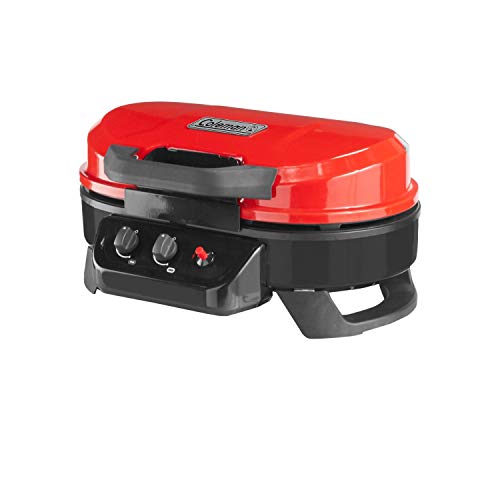
2. Coleman RoadTrip 225 Portable Tabletop Grill — Best for Bigger Batches
If a single small burner feels limiting, the RoadTrip 225 is the roomier answer. It offers 225 square inches of cooking area — the largest in this roundup — split across two independently adjustable burners delivering up to 11,000 BTUs in total, so you can sear on one side and keep food warm on the other. Coleman’s Instastart push-button ignition lights it without matches, and the porcelain-coated cast-iron grates are part of the SwapTop system, meaning griddle and stove-grate tops (sold separately) can be swapped in for different meals. A sliding grease tray pulls out for cleaning, and the locking lid keeps everything contained in transit. This tabletop version is made to sit on a picnic table, tailgate or workbench rather than its own stand. Pick it for family camping trips and game-day cooking where a compact grill still needs to feed a group in fewer batches.
View Coleman RoadTrip 225 Portable Tabletop Grill on Amazon
3. Cuisinart Petit Gourmet Portable Tabletop Gas Grill (CGG-180T) — Best Compact Carry
The Petit Gourmet is built around one idea: a real gas grill that stores like a briefcase. The legs fold up, the lid locks down, and integrated carry handles make it easy to move between a small balcony, a car boot and a picnic table. Inside, a 5,500 BTU stainless burner heats 150 square inches of porcelain-enameled cooking grate — enough for a couple’s burgers, sausages or chicken pieces in one batch. Ignition is a simple twist-to-start, heat adjusts with a single control knob, and a spill tray catches grease so cleanup stays quick. The enameled grate is also dishwasher safe according to Cuisinart, which removes one of the usual chores of small grills. It runs on standard 1 lb propane cylinders. This is the pick for solo cooks and couples in tight spaces who want gas convenience in the smallest, lightest package on this list.
View Cuisinart Petit Gourmet Portable Tabletop Gas Grill (CGG-180T) on Amazon
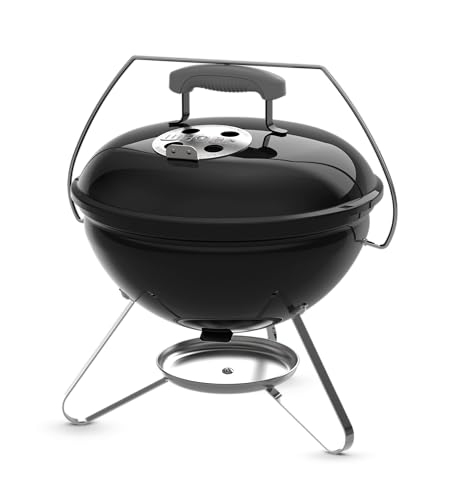
4. Weber Smokey Joe 14-Inch Charcoal Grill — Best Charcoal
For cooks who would rather have charcoal flavour than instant gas heat, the Smokey Joe shrinks Weber’s classic kettle formula down to a 14-inch tabletop size. The porcelain-enameled steel bowl and lid retain heat and resist rust, and the plated-steel cooking grate provides 147 square inches of space — enough for about five burgers at a time. Rust-resistant aluminum dampers on the lid and bowl let you manage airflow and therefore temperature, and an aluminum ash catcher underneath keeps spent ash contained and makes emptying straightforward. At under 10 pounds it is the lightest grill here, and the glass-reinforced nylon handle stays cool enough to move the lid safely. There is no ignition system or gas bottle to worry about — just charcoal, a starter and a few extra minutes of patience. Choose it for campsites, beaches and small patios where charcoal is allowed and flavour matters most.
View Weber Smokey Joe 14-Inch Charcoal Grill on Amazon
5. Blackstone 1814 17-Inch Tabletop Griddle — Best Flat-Top Griddle
Not every tabletop cook wants grates. The Blackstone 1814 replaces them with a 17-inch flat steel griddle top, which opens up breakfasts of eggs and pancakes, smash burgers, fried rice and vegetables that would fall through a normal grill. A single H-style burner puts out 12,000 BTUs for fast, even heating across the plate, and the included hood helps with preheating, shields the surface from wind and keeps splatter down. The stainless steel front plate houses the control knob and push-button ignition, while Blackstone’s rear grease management system channels drippings into a removable cup, so scraping the top clean after cooking takes a minute. It runs on 1 lb propane cylinders and is sized for camping, tailgating and small patios. Pick the 1814 if your tabletop cooking leans more towards diner-style flat-top food than traditional barbecue.
View Blackstone 1814 17-Inch Tabletop Griddle on Amazon
What to Look For
| Factor | Why it matters | What to check |
|---|---|---|
| Fuel type | It decides where you can use the grill and how it cooks. | Gas, charcoal or electric, plus fuel container type |
| Cooking area | It sets how much food fits at once. | Maker’s grate size and how many portions it suits |
| Materials | Body and grate materials affect durability and heat. | Steel gauge, coatings and cast or plated grates |
| Heat control | Adjustable heat helps with different foods. | Vents, dials, lid design and any built-in thermometer |
| Stability | Hot cookware must sit firmly on its surface. | Leg design, rubber feet and heat shielding |
| Portability | Carrying matters for trips and small storage. | Weight, handles, locking lid and folded size |
| Cleaning | Grease and ash build up quickly in small cookers. | Removable trays, ash catchers and grate access |
Setup and Care Tips
- Read the maker’s instructions before the first use and follow its fuel guidance.
- Place the grill on a flat, heat-resistant surface with plenty of space around it.
- Preheat the grates and oil them lightly before adding food.
- Let the grill cool completely before moving, cleaning or covering it.
- Scrape the grates after each use and empty the drip tray or ash.
Mistakes to Avoid
- Using a grill where local rules do not allow open flames.
- Placing it on a surface that cannot handle heat.
- Overloading a small grate and cooking unevenly.
- Leaving grease to build up between uses.
- Carrying or covering the grill while it is still warm.
Understanding the Types of Tabletop Grills
The phrase tabletop grill covers several quite different cookers, and the fuel decides almost everything else about how one behaves. Before comparing sizes and prices, decide which family fits the way you cook.
Gas tabletop grills
Small gas grills run on propane, usually from disposable 1-pound canisters, and some accept a hose adapter for a larger refillable tank. They light with a push-button igniter, reach cooking temperature within minutes, and give you a control knob that works much like a stovetop. That convenience is why gas models, including the Weber Q1200 and Coleman RoadTrip 225 in this guide, suit balconies and campsites where you want dinner without waiting for coals. The trade-off is that you carry fuel, and small canisters do not last forever on high heat.
Charcoal tabletop grills
A charcoal model like the Weber Smokey Joe burns briquettes or lump charcoal. It takes longer to prepare, because the fuel has to light and burn down to a steady glow, and temperature control comes from vents and how you arrange the coals. In return, many cooks prefer the flavor, and charcoal is inexpensive and easy to buy. Charcoal also produces more smoke and leaves ash to dispose of, which matters in a shared building or at a park with rules about hot coal disposal.
Electric tabletop grills
Electric models plug into an outlet and use a heating element, so there is no open flame and no fuel to carry. That makes them popular where gas and charcoal are banned, such as some apartment buildings. They do not produce the same smoky char, and they depend on a nearby outlet and a suitable extension cord. If your reason for choosing a tabletop grill is building rules rather than taste, check electric options first.
Griddle-style cookers
A flat-top such as the Blackstone 1814 replaces open grates with a steel plate. It handles foods that fall through grates, like eggs, diced vegetables and fried rice, and it makes smash burgers and breakfast easy. It will not give you grill marks or the same drip-and-flare flavor. Griddles also need regular seasoning and cleaning of the cooking surface to prevent rust, which is a different maintenance routine from scrubbing grates.
Matching a Grill to Where You Cook
- Apartment balcony: begin by reading your lease, building rules and local fire codes. Many buildings restrict gas and charcoal on balconies, which pushes you toward electric. If open flames are allowed, a gas model produces less smoke and ash than charcoal.
- Camping and tailgating: portability, fuel availability and wind resistance matter. A model with a locking lid and sturdy carry handles makes travel easier, and a grill that runs on small disposable canisters means you do not need a full tank in the car.
- Small patio: if you grill most weeks, you may prefer a larger cooking area and a better-built unit. Tabletop grills sit on a table or a purpose-built stand, so check that the surface can handle heat and weight.
- Picnics and parks: charcoal grills are common in public park rules, while gas may be restricted. Look up the park’s regulations before packing.
- Backup grill: some households keep a tabletop model for weeknight cooking and a full-size grill for larger gatherings. In that case, a compact gas unit starts quickly and stays out of the way.
Cooking Area, Heat and Real Capacity
Cooking area is quoted in square inches, and it is easy to underestimate how little that is. A 200 square inch surface sounds respectable, but a few burgers, a sausage or two and some vegetables will fill it. Use these rough rules to translate a number into a meal:
- Plan on about 20 to 30 square inches per burger patty, including space between patties so heat can circulate.
- Leave a cooler zone where you can move food that is cooking too fast. On a one-burner grill, that zone is often just the edge.
- Divide any stated area by the number of people you cook for. Two people and an occasional guest is a different task from a family of five.
Heat output on gas grills is stated in BTU per hour, and it is easy to over-trust. The same BTU number can cook very differently in a grill with a tight lid and a well-shaped firebox versus one with gaps and thin metal. A modest burner in a well-built enclosure can outperform a hotter burner in a leaky one, and thicker materials such as cast iron or porcelain-coated grates hold heat better than thin plated wire. Compare construction details, not only the BTU figure.
Specs Worth Checking Before You Buy
| Feature | What it affects | What to look for |
|---|---|---|
| Grate material | Searing, cleaning, rust risk | Cast iron or coated steel; check how the coating is described |
| Lid and firebox | Heat retention, wind resistance | A snug-fitting lid and solid body |
| Legs or base | Stability on a table | Wide, locking legs and non-slip feet |
| Grease management | Flare-ups and cleanup | A removable tray and a clear grease path |
| Weight and handles | Portability | Total weight and secure carry points |
| Fuel connection | Cost and convenience | Canister type, adapter hose option |
One feature that sounds minor but proves useful is a lid with a built-in thermometer, because small grills run hot and the lid dome temperature is the only quick indicator of what is going on inside. A built-in ignition also saves fumbling with matches, although a lighter should always be available if it fails.
Safety Rules That Apply to Small Grills
Compact grills are not less dangerous than large ones, and the table or balcony under them is often the weak point. Follow these basics:
- Place the grill on a heat-resistant, level, stable surface. A wooden or plastic table can scorch, warp or catch fire. A paver, concrete slab or metal stand is safer. A grill-safe mat under the legs adds protection.
- Keep clearance from walls, railings, overhangs, plants and anything flammable. The manufacturer’s manual states the minimum distance, and following it matters.
- Never use a charcoal or gas grill in an enclosed space such as a tent, garage or covered porch. Burning fuel makes carbon monoxide, which can accumulate quickly and has no smell.
- For gas, check the canister connection with soapy water for bubbles that signal a leak, and turn off the valve when finished. Store fuel upright, in a cool place and away from living space.
- Keep a bucket of sand, a fire extinguisher rated for grease fires, or a lid within reach. Do not use water on a grease fire.
- Let the grill cool completely before moving it. Dispose of charcoal ash only after it has been cold for a full day, in a metal container.
Cleaning, Storage and Making It Last
A small grill gets dirty fast because grease has fewer places to go. Brush the grates while the unit is still warm, then wipe with a cloth once it cools. Empty the grease tray after every few uses, since built-up fat is the main cause of flare-ups and odd smells. Porcelain-coated or cast-iron grates should be cleaned with a brush rather than harsh scrapers that chip the finish, and cast iron benefits from a light coat of cooking oil to resist rust.
For storage, let everything dry completely, then keep the grill under a cover or indoors if you can. Moisture trapped under a cover accelerates rust, so cover only when the grill is dry. Disconnect and store gas canisters separately according to the manual. Take a minute at the start of each season to check the legs, hinges, igniter and any hoses. A cracked hose or loose leg is a reason to stop using the grill until you replace the part.
Fuel and Accessories Worth Having
A few inexpensive extras make a tabletop grill easier to live with. Long-handled tongs and a spatula keep your hands away from the heat, and a grill brush with a sturdy handle handles cleanup while the grates are warm. An instant-read thermometer takes the guesswork out of chicken and burgers, which cook quickly on small grills and can look done before they are. Heat-resistant gloves are useful for adjusting the lid and moving hot parts. For charcoal, a chimney starter lights briquettes without lighter fluid, and for gas, a spare canister saves a trip when the first one runs out mid-meal. Foil trays help with delicate foods such as fish and vegetables, and a small pad or tile under the grill protects the table. Keep all of these in a bag with the grill so they travel together.
Using the Picks in Real Life: Tabletop Grills
Specifications are useful, but they rarely tell the whole story with tabletop grills. Two models can look almost identical on paper and still feel very different once they are set up, used under time pressure, or shared with other people. The notes below add the practical layer that sits between a comparison table and a confident decision: fit, workflow, upkeep, and the small frustrations that are easy to avoid when you know to look for them in advance.
Start with the situation you will face most often, for example a balcony cookout for two. Picture the whole sequence from beginning to end: getting the equipment ready, doing the main task, and putting everything away afterwards. A choice that feels slightly less impressive in a headline feature can easily be the better one if it makes that full sequence calmer and more repeatable. With tabletop grills, consistency across many ordinary sessions is worth more than one standout moment, because you will live with the routine far longer than you will admire the purchase.
Next, be honest about the environment. In the case of a small kitchen with limited counter space, the room, the light, the available surface, or the people nearby will shape the result as much as the product itself. Walk through that setting before you order and note anything fixed that you cannot change: a narrow surface, a shared space, limited storage, or a tight schedule. Matching tabletop grills to those fixed facts first prevents the most common disappointment, which is buying a capable product that simply does not suit the place where it will actually be used.
One of the most useful checks concerns cooking area for the group size. Do not treat this as a box to tick and move on. Ask how it affects the first use, how it affects a busy day when you have no time to adjust things, and how it will feel after months of use. If the guide above flags a pick as stronger or weaker on this point, weigh that note against your own priorities rather than assuming the overall winner is automatically the right winner for you. Personal fit beats a general ranking every time the two disagree.
It also helps to think about fuel or power type and where it can be used in plain language. Write down what good enough looks like for you before you compare models, because it is easy to keep moving the goalposts as you read. For many buyers of tabletop grills, the sensible target is a product that handles the main job reliably, is easy to live with, and leaves some budget for the accessories, supplies, or setup help that make the whole system work better. Spending everything on the headline item and nothing on the supporting details usually leads to a weaker result overall.
A Deeper Checklist Before You Choose
Consider who else will be involved. For a camping trip with a portable setup, another person may need to use, move, clean, or simply live alongside your choice. Controls that seem obvious to the person who did the research can confuse a guest, a colleague, a student, or a family member. The best tabletop grills tend to be forgiving in shared hands: they behave predictably, they recover gracefully from a wrong setting, and they do not demand that everyone read a manual before getting a decent result.
Think, too, about the learning curve. Nobody masters tabletop grills on the first day, and a fair comparison allows for that. During the first few sessions, keep notes on what you adjusted, what surprised you, and what you would do differently next time. Those notes quickly reveal whether a difficulty is a one-off beginner problem that practice will solve, or a lasting mismatch between the product and your habits. That distinction matters, because returning or replacing gear is far easier when you can describe the problem clearly and early.
Budget thinking deserves a wider lens than the purchase itself. With tabletop grills, the total cost of ownership can include cases, mounts, media, refills, replacement parts, protective storage, or simply the time spent on upkeep. None of that argues against buying; it argues for buying with your eyes open. A slightly simpler model that you can afford to support properly will usually serve you better than a flagship model that leaves nothing in reserve for the things it needs to do its job well.
Finally, plan for the day something goes wrong, because with regular use something eventually will: a setting is changed by accident, a part is misplaced, a session runs longer than expected, or conditions are worse than usual. Ask yourself how you would recover in the middle of a family table where everyone cooks together. Products that make recovery simple, with clear controls, sensible defaults, and widely available support, earn their place over time. Reliability in this ordinary, unglamorous sense is one of the strongest reasons a pick stays recommended year after year.
Turn that thinking into a short written checklist before you order. Include the setting, the main task, the people involved, the supporting items you already own, and the one feature you refuse to compromise on. Then read the detailed reviews above once more with that checklist beside you. You will find that most picks eliminate themselves quickly and honestly, and the remaining choice feels obvious rather than forced. That is the sign of a good buying process: not more information, but the right information applied to your own situation.
Setup, Care and Troubleshooting for Tabletop Grills
Good setup is not about fussiness; it is about removing variables so that the result depends on your decisions rather than on luck. Before the first real session, set aside enough unhurried time to unpack, inspect, and configure everything in daylight and without an audience. Check that every part moves, fits, or connects as described, and keep the packaging until you are confident nothing needs to go back. That calm first hour prevents most of the frantic troubleshooting that otherwise happens at the worst possible moment.
Work through the basics in a deliberate order. Start with placement and stability, then connections, then settings, and only then judge performance. Changing several things at once makes it impossible to know which change helped. If the guide above gives a recommended starting point for tabletop grills, use it exactly for the first session, even if you suspect you will prefer something else later. A known baseline gives you something trustworthy to compare against, and it makes advice from manuals, support teams, and other owners much easier to apply.
Keep a simple record of your starting setup: a photo of the arrangement, a note of the settings you chose, and a line about the result. This sounds like extra work, but it pays for itself the first time a session goes unusually well or unusually badly, because you can recreate the success or avoid repeating the problem. Over a few weeks that record becomes a personal quick reference that is more useful than any general guide, since it reflects your space, your subjects, and your taste.
Cleaning and storage deserve the same calm attention. Decide where the product will live when it is not in use, how it will be protected from dust, knocks, heat, or curious hands, and what you will wipe, empty, charge, or check after each session. Small habits done every time are far more effective than an occasional deep clean. They also extend working life in a way that is easy to underestimate: most wear comes from grit, strain, damp, and hurried handling rather than from honest regular use.
When a result disappoints, troubleshoot in a fixed order before blaming the product. Confirm the basics first, such as power, connections, placement, and the settings most likely to have been changed. Then change one thing, test again, and note the outcome. If the problem follows a particular accessory, location, or subject, that pattern is valuable evidence. And if you contact support or a retailer, describe the steps you have already tried; a clear description usually leads to a faster, more useful answer than a general complaint.
Matching a Pick to the Person Using It
Comparing the picks against each other is most helpful when you compare them on the job you actually have, not on every feature they offer. Take the strongest overall pick in the guide and ask a blunt question: what would make you choose a different model instead? Sometimes the answer is a smaller size for a tight space, sometimes it is a simpler control layout, and sometimes it is a specialist strength that only matters for one kind of work. Naming that reason out loud turns a long shortlist into a short, honest decision.
Pay attention to trade-offs that the guide states plainly. A model praised for power or range may ask more of you in weight, setup time, or upkeep. A model praised for simplicity may give up fine control that an experienced user would miss. Neither pattern is a flaw; they are different answers to the question of who the product is for. The mistake is buying the trade-off that suits somebody else’s priorities and then spending months working around it.
Experience level should influence the choice more than it usually does. A beginner benefits from forgiving behaviour, clear feedback, and a setup that produces a decent result without expert technique. An experienced user can exploit finer controls and will notice small limitations sooner. If you expect your skills to grow quickly, look for a pick that leaves some headroom, but do not buy so far beyond your current needs that the first months feel like hard work. Enjoyment is a practical feature, because gear that is enjoyable gets used, and used gear is what improves results.
Think about how the choice fits what you already own. Compatibility is not only a question of whether two things connect; it is also about whether sizes match, whether your storage can hold the result, whether your existing accessories still serve a purpose, and whether your usual workflow stays smooth. A pick that forces you to replace several perfectly good supporting items may be poorer value than it first appears, while a pick that slots into your current setup can feel like an upgrade across the whole system.
A useful final test is the ordinary-week test. Imagine the product in your life on a tired weekday, not on an exciting first weekend. Will you still bother to set it up properly? Will the upkeep still feel reasonable? Will other people in the house or team still cope with it? If the answer is yes, you have probably found the right level of ambition. If the answer is no, choosing the simpler or more forgiving pick is not settling; it is buying the result you will actually get.
Revisit that matching exercise whenever your circumstances change. A new room, a new hobby, a growing family, a different job, or simply more experience can all move the right answer from one pick to another, and that does not mean the first purchase was wrong. It means the product served one chapter well. Keeping your notes, your checklist, and a clear head about what changed makes the next decision faster, cheaper, and far more likely to satisfy, whether you stay with tabletop grills for years or move on to something quite different.
One more practical habit is worth adopting with tabletop grills: review your results after a handful of sessions rather than after the first one. Early impressions are dominated by novelty and by the small awkwardness of anything new. By the fifth or sixth session, patterns emerge that you can trust, such as which settings you always change, which accessories you never reach for, and which frustrations have quietly disappeared with practice. Judging at that point leads to calmer decisions about keeping, adjusting, or upgrading, and it stops a single difficult day from colouring your view of an otherwise sound purchase.
Seasonal and occasional changes are easy to forget when choosing tabletop grills. Light changes through the year, rooms get rearranged, guests arrive, workloads rise and fall, and storage that seemed generous in a quiet month can feel tight in a busy one. A pick that copes gracefully with that kind of change, by being easy to move, easy to store, or easy to reconfigure, has a quiet advantage that rarely appears in a comparison table. If your life is fairly settled, this matters less; if your space or schedule shifts often, let flexibility carry real weight in the decision.
It is also worth deciding in advance how you will judge success. For tabletop grills, success might be a result that needs less correction, a routine that takes less time, fewer complaints from the people sharing the space, or simply reaching for the product more often because it is pleasant to use. Pick one or two measures that matter to you and check them after a month. Clear measures protect you from two opposite mistakes: replacing a good product because a newer one appeared, and keeping a poor fit for years out of habit.
Where you buy can matter almost as much as what you buy. A seller with a clear returns process, honest descriptions, and responsive support reduces the risk of any choice, especially when you are deciding between two close picks. Keep the order confirmation and warranty details somewhere you can find them without searching old messages, and register the product if the maker offers a simple way to do so. These small administrative habits take minutes, yet they are the difference between a minor hiccup and a long, frustrating detour if anything needs attention later.
More Questions About Tabletop Grills
How long should I spend deciding between two close picks?
Once you have confirmed that both picks meet your basic requirements, extra days of comparison rarely change the outcome. List the two or three differences that will affect your weekly use, decide which of those matters most, and choose on that basis. If the difference is still unclear, favour the option that is easier to live with, easier to support, and easier to resell or pass on if your needs change. A decision you can act on confidently is worth more than a theoretically perfect decision made too late.
What is the most common reason people are disappointed with a purchase like this?
The most common reason is a mismatch between the product and the real setting, not a defect in the product itself. Buyers imagine their best day, with plenty of time and ideal conditions, and then use the product on ordinary days with less time and more distractions. Reading the sections above with your ordinary routine in mind, and being honest about space, storage, and who else will be involved, prevents most of that disappointment before any money is spent.
Should I buy accessories at the same time?
Buy only the accessories that the first sessions genuinely require, such as protection, mounting, storage, or the consumables the product needs to work at all. Everything else can wait until your own notes show a real need. This keeps the initial setup simple, makes troubleshooting easier because there are fewer new variables, and avoids spending on extras chosen for a workflow you may not end up following. Good accessories bought later, for a proven reason, almost always serve better than a bundle bought on day one.
How can I tell whether a problem is my technique or the product?
Change the setting before you change the product. Use the same pick in an easier situation, follow the guide’s recommended starting setup exactly, and simplify the task until you get a clean result. If the problem disappears when conditions are easier, technique and practice are usually the answer. If the same fault appears in simple conditions, with a careful setup and after a reset to sensible defaults, then the product, or that particular unit, deserves a closer look and a conversation with support.
Is it worth paying more for a model aimed at experienced users?
It is worth it when the extra control solves a problem you already have, or one you can describe clearly from your recent work. It is rarely worth it for a problem you only imagine having one day. Experienced-user models often assume better supporting gear, more setup time, and a willingness to learn a deeper control layout. If those assumptions fit your life, the step up can be satisfying and long lasting. If they do not, a mid-level pick used confidently will produce better results than an advanced pick used hesitantly.
What should I check in the first week so a return is still easy?
Use the product for its main job at least twice, in the setting where it will normally live, and keep all packaging, inserts, and receipts together. Note any fault, missing part, or mismatch with the description while the details are fresh, and photograph anything that looks damaged or wrong. Testing promptly and gently is fair to everyone: you learn whether the pick suits you while the retailer’s process is still simple, and the product stays in the condition a return requires.
FAQ
Which fuel type is easiest?
Electric and gas models heat quickly and need little preparation, while charcoal takes longer but many cooks like the flavour. Your location and rules decide what is allowed.
Can a small grill cook for a group?
It can cook in batches, but the grate area is limited. Compare the stated cooking area with the number of people you usually feed.
Can I use a tabletop grill on a wooden table?
It is not recommended. Grill bottoms and legs get hot, and wood can scorch or catch fire. Use a stone, concrete or metal surface, or add a heat-rated barrier under the grill. Follow the maker’s clearance instructions and never leave a lit grill unattended.
How long does a 1-pound propane canister last on a small grill?
It varies with burner output and temperature, but on high heat a small canister usually lasts only a couple of hours of cooking. Low heat stretches it longer. Check the grill’s stated burner rating, and carry a spare canister for camping trips or long cookouts.
Are tabletop grills allowed on apartment balconies?
Often not. Many leases, building rules and local fire codes prohibit gas and charcoal grills on balconies, while electric grills are sometimes allowed. Check your lease, ask the property manager, and look up local regulations before buying, since fines and insurance issues can follow.
Gas or charcoal for a small grill?
Gas is faster to start, easier to control and cleaner, which suits weeknight cooking. Charcoal takes longer and needs ash disposal, but many people prefer the smoky flavor and lower fuel cost. Choose by convenience, flavor preference and the rules where you plan to cook.
Is a griddle better than a grill for a small space?
A griddle suits breakfast foods, smash burgers and anything that would fall through grates, and it offers more even contact heat. A grill gives char and smoky flavor. If you cook a wide variety, a flat top is versatile, but it needs seasoning and careful cleaning.
The Short Version
A good tabletop grill suits your space, your fuel preference and the amount of food you cook. Check local rules, compare the specs and choose a model that is stable, easy to clean and simple to carry. Before buying, picture a typical meal: how many people you feed, where the grill will stand and how you will clean it afterwards. Include tongs, a brush and a heat-resistant mat in your plan, since these small extras shape the experience as much as the grill does.