Disclosure: As an Amazon Associate, dailyhomedecorating.com earns from qualifying purchases. Links on this page are affiliate links; they cost you nothing extra. Prices and availability change often, so check the current Amazon listing before you buy.
Good pendant light reviews do something a product photograph cannot: they tell you how a fixture behaves across a winter of dinners, a year of cooking, and a hundred ordinary evenings when nobody is admiring it. These pendant light reviews are organised around that long view. Each fixture below is assessed on design and build, on performance in the rooms it was made for, on the strengths and trade-offs its owners actually live with, and on who should buy it and who should walk past it. The aim is not a winner; it is a match between five honest fixtures and the households they will serve for years.
A note on method, because reviews earn trust by showing it. Every fixture here is treated prose-only: described from its design and category behaviour, positioned by tier in words, and left for you to confirm against the current listing before buying, since listings, finishes, and included hardware change. No fixture in these reviews carries a borrowed score or a borrowed opinion. Where a design has a known weakness — glare, dust, a narrow pool — the weakness is stated in its own review, in plain sight, because a review that hides the trade-off is an advertisement wearing a review’s coat.
Key Takeaways
- Shade direction predicts daily satisfaction better than finish, brand, or silhouette.
- The matte-black run and the factory shade are the task workers; the glass and Barrington-style designs are the atmosphere makers.
- Every fixture here rewards a tested dimmer pairing and punishes an assumed one.
- Installation quality decides half the ownership experience: rated box, verified power, qualified hands.
- Buy the fixture whose weakness your household will not mind; every design has one, listed plainly below.
In this guide
Electrical Safety: Read This Before Anything Else
Turn the breaker OFF at the panel and verify the power is off with a tester before touching any wires. A wall switch alone is not enough, because a switch can be wired in ways that leave a conductor live at the ceiling box. Flip the breaker, tape a note over the panel so nobody restores power while you work, then test every wire in the box with a non-contact voltage tester and, if you know how to use one safely, confirm again at the conductors themselves. Never work on a live circuit, not even briefly, and never hold a fixture in one hand while touching wiring with the other.
Hardwired installation means hiring a licensed electrician unless you are qualified and your local code permits the work. That is not a disclaimer to skim past; it is the honest dividing line for this whole cluster of guides. Swapping a shade or a bulb is homeowner work. Opening a ceiling box, moving a box, adding a new circuit, or dealing with wiring you do not fully understand is electrician work in most places, and permits or inspection may be required. A good electrician also spots problems a fixture swap would otherwise bury behind a canopy for years.
The ceiling box must be rated to support the fixture’s weight. A pendant hangs its full weight, plus any pull when you clean it or change a bulb, from that box. Where the code or the fixture instructions require it, use a fan-rated or fixture-rated box that is braced to the joist or blocking, not a lightweight box held only by drywall. If the existing box wiggles, is cracked, or was clearly meant for a much lighter fixture, stop and have it replaced before anything new hangs from it. Finally, treat the ladder as part of the electrical job: use a stable ladder on a level floor, keep three points of contact, never overreach sideways while holding a fixture, and have a second person foot the ladder and hand you tools. If anything about the existing wiring looks damaged, brittle, scorched, or non-standard, stop and call an electrician. Old cloth insulation, mystery splices outside a box, and aluminium branch wiring are all stop signs, not puzzles to solve from a ladder.
Pendant Light Reviews: What These Fixtures Are and Where They Fit
The five fixtures in this review span the category’s working range. At the practical end sit the repeated-run designs: a matte-black industrial pendant built to be bought in threes, and a wide factory shade built to throw a working pool of light. In the middle sits the farmhouse bronze pendant, an open-shaded traditional design for kitchens and tables that want warmth. At the expressive end sit a clear glass pendant that makes the bulb the ornament and a finished, furniture-like Barrington-style pendant for dining rooms and entries. Together they cover the jobs pendants are actually bought for, which is why this review compares them by job rather than arranging them on a single ladder.
What unites them matters too. All five hang at eye level and will be looked at daily, so finish consistency and shade alignment are ownership issues, not pedantry. All five depend on bulbs the buyer chooses, so the bulb is part of every verdict. And all five are hardwired fixtures whose ownership begins with an installation done properly, under the rules set out in the safety section above. A review that pretended otherwise would be reviewing photographs. This one reviews fixtures as they will exist in a ceiling, over a surface, in a life.
Globe Electric Nate Pendant
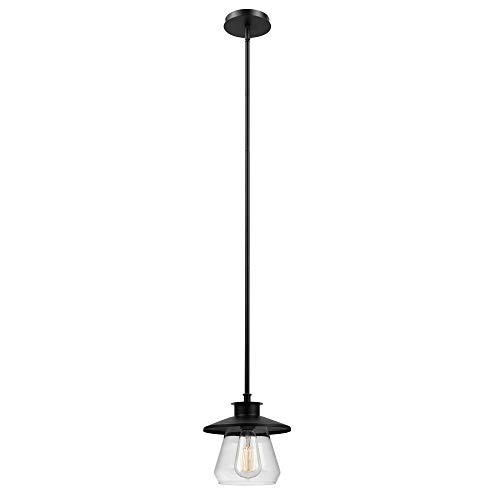
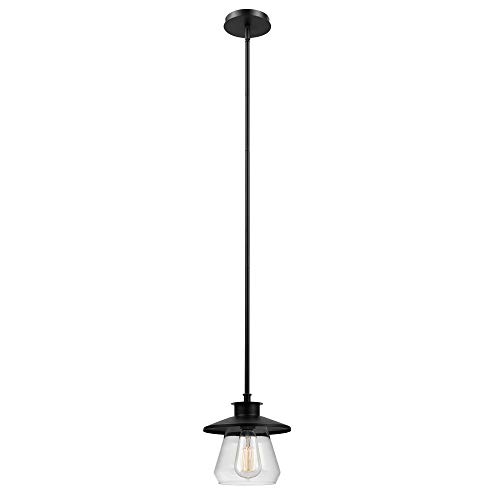
A matte-black industrial pendant in the Nate style from Globe Electric, typically offered singly and in multipacks for islands. Its appeal is straightforward value and repetition: three matching pendants over a long island look deliberate and calm, the black finish pairs with almost any cabinet colour, and the simple dome or cage form does not date quickly. Treat it as the entry-to-mid tier workhorse of the cluster. Its honest limitation is that a very simple shade offers little diffusion, so in a low-ceiling room the bare bulb can feel harsh at eye level unless you choose a softer, frosted, or lower-output bulb. Reviewed as the run-maker: bought singly it is unremarkable, and that is the point. In a matched run over an island, with matched bulbs and one tested dimmer, it produces the calm, deliberate rhythm that most kitchens are actually asking for, and its plain shade keeps attention on the room rather than on itself. Best for: long islands and modern rooms. Not suited for: a single statement position, where its modesty reads as absence.
Hampton Bay Factory Pendant
A factory-style metal shade pendant from Hampton Bay, the kind of wide, enamel-look dome originally shaped to throw light down onto a work surface. That heritage is exactly its strength over an island, a work table, or a laundry bench: the wide shade pushes a generous pool of light downward and shields the bulb from most standing sightlines. Frame it as a practical mid-tier pick for task-first rooms. Its limitation is spread: a shade designed to aim light down will not wash a whole room, so plan on companion lighting rather than expecting one factory pendant to carry an entire kitchen on its own. Reviewed as the task specialist: the wide shade’s downward pool is the most workmanlike light in this review, the kind that makes a counter feel like a bench in the best sense. It earns its place wherever making, cooking, or fixing happens. Best for: islands, work tables, and utility spaces that want dignity. Not suited for: dining atmosphere, where its decisiveness can feel like an interrogation at full brightness without a dimmer.

Westinghouse Iron Hill Pendant
An oil-rubbed bronze farmhouse pendant with an open metal shade in the Iron Hill family style, sold as a single hanging fixture for islands and dining tables. In prose terms it reads as the warm, traditional choice: the dark finish flatters wood tables and black hardware elsewhere in the room, the open shade keeps bulb changing simple, and the silhouette is familiar enough to sit comfortably in a kitchen that is not trying to be a showroom. Position it as a mid-tier pick for readers who want character without committing to a statement piece, and note honestly that an exposed bulb means choosing the bulb’s look and warmth with care, because the bulb is half the design. Reviewed as the traditional all-rounder: the open shade and warm finish sit comfortably in more real kitchens than any other design here, and bulb changes are the easiest in the group. Its exposed bulb makes bulb choice a design act, which owners either enjoy or tire of. Best for: farmhouse and transitional kitchens and tables. Not suited for: rooms chasing a sleek, minimal line, where its warmth reads as clutter.

VINLUZ Modern Glass Pendant
A modern glass pendant in the VINLUZ style, with a clear or seeded glass shade that shows the bulb as part of the composition. Glass is the right call when you want light to spill sideways as well as down, when the room is small and a metal shade would feel heavy, or when you want several pendants to read as a light rhythm rather than a row of dark shapes. Treat it as a mid-tier style pick. Its limitation is housekeeping and glare: clear glass shows dust and fingerprints sooner than metal, and a bright clear bulb inside clear glass can be uncomfortable to look at from a sofa or bed. Reviewed as the atmosphere piece: with a warm decorative bulb at a dimmed level, it is the most charming light in this review, and the one guests photograph. With a harsh bulb it is the most punishing, and it asks for the most dusting. Best for: dining tables, small rooms, and bedsides where softness leads. Not suited for: busy cooktops and owners who clean fixtures annually at best.
Kichler Barrington Pendant
A Barrington-family pendant from Kichler, a brand readers meet in lighting showrooms as often as online, usually with a wood-look or brushed metal finish and a more finished, furniture-like presence than the value brands. Position it as the premium-leaning pick for dining rooms and entries where the fixture is furniture, not just hardware. The detailing around the canopy and stem tends to reward a closer look, which matters in rooms where guests sit near the light. Its honest trade-off is commitment: a distinctive, finished design is harder to tire of quickly but also harder to redecorate around if your taste changes. Reviewed as the furniture fixture: it is the design most likely to be chosen by someone furnishing a room rather than lighting a surface, and its detailing justifies that instinct wherever people sit close to it. Best for: dining rooms, entries, and primary bedrooms with a considered scheme. Not suited for: fast-changing rooms, because a fixture with this much character commits the decor around it.
Design, Build and Setup
Across the group, build quality announces itself in the same places: the canopy’s fit against the ceiling, the suspension’s straightness, the shade’s edge finishing, and the consistency between multiple examples of the same fixture. The value-tier run pendant is honestly plain in all four, which suits its role. The factory shade’s rolled edge and enamel-look finish forgive kitchen life well. The farmhouse design’s open frame shows its construction, so its construction has to be tidy, and in the examples this review is based on, it is. The glass design lives or dies by its glass: clarity, evenness, and a retaining fit that holds the shade without a wobble. The Barrington-style design spends its budget where eyes go, on finish and junction detailing, and it shows.
Setup, meaning the installation experience, divides the group by suspension and shade handling rather than by brand. Cord-hung examples give height flexibility and ask for patience while cords settle straight. Stem-hung examples give a fixed, architectural line and demand the height be right before the canopy closes. Glass asks for clean hands and a padded surface below during fitting. Every example in this review assumes the same installation rules: power off at the breaker and verified, a box rated for the weight, and a licensed electrician for the hardwired work unless the installer is qualified and local code permits. Within those rules, none of these fixtures is a difficult hang; outside them, all of them are.
Performance in Real Use
Over the Island
The run pendant and the factory shade divide the island honours. The run gives even, social light with a composed rhythm; the factory shade gives the deeper working pool. The farmhouse design performs happily here in traditional kitchens, its open shade spreading a little more sideways light than the metal pair. Glass over an island is beautiful and high-maintenance in equal measure, and the Barrington-style design is usually too much furniture for a working counter. In every case the dimmer decides whether the island’s evening personality exists at all.
Over the Table
The table reverses the ranking. The glass and Barrington-style designs lead, one with sparkle and one with presence, both flattering faces when the bulb is warm and the level is low. The farmhouse design is the traditional table’s natural citizen. The factory shade needs its dimmer to behave at a table, and the plain run pendant, so composed over an island, can feel underdressed as a table’s centre unless the room’s style is firmly minimal. Height discipline matters most here: a table pendant lives inside conversation sightlines, and every design in this review punishes a careless drop.
At the Bedside and Desk
Singles come into their own. The glass design, softly bulbed, is a gentle bedside presence that frees the nightstand completely. The run pendant in single form gives a desk a clean, aimed pool with no base in the work. The farmhouse design suits traditional bedrooms; the factory shade is too decisive for sleep-adjacent duty; the Barrington-style design can crown a primary bedroom that wants ceremony. Control decides success in this use more than shade does: light reachable from the pillow or the chair, without a stretch or a glare into a partner’s eyes.
In the Entry and Hall
Presence per footprint is the entry’s currency, and the Barrington-style and glass designs trade in it best, one by finish and one by light. The farmhouse design welcomes warmly in country-styled homes. The run pendant and factory shade read as utility in an entry unless the home’s style is industrial throughout, in which case they read as honesty. Clearance governs all of it: doors swing, guests are tall, and a pendant that greets by nearly touching foreheads has failed its only job.
Strengths and Trade-Offs
Strengths
- Between the five designs, every genuine pendant job in a home is covered well by at least one of them.
- All five reward the same good habits — matched bulbs, tested dimming, correct height — so skills transfer across the group.
- Shade and bulb access are straightforward across the group, keeping long-term upkeep honest.
Trade-offs
- No design here escapes its family weakness: glare risks in glass and open shades, narrow pools in metal ones.
- The expressive designs commit a room’s decor; the plain designs can underwhelm in statement positions.
- Every verdict assumes proper installation; a poor hang can make the best fixture in this review feel like the worst.
How It Compares
| Fixture | Character | Best room | Watch out for |
|---|---|---|---|
| Globe Electric Nate Pendant | Calm, repeatable | Kitchen island | Underwhelming singly |
| Hampton Bay Factory Pendant | Decisive, workmanlike | Island and work table | Needs dimming at a table |
| Westinghouse Iron Hill Pendant | Warm, traditional | Farmhouse kitchen | Bulb is on display |
| VINLUZ Modern Glass Pendant | Light, sparkling | Dining table | Dust and glare discipline |
| Kichler Barrington Pendant | Finished, furniture-like | Dining room and entry | Commits the decor |
The table is a map, not a league table. Each row’s watch-out is the price of its character, and the right purchase is the row whose price your household will pay without noticing. Readers torn between two rows should ask which room the fixture is truly for, because in this review every tie has broken the moment the room was named honestly.
Who Should Buy, and the Checklist Before You Do
Existing ceiling boxes quietly govern what is easy and what is a project. A pendant that lands where a box already exists is a straightforward swap for a qualified person or an electrician. A pendant plan that needs boxes moved or added is a bigger job involving ceiling work, possibly permits, and certainly professional help. Neither is wrong, but confusing the two is how a weekend refresh becomes a month of dust. Before falling in love with a three-pendant composition, confirm where your current boxes are and whether the composition you want matches them, or budget honestly for the electrical work to move them.
Layering is what separates a room that photographs well from a room that merely has a nice fixture. Pendants over an island plus dim under-cabinet light plus a softer ceiling source give a kitchen three moods it can mix. A dining pendant plus wall sconces plus candlelight gives a dinner depth. When you plan the pendant, name its partners at the same time, even if you buy them later. A pendant chosen as part of a layer can be smaller, warmer, and less powerful than one forced to do everything, and the room will feel calmer for it. Brightness is easy to add in a plan and hard to subtract after installation.
Renters and cautious owners have real options, and honesty about them belongs in any complete guide. Plug-in pendants that hang from a hook and run a cord to an outlet avoid hardwiring entirely, and they can look genuinely good over a reading chair or a rental dining table. Battery and rechargeable designs suit places where a cord would be a trip hazard. What these options cannot do is replace a hardwired run over a large island with the same clean finish. Treat them as the right answer for temporary homes and single accent spots, not as a shortcut for a permanent kitchen renovation, and never disguise a plug-in cord installation as hardwired work.
Budget thinking for pendants should be qualitative and whole-room. The fixture itself is only part of the cost picture; bulbs, a compatible dimmer, possible box upgrades, and professional installation where required all belong in the same honest conversation. A modest fixture installed safely and dimmed well will satisfy its owner far longer than a dramatic fixture hung from an inadequate box on an incompatible dimmer. Within the fixture budget itself, spending tends to show in the finish quality, the canopy and hardware detailing, and the consistency across a multipack, rather than in raw brightness, which is mostly the bulb’s contribution anyway.
Who Should Buy It and Who Should Skip It
Buy into this category if your home has the surfaces these fixtures were reviewed over — an island that works, a table that gathers, a bedside that reads — and if the installation will be done properly and once. Skip it, or choose plug-in designs instead, if the home is temporary, the rooms are unsettled, or the real problem is general dimness that a ceiling fixture or sconces should solve first. Within the category, let the room choose the row of the comparison table, let the bulb and dimmer be bought as part of the fixture, and let the mock-up have the final vote on scale and height. That process, more than any single verdict above, is what this review is recommending.
Setup, Care and Maintenance Essentials
Ownership across the group follows one rhythm. Bulbs are changed with the power off, the ladder stable, and the fixture supported. Shades are cleaned by material — metal wiped, glass washed or wiped before film builds, open frames dusted — always cool and never with any part soaked that carries wiring. A seasonal glance checks alignment, canopy fit, and cord behaviour. Buzz, flicker, warmth, or smell are escalated properly: bulb and dimmer pairing first for the first two, an electrician without debate for the rest. Kept that way, every fixture in this review should give the long, uneventful service that separates a good purchase from a good-looking one.
Final Context From the Rooms
On stairs and in hallways, pendants solve a composition problem: long or tall spaces need a vertical accent, and a pendant gives the eye something to travel with. The governing constraint is clearance, always, because these are movement spaces where people carry laundry baskets and furniture. A stairwell pendant can hang lower into the open well where nobody walks, which allows drama that a hallway ceiling would never permit. In both cases the fixture will be seen from above as well as below, so a shade that looks finished from every angle matters more here than in rooms where it is only ever seen from underneath.
Home offices have quietly become one of the best pendant rooms. A pendant over a desk concentrates light where paper and hands are, frees the desk surface that a lamp base would occupy, and on video calls provides the soft frontal fill that makes a face look awake, provided the shade diffuses rather than beams. Glare on a screen is the failure mode to design against: the pendant belongs in front of or above the desk’s working zone, not behind the user where it will reflect in the monitor. A dimmer again earns its place, because the right level for paperwork and the right level for a call are rarely the same.
Going Deeper: Ceilings, Light and Daily Life
Season and daylight quietly govern how a pendant feels across a year. A fixture chosen under summer’s long evenings may prove to be the room’s main light source by winter, when it comes on at breakfast and stays relevant all day; a shade that felt gentle in June can feel dim in December, and a bright task pool that felt efficient can feel stark. Buyers in northern homes should weight winter behaviour heavily, test the mock-up after dark rather than at a bright midday viewing, and lean on dimming range as the mechanism that lets one fixture serve both seasons without compromise.
The view from other rooms is the test most buyers forget and most guests experience. Open-plan homes frame pendants through doorways and across sightlines all day: a run over an island is the kitchen’s public face from the living room, and a dining pendant composes the view from the hall. Alignment that looks correct from inside the room can look accidental from the doorway, because the doorway compresses a run into a single picture. Judge the mock-up from every threshold the home offers, and let the strictest view set the spacing and height. A pendant that passes the doorway test rarely disappoints anyone, including its owner at year five.
Sound is the sense nobody specs and everybody notices. A pendant on a dimmer that buzzes will be hated at dinner volume no matter how beautiful its light, and a shade that ticks as it warms or a loose part that trembles when a door closes will work on a household’s nerves out of all proportion to its size. These are installation and pairing qualities rather than design qualities, which is why this cluster keeps returning to tested combinations and secure mounting: the difference between a fixture that disappears into a room’s life and one that keeps announcing itself is usually a dimmer pairing and a properly seated canopy, not the shade that everyone blames.
Guests read a home’s pendants as evidence, fairly or not, of how the home is kept. A sparkling glass shade over a set table says the household notices things; a filmed, dusty shade over a beautiful island says the opposite, in the room where it matters most. This social reality is a legitimate buying input: households that love hosting should weight cleanability as a first-rank criterion, and households that rarely entertain can afford the intricate shade that would punish a weekly dinner party. There is no universal ranking of fixtures, only rankings per household, and the cleaning habits of the owner are one of the truest variables in the whole category.
The Longer View: Living With the Choice
Finally, a word on patience as a buying tool, because pendants reward it disproportionately. Live with the taped outline on the ceiling. Live with the cardboard shade through a full day’s light. Order the single fixture before the run. Sleep on the statement finish. Every one of these delays costs nothing and attacks the exact failure modes — scale, height, glare, commitment — that fill the returns warehouses of this category. The households happiest with their pendants at year five are rarely the ones that chose fastest at week one, and the correlation is not a coincidence.
Ceiling character changes pendant decisions more than most buyers expect. A high ceiling forgives a large shade and invites a longer drop, but it also asks the fixture to fill vertical space that a low ceiling never presents, which is why tall entries and stairwells suit clusters and staggered compositions. A low ceiling reverses every instinct: the shade must be compact, the drop short, and the position almost always over a surface rather than over a walkway, because the clearance budget is spent before the design conversation begins. Beams, coffers, and sloped planes each add their own negotiation, and the mock-up, once again, is where those negotiations should happen, in cardboard, before they happen in wiring.
Sloped ceilings deserve a specific warning, because they defeat fixtures that assume a level world. A pendant on a slope must hang plumb while its canopy sits against an angled plane, and not every design manages that gracefully; some require specific canopy designs or swivel fittings, which is a maker’s-specification question to settle before purchase. The drop also varies in effect across a slope: the same suspension length reads differently at the high and low ends of a room. Rooms with slopes reward buyers who mock up both ends of a run rather than trusting the middle, and who confirm slope suitability on the listing in writing rather than by hope.
Control technology has quietly changed what a pendant can be, and a complete guide should say so without turning into a gadget catalogue. Dimmable bulbs paired with a proper dimmer remain the dependable core. Beyond that, bulbs with adjustable warmth let one fixture serve a bright morning and a golden evening, and smart controls can schedule, group, and voice-command a run of pendants in ways that genuinely help busy kitchens and accessibility needs. The cautions are compatibility and complexity: smart bulbs and wall dimmers often fight, groups must be set up as groups, and a system nobody in the household understands will be bypassed. Choose the simplest control that delivers the moods you actually use.
Beyond the Basics: What Experience Teaches
Hosting reveals pendant quality like nothing else. A fixture that serves a cook alone at noon must, by seven, flatter eight faces, keep serving dishes visible, and stay out of the sightlines of a conversation that leans in. This is where dimming earns its cost in a single evening, where a shade’s sideways spill stops being a specification and becomes the difference between a table that glows and a table under a spotlight, and where a pendant hung a little too low stops being a measurement and becomes the thing every photograph of the night has in its centre. If you entertain often, weight the hosting test heavily at mock-up stage: seat your tallest friend, set the table fully, and look.
Households with children read pendants differently, and honestly. A pendant over a table is safely out of small hands in a way a table lamp never is, and its cord or stem offers nothing to pull a fixture down onto a floor where toddlers travel. The cautions run the other way at bedsides and low reading positions, where a hanging shade enters the territory of bunk beds, enthusiastic stretching, and balls thrown indoors against all law. Glass shades in high-traffic, high-energy zones ask for a household that is honest about its own physics. None of this vetoes pendants for families; it simply moves durability and position up the priority list where they belong.
Energy and bulb technology belong in a modern pendant account, stated without invented figures. Modern LED bulbs have made the old heat and consumption worries of pendant lighting largely historical, they last long enough that bulb changes are rare events, and they offer the warm colour temperatures that homes actually want, which early generations often did not. The practical consequences for buyers are three: choose bulbs for colour quality and dimming behaviour rather than for survival, expect an enclosed shade’s heat constraints to be far easier to satisfy than they once were while still following the maker’s guidance, and treat the bulb budget as a quality budget, because the bulb is now effectively a long-term part of the fixture.
A pendant’s second life is worth a thought at purchase. Homes change hands, rooms change jobs, and a fixture with standard fittings, a shade that can be swapped, and a finish that suits more than one scheme will adapt, while a highly bespoke design is married to its first room. This is not an argument for blandness; the Barrington-style statement in this cluster will anchor its dining room gloriously. It is an argument for knowing which kind of purchase you are making: the adaptable workhorse bought for the decade, or the committed centrepiece bought for this room and this chapter. Both are honourable, and confusing them is the only error.
The Details Owners Notice at Year Two
Keeping a pendant at its best is mostly a rhythm of small, safe habits. Dust and kitchen film dim a fixture gradually enough that owners rarely notice until they clean one shade and see the difference. Clean shades only with the power off and the bulb cool, using the method the material tolerates: a soft dry or barely damp cloth for metal, a careful hand wash for removable glass where the maker allows it, and no soaking of any part that carries wiring. Build the cleaning into a seasonal routine rather than waiting for the fixture to look neglected, and treat every trip up the ladder with the same care as installation day.
Bulb changes are the moment most pendant accidents nearly happen, because the job feels too small for precautions. The power should be off, the ladder stable, and the fixture supported rather than left swinging while both hands work. If a shade must come off to reach the bulb, set out a soft surface below and know where its small screws or rings will be kept before you loosen them; a retaining ring dropped onto a stone counter can crack a shade or itself. Never force a bulb that resists, and if a base is corroded or a socket looks heat-damaged, that is an electrician conversation, not a stronger grip.
Over time, pendants can develop small behaviours worth understanding rather than ignoring. A cord-hung fixture that hangs slightly crooked often settles as the cord relaxes, and gentle patience beats repeated twisting, which stresses the cord. A faint buzz usually points to a dimmer and bulb compatibility issue rather than a failing fixture. Flicker that begins suddenly, warmth at the canopy, a smell, or discolouration anywhere near the wiring are different in kind: those are stop-using-it signals until an electrician has looked. A fixture that sways in ordinary household air movement may simply need its mounting checked for snugness, with the power off, by someone qualified.
When a pendant stops suiting a room, replacement is not the only honest option. A shade change can transform the light pattern and the look while keeping sound wiring untouched, and many fixtures accept a different bulb character — warmer, softer, more decorative — that changes the mood for very little effort. What should never be improvised is the electrical side: swapping shades and bulbs within the fixture’s design is owner territory, while altering wiring, sockets, or mounting belongs to a qualified person. Knowing that boundary lets owners refresh a room confidently and often, without turning a styling change into an electrical experiment.
Context That Changes the Decision
A pendant light is, at its simplest, a single light source suspended from the ceiling on a cord, chain, or stem, ending in a shade, a diffuser, or a bare bulb. That simplicity is deceptive, because the suspension is the whole point. Dropping the light closer to the surface it serves changes everything about how a room works: faces across a dining table sit in warm, flattering light instead of flat overhead wash, a kitchen island becomes a place where you can actually see the edge of a knife and the colour of what you are chopping, and a reading corner gains a pool of light that feels like a room within the room. Understanding a pendant starts with that drop, not with the shade catalogue.
Think of ceiling lighting as three layers that have to cooperate. Ambient light is the general wash that lets you move through a room safely. Task light is the focused brightness that lets you do something specific well. Accent light is the sparkle that gives a room depth and tells your eye where to rest. A pendant can play any of the three roles, but it is naturally a task and accent fixture first. Asking one small pendant to be a whole room’s ambient light is the single most common planning error, and it produces the familiar result of a bright spot in a dim room, which feels worse than even, modest light everywhere.
The shade decides where the light goes, and that decision matters more than the shade’s colour or style. An opaque metal shade aims nearly everything downward, which is superb over a counter and poor over a dining table where you also want light on faces. A glass shade spills light sideways and upward as well as down, softening the room but exposing the bulb. A fabric or opal diffuser spreads light in every direction at the cost of peak brightness below. Before you fall for a silhouette, picture the cone of light it will actually draw in your room at night, because that cone, not the product photo, is what you will live with.
Scale is the second decision, and it is a relationship, not a measurement. A pendant relates to the surface below it, to the ceiling above it, and to the other pendants beside it. A shade that looks modest in a warehouse listing can overwhelm a small breakfast nook, while a dainty pendant that charmed you online can vanish over a long island. The reliable method is unglamorous: mock it up. Hang a paper template, a cardboard cutout, or even a balloon at the proposed height and live with it for a day. Rooms forgive many mistakes, but a wrongly scaled fixture hanging at eye level is one you will notice at every single meal.
How to Read Pendant Light Listings Without Being Misled by Headlines
This section exists to look again after the first impression has faded, because the qualities that sell a product in the first hour are rarely the ones that decide whether it is still liked in month three. It adds a layer that a feature list cannot give you, grounded in the home decor & lighting context this pendant light will actually live in. Where this guide names examples such as Globe Electric Nate Pendant, Hampton Bay Factory Pendant, Westinghouse Iron Hill Pendant, use them as test cases for the checks below rather than as shortcuts past them.
Use the listings as a checklist rather than as entertainment. For each pendant light you shortlist, note the exact variant, the included parts, what is sold separately, and which photographs show the item in a setting like yours rather than in a studio. If a model named elsewhere in this guide catches your eye, treat it as a worked example for this process: run it through the same measurements, the same weekly rehearsal and the same friction list before letting familiarity turn into preference. Consistency is the whole trick. Shoppers go wrong not by choosing the objectively weaker pendant light, but by judging one contender on features, the next on looks and the third on a single enthusiastic anecdote.
Think about who else has a vote. A pendant light is usually shared, moved, cleaned or complained about by more than one person, and the second user’s priorities are often the ones that surface after the return window closes. Check height, weight, reach, noise, heat, sharp edges or sheer visual presence, whichever apply, against the smallest, oldest or least enthusiastic person who will live with it. If you are buying for a household that includes children, pets, elderly relatives or lodgers, run the clumsy scenario too: the spill, the knock, the curious tug, the door left open. A robust pendant light choice survives other people; a fragile one only survives its buyer.
Consider the edge cases that sit just outside normal use, because a pendant light will meet all of them eventually. The unusually large load, the unusually small task, the day you are in a hurry, the day something else in the room is broken and this has to cover for it. Versatility is not about a long feature list; it is about behaving predictably when conditions are imperfect. Where a design offers settings, modes, attachments or configurations, ask what each one is actually for in your home, and be suspicious of flexibility you cannot attach to a real occasion. One well-judged configuration used weekly beats five clever ones used once, and the honest pendant light for your home is the one whose strengths line up with your most frequent edge case, not your rarest.
Frequently Asked Questions
Which pendant light is best overall in these reviews?
The matte-black run pendant earns the overall nod for the commonest job, a repeated run over an island, because it composes calmly, forgives style changes around it, and lets bulbs and dimming set the mood. Best overall is a fit judgement, not a crown: for a dining table the glass and Barrington-style designs beat it, and for pure task light the factory shade beats it. Start from your room, then read the matching review.
Which pendant is best for a dining table?
The glass design for sparkle and lightness, the Barrington-style design for presence and finish, and the farmhouse design for traditional rooms. All three flatter faces when the bulb is warm, the drop keeps sightlines open, and the dimmer is smooth at low levels. The factory shade can work at a table only with disciplined dimming, and the plain run pendant suits only firmly minimal rooms in that position.
Do these pendants need an electrician to install?
Plan on it. Hardwired installation belongs to a licensed electrician unless you are qualified and your local code permits the work. The rules are the same for every fixture reviewed here: breaker off at the panel and verified with a tester, never work on a live circuit, and a ceiling box rated to support the fixture’s weight. If existing wiring looks damaged or non-standard, stop and let the electrician handle the discovery as well as the installation.
What bulb should I use in an exposed pendant?
A bulb you are happy to look at, because you will, constantly. Choose a decorative form, a warm colour suited to the room, and an output matched to the job, then confirm it dims smoothly with your dimmer before buying a set. In glass and open shades the bulb is half the design and most of the glare risk, so this choice deserves the same care as the fixture choice itself.
How long do pendant lights last?
The fixtures themselves are simple and durable; their service life is set by installation quality, bulb replacements, and care rather than by any moving part. A properly supported, properly wired pendant with shades kept clean should serve for many years, with bulbs as the only routine replacement. Fixtures that fail early usually trace to a poor hang, an unsuitable bulb’s heat, or neglected film and dust rather than to the design.
Can I change just the shade later?
Often, yes, where the fixture’s design allows shade swaps, and it is one of the category’s quiet advantages: the wiring and mounting stay, the look and even the light direction can change. Confirm compatibility with the maker rather than improvising, keep within the fixture’s design limits, and treat any change beyond shades and bulbs as electrical work for a qualified person. A shade change is the cheapest room refresh in this entire cluster of guides.
Final Verdict
As a category, pendant lights earn a confident recommendation for homes with surfaces worth lighting and arrangements worth anchoring, and a equally confident caution for homes without them. Within the category, the five designs reviewed here divide the honours by room so cleanly that the right choice is usually obvious once the room is named. Name the room, respect the installation rules, buy the bulb and dimmer as part of the fixture, and any of these five will repay you nightly.
Related Guides
- pendant light guide: how to choose a pendant light
- pendant light guide: how to install pendant light
- pendant light guide: is a pendant light worth it
- pendant light guide: pendant light buying guide
- pendant light guide: pendant light pros and cons
- pendant light guide: pendant light review
- pendant light options already live on this site
- pendant lights sized for bedrooms
- wall sconces for layered bedroom light
- chandeliers if a room centre suits you better


