Disclosure: As an Amazon Associate, dailyhomedecorating.com earns from qualifying purchases. Links on this page are affiliate links; they cost you nothing extra. Prices and availability change often, so check the current Amazon listing before you buy.
Learning how to choose a pendant light is really learning to make five decisions in the right order: the job the light must do, the shade that throws light the right way, the scale that suits the surface, the drop that suits the people, and the bulb and dimmer that finish the job. Most unhappy pendant purchases reverse that order, starting with a photograph of a beautiful shade and discovering the job, the scale, and the wiring afterwards. This guide works through the decisions in the order a room actually presents them, then shows the same method applied to three different buyers, so you can borrow the reasoning even when your room looks nothing like the examples.
The short answer is that the deciding criteria are light direction and fit, not finish. A pendant that throws light where your room needs it, at a scale your surface can carry, hung at a height your household can live under, will satisfy you in a dozen finishes. A pendant that fails any of those three tests will annoy you in every finish ever made. Choose direction first, fit second, and let style be the tiebreaker among fixtures that already pass, and the famous difficulty of choosing a pendant mostly evaporates.
Key Takeaways
- Decide the job first: task, ambient support, or accent. The shade follows the job, never the other way round.
- Light direction is the shade’s real specification. Metal aims down, glass spills, diffusers spread.
- Mock the size and height up in the room before buying. Paper and patience beat returns.
- Bulb and dimmer are half the fixture. Test one full combination before buying a whole run.
- Hardwired changes belong to a licensed electrician unless you are qualified and local code permits.
In this guide
Electrical Safety: Read This Before Anything Else
Turn the breaker OFF at the panel and verify the power is off with a tester before touching any wires. A wall switch alone is not enough, because a switch can be wired in ways that leave a conductor live at the ceiling box. Flip the breaker, tape a note over the panel so nobody restores power while you work, then test every wire in the box with a non-contact voltage tester and, if you know how to use one safely, confirm again at the conductors themselves. Never work on a live circuit, not even briefly, and never hold a fixture in one hand while touching wiring with the other.
Hardwired installation means hiring a licensed electrician unless you are qualified and your local code permits the work. That is not a disclaimer to skim past; it is the honest dividing line for this whole cluster of guides. Swapping a shade or a bulb is homeowner work. Opening a ceiling box, moving a box, adding a new circuit, or dealing with wiring you do not fully understand is electrician work in most places, and permits or inspection may be required. A good electrician also spots problems a fixture swap would otherwise bury behind a canopy for years.
The ceiling box must be rated to support the fixture’s weight. A pendant hangs its full weight, plus any pull when you clean it or change a bulb, from that box. Where the code or the fixture instructions require it, use a fan-rated or fixture-rated box that is braced to the joist or blocking, not a lightweight box held only by drywall. If the existing box wiggles, is cracked, or was clearly meant for a much lighter fixture, stop and have it replaced before anything new hangs from it. Finally, treat the ladder as part of the electrical job: use a stable ladder on a level floor, keep three points of contact, never overreach sideways while holding a fixture, and have a second person foot the ladder and hand you tools. If anything about the existing wiring looks damaged, brittle, scorched, or non-standard, stop and call an electrician. Old cloth insulation, mystery splices outside a box, and aluminium branch wiring are all stop signs, not puzzles to solve from a ladder.
What You Need to Know Before Comparing
Before comparing a single fixture, walk the room at the time of day the pendant will actually be used and notice where the light is needed and where it currently fails. Kitchens fail at the counter’s edge, where a cook’s own body shadows the board. Dining rooms fail on faces. Bedrooms fail at the page. That short observation tells you the job, and the job eliminates most of the catalogue immediately: a task failure wants a downward shade repeated along the work, an atmosphere failure wants diffusion and warmth, and a reading failure wants a local, gentle, well-aimed pool. Shoppers who skip this walk end up comparing finishes when they should be comparing light patterns.
Next, establish what your ceiling can offer. Note where the existing electrical boxes are, how high the ceiling is, and whether the surface below is fixed or movable. A pendant over a fixed island is married to the box positions in a way a pendant over a movable dining table is not, because the table can shift a little to meet the light while the island cannot. This is also the moment to be honest about scope: using an existing box is one kind of project, and moving or adding boxes is another, larger kind that involves an electrician and ceiling work. Both are legitimate; choosing between them consciously is what keeps a project pleasant.
Finally, decide how the pendant will be controlled before you decide which pendant it is. A run of pendants on one dimmer behaves like a single instrument and suits islands and tables. Individually switched pendants suit bedsides and reading spots, where one person sleeps while the other reads. Smart bulbs can add control without rewiring, but they change how dimmers behave and can conflict with them, so the control plan and the bulb plan must be made together. Control sounds like a detail; in daily life it is the difference between light you use exactly as intended and light you leave off because using it is fiddly.
How to Choose a Pendant Light in 7 Steps
Step 1: Name the Job in One Sentence
Write the job down in plain words: light the island for cooking, make the dining table feel warm, replace two bedside lamps. A job stated that plainly becomes a test every candidate fixture can be passed or failed against. If a shade you love cannot do the sentence’s job, it belongs in a different room or a different life, and knowing that early is a kindness. Shoppers who cannot state the job usually end up buying a compromise fixture that does two jobs poorly, then supplementing it with lamps and complaints for years.
Step 2: Choose the Light Direction
Match the shade to the job’s direction. Downward and focused for work surfaces, where brightness on the task and shade from glare matter most. Sideways and diffuse for tables and living spaces, where faces and atmosphere matter. Gentle and local for bedsides, where the light should serve one reader and spare one sleeper. If the room needs two directions at once, that is information too: it usually means the pendant is one layer of a plan, and a second source, sconces or a ceiling fixture or under-cabinet light, should be named now rather than improvised later.
Step 3: Set the Scale Against the Surface
Judge size against the surface below, the ceiling above, and any companions beside it. A single pendant over a table should feel like the table’s centre, substantial enough to anchor it and light enough not to loom. A run over an island should read as a rhythm, each shade smaller than a solo fixture would be, the group doing the visual work together. Mock the leading candidate up at full size before ordering multiples. A cardboard silhouette costs nothing and has saved more pendant projects than any other single habit in this guide.
Step 4: Set the Drop for the People
Hang the mock-up, then use the room. Sit in every seat, stand at every working position, walk the paths people actually walk, and look across the fixture at the person opposite. The right height is the one where the light lands on the work, the shade stays out of sightlines, and nobody ducks, consciously or not. Over walkways the answer is simply generous clearance. Over beds and desks the answer borrows from lamps: roughly where a good lamp shade would sit. Adjust the mock-up until the room feels easy, and only then treat the height as decided.
Step 5: Choose Suspension and Adjustability
Decide whether you want the height fixed forever or changeable later. Stems hold a crisp, exact height and suit rooms whose arrangement is settled. Cords and chains forgive, adjust, and suit rooms that evolve, sloped ceilings, and anyone who suspects they will second-guess the drop. If the ceiling is sloped, confirm the fixture is designed to hang correctly from it rather than assuming any pendant will cope. Adjustability is also a hedge against your own taste: the buyer who can raise a pendant a little next year owns a more forgiving fixture than the buyer locked into today’s guess.
Step 6: Pick the Bulb and Dimmer as a Pair
Choose warmth for the room’s mood, output for the job’s demands, and a dimmer confirmed to work with the bulb you chose. Buy one bulb first if the plan involves several pendants, live with it for an evening at full and dimmed levels, and only then buy the set. Check that exposed-bulb designs get a bulb worth looking at, since it will be looked at constantly, and that enclosed shades get a bulb whose heat the fixture is designed to handle, following the fixture maker’s guidance rather than improvisation. This step feels slow and saves more returns than any other.
Step 7: Confirm the Electrical Reality
Before ordering, confirm the box position matches the plan, the box is rated for the fixture’s weight, and the installation route is settled: a licensed electrician booked, or a plug-in design chosen, or your own qualifications and local code genuinely covering the work. Re-read the safety section above if any part of this step feels fuzzy. A pendant chosen perfectly and installed questionably is not a finished project, and the time to discover a box problem is while the fixture is still in its packaging, not while it is in your hands above a ladder.
The Details That Separate a Good Choice From a Lucky One
The shade decides where the light goes, and that decision matters more than the shade’s colour or style. An opaque metal shade aims nearly everything downward, which is superb over a counter and poor over a dining table where you also want light on faces. A glass shade spills light sideways and upward as well as down, softening the room but exposing the bulb. A fabric or opal diffuser spreads light in every direction at the cost of peak brightness below. Before you fall for a silhouette, picture the cone of light it will actually draw in your room at night, because that cone, not the product photo, is what you will live with.
Scale is the second decision, and it is a relationship, not a measurement. A pendant relates to the surface below it, to the ceiling above it, and to the other pendants beside it. A shade that looks modest in a warehouse listing can overwhelm a small breakfast nook, while a dainty pendant that charmed you online can vanish over a long island. The reliable method is unglamorous: mock it up. Hang a paper template, a cardboard cutout, or even a balloon at the proposed height and live with it for a day. Rooms forgive many mistakes, but a wrongly scaled fixture hanging at eye level is one you will notice at every single meal.
Hanging height is best handled qualitatively, because the right drop depends on the room rather than on a universal figure. Over a table or island, the shade should sit low enough to define the surface and keep light on the work, yet high enough that seated and standing sightlines pass under or over it without the shade blocking faces or views. In open floor space where people walk beneath, the fixture must clear head height comfortably with room to spare. Over a bedside, it should hover near the height a table lamp’s shade would occupy. When in doubt, hang it temporarily, sit and stand in every seat the room offers, and adjust before anything is final.
The suspension type shapes both look and practicality. A cord-hung pendant feels relaxed, can often be swagged or adjusted, and suits informal rooms, but a cord can hang imperfectly straight at first and may need time or gentle training to settle. A stem or rod gives a crisp, architectural line, holds the shade at a fixed and predictable height, and behaves better where air movement would swing a cord. A chain offers the most forgiving adjustment of all and suits traditional rooms. None is better in the abstract; the question is whether your room wants softness, precision, or adjustability, and whether you will ever want to change the height later.
Bulb choice is half the fixture, and with exposed-bulb designs it is literally half of what you see. Warm light flatters skin, wood, and food, and suits dining and living spaces. Cooler, crisper light can help a work surface but can also make a home kitchen feel institutional at night. Brightness should be judged by the job: a task pendant needs enough output to work by without squinting, while a bedside pendant should be gentle enough not to assault sleepy eyes. Dimmability is worth insisting on wherever the pendant serves more than one mood, which in practice means almost everywhere, because the same island hosts homework, prep, and a late-night cup of tea.
Gear for This Guide
Four pendants illustrate the method, each passing a different job test. Treat them as worked examples of the steps above rather than as a ranking, and note the tier of each in words, since the right question is fit, not price.
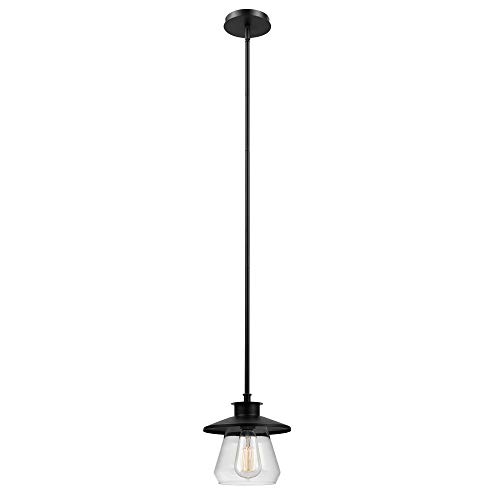
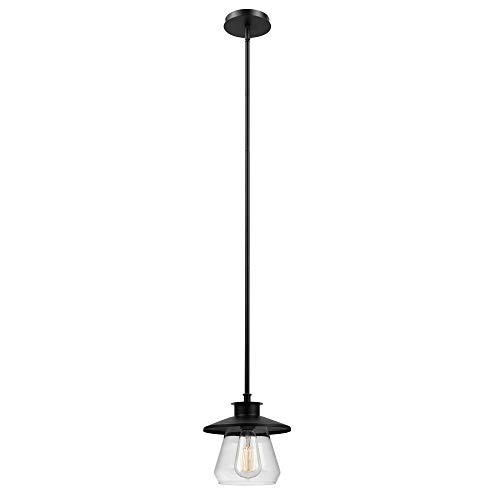
Globe Electric Nate Pendant
A matte-black industrial pendant in the Nate style from Globe Electric, typically offered singly and in multipacks for islands. Its appeal is straightforward value and repetition: three matching pendants over a long island look deliberate and calm, the black finish pairs with almost any cabinet colour, and the simple dome or cage form does not date quickly. Treat it as the entry-to-mid tier workhorse of the cluster. Its honest limitation is that a very simple shade offers little diffusion, so in a low-ceiling room the bare bulb can feel harsh at eye level unless you choose a softer, frosted, or lower-output bulb. As the entry-to-mid tier example, it is the Step 2 lesson in physical form: choose it when the job is a repeated run and the direction test matters more than ornament.
Hampton Bay Factory Pendant
A factory-style metal shade pendant from Hampton Bay, the kind of wide, enamel-look dome originally shaped to throw light down onto a work surface. That heritage is exactly its strength over an island, a work table, or a laundry bench: the wide shade pushes a generous pool of light downward and shields the bulb from most standing sightlines. Frame it as a practical mid-tier pick for task-first rooms. Its limitation is spread: a shade designed to aim light down will not wash a whole room, so plan on companion lighting rather than expecting one factory pendant to carry an entire kitchen on its own. As a mid-tier task example, it passes Step 1 for work surfaces decisively, and its wide shade is the clearest illustration in this guide of direction chosen on purpose.

VINLUZ Modern Glass Pendant
A modern glass pendant in the VINLUZ style, with a clear or seeded glass shade that shows the bulb as part of the composition. Glass is the right call when you want light to spill sideways as well as down, when the room is small and a metal shade would feel heavy, or when you want several pendants to read as a light rhythm rather than a row of dark shapes. Treat it as a mid-tier style pick. Its limitation is housekeeping and glare: clear glass shows dust and fingerprints sooner than metal, and a bright clear bulb inside clear glass can be uncomfortable to look at from a sofa or bed. As a mid-tier style example, it is the Step 6 lesson: with glass, the bulb is the design, so its success depends on the bulb-and-dimmer pairing more than on the shade itself.
Kichler Barrington Pendant
A Barrington-family pendant from Kichler, a brand readers meet in lighting showrooms as often as online, usually with a wood-look or brushed metal finish and a more finished, furniture-like presence than the value brands. Position it as the premium-leaning pick for dining rooms and entries where the fixture is furniture, not just hardware. The detailing around the canopy and stem tends to reward a closer look, which matters in rooms where guests sit near the light. Its honest trade-off is commitment: a distinctive, finished design is harder to tire of quickly but also harder to redecorate around if your taste changes. As the premium-leaning example, it suits Step 3’s anchor role over a table, where one fixture must carry a room’s centre and detailing is seen up close.
Common Mistakes
The first mistake is buying the photograph: a styled image with a high ceiling, a huge island, and daylight doing half the lighting work. The second is sizing from the product’s dimensions alone without a mock-up in the room. The third is forgetting the view from the next room, where a pendant run is often seen end-on and spacing errors double. The fourth is matching every metal in the room exactly, which flattens a space, instead of coordinating temperatures and letting one finish lead. The fifth, and the only dangerous one, is treating the electrical step as an afterthought: boxes, ratings, and qualified help are part of choosing, not paperwork after it.
Pro Tips
Photograph your mock-up from the doorway and from each seat; a phone picture reveals scale problems the eye forgives in person. If two pendants tempt you, choose the one whose shade you can clean and whose bulb you can change without a production. Keep the packaging until the fixture has survived a week of real evenings, including one dinner, one work session, and one late-night dimmed hour. And when a run of pendants is planned, order one first whenever the seller allows it: a single real fixture in the real room settles arguments that no amount of measuring can.
Worked Examples
The Long Island, Two Cooks
The job sentence is task light for two people working side by side. Direction is downward, scale is a rhythm of repeated shades rather than one hero, and the drop must keep light on the boards without putting shades in tall cooks’ sightlines. The factory-style and matte-black examples above both fit the reasoning; the choice between them is style, made safely because the functional tests were passed first. Control is one dimmer for the run, tested with the chosen bulb before the full set is bought.
The Small Dining Room
The job sentence is warmth and a centre for a table that seats six in a room that seats little else. Direction is diffuse, scale is one anchoring fixture rather than a run, and the drop is set by sitting in every chair and checking faces across the shade. The Barrington-style example fits because the room rewards detailing seen closely. The mistake this buyer avoids is the tiny, timid pendant bought out of fear of the small room; small rooms need a centre as much as large ones, just a proportionate one.
The Bedside Upgrade
The job sentence is freeing two nightstands and giving two readers independent light. Direction is gentle and local, control is individual rather than shared, and the drop borrows from lamp height. The glass example suits one side of this reasoning because its sideways spill is kind at low output, provided the bulb is soft and the other sleeper is shielded by shade choice and aim. The electrical reality check matters most here: bedside boxes rarely exist already, so this buyer budgets for an electrician or chooses plug-in pendants honestly from the start.
Room by Room: Applying the Method
Over a kitchen island, pendants earn their keep more honestly than anywhere else in the home. The island is where knives move, where recipes are read, where children do homework, and where guests perch with a glass while dinner finishes. Light there has to be bright enough for work, kind enough for lingering, and arranged so that a person standing at the counter does not cast their own shadow onto the board. A run of pendants answers all three needs when the shades aim light down, the spacing matches the working positions, and a dimmer lets the same fixtures soften once the work is done and the island becomes a bar.
Over a dining table, the pendant’s job reverses: atmosphere first, task second. Nobody needs surgical brightness to eat, but everybody looks better and feels better in warm light that models faces gently and pools on the table like a hearth. A single larger pendant or a small cluster centres the table in the room and gives the eye a reason the table is where it is. The fixture should relate to the table’s shape — a line over a rectangle, a centre over a round — and hang low enough to feel intimate without entering the conversation as an obstacle between faces.
Bedside pendants are a small decision with outsized daily returns. Freeing the nightstand surface means room for a book, a glass of water, and the ordinary clutter of a night, and the light itself, hung at roughly the height a lamp shade would sit, is better aimed at a page than most lamps manage. The cautions are real: the switch or dimmer must be reachable from the bed without a stretch, the shade must not glare into the eyes of the person on the other side, and the drop must clear anyone sitting up in the dark. Get those three right and most owners never go back to table lamps willingly.
In an entry, a pendant is a greeting. It is often the first fixture a guest sees and the one that sets the home’s temperature, warm and considered or bright and brisk. Entries also have practical demands: enough light for coats, keys, leashes, and muddy boots, and a fixture that clears both the swing of the door and the heads of tall visitors. Because entries are usually small, a pendant there can afford to be the most characterful in the home, the one place a slightly theatrical shade earns its drama without competing with a room full of furniture.
Going Deeper: Ceilings, Light and Daily Life
Energy and bulb technology belong in a modern pendant account, stated without invented figures. Modern LED bulbs have made the old heat and consumption worries of pendant lighting largely historical, they last long enough that bulb changes are rare events, and they offer the warm colour temperatures that homes actually want, which early generations often did not. The practical consequences for buyers are three: choose bulbs for colour quality and dimming behaviour rather than for survival, expect an enclosed shade’s heat constraints to be far easier to satisfy than they once were while still following the maker’s guidance, and treat the bulb budget as a quality budget, because the bulb is now effectively a long-term part of the fixture.
A pendant’s second life is worth a thought at purchase. Homes change hands, rooms change jobs, and a fixture with standard fittings, a shade that can be swapped, and a finish that suits more than one scheme will adapt, while a highly bespoke design is married to its first room. This is not an argument for blandness; the Barrington-style statement in this cluster will anchor its dining room gloriously. It is an argument for knowing which kind of purchase you are making: the adaptable workhorse bought for the decade, or the committed centrepiece bought for this room and this chapter. Both are honourable, and confusing them is the only error.
Season and daylight quietly govern how a pendant feels across a year. A fixture chosen under summer’s long evenings may prove to be the room’s main light source by winter, when it comes on at breakfast and stays relevant all day; a shade that felt gentle in June can feel dim in December, and a bright task pool that felt efficient can feel stark. Buyers in northern homes should weight winter behaviour heavily, test the mock-up after dark rather than at a bright midday viewing, and lean on dimming range as the mechanism that lets one fixture serve both seasons without compromise.
The view from other rooms is the test most buyers forget and most guests experience. Open-plan homes frame pendants through doorways and across sightlines all day: a run over an island is the kitchen’s public face from the living room, and a dining pendant composes the view from the hall. Alignment that looks correct from inside the room can look accidental from the doorway, because the doorway compresses a run into a single picture. Judge the mock-up from every threshold the home offers, and let the strictest view set the spacing and height. A pendant that passes the doorway test rarely disappoints anyone, including its owner at year five.
The Longer View: Living With the Choice
Sound is the sense nobody specs and everybody notices. A pendant on a dimmer that buzzes will be hated at dinner volume no matter how beautiful its light, and a shade that ticks as it warms or a loose part that trembles when a door closes will work on a household’s nerves out of all proportion to its size. These are installation and pairing qualities rather than design qualities, which is why this cluster keeps returning to tested combinations and secure mounting: the difference between a fixture that disappears into a room’s life and one that keeps announcing itself is usually a dimmer pairing and a properly seated canopy, not the shade that everyone blames.
Guests read a home’s pendants as evidence, fairly or not, of how the home is kept. A sparkling glass shade over a set table says the household notices things; a filmed, dusty shade over a beautiful island says the opposite, in the room where it matters most. This social reality is a legitimate buying input: households that love hosting should weight cleanability as a first-rank criterion, and households that rarely entertain can afford the intricate shade that would punish a weekly dinner party. There is no universal ranking of fixtures, only rankings per household, and the cleaning habits of the owner are one of the truest variables in the whole category.
Finally, a word on patience as a buying tool, because pendants reward it disproportionately. Live with the taped outline on the ceiling. Live with the cardboard shade through a full day’s light. Order the single fixture before the run. Sleep on the statement finish. Every one of these delays costs nothing and attacks the exact failure modes — scale, height, glare, commitment — that fill the returns warehouses of this category. The households happiest with their pendants at year five are rarely the ones that chose fastest at week one, and the correlation is not a coincidence.
Ceiling character changes pendant decisions more than most buyers expect. A high ceiling forgives a large shade and invites a longer drop, but it also asks the fixture to fill vertical space that a low ceiling never presents, which is why tall entries and stairwells suit clusters and staggered compositions. A low ceiling reverses every instinct: the shade must be compact, the drop short, and the position almost always over a surface rather than over a walkway, because the clearance budget is spent before the design conversation begins. Beams, coffers, and sloped planes each add their own negotiation, and the mock-up, once again, is where those negotiations should happen, in cardboard, before they happen in wiring.
Beyond the Basics: What Experience Teaches
Sloped ceilings deserve a specific warning, because they defeat fixtures that assume a level world. A pendant on a slope must hang plumb while its canopy sits against an angled plane, and not every design manages that gracefully; some require specific canopy designs or swivel fittings, which is a maker’s-specification question to settle before purchase. The drop also varies in effect across a slope: the same suspension length reads differently at the high and low ends of a room. Rooms with slopes reward buyers who mock up both ends of a run rather than trusting the middle, and who confirm slope suitability on the listing in writing rather than by hope.
Control technology has quietly changed what a pendant can be, and a complete guide should say so without turning into a gadget catalogue. Dimmable bulbs paired with a proper dimmer remain the dependable core. Beyond that, bulbs with adjustable warmth let one fixture serve a bright morning and a golden evening, and smart controls can schedule, group, and voice-command a run of pendants in ways that genuinely help busy kitchens and accessibility needs. The cautions are compatibility and complexity: smart bulbs and wall dimmers often fight, groups must be set up as groups, and a system nobody in the household understands will be bypassed. Choose the simplest control that delivers the moods you actually use.
Hosting reveals pendant quality like nothing else. A fixture that serves a cook alone at noon must, by seven, flatter eight faces, keep serving dishes visible, and stay out of the sightlines of a conversation that leans in. This is where dimming earns its cost in a single evening, where a shade’s sideways spill stops being a specification and becomes the difference between a table that glows and a table under a spotlight, and where a pendant hung a little too low stops being a measurement and becomes the thing every photograph of the night has in its centre. If you entertain often, weight the hosting test heavily at mock-up stage: seat your tallest friend, set the table fully, and look.
Households with children read pendants differently, and honestly. A pendant over a table is safely out of small hands in a way a table lamp never is, and its cord or stem offers nothing to pull a fixture down onto a floor where toddlers travel. The cautions run the other way at bedsides and low reading positions, where a hanging shade enters the territory of bunk beds, enthusiastic stretching, and balls thrown indoors against all law. Glass shades in high-traffic, high-energy zones ask for a household that is honest about its own physics. None of this vetoes pendants for families; it simply moves durability and position up the priority list where they belong.
The Details Owners Notice at Year Two
When a pendant stops suiting a room, replacement is not the only honest option. A shade change can transform the light pattern and the look while keeping sound wiring untouched, and many fixtures accept a different bulb character — warmer, softer, more decorative — that changes the mood for very little effort. What should never be improvised is the electrical side: swapping shades and bulbs within the fixture’s design is owner territory, while altering wiring, sockets, or mounting belongs to a qualified person. Knowing that boundary lets owners refresh a room confidently and often, without turning a styling change into an electrical experiment.
A pendant light is, at its simplest, a single light source suspended from the ceiling on a cord, chain, or stem, ending in a shade, a diffuser, or a bare bulb. That simplicity is deceptive, because the suspension is the whole point. Dropping the light closer to the surface it serves changes everything about how a room works: faces across a dining table sit in warm, flattering light instead of flat overhead wash, a kitchen island becomes a place where you can actually see the edge of a knife and the colour of what you are chopping, and a reading corner gains a pool of light that feels like a room within the room. Understanding a pendant starts with that drop, not with the shade catalogue.
Think of ceiling lighting as three layers that have to cooperate. Ambient light is the general wash that lets you move through a room safely. Task light is the focused brightness that lets you do something specific well. Accent light is the sparkle that gives a room depth and tells your eye where to rest. A pendant can play any of the three roles, but it is naturally a task and accent fixture first. Asking one small pendant to be a whole room’s ambient light is the single most common planning error, and it produces the familiar result of a bright spot in a dim room, which feels worse than even, modest light everywhere.
Dimming deserves its own warning, because it is where good pendants go to disappoint. A dimmer, a bulb, and a fixture have to be compatible, and an inexpensive bulb on the wrong dimmer can buzz, flicker at low levels, or refuse to dim smoothly. If you are buying several pendants for one run, buy the bulbs from the same family so they dim and colour-match together, and test one complete combination before committing to the whole set. A pendant run where one bulb glows noticeably warmer or brighter than its neighbours looks like a mistake even when every individual part is perfectly good.
Context That Changes the Decision
Finish is a coordination exercise, not a matching exercise. A pendant’s finish does not need to copy the faucet, the cabinet pulls, and the appliance handles exactly; rooms that match everything tend to feel like showrooms. What works is a family resemblance: metals in the same temperature family, blacks that agree with each other, and one finish allowed to be the quiet background while another carries the accent. Consider also how a finish ages in its room. Polished surfaces show every fingerprint in a busy kitchen, brushed and matte finishes forgive more, and dark finishes show dust in bright sunlit rooms in a way that surprises many owners.
Rooms ask different things of pendants, and naming the room’s job clarifies every later choice. A kitchen island wants even, shadow-aware task light repeated along its length. A dining table wants atmosphere, faces lit kindly, and a fixture that composes with the table rather than hovering like equipment. An entry wants welcome and a hint of the home’s character, plus enough light to find keys and manage coats. A bedroom wants restraint, warmth, and light that can be low and local. A bathroom vanity wants light on a face without harsh downward shadows, which is why pendants there are usually paired or placed with unusual care.
Start any pendant plan with the surface, not the ceiling. Measure the island, table, or counter in your head as a working area: where do people stand, sit, chop, read, and set things down? Light should land on those places with a little generosity at the edges, because a pool of light that ends exactly at the counter’s edge makes the room beyond feel like a cave. If two people regularly work side by side, the light needs to serve both without one person’s head shadowing the other’s hands, which is an argument for more than one pendant even on a modest island.
Deciding how many pendants a surface needs is a rhythm question as much as a brightness question. Odd numbers compose easily over a table, reading as a deliberate arrangement. Even numbers suit long islands where pairs can align with stools, sinks, or cooktops. What matters most is spacing that feels even to the eye from the room’s main viewpoints, not from directly overhead. Stand where you will actually enter and look at the run, because a spacing that is mathematically perfect can look off when a doorway, a window, or a tall cabinet interrupts the line, and your eye is the instrument that has to live with the result.
Frequently Asked Questions
How many pendants do I need over an island?
Enough that the working positions along the island are each lit without a cook’s own shadow falling on the board, arranged as an even rhythm your eye accepts from the doorway. For most islands that means a repeated run rather than one fixture, with the final count settled by a mock-up at the real height. If two people cook side by side, plan for both positions explicitly rather than lighting the island’s centre and hoping the edges cope.
What height should a pendant hang at?
There is no single figure that suits every room, and honest guidance is qualitative. Over a table or island, low enough to pool light on the surface and high enough to keep faces and sightlines clear. Over walkways, comfortably above head height. At a bedside, about where a table lamp’s shade would sit. Set the height with a mock-up, then sit, stand, and walk the room before making anything permanent.
Is a glass or a metal shade better?
Neither is better in general; they throw light differently. Metal aims light downward and suits work surfaces. Glass spills light sideways and upward, softening a room but exposing the bulb and showing dust sooner. Choose by the direction your job sentence demands, then check the consequences: glare and cleaning for glass, limited spread for metal. Many good rooms use both, metal at the work and glass at the table.
Can I install a pendant light myself?
Only within strict limits. Turn the breaker off at the panel and verify with a tester before touching wires, never work on a live circuit, and remember the ceiling box must be rated for the fixture’s weight. Hardwired installation should be done by a licensed electrician unless you are qualified and local code permits it. If existing wiring looks damaged or non-standard, stop and call an electrician rather than adapting to it.
What bulb should I choose for a pendant?
Choose warmth for the room’s mood, output for the job, and a form that suits the shade, then confirm the bulb and dimmer work together smoothly before buying a full set. Exposed-bulb designs need a bulb that looks good switched off as well as on. Enclosed shades need a bulb the fixture is designed to handle. When several pendants share a run, buy bulbs from the same family so colour and dimming match across the group.
Should pendant finishes match my faucet and handles?
Coordinate rather than copy. Finishes in the same temperature family, with one allowed to lead and the others kept quiet, almost always look better than a room where every metal is identical. Exact matching also makes future changes harder, because one new appliance can break the set. Borrow one element from the room — a colour, a material, a line — and repeat it in the fixture for a result that looks chosen rather than matched.
Related Guides
- pendant light guide: how to install pendant light
- pendant light guide: is a pendant light worth it
- pendant light guide: pendant light buying guide
- pendant light guide: pendant light pros and cons
- pendant light guide: pendant light review
- pendant light guide: pendant light reviews
- pendant light options already live on this site
- pendant lights sized for bedrooms
- pendant lights for modern homes
- chandeliers if a room centre suits you better