Disclosure: As an Amazon Associate, dailyhomedecorating.com earns from qualifying purchases. Links on this page are affiliate links; they cost you nothing extra. Prices and availability change often, so check the current Amazon listing before you buy.
Is a tv stand worth it when a wall mount costs less effort on paper and the floor is already paid for? The short answer is that is a tv stand worth it depends entirely on storage, children, renters’ rules, and how much equipment you own. Worth it if you need storage, cable control, and flexible placement. Not worth it if you own almost nothing but the screen and can mount it safely.
Key Takeaways
- Worth it for: storage needs, renters, families, multi-device setups.
- Not worth it for: minimal single-screen rooms that can wall-mount.
- The hidden costs are space, assembly time, and anchoring hardware habits.
- Value rises every year you keep it; stands are long-lived furniture.
In this guide
Is a TV Stand Worth It? The Short Answer First
Worth it if you need storage, cable order, anchored safety for children, and freedom to rearrange the room without drilling. Not worth it if the screen is nearly all you own, the room is tiny, and a safe wall mount is allowed and practical. Everything after this section exists to help you place your own household firmly on one side of that line.
What You Actually Get
Think about the room before the product page. In a small apartment the stand often has to earn its footprint twice, hiding board games, blankets, and chargers as well as holding the screen. In a family room it becomes the anchor that seating, rug, and lighting all arrange themselves around. In a bedroom it needs to sit lower and quieter, without bright indicator lights at eye level from the bed. The same stand can be perfect in one of those rooms and awkward in another, which is why honest room thinking beats chasing a showroom photograph taken in a space twice the size of yours.
Storage needs are easy to overestimate and just as easy to underestimate. List what genuinely lives near the television: the console, perhaps a soundbar, a router, a small stack of games or discs, remotes, chargers, and the household odds and ends that drift toward the screen. Closed storage hides the visual noise and keeps dust off equipment, while open shelves make plugging, unplugging, and ventilation simpler. Many households land happiest with a mix: doors for the clutter, an open bay for the warm-running box, and one drawer that becomes the honest home for remotes instead of the sofa cushions.
Cable management decides whether a living room feels calm or cluttered. A good stand gives cables a planned route: openings at the back, shelves that let power strips sit out of sight, and enough depth that plugs do not force the furniture away from the wall. Bundle related cables together, leave gentle slack for anything you move to clean behind, and label both ends of the leads you rarely touch. Keep remote-heavy top surfaces clear as a daily habit, because a crowded top invites remotes, game controllers, mugs, and chargers to migrate toward the screen and the edges, where a knock can send something onto the floor or into the set.
Television size is measured diagonally, corner to corner of the screen, and that single habit explains most sizing mistakes. A screen sold by its diagonal can be considerably narrower than the number suggests once you account for the bezel, or wider in feel once the feet are placed near the edges. What matters at home is the actual width of the set from side to side and the distance between its feet. The stand must be wider than the television’s real width, with a little breathing room on each side, and the top must be deep enough that both feet sit fully on the surface with margin front and back. Measure the set itself, measure the feet spacing, and only then shop.
Safety comes before style with any television on furniture. A television on a stand is a tip-over hazard for climbing children, and the risk rises when a curious child pulls on a drawer, a door, or the screen itself to stand up. Anchor the television to the wall with an anti-tip strap, and anchor tall stands to the wall as well, so neither piece can move independently. Never let children climb on drawers, shelves, or open doors, and never treat a stand as a step stool during setup. Keep the heaviest components low and centred, because weight placed high makes any piece of furniture less forgiving.
Ventilation is the quiet requirement people forget until a console runs hot. Game consoles, streaming boxes, and amplifiers all shed heat, and they should never be sealed inside a closed cabinet with the door shut during long sessions. Open-backed shelves, slatted doors, and generous gaps around each device let warm air escape the way the makers intended. If you prefer doors for a tidy look, leave the door open while playing, choose a design with ventilation cut into the back panel, and check by hand after a long session: a shelf that feels noticeably warm is telling you the airflow needs help.
The Real Costs Beyond Money
Assembly is part of the real cost of any flat-packed stand, paid in time and patience rather than money. Read the instructions fully before opening the hardware bags, lay every panel out and check it against the parts list, and build on a rug or blanket so finished surfaces are not scratched by the floor. Tighten fixings in stages rather than fully at the first pass, because a frame pulled square at the end sits straighter than one forced together early. Keep the spare fixings and the hex key in a labelled bag inside the stand itself, so a future tightening takes minutes.
Think about the room before the product page. In a small apartment the stand often has to earn its footprint twice, hiding board games, blankets, and chargers as well as holding the screen. In a family room it becomes the anchor that seating, rug, and lighting all arrange themselves around. In a bedroom it needs to sit lower and quieter, without bright indicator lights at eye level from the bed. The same stand can be perfect in one of those rooms and awkward in another, which is why honest room thinking beats chasing a showroom photograph taken in a space twice the size of yours.
Day-to-day care is simple but not optional. Dust with a soft cloth, lift objects rather than dragging them across the top, and use coasters under drinks without exception, because a single ring mark on a veneer top is permanent in a way a dusty shelf is not. Check the anti-tip strap and wall fixings whenever you move the stand to clean behind it, and re-tighten any fixing that has worked loose. Keep cables from pinching between the stand and the wall, and give the whole setup a slow look every few months: wobble, heat, dust build-up, and cable strain all announce themselves early if you bother to look.
Cable management decides whether a living room feels calm or cluttered. A good stand gives cables a planned route: openings at the back, shelves that let power strips sit out of sight, and enough depth that plugs do not force the furniture away from the wall. Bundle related cables together, leave gentle slack for anything you move to clean behind, and label both ends of the leads you rarely touch. Keep remote-heavy top surfaces clear as a daily habit, because a crowded top invites remotes, game controllers, mugs, and chargers to migrate toward the screen and the edges, where a knock can send something onto the floor or into the set.
Ventilation is the quiet requirement people forget until a console runs hot. Game consoles, streaming boxes, and amplifiers all shed heat, and they should never be sealed inside a closed cabinet with the door shut during long sessions. Open-backed shelves, slatted doors, and generous gaps around each device let warm air escape the way the makers intended. If you prefer doors for a tidy look, leave the door open while playing, choose a design with ventilation cut into the back panel, and check by hand after a long session: a shelf that feels noticeably warm is telling you the airflow needs help.
Who It Pays Off For
Safety comes before style with any television on furniture. A television on a stand is a tip-over hazard for climbing children, and the risk rises when a curious child pulls on a drawer, a door, or the screen itself to stand up. Anchor the television to the wall with an anti-tip strap, and anchor tall stands to the wall as well, so neither piece can move independently. Never let children climb on drawers, shelves, or open doors, and never treat a stand as a step stool during setup. Keep the heaviest components low and centred, because weight placed high makes any piece of furniture less forgiving.
Storage needs are easy to overestimate and just as easy to underestimate. List what genuinely lives near the television: the console, perhaps a soundbar, a router, a small stack of games or discs, remotes, chargers, and the household odds and ends that drift toward the screen. Closed storage hides the visual noise and keeps dust off equipment, while open shelves make plugging, unplugging, and ventilation simpler. Many households land happiest with a mix: doors for the clutter, an open bay for the warm-running box, and one drawer that becomes the honest home for remotes instead of the sofa cushions.
Think about the room before the product page. In a small apartment the stand often has to earn its footprint twice, hiding board games, blankets, and chargers as well as holding the screen. In a family room it becomes the anchor that seating, rug, and lighting all arrange themselves around. In a bedroom it needs to sit lower and quieter, without bright indicator lights at eye level from the bed. The same stand can be perfect in one of those rooms and awkward in another, which is why honest room thinking beats chasing a showroom photograph taken in a space twice the size of yours.
Ventilation is the quiet requirement people forget until a console runs hot. Game consoles, streaming boxes, and amplifiers all shed heat, and they should never be sealed inside a closed cabinet with the door shut during long sessions. Open-backed shelves, slatted doors, and generous gaps around each device let warm air escape the way the makers intended. If you prefer doors for a tidy look, leave the door open while playing, choose a design with ventilation cut into the back panel, and check by hand after a long session: a shelf that feels noticeably warm is telling you the airflow needs help.
Materials shape both the look and the lifespan of a stand. Solid wood feels substantial and can often be repaired, engineered wood keeps larger designs lighter and more consistent in finish, metal frames read modern and keep the profile slim, and glass tops brighten a room while showing every fingerprint and cable shadow. None of these is automatically best. What matters is honest construction where it counts: joints that do not wobble, shelves that do not bow under a receiver, doors that hang straight, and a finish that survives the duster and the occasional moved ornament without marking at the first touch.
Who Should Skip It
Viewing height is an ergonomic decision disguised as a furniture decision. Ideally the centre of the screen sits near eye level from your main seat, so your neck stays neutral through a film or a match. A stand that is too tall forces a permanent slight tilt of the head, and a stand that is too low does the same in the other direction. Sofa seat height, cushion sink, and viewing distance all feed into the right number for your room, so sit where you actually sit, note where your eyes rest on the wall, and work backwards from there rather than copying a height from a catalogue.
Buying well is mostly about resisting the first attractive photograph. Check the real width against your television’s real width, check the feet spacing, check the internal shelf dimensions against the largest box you own, and check how the back is finished, because the back decides your cable and ventilation options. Read the assembly description honestly against your patience and tools. A stand is a long-lived, low-excitement purchase that you will look at every single day, so boring correctness on measurements and construction matters far more than a fashionable detail you will stop noticing within a month.
Materials shape both the look and the lifespan of a stand. Solid wood feels substantial and can often be repaired, engineered wood keeps larger designs lighter and more consistent in finish, metal frames read modern and keep the profile slim, and glass tops brighten a room while showing every fingerprint and cable shadow. None of these is automatically best. What matters is honest construction where it counts: joints that do not wobble, shelves that do not bow under a receiver, doors that hang straight, and a finish that survives the duster and the occasional moved ornament without marking at the first touch.
Think about the room before the product page. In a small apartment the stand often has to earn its footprint twice, hiding board games, blankets, and chargers as well as holding the screen. In a family room it becomes the anchor that seating, rug, and lighting all arrange themselves around. In a bedroom it needs to sit lower and quieter, without bright indicator lights at eye level from the bed. The same stand can be perfect in one of those rooms and awkward in another, which is why honest room thinking beats chasing a showroom photograph taken in a space twice the size of yours.
Strengths and Trade-Offs
Strengths
- Storage, cable order, and placement freedom in one purchase.
- Safer, anchored setups for families than improvised furniture.
- Moves with you between homes, unlike a fixed mount.
Trade-offs
- Floor space is a real cost in small rooms.
- Assembly and anchoring take an afternoon of honest effort.
- A poor size match wastes the whole purchase.
Alternatives to Consider
Buying well is mostly about resisting the first attractive photograph. Check the real width against your television’s real width, check the feet spacing, check the internal shelf dimensions against the largest box you own, and check how the back is finished, because the back decides your cable and ventilation options. Read the assembly description honestly against your patience and tools. A stand is a long-lived, low-excitement purchase that you will look at every single day, so boring correctness on measurements and construction matters far more than a fashionable detail you will stop noticing within a month.
Style works best when it answers to the room you already have. A stand that echoes one or two existing notes, the wood tone of a coffee table, the black metal of a lamp, the woven texture of a rug, will settle in quietly, while a stand chosen as a statement in isolation can fight everything around it for years. Consider the wall behind it as well: a dark stand against a pale wall reads bold and graphic, a pale stand can disappear and let the screen dominate, and open-legged designs let more floor show, which helps smaller rooms feel less full.
Think about the room before the product page. In a small apartment the stand often has to earn its footprint twice, hiding board games, blankets, and chargers as well as holding the screen. In a family room it becomes the anchor that seating, rug, and lighting all arrange themselves around. In a bedroom it needs to sit lower and quieter, without bright indicator lights at eye level from the bed. The same stand can be perfect in one of those rooms and awkward in another, which is why honest room thinking beats chasing a showroom photograph taken in a space twice the size of yours.
FITUEYES Floor TV Stand
The FITUEYES Floor TV Stand is a floor-standing mount-style design that lifts the screen on a central column, useful where you want an open, minimal footprint and easy height adjustment in feel. Consider it in the premium-leaning tier in qualitative terms, and judge it on the same checks as everything else in this guide: real width against your television’s real width, feet spacing, shelf room for your largest device, and a back design that lets cables out and warm air escape. During setup, anchor the television with an anti-tip strap, keep the heaviest device on the lowest shelf, and leave the top surface clear apart from the screen itself.
In daily use, the honest questions are simple. Does it wobble when a door closes? Do the warm devices get air? Can you reach the power strip without moving the whole piece? Does dust show fast enough to annoy you, and does the finish forgive the duster? A stand that answers those questions well for your room is a better buy than a more fashionable stand that answers them badly, whatever the product photograph promised.

Furinno Turn-N-Tube TV Stand
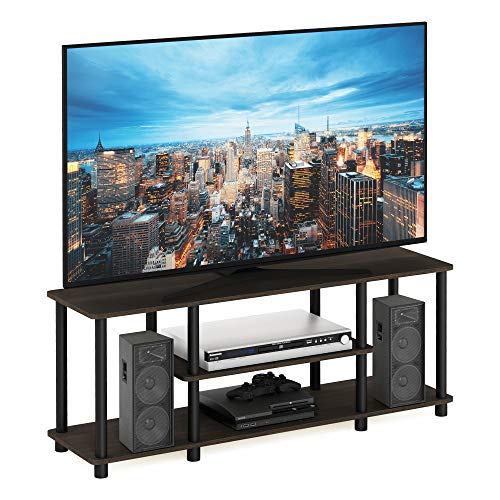
The Furinno Turn-N-Tube TV Stand is a simple open-shelf, entry-tier design built around easy tool-light assembly, best for lighter setups, spare rooms, and first apartments. Consider it in the entry tier in qualitative terms, and judge it on the same checks as everything else in this guide: real width against your television’s real width, feet spacing, shelf room for your largest device, and a back design that lets cables out and warm air escape. During setup, anchor the television with an anti-tip strap, keep the heaviest device on the lowest shelf, and leave the top surface clear apart from the screen itself.
In daily use, the honest questions are simple. Does it wobble when a door closes? Do the warm devices get air? Can you reach the power strip without moving the whole piece? Does dust show fast enough to annoy you, and does the finish forgive the duster? A stand that answers those questions well for your room is a better buy than a more fashionable stand that answers them badly, whatever the product photograph promised.

Walker Edison Modern Farmhouse TV Stand
The Walker Edison Modern Farmhouse TV Stand is a farmhouse-leaning design with cabinet storage that suits family living rooms wanting doors on the clutter and a warm wood-look finish. Consider it in the mid tier in qualitative terms, and judge it on the same checks as everything else in this guide: real width against your television’s real width, feet spacing, shelf room for your largest device, and a back design that lets cables out and warm air escape. During setup, anchor the television with an anti-tip strap, keep the heaviest device on the lowest shelf, and leave the top surface clear apart from the screen itself.
In daily use, the honest questions are simple. Does it wobble when a door closes? Do the warm devices get air? Can you reach the power strip without moving the whole piece? Does dust show fast enough to annoy you, and does the finish forgive the duster? A stand that answers those questions well for your room is a better buy than a more fashionable stand that answers them badly, whatever the product photograph promised.
How to Get the Most Value If You Buy
Day-to-day care is simple but not optional. Dust with a soft cloth, lift objects rather than dragging them across the top, and use coasters under drinks without exception, because a single ring mark on a veneer top is permanent in a way a dusty shelf is not. Check the anti-tip strap and wall fixings whenever you move the stand to clean behind it, and re-tighten any fixing that has worked loose. Keep cables from pinching between the stand and the wall, and give the whole setup a slow look every few months: wobble, heat, dust build-up, and cable strain all announce themselves early if you bother to look.
Cable management decides whether a living room feels calm or cluttered. A good stand gives cables a planned route: openings at the back, shelves that let power strips sit out of sight, and enough depth that plugs do not force the furniture away from the wall. Bundle related cables together, leave gentle slack for anything you move to clean behind, and label both ends of the leads you rarely touch. Keep remote-heavy top surfaces clear as a daily habit, because a crowded top invites remotes, game controllers, mugs, and chargers to migrate toward the screen and the edges, where a knock can send something onto the floor or into the set.
Ventilation is the quiet requirement people forget until a console runs hot. Game consoles, streaming boxes, and amplifiers all shed heat, and they should never be sealed inside a closed cabinet with the door shut during long sessions. Open-backed shelves, slatted doors, and generous gaps around each device let warm air escape the way the makers intended. If you prefer doors for a tidy look, leave the door open while playing, choose a design with ventilation cut into the back panel, and check by hand after a long session: a shelf that feels noticeably warm is telling you the airflow needs help.
Viewing height is an ergonomic decision disguised as a furniture decision. Ideally the centre of the screen sits near eye level from your main seat, so your neck stays neutral through a film or a match. A stand that is too tall forces a permanent slight tilt of the head, and a stand that is too low does the same in the other direction. Sofa seat height, cushion sink, and viewing distance all feed into the right number for your room, so sit where you actually sit, note where your eyes rest on the wall, and work backwards from there rather than copying a height from a catalogue.
Storage needs are easy to overestimate and just as easy to underestimate. List what genuinely lives near the television: the console, perhaps a soundbar, a router, a small stack of games or discs, remotes, chargers, and the household odds and ends that drift toward the screen. Closed storage hides the visual noise and keeps dust off equipment, while open shelves make plugging, unplugging, and ventilation simpler. Many households land happiest with a mix: doors for the clutter, an open bay for the warm-running box, and one drawer that becomes the honest home for remotes instead of the sofa cushions.
The Decision Checklist
Answer honestly: Do you own more than the screen itself? Do children visit or live here? Are you allowed to drill for a mount? Do cables currently bother you weekly? Do you need the storage elsewhere in the room? Will this television size stay for years? Four or more yes answers mean a stand will almost certainly earn its place; four or more no answers mean mounting or a minimal floor design deserves the first look.
Television size is measured diagonally, corner to corner of the screen, and that single habit explains most sizing mistakes. A screen sold by its diagonal can be considerably narrower than the number suggests once you account for the bezel, or wider in feel once the feet are placed near the edges. What matters at home is the actual width of the set from side to side and the distance between its feet. The stand must be wider than the television’s real width, with a little breathing room on each side, and the top must be deep enough that both feet sit fully on the surface with margin front and back. Measure the set itself, measure the feet spacing, and only then shop.
Storage needs are easy to overestimate and just as easy to underestimate. List what genuinely lives near the television: the console, perhaps a soundbar, a router, a small stack of games or discs, remotes, chargers, and the household odds and ends that drift toward the screen. Closed storage hides the visual noise and keeps dust off equipment, while open shelves make plugging, unplugging, and ventilation simpler. Many households land happiest with a mix: doors for the clutter, an open bay for the warm-running box, and one drawer that becomes the honest home for remotes instead of the sofa cushions.
More Practical Notes
Day-to-day care is simple but not optional. Dust with a soft cloth, lift objects rather than dragging them across the top, and use coasters under drinks without exception, because a single ring mark on a veneer top is permanent in a way a dusty shelf is not. Check the anti-tip strap and wall fixings whenever you move the stand to clean behind it, and re-tighten any fixing that has worked loose. Keep cables from pinching between the stand and the wall, and give the whole setup a slow look every few months: wobble, heat, dust build-up, and cable strain all announce themselves early if you bother to look.
Buying well is mostly about resisting the first attractive photograph. Check the real width against your television’s real width, check the feet spacing, check the internal shelf dimensions against the largest box you own, and check how the back is finished, because the back decides your cable and ventilation options. Read the assembly description honestly against your patience and tools. A stand is a long-lived, low-excitement purchase that you will look at every single day, so boring correctness on measurements and construction matters far more than a fashionable detail you will stop noticing within a month.
Think about the room before the product page. In a small apartment the stand often has to earn its footprint twice, hiding board games, blankets, and chargers as well as holding the screen. In a family room it becomes the anchor that seating, rug, and lighting all arrange themselves around. In a bedroom it needs to sit lower and quieter, without bright indicator lights at eye level from the bed. The same stand can be perfect in one of those rooms and awkward in another, which is why honest room thinking beats chasing a showroom photograph taken in a space twice the size of yours.
Materials shape both the look and the lifespan of a stand. Solid wood feels substantial and can often be repaired, engineered wood keeps larger designs lighter and more consistent in finish, metal frames read modern and keep the profile slim, and glass tops brighten a room while showing every fingerprint and cable shadow. None of these is automatically best. What matters is honest construction where it counts: joints that do not wobble, shelves that do not bow under a receiver, doors that hang straight, and a finish that survives the duster and the occasional moved ornament without marking at the first touch.
One Last Test Before You Decide
One more honest test is the five-year question. Picture the room five years from now: the television may have grown, the console will certainly have changed, and children who crawl today will be climbing tomorrow. A stand bought on correct measurements, with anchoring fitted from day one, open airflow for warm equipment, and storage that matches how the household actually lives, absorbs all of that change without complaint. A stand bought on a photograph alone tends to be replaced at the first change, and replacement is where the real waste sits in any worth-it calculation.
The Break-Even Question: When a Tv stand Earns Its Space, and When It Honestly Does Not
Worth it is a personal verdict dressed as a product question. The same tv stand can be money well spent for one household and an expensive ornament for another, and the difference is almost never quality — it is frequency of use, fit with the space, and what it replaces. This section gives you a break-even way of thinking about the tv stand: a simple accounting of cost per use, space per benefit, and effort per result, plus the honest signs that your household should skip it, borrow it, or buy the simpler version instead. Run your own numbers through it before you decide.
The Arithmetic That Actually Matters
Start with cost per use. Take the full cost of owning the tv stand — purchase, any consumables, any accessories you genuinely need, and the space it occupies valued honestly — and divide it by a realistic count of uses in its first two years. Realistic is the key word: count the uses your calendar supports, not the uses your intentions promise in January. Then compare that figure with the alternatives you would actually use — hiring, borrowing, a service, or the simpler item you already own. A tv stand that wins that comparison on your real schedule is worth it almost regardless of its badge; one that only wins on an imagined schedule is not.
The Signs on Each Side of the Line
On the worth-it side: you already do the task or feel the gap weekly; you have measured the space and it fits with room to live around; someone besides the buyer will use it too; and you can name what it replaces or retires. On the skip-it side: the purchase is motivated by a rare event, a visitor, or a version of your routine you have never actually kept; the space only works if something else is moved into storage; or the honest plan is to change your habits first and buy later. Neither list is a judgement — households change, and a tv stand that fails the test this year may pass it easily after a move, a new job or a new family member.
Before you buy the tv stand, answer these five questions out loud or on paper:
- How many times did I genuinely need this in the last three months — not wished for it, needed it?
- What exactly does it replace, retire or stop me paying for, starting in its first month?
- Where does it live when idle, measured and checked, and what currently in that spot gets moved?
- Who else in the household will use it without being asked, and who will maintain it?
- If it stopped working in a year, would I replace it immediately, manage without, or feel quietly relieved?
Notice which parts are replaceable and which are not; a tv stand whose wear parts can be swapped cheaply often outlasts a sealed design twice its price in spirit, if not in years. Consider the tv stand from the perspective of the person who cleans around it, because designs that trap dust, block access or demand special products quietly tax every week of ownership. Think about noise, light and heat as neighbours of the tv stand, not afterthoughts, since a choice that performs well but disturbs the room around it rarely stays popular for long.
The last question is the sharpest: immediate replacement means the tv stand has become infrastructure in your home, and purchases like that are almost always worth it. Quiet relief means the opposite, however good the reviews were. Decide with your own arithmetic and your own answers, and whichever way the verdict falls you will have bought — or saved — with your eyes open, which is the only definition of value that survives contact with real life.
Frequently Asked Questions
How wide should a TV stand be compared with the TV?
Wider than the television’s actual width, not its diagonal screen size. Television size is measured diagonally, so check the set’s real side-to-side width and the spacing between its feet, then choose a stand with a little clear surface on each side. That margin looks better, feels more stable, and keeps the set from overhanging the furniture in a way that invites knocks.
Do I really need to anchor a TV on a stand?
Yes. A television on a stand is a tip-over hazard for climbing children, and anchoring is the simple step that changes that. Fit an anti-tip strap from the television to the wall, anchor tall stands to the wall as well, and never let children climb on drawers, shelves, or doors. Check the strap whenever you move the furniture to clean behind it.
Can I keep a game console inside a closed cabinet?
Not while it is running hard for long sessions. Consoles shed heat and should never be sealed inside a closed cabinet without airflow. Choose open-backed shelving, leave the door open during play, or pick a design with ventilation in the back panel, and check the shelf by hand afterwards. A noticeably warm shelf is a clear sign the setup needs more air.
What should I keep on top of a TV stand?
As little as possible. Keep remote-heavy top surfaces clear, with the television centred, perhaps a soundbar with a clear line to the room, and nothing stacked near the edges. Remotes belong in a drawer or a small tray, drinks belong on coasters on a side table, and chargers belong out of sight. A clear top is safer, calmer to look at, and easier to dust.
How do I hide cables without trapping heat?
Route cables through the stand’s rear openings, bundle related leads together with gentle slack, and keep the power strip accessible rather than buried. Hiding cables and ventilating equipment are compatible goals as long as warm devices sit in open bays or vented sections. Photograph the layout once it works, so any future unplugging for cleaning or moving rebuilds in minutes.
How often should I check a TV stand for safety?
Give it a slow check every few months and after every move or deep clean. Look for wobble, loose fixings, a slack anti-tip strap, dust build-up around vents, and cables pinched against the wall. Tighten what has loosened, re-seat what has shifted, and confirm the television still sits fully on its feet with margin on the stand top.
Day-to-day care is simple but not optional. Dust with a soft cloth, lift objects rather than dragging them across the top, and use coasters under drinks without exception, because a single ring mark on a veneer top is permanent in a way a dusty shelf is not. Check the anti-tip strap and wall fixings whenever you move the stand to clean behind it, and re-tighten any fixing that has worked loose. Keep cables from pinching between the stand and the wall, and give the whole setup a slow look every few months: wobble, heat, dust build-up, and cable strain all announce themselves early if you bother to look.
Buying well is mostly about resisting the first attractive photograph. Check the real width against your television’s real width, check the feet spacing, check the internal shelf dimensions against the largest box you own, and check how the back is finished, because the back decides your cable and ventilation options. Read the assembly description honestly against your patience and tools. A stand is a long-lived, low-excitement purchase that you will look at every single day, so boring correctness on measurements and construction matters far more than a fashionable detail you will stop noticing within a month.


