Disclosure: As an Amazon Associate, dailyhomedecorating.com earns from qualifying purchases. Links on this page are affiliate links; they cost you nothing extra. Prices and availability change often, so check the current Amazon listing before you buy.
So, is a gazebo worth it? Short answer: worth it if you will genuinely live under it, weekly in season, and you are willing to anchor it, assemble it properly, and keep up its light seasonal care; not worth it if it would stand as an ornament you visit twice a year while resenting its upkeep. The longer answer, and the honest one, depends on what you actually get, what it costs you beyond money in space, effort, and attention, and which of the cheaper alternatives would solve your real problem just as well. This article works through all of that, with profiles of the households it pays off for, the households that should skip it, and a decision checklist to close the question for your garden specifically.
Key Takeaways
- Worth it if: frequent outdoor living, real sun or rain barriers, settled plot.
- Not worth it if: rare use, no maintenance appetite, temporary living situation.
- The true costs are space, assembly effort, anchoring duty and seasonal care.
- Alternatives solve narrower problems more cheaply; compare honestly.
- Use the decision checklist at the end; count your answers, do not negotiate them.
In this guide
Is a Gazebo Worth It? What You Actually Get
You get the most complete outdoor room available as a garden purchase: full shade at the hours that matter, shelter that turns showers into background, privacy that makes a plot feel like yours, and a defined space that organises furniture, lighting, and planting around it. What you get, in short, is use: evenings and meals and mornings that happen outside by default instead of by special effort.
The roof is the working heart of a gazebo. A solid hardtop sheds rain completely, quiets the space underneath during a shower, and gives dependable, full shade through the middle of the day. A fabric canopy feels lighter and softer, and it can be removed for winter storage in many designs, but it asks for more attention: it flaps more in wind, it holds water if it sags, and sun slowly weakens it over the seasons. Tiered and vented roof shapes exist for a reason, since warm air rises and a vent gives it somewhere to go, which makes the shade underneath feel less trapped on still, hot afternoons. Whichever style you lean toward, picture it in the worst weather your yard normally gets, not the best, because the roof is the part storms test first.
Privacy is one of the main reasons people choose a gazebo over more open structures. The defined roof and posts create a room-like boundary, and many designs accept curtains, screens, or side panels that can be drawn when neighbours are close or when a low evening sun slips under the roof edge. Even without accessories, the sense of enclosure changes behaviour: conversations feel more contained, meals linger longer, and the space reads as a destination rather than a patch of lawn with chairs on it. Plan privacy in layers, combining the structure itself with planting, a fence line, or movable screens, so you can adjust it by season and by occasion instead of being locked into one fixed level of exposure.
Lighting extends a gazebo further into the evening than any other single addition. Plan it in layers: a soft ambient source so the space feels welcoming, a practical light over a table if you eat there, and low accents that mark steps and edges for safety after dark. Warm-toned light flatters faces, food, and planting, while harsh white light can make an evening space feel like a workplace. Solar options suit gentle accent roles and need no wiring, but their output depends on the charge the day provided, so keep expectations in that lane. Whatever you choose, keep fittings rated for outdoor use, route any cables where they cannot be tripped over or nicked by garden tools, and test the effect from the house as well as from the seats.
The Real Costs Beyond Money
The money is only the first cost. Add the footprint, which is gone from the garden for other purposes; the assembly project, which needs people, time, and ladder work; the anchoring duty, which is a safety obligation; and the seasonal care rhythm of inspections, cleaning, and winter preparation. None is unreasonable, but together they are the true price, and they are paid by your calendar as much as by your card.
Judge a gazebo by the hours it will actually host, not by the photographs that sold it. A household that eats outside most summer evenings, reads in the shade on weekends, and hosts friends regularly will extract real value from even a demanding structure, because the cost and effort are divided across hundreds of uses. A household that imagines using it twice a year is buying an ornament with a maintenance schedule, and ornaments that need anchoring, cleaning, and inspection quickly become resented. Be honest about your patterns before you buy: look at how often you currently sit outside, and what stops you. If the honest answer is sun, rain, and insects, a gazebo addresses real barriers. If the honest answer is time, a roof will not manufacture evenings.
The base deserves the same seriousness as the frame. A level, stable foundation keeps doors of geometry honest: posts stand plumb, roof panels meet without force, and water sheds the way the design intends. On a deck, confirm the structure beneath the boards can take both the weight and the anchoring fixings, and spread the load as the maker directs. On a patio, check for cracked or rocking slabs and correct them first. On grass or soil, a prepared pad or individual footings are the durable answer; a frame simply standing on turf will settle unevenly, hold moisture against its feet, and slowly rack itself out of square through a single wet season. Time spent on the base is never wasted, because every later step assumes it.
Anchoring is not an optional finishing touch; it is the safety core of the whole structure. A gazebo presents a large roof surface to the wind, and in a strong gust an unanchored frame can shift, rack, lift, or in the worst case be blown over entirely, damaging property and endangering anyone nearby. Every post should be fixed down to a solid foundation or deck with the fasteners and brackets the maker specifies for that model, following the manual rather than improvising. On a deck, confirm the fixings reach structural material rather than surface boards alone. On the ground, use a proper base such as a prepared pad or footings suited to your soil instead of simply resting posts on grass or loose pavers. If a storm beyond the ordinary is forecast, follow the maker guidance for securing or removing fabric elements, and never treat a heavy frame as proof that anchoring can be skipped.
Who It Pays Off For
It pays off for the outdoor-dining household in a rainy climate, for the shade-starved family whose afternoons are currently unusable, for the hosts whose gatherings regularly overflow the house, and for the settled gardener who enjoys caring for a structure. In each profile the common thread is frequency: the cost is divided across so many uses that it shrinks to something small per evening.
For hosting, judge the gazebo by the largest gathering you host regularly, not the largest you can imagine. A dining setup needs table clearance, serving access, and a route from the house or grill that does not squeeze behind seated guests. A lounge setup needs lower, deeper seating and side surfaces for drinks and books, plus lighting that flatters rather than glares. If you host both ways, choose flexible, lighter furniture you can rearrange over a fixed suite that locks the space into one mode. Test the layout with your existing pieces before buying anything new, live with it for a few gatherings, and let real evenings, with real elbows, trays, and conversations, tell you what the space is missing and what it already does well.
Families should read a gazebo through younger and four-legged eyes. Rounded, stable furniture, fixings checked so nothing works loose at grabbing height, and a floor surface that is not slippery when wet all matter more than styling. Shade is a genuine benefit for children playing outside, but supervision rules do not change under a roof: the structure is not a climbing frame, and curtains, cords, and screens should be arranged so they cannot entangle. For dogs, a shaded, breezy resting spot is a real kindness in summer, provided water is available and the space never becomes a place an animal is shut in during heat. Choose finishes and fabrics that forgive muddy paws and can be washed down without ceremony.
Comfort under a gazebo is mostly about managing sun, breeze, and insects rather than about furniture alone. Track how the sun moves across the space through the day and use curtains, shade panels, or planting on the side that takes the hard late-afternoon light. A gentle through-breeze is pleasant; a wind tunnel is not, and a screen or hedge on the prevailing-wind side can calm the space without sealing it. For insects, screens are the structural answer, while fans moving the air also discourage weak fliers and make warm evenings feel cooler. Add comfort gradually and in response to real evenings spent outside, noting what actually bothered you, rather than buying every accessory in advance for problems your particular yard may never present.
Who Should Skip It
Skip it if your honest outdoor pattern is occasional, if you are likely to move soon, if your plot is so exposed that you will not engineer anchoring seriously, or if maintenance of any kind reliably slides to the bottom of your list. In each case the structure’s costs stay fixed while its benefits never arrive, and that arithmetic, not the product, is what produces disappointment.
Where the gazebo sits decides almost everything that follows. Walk the yard at the times you actually plan to use it, morning and late afternoon especially, and watch where the sun lands, where water pools after rain, and which direction the prevailing breeze crosses the space. A spot that looks perfect at noon can be glaring by dinner and damp underfoot after every storm. Keep clear of low ground that stays soggy, keep the structure away from overhanging limbs that drop debris onto the roof, and leave comfortable walking room on every side so the posts never crowd a path, a gate swing, or a mower route. Think, too, about the view from inside the house, because a gazebo is a large visual object you will see every day, in every season, whether you are sitting under it or not.
Most gazebo disappointments trace back to a handful of avoidable mistakes. Buying the footprint from a photograph instead of a string outline on your own ground. Skipping or skimping the anchoring because the frame felt heavy on a calm day. Placing the structure where water collects, then blaming the roof for a damp floor. Choosing a fabric roof for a windy, exposed yard, or a demanding wood frame with no intention of maintaining the finish. Forgetting to check local rules and association conditions until after the build. And furnishing to the edges on day one, leaving no room to move. Every one of these is cheap to avoid at the planning stage and expensive to correct afterwards, which is why this guide returns to measuring, anchoring, and honest self-knowledge so often.
Alternatives to Consider
If your problem is only midday sun over one table, an umbrella or sail solves it for a fraction of the commitment. If your problem is openness and you want dappled shade and plants overhead, a pergola is the better buy. If your problem is insects at dusk, screens on an existing covered patio may answer it. Buy the gazebo only when your problem is the combination, sun, rain, privacy, and definition, because combination problems are what complete structures are for.
A gazebo is one answer among several, and comparing it honestly with the alternatives protects you from buying the wrong structure confidently. A pergola gives partial shade and an open, airy frame for planting, but it does not shed rain and offers less privacy. A simple shade sail costs and weighs far less and can be taken down seasonally, but it gives no defined room, no real rain shelter, and little wind calm. A patio umbrella is flexible and small in footprint, yet it covers a modest circle and is the first thing to close when wind rises. A screened porch is the most complete outdoor room of all, but it is a building project rather than a garden purchase. Match the structure to the barrier you actually face, and the choice usually becomes clear.
Think in tiers rather than in prices. Entry-tier gazebos generally use lighter frames and fabric roofs, suit occasional use and sheltered gardens, and ask the most seasonal attention. Mid-tier designs step up to sturdier frames, better fabrics or simpler hardtops, and hardware that feels less fragile during assembly and adjustment. Premium-tier structures bring heavier timber or more substantial metalwork, solid roofs, and detailing that reads as garden architecture rather than equipment. The right tier is the lowest one that honestly matches your weather, your frequency of use, and your maintenance appetite, because overspending on a structure you rarely use is as poor a decision as underspending on one that must survive an exposed, windy plot through every season of the year.
How to Get the Most Value If You Buy
Value is protected by process: choose by the steps in the companion choosing guide, size with string, anchor without compromise, furnish gradually from real use, light the space for evenings, and keep the small maintenance rhythm so the structure stays inviting. Owners who do these things report the same pattern: the gazebo becomes the default room of the summer, and the question of worth answers itself by August.
Routine care is light but it is not zero, and the gazebo you maintain in small regular passes will outlast the one that waits for an annual rescue. Wash frame surfaces down periodically to remove pollen, dust, and the film that encourages mildew, rinse the roof so debris does not sit in seams and valleys, and clear leaves before they compost themselves into corners. Inspect fixings a couple of times a year and tighten anything that has worked loose, because a frame that is allowed to move wears its joints faster. Touch up damaged coating on metal promptly, keep wood finishes renewed on the maker schedule, and store or secure fabric elements as directed for winter. None of this is difficult; all of it is easier in short, regular sessions.
Furnish the gazebo as a room, not as storage for spare chairs. Start with the main activity: dining, lounging, or a mix, and choose pieces scaled to the footprint you tested with string, leaving honest circulation space. Outdoor fabrics that dry quickly and cushions that can be stored dry will keep the space inviting rather than faintly damp. A weather-resistant storage box nearby solves the daily reality of cushions, throws, and games far better than piling them on chairs. Leave one side more open than the others as the natural entrance, and resist filling every corner in the first month; living in the space briefly shows you what it actually needs, and additions chosen after real use are almost always better than a complete set bought on guesswork.
When you shop, read listings like an inspector rather than a dreamer. Confirm the roof type and material, the frame material and finish, what is actually included in the box, whether curtains or screens are included or sold separately, and what anchoring hardware is supplied versus what you must source for your surface. Look for the assembly requirements, the stated number of helpers, and the care schedule, and be wary of any listing that is vague about the base it requires. Photographs show the best angle on the best day; the specification text and the manual tell you what will arrive. Download or read the manual before purchase if it is available, because ten minutes with the instructions prevents most expensive misunderstandings.
Examples to Consider If You Decide Yes
The examples below are presented prose-only, without links, because they could not be confidently verified for this draft. Each is a real market design family used here to make the tiers and trade-offs concrete. Use them as a shortlist shape, then confirm the exact current listing, configuration, hardware, and instructions on the retailer page before any purchase.

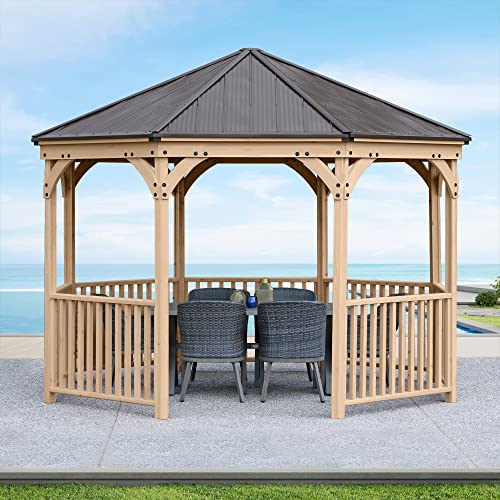
Yardistry Meridian Gazebo
a wood-framed design in the premium tier, suited to households that want the warm, furniture-like presence of timber and are willing to keep a finish renewed on schedule. Treat it as a long-term garden room frame: its appeal is the way wood settles into planting and pairs with traditional patio furniture. Best for: settled gardens, dining under a solid roof, and buyers who enjoy maintaining wood. Not suited for: anyone wanting a fit-and-forget frame, or a very exposed, windswept plot where a fabric-free but heavy build still demands rigorous anchoring and storm checks. Check the current listing for the exact configuration, included hardware, and care guidance before you buy, and plan the anchoring method for your surface at the same time as the purchase, not after delivery.
Best for: see the verdict in the description above. Check price on Amazon for the current listing of this prose-only pick, and confirm every detail there, because configurations and included accessories change.

Sunjoy Chatham Steel Gazebo
a steel-framed option in the mid tier that suits buyers who prefer the crisper lines and lower routine upkeep of coated metal over timber. Steel frames wash down easily and do not need refinishing, though chips in the coating should be touched up promptly so corrosion cannot start underneath. Best for: contemporary gardens, households short on maintenance time, and buyers who want a solid-roof feel without a wood-care calendar. Not suited for: anyone who will ignore coating damage season after season, or coastal and highly corrosive settings without checking the maker guidance for that environment. Read the current listing for roof construction, included curtains or screens if any, and the stated anchoring approach, and match those details to your yard rather than to the photographs.
Best for: see the verdict in the description above. Check price on Amazon for the current listing of this prose-only pick, and confirm every detail there, because configurations and included accessories change.
The Decision Checklist
Answer yes or no, honestly. Do you sit outside at least weekly in season now, or would if shade and shelter existed? Is sun, rain, or privacy a real barrier in your garden? Do you have a plot position that can take a prepared, level base? Will you anchor the structure fully and check it seasonally? Can you field two or more people for assembly, with safe ladder work? Have you confirmed the local rules and any association conditions? Will the footprint still leave the garden working well? Five or more yes answers: a gazebo is very likely worth it for you. Three or fewer: choose an alternative and revisit the question in a year.
More Practical Considerations Before You Commit
Measure honestly before you fall for a footprint. Mark the corners on the ground with stakes and string, or lay out the shape with a garden hose, then place the furniture you truly intend to use inside that outline and walk around it. People consistently imagine more clearance than they have: chairs need room to push back, a table needs serving space on at least two sides, and a lounger needs length plus a route past it. Check the slope as well, because even a gentle grade changes how level the frame will sit and how rain runs off the base. If the outline feels tight on the lawn, it will feel tighter once posts, braces, and a roof overhang are standing in it, so treat the string test as the cheapest decision you will make in the whole project.
Frame material shapes both the look and the upkeep rhythm of the structure. Wood brings warmth and weight, blends naturally with planting, and can be refinished when the finish tires, but it asks for periodic sealing and honest inspection for soft spots, splits, and insect interest. Powder-coated metal frames feel crisper and more contemporary, resist rot entirely, and usually need little more than washing and touch-up where the coating is chipped, though a neglected chip can let rust start underneath. Mixed designs pair a metal roof structure with wood posts or the other way round, trading a little visual simplicity for practical benefits. There is no universally better answer here, only the material whose maintenance pattern matches the time you genuinely have, year after year, not just the enthusiasm you have this spring.
Plan the build as a team job from the start. Assembly needs two or more people throughout: posts must be held plumb while crosspieces are offered up, roof sections are wide and awkward rather than merely heavy, and many steps require one person to support a part while another drives the fixings. Trying to improvise alone with props and clamps is how frames get twisted, holes get misaligned, and people get hurt. Schedule the work for a calm, dry day, lay every part out in order before you begin, check the full parts list against the manual before the first bolt is turned, and agree on who leads each step. A steady, unhurried build with enough hands almost always finishes faster than a rushed one that has to be taken apart and corrected.
Roof work is where ladder safety matters most. Use a sound ladder on firm, level ground, keep three points of contact while climbing, and never lean out sideways to reach a fixing; climb down and move the ladder instead, every time. A second person should foot the ladder and pass parts up, so nobody climbs while carrying a wide roof panel against the wind. Wear closed footwear with grip, keep tools in a belt or a bucket rather than in your hands while climbing, and stop if gusts pick up, because a roof panel acts like a sail at height. If any part of the roof assembly feels beyond your comfortable reach or experience, pausing and bringing in experienced help is a strength, not a failure, and it is far cheaper than an injury or a bent frame.
Snow load is a regional question, not a universal one. In areas where meaningful snow is part of winter, a still roof can accumulate a heavy, uneven load, and the safe habit is to clear accumulation gently from the ground where possible rather than letting it build and refreeze, always following the maker guidance for your specific structure. In mild regions the bigger winter issue is usually saturated ground softening around footings and wind driving rain under the roof edge. Either way, treat winter as a season the gazebo must be prepared for rather than ignored through: remove or secure fabric elements as directed, check fixings after the first hard storms, and inspect the roof line in spring for anything that shifted, sagged, or loosened while you were not watching.
Before you buy, check the local rules that may apply to a garden structure of this size in your area. Requirements vary widely from place to place and can touch on placement near boundaries, overall height, and whether a structure of a given footprint needs any form of approval, and neighbourhood or homeowners association covenants can add their own conditions about style, colour, or position. This guide cannot state the rules for your address, because they genuinely differ between neighbouring jurisdictions. A short enquiry with the relevant local office, and a look at any association documents you are bound by, takes little time before the build and can prevent the far larger cost of moving or removing a finished structure afterwards.
Think about water as a design material. A solid roof concentrates rainfall and delivers it at the edges, so decide in advance where that water should go: away from the seating area, away from the foundation of the house, and not across the path everyone uses in the rain. Slight grading, a gravel margin, or simple drainage channels can keep the floor of the gazebo dry and stop the ground around the posts from staying saturated, which matters for both comfort and the long life of footings and fixings. After the first heavy rain, go out and watch how your arrangement actually behaves, because water rarely follows the plan exactly, and small corrections made early prevent muddy, slippery habits forming around the structure for years.
Plan for delivery and staging before the boxes arrive. Gazebo kits are bulky and can be surprisingly heavy in aggregate, and the build goes far better when parts are laid out in a dry, flat staging area close to the site, checked against the parts list, and grouped in build order. Read the manual fully before opening the hardware bags, because most kits reward sequence: a step skipped or reversed early often has to be undone later with the frame half built. Keep the packaging until the structure is complete and checked, keep small fixings in labelled containers as you open each bag, and photograph the laid-out parts if you need to pause mid-build, so resuming does not become a guessing game about what was already fitted.
Heat management separates a pleasant gazebo from a handsome oven. Warm air collects under any roof at the hottest part of the day, so designs that vent at the peak, leave honest gaps at the eaves, or raise the roof on taller posts will feel noticeably kinder in still weather. Orientation helps as well: a roof that shades the seating at the hours you use it, rather than at noon when you are indoors, is the one that earns its keep. Light-coloured roof surfaces reflect more heat than dark ones, while dark frames absorb warmth you can feel when you touch a post. Combine structure with behaviour, too: open curtains and screens on the shaded side to let air travel, and close them on the sunny side, adjusting through the day as the sun moves.
Insects decide whether summer evenings happen at all in many gardens. A gazebo helps in layers: the roof removes the sense of exposure that draws people indoors, moving air from a fan discourages weak fliers, and fitted screens, where the design accepts them, provide the only complete physical answer at dusk. If screens matter to you, check before buying that the frame is designed to carry them neatly, with tracks or ties in the right places, rather than planning to improvise with loose netting that gaps at every corner. Keep the area under and around the structure free of standing water, clear fallen fruit promptly, and store cushions dry, because a well-kept gazebo environment removes much of what attracts insects in the first place.
Decide your winter plan before the first winter arrives. Fabric elements generally live longer stored dry and out of the wind, following the maker instructions for removal and folding. Hardtop structures usually stay in place, but they earn a pre-winter inspection: fixings tightened, roof cleared of debris, drainage paths open, and any coating damage touched up before months of wet weather find it. In snowy regions, revisit the snow guidance in this guide and set a personal routine for clearing accumulation gently and safely. In storm-prone regions, agree in advance what you will secure or remove when severe weather is forecast, so the decision is a checklist rather than an argument conducted while the wind is already rising outside.
A gazebo changes the sound of a garden as much as its look. A solid roof softens rain into a companionable drumming that many owners count among the pleasures of the structure, while fabric roofs are quieter in rain but can flap and snap in wind if they are not kept taut and well secured. The enclosed feeling also contains conversation, making gatherings feel more intimate and slightly less exposed to neighbouring ears, though no garden structure is a soundproof room and voices still carry on a still night. If your garden is near a road, planting and a fence line will do more for background noise than the roof will, so treat the gazebo as one layer in a wider plan for a calmer outdoor room.
Longevity is decided less by the badge on the box than by the match between structure, site, and owner. A modest frame, correctly anchored on a prepared base in a sheltered garden and inspected twice a year, will commonly outlast a premium structure planted on soggy ground, left unanchored, and ignored. When you compare options, therefore, weigh the unglamorous details: how the feet are protected from standing water, whether replacement fabric or parts are obtainable, how the finish is renewed, and whether the manual is clear enough that you will actually follow its maintenance schedule. Ask yourself honestly whether future-you will do the care this design needs, and choose the structure that forgives the owner you are, not the owner in the brochure.
A gazebo can be a reasonably sustainable garden choice when it is bought once and kept for years. Durable, repairable materials, obtainable replacement fabrics, and finishes you can renew all extend service life and keep a large object out of landfill. Timber from responsibly managed sources, where a maker states it clearly, is worth preferring, and metal frames are widely recyclable at end of life. The least sustainable gazebo is the flimsy one replaced every couple of seasons, so buying a tier above your first instinct, maintaining it properly, and passing it on or recycling it responsibly at the end are the practical green choices available to an ordinary buyer making an ordinary garden better.
Season-by-Season and Household Considerations
Budget your time as deliberately as your money, because a gazebo consumes both and only one of them is refundable. There is the planning time, which this guide tries to make efficient; the build time, which needs people and a protected day or two; and the ownership time, a modest but permanent rhythm of checks, cleaning, and seasonal preparation. Households that resent the purchase usually do not resent the object; they resent discovering the time budget after committing to it. So state it now, plainly: a few hours across a season, in small pieces, plus one thorough check in spring and one before winter. If that sounds like a fair rent for an outdoor room, proceed with confidence. If it sounds like a burden, a lighter structure will make you happier.
Spring is the gazebo’s audit season. Walk the structure slowly with a cloth and a driver in hand: wash away the winter film, clear the roof valleys and corners where leaves have composted, check every fixing for the small looseness that cold and wet encourage, and look at the ground around each post for softening or standing water that was not there in autumn. Open curtains and screens fully on a dry day so any mildew is found early and aired out. This single unhurried hour sets the tone for the whole year, because problems caught at this size are cleaning jobs, while the same problems found in midsummer, with guests arriving, have a way of becoming repairs.
High summer is when the gazebo must prove itself daily, and small habits separate a delightful space from a slightly disappointing one. Open the shaded side and close the sunny side early in the day, before heat builds, rather than reacting once the space is already hot. Keep a broom nearby and use it often, because grit underfoot and debris on the roof are the background untidiness that quietly lowers everyone’s pleasure. Rinse spills the day they happen, especially under a dining table, and keep cushions stored dry overnight rather than left out to collect dew. Used this way, the structure stays ready at all times, which is the real luxury a gazebo offers: a room that is simply there, every evening, without a project attached.
Autumn asks for transition rather than farewell. As the light lowers, the gazebo often becomes more valuable, not less: the roof sheds the season’s rain, the enclosure calms the cooler breeze, and lighting that was decorative in June becomes essential in October. This is the moment to review drainage again, because falling leaves will find every channel and valley you have neglected, and to decide honestly which fabric elements will be stored and which will stay, following the maker’s guidance. Check the anchoring once more before the storm season, while the ground is still workable, and touch up any finish damage now, giving coatings and sealants their best chance to cure before the wettest months arrive.
Designing for guests is different from designing for yourselves, and a gazebo that hosts well has a few quiet features. There is a clear, step-free route from the house that works while carrying a tray. There is light at the entrance and at any change of level, so nobody negotiates the garden by memory. There is somewhere to put a drink down within reach of every seat, and enough elbow room that a full table does not become a contact sport. And there is a plan for the evening turning cool or wet that does not involve moving the whole party indoors: screens or curtains on the windward side, and the roof doing the rest. None of this requires buying anything grand; it requires walking the guest’s path once, honestly, before the first invitation.
A gazebo changes your neighbours’ garden as well as yours, and a little consideration at the planning stage protects both the relationship and your enjoyment. Think about sightlines: a tall roof near a boundary can overlook, or feel overlooked by, the house next door, and planting or a screen on that side solves in advance what a complaint solves badly afterwards. Think about sound, too, because an enclosed-feeling space encourages later, louder evenings than an open lawn did, and voices carry further on still nights than hosts ever believe. A brief, friendly word with neighbours before a large structure appears is rarely wasted, and where association or local rules touch on placement, following them visibly is part of being easy to live beside.
Consider, finally, how a gazebo reads to a future buyer of your home, because for most households this is a structure with a long life in one garden. A well-anchored, well-maintained gazebo on a proper base reads as an asset: an outdoor room that extends the house and photographs beautifully. A neglected one, racked out of square on soggy ground with a torn roof, reads as a removal cost, and buyers price it accordingly. You cannot know whether you will sell, or when, but you do not need to: the maintenance that keeps a gazebo delightful for you is exactly the maintenance that keeps it valuable for whoever comes next, so the incentives point the same way from the first day.
The Break-Even Question in Real Life: When a Gazebo Pays Its Way
This section exists to ask the break-even question honestly, counting not just the purchase but the space, upkeep and attention the item will claim for as long as it is owned. It adds a layer that a feature list cannot give you, grounded in the patio & outdoor living context this gazebo will actually live in. Where this guide names examples such as Yardistry Meridian Gazebo, Sunjoy Chatham Steel Gazebo, use them as test cases for the checks below rather than as shortcuts past them.
Start with the unglamorous measurements. For a gazebo, the numbers that decide satisfaction are rarely the headline ones in a listing; they are ground level, exposure to wind and rain, clearance from walls and planting, and where the item will actually live in winter. Write the real dimensions of your space down, including the awkward constraints you normally work around without thinking, and hold every contender up against that sheet rather than against a showroom photograph. Then walk the route the gazebo will take on delivery day and during normal use. A choice that fits on paper but fights you every time it is moved, opened, cleaned or stored will lose its shine quickly, however strong its other qualities look in a comparison table.
Next, rehearse the week, not the ideal day. Picture the gazebo inside a long summer evening with friends, a quick weeknight session for two, and the first cold snap that tests every cover and joint. Most disappointment comes from buying for the best-case scenario: the tidy version of the household, the motivated version of yourself, the weather or the guest list you hope for rather than the one you usually get. If the gazebo only makes sense when everything goes to plan, it is the wrong size, the wrong format or the wrong purchase for now. If it still looks useful on the tired, rushed, slightly chaotic version of the day, it has passed the most honest test there is, and the remaining questions are about detail rather than direction.
Pay close attention to the recurring friction points, because they compound. With a gazebo, owners tend to run into rust spots at the fixings, covers that pool water, and finishes that fade faster on the sunny side than the shaded side. None of these is dramatic on its own, and that is exactly why they get underestimated at buying time. Ask how the design you are considering handles each one: can the wearing part be replaced, can the awkward part be reached without tools, does the job take two minutes or twenty. A gazebo that makes its own upkeep easy gets maintained; one that makes upkeep a project gets neglected, and neglected products perform badly in ways that then get blamed on the original purchase.
Use the listings as a checklist rather than as entertainment. For each gazebo you shortlist, note the exact variant, the included parts, what is sold separately, and which photographs show the item in a setting like yours rather than in a studio. If a model named elsewhere in this guide catches your eye, treat it as a worked example for this process: run it through the same measurements, the same weekly rehearsal and the same friction list before letting familiarity turn into preference. Consistency is the whole trick.
Frequently Asked Questions
Does a gazebo need to be anchored?
Yes. Anchoring is essential, not optional. A roof presents a large surface to the wind, and an unanchored frame can shift or be blown over in a strong gust. Fix every post to a solid foundation or deck using the brackets and fasteners the maker specifies for that model, and check the fixings periodically, especially after storms. On the ground, use a proper prepared base or footings suited to your soil rather than resting posts on grass or loose pavers, and follow the manual for your exact structure rather than improvising a method.
How many people does it take to assemble a gazebo?
Plan for two or more people throughout the build. Posts need holding plumb while crosspieces are fitted, roof sections are wide and awkward to handle, and many steps need one person supporting a part while another drives the fixings. Working alone with props invites twisted frames, misaligned holes, and injury. Choose a calm, dry day, lay all parts out in order, check the parts list against the manual before starting, and agree who leads each step before the first bolt is turned.
Is a gazebo safe to work on with a ladder?
Only with proper ladder discipline. Use a sound ladder on firm, level ground, keep three points of contact, and never lean out sideways; climb down and move the ladder instead. A second person should foot the ladder and pass parts up, so nobody climbs carrying a wide roof panel that can catch the wind. Wear footwear with grip, keep tools in a belt or bucket, and stop work if gusts pick up. If roof assembly feels beyond comfortable reach or experience, bring in experienced help.
What about snow on a gazebo roof?
Snow is a regional question. Where meaningful snow is normal, a still roof can accumulate a heavy, uneven load, so clear accumulation gently where possible, following the maker guidance for your structure, rather than letting it build and refreeze. In mild regions the winter risks are more often saturated ground around footings and wind-driven rain. In both cases, secure or remove fabric elements as directed, check fixings after early storms, and inspect the roof line in spring for anything that shifted or loosened.
Do I need permission to put up a gazebo?
You may, depending on where you live, which is why checking comes before buying. Local requirements vary widely and can touch on boundary placement, height, and footprint, and homeowners association covenants can add conditions on style, colour, or position. This guide cannot state the rules for your address. A short enquiry with the relevant local office and a read of any association documents you are bound by takes little time beforehand and can prevent the much larger cost of moving or removing a finished structure.
How much maintenance does a gazebo need?
Expect light but regular care. Wash frame surfaces periodically, rinse the roof so debris does not sit in seams, clear leaves from corners, and inspect and tighten fixings a couple of times a year. Touch up chipped coating on metal promptly, renew wood finishes on the maker schedule, and store or secure fabric elements for winter as directed. None of these jobs is difficult, and all of them are far easier in short regular passes than in one annual rescue after a season of neglect.
Related Reading
Continue planning with these companion guides and neighbouring topics from the same site: gazebo buying guide gazebo pros and cons gazebo review gazebo reviews patio furniture deals outdoor chairs for a patio outdoor string lights patio chaise lounge chairs outdoor rugs for a deck.