Disclosure: As an Amazon Associate, dailyhomedecorating.com earns from qualifying purchases. Links on this page are affiliate links; they cost you nothing extra. Prices and availability change often, so check the current Amazon listing before you buy.
Learning how to choose a decorative wall mirror is mostly learning what to decide first, because the decisions have an order and getting it backwards is how money gets wasted. Frame before view, size before template, photograph before measurements — each reversal produces the familiar regrets of this category. In the right order, the process is almost relaxing: choose what the mirror will reflect, prove the size on the wall in paper, pick the shape that answers the room, match the frame to moisture and palette, check the glass honestly, and plan the fixing before any money moves. This guide takes each step slowly, with the mistakes and the worked examples that make the steps stick.
Key Takeaways
- Decide in order: reflection, size, shape, frame, glass, fixing, tier.
- The paper template is the highest-value ten minutes in the whole purchase.
- A mirror is only as beautiful as what it reflects and only as safe as its fixing.
- Mid-tier quality in the right shape beats premium quality in the wrong one, every time.
What You Need to Know Before Comparing
A decorative wall mirror earns its keep first through light. Hung opposite or beside a window, it catches daylight that would otherwise stop at the wall and throws it back into the room at a softer angle, lifting corners that lamps rarely reach. The effect is not magic and it is not automatic: a mirror facing a dark hallway reflects a dark hallway, while a mirror angled toward a garden, a bright curtain or a pale wall reflects brightness. Before choosing a size or a frame, stand where the mirror will hang and look at what it will face. That view, doubled, is what you are really buying. Rooms that feel dim despite decent windows often improve more from one well-placed mirror than from another lamp, because the mirror works all day without a switch and without adding heat, cords or another surface to dust around the base.
Decide early whether your mirror is the star or the supporting act, because the choice organises everything else. A star mirror is sized generously, framed with intent, given the room’s best wall and allowed empty space around it; other decoration steps back. A supporting mirror is chosen for what it does — light in a dark corner, a reflection where you dress, sparkle in a hallway — and can be quieter in frame and scale. Trouble comes from the undecided middle: a mirror too decorative to disappear and too small to lead, hung on a wall already busy with art, ends up as visual noise. Walk into the room and ask what your eye should meet first. If the answer is the mirror, commit — size, frame and position all step up. If the answer is the sofa, the view or the art, let the mirror serve, and choose the calm frame that does its work without applause.
In this guide
How to Choose a Decorative Wall Mirror in Seven Steps
Step 1: Choose the Reflection Before the Mirror
A mirror is only as beautiful as what it reflects, and this simple truth should be printed on every box. Before choosing the wall, choose the view: the mirror will double whatever faces it, so aim it at the window, the garden, the bookshelf you styled, the painting you love. Aim it away from the exercise bike that became a clothes horse, the utility corner, the television’s black stare. Sometimes the right answer is to improve the view first — clear the surface opposite, hang the picture, move the plant — and let the mirror multiply something worth multiplying. This is also why two people shopping together sometimes disagree about a mirror’s effect in a showroom: they are picturing different reflections. Picture yours, specifically, in your room, from your chair. If the doubled view delights you on an ordinary Tuesday, the mirror will earn its wall; if it doubles the chores, move the mirror or move the mess.
Where light comes from matters as much as how much of it there is. A mirror opposite a window fills with the view and the sky, the most flattering reflection of all. A mirror on the wall adjacent to a window catches light at an angle and throws it deeper into the room, often the better trick in a long or north-facing space. Direct sun blasting into a mirror can dazzle people sitting opposite and, concentrated by an unlucky angle, is unkind to fabrics and floors nearby, so watch a sunny room at different hours before fixing positions. Evening light deserves the same thought: a mirror behind a table lamp doubles a warm pool of light beautifully, while one that catches a bare bulb or a screen’s glare will annoy you nightly. The template test, repeated morning and evening, settles all of this before a single hole exists.
Step 2: Prove the Size With a Paper Template
Scale is the decision buyers get wrong most often, usually by going too small. A modest mirror floating alone on a wide wall reads as an afterthought, while the same wall with a generously sized mirror reads as designed. The reliable anchor is the furniture beneath it: a mirror above a console, sideboard or vanity generally looks settled when it is noticeably narrower than that piece but not by much, and a mirror standing alone can afford to be larger still. Height matters as much as width, because a tall shape pulls the eye upward and makes ceilings feel less close. When in doubt, cut a paper template to the size you are considering, tape it to the wall, and live with the outline for a day. Cardboard and painter’s tape are humble tools, but they prevent the most common and most avoidable disappointment in this whole category.
Measure twice is a cliché because it keeps being true. Before ordering, measure the wall, the furniture beneath the mirror’s future home and the space between shelves, sconces or door frames that the mirror must respect. Then make a paper template of the exact size you are considering — taped-together newspaper or the cardboard from a large delivery box works well — and fix it to the wall at the height you intend. Live with it through a day: check it standing, seated, and from the doorway, and check what the real mirror would reflect from each angle. This ten-minute rehearsal catches the errors that photographs never do — the mirror that would have reflected the boiler cupboard, the size that crowds a light switch, the height that cuts a tall partner’s reflection at the chin. Ordering after the template, rather than before it, is the single easiest upgrade to any mirror purchase.
Step 3: Let the Room Choose the Shape
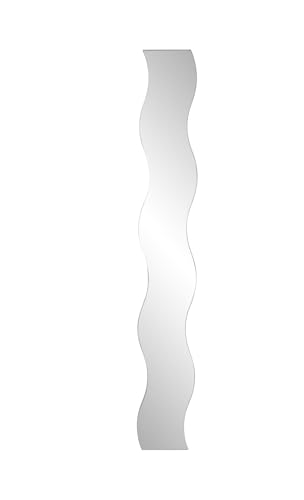
Shape changes the mood of a room more than frame colour does. Round and oval mirrors soften spaces full of hard rectangles — sofas, screens, door frames, shelving — and they suit entryways and bathrooms where a gentler outline feels welcoming. Rectangular mirrors echo architecture, sit happily above consoles and mantels, and give the most usable reflection for getting dressed. Arched mirrors borrow the language of windows and doorways, adding height and a hint of formality that works in hallways and bedrooms. Irregular, wavy or sunburst shapes are the most decorative and the least about reflection; treat them as wall art that happens to shine. None of these is better in the abstract. The right shape is the one that answers the room: soften a boxy space with a curve, structure a loose space with a rectangle, or lift a low space with an arch.
Tie shape to room and the shortlist writes itself. Entryways love round and arched mirrors: welcoming, space-softening, easy above a console crowded with the day’s arrivals. Living rooms take the statement pieces — large rectangles over sideboards, generous rounds over mantels, the occasional sunburst where pure decoration is the point. Bedrooms want tall, calm shapes, rectangles and soft arches that serve dressing without shouting. Bathrooms reward ovals and rounds above basins, softening tile and chrome, with rectangles where two basins ask for order. Dining rooms carry the most traditional shapes with the deepest frames, because the mirror is furniture there, seen for hours at candle distance. Hallways take whatever borrows the most light — often a tall, slim shape that turns a corridor’s end into a destination. Keep this map in mind and showroom wandering becomes decision-making: you are no longer choosing a mirror, you are choosing the one your room described.
Step 4: Match the Frame to the Room
Wood frames bring warmth that metal cannot imitate, and they range from pale, Scandinavian-leaning timbers to deep walnut tones that anchor a traditional room. A real wood frame also ages gracefully: small knocks can often be touched up, and the finish can be refreshed or even repainted years later if your palette changes. What to look for is honest joinery — mitres that meet cleanly at the corners without gaps or filler — and a finish that is even rather than blotchy. In steamy bathrooms, wood needs a properly sealed finish on every face, including the back edges, or moisture will creep in and lift it over time. In living rooms and bedrooms, wood is the forgiving choice, pairing with floors, side tables and picture frames you already own, and it rarely fights with changing textiles the way a strongly coloured frame can.
Metal frames give a mirror its crispest outline. Slim black metal suits industrial and modern rooms, reads almost like a drawn line on the wall, and disappears visually so the reflection does the work. Brass, gold and bronze tones add warmth and a little ceremony, flattering dining rooms, dressing areas and any space with warm lighting. Thicker metal frames feel more architectural and can carry larger glass with less visual bulk than wood. The honest cautions are fingerprints, which show quickly on polished finishes, and cheap plating, which can wear at the corners where hands adjust the mirror. A powder-coated or brushed finish hides daily life better than a mirror-polished one. Metal is also the practical pick where a slim profile matters, such as a hallway where every centimetre of passage counts and a deep frame would catch passing shoulders and bags.
Frameless mirrors, often with polished or bevelled edges, are the quietest option of all. With nothing to match and nothing to clash, they suit rented homes, changing schemes and rooms where the mirror is there for light and function rather than decoration. A bevelled edge catches a fine line of light and keeps the piece from feeling like a bare sheet of glass. The trade-offs are real, though. The exposed edge is the most vulnerable part of the mirror, so chips happen more easily during moving and cleaning, and fingerprints along the edge are part of ownership. Frameless also offers no visual anchor, which means in a large, plain room it can almost disappear when you wanted a focal point. Choose frameless when the room already has strong furniture and art; choose a frame when the wall itself needs the help.
Step 5: Judge the Glass and the Backing
Not all mirror glass reflects equally honestly, and the differences are visible the moment you stand in front of it. A good mirror gives a true, calm image: straight lines stay straight to the edges, faces look like faces, and colours are not pushed green or grey by cheap glass. Wave a hand slowly across a large mirror and watch the reflection; rippling or warping, especially near the edges, signals glass that will annoy you daily in a dressing mirror, though it may matter less in a purely decorative sunburst. Edge finishing tells its own story — clean polished or bevelled edges on frameless pieces, frames that meet the glass neatly without gaps. The reflective backing should be even, with no cloudy patches or dark speckles, faults that only spread with time and humidity. In a category where you will literally look at the product every day, this quiet quality is worth more than ornament.
The part of a mirror you never see decides how long it lasts. Behind the glass sits the reflective layer and its protective backing, and moisture is its enemy: steam and cleaning fluid creep in at the edges, and the familiar dark spots and cloudy corners of old bathroom mirrors are the result. Better mirrors seal their edges and backings more thoroughly, and mirrors intended for bathrooms are built with exactly this battle in mind. You can help whichever mirror you choose. Ventilate after showers, wipe splashes rather than letting them sit on the bottom edge, keep spray cleaners off the glass perimeter, and avoid hanging a cherished dry-room mirror in a steamy bathroom just because the size fits. In dry rooms the backing asks almost nothing of you, which is one reason a quality mirror moved from room to room over the years so often outlives the furniture bought alongside it.
Step 6: Plan the Fixing Before You Order
Hanging hardware shapes the whole installation. Rings or brackets fixed to the back of the frame, each on its own wall fixing, give the most control and keep the mirror flat and steady — the method to prefer for heavier pieces, ideally landing on studs. A hanging wire strung between two rings is forgiving of slightly uneven fixings but lets a mirror tilt forward at the top, concentrates load, and can creep over time; if a wire is supplied on a substantial mirror, upgrading the approach is worth considering. Keyhole slots are neat on small, light mirrors and maddening to align on large ones. A French cleat — interlocking angled rails, one on the wall and one on the mirror — spreads weight beautifully, holds the piece flat, and makes levelling almost pleasant; it is the connoisseur’s choice for big glass. Whatever arrives in the box, the wall side of the system must match your wall and the mirror’s weight, not merely the packet’s optimism.
You will rarely know a mirror’s exact weight before it arrives, and you do not need to: you need an honest category. Small, frameless or thin-framed mirrors are light objects that modest fixings handle easily. Medium framed mirrors — the console and dresser workhorses — are serious enough to deserve studs or proper anchors and a two-handed lift. Large mirrors, thick glass in deep wooden or metal frames, are heavy furniture that happen to hang: plan two people, load-spreading hardware and studs, or book the professional. Judge by size, frame material and glass area, and if the listing states a weight, believe it and plan around it rather than hoping the wall will cope. The moment of truth should never be the moment you let go of the frame. Support the mirror fully until every fixing is engaged, step back, and only then admire — in that order, every time.
Step 7: Set Your Tier and Read the Listing Slowly
Price tiers in mirrors buy understandable things, as long as you know what they are. At the entry level you are paying for glass, a light frame and a look; expect simpler materials, lighter construction and a shorter tolerance for steam and knocks. In the middle, frames become substantial, finishes more convincing, glass calmer and hardware more serious — for most homes this is the tier that quietly satisfies for years. At the premium end you are buying craftsmanship: beautiful timber or metalwork, hand-finished detail, statement scale and the kind of presence that carries a room. What higher tiers should never be bought for is a better reflection alone; an honest mid-tier mirror reflects as truly as a costly one. Decide your tier by the room’s importance and the mirror’s job — statement or service — and by how long you expect to keep it, then spend once, in the right tier, rather than twice across two.
Reading a mirror listing well is a skill, because the details that matter are rarely the headline. Establish whether the stated size is the whole piece including frame or the glass alone — the difference changes how it fills a wall. Look for the hanging method: rings, a wire, keyholes or a cleat each ask different things of your wall, and a wire on a heavy mirror concentrates load in ways a cleat does not. Note the frame material honestly described — solid wood, engineered wood, metal, resin moulding — and the finish, since a photograph cannot tell you how a finish feels or wears. Weight, stated or sensibly estimated from size and materials, drives your fixing decision. And read what the listing says about bathroom suitability before falling for a frame in a steamy room. None of this requires expertise; it requires ten slow minutes before the exciting part, which is exactly when most buying mistakes are made or avoided.
Gear for This Guide
Four prose-first picks cover the outcomes these steps usually produce — statement, versatile, calm glass and practical value.

Howard Elliott Decorative Wall Mirror
a statement piece in the classic mould: substantial framing, formal shapes and finishes that suit mantels, dining rooms and entryways where the mirror is meant to be noticed. In prose terms it sits at the premium tier, and it earns that position through presence rather than novelty — the kind of piece you hang once and redecorate around for years. Best for: traditional and transitional rooms wanting a focal point. Not suited for: minimal schemes where the frame would argue with everything else, or steamy bathrooms unless the specific piece is described for bathroom use. As a prose-first pick it is presented here at the premium tier with qualitative positioning only; check the current listing for the exact size, finish, hanging method and bathroom suitability before you order, and confirm the stated dimensions include the frame. Judge it against your template measurements and your wall, and hang it by the safety rules in this guide — studs or matched anchors, two people for larger pieces, and never heavy glass above a bed, cot or sofa.
Kate and Laurel Decorative Wall Mirror
a versatile, design-led option whose range runs from soft arches and rounds to clean modern rectangles, usually in finishes chosen to sit comfortably in lived-in rooms rather than showrooms. It sits in the mid tier and suits buyers who want the shape to do the decorating — an arch over a console, a round over a dresser — without the ceremony of a heavy formal frame. Best for: entryways, bedrooms and modern-traditional living rooms. Not suited for: anyone wanting heirloom-weight construction or a very large single piece of glass. As a prose-first pick it is presented here at the mid tier with qualitative positioning only; check the current listing for the exact size, finish, hanging method and bathroom suitability before you order, and confirm the stated dimensions include the frame. Judge it against your template measurements and your wall, and hang it by the safety rules in this guide — studs or matched anchors, two people for larger pieces, and never heavy glass above a bed, cot or sofa.
Dulles Glass Decorative Wall Mirror
a glass specialist’s take on the category: clean, frameless or minimally edged pieces where the quality of the glass and the finish of the edge are the product. It sits at the mid-to-premium tier and suits bathrooms, dressing areas and modern rooms that want light and reflection without a frame to match. Best for: contemporary schemes, bathroom vanities and anyone whose eye is bothered by distortion in cheaper glass. Not suited for: rooms needing the warmth and anchoring weight that only a real frame provides. As a prose-first pick it is presented here at the mid-to-premium tier with qualitative positioning only; check the current listing for the exact size, finish, hanging method and bathroom suitability before you order, and confirm the stated dimensions include the frame. Judge it against your template measurements and your wall, and hang it by the safety rules in this guide — studs or matched anchors, two people for larger pieces, and never heavy glass above a bed, cot or sofa.

MCS Studio Decorative Wall Mirror
a practical, gallery-minded choice: straightforward framed mirrors in the shapes and finishes that work over consoles, mantels and vanities, without pretending to be furniture. It sits at the entry-to-mid tier and makes sense where the mirror’s job is service — light, reflection, a finished wall — across several rooms at once. Best for: first homes, rentals with permission to fix, and multi-room refreshes on a sensible budget of effort. Not suited for: a single grand statement wall, where its quietness would be outscaled by the room. As a prose-first pick it is presented here at the entry-to-mid tier with qualitative positioning only; check the current listing for the exact size, finish, hanging method and bathroom suitability before you order, and confirm the stated dimensions include the frame. Judge it against your template measurements and your wall, and hang it by the safety rules in this guide — studs or matched anchors, two people for larger pieces, and never heavy glass above a bed, cot or sofa.
Common Mistakes
Most mirror mistakes are small, early and entirely avoidable. Hanging before deciding — drilling on the first enthusiastic afternoon — produces the extra holes that everyone then lives with; templates and pencil exist precisely to absorb that enthusiasm safely. Going too small is the aesthetic classic, fixed by remembering the furniture rule and testing with paper. Ignoring the reflection — hanging a beautiful mirror opposite a boiler door or a pile of laundry — wastes the purchase. Skimping the fixing is the only dangerous mistake on the list, and it is the one this guide repeats deliberately: match anchor to wall and weight, prefer studs, and never hang heavy glass over beds, cots or sofas. The final mistake is buying for the photograph instead of the room: colours shift, scale lies and finishes flatter online, so measure your wall, read the listing slowly, and let your own room cast the deciding vote.
Pro Tips
Hanging height is a compromise between the mirror’s jobs. A mirror used for faces should centre roughly at the eye level of the people using it, which in a shared household means splitting the difference rather than optimising for one person. Above furniture, leave a breathing gap between the top of the console or sideboard and the bottom of the frame — enough that objects on the surface do not visually collide with the glass, not so much that mirror and furniture drift apart into unrelated objects. In dining rooms, hang for seated eyes as well as standing ones. Over a mantel, the mirror should relate to the fire surround as one composition. There is no universal number that survives contact with real rooms, which is why the template test, viewed from the actual seats and doorways, beats any rule of thumb. Mark the final position in pencil, step back once more, and only then drill.
Mirrors and wall lights are old partners, and pairing them well is a quiet art. Flanking a mirror with two lights gives the most even, flattering illumination for faces — the arrangement hotels and theatres settled on long ago — and in a living room the same pairing creates a composed, symmetrical wall that needs nothing else. A single light above a mirror is simpler and works where width is tight. Think about reflection: every visible bulb is doubled, so choose shades and diffusers that are pleasant to look at twice, and position lights so their glare does not bounce straight into seated eyes. Warm light flatters wood and brass frames; cooler light suits chrome and black metal and modern schemes. If wiring new lights is not in the plan, a table lamp on the console beneath the mirror achieves much of the same glow, reflected upward, with no electrician required.
Worked Examples
The dark hallway: no window, doors on both sides, a console’s worth of keys and post. The steps point to a tall arched or generous round mirror above the console, facing the doorway’s borrowed light, in a frame echoing the door hardware — service first, and the hallway becomes a place. The steamy family bathroom: the steps eliminate unsealed wood immediately, favour a bathroom-described mirror with sealed edges, calm glass for honest faces, and fixings suited to tile. The formal dining room: reflection means candlelight and the table itself, size means presence, and the steps land on a deep-framed traditional piece at the premium tier, hung for seated eyes and checked twice for chair clearance.
Safety First: The Rules That Outrank Every Style Decision
Every honest conversation about wall mirrors ends at the fixing, because glass and gravity are unforgiving. The strongest fixing is into a wall stud — the timber or metal framing behind the plaster — and for anything beyond a small, light mirror, finding a stud should be your first plan. Where a stud is not where you need it, the anchor must match the wall: proper expanding or toggle-style anchors for hollow plasterboard, solid plugs for masonry and brick, and fixings suited to tile where bathrooms are concerned. The anchor must also match the weight, judged honestly — a big framed mirror in solid wood is a heavy object even if you can lift it easily for a moment. Hardware that arrives in the box is a starting suggestion, not a guarantee for your wall. When the wall, the weight or your confidence is in doubt, a stud finder, better anchors or a professional are all cheaper than a falling mirror.
Before any drill touches any wall, pause for the invisible: cables and pipes run through walls exactly where mirrors like to hang, especially above sockets, switches and radiators, and in bathrooms and kitchens where plumbing concentrates. A detector that senses studs, metal and live cables is a small price for certainty, and it should be swept over the whole area you plan to drill, not just the marked points. Treat the zones directly above and below switches and sockets as cable country even when a detector is quiet, and be doubly careful on walls shared with a bathroom or a boiler. If you strike something unexpected — resistance that changes, a hiss, a spark, water — stop immediately, make the area safe, and call the appropriate professional. No mirror, however beautiful, is worth an electric shock or a flooded wall cavity, and this check takes minutes.
Large mirrors are a two-person object from the moment they arrive, and treating them that way prevents most of the damage and all of the drama in this category. Two people carry a big mirror — one at each end, the glass kept upright rather than flat, never lifted by the frame alone, and never rested on a hard floor without a blanket or cardboard beneath its edge. Plan the route before lifting: doors, corners and stairs are rehearsed empty-handed first. Once hung, a large mirror should be fixed with a system that spreads the load — a cleat or multiple fixings into studs where possible — rather than a single point taking everything. If a mirror is so large that you are improvising any part of carrying, fixing or lifting it into place, that is the definition of a job for a professional installer, and paying for one is cheaper than replacing glass or repairing a wall.
The short answer: choose the reflection, prove the size, let the room pick the shape, match the frame to the moisture, judge the glass in daylight, plan the fixing, and buy once in the right tier. Follow the order and choosing a decorative wall mirror stops being a gamble on a photograph and becomes what it should be — a calm, almost obvious decision.
The Careful Way Through: Checks That Keep a Decorative Wall Mirror Task on Track
The main steps for the decorative wall mirror are covered above; what follows is the working discipline around those steps, covering preparation, order of work, the checks that catch mistakes early and the small follow-up habits that keep the result sound. It is written for real homes, where interruptions and imperfect spaces are normal.
Start With Your Space and Your Routine
A good test is the two-week question: imagine the decorative wall mirror after a fortnight of ordinary use, with no special effort from you, and ask whether you would still choose it. A return is easiest when you have kept the packaging until you are sure, so give the decorative wall mirror a fair trial period in its real position before you break down boxes and dispose of padding. Keep the care routine simple enough to repeat: a decorative wall mirror that needs ten minutes of attention weekly will usually get it, while one that needs an hour monthly often gets none. A slight wobble, a stiff action or a small misalignment on day one rarely improves on its own, so address it during setup while adjustments are still easy to make.
Check your work from a distance as well as up close, because proportions, levels and alignment in Home Decor & Lighting tasks are far easier to judge from across the room. Colour and finish samples in listings are taken under controlled light, so expect the decorative wall mirror to look different at home and favour options that sit comfortably with the tones already in the room. Apply the same checks to each shortlisted example, whether that is the Howard Elliott Decorative Wall Mirror; the MCS Studio Decorative Wall Mirror; the Dulles Glass Decorative Wall Mirror, because consistent testing is what makes the differences between models visible. Seasonal checks suit most Home Decor & Lighting items well, so tie a quick inspection of the decorative wall mirror to a job you already do, such as changing clocks or clearing gutters.
When Small Problems Appear
Where the decorative wall mirror has moving parts, work them through their full range during your first checks, listening and feeling for roughness that a photograph cannot show. Take a break between shortlisting and ordering if you can, and return to the listings with fresh eyes, because fatigue makes almost any decorative wall mirror look acceptable late in a long search. Beware of choosing a decorative wall mirror for a rare occasion, such as a large gathering once a year, if that choice makes everyday use worse for the other fifty-one weeks. Consider the busiest version of the day, not the calmest one, and ask whether the decorative wall mirror still works when people are hurrying, carrying things or sharing the same space.
If you are replacing an older decorative wall mirror, list what failed or frustrated you about it, and check each item on that list against the new listing before you order its successor. When you have finished, run one deliberate test of the decorative wall mirror doing its ordinary job, and fix small issues immediately while the steps and the tools are still fresh in your mind.
A Short Decision Checklist
- Packaging kept until the decorative wall mirror has passed its first trial in place
- Who will use the decorative wall mirror most, and any limits they have
- Delivery path, from the door to the final position
- Assembly needs, tools required and whether help is needed
- The material and finish, matched to light, moisture and wear in its spot
- How the decorative wall mirror will be cleaned in an ordinary week
- The one feature you will not compromise on
- Where the decorative wall mirror and its accessories will be stored when not in use
Taken together, these checks take only a little time, yet they answer the questions that decide whether the decorative wall mirror suits your home, your household and your routine, and they do so before money changes hands rather than after.
Frequently Asked Questions
Can I hang a decorative wall mirror in a bathroom?
Yes, if the mirror is described for bathroom use, with sealed edges and a backing made to resist moisture. Ventilation matters as much as the product: run the extractor or open a window after showers, wipe splashes from the bottom edge, and keep spray cleaner on the cloth rather than soaking the glass perimeter. A decorative dry-room mirror with an unsealed wooden frame will slowly spoil in steam, so match the mirror to the room rather than only to the colour scheme.
What is the safest way to hang a heavy mirror?
Fix into wall studs wherever possible, or use anchors matched both to your wall type — hollow plasterboard, masonry, lath and plaster, tile — and to the mirror’s honest weight, with a load-spreading method such as a cleat or two separate fixings for larger pieces. Two people should lift and hold the mirror while fixings engage. Never hang a heavy mirror above a bed, a cot or a sofa where people sit or sleep, and if any part of the job feels improvised, hire a professional installer.
Should a mirror face a window?
Facing a window is usually the best seat in the house: the mirror fills with sky and view and returns real daylight to the room. An adjacent wall can work even better in long or dim rooms, catching light at an angle and throwing it deeper. What matters is the reflection itself — aim the mirror at something worth doubling, and watch a sunny room at different hours before fixing, so direct sun does not dazzle anyone seated opposite or glare across a screen.
How do I clean a mirror without damaging it?
Dust the frame first with a dry soft cloth, then mist glass cleaner onto a microfibre cloth — not onto the mirror — and wipe the glass in a slow S pattern, buffing with the dry side. Use as little moisture as possible around the edges, because liquid creeping behind the glass is what causes dark spots and cloudy corners over time. Wood frames need only a barely damp cloth and prompt drying; metal frames a soft, dry polish.
Round or rectangular: which shape should I choose?
Choose the shape that answers the room. Round and oval mirrors soften spaces full of rectangles — doors, screens, sofas, shelving — and suit entryways, bathrooms and above dressers. Rectangles echo architecture, give the most usable dressing reflection, and sit naturally over consoles and mantels. Arches add height and a formal, window-like note for hallways and bedrooms. Irregular and sunburst shapes are decoration first and reflection second. If the mirror must work for faces daily, favour the calm, larger shapes; if it must sparkle, shape can lead.
Can renters hang a decorative wall mirror?
Usually, with judgement. Check your tenancy agreement, keep fixings few and honest, and plan to fill and paint the holes when you leave. A single proper fixing, made good later, is generally safer than adhesive products asked to hold glass beyond their limits. Smaller mirrors can lean on a dresser or mantel if secured against slipping and kept out of through-traffic and children’s reach. Photograph walls before and after, and keep a note of the paint colour with your household supplies.
Related Reading
Keep exploring within this cluster and the wider mirror guides on the site:
- decorative wall mirror buying guide
- decorative wall mirror pros and cons
- decorative wall mirror review
- best wall mirror under 100
- best wall mirror for small rooms under 100
- best wall mirror for bedrooms under 100
- best wall mirror for modern homes under 100
Going Deeper: More Judgement Calls Worth Making Well
The entryway is where a decorative wall mirror works hardest per square inch. It gives you a final check before leaving, bounces light into a space that often has no window at all, and makes a narrow hall feel like a place rather than a passage. Hung above a slim console or a row of hooks, it completes the landing strip every home needs: keys, post and bags below, your reflection above. Practical details matter here. The mirror will be seen up close and in passing, at every hour, so a true, undistorted reflection matters more than in a purely decorative spot. It will also be bumped by coats, umbrellas and delivery boxes, so a secure fixing is not optional. A round or arched shape softens the hard lines of doors and shoe storage, and a frame that echoes your door hardware ties the whole small space together.
In the living room, a decorative wall mirror usually plays one of two roles: focal point or quiet amplifier. As a focal point — large, framed with intent, hung where a picture might otherwise go — it anchors the seating arrangement and reflects the best of the room back at itself. As an amplifier, it sits behind a lamp, beside a window or opposite the garden doors, multiplying light without demanding attention. Both roles fail the same way: by reflecting something you do not want doubled, such as a cluttered shelving unit, the back of a television or a tangle of chargers. Walk the room before drilling anything. Sit in each seat and check the sightlines. And respect the safety rule that runs through this whole guide: a heavy mirror belongs on a properly fixed wall over a console or sideboard, never hung casually above the sofa where people sit and lean back beneath it.
Bedrooms ask a mirror to be useful and calm at the same time. A decorative wall mirror above a dresser or beside a wardrobe turns getting dressed from a bathroom queue into a civilised routine, and a tall shape lets you check an outfit head to toe without standing on tiptoe. The calming part is about placement at night: some sleepers love waking to reflected morning light, while others find a mirror facing the bed unsettling or simply distracting in the dark. Neither reaction is wrong, and the fix is easy — angle the mirror toward a window or a dressing corner rather than straight at the pillows. Keep heavy glass away from the wall directly above the bed itself; the space over a headboard is for light art, textiles or nothing at all. A soft frame finish, warm wood or brushed metal suits the room’s quieter palette.
Bathrooms are the most demanding room a mirror will ever live in, and the most rewarding when it is chosen well. Steam, splashes and daily cleaning test the backing and the frame in ways a hallway never will. Look for mirrors described for bathroom use, with sealed edges and a backing that resists the dark spots — caused by moisture reaching the reflective layer — that creep in from the corners of cheaper glass. Ventilation is your mirror’s best friend: an extractor fan or an open window after showers extends its life more than any coating. A decorative frame can lift a plain bathroom enormously, turning a purely functional vanity mirror into the room’s designed moment, but choose finishes that tolerate humidity and wipe clean easily. Finally, light yourself kindly: a mirror flanked by or paired with even lighting flatters faces and makes shaving and make-up honest work rather than guesswork.
Dining rooms are where decorative mirrors have been earning their place for centuries, and candlelight is the reason. A mirror behind or beside a dining table doubles every flame and pendant glow, giving small dinners a sense of occasion that brighter overhead light destroys. It also helps the room that so many homes have: the dining space that is really a corner of an open plan, defined by a rug and a table. A substantial framed mirror on the wall gives that corner architecture, a sense of being a room within the room. Choose a frame with some presence — deeper wood, aged metal, a classic profile — because at dining distance the frame is seen and enjoyed for hours. Position it to reflect the table and its people rather than the kitchen beyond, and hang it securely; dining chairs move, guests lean, and this is glass living at elbow height.
Small rooms and hallways are the mirror’s natural habitat. A windowless box room, a corridor that ends in a blank wall, a cloakroom under the stairs — these are the spaces where one well-chosen mirror changes how the whole home feels. The trick is proportion and nerve: in a tiny space, one larger mirror usually works better than several small ones, because it reads as an opening rather than as decoration. A mirror at the end of a hallway, reflecting light from a doorway, can make the corridor feel twice its length. In a small bedroom or study, place the mirror where it reflects the window or the door, not the bed or the desk clutter. Renters should note that this transformation does not require a huge piece; a medium mirror, properly fixed and thoughtfully faced, delivers most of the effect with none of the handling drama of an oversized one.
Different walls ask different questions. Modern plasterboard is easy to drill and easy to overload; it rewards studs and proper hollow-wall anchors and punishes screws driven straight into the board. Older plaster over lath can crumble if rushed, and benefits from patience, a sharp bit and fixings that spread the load. Brick and block walls are strong once you are into them properly with masonry fixings, but the drilling is slower and dustier, and mortar joints are weaker than the brick itself. Tiled walls demand care: drill the tile with the right bit and steady pressure, fix into the wall behind it, and never hang a heavy mirror from tile adhesive alone. Knowing which wall you have — knock, check an inconspicuous spot, look at what came out of a previous hole — is not a preliminary chore. It is the decision everything else depends on.