Disclosure: As an Amazon Associate, dailyhomedecorating.com earns from qualifying purchases. Links to Amazon on this page are affiliate links; they cost you nothing extra. Prices and availability change often, so check the current Amazon listing before you buy.
The best yarn for chunky knit blankets is a bigger decision than it looks, because at jumbo gauges the yarn is not an ingredient in the blanket — it is the blanket, structurally and visually, with nothing to hide behind. A chunky knit shows every property of its yarn at architectural scale: its loft or limpness, its shedding, its weight, its stitch definition, its aging. Choose well and an evening of arm knitting produces the most satisfying object in the house; choose badly and the same evening produces a heavy, shedding rope that unravels its dignity within the month. This guide ranks the yarn types — tube chenille, roving-style wool blends, cotton tube, jumbo acrylic, and t-shirt yarn — by the properties that matter at this scale, and includes the pool’s one honest link: a finished hand-knit cotton blanket for readers who want the result without the making.
Format honesty: five of the six picks are prose-only yarn types, described qualitatively with no links and no invented specifications, because our verified pool contains finished blankets, not yarn. Specific yardages vary by maker and blanket size, so the guide teaches the estimation method rather than printing numbers that would be wrong for your project. The companion guides complete the craft shelf: Best Yarn Weight For Blankets explains the weight system this guide’s jumbos sit at the top of, and Best Crochet Patterns For Blankets covers the crocheted cousins of these projects.
A word about the elephant in the craft room: unspun roving, the cloud-soft material of a thousand social-media blankets, is deliberately not a top pick here, and its section within the wool review explains why — beauty that pills, sheds, and cannot be washed is a photograph, not a blanket. This guide is for blankets that get used.
Where to Buy
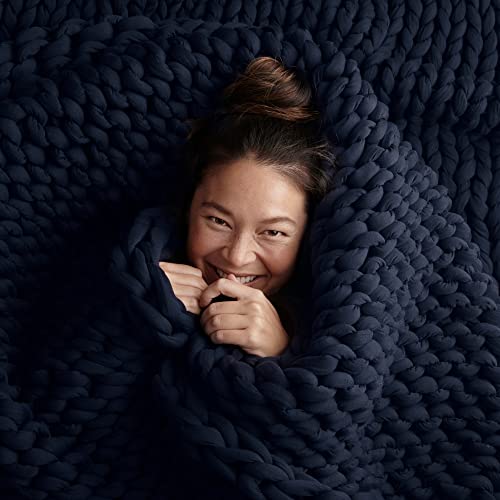
Chunky yarns are sold at craft stores, yarn shops, and online marketplaces. Since this guide’s picks are yarn types, shop by the type name, then judge candidates by the tests in these reviews: squeeze the skein (does it spring back?), rub it (does it shed?), lift it (can your blanket budget carry this weight at blanket scale?), and read the fiber label and care instructions as the binding documents. The one linked product is the finished alternative: the Bearaby Cotton Hand-Knit Weighted Blanket — Check on Amazon.
In this guide
Quick Picks
| Pick | Badge | Why it earns its place |
|---|---|---|
| Jumbo chenille tube yarn (prose-only) | Best Overall | A knitted tube with soft fill: plush stitches that hold their shape, resist shedding, and wash like a blanket should. |
| Cotton tube yarn (prose-only) | Best Breathable and Washable | The same tube construction in cotton — cooler, heavier drape, and the family-proof choice. |
| Wool-blend jumbo yarn (prose-only) | Best for Warmth and Heirlooms | Spun and plied wool blends that knit into real, warm, lasting blankets — unlike fragile unspun roving. |
| Jumbo acrylic yarn (prose-only) | Best Budget | The accessible classic: consistent, washable, and cheap enough for a first giant blanket. |
| T-shirt / jersey yarn (prose-only) | Best Durable and Upcycled | Cut fabric strips that knit into dense, rugged blankets — and can be made from old shirts. |
| Bearaby Cotton Hand-Knit Weighted Blanket | Best Finished Alternative | The chunky hand-knit look in cotton, professionally made — the benchmark your project is aiming at. |
Key Takeaways
- Tube yarns (a knitted casing with fill) are the modern answer: they hold stitch shape, shed least, and survive washing.
- Unspun roving makes beautiful photographs and poor blankets — choose spun or tube constructions for anything that will be used.
- Weight is a yarn property at this scale: a chunky blanket can be surprisingly heavy, and fiber choice decides whether that is cozy or oppressive.
- Five picks are yarn types (prose-only); estimate yardage by the method in the How to Choose section, and buy one dye lot.
- The linked Bearaby is the finished benchmark — cotton tube-style loops, hand-knit, weighted by construction.
How These Picks Were Chosen
We evaluated the chunky-yarn landscape by the four properties that decide a jumbo blanket’s fate. Construction: is the yarn a stable structure (tube, plied, or cut strip) or a fragile one (unspun roving)? Surface behavior: does it shed, pill, or fuzz under the friction of use? Washability: can the finished blanket be laundered by the methods real households use? And hand: does the yarn produce the plush, architectural stitches the style promises, at a weight the recipient can enjoy? Tube chenille wins the general case on the strength of all four; cotton tube trades plush for coolness and durability; spun wool blends win warmth and longevity; acrylic wins access; t-shirt yarn wins ruggedness and the upcycling story.
The pool note, in the open: the verified pool behind this site contains one chunky hand-knit product — the Bearaby — and no yarns. The Bearaby is included as the finished alternative and as a physical benchmark (its construction is, tellingly, a cotton tube-style loop: the same engineering this guide recommends in yarn form). The other five slots are the yarn types themselves, honestly prose-only.
Skill assumptions are minimal and stated: chunky blankets are usually arm-knit or worked on oversized needles or hooks, and every yarn here is suitable for a first project. The differences that matter are not difficulty but destiny — what the blanket will be like in a year — and the reviews are written from that future backward.
The 6 Best Best Yarn for Chunky Knit Blankets — Reviewed
Jumbo Chenille Tube Yarn (Prose-Only)
Our badge: Best Overall
Tube yarn is the construction that fixed chunky knitting: instead of a fragile strand of fibers, it is a knitted or woven tube — usually a soft synthetic casing — filled with a light stuffing, producing a yarn with the diameter of a rope and the behavior of a well-made cord. In chenille form, the casing is velvety, and the resulting stitches are the plush, rounded, marshmallow loops of the modern chunky blanket: defined, springy, and stable. The tube does not shed (there are no loose fiber ends), does not pill the way roving does, and holds the blanket’s architecture through washing and use.
Working with it is the arm-knitting pleasure the style promises: stitches form fast, errors show clearly and forgive easily, and a throw-sized blanket is an evening’s work. Judge skeins by the casing’s density (a tight casing wears; a loose one snags) and the fill’s resilience — squeeze hard, and the yarn should rebound rather than stay dented. The finished blanket is lighter than its looks suggest, since the fill is mostly air, which makes chenille tube the rare chunky yarn whose blankets are dramatic without being a workout to move.
Best for: the classic plush chunky blanket, gifts, and first projects / Not suited for: makers wanting natural fibers or a cool summer hand
Choose this yarn for the modern standard; there is no link for this pick — judge by casing density and squeeze recovery.
Cotton Tube Yarn (Prose-Only)
Our badge: Best Breathable and Washable
Cotton tube yarn takes the same engineered construction — a knitted cotton casing around a light fill — and trades chenille’s plush warmth for cotton’s cool, matte, washable practicality. The stitches read smooth and architectural rather than velvety; the blanket drapes with more weight and less loft; and the whole object can be machine washed with a confidence no wool or roving permits. It is the chunky yarn for warm climates, for kids’ and pets’ blankets, and for households whose laundry philosophy is “everything in the machine.”
Its character reference is sitting in this guide’s final pick: the Bearaby’s loops are essentially this construction at professional scale, and their reputation — breathable weight, even drape, no shedding — is the cotton tube’s résumé written by a finished product. A cotton-tube blanket is also the chunky family’s entry in the world of Best Blankets For Warm Weather — the one jumbo knit a warm house can keep on the couch past May. Judge skeins by casing tightness and fill evenness (lumpy fill makes lumpy stitches), and expect the finished blanket to be the heaviest-feeling of the tube family, in the way recipients describe as substantial rather than burdensome when the size is kept to throw scale.
Best for: warm homes, kids and pets, and machine-wash households / Not suited for: maximum plushness or feather-light blankets
Choose this yarn for practical luxury; there is no link for this pick — check the care label for machine washing, most cotton tubes welcome it.
Wool-Blend Jumbo Yarn (Prose-Only)
Our badge: Best for Warmth and Heirlooms
The heirloom end of the chunky world is spun yarn: wool or wool-blend fibers twisted and plied into a true jumbo yarn, with the fiber’s natural elasticity, warmth, and stitch memory intact. A blanket from spun wool blend is a real blanket in the old sense — warm beyond its weight, increasingly soft, and built to be re-blocked, repaired, and handed down. Blends with a synthetic component trade a whisper of wool’s purity for meaningful gains in washability and abrasion resistance, and for most households that trade is correct.
And now the roving warning, delivered with love: unspun roving — the thick, cloud-like pencil of pure fiber in the viral photographs — is not yarn. It has no twist to hold it together, so it pills on contact, sheds on everything, mats where bodies rest, and cannot be washed. A roving blanket is a short-lived sculpture. If your heart is set on that look, the tube yarns above are how the look survives contact with life; if your heart is set on wool, buy it spun. The distinction is the single most valuable sentence in this guide.
Best for: cold climates, heirloom intent, and natural-fiber purists (spun, never roving) / Not suited for: machine-wash households or allergy-sensitive homes without a blend
Choose this yarn for keeps; there is no link for this pick — verify it is spun and plied, and buy the whole project in one lot.
Jumbo Acrylic Yarn (Prose-Only)
Our badge: Best Budget
Jumbo acrylic — the classic spun synthetic in blanket-store skeins — is the gateway yarn: inexpensive, everywhere, consistent from skein to skein, washable without ceremony, and available in every color the rainbow files. For a first chunky blanket, a dorm blanket, a gift whose budget matters, or a maker’s experiment with a new stitch at giant scale, it removes every excuse and most of the risk.
Its honest limits are hand and heat: acrylic’s stitches feel less luxurious than tube chenille’s or wool’s, and the fiber softens near heat, so acrylic blankets live away from radiators and never meet an iron. Quality varies more within this type than any other in the guide — the squeeze-and-rub tests in the store separate the springy, well-spun skeins from the limp ones, and the difference shows at jumbo scale. Buy the better skein; at acrylic prices, “better” is still the budget pick of the guide.
Best for: first projects, gifts at scale, dorms, and experiments / Not suited for: heirloom ambitions or luxury hand-feel
Choose this yarn to begin; there is no link for this pick — squeeze-test in the store, and keep the finished blanket from heat.
T-Shirt / Jersey Yarn (Prose-Only)
Our badge: Best Durable and Upcycled
T-shirt yarn is not spun at all: it is fabric — jersey knit cut into continuous strips, either commercially (from textile-industry remnants) or at home from old shirts. Knitted or crocheted at chunky gauge, it produces a dense, heavy, almost indestructible blanket with a casual, modern hand: the picnic blanket, the floor blanket, the dog-proof and kid-proof throw, the one that lives in the car and the cabin and comes home for a wash without a worry in the world.
The working notes are physical: the strips have no elasticity beyond the jersey’s own give, the finished blanket is the heaviest in this guide per square foot, and home-cut yarn varies in width (which the chunky gauge forgives, mostly). The upcycling story is genuine — a blanket knitted from a family’s outgrown shirts is a memory object no store sells — and the commercial versions offer consistency for makers who want the durability without the cutting. Either way, this is the yarn for blankets that will be used hard and loved roughly.
Best for: rugged use, floor and picnic blankets, and upcycled memory projects / Not suited for: lightweight or drapey blankets, or makers with wrist issues — it is heavy work
Choose this yarn for durability; there is no link for this pick — check strip width consistency, commercial or home-cut.
Bearaby Cotton Hand-Knit Weighted Blanket
Our badge: Best Finished Alternative
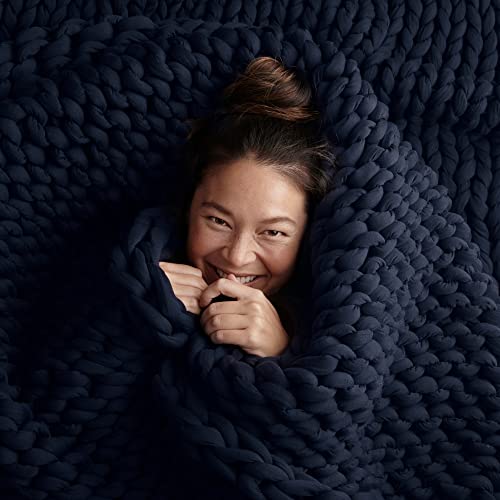
The Bearaby Cotton Hand-Knit Weighted Blanket closes the guide as both an option and an argument. It is a finished chunky hand-knit blanket whose loops are cotton in a tube-style construction — the very engineering the cotton tube review recommends — weighted to 10 pounds by its own material, with no fillers or beads. For the reader whose research ends in “I want that, but I do not want to make it,” this is the honest product: the look, the hand, and the heft, delivered.
Strengths
- Chunky hand-knit cotton loops with genuine stitch definition — the project aesthetic, perfected
- Open-loop construction breathes, so its 10 pounds wear cooler than filled weighted blankets
- Even, material-only weight: nothing to shift, bunch, or leak
Trade-offs
- It is bought, not made — none of the project’s satisfactions (or savings) apply
- 10 pounds is a presence; it is a personal lap-and-couch blanket, not a light throw
- Premium pricing relative to a DIY blanket in acrylic or chenille
| Color | Moonstone Grey |
| Size | 40″ x 64″ |
| Weight | 10 pounds |
Makers should study it anyway: its even gauge and loop consistency are the standard to aim at, and its existence proves the cotton-tube thesis — that construction, not fiber romance, is what makes a chunky blanket last. Everyone else can simply enjoy it on the couch tonight, in the company of the styling ideas in Best Throw Pillows Under $100.
Best for: the chunky look without the project, and breathable weighted comfort / Not suited for: makers — your picks are the five yarns above
Choose it to skip the making; skip it to make. Check on Amazon
Comparison Table
| Yarn type | Construction | Hand | Washability | Best blanket |
|---|---|---|---|---|
| Chenille tube | Filled knitted tube | Plush, velvety | Good | Classic chunky throw |
| Cotton tube | Filled cotton tube | Smooth, cool | Excellent | Family-proof luxury |
| Wool blend jumbo | Spun and plied | Warm, elastic | Careful | Heirlooms |
| Jumbo acrylic | Spun synthetic | Consistent, basic | Excellent | First projects, gifts |
| T-shirt yarn | Cut jersey strips | Dense, rugged | Excellent | Floor and picnic |
| Bearaby (finished) | Cotton loops | Substantial, breathable | Per maker | No-project option |
How to Choose the Best Yarn for Chunky Knit Blankets
Choose construction before fiber
At jumbo scale, construction decides survival: tube first, spun-and-plied second, cut strips for rugged work, unspun roving never (for a blanket that will be used). Fiber refines the choice within a sound construction — chenille for plush, cotton for cool, wool for warmth — but no fiber rescues a fragile structure. This ordering is the guide’s whole philosophy in one rule.
Estimate yardage by weight and swatch, not hope
Chunky projects consume yarn at a rate that surprises: work a measured swatch with your actual yarn and hands (arm knitting gauges vary wildly by maker), weigh or measure what the swatch consumed, and scale to your blanket’s dimensions with a margin. Buy the full estimate plus a skein, in one dye lot, from a source that accepts returns of the unopened extra. Running out at row thirty of thirty-two is the craft’s signature heartbreak, and it is entirely a planning failure.
Heft-test the finished weight before committing
Multiply before you buy: a skein’s weight times the skein count is the blanket your recipient will lift, fold, and wash. Cotton tube and t-shirt yarns produce genuinely heavy blankets; chenille tube is the light-for-its-size exception. Match the heft to the human — a child, an elderly parent, and a linebacker want different blankets from the same pattern.
Interrogate the care label as a blanket owner
The yarn’s care instructions become the blanket’s, forever. Machine-washable yarns (cotton tube, acrylic, t-shirt) suit real households; wool blends ask for the gentle regime; anything dry-clean-only at blanket scale is a lifetime appointment you are choosing today. Read the label in the store with your actual laundry habits in mind.
Plan the color story at architectural scale
Chunky stitches are huge; color changes are events, not details. Solids and slow gradients show the stitch architecture best; stripes at this gauge are bold graphic statements; and variegated jumbo yarns can turn to visual noise at blanket scale. Lay the skeins together in the store’s light and squint — the blanket you squint at is the blanket you will live with.
How to Arm-Knit a Chunky Blanket That Lasts
Arm knitting is the style’s signature technique, and its quality secret is tension consistency: the loops on your arms want to vary with your reach and fatigue, and the blanket records every variation. Work in a chair with arm support, keep the working yarn’s feed smooth, and size each stitch against the previous row’s rather than against your arm’s mood. Count stitches at every row’s end — at jumbo gauge a dropped stitch is a dropped ladder within two rows — and keep the work’s weight supported on a table or your lap rather than hanging from your arms, which stretches the lower rows. When the blanket is done, weave the tail through several stitches in two directions (at this scale, ends work loose with enthusiasm), and give the finished piece a gentle wash and a flat dry or per the yarn’s label before its debut: the stitches settle, the gauge evens, and the blanket arrives at its true self. Store it folded loosely rather than compressed — the storage discipline of our other guides applies, with loft as the asset being protected.
Problem: the stitches are uneven, tight then loose — tension drift: support the work’s weight, size each loop against its neighbors, and slow down at row ends where drift concentrates.
Problem: the blanket is shedding — the yarn is roving or a loose-casing tube: there is no fix for roving (retire it to decorative duty); a quality tube should not shed — if it does, the casing was too loose, and the lesson is for the next purchase.
Problem: you are running out of yarn — the planning failure: finish early as a smaller throw, add a deliberate contrast border section, or buy the extra skein and accept a possible dye-lot shift at the border where it reads as design.
Problem: the ends keep coming undone — weave tails longer and in two directions, and add a discreet knot inside a stitch at this gauge; jumbo stitches exert jumbo leverage on short tails.
The Economics of a Chunky Blanket
A clear-eyed paragraph on cost, because chunky blankets surprise wallets. The yarn for a throw-sized chunky blanket is a real purchase — jumbo yarns are sold in modest yardage per skein, and a blanket takes many skeins; the total routinely rivals the price of a good finished throw, and in premium fibers exceeds it. The honest accounting includes what the money buys beyond the object: an evening or three of making, a blanket fitted exactly to its human and room, and the maker’s premium that no store can stock. It excludes any fantasy of savings. Makers who want the economics to work choose acrylic or watch for the craft-store sales cycle (yarn discounts are among the most reliable promotions in retail, and the seasonal events in Black Friday Throw Pillow And Blanket Deals have craft-aisle cousins). Makers who want the object to work choose tube or spun construction. Makers who want both, wait for the sale and buy the tube yarn then — the blanket will be made in an evening and kept for a decade, which is the only arithmetic that matters.
Caring for a Chunky Knit Blanket
The finished blanket’s care is written by its yarn: cotton tube and acrylic and t-shirt blankets go in the machine on gentle, cool, and come out for a flat or low-tumble dry; wool blends want the gentle wool regime and a flat dry with re-blocking; chenille tube follows its label, usually a gentle machine wash. Across all types: the blanket’s weight when wet is the handling hazard — lift it supported, never by one corner — and storage should be loose folds on a shelf rather than a compressed bag, because loft is the whole point and compression spends it. Snags at jumbo gauge are visible and fixable: work the loop back into gauge with a crochet hook rather than cutting anything, ever. A chunky blanket maintained this way ages like a good sweater — slowly, gracefully, and with increasing sentimental interest. In service, it joins the household’s working rotation — the throws ranked for exactly that duty in Best Blankets For Snuggling — with the maker’s advantage that every compliment it earns comes with a story attached.
Arms, Needles, or Hook: The Three Ways to Work Jumbo Yarn
Chunky yarn offers three production methods, and the choice shapes the blanket’s character more than beginners expect. Arm knitting — stitches formed on the forearms — is the fastest and the most forgiving of uneven tension in one sense (the loops are huge and uniform-ish by anatomy) and the least forgiving in another (your gauge is your arm, and it changes as you tire). It produces the loosest, drapiest fabric of the three methods, ideal for the couch throw’s relaxed architecture. Oversized needles give the maker control: consistent gauge, the full stitch vocabulary, and a denser fabric that holds its shape on a bed — at the cost of speed and a certain amount of shoulder. The jumbo crochet hook is the third road, producing the firmest fabric of all, with crochet’s structural advantage (each stitch locked, runs impossible) at chunky scale; a crocheted jumbo blanket is the one most likely to survive a decade of kids. None of the three is the “real” method — the viral arm-knit aesthetic, the knitter’s classic throw, and the crocheter’s rugged field blanket are all legitimate citizens of the chunky world — but a maker should choose deliberately, because the same yarn becomes three different blankets in the three hands.
Sizing a Chunky Blanket: Dimensions That Work at Jumbo Gauge
Chunky blankets have a natural size range, and working outside it fights the material. At the small end, a lap blanket around 36 by 48 inches is the minimum that reads as a blanket rather than a sample — below that, the giant stitches dominate the object and it becomes a mat with ambitions. The throw standard, roughly 50 by 60 inches, is the gauge’s sweet spot: large enough for the stitches to settle into rhythm and pattern, small enough that the finished weight in cotton or t-shirt yarn stays liftable and the yarn bill stays sane. Bed sizes are where makers should pause: a queen blanket at jumbo gauge is a serious object — heavy in most fibers, expensive in all of them, and difficult to wash in home machines — and the honest recommendation for bed scale is to drop a yarn class to bulky or super bulky, where the chunky character survives and the logistics relent. The other sizing trap is shrinkage and settle: chunky fabrics relax after their first wash, growing a few percent in length as the stitches find their resting shape, so work the blanket a touch short of target and let the wash deliver the final dimensions — measured, as always, from the washed swatch’s testimony rather than from hope.
Color and Pattern at Giant Scale
Design behaves differently when each stitch is the size of a thumb. Color blocking — wide bands of two or three colors — is the scale’s natural graphic language: stripes that would be timid in worsted become bold architecture in jumbo, and a single contrast row can divide a blanket like a horizon. Intricate colorwork, by contrast, dissolves; a motif needs a minimum of stitches to resolve, and at four stitches per foot the resolution simply is not there, which is why chunky design favors the geometric and the abstract. Texture follows the same law: the basic stitch textures — garter’s ridges, seed stitch’s pebble, a simple cable’s rope — read magnificently at scale, while lace and fine patterning vanish into the yarn’s own bulk. The maker’s palette discipline matters more, not less, for the simplification: with only a few dozen stitches across, every color is a large percentage of the whole, so lay the skeins together and judge the proportions as areas, not as accents. The chunky blankets that look expensive in photographs obey this arithmetic instinctively; the ones that look like accidents are usually fine designs executed at the wrong resolution.
Repairing and Refreshing a Chunky Blanket
The good news about damage at jumbo gauge is that everything is visible and reachable. A snagged loop is worked back into gauge with a crochet hook, easing the excess along the row a few stitches at a time rather than pulling it into a pucker. A broken strand — rare in tube yarn, commoner in t-shirt strips — is repaired by overlapping the new end with the old for several stitches and weaving both tails in opposite directions, a mend that disappears into the scale. Pilling, the roving blanket’s chronic condition, can be managed cosmetically with a fabric shaver for special occasions, though the underlying fiber will keep supplying pills as long as it is used; tube and spun blankets should barely pill at all, and if they do, a wash and an airing usually restore the surface. Refreshing a tired chunky blanket is mostly a matter of its wash and a re-block — laid flat, squared by hand, dried in shape — which returns the stitches to their architectural intentions. These repairs share a theme: at this scale, the maker can see and touch every structural element of the blanket, which makes the chunky blanket the most maintainable textile in the house — one more argument, beyond speed and drama, for the gauge itself.
Chunky Blankets for Kids, Pets, and Other Honest Critics
The recipients who test a chunky blanket hardest deserve a planning section of their own. For children, the yarn decision narrows quickly: washability is non-negotiable (cotton tube and quality acrylic lead), the finished weight must suit a small person’s lifting and sleeping — a jumbo cotton blanket that delights an adult can overwhelm a six-year-old, so scale the project down and consider super bulky rather than jumbo gauges — and the construction must survive being a fort, a cape, a picnic ground, and occasionally a sled. For pets, add the claw and chew audit: tube yarns resist claws best, t-shirt yarn shrugs off everything including dignity, and any blanket destined for a dog’s bed should be a yarn whose wash instructions you would enjoy following weekly. The elderly recipient inverts the child’s math: warmth is prized, weight is a hazard, and chenille tube’s light-for-its-loft character makes it the thoughtful choice, sized as a lap blanket that can be moved without assistance. In every case the principle is the one running through this site’s blanket guides — the textile serves the body that uses it, and the maker’s job is to match yarn to that body before matching it to a color palette.
The Social Life of a Chunky Blanket: KALs, Classes, and Making Together
Chunky blankets are the most social project in the textile world, and the phenomenon deserves a note because it changes how many people should choose their yarn. Arm-knitting classes and knit-alongs run on these yarns precisely because a beginner finishes — the feedback loop closes in an evening — and group making imposes its own requirements: yarns that forgive being put down mid-row for conversation, constructions that do not punish a gauge that loosens as the wine and laughter accumulate, and colors chosen to photograph well because the finished blankets will be photographed together, inevitably, in a row. If you are buying yarn for a group project, standardize the yarn and let color be the variable; a table of makers working the same tube yarn in six colors produces six comparable blankets and one excellent photograph, while six different yarns produce a support group. The social frame also supplies the craft’s best quality control — mistakes are spotted across the table in real time — and its best motivation, since no one wants to be the only unfinished blanket at the reveal. Choose the yarn for the room as well as the blanket, and the project becomes the rare kind that is both an object and an occasion.
Storing and Gifting: The Blanket After the Making
A finished chunky blanket enters the household’s textile economy, and its aftercare begins with how it is given and stored. Gifting presentation should respect the object’s scale: folded once and tied with a wide ribbon or a strip of its own yarn, with the care card this guide keeps prescribing — fiber, wash method, and the maker’s name and date, because a handmade blanket without provenance becomes anonymous within a generation. Storage at home follows the loft rule: loose folds on a shelf or in a breathable bag, never vacuum-compressed (the one category where our storage guide’s hero tool is the villain, since the blanket’s entire value is the air inside its stitches), and never hung, because jumbo stitches stretch under the blanket’s own hanging weight into a longer, sadder geometry. Seasonal rotation treats it like the woolens: clean before storage, aired at return. Makers who keep a photograph and a project note — yarn, quantity, gauge, recipient — close the loop that the crochet guide’s pattern library opens, and the second blanket for the same beloved human, years later, can be made to match the first in everything but the date on the card.
A Short History of the Giant Blanket
The chunky blanket’s rise is recent enough to remember and instructive enough to retell. Oversized knitting existed for decades as a novelty — giant needles as craft-fair theater — before three things converged in the 2010s: the arrival of tube yarn, which made the giant stitch durable; the social-media photograph, which made it desirable; and the arm-knitting tutorial, which made it accessible to people who had never held a needle. The roving blanket was the era’s first icon and its first lesson, as a generation of makers learned the difference between a fiber and a yarn by watching their clouds disintegrate. The market’s correction — toward tubes, toward spun jumbos, toward honest constructions — is the history this guide’s rankings encode: every pick here is a survivor of that correction. The style has since settled from viral moment to craft staple, its blankets aging on couches into the proof of their constructions. Knowing the history is not trivia; it is the shortest explanation of why the guide insists on construction before fiber, and why the most-photographed yarn in the category’s history is the one this guide will not recommend for a blanket that has to live a life.
Photographing and Documenting the Finished Blanket
A handmade blanket deserves a record, and the maker’s phone is the archive. Photograph the finished piece in natural light, draped the way it will live — over the couch, across the bed’s foot — rather than flat, because chunky stitches are architecture and architecture photographs in three dimensions. Include one close frame that shows the stitch honestly; future you, asked to make a matching blanket in three years, will bless that frame for its gauge evidence. Note the facts alongside the photographs in the project journal: yarn and colorway, skeins used, method and gauge, finished dimensions after washing, and the recipient. The documentation habit sounds like bureaucracy until the first time a beloved blanket needs a repair, a twin, or a eulogy, at which point it becomes the difference between a textile with a biography and a beautiful object no one can quite account for. Makers keep these records for the same reason this site keeps sources for its guides: the work deserves its evidence.
Common Buying Mistakes
Buying unspun roving for a real blanket
The photograph is not the product’s future. Roving pills, sheds, mats, and cannot be washed. Tube yarn gives the same look with a blanket’s lifespan.
Underestimating the yardage
Jumbo gauge eats yarn at a shocking rate. Swatch, scale, add margin, buy one lot — or meet the dye-lot problem at row thirty.
Ignoring the finished weight
Skein math is blanket math. A cotton or t-shirt blanket at bed scale can be a two-person lift when wet; size and fiber should be chosen with the lifter in mind.
Choosing by skein softness alone
Every yarn is soft in the skein. Squeeze for recovery, rub for shedding, read the casing and the care label — the blanket’s year-two self is what you are buying.
Skipping the gauge swatch because “it’s just arm knitting”
Arm gauges vary by maker, mood, and arm. The swatch is ten minutes; the wrong-sized blanket is forever.
Final Recommendation
For most makers, jumbo chenille tube yarn is the answer: the plush look, the stable construction, the washable life. Choose cotton tube for warm homes and machine-wash households, spun wool blends for heirlooms and cold climates, acrylic to learn on, and t-shirt yarn when the blanket’s destiny is glorious abuse. Avoid unspun roving for anything but a photograph. And if the verdict of your research is that you admire the craft more than you want to practice it, the Bearaby Cotton Hand-Knit Weighted Blanket — Check on Amazon — is the finished form of everything this guide recommends, ready tonight.
Frequently Asked Questions
How much yarn do I need for a chunky knit blanket?
It depends on the yarn’s bulk, your gauge, and the blanket’s size, which is why this guide teaches the method instead of a number: knit a measured swatch, record its consumption, and scale to your dimensions with a margin of at least one skein. Chunky blankets consume far more yarn than intuition suggests — plan generously and buy one dye lot.
Why is roving not recommended for blankets?
Roving is unspun fiber: with no twist holding it together, it pills, sheds, mats under use, and cannot be washed. It photographs beautifully and lives briefly. Tube yarns replicate the look with an engineered construction that survives blankets’ actual lives.
What is tube yarn?
A yarn built as a soft tube — a knitted or woven casing filled with light stuffing — giving jumbo diameter with structural stability. It holds stitch shape, resists shedding, and washes well, which is why chenille tube and cotton tube top this guide’s rankings.
Can I machine wash a chunky knit blanket?
It depends on the yarn: cotton tube, acrylic, and t-shirt yarn blankets generally yes (gentle, cool); wool blends want gentle wool care and flat drying; roving effectively no. The yarn’s care label becomes the blanket’s — read it before you buy, not after you knit.
Is arm knitting hard to learn?
It is among the most accessible textile crafts: the stitches are the basic knit stitch at a scale your arms make visible, and a first throw is realistically an evening’s project. Tension consistency is the skill that develops; the swatch and the counting habits in this guide carry a beginner through.
What is the best chunky yarn for a gift blanket?
Chenille tube for plush luxury that washes; cotton tube for warm climates and practical households; acrylic for budget gifts at scale. The gift questions are the care questions — choose the yarn whose laundry life matches the recipient’s, and include a care note with the blanket.


