Disclosure: As an Amazon Associate, dailyhomedecorating.com earns from qualifying purchases. Links to Amazon on this page are affiliate links; they cost you nothing extra. Prices and availability change often, so check the current Amazon listing before you buy.
The best crochet patterns for blankets are not a single ranking — they are a matching problem. A pattern is right when its stitch texture suits the blanket’s job, its repeat structure suits the maker’s patience and skill, and its yarn appetite suits the budget. The six patterns in this guide are the enduring architecture of crocheted blankets: the granny square’s modular geometry, the ripple’s flowing rows, corner-to-corner’s diagonal pixel logic, the moss stitch’s woven calm, the waffle stitch’s thermal depth, and the temperature blanket’s year-long ritual. Each has survived decades of makers because each solves a different blanket problem beautifully.
An honesty note about this guide’s format: five of the six picks are prose-only — pattern types described qualitatively, with no links and no invented specifications — because patterns are techniques, not products in our verified pool. The sixth pick is the pool’s one honest link: a finished hand-knit blanket for the many readers who arrive at this keyword, fall in love with the handmade look, and quietly admit they want the blanket more than the hobby. If you are here for the making itself, the technique sections cover stitch selection, sizing math, yarn planning, and the mistakes that unravel beginners’ first blankets. If you finish and decide to buy instead, our Best Blankets For Snuggling guide ranks the finished throws by the same comfort logic your crochet is chasing.
Throughout, sizes are given in the craft’s standard blanket dimensions (receiving, throw, twin, queen), and yarn guidance stays at the level of weights and fiber behavior — specific yarns are covered in our companion guides, Best Yarn For Chunky Knit Blankets and Best Yarn Weight For Blankets, which pair with this one.
Where to Buy
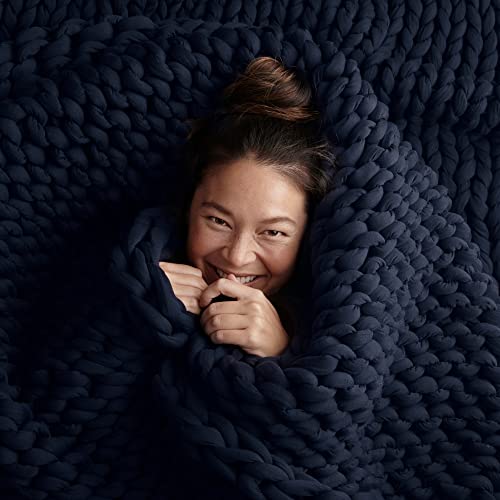
Patterns themselves are techniques — most are free in the crochet community’s shared knowledge, and the prose-only picks below describe each pattern type so you can find books, tutorials, and charts by name. The one linked product in this guide is the finished-blanket alternative: the Bearaby Cotton Hand-Knit Weighted Blanket — Check on Amazon — for readers who want the handmade result without the making.
In this guide
Quick Picks
| Pick | Badge | Why it earns its place |
|---|---|---|
| Granny square blanket (prose-only) | Best Overall | The modular classic: portable squares, infinite color play, and a join that turns scraps into heirlooms. |
| Ripple / chevron blanket (prose-only) | Best for Color Waves | Rows of peaks and valleys that make stripes move — the stash-busting, giftable favorite. |
| Corner-to-corner (C2C) blanket (prose-only) | Best for Pictures and Graphs | Diagonal pixel blocks that turn charts into images — names, logos, and pictures in yarn. |
| Moss stitch blanket (prose-only) | Best for Beginners | A two-stitch woven texture that lies flat, hides uneven tension, and never curls. |
| Waffle stitch blanket (prose-only) | Best for Warmth | Deep thermal pockets that trap air — the heaviest, coziest texture in the set. |
| Bearaby Cotton Hand-Knit Weighted Blanket | Best Finished Alternative | The handmade look, professionally made: hand-knit chunky cotton for makers who want the result now. |
Key Takeaways
- Choose the pattern by the blanket’s job: warmth (waffle), portability (granny), pictures (C2C), calm (moss), movement (ripple).
- Yarn appetite varies enormously by stitch — dense textures like waffle consume far more yarn per square foot than open or flat stitches.
- Gauge swatches are not optional homework; they are how a blanket ends up the size on the label instead of a surprise.
- Five picks here are pattern techniques (prose-only); one is a finished hand-knit blanket for readers who prefer buying to making.
- The temperature blanket is a year-long variant of any simple stitch — a ritual, not a pattern, and the most personal blanket a maker can produce.
How These Picks Were Chosen
We selected the pattern types that dominate blanket crochet for structural reasons, not fashion: each represents a distinct construction logic. Granny squares are modular (built in units, joined later); ripple is row-based geometry (increases and decreases make the wave); C2C is diagonal pixel construction (each block is a tile in a chart); moss is a flat woven texture (chained spaces and short stitches interlock); waffle is a dimensional texture (post stitches build the grid). A maker who understands these five logics can read nearly any blanket pattern ever published, which is why this guide teaches the types rather than listing thirty named patterns that are secretly these five in costumes.
The temperature blanket is treated inside the moss and ripple discussions rather than as a seventh pick, because it is a color-planning ritual applied to a simple stitch — choose your base stitch from this guide, then assign colors to daily temperatures for a year. The Bearaby’s inclusion is the guide’s honesty valve: search behavior on this keyword includes many readers researching a look they ultimately buy, and the pool’s hand-knit blanket is the closest finished object to a chunky handmade blanket that exists in it. Its review says plainly what it is and is not (knit, not crochet; weighted; cotton).
Skill ratings in the reviews are calibrated to a maker who can chain, single crochet, and double crochet. Every pattern here except confident C2C graph work is reachable from that base within one project, and each review names its own learning curve and its characteristic failure mode, because patterns fail in predictable ways and a guide’s job is to predict them.
The 6 Best Best Crochet Patterns for Blankets — Reviewed
Granny Square Blanket (Prose-Only)
Our badge: Best Overall
The granny square is crochet’s founding blanket architecture: small motifs of clustered double crochet, worked in rounds from the center out, joined into a field that can become a baby blanket, a throw, or a bedspread one square at a time. Its genius is logistical — squares are portable (a blanket that travels in a handbag), forgiving (a bad square is a small loss), and chromatically free (every square can carry a different color story, which is why granny blankets are the traditional destiny of yarn leftovers).
The maker’s decisions are the join and the layout. Joining as you go produces a blanket that grows in your hands; joining at the end allows layout play — color placement arranged on the floor like a quilt — at the cost of a seaming marathon. Borders civilize the finished piece: a few rounds of a unifying color around the whole field turn a scrap project into a designed object. The characteristic failure is squares that will not lie flat or match in size, cured by blocking and by counting clusters with monastic consistency; the second failure is weaving in roughly nine thousand ends, cured by weaving as you go, a sentence every maker reads and most ignore exactly once.
Choose the granny for gifts built over months, stash reduction, and blankets meant to carry many colors and memories. It pairs naturally with the yarn-weight guidance in Best Yarn Weight For Blankets — a consistent worsted or DK across squares keeps the field even.
Best for: modular making, color play, and stash-busting heirlooms / Not suited for: makers who want a blanket fast or hate weaving in ends
Choose the pattern for its freedom; there is no link for this pick — search the pattern name for charts, books, and tutorials.
Ripple / Chevron Blanket (Prose-Only)
Our badge: Best for Color Waves
The ripple blanket is a single piece of fabric whose rows rise and fall in regular peaks and valleys, built from a repeating count of stitches with increases at the peaks and decreases in the valleys. Worked in stripes, it turns flat color changes into moving waves — the pattern that made a generation of zigzag afghans in harvest gold, and that modern makers run in ombrés and rainbows to equal effect. Its pleasure is rhythm: after the first rows, the count becomes muscle memory and the blanket grows meditatively, row upon row, with no joining and no motifs to manage.
The discipline is the count. A ripple is a contract: the stitch multiple must be maintained exactly, or the wave drifts, the edges wander, and the blanket slowly becomes a trapezoid with opinions. Stitch markers at each peak and valley for the first several rows are the beginner’s insurance; counting at each row’s end is the habit that replaces them. Edges are the other frontier — the first and last partial waves must be worked exactly as the pattern directs, or the sides slope. Get those two things right and the ripple is the fastest large blanket in this guide, a genuine weekend-warrior throw at chunky weights.
Choose the ripple for striped gifts, stash stripes, and the temperature-blanket ritual, where each day’s color becomes one row of the wave and the year reads as weather made visible.
Best for: stripes, ombrés, and meditative row-work at any size / Not suited for: makers who will not count — the wave keeps receipts
Choose the pattern for movement; there is no link for this pick — search the pattern name for stitch multiples and tutorials.
Corner-to-Corner (C2C) Blanket (Prose-Only)
Our badge: Best for Pictures and Graphs
Corner-to-corner crochet builds a blanket diagonally, one small block at a time, from a single starting tile to the widest diagonal and back down to the opposite corner. Because each block is a pixel, C2C is the picture technology of crochet: any chart — a name, an animal, a logo, a child’s drawing gridded out — becomes a blanket by reading the chart block by block and changing colors as the pixels demand. It is how crochet makes images without tapestry’s carried yarn or intarsia’s bobbins at every row end.
The craft of C2C is color management. Each color region is worked from its own small ball or bobbin, and a detailed chart can mean a dozen working yarns across a row; makers who tame the tangle (bobbins, clothespins, working from both ends of a skein) find the technique deeply satisfying, and makers who do not, find religion of a different kind. The other skill is reading the diagonal: increases build the triangle to the chart’s widest row, then decreases mirror it home, and the chart must be followed with a row tracker — a lost place in a graphgan is a genuinely hard recovery. Finish with a simple border to square the pixel field’s edge.
Choose C2C for personalized gifts no store sells: the nursery blanket with the family dog rendered in yarn, the fan blanket with the beloved emblem, the name blanket for the child whose name is never on the gift-shop rack.
Best for: charted pictures, names, and personalized graph blankets / Not suited for: tangle-averse makers or projects on a deadline
Choose the pattern for pictures; there is no link for this pick — search the pattern name plus “graph” for chart tools and tutorials.
Moss Stitch Blanket (Prose-Only)
Our badge: Best for Beginners
The moss stitch (also called linen or granite stitch) alternates single crochet and chain spaces so each stitch lands in the previous row’s space, producing a flat, woven-looking fabric with a fine, even grain. It is the kindest pattern in this guide: the fabric lies flat without blocking, never curls, drapes like a textile rather than a craft project, and — the beginner’s blessing — hides uneven tension inside its texture, so a first blanket looks intentional from the first rows.
Its character is subtlety. Moss stitch is a ground, not a drama: it shines in solids, gentle heathers, and slow color gradients where the woven grain does the visual work, and it is the connoisseur’s choice for baby blankets, where its flat, hole-free surface suits small fingers and its drape swaddles the edges of a stroller beautifully. The cost is speed — single crochet is the shortest stitch, so a moss blanket grows slowly and eats a middling amount of yarn for its size. Makers who want a blanket this month choose a taller stitch; makers who want a blanket that looks woven on a loom choose moss and settle in.
It is also the finest base for a temperature blanket for makers who prefer texture to waves: one row a day, the color telling the day’s temperature, the grain recording a year in cloth.
Best for: first blankets, baby blankets, and woven-look minimalism / Not suited for: makers in a hurry — short stitches grow slowly
Choose the pattern for calm; there is no link for this pick — search the pattern name for tutorials, including its linen and granite aliases.
Waffle Stitch Blanket (Prose-Only)
Our badge: Best for Warmth
The waffle stitch uses front-post double crochet to build a deep grid of recessed squares — a fabric with genuine three-dimensional structure, whose pockets trap air and whose mass makes the warmest crocheted blanket in this guide. It looks architectural, feels substantial, and turns a simple solid yarn into a textile people stroke. For a winter blanket, a reading blanket, or any blanket whose job is thermal, the waffle is the pattern that behaves most like a quilt.
The price is yarn and weight. The post stitches that build the grid consume significantly more yarn per square foot than flat stitches — plan generously, because a waffle blanket that runs out of yarn in the final rows is a heartbreak with a dye-lot problem attached. The finished blanket is also heavy in the hand (not weighted-blanket heavy, but substantial), which most recipients read as quality. The stitch itself is a small step up in skill — post stitches require reaching around the stitch below — and repays the learning within the first repeat. Edges benefit from a border round to neaten the grid’s rhythm.
Choose the waffle for the cold-house blanket, the cabin blanket, the blanket that will be fought over. Pair it with the fiber guidance in this guide’s how-to section: smooth, sturdy yarns show the grid best; fuzzy yarns blur it.
Best for: maximum warmth and texture, statement winter blankets / Not suited for: tight yarn budgets or lightweight summer throws
Choose the pattern for warmth; there is no link for this pick — search the pattern name for post-stitch tutorials.
Bearaby Cotton Hand-Knit Weighted Blanket
Our badge: Best Finished Alternative
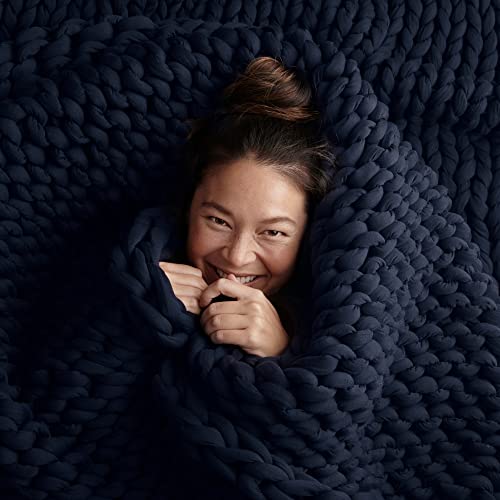
The Bearaby Cotton Hand-Knit Weighted Blanket is this guide’s one linked product, included with its nature stated plainly: it is a finished, hand-knitted (not crocheted) chunky cotton blanket, weighted by its own looped construction at 10 pounds, for the reader who came for the handmade aesthetic and is leaving with a purchase instead of a project. No glass beads, no fillers — the weight is the yarn itself, knitted into the open loops that give it the crafted look this keyword’s searchers are picturing.
Strengths
- Genuine hand-knit chunky texture — the handmade look, immediately, in 100% cotton
- Open-loop construction breathes, so the weight does not overheat like filled weighted blankets
- Even, filler-free weight distribution with no shifting or bunching
Trade-offs
- It is knit, not crochet, and bought, not made — the project’s satisfactions are not included
- 10 pounds of cotton is a real presence; it is a personal blanket, not a light throw
- The handmade look carries a handmade price relative to mass-market throws
| Color | Moonstone Grey |
| Size | 40″ x 64″ |
| Weight | 10 pounds |
For makers, the Bearaby is also a reference object: study its loop gauge and evenness and you have a target for the chunky hand-knit projects in Best Yarn For Chunky Knit Blankets. For everyone else, it is the honest shortcut — a blanket with a maker’s texture and a maker’s material honesty, warming a couch tonight instead of next season.
Best for: the handmade look without the making, and weighted-blanket comfort in cotton / Not suited for: crocheters seeking a pattern — the five picks above are the patterns
Choose it to skip the project; skip it to make the blanket yourself. Check on Amazon
Comparison Table
| Pattern / pick | Construction | Skill | Yarn appetite | Best blanket job |
|---|---|---|---|---|
| Granny square | Modular motifs, joined | Beginner+ | Moderate | Color play, stash, heirlooms |
| Ripple / chevron | Row geometry | Beginner+ | Moderate | Stripes and waves |
| Corner-to-corner | Diagonal pixel blocks | Intermediate | Moderate–high | Pictures and names |
| Moss stitch | Flat woven texture | Beginner | Moderate | Baby and minimal blankets |
| Waffle stitch | Post-stitch grid | Intermediate | High | Warmth and texture |
| Bearaby Cotton Knit (finished) | Hand-knit loops | None — purchased | — | Handmade look, now |
How to Choose the Best Crochet Patterns for Blankets
Match the pattern to the blanket’s job first
Warmth wants structure (waffle); drape wants flatness (moss); portability wants modules (granny); personality wants geometry or pixels (ripple, C2C). A pattern chosen against its blanket’s job produces a beautiful object that fails as a blanket — the most common advanced-beginner disappointment, and entirely avoidable at the planning stage.
Count the yarn before the stitches
Every stitch has an appetite. Dense and dimensional stitches consume dramatically more yarn per area than flat ones; motifs consume ends and patience in proportion to their number. Estimate from the pattern’s stated yardage, buy the whole project in one dye lot with a skein of margin, and keep the receipt — the waffle blanket that runs short in a discontinued dye lot is the craft’s oldest tragedy.
Swatch, measure, and believe the swatch
A gauge swatch — a small square in the pattern stitch, washed and measured — is how a blanket lands at its intended size. Skipping it does not save time; it defers the discovery that the throw is a rug or a scarf to the fortieth row. Swatch in the actual stitch pattern, not in plain double crochet, because textures gauge differently.
Choose yarn for the pattern’s visibility
Texture stitches (waffle, moss) need smooth, solid or gently heathered yarns to show their architecture; busy variegated yarns dissolve the pattern into noise. Stripes and motifs (ripple, granny) are where the bold color yarns belong. Fiber follows use: washable acrylics and cottons for baby and gift blankets that will be laundered by non-makers; wool for the maker’s own heirloom, with care instructions attached to any gift.
Plan the finish at the start
Borders, joining method, and blocking are not afterthoughts — they are the difference between a project and a blanket. Decide the border before the first row (it affects your dimensions), join granny squares as you go unless layout play is the point, and budget the last session for weaving ends and blocking, the two chores that convert effort into heirloom.
How to Start Your First Crocheted Blanket Without the Classic Failures
Begin with the moss stitch or a simple ripple in a smooth, light-colored, worsted-weight yarn: light colors show your stitches (dark yarn hides them from teachers and from you), smooth yarn splits less and reads clearly, and worsted weight grows at an encouraging pace. Make the gauge swatch and measure it honestly. Work the first rows slowly with markers where the pattern repeats, count at the end of every row for the first ten rows, and keep the project in a bag with its hook and a notebook — the notebook records hook size, yarn, and row counts, and becomes the difference between a resumable project and an archaeological one. Wash and block the finished blanket before judging it: crochet relaxes and evens in the wash, and many a blanket that looked homemade in the worrying sense looks handmade in the proud sense after blocking.
Problem: the blanket is getting narrower (or wider) — stitches are being gained or lost at the row ends; count every row, mark the first and last stitch, and remember the turning chain’s role in your stitch.
Problem: the edges ripple or the fabric curls — tension and stitch choice: moss and granny lie flat by construction, while plain stitch fields may need a border; consistent tension comes with rows, so swatch first.
Problem: you ran out of yarn mid-blanket — the dye-lot tragedy: prevention is buying the project’s yardage plus margin in one lot; rescue options are a deliberate contrast border or contrasting final section, framed as design.
Problem: the granny squares are all different sizes — block them to a template before joining, and count clusters in every round; squares forgive much, but not arithmetic.
The Temperature Blanket: A Year in Rows
The temperature blanket deserves its own section because it is the pattern-as-ritual that converts thousands of casual searchers into finishers. The method: assign a color to each temperature band, crochet one row (or one granny square, or one ripple) per day using the color of that day’s high temperature, and continue for a year — a birthday year, a baby’s first year, a marriage’s first year are the classic frames. The base stitch should be simple and sustainable (moss for texture-lovers, ripple for wave-lovers, plain rows for minimalists), because the project’s difficulty is not skill but duration: 365 rows is a marathon that punishes ambitious stitches. Plan the palette before January — a gradient across the temperature bands produces the most beautiful fields — and record temperatures in a notebook or app on the day, not from memory in June. Makers consistently report the same arc: enthusiasm, a February wobble, spring catch-ups, and a finished object unlike any other they own, because no one else lived that exact year in that exact place. It is the strongest argument in this guide that a pattern’s value can be the making itself. Finished temperature blankets are styled like the seasonal textiles they are — draped over the couch’s arm as the year’s most personal throw, in the spirit of the rotation in Best Blankets For Fall.
Sizing a Crocheted Blanket: The Dimensions That Matter
Blankets fail by size more than by stitch. The standard targets: receiving and baby blankets around 36–40 inches square (or the stroller’s smaller rectangle); lapghans near 36×48 for chairs and wheelchairs; throws at 50×60, the couch standard every pattern in this guide assumes; twin near 66×90; queen near 90×100 for full drape. Work backward from the target: your gauge swatch gives stitches per inch, the stitch pattern’s multiple gives the repeat, and the starting chain is the multiple times the repeats that land nearest the target width — nearest, not exact, because borders add their inches at the end. Length is the maker’s freedom (rows until it measures right, measured relaxed and un-stretched, ideally after a wash of the swatch has told you the fabric’s true behavior). Keep the arithmetic in the project notebook; future-you, resuming in October, will be grateful. And when the blanket is finished and blocked, style it as the room’s textile anchor — the pairing logic in Best Throw Pillows Under $100 shows how a handmade throw becomes the piece the rest of the couch arranges itself around.
Joining Methods Compared: Sewing, Slipping, and Join-As-You-Go
Every modular pattern eventually faces the join, and the method chosen changes the blanket’s look, strength, and making experience enough to deserve its own decision. Whipstitch sewing — joining squares edge to edge with a yarn needle — produces a flat, nearly invisible seam and lets the maker arrange the full layout before committing, at the cost of a long final assembly session and a seam that can grin open if the tension is uneven. Slip-stitch and single-crochet joins work the connection with the hook, producing a more defined ridge (a feature, in designs that use it as a grid line, especially in a contrasting color) and a stronger, more elastic connection. Join-as-you-go eliminates the assembly session entirely by connecting each new motif to the growing blanket in its final round — the blanket is finished when the last square is, which makers consistently describe as the difference between finishing and abandoning — but it demands the layout be decided in advance and makes repairs and rearrangements surgical. The honest guidance: layout-driven projects (color stories, picture arrangements) should be sewn after a floor-arranging session; production projects (the tenth baby blanket of the year) should be joined as they go; and every maker should try the ridge join once, because on the right granny blanket it is not a compromise but the design.
Reading a Pattern Like a Maker: The Skills Between the Lines
Patterns are compressed instructions, and blanket patterns compress the most, because they assume a reader who can expand them. The skills that separate a smooth project from a frogged one are mostly literacy skills. Read the whole pattern before the first stitch — the border instructions on page three change the starting chain on page one. Translate the abbreviations into your own handwriting if your dialect differs (American and British terms name different stitches with the same words; a “treble” is not a treble everywhere, and this single trap has unmade more blankets than any hook shortage). Find the stitch multiple and write it on the project bag. Locate the pattern’s own gauge statement and honor it with the swatch the how-to section prescribes. And keep a row tally in the project notebook — patterns are written by people who could hold the count in their heads, and there is no shame, only survival, in writing it down. Makers who build these five habits find that “intermediate” patterns quietly reclassify themselves as easy, which is the craft’s open secret: difficulty lives in the reading more than in the stitches.
Which Pattern for Which Person: A Gifting Field Guide
Because so many crocheted blankets are gifts, the pattern decision is often a person decision wearing a yarn costume. For a baby: moss stitch or a simple granny in washable yarn, sized generously enough to serve as a toddler blanket later — the gift that grows is the gift that stays. For a grandparent: a ripple in their colors, worsted weight, warm without weight, because ease of care and lightness matter more with every decade. For a college student: the boldest ripple or the fastest waffle in the dorm’s colors, in acrylic that will survive communal laundry and communal living. For a wedding: C2C with the couple’s initial or a white-on-white waffle whose texture does the talking — the two registers of wedding blankets, personal and formal, both covered in this guide. For the maker themselves, the one pattern too often skipped: the temperature blanket, because no one else will ever record your year for you. Matching pattern to person this way is the difference between a blanket that is admired at the unwrapping and one that is used for a decade — and use, as every guide on this site insists in its own category, is the only compliment that counts.
Blocking and Finishing: The Steps That Make It Look Made
Ask experienced makers what separates a homemade-looking blanket from a handmade-looking one and most will give the same unfashionable answer: the finishing. Blocking — washing or steaming the finished piece and pinning or laying it to its true dimensions while it dries — relaxes every stitch into its intended shape, squares the corners, evens the gauge variations that every human hand produces, and flattens edges that wanted to curl. Granny squares blocked to a template join like tiles; unblocked, they join like opinions. The border is the second finisher: two or three rounds in the blanket’s main or a unifying color give the eye a frame, hide the edge stitches’ natural unevenness, and add the dimensions that let a slightly small field reach its target size — a rescue experienced makers plan for rather than apologize for. Weaving ends is the third, and its technique matters at blanket scale: weave in three directions, leave a small tail allowance for the fabric’s movement, and never weave through to the visible face. None of these steps is glamorous, all of them together take less time than one motif repeat, and they are collectively the difference between a blanket that is displayed and one that is stored. The makers who skip them are not saving time; they are spending the project’s whole budget of effort and declining to collect its value.
Crochet Blankets for Charity: What Donation Projects Teach
A significant share of the world’s crocheted blankets are made for strangers — hospital programs, shelter drives, disaster relief, and the long tradition of the charity afghan — and the donation world’s accumulated wisdom improves any maker’s practice. Its first rule is washability above beauty: donated blankets are laundered industrially and loved hard, so acrylic and cotton in forgiving stitches (moss, simple granny, ripple) outrank every delicate fiber and fussy texture. Its second rule is size honesty: programs specify dimensions because a too-small blanket fails its recipient, and makers learn to measure rather than estimate — a discipline that improves their gift blankets too. Its third rule is color generosity: cheerful, varied, and dignified colors, because the recipient did not choose the blanket and the blanket should not announce charity. Makers who join a donation project for a season consistently report the same side effect — their technique tightens, their finishing improves, and their sense of which patterns are truly practical (versus merely photogenic) becomes unerring. The patterns in this guide are ranked by that same practical light, and it is no accident that the charity world’s favorites and this guide’s top picks are the same stitches.
The Pattern Library: Organizing What You Know
A maker’s patterns accumulate like a cook’s recipes, and a small organizational system pays compound interest. Keep a project journal — notebook or app — with one entry per blanket: the pattern and its source, the yarn and dye lot, the hook, the finished dimensions, the recipient, and one honest sentence about what you would change. Photograph every finished blanket in daylight before it leaves; the photograph becomes the record when the blanket itself is a state away being loved. Store patterns by construction logic (the five families of this guide) rather than by name, and future projects assemble themselves — the maker who wants “a warm one, fast, for a tall person” can search their own library by the axes that matter. And annotate patterns as you work them: the row where the count confused you, the border you substituted, the join you preferred — annotations are how a pattern becomes yours, and how the second blanket of a design takes half the time of the first. None of this is bureaucracy; it is the difference between a hobby that restarts at zero every project and a craft that accumulates, which is, in the end, the difference between the two words themselves.
Crochet vs Knitting for Blankets: An Honest Word
Readers arrive at this keyword from both crafts, and the comparison deserves a straight answer rather than tribal loyalty. Crochet builds fabric stitch by stitch with a single live loop, which makes it structurally forgiving (a dropped stitch stays put), naturally suited to motifs and geometry (the granny and C2C have no true knitting equivalents), and somewhat denser and less elastic in the finished fabric — a crocheted blanket drapes with more body and holds its shape on a bed with more authority. Knitting holds hundreds of live stitches, produces a finer, drapier, more elastic fabric at the same yarn weight, and owns the cable and lace traditions at their most refined. For blankets specifically, crochet’s advantages are real: it works up faster for most makers, its motifs travel, and its fabric resists the stretching that long knitted blankets can suffer under their own weight. Its honest costs are yardage (crochet consumes more yarn for the same area) and a hand that some recipients read as less “soft” at the same fiber — a judgment the moss stitch’s woven drape exists to refute. The crafts are not rivals but relatives, and the blanket shelf of a two-craft household, like the finished Bearaby’s knitted loops beside this guide’s crocheted fields, is richer for both.
Edges That Behave: Preventing the Wavy Border
The wavy, ruffled edge is the blanket finisher’s most common grief, and it is almost always arithmetic rather than tension: too many stitches worked along the sides, where the border’s ratio of stitches to rows was guessed instead of calculated. Every stitch pattern has a natural ratio — the number of border stitches per row that keeps the edge flat — and the maker’s swatch, measured honestly, reveals it before the blanket is at stake. Work the first border round slowly, count against the ratio, and check the corners every few inches by laying the work flat; a border that is going to wave announces itself within the first side, while the fix is still a matter of a few discreet decreases rather than a full frogging. The corners themselves want their increases worked exactly as the pattern directs — the corner is where the blanket turns, and a starved corner curls while a flooded one ruffles. Finish with the blocking the earlier section prescribes, and the edge that emerges is the frame the whole project deserved.
Common Buying Mistakes
Choosing a pattern by its photograph alone
The photograph shows a finished, blocked, styled blanket in perfect yarn. Read the construction, the stitch, and the yardage before falling in love — the pattern’s logic, not its photo, is what you will live with for months.
Buying yarn a skein at a time
Dye lots differ visibly in a large flat field. Buy the project’s full yardage, plus margin, in one lot, and store it together away from light.
Skipping the gauge swatch
The swatch is ten minutes; the frogging is ten hours. Every size surprise in crochet history was a skipped swatch sending its regards.
Matching busy yarn to a textured stitch
Variegated yarn plus waffle stitch equals expensive mud. Texture wants smooth solids; color chaos wants flat stitches. Pair them correctly and both shine.
Abandoning the last 5 percent
Ends, borders, and blocking are the blanket. A project abandoned at 95 percent is a UFO in a bag; finished, it is an heirloom. Schedule the finish like you scheduled the start.
Final Recommendation
For most makers, start where this guide starts: the granny square for its freedom, or the moss stitch for its calm — the two patterns that teach the craft while producing a blanket worth keeping. Choose the ripple when color is your joy, C2C when a picture is the point, and the waffle when warmth is the brief. And if the honest conclusion of your research is that you want the blanket more than the hobby, the Bearaby Cotton Hand-Knit Weighted Blanket — Check on Amazon — delivers the handmade texture tonight. Either way, you end with a blanket with a story, which is what this keyword was always about.
Frequently Asked Questions
What is the easiest crochet blanket pattern for a beginner?
The moss stitch, worked in a smooth worsted yarn: two basic techniques, a fabric that lies flat and hides uneven tension, and no counting beyond a simple alternation. A simple granny square is the other classic first project, with the joining and ends as its extra lessons.
How much yarn does a crocheted throw blanket take?
It varies strongly with stitch and yarn weight — flat stitches in worsted yarn sit at the economical end, and dense textures like waffle can require half again as much or more for the same dimensions. Always work from your pattern’s stated yardage for its size, buy it all in one dye lot, and add a skein of margin.
What is a temperature blanket?
A year-long project in which each day’s row (or motif) is worked in a color assigned to that day’s temperature, producing a blanket that records a year of weather. Any simple base stitch works; the commitment is duration, not difficulty.
Why is my crocheted blanket not the size I planned?
Almost always gauge: your stitches are larger or smaller than the pattern’s assumption, and the difference multiplies across a blanket. The cure is the gauge swatch in the actual pattern stitch, measured after washing, with hook size adjusted until the swatch matches.
Can I crochet a weighted blanket?
Not in the commercial sense — crocheted blankets gain weight only from dense stitch and heavy yarn (a waffle stitch in chunky cotton gets genuinely substantial), but they do not replicate a weighted blanket’s engineered heft. Makers who want real weight buy a finished product like the Bearaby; makers who want a heavy handmade blanket choose dense stitches and cotton or wool yarns.
What yarn weight is best for crocheted blankets?
Worsted (medium) weight is the versatile standard — warm, fast enough, and supported by the most patterns. Chunky weights finish dramatically faster for throws; DK and sport weights make finer baby blankets. Our companion guide, linked in the introduction, covers yarn weights in full.


