Affiliate disclosure: Daily Home Decorating participates in the Amazon Services LLC Associates Program. As an Amazon Associate, we earn from qualifying purchases. Product formulas, instructions, and availability can change; verify the current label, technical data sheet, and safety data sheet before use.
The best water-soluble oil for a band saw is the coolant concentrate approved for your exact metal-cutting saw and pump system. A horizontal metal saw may use a water-miscible coolant to carry heat and chips away from the cut, but a woodworking bandsaw generally does not use a liquid coolant. Even among metal saws, the coolant specification varies by model: one manufacturer may name a soluble oil, another may require a synthetic coolant, and a third may warn against soluble oils for a particular material.
For a specifically labeled band-saw concentrate, REL-Saw from Relton is a direct product to compare: the manufacturer calls it a band-saw coolant concentrate and lists rust inhibitors and boundary lubricants. Kool Mist Formula 77 is another water-diluted concentrate whose maker lists bandsawing and general flood cooling among its applications. Fusion Cool 2255 is a synthetic metalworking coolant with band-saw fluid among the Amazon listing’s stated uses; its technical sheet says it is formulated for ferrous metals and gives typical dilution ranges. These examples are not interchangeable approvals. Your saw manual and coolant maker determine whether a product belongs in the reservoir.
Before buying, identify the saw model, confirm its coolant type, check the target concentration, and review material restrictions. Never mix concentrates by guesswork. Do not use a soluble oil on magnesium unless the machine and fluid makers explicitly approve it; Grizzly warns that water in oil-water solutions can intensify a magnesium-chip fire on its metal band saw. Follow all product and saw manuals, keep coolant away from electrical connections, and use the ventilation and protective equipment indicated by the safety data sheet.
Quick picks
- Best band-saw-specific concentrate to compare: Relton REL-Saw, which is explicitly labeled as a band-saw coolant concentrate and includes corrosion inhibitors and boundary lubricants.
- Best mist/flood coolant with listed band-saw use: Kool Mist Formula 77, if the saw’s manual permits a water-diluted coolant and the delivery method suits the product.
- Best synthetic option for ferrous metal systems: Fusion Cool 2255, when its technical data and required mix match the saw’s coolant system and cut material.
These are comparison categories, not universal endorsements. Check your manual for a named fluid or exact requirements before placing any product in the tank. If the manual says “water-soluble oil only,” do not replace it with straight cutting oil, pipe thread oil, chainsaw bar oil, or a coolant meant for another machine.
Verified product examples
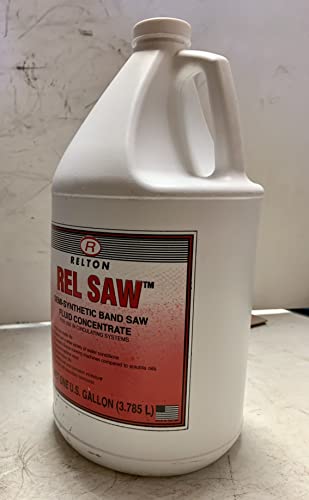
ASIN: B000HH6KUK. Relton describes REL-Saw as a band-saw coolant concentrate with corrosion inhibitors and boundary lubricants. Confirm the current dilution, compatibility, and Prop 65 warning details on the label and product safety information.

ASIN: B00H9P12HE. The manufacturer describes Formula 77 for mist and flood cooling and lists bandsawing among the applications on its site. Confirm that the delivery method and approved dilution fit your specific saw.

ASIN: B0BXFSSL7H. The manufacturer’s technical sheet describes a synthetic coolant formulated for ferrous metals; the Amazon title includes bandsaw cutting fluid. Verify concentration, metal compatibility, sump needs, and material restrictions before use.
Amazon images and catalog data can change. Confirm that the current listing matches the product, container size, and fluid family shown here.
First distinguish a metal band saw from a woodworking bandsaw
The phrase “band saw” can refer to machines with very different jobs. A woodworking bandsaw typically cuts wood with a toothed blade and runs dry. A metal-cutting bandsaw often cuts ferrous or non-ferrous stock at lower blade speeds, may include a pump and reservoir, and can use coolant to reduce heat and carry away chips. A water-soluble concentrate designed for metal is not a default maintenance product for a woodworking machine.
Before you compare coolants, identify whether your saw has a coolant tank, pump, hose, or delivery nozzle. Read the manual and confirm the manufacturer actually requires or permits liquid. If there is no designed coolant system, do not add one or splash coolant around a wood saw because a product says it works on “saws.” For general equipment comparisons, see our guides to metal-cutting band saws and portable band saws; those buying guides cover machine style, while this article focuses on fluid compatibility. Our band-saw guide under $500 also compares the machine purchase itself, not coolant choice.
There is another important distinction: “water-soluble oil” is often used as a broad shop term for water-miscible metalworking fluid. Some concentrates are emulsifiable oils that form a milky mixture; others are semi-synthetic or synthetic coolants that mix into water differently. The label and technical sheet should tell you which product family you are buying. Do not judge by appearance alone or assume every fluid that mixes with water is compatible with the pump or material.
What coolant does in a metal band saw
Coolant may perform several jobs at once. It can remove heat from the blade and workpiece, lubricate the cutting contact, flush chips away, and reduce corrosion on machine components. The balance depends on blade speed, tooth pitch, feed force, stock material, coolant delivery, and the saw’s design. A product with good cooling but poor lubrication may not suit a cut that demands boundary lubrication; a sticky straight oil may be unsuitable for a pump designed for water-diluted fluid.
Grizzly’s G0561 support FAQ says its coolant system is designed for water-soluble oils only, recommends its own soluble oil, and warns against pipe cutting oil because a non-soluble lubricant may damage the pump and reduce blade life. The G0561 manual describes the coolant system as lowering cutting temperature and washing away chips. This is specific to that model, but it illustrates why saw-specific instructions matter more than a generic “bandsaw coolant” label.
OSHA’s metalworking-fluids manual explains that soluble oils are concentrates diluted with water and that water-miscible fluids require attention to safe use, storage, dispensing, and maintenance. Coolant is not a set-and-forget liquid. Concentration, contamination, mist, ventilation, and skin contact can affect worker comfort and shop conditions. Follow the product’s safety data sheet and the practices established for the workshop.
Compare by coolant chemistry and system
| Product type | How it is supplied | What to confirm |
|---|---|---|
| Soluble oil concentrate | Oil-based concentrate mixed with water to create a working fluid | Manual approval, correct concentration, water quality, corrosion control, sump care, and mist control |
| Semi-synthetic coolant | Water-miscible concentrate with a mixture of base fluid and synthetic components | Compatibility with ferrous/non-ferrous metals, pump, seals, concentration, foaming, and disposal directions |
| Synthetic coolant | Concentrate that may mix with water without a mineral-oil base | Material compatibility, pH, concentration, corrosion protection, and manufacturer limits |
| Straight cutting oil | Ready-to-use oil not diluted with water | Only suitable in a saw and delivery system designed for straight oil; never substitute into a water-soluble system |
Those are broad categories; individual formulas can differ. Read the product’s current technical data sheet and ask the coolant supplier about the saw model, stock material, water hardness, and delivery system. If you have a recirculating sump, the fluid also needs to maintain the required concentration as water evaporates or drag-out occurs.
REL-Saw: purpose-built band-saw concentrate
Relton’s product page identifies REL-Saw as a band-saw coolant concentrate. The manufacturer lists blade-life support, stability across a variety of water conditions, cleaner-running machines compared with soluble oils, corrosion inhibitors, and boundary lubricants. That targeted product category makes it a reasonable first listing to compare when the manual calls for band-saw coolant concentrate.
Relton also posts a California Proposition 65 warning for the product, naming diethanolamine. Read the current label and safety data sheet before use. Do not assume a product is hazard-free because it is water-diluted or sold for a hobby shop. Use gloves, eye protection, ventilation, spill control, and disposal procedures as required by the actual label and workplace policy.
The public product page does not show all mixing details in the same view as its feature list. Do not invent a ratio from a third-party listing or another brand. Ask Relton or consult the current label/SDS for the recommended concentration and use that only after confirming the saw manual accepts REL-Saw. The important purchase question is not simply “will it mix with water?” but “does this saw maker approve this product at this concentration for my cut?”
Kool Mist Formula 77: mist and flood applications
Kool Mist describes Formula 77 as a coolant for mist and flood cooling where tougher machining conditions require greater lubricity. Its official page lists bandsawing among application areas and says the diluted fluid is designed not to cause rust or corrosion on workpieces and machine parts. This supports comparing Formula 77 when a metal saw’s manual allows a compatible water-diluted coolant and its system can deliver the fluid as intended.
Formula 77 is not a blanket replacement for the saw maker’s named coolant. The delivery method matters: a mist coolant, flood system, small portable saw tank, and large recirculating sump may impose different demands. Follow the product’s start-up guide and safety sheet for concentration. If the saw’s manual says to use only a specific soluble oil, ask the saw maker before substituting a mist/flood formula.
Consider container size and shop usage. A one-gallon bottle may be easier to handle than a larger pail if you cut infrequently. A large volume may make sense for a shop that uses a coolant system daily, but only if you can store the concentrate correctly and control the working sump. Do not mix more than you need or keep a diluted batch indefinitely without monitoring it.
Fusion Cool 2255: synthetic coolant for ferrous metals
Fusion Chemical’s technical data sheet describes Cool 2255 as a synthetic metalworking coolant formulated for ferrous metals. It lists corrosion inhibition at dilutions as low as 3% and typical use dilutions of 5–10%, depending on application severity. The sheet also lists pH at 10%, a liquid film residue, and product handling information. Those are manufacturer-published parameters; they do not guarantee performance in every band saw.
The Amazon catalog title includes band-saw cutting fluid, but the saw manual still comes first. Verify that the product is suitable for your pump, seals, and metals, and use the supplier’s refractometer or mix instructions to reach the required concentration. Do not copy a general TDS range if the saw maker or fluid supplier gives a model-specific recommendation.
A synthetic concentrate can appeal to shops that want a different sump life or residue profile from a traditional soluble oil, but it also requires correct monitoring. Check compatibility with non-ferrous metals if you cut aluminum or brass. The TDS cited here says the product is formulated for ferrous metals, so do not extend that claim to every alloy without confirmation from the coolant maker.
How to select coolant for your saw and stock
1. Read the saw manual first
Find the section on cutting fluid, coolant, or lubrication. Write down the permitted fluid category, named product, concentration, tank size, and maintenance interval. If the documentation is missing, search the manufacturer’s official manual archive using the model number or contact product support. A seller’s generic FAQ can help, but the current manual for the exact saw is the controlling reference.
Check whether the pump, hose, seals, screen, and return path are designed for diluted coolant. A saw can have a pump but still be restricted to a narrow fluid family. If the manual says water-soluble only, do not pour straight oil into the reservoir. If it says not to use oil-water solutions on certain metals, follow that prohibition.
2. Identify the metals you will cut
Coolant suitability can change with the workpiece. Steel, stainless steel, cast iron, aluminum, brass, copper, and exotic alloys have different cutting and corrosion considerations. Some machine manuals exclude hazardous material combinations. For example, Grizzly’s G0561 manual warns against cutting magnesium with oil-water solution because the water can intensify a magnesium-chip fire. Do not rely on a coolant product’s broad “all metals” claim to override a saw warning.
If you change from one metal to another, confirm that the same coolant remains appropriate. Chips from dissimilar metals, tramp oil, and cleaning chemicals can affect the sump. If you cut material with a special hazard, use the machine maker’s and material supplier’s instructions rather than general shop advice.
3. Confirm the concentrate ratio
Use the exact concentration specified by the manufacturer. A mix that is too weak may not provide enough corrosion protection or lubrication; an overly strong mix may increase residue, irritation, cost, foam, or other problems. Measure with a suitable tool rather than guessing from a capful. Add concentrate and water in the order the coolant supplier specifies; some manufacturers require concentrate into water to avoid an unstable emulsion.
When the coolant is in a recirculating tank, evaporation and fluid carryout can change the working concentration over time. Use a refractometer or supplier-approved test method if the product calls for one. Record initial mix and subsequent adjustments so different operators do not make conflicting changes.
4. Consider water quality
Water hardness and dissolved minerals can affect emulsion stability, residue, corrosion, and foam. Product makers may publish a range of acceptable water conditions or describe stability across different water types. If your fluid separates, foams, or leaves unusual deposits, check water quality and concentration before adding more concentrate. Contact the coolant supplier rather than combining additives.
Do not use untreated water or add biocide, rust inhibitor, dye, or cleaner unless the product and machine makers allow it. Mixing brands can cause the fluid to break, produce excess foam, or alter its safety characteristics. Keep a copy of the product SDS near the machine and follow its storage and handling directions.
5. Match flow and tank size
A suitable coolant must reach the cut at the flow rate the saw was designed to use. Adjust the valve or nozzle as the manual instructs. Too little flow can fail to cool or flush chips; excess flow can splash onto the floor, create slip hazards, or spread mist. A clogged filter or hose can interrupt delivery even when the tank is full.
Check tank capacity and whether the system has a pump screen, return filter, or chip tray. A small portable saw and an industrial horizontal bandsaw will not necessarily use the same concentrate or maintenance process. Choose product container size based on actual consumption, not a marketing claim about coverage.
Mixing and sump maintenance
Before mixing, read the label, technical sheet, and SDS. Wear the personal protective equipment the documents specify. Use a clean, labeled container and measure accurately. If the product maker instructs users to add concentrate to water, follow that order. Never make a mix in a food or beverage container or leave the working fluid where children or pets can access it.
Before topping up a sump, inspect the fluid and tank. Remove metal chips and tramp oil as the saw maker directs. Do not pour new coolant over a contaminated tank and assume the problem is solved. If the fluid has an unusual odor, separation, sludge, or unexpected color change, stop and investigate using the product’s maintenance guidance. Dump and replace fluid at the recommended interval and dispose of it according to local rules and the SDS.
Maintain the pump, hose, filter screen, and return path. Verify flow before cutting, watch for leaks, and keep coolant away from electrical connectors and wet floors. Grizzly’s manual warns that excessive flow can spill coolant and create a slip hazard; it also includes an electrocution warning around wet hands and floors. Isolate the machine from power before cleaning, changing a filter, or adjusting components in a way the manual requires.
Health, exposure, and shop ventilation
Water-miscible metalworking fluids can generate mist or become contaminated during use. OSHA’s metalworking-fluids manual discusses potential health and safety issues related to fluid delivery, concentration, additives, microbial control, ventilation, and mist collection. Keep the fluid system maintained and use the controls specified by the product and workplace safety program. A “water-based” or “synthetic” label does not mean the working fluid can be handled without precautions.
Review the SDS for skin, eye, inhalation, storage, spill, first-aid, and disposal information. Provide ventilation suitable for the machine and fluid. Avoid breathing mist, do not eat or drink near the sump, and wash hands after handling coolant. If the shop has multiple machines or visible mist, consult a qualified industrial hygienist or safety professional about exposure controls and fluid maintenance.
Do not dispose of spent coolant by pouring it into a drain, on soil, or into a storm sewer unless local authorities and the SDS explicitly permit the method. Metalworking fluid can contain chips, additives, and contaminants from the process. Collect it in a compatible labeled container and use the local hazardous-waste or industrial-waste route specified for your area.
Coolant mistakes that shorten blade life
- Putting straight oil in a soluble-coolant pump: it can be incompatible with the pump, seals, or manufacturer design.
- Assuming all water-soluble concentrates are equivalent: formulas vary in lubrication, corrosion inhibition, foam, and material compatibility.
- Guessing the ratio: use the exact label or supplier instruction and measure it.
- Ignoring concentration drift: evaporation and carryout can change the working fluid over time.
- Cutting prohibited materials: follow all material-specific warnings in the saw manual, including magnesium cautions.
- Running with no flow: a full tank is not enough if a clogged filter or pump prevents fluid reaching the blade.
- Mixing brands or adding home remedies: unapproved additives can destabilize the coolant or create a new hazard.
- Leaving chips in the sump: remove debris as directed and maintain screens and return lines.
- Ignoring mist and skin contact: follow the SDS and workplace exposure controls.
Water-soluble coolant versus straight cutting oil
A water-soluble concentrate is mixed with water to make a working fluid and commonly circulates through a pump. Straight cutting oil is used undiluted and may be intended for a different cutting process or a saw built for oil. A manufacturer may prohibit straight oil in a soluble-fluid system because the pump is designed around lower viscosity and water-miscible chemistry. Conversely, a machine designed for straight oil may not provide the corrosion or lubrication behavior needed from water.
Do not infer the correct product from the word “band saw.” A portable metal saw may be used without a coolant tank; a horizontal machine may include a pump; a woodworking bandsaw normally uses no liquid. Read the exact manual and seek approval before making a substitution. If the product is not sold under the named brand on Amazon, the user can search the product name on Amazon, but the search result does not establish equivalency or compatibility.
Frequently asked questions
Can I use water-soluble oil in a woodworking bandsaw?
Usually a woodworking bandsaw is designed for dry wood cutting and does not have a coolant system. Do not add a liquid unless the manufacturer explicitly instructs you to. Water and coolant can affect wood, bearings, guides, table surfaces, electrical parts, and dust collection.
Is REL-Saw the best coolant for every metal bandsaw?
No. Relton describes it as a band-saw coolant concentrate, but the saw manual may specify another product or chemistry. Confirm the recommended concentration, metal compatibility, water quality, pump needs, and safety information with both manufacturers before use.
Can I use Kool Mist Formula 77 in a bandsaw?
Kool Mist lists bandsawing among the applications for Formula 77 and describes it for mist and flood cooling. Your saw’s delivery system and manual must permit it. Follow Kool Mist’s current instructions and verify the concentration with the supplier.
Is a water-soluble metalworking coolant safe for aluminum?
It depends on the exact formula, alloy, and saw. Some coolant data sheets specify only ferrous metals; others list broader uses. Confirm compatibility with the coolant manufacturer and saw maker before cutting aluminum or any non-ferrous metal.
How do I know whether the coolant mix is correct?
Use the exact mix ratio from the label or manufacturer and a suitable measuring or testing method. For a recirculating sump, concentration can shift through evaporation and carryout. Use the product maker’s recommended refractometer conversion or test procedure rather than estimating by eye.
Can I use pipe cutting oil in a coolant tank?
Not unless your saw maker specifically approves it. Grizzly says its G0561 coolant system is designed for water-soluble oils only and warns that pipe cutting oil or other non-soluble lubricants may damage its pump and reduce blade life. Check your own saw’s manual; the restriction can vary by model.
What coolant should I use for magnesium?
Follow the exact saw and coolant manufacturers’ material guidance. Grizzly’s G0561 manual warns not to cut magnesium with oil-water solutions because water can intensify a magnesium-chip fire. Do not proceed based on a general coolant recommendation; contact the machine maker for a suitable process.
Bottom line
The best water-soluble oil for band saws is a coolant that the manufacturer approves for the exact metal-cutting saw, sump, material, and delivery method. REL-Saw is purpose-labeled as a band-saw coolant concentrate; Kool Mist Formula 77 lists bandsawing and mist/flood use; Fusion Cool 2255 is a synthetic option formulated for ferrous metals. Compare their current instructions, mix ratios, SDS, and compatibility rather than assuming one product can serve every machine. Keep woodworking bandsaws dry, and never override a material-specific warning in the manual.
Sources and further reading
- Grizzly G0561 FAQ: compatible coolant and soluble-oil system
- Grizzly G0561 manual: coolant system and material cautions
- Relton: REL-Saw band-saw coolant concentrate
- Kool Mist: Formula 77 product details and applications
- Fusion Chemical: Cool 2255 technical data sheet
- OSHA: Metalworking Fluids safety and health best practices manual
Certain content that appears on this site comes from Amazon. This content is provided “as is” and is subject to change or removal at any time. Product examples and images are supplied through Amazon Creators API; confirm specifications and availability on the current listing.