Disclosure: Daily Home Decorating participates in the Amazon Services LLC Associates Program. As an Amazon Associate, we earn from qualifying purchases.
A metal band saw can make repeated cuts in tubing, bar, angle, and other stock with less effort than a handheld saw. The right machine depends on the largest piece you need to cut, how often you work, the available floor space, and whether you want the saw to feed through a cut automatically. Compact 4-by-6-inch machines suit small shops and repair benches; 5-by-6-inch models add capacity; 7-by-12-inch horizontal/vertical saws handle larger stock but require more space, power planning, and heavier delivery handling.
For a first stationary metal-cutting saw, the WEN BA4664 is a sensible capacity-to-footprint starting point to compare. It cuts in both horizontal and vertical orientations, offers three blade speeds, and includes a wheeled stand according to WEN. For a larger general shop, the Grizzly G0561 and JET HVBS-712 move into 7-by-12-class work. If your budget or shop is smaller, a 5-by-6-inch JET HVBS-56 can be a more compact alternative. These are not test winners: recommendations below are based on manufacturer specifications and verified Amazon catalog listings, not side-by-side cutting tests.
This guide focuses on stationary horizontal/vertical metalworking band saws. Handheld portable band saws are a different category, and the material capacity and workholding approach differ. Before buying, compare the exact cut capacity at 90 and 45 degrees, blade length and width, speed settings, electrical service, vise design, coolant needs, and the machine’s footprint. Prices, stock, and included accessories change; check the current manufacturer manual and seller listing.
Quick answer: match capacity to your real stock
Measure the largest round and rectangular stock you actually cut. A saw advertised as 7-by-12 inches may offer one capacity for round stock and a different one for rectangular stock, and its limit usually shrinks at a miter angle. Then decide whether you need a vertical table for manual contour or short cuts, or whether a horizontal drop-cut format covers your work.
- Smaller repair shop: compare a 4-by-6 machine such as the WEN BA4664 for tubing and bar within its published limits.
- Compact metal shop: look at a 5-by-6 saw such as the JET HVBS-56, while checking floor footprint and 20-amp circuit guidance.
- Higher capacity and coolant: compare 7-by-12-class options such as the Grizzly G0561 and JET HVBS-712.
- Jobsite portability: consider a handheld portable band saw instead of a stationary horizontal saw; see our portable band saw guide.
Capacity is not the only limiting factor. You also need a blade suited to the material and wall thickness, a vise that secures the stock, adequate room around the saw, and a circuit that meets the manufacturer’s requirements. A larger frame may save time on a common job but can be a poor purchase if it overwhelms your space or power service.
Metal band saws to compare
The models below serve different workshop sizes. “Best for” indicates a use case to investigate, not a measured ranking. All product links lead to verified Amazon ASINs with current catalog images; confirm the selected model and accessories before checkout.
1. WEN BA4664 — best compact shop starter to compare
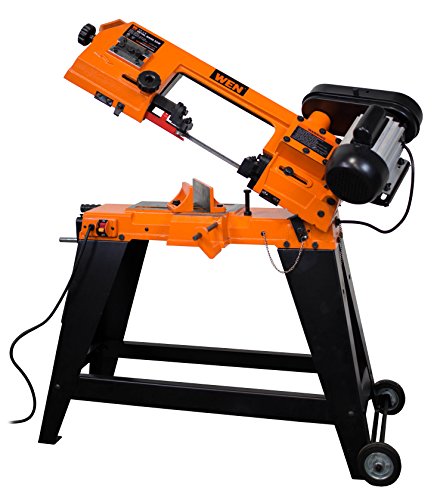
Horizontal/vertical machine with a wheeled stand and three published speed settings.
View on Amazon
The BA4664 is a 4-by-6-inch metal-cutting saw with a stand. WEN lists 80, 120, and 200 feet per minute settings, a 4.6-amp motor, a mitering vise, and operation in horizontal and vertical positions. Its manufacturer states that it can cut round stock up to 4-1/2 inches in diameter and rectangular stock up to 4 by 6 inches at 90 degrees; the maximum at 45 degrees is smaller. It includes a pre-installed 64-1/2-inch blade, a workpiece stop, wheels, and a two-year warranty in the current product description.
Good fit: a smaller repair shop or hobby metalworker whose stock fits the published envelope and who values a stand and wheels. Check first: cutting capacity at your miter angle, blade replacement availability, vertical-table dimensions, and the clearance needed for long stock. A compact saw still requires a stable, level location and safe support for material extending beyond the vise.
WEN says the saw automatically shuts off after completing a horizontal cut and that its feed rate can be adjusted. Automatic shutoff is convenient, but it does not mean the machine can be left unattended. Follow the manual, inspect the cut area, and remain in control of the work. See the WEN BA4664 manufacturer page for current specifications and manual access.
2. JET HVBS-56 — best compact 5-inch-class stationary saw

Three blade speeds and a vise that swivels for miter cuts.
View on Amazon
JET’s HVBS-56 occupies a compact stationary footprint while providing a horizontal/vertical format. The official page lists a 0.5-horsepower, 115-volt single-phase motor and blade speeds of 80, 120, and 200 surface feet per minute. Its listed 90-degree capacities include 5-inch round stock and rectangular cuts up to 5 by 5-3/4 inches or 2 by 6 inches, depending on orientation. At 45 degrees, the listed rectangular capacity is reduced to 4-1/2 by 3 inches and round capacity to 3 inches.
Good fit: a small shop that wants the flexibility of a tilting table and mitering vise without moving to a full 7-by-12 machine. Check first: JET’s recommended 20-amp circuit size, actual footprint with the bow lowered, and the included blade length and pitch. The product data lists approximately 153 pounds net, so plan delivery and placement rather than treating it as a lightweight bench tool.
The cast-iron tables and adjustable blade tracking are features JET highlights. The machine’s speed choices are discrete settings rather than an unlimited dial. Choose by material and workpiece thickness according to the manual. See the JET HVBS-56 specifications for exact capacity and power requirements.
3. JET HVBS-712 — best 7-by-12-class saw to compare for general shop use

Horizontal/vertical format, hydraulic downfeed, and 115/230-volt single-phase input.
View on Amazon
The HVBS-712 moves into a larger metalworking capacity class. JET lists a 0.75-horsepower motor, four blade speeds—86, 132, 178, and 260 feet per minute—and a 115/230-volt single-phase configuration. It can operate horizontally or vertically and includes a vertical-position worktable, adjustable material stop, hydraulic downfeed, and a mobile stand with storage features. Its 45-degree vise setting supports miter work, but the maximum rectangular capacity is lower at an angle than at 90 degrees.
Good fit: a small fabrication shop with recurring cuts in larger tubing, bar, or rectangular stock and room to keep a wheeled machine set up. Check first: the exact capacity table for your stock profile, circuit requirements, footprint, shipping weight, and which blade is included. Product pages may list slightly different descriptions across revisions; use the manual for the exact model and item number you purchase.
JET describes a cast-iron wheel and hydraulic feed on its official product page. The saw’s vertical position can make it more flexible for certain operations, but set up only as the manual permits and keep guards in place. Review the JET HVBS-712 specifications and support documents before choosing a circuit or planning a shop layout.
4. Grizzly G0561 — best to compare for higher capacity and integrated coolant

Horizontal/vertical use, adjustable hydraulic downfeed, and a coolant system.
View on Amazon
Grizzly specifies the G0561 for 7-inch round or 7-by-12-inch rectangular stock at 90 degrees, with reduced capacity for 45-degree cuts. The machine has a 1-horsepower motor, four speeds from 90 to 255 feet per minute, a 93-inch blade, a quick-release vise, hydraulic downfeed, and a 2.5-gallon coolant system. The manufacturer says it can cut in horizontal or vertical positions and includes the stand shown in the product configuration.
Good fit: a workshop that needs the larger 7-by-12 cutting envelope and expects coolant to be part of its metal-cutting routine. Check first: the machine’s substantial footprint and weight, the required circuit, coolant type, and delivery access. Grizzly says its coolant system is designed for water-soluble cutting fluids; do not substitute an incompatible oil. Coolant is not included, and its storage and cleanup are part of owning the machine.
The official product page provides detailed capacity, speed, and electrical information, while the manual covers setup and maintenance. Check both documents because a machine’s capacity can vary by angle and profile. Grizzly’s G0561 product page includes the specification sheet, manual, and parts support.
Horizontal, vertical, and portable metal band saws
Horizontal saws lower the blade through a vise-held workpiece. They are convenient for repeated crosscuts in bar and tube because the vise supports the stock and the saw head can feed through the cut. Many models use a hydraulic or adjustable downfeed mechanism. The operator still needs to set the vise, blade speed, and feed according to the machine’s instructions.
Horizontal/vertical models can also be repositioned for certain manual cuts with a vertical table. That versatility is useful in a small fabrication shop, but the vertical setup does not turn the saw into a general woodworking bandsaw. Use the blade and workholding system for the metal and operation described in the manual.
Handheld portable metal band saws are designed around carrying the tool to the work, often for conduit, pipe, or installed stock that is awkward to bring to a shop machine. They generally have different capacities and feed control than the stationary models reviewed here. Compare our portable band saw guide if mobility is your main need.
| Format | Best use case | Main trade-off |
|---|---|---|
| 4-by-6-class horizontal/vertical | Smaller stock and limited shop footprint | Less capacity for large rectangular profiles |
| 5-by-6-class horizontal/vertical | General repair and small fabrication | Still limited at a 45-degree miter |
| 7-by-12-class horizontal/vertical | Higher capacity and repeat shop crosscuts | More space, power planning, weight, and cost |
| Handheld portable saw | Cutting stock in place or moving between job sites | Operator supports the tool and controls the cut |
Our general band saw guide discusses woodworking band saws and broad selection factors. Metalworking saws use slower blade speeds and different blades and coolant needs, so do not assume that a wood bandsaw can be converted safely by changing its blade alone.
How to choose capacity without overspending
Measure round and rectangular stock separately
A manufacturer may publish different capacities for round, rectangular, and square stock. A 7-inch round capacity does not mean that every 7-inch-wide profile will fit the vise or table. Consider the material’s actual orientation, clamp reach, blade-to-frame clearance, and the way the saw head moves. Long stock also needs infeed and outfeed support.
For angled cuts, check the 45-degree table separately. A miter angle can reduce capacity substantially, especially for a wide rectangle. If you routinely cut miters, use the angled capacity—not the 90-degree headline number—to size the machine.
Think about part length and production rhythm
A material stop helps make repeated lengths more consistent when the machine includes one. It does not automatically make every cut accurate; vise alignment, blade condition, and stop setup still matter. If you make only a few cuts each month, a smaller machine with a suitable vise may be more practical than a larger production saw. If you cut a batch of stock daily, downfeed control, blade life, and coolant maintenance can matter as much as raw capacity.
Plan shop space and material handling
Metal band saws require clearance around the vise, bow, stand, and long stock. Before delivery, measure doorways, floor space, and the path from the loading area to the final position. A machine on wheels still needs a stable operating location and adequate support for long material. Consider where chips and coolant will go and how the machine will be cleaned.
Choose the blade and speed for the workpiece
Metal band saw blades are specified by length, width, thickness, tooth pitch, and tooth pattern. The machine manual identifies the blade size that fits the wheels and guides. Once you know that size, select a blade tooth pitch suited to the material’s thickness and profile. Thin-wall tubing needs enough teeth engaged in the cut to avoid snagging; thicker stock needs a tooth pattern that can clear chips. Ask the blade supplier or saw maker when the choice is not clear.
Blade speed is typically listed in surface feet per minute (SFPM or FPM). Metal-cutting machines offer a few speed ranges or an adjustable drive. Use the manufacturer’s material chart to select a setting for the metal and blade. Do not equate higher speed with faster or better cutting: the wrong speed can shorten blade life, heat the workpiece, or produce poor results.
Blade tension, tracking, guide alignment, and sharpness affect cut quality. Install and adjust the blade only as instructed. A blade that wanders or makes an uneven cut may point to a setup, tension, feed, or blade-selection issue. Stop the machine and diagnose it according to the manual rather than forcing the stock or increasing pressure arbitrarily.
For maintenance, check blade availability and cost before buying the saw. A common blade size may be easier to source than an unusual length. Find out whether the saw ships with a blade, which pitch it uses, and whether replacement blades are sold by the manufacturer or reputable suppliers. Also check whether the machine needs a coolant type or concentration specific to its pump and material.
Check electrical requirements before delivery
Several machines in this class are prewired for 115 volts but may be convertible to 230 volts. Read the nameplate and manufacturer’s specification sheet to confirm the voltage, phase, and recommended circuit size. Do not assume a common wall outlet or extension cord is adequate, especially for a machine with a larger motor. Have a qualified electrician assess shop wiring when the required circuit is uncertain.
Also account for motor starting current and the other equipment sharing the circuit. If a machine needs a dedicated 20-amp circuit or a 230-volt connection, plan that before the saw arrives. Electrical conversion and plug changes must follow the manufacturer instructions and local code.
Understand coolant and chip handling
Some metal band saws include a coolant pump and tank; others are intended for dry cutting or depend on different accessories. Coolant can help control heat and extend blade life when the machine and operation call for it. The correct fluid is machine-specific. Grizzly, for example, says the G0561 system uses water-soluble oil and warns against incompatible pipe-cutting oil. Follow the exact model’s recommendations rather than pouring a familiar fluid into any reservoir.
Coolant creates its own responsibilities: checking flow, managing concentration, cleaning chips from the tank, containing spills, and disposing of used fluid properly. Read the safety data sheet for the product you use and follow local disposal rules. Metal chips can be sharp, so use suitable tools and PPE for cleanup and wait until the machine is stopped. Do not reach into the blade path or brush away chips while the blade is moving.
A coolant pump does not replace guards or safe workholding. Inspect hoses and the pump, keep fluid away from electrical connections, and clean up leaks promptly. If you do not want to manage coolant, compare models that do not require it for the material and application you have. Never operate a wet-cut machine contrary to its manual.
Safety checks for metal band saw buyers
Band saws have an exposed point of operation where the blade meets the stock, along with moving wheels and pinch points. OSHA notes that blade contact is a common band-saw hazard and advises guarding the blade except at the working area. Follow the machine’s guard settings and manual, keep hands clear of the cut, secure stock in the vise, and use the right PPE for flying chips and sharp metal.
- Use the machine only after reading the manual for the exact model.
- Keep blade guards in place and adjust guides as instructed for the stock.
- Clamp the workpiece securely; do not hold small stock by hand near the blade.
- Wait for the blade to stop before removing cutoffs or cleaning chips.
- Disconnect power before blade changes, adjustments, or maintenance.
- Wear suitable eye protection and footwear; assess hearing and chip hazards for the task.
- Keep loose clothing, jewelry, hair, and cords away from moving parts.
- Use only blades, speeds, and materials permitted by the manufacturer.
- Keep the floor clear of coolant and metal offcuts, and follow fluid handling instructions.
OSHA’s band-saw machine-guarding guidance describes point-of-operation, moving-part, and guarding hazards. For workplace use, follow the applicable standards and your shop’s safety program. A product feature such as automatic shutoff or a vertical table does not eliminate the need for operator training or proper guards.
When a metal band saw is not the best tool
A chop saw or cold saw may be more appropriate when you need fast, repeatable cutoff work and the machine is designed for your material. A portable metal band saw can be easier to bring to installed stock. A hacksaw can handle occasional small cuts without a machine footprint, while a plasma cutter or other thermal process is a different choice with its own equipment and safety demands. The best option depends on stock, finish, portability, and how many pieces you need to cut.
Use our guides to portable band saws for handheld needs and band saws under $500 for more budget-conscious comparisons. Those pages discuss broader categories; this article focuses on stationary metal-cutting models and their capacity, speed, coolant, and shop requirements.
Frequently asked questions
What is the best metal band saw for a small shop?
Start by measuring your largest stock. A 4-by-6 machine such as the WEN BA4664 may suit smaller profiles and tighter spaces; a 5-by-6 model such as the JET HVBS-56 offers a step up. Check the exact capacity, circuit, and footprint against your shop before choosing.
What does 7-by-12 capacity mean?
It generally describes a maximum rectangular stock envelope at a specified angle, but product pages also list separate round and square capacities. Capacity shrinks for miter cuts. Read the model’s full capacity table and verify that the stock fits the vise and frame.
Can a metal band saw cut aluminum?
Many metal-cutting models list aluminum among suitable materials, but use a blade and speed recommended by the saw and blade manufacturers. Material shape and thickness affect the tooth pitch and setup. Do not assume that every bandsaw or blade is suitable for metal.
Do I need coolant?
Some saws include a coolant system and require a specified fluid; others use a different approach. Follow the exact machine manual and fluid instructions. Never substitute a fluid because it is available in the shop.
What is the difference between a metal and woodworking band saw?
Metal saws use blades and speeds selected for metal and often include a vise, horizontal downfeed, and sometimes coolant. Woodworking saws typically use different blade speeds and worktables. A blade change alone does not make one category a safe or appropriate substitute for the other.
Is a horizontal/vertical saw worth it?
It can be useful if both orientations match your work. The horizontal mode supports repeated crosscuts; the vertical mode may handle certain manual operations with a table. Check what accessories are included and follow the manual for each setup.
How much space does a 7-by-12 saw need?
More than its base dimensions: leave room for the saw head, long stock, operator access, vise adjustment, and maintenance. Measure doorways and delivery access as well as the final floor area. Consult the product dimensions and support long stock safely.
Should I choose variable speed?
Speed selection is useful when the machine offers settings appropriate to the material and blade. Some machines use discrete speeds; others have a variable control. Use the maker’s chart instead of choosing by intuition or assuming higher speed is better.
Bottom line
The best metal band saw is one whose capacity, blade speed, vise, and power requirements match the material you actually cut. The WEN BA4664 is a compact starting point to compare, JET’s HVBS-56 fits a smaller stationary shop, and the JET HVBS-712 and Grizzly G0561 move into a larger 7-by-12 class. Compare their manuals and accessory costs before you decide; capacity alone does not determine whether a machine fits your shop.
Measure stock at both 90 and 45 degrees, plan the electrical circuit and floor space, and understand blade and coolant requirements. If you mainly need a saw that moves to the material, compare portable models instead. For stationary production cuts, proper workholding, blade choice, guards, and maintenance are as important as the saw’s nominal capacity.
Sources: WEN BA4664 specifications; JET HVBS-56 specifications; JET HVBS-712 specifications; Grizzly G0561 information; OSHA band-saw machine guarding.
Certain content that appears on this site comes from Amazon. This content is provided “as is” and is subject to change or removal at any time. Product examples and images are supplied through Amazon Creators API; confirm specifications and availability on the current listing.
const fs=require(‘node:fs’);const h=fs.readFileSync(‘best-metal-band-saws.html’,’utf8′);const t=h.replace(/<[^>]+>/g,’ ‘).replace(/&(?:[a-z]+|#d+);/gi,’ ‘).replace(/s+/g,’ ‘).trim();const o={words:t.split(‘ ‘).length,images:(h.match(/