Where to buy
Check the latest price, availability and delivery on Amazon. Orders are placed on Amazon. We may earn a commission from qualifying purchases.
- Best overall for renters: MONDAY MOOSE Decorative Throw Pillow Covers, Set of 4, 18×18 (Brown/Beige) — four covers only, check price on Amazon — Check on Amazon
- Best feather inserts: puredown Feather Down Throw Pillow Inserts, 18×18, Set of 2 — two inserts, check price on Amazon — Check on Amazon
- Best single statement insert: Continental Bedding 50/50 Down and Feather Throw Pillow Insert, 18×18, Single — one insert, check price on Amazon — Check on Amazon
- Best value inserts: Utopia Bedding Throw Pillow Inserts, 18×18, Set of 4 — four inserts, check price on Amazon — Check on Amazon
See 2 more options
- Best textured covers: Foindtower Textured Boucle Throw Pillow Covers, 18×18, Pack of 2 (Camel) — two covers only, check price on Amazon
- Best natural-fiber covers — with a spec warning: Foindtower Linen Fringe Throw Pillow Covers, 18×18, Set of 2 (Beige) — two covers only, check price on Amazon; read its review before buying, because this product line publishes two different fiber blends under the same name
Read the full guide ↓
Disclosure: As an Amazon Associate, dailyhomedecorating.com earns from qualifying purchases. Links to Amazon on this page are affiliate links; they cost you nothing extra. Listing details such as price and availability change often, so check the current Amazon listing before you buy.
Renting imposes a short list of rules on decorating, and every item on it points at the same purchase. You cannot paint the greige walls without a negotiation, or hang heavy shelves without risking the deposit. The sofa is probably a plain, landlord-neutral piece you did not choose and cannot replace. What you can do — completely, reversibly, and without asking anyone — is change what sits on that sofa. Throw pillows are the largest decor lever a renter is allowed to pull: they carry color, pattern and texture into a room that offers none, they come with you when the lease ends, and $75 is the first budget in this category that buys the real version rather than the decorative suggestion. This guide is written for that job: furnishing a rented living room so it reads as yours, with components that pack flat and leave no trace when you move.
Two facts govern everything below, and apartment life makes both of them sharper. The first is that a throw pillow is two products — a cover and an insert — and at $75 they are usually sold separately. A listing in this tier can be four empty covers; another can be two feather inserts with nothing around them; one pick below is a single bare insert sold on its own. In an apartment, miscounting that is worse than an annoyance: there is no spare room to absorb the mistake and no storage for the wrong half of a pillow. Every pick here therefore states exactly what arrives in the box, and every route is described as finished pillows. The second fact is that $75 is where real fill begins. Below this tier, inserts are polyester almost without exception. At $75 you can buy inserts filled with 95 percent goose feather, and one that is a genuine 50/50 down-and-feather blend — with an honest consequence a small space amplifies: natural fill can smell when new, and in a one-bedroom that smell has nowhere to go except the room you sleep in. The covers carry their own labeling traps: the word “linen” on this page means three different fabrics depending on which specification field you read, and the bouclé pick is polyester wearing a wool look.
There are three honest ways to spend the $75, and this guide describes each. The coordinated route: the MONDAY MOOSE set of four velvet covers plus the Utopia Bedding four-pack of inserts builds four complete 18×18 pillows — enough for a three-seat sofa, or a loveseat plus the reading chair, with room left in the budget for a lumbar. The real-materials route: the puredown feather inserts inside the Foindtower linen fringe covers builds two pillows that feel like the ones in good hotels — check price on Amazon for each component. The single-statement route: one Continental Bedding 50/50 insert inside the best cover you already own — the finest single pillow this budget assembles, aimed at the one chair that is truly yours. The recommendation at the end argues which route wins by sofa size. For the same components re-ranked without the rental lens, see Best Throw Pillows Under $75.
Quick Picks
Short on time? Each row names a buyer type and the product that suits it. Each row is always stated with what is in the box — covers only, inserts only, count and size — because in this category the contents decide the value; check price on Amazon for the current figure.
| Buyer type | Pick | Why it stands out | Link |
|---|---|---|---|
| Best overall for renters | MONDAY MOOSE Pillow Covers, Set of 4, 18×18 | Four coordinated double-sided velvet covers — check price on Amazon; inserts not included | Check on Amazon |
| Best feather inserts | puredown Feather Down Inserts, 18×18, Set of 2 | 95% goose feather / 5% down in a cotton shell — check price on Amazon; the cheapest honest entry to real feather | Check on Amazon |
| Best single statement insert | Continental Bedding 50/50 Insert, 18×18, Single | A true 50% down blend in a 250-thread-count cotton shell — check price on Amazon; one insert, and the best pillow core here | Check on Amazon |
| Best value inserts | Utopia Bedding Inserts, 18×18, Set of 4 | Four down-alternative inserts — check price on Amazon; the fill every budget build in this guide stands on | Check on Amazon |
| Best textured covers | Foindtower Boucle Covers, 18×18, Pack of 2 | The looped bouclé look in a pair — check price on Amazon — and the listing’s own spec field says the fabric is 100% polyester | Check on Amazon |
| Best natural-fiber covers | Foindtower Linen Fringe Covers, 18×18, Set of 2 | Fringed, stonewashed-look covers in a pair — check price on Amazon — with two conflicting fiber blends published for the same line | Check on Amazon |
How These Picks Were Chosen
The first filter was the box. Every candidate was classified before it was compared: cover only, insert only, complete pillow, or a coordinated set — and it was only ever compared inside its own class. This sounds obvious and is violated by nearly every roundup in the category, which is how an inexpensive pair of empty covers ends up ranked against a premium filled pillow as if they were substitutes. They are not. A cover with nothing in it is a photograph; an insert with no cover is a white square. For a renter the discipline matters twice, because a mismatched purchase does not just waste money — it occupies the one closet you have.
The second filter was verification. A product earns a link here only when its listing identity could be pinned from two independent sources — the Amazon listing itself plus a second retailer, or registry and deal records of the same item. Where a well-known product could not be pinned at all, it was left out rather than guessed at — more than one famous faux-fur statement pillow was dropped for exactly that reason.
The third filter was the specification field over the title, and this category is exactly why that rule exists. Titles in this aisle are written by marketers; spec fields are written, eventually, by lawyers. So: a cover is “linen” in this guide only if a fiber percentage appears in the maker’s own specification material, and the percentage is printed with it. One pick below is sold under the word linen while its spec field names a ramie-and-cotton blend with no flax in it at all; another line publishes 80 percent linen for one color and 70 percent ramie for its siblings. Feather claims got the same treatment. An insert labeled “feather down” is, in the industry’s standard recipe, 95 percent feather and 5 percent down — the puredown pick’s own product name says so — and the only insert here with a genuinely high down content is the Continental at a stated 50/50, which is why it sits at the premium end of this tier.
The fourth filter was apartment arithmetic, which is stricter than house arithmetic. A route had to assemble into complete pillows inside $75, fit the seating a lease actually contains — a loveseat, a compact three-seater, one armchair — and leave nothing bulky to store. Spare inserts are furniture in a small apartment; spare covers fold flat into a drawer. That asymmetry runs through the reviews: components that store flat score better here than they would in a house. The step down is real, and Best Throw Pillows Under $40 shows what it buys — polyester fills throughout, covers in thinner fabrics, and no route to feather at all. What the extra money buys at $75 is fill that is still plump in five years — which, for a renter, means fill that survives two leases — and covers whose fiber content survives a spec-field reading.
The 6 Best Throw Pillows for Apartments Under $75
MONDAY MOOSE Decorative Throw Pillow Covers, Set of 4, 18×18
Who it suits: A renter starting from a bare, plain sofa who wants the whole arrangement — four coordinated pillows in one order — and is willing to buy the inserts as a separate, named line item.
For an apartment, this set’s argument is not fabric; it is that the styling work is already done. The set is four 18×18 covers in a pre-mixed palette of patterns and solids (the Brown/Beige colorway is the one featured here; the same set sells in several color families — check price on Amazon), each cover double-sided with a different face front and back, closed by a concealed zipper color-matched to the fabric, with overlock stitching at the seams. Which pattern sits next to which solid, and in what proportion, is decided in the box — the exact decisions that make a rental living room look assembled rather than accumulated. The fabric is where this set is honest about itself: the maker’s own specification names it as 100 percent polyester velvet. In a rental, that is close to a feature: polyester velvet is the washable, fade-resistant, pet-tolerant end of the velvet world — it survives a sofa that is also the dining room, the guest bed and the dog’s lookout post — and outlasts many cotton velvets. What it is not is a natural fiber, and this guide does not let the word velvet smuggle one in.
The build is the review’s real content. These are covers only — the listing says so, and the guide repeats it because it is the single most-misread line in the category, and the one most likely to leave a renter with four flat squares and no closet to hide them. Paired with the Utopia four-pack below, the full purchase builds four complete 18×18 pillows, with part of the budget still unspent — check price on Amazon for each component. Apartment seating math then takes over: four 18×18 pillows dress a compact three-seat sofa completely, or split two-and-two across a loveseat and the reading chair — the split most one-bedrooms actually need. That unspent remainder is not spare change; it is the lumbar fund, and the choosing section below explains the one-lumbar-finishes-a-sofa rule it should be spent on. Two limitations deserve their lines. The palette is fixed: you are buying someone’s coordination, and if your sofa is a strong color the pre-mixed sets can fight it — the reversible faces soften this, since each pillow has a quieter side, but a set is a set. And polyester velvet shows pressure marks and seat shine sooner than woven fabrics; these are three-to-five-year covers at daily use. Renters dressing a bed instead of a sofa will find this same set weighed for that job in Best Throw Pillows For Bedrooms Under $75.
- Four coordinated, reversible covers — check price on Amazon — the design work is done, and each pillow has a second look built in.
- Concealed, color-matched zipper and overlocked seams per the listing — the finishing details cheap sets skip.
- The set plus a four-pack of inserts builds a complete rental living room of pillows inside the budget, with room left for a lumbar — check price on Amazon for each part.
Honest limitation: Covers only — this listing includes no fill whatsoever — and the fabric is 100 percent polyester velvet per the maker’s spec field, with a fixed palette you cannot edit.
Choose it if your rental sofa is bare and you want the coordinated answer in one order. Skip it if you already own good covers — your money belongs in the feather inserts below, which upgrade pillows you can already see.

puredown Feather Down Throw Pillow Inserts, 18×18, Set of 2
Who it suits: A renter who has squeezed a hotel or a good sofa’s pillow, felt it mold and stay molded, and wants that feel in the apartment — this is the cheapest honest way in.
Start with the label, because this pick is the guide’s standing lesson in reading one. The product name is “Feather Down,” and the maker’s own fuller naming gives the recipe: 95 percent feather, 5 percent down. That is not a scandal; it is the industry-standard feather insert, and puredown prints the ratio where many brands bury it. But know what the ratio means. Feather — small, curved, with a quill shaft — gives structure, weight and the famous karate-chop dent that stays where you put it. Down — the quill-less under-plumage — gives loft and softness. At 5 percent down, this is a feather pillow with a down garnish: it will feel substantial, moldable and slightly firm, it will hold a chop, and it will not feel like a cloud. Buyers expecting cloud should note the Continental pick below. The shell is 100 percent cotton, down-proof woven — the detail that decides whether a feather insert is a pleasure or a slow leak of quills into your sofa cushions — and the pair is machine washable per the maker’s listing, unusual in a feather product. The set is two 18×18 inserts — check the current price on Amazon.
Now the two honest problems of feather, printed because every feather insert has them — and because apartment dimensions turn both up. New feather fill can smell: a faint barnyard note from the natural material, strongest in the first days. In a house it airs out in a spare room; in a one-bedroom, the airing happens in the room where you eat and sleep — plan for a day or two near an open window or on the balcony, plus a tumble in the dryer, before judging them; if the note does not fade, that is a return, not a trait to live with. Quills are the second problem, and the down-proof shell is the answer — but in a small apartment a stray quill is noticed rather than lost in a large sofa’s acreage. Feather inserts also settle. They are meant to be fluffed — a daily karate chop and a weekly shake are the maintenance, and a household that will not do it will watch these go politely flat while a polyester insert bounces back unasked. The build: two puredown inserts inside the Foindtower fringe covers below makes two complete natural-fiber pillows — the feel-first route through this budget, and the one this guide recommends to a renter whose two best pillows matter more than four adequate ones.
- A real feather core — 95% goose feather / 5% down per the maker’s own naming — check price on Amazon; the tier’s accessible entry to natural fill.
- 100% cotton down-proof shell: the weave that keeps quills inside the pillow instead of migrating into your covers.
- Machine washable per the listing, and feather’s moldability gives the styled, choppable look polyester cannot imitate.
Honest limitation: At 5 percent down this is a feather pillow, not a down pillow — expect structure, not cloud — and new feather can carry a natural smell for the first days that fills a small apartment while it airs out.
Choose it if you want the moldable, hotel-pillow feel and will fluff what you own. Skip it if anyone in the house has a feather sensitivity, or if the pillows are for a futon that gets washed weekly — the Utopia set below is the wash-and-forget answer.
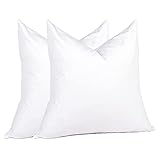
Continental Bedding 50/50 Down and Feather Throw Pillow Insert, 18×18, Single
Who it suits: The renter furnishing one good chair — the reading corner, the single armchair that is the best seat in the apartment — anyone who would rather own one excellent insert than four adequate ones.
This is the premium insert, and the pick in the guide whose positioning needs a paragraph of its own. Continental Bedding sells this 18×18 insert singly — one insert in the box — filled with a stated 50 percent white goose down and 50 percent goose feather, inside a 100 percent cotton shell at a 250 thread count, at a medium loft. Every element of that sentence is a tier above the puredown pair: ten times the down fraction, a finer shell, and a fill that behaves like bedding rather than stuffing. A 50/50 blend is the recipe behind the pillows in genuinely good hotels: the feather half gives the body and the chop, the down half gives the loft that springs back and the softness at the surface, and the result molds like feather while recovering like down. Check the current price on Amazon, because this is the premium end of the tier and the figure to check before you commit. As a single insert it takes the largest share of this budget by itself. That is not a flaw in the pick; it is the pick.
The apartment case for it is concentration. Most leases have exactly one seat that gets used for hours daily — the reading chair, the corner of the sectional nearest the lamp — and one excellent pillow there outperforms four mediocre ones spread across the rest of the furniture. What the money buys beyond feel is time, and time is a rental asset: down-blend inserts are the longest-lived components in this guide. A quality 50/50, fluffed regularly and kept in a down-proof shell, holds its loft for the better part of a decade — across two or three leases — where the polyester inserts below are a two-to-four-year proposition before they pack down into lumps. Judged over its service life, the Continental is arguably the strongest value here, and it moves in a coat closet, not a truck. The limitations are the natural fill’s own, sharpened by small square footage. It carries the same new-feather smell caveat as the puredown — milder at this down fraction, but in a studio there is no door to close on it while it airs — and the same intolerance for neglect: an unfluffed down blend in a damp bathroom-adjacent closet will clump and sulk. It is also, deliberately, a component without a costume: the honest build is this insert inside the best cover you already own. Adding a new quality cover from this guide — the fringe pair — will push the combined spend toward or over the budget, and the guide states that plainly rather than pretending the cover is free. If the cover must be new too, the puredown route above is the version of the statement idea that fits the budget more comfortably. Design-led rentals should also see Best Throw Pillows For Modern Homes Under $75.
- A true 50% goose down / 50% goose feather fill — the only high-down recipe in this guide, and the feel the other inserts imitate.
- 100% cotton shell at 250 thread count, medium loft: a finer, quieter shell than the standard down-proof weave.
- The longest service life here — down blends hold loft for years beyond polyester’s working life, so its value over time is the strongest in the guide and the insert outlasts the lease.
Honest limitation: One insert that takes the largest share of the budget for a component with no cover — check price on Amazon, because the live figure decides.
Choose it if one chair matters more than the whole sofa and you already own a cover worthy of it. Skip it if you are furnishing a whole rental sofa from zero — the coordinated route below builds four complete pillows instead of concentrating the budget on one insert.

Utopia Bedding Throw Pillow Inserts, 18×18, Set of 4
Who it suits: A renter building pillows in quantity — a full sofa, a futon that doubles as a guest bed, a loveseat plus chair — who needs four honest inserts at the lowest defensible cost per pillow and will spend the savings on covers.
Every budget in this guide is built on this box. The Utopia set is four 18×18 inserts filled with down-alternative polyester, each carrying a stated 500 grams — about 1.1 pounds — of fill, which the maker notes is roughly 15 percent more than its standard insert, in a plain white shell. The set is four inserts — check price on Amazon — and it sits at the accessible end of this tier as a legitimate core for budget builds. Polyester fill is the right villain of premium guides and the right hero of this one, and rental life is why: it is hypoallergenic, it survives machine washing without clumping into grief — decisive when the sofa is also the guest bed and the dining bench — it asks for no fluffing ritual, and modern siliconized fiber genuinely imitates down’s first-month feel. What it cannot imitate is down’s fifth year. Polyester packs down with use — the fibers mat, the loft thins, and the pillow that bounced in January leans by the following winter. That is a consumable positioned as one, and replacing the set in year three is still a modest route compared with concentrating the budget on one premium insert.
The sizing note matters more with this pick than any other, because a four-pack invites one-size thinking. The maker’s own guidance is to pair these with covers one size smaller for a full look — an 18×18 insert inside a 16×16 cover gives the plump, tailored silhouette; inside a 20×20 cover it will look underfilled no matter how it is fluffed. Buy the insert for the cover, not the other way round. The build is the coordinated route itself: this four-pack plus the MONDAY MOOSE set above builds four complete pillows inside the budget, and the box doubles as the spare-parts shelf for every other route — any cover in this guide can be stuffed from it. One apartment caution the house version of this guide does not need: four pillows is a full sofa’s worth, and on a loveseat it is a crowd that leaves nowhere to sit. Count your seats before you count your pillows — two on the loveseat and two in the chair is a layout, four on the loveseat is storage you sit on. Studios and dorm-scale rooms, where even that split is too much, will find the count argued down further in Best Throw Pillows For Small Rooms Under $75.
- Four inserts — check price on Amazon — an accessible core per complete pillow at this tier.
- A stated 500 g of fill per insert, about 15% above the maker’s standard: fuller out of the box than the category’s typical stuffer.
- Hypoallergenic, machine-washable, zero-maintenance fill — the set for apartments that host guests, pets and takeout on the same cushions.
Honest limitation: Polyester packs down over two to four years of use into a thinner, lumpier pillow — it is a consumable, positioned as one.
Choose it if you are stuffing covers in quantity or furnishing anything that gets washed, rented or sat on hard. Skip it if the pillows are the apartment’s one luxury and you will touch them daily for a decade — that is the feather picks’ job.

Foindtower Textured Boucle Throw Pillow Covers, 18×18, Pack of 2 (Camel)
Who it suits: A renter chasing the looped, nubby bouclé texture that defines the current neutral living room — and who wants the look without the designer end of the market, with eyes open about what delivers it.
Bouclé is a weave before it is a fabric: yarn looped back on itself until the surface turns to small, soft curls. In its original form it is wool, and a wool bouclé cover at retail costs more than this entire budget. This pair of 18×18 covers — the Camel colorway is the one verified here — reproduces the texture faithfully, and the maker’s own product text states the material without decoration: 100 percent polyester bouclé fabric. This guide prints that sentence in the review’s second paragraph rather than its last, because it is the most important fact about the product. For a rental sofa it cuts in the renter’s favor more often than not: polyester bouclé will not pill the way a cheap wool blend does, it shrugs off the spills and the window sunlight that would fade and felt the real thing — and apartment sofas sit in window light because there is nowhere else to put them — and it can be washed without a specialist. Check price on Amazon for the pair — it is positioned at the accessible end of the tier for the most fashionable texture in the category.
Texture is doing a specific job in a rental: a plain sofa in a plain room has no pattern, no wood grain, no architectural detail to look at, and a looped, shadow-catching surface is the cheapest way to give the eye somewhere to land. Two bouclé pillows will not do it alone — bouclé is a texture, not a pattern, and the pair wants a smoother or patterned partner from the set above. The practical notes are the ones the listing itself volunteers, to its credit. The maker allows a one-to-two centimeter deviation from hand-cutting and sewing, which means these covers can run slightly small — pair them with a true-size insert rather than sizing up aggressively, or the zipper takes the strain. Covers only, as with every Foindtower product in this guide: the build is this pair over two inserts from the Utopia box for two textured pillows inside the budget, or over the puredown pair for the full texture-plus-feel combination — check price on Amazon for each component. And the storage note: a spare pair of covers folds flat into a drawer, so a seasonal swap — bouclé in winter, the fringe pair below in summer — costs no closet at all. Care follows the fabric: gentle wash, no bleach, and keep the loops away from hooks or rough stitching in the same load — looped yarn snags, on premium covers and here alike.
- The genuine bouclé loop texture — check price on Amazon — the designer look at the tier’s accessible end.
- 100% polyester per the maker’s own text: washable, fade-resistant and pet-tolerant where real wool bouclé is none of the three.
- An 18×18 pair that builds two complete pillows over budget inserts, or over feather for the fuller combination — and stores flat when swapped out.
Honest limitation: It is polyester wearing wool’s most famous texture — no natural fiber anywhere in it — and looped yarn snags on hooks and rough hardware; the maker’s stated 1–2 cm size tolerance means covers can run small.
Choose it if texture is the missing layer on your rental sofa and washability matters more than fiber romance. Skip it if you are buying natural materials on principle — the fringe covers below are the pair in this guide with real plant fiber to argue about.

Foindtower Linen Fringe Throw Pillow Covers, 18×18, Set of 2 (Beige)
Who it suits: A renter who wants the relaxed, stonewashed natural-fiber cover — slubby weave, fringed edges, nothing shiny — to soften a boxy rental sofa, and who is willing to do one spec check on delivery that this review will explain.
This is the natural-fiber pick, and it carries the guide’s most instructive label problem, so the facts first and the warning with them. The set is two 18×18 covers with short fringe on the edges, in a slubbed plain weave with a stonewashed look, closed by zipper, covers only. For the Beige colorway featured here, the maker’s listing copy states the fabric as 80 percent linen and 20 percent cotton — a genuinely high flax content, the real article, and the reason this pair was shortlisted. Check price on Amazon for the pair. Now the warning, printed in full because the guide’s honesty rule requires it: other colorways of this same fringe line, sold under the same product name, publish a different blend in their specification fields — 70 percent ramie and 30 percent cotton, with no linen in them at all — and the maker’s solid (non-fringe) “linen” covers are spec’d at that same 70/30 ramie blend. Ramie is a real natural bast fiber, a cousin of flax with a similar hand, and a 70 percent ramie cover is a perfectly good product. It is not, however, linen, and a buyer expecting linen has been mislabeled to.
Judged as covers, whichever bast fiber arrives, the pair does the natural-fiber job properly, and the job matters in a rental: fringe and slub are softness you can see, the antidote to the sharp, wipe-clean geometry of landlord furniture. The slub weave hides the creasing that makes smooth linen look tired by noon; the fringe softens the pillow’s outline in a way piping never will; and the care instructions are the natural fiber’s usual honest bargain — hand wash recommended, machine wash in a bag on gentle if you must, tumble low, no iron — which is to say these are covers for a sofa that hosts adults, and in an apartment without a laundry room they are a sink-wash commitment worth knowing before you buy. The build is the real-materials route: this pair over the puredown feather inserts makes two complete pillows, natural inside and out, and it is the combination this guide would put on its own rental sofa. Over Utopia inserts the same covers build two pillows while keeping the natural surface and leaving more of the budget for elsewhere. One more limitation, and it is the fiber’s rather than the maker’s: natural bast fabrics soften and fade gently with washing, which devotees call character and minimalists call wear — if your room’s look depends on covers staying exactly as photographed, the polyester picks above will hold their color longer.
- A stated 80% linen / 20% cotton blend on the verified colorway — the highest natural-fiber content of any cover in this guide.
- Slubbed weave and fringe edges: the relaxed natural look, with a weave that hides creasing instead of advertising it.
- Builds the guide’s recommended two-pillow route — complete over feather inserts, or over polyester for the more budget-led version.
Honest limitation: The same product line publishes a 70% ramie / 30% cotton blend — no linen at all — for other colorways, so the fiber tag on delivery is the only guarantee; and natural bast fabric wants gentle washing, not the family wash cycle.
Choose it if natural fiber and the softened, fringed look are the point, and you will verify the tag on arrival. Skip it if you need the word linen to be a promise you never have to check — at this price, on this platform, it is a claim to verify, and the bouclé pair above makes no such claim.

Comparison Table
One row per pick, described by exactly what arrives in the box. Fiber and fill figures are the makers’ own specification claims, printed with their percentages because in this category the percentage is the product.
| Product | What you get | Price | Fiber / fill (maker spec) | Care | Link |
|---|---|---|---|---|---|
| MONDAY MOOSE Covers, Set of 4 | 4 covers only, 18×18 | Check price on Amazon | 100% polyester velvet | Zip-off covers; follow label | Check on Amazon |
| puredown Inserts, Set of 2 | 2 inserts only, 18×18 | Check price on Amazon | 95% goose feather / 5% down; 100% cotton shell | Machine washable per listing | Check on Amazon |
| Continental Bedding 50/50 Insert | 1 insert only, 18×18 | Check price on Amazon | 50% goose down / 50% goose feather; cotton shell, 250 TC | Fluff regularly; spot care | Check on Amazon |
| Utopia Bedding Inserts, Set of 4 | 4 inserts only, 18×18 | Check price on Amazon | Down-alternative polyester, 500 g fill each | Machine washable | Check on Amazon |
| Foindtower Boucle Covers, Pack of 2 | 2 covers only, 18×18 | Check price on Amazon | 100% polyester bouclé | Gentle wash; no bleach | Check on Amazon |
| Foindtower Linen Fringe Covers, Set of 2 | 2 covers only, 18×18 | Check price on Amazon | Stated 80% linen / 20% cotton (line also publishes 70% ramie / 30% cotton) | Hand wash recommended; gentle machine in a bag | Check on Amazon |
How to Choose Throw Pillows for an Apartment Under $75
- Budget the pillow, not the product. A finished throw pillow is a cover plus an insert, and at this tier the two are almost always sold apart. Before comparing any two picks, write down what each box contains and add the missing half: a cover set still needs inserts; a feather pair still needs covers — check price on Amazon for each half. The guide’s three routes are the three honest ways to make the two halves fit inside $75.
- Count seats before pillows, and scale the formula down. The standard formula — two large, two medium, one lumbar — is written for a full three-seat sofa in a full-size room. A loveseat takes 2 + 1: two 18×18 pillows at the arms and one lumbar or one textured pillow in front, and a third square will cost someone their seat. A compact three-seater takes the four-pillow coordinated build and stops. In a studio, the bed is also seating, so buy covers that work on both — the reversible MONDAY MOOSE faces earn their keep exactly here.
- Size the insert one to two inches larger than the cover. This is the single rule that separates styled pillows from sad ones. An 18×18 cover wants a 20×20 insert for the full, tailored look, or a true 18×18 for a relaxed one; an insert smaller than its cover guarantees limp corners. Feather takes the rule further — it molds rather than pushes, so feather in an exact-size cover gives the soft, slumped designer silhouette, while feather one size up gives structure.
- Read the fill percentage, not the fill name. “Feather down” on a title means, by industry recipe, about 95 percent feather and 5 percent down. Down percentage drives both the positioning and the feel: 5 percent gives structure and a chop; 50 percent gives loft, recovery and a decade of service. If a listing will not state its ratio, it is telling you the ratio would not help the sale.
- Read the fiber percentage, not the fiber name. The same rule, one layer out. “Linen” covers in this guide’s research resolved, in spec fields, to 80 percent linen, to 70 percent ramie with no flax at all, and to pure polyester with a linen look. All three can be good covers; they are not the same cover, and only one of them is linen. The sewn-in tag on delivery is the final authority — check it while returns are still free.
- Match the fill to the household, not the photograph. Feather and down blends are for adults who fluff; polyester is for apartments with children, dogs, guests on the futon and a laundromat schedule. Neither is a compromise — a washable budget insert that survives a toddler is a better product, for that household, than a premium insert it destroys. Choose the maintenance you will actually perform.
- Check the closure before the color. A concealed zipper — metal or quality nylon, running most of one side — is what makes a cover removable, washable and worth its insert. Short zippers tear covers during stuffing; envelope backs slump and gap on large pillows. Every cover in this guide closes with a zipper per its listing; verify it on the live listing, because closures are the first place a quietly revised product saves money.
Common Buying Mistakes
- Comparing a cover price to a pillow price. The category’s founding trick. A set of four covers and a single filled pillow are not rivals; one of them is four photographs and the other is a pillow. Every listing in this guide states its contents — read that line first, always.
- Dressing a loveseat like a sectional. Five pillows on a two-seat sofa means three of them live on the floor, and floor pillows in a small apartment are clutter with a cleaning schedule. Buy for the seats you have.
- Believing the word “down” on a feather insert. A 95/5 feather insert is a good product honestly labeled by its maker and dishonestly read by its buyer. If the softness of down is what you are paying for, the percentage is the product — and at this budget, real down content starts at the Continental’s 50 percent and costs accordingly.
- Believing the word “linen” on a ramie cover. Ramie is a fine natural fiber with a similar hand, which is exactly why it is substituted. The spec field and the sewn-in tag carry the truth; the title carries the aspiration. Check both, and return on the tag if it disagrees with what you paid for.
- Buying the insert the same size as the cover — or smaller. The limp-corner mistake, made by most first-time buyers. Insert one to two inches larger is the rule; listings that suggest sizing up are giving away the trade’s one real secret for free.
- Spending the whole budget on covers. Four beautiful empty covers and whatever flat inserts were already in the closet is the $75 failure mode. The insert is the pillow; the cover is its clothes. If the split must be uneven, let it be uneven toward the fill.
- Ignoring the new-feather smell until the return window closes. Natural fill can carry a barnyard note for the first days, and a small apartment gives it nowhere to dissipate. Air it, tumble it, and judge it within the week — if the smell survives airing, return it inside the window rather than hoping in month two.
Final Recommendation
For the typical apartment — a loveseat or compact three-seater in a living room that also does everything else — the coordinated route wins, and it is not close. The MONDAY MOOSE set of four covers over the Utopia Bedding four-pack of inserts delivers four complete, coordinated 18×18 pillows inside the budget: two for the sofa’s arms, two split between the second seat and the reading chair, washable end to end, styled by someone else, with room left in the budget to finish the arrangement with a single lumbar. It is the only route that solves the whole rental living room inside the budget, it asks nothing of the landlord, and every component moves with you in one box. Choose the real-materials route instead if the apartment is small but the pillows are few and touched constantly: the puredown feather inserts inside the Foindtower fringe covers build two pillows that feel like a good hotel’s — the pair this guide would own. And if one chair is the whole project, the Continental 50/50 insert in a cover you already love is the finest single pillow this $75 budget can assemble — just check the current price on Amazon first. Whichever route you take, hold the discipline the guide was built on: know what is in the box, read the percentage, size the insert up, and count your seats before your pillows.
Frequently Asked Questions
Are throw pillow covers and inserts always sold separately at this price?
Almost always, yes — and the listings that blur the point are the ones to read twice. At $75 and below, the standard offers are covers only (the MONDAY MOOSE and both Foindtower picks here), inserts only (puredown, Continental, Utopia), or coordinated sets of covers. Complete pillows exist, but the well-known ones could not be verified to the standard a link requires, so they were left out rather than guessed at.
Is a feather insert really better than a down-alternative one?
Better at some jobs, worse at others. Feather molds, holds a styled chop, breathes, and — in a down-proof cotton shell — lasts for many years; it also needs fluffing, can smell when new, and is the wrong choice for allergy-sensitive households. Down-alternative polyester is washable, hypoallergenic, maintenance-free and more accessible per insert; it also packs down over a few years into a thinner pillow.
What does “95% feather, 5% down” actually feel like?
Substantial, moldable and slightly firm — closer to a beanbag’s obedience than a cloud’s loft. The feather’s quills give the pillow body and let it hold a karate-chop dent; the small down fraction softens the surface.
How do I know if a “linen” cover is really linen?
Read the specification field, not the title — and then read the sewn-in fiber tag when it arrives. In this guide’s research, covers sold under the word linen resolved to 80 percent linen in one verified colorway, to 70 percent ramie and 30 percent cotton — no flax at all — in other colorways of the same line, and elsewhere to polyester with a linen texture. Ramie is a legitimate natural fiber and a fine cover; it is simply not linen, and it should not be priced as linen.
What size insert should I buy for an 18×18 cover?
A 20×20 for the full, tailored look; a true 18×18 for a relaxed one. The insert one to two inches larger than the cover is the trade’s standing rule, and the makers in this guide say so themselves — Utopia advises pairing its inserts with covers one size smaller for fullness. The exception is feather, which molds instead of pushing: an exact-size feather insert gives the soft, slumped silhouette designers style on purpose.