Where to buy
Check the latest price, availability and delivery on Amazon. Orders are placed on Amazon. We may earn a commission from qualifying purchases.
- Only pick verified within budget at a regular price: ASMAD Solar Firefly Lights, 2-Pack (16 LEDs) — check price on Amazon — Check on Amazon
- Best value per light, near-miss: GIGALUMI 12-Pack Solar Pathway Lights (Plastic) — usually sits just above this guide’s budget and regularly dips within it on sale; buy only when the live price falls within budget — check the current price on Amazon — Check on Amazon
- Best ground disks, deal-dependent: SOLPEX 10-Pack Solar Ground Lights (Warm White) — regularly priced above this tier and reaches it only on deal or with a code — check price on Amazon — Check on Amazon
- Best documented specs: Maggift 8-Pack Solar Powered LED Garden Lights — check the current price on Amazon; buy only if the live price falls within this guide’s budget — Check on Amazon
- Best hanging option, near-miss: GIGALUMI 12-Pack Crackle Glass Hanging Solar Lights — sits just over budget even when a code applies — check price on Amazon — Check on Amazon
See 1 more option (prose-only — no verified link)
- DenicMic 10-Pack Solar Pathway Lights — the honest step-up, priced in the tier above this guide’s budget; search Amazon by the product name — it is over budget, and appears here so you can see what stepping up a tier buys.
Read the full guide ↓
Disclosure: As an Amazon Associate, dailyhomedecorating.com earns from qualifying purchases. Links to Amazon on this page are affiliate links; they cost you nothing extra. Listing details such as price and availability change often, so check the current Amazon listing before you buy.
Here is the honest headline for solar garden lights under $15, stated before anything else: at regular prices, this budget buys accent lighting, not path lighting, and it barely buys that. Of the dozens of sets researched for this guide, exactly one could be verified within budget at an everyday, no-coupon price — a two-pack of decorative firefly lights. The big 10- and 12-packs that fill Amazon’s search results at this tier usually live in the price band above this budget in real money, and reach this tier only on sales, with clip-on coupons, or with checkout codes that expire without notice. Every brightness and runtime number in this category is a maker’s own claim with no common test standard behind it: the two most honest spec sheets in this guide rate their lights at 3 and 5 lumens respectively, which is a marker glow — enough to show where a path edge is, nowhere near enough to light the path itself, and certainly not security lighting. Solar path lights also need six to eight hours of direct sun on the panel to deliver even their claimed runtime; a shaded bed, a north-facing yard or a run of overcast winter days cuts that runtime hard. Buy at this tier expecting one to two seasons of decorative glow from plastic stakes, and this guide will not disappoint you. Buy expecting illumination, and it will.
So the six products below are the honest shape of this tier: the category’s best-known 12-pack, included as a near-miss because its regular price sits just over budget and its sale price regularly lands within it; a 10-pack of flush ground disks that only qualifies with a deal or a code; an older 8-pack with the best-documented spec sheet in the category and the only replaceable battery in the guide, which carries a check-price rule — check the current price on Amazon and buy only if it falls within budget; the one verified in-budget buy, a firefly two-pack that is pure decoration and makes no apology for it; a crackle-glass hanging set that misses the budget by a small margin even with its code applied; and one prose-only step-up in the tier above this budget, included so the gap between this budget and “actually a path set” is shown in the open. Readers lighting a specific space will also find the companion guides useful: Best Solar Garden Lights For Apartments Under $15 covers balconies, patios and rental-friendly placement, and Best Solar Garden Lights For Bedrooms Under $15 applies the same budget to the beds and borders outside bedroom windows.
Quick Picks
Short on time? Each row below names a buyer type and the product that suits it. Compare pack counts before anything else — in this category the pack count drives the value, and the per-light comparison is the only honest way to compare two sets. For every linked pick, check price on Amazon before judging it against this budget.
| Buyer type | Pick | Why it stands out | Link |
|---|---|---|---|
| Best value per light (sale-dependent) | GIGALUMI 12-Pack Solar Pathway Lights, Plastic | The category’s standard 12-pack: usually just above budget at its regular price and regularly within budget on sale — buy only when the live price falls within this guide’s budget; check the current price on Amazon | Check on Amazon |
| Best flush ground disks (deal-dependent) | SOLPEX 10-Pack Solar Ground Lights, Warm White | Disks sit flush so you can mow and walk over them; maker rates output at a candid 5 lumens max; qualifies only on deal or with a code — check price on Amazon | Check on Amazon |
| Best documented specs | Maggift 8-Pack Solar Powered LED Garden Lights | Maker publishes a real figure — 3 lumens per light — plus IP44 and the only replaceable battery in the guide; check the current price on Amazon and buy only if it falls within budget | Check on Amazon |
| Only verified buy within budget | ASMAD Solar Firefly Lights, 2-Pack (16 LEDs) | Verified within budget at a regular price, no code needed — but it is two decorative stakes, not a path set; check price on Amazon to confirm it is still in budget | Check on Amazon |
| Best hanging option (near-miss) | GIGALUMI 12-Pack Crackle Glass Hanging Solar Lights | Crackle-glass globes for hooks and branches; sits just over budget even when a code applies — check the current price on Amazon | Check on Amazon |
| The honest step-up | DenicMic 10-Pack Solar Pathway Lights | Priced in the tier above this budget — the realistic floor for a 10-pack with published specs, including a small 250 mAh battery per light; over budget, so prose-only | Search Amazon by name; it is over this guide’s budget |
How These Picks Were Chosen
The first filter was the budget, applied to a stated pack count. Solar light prices are meaningless without the count attached: a headline price for “solar lights” can hide a 2-pack, a 6-pack or a 12-pack, and the per-light value swings enormously inside this one guide depending on how many lights the pack actually contains. Every comparison below therefore names its pack size, and value is judged per light rather than per pack. The second filter was verification. A product earns a link in this guide only when its Amazon listing could be pinned down from two independent sources; where the listing was certain, the pick is linked with a check-price rule — check the current price on Amazon and buy only if it falls within budget (the Maggift works this way throughout); where the exact listing could not be pinned, the pick is prose-only with no link (the DenicMic step-up). Prices in this category are unusually slippery — the same 12-pack moves between its list position, its regular selling position and its sale position across its selling cycle — so no static price is printed for any pick here; the live listing is the only price that counts.
Brightness and runtime were handled as what they are: unstandardized maker claims. There is no common test, certification or regulator behind the lumen and hour figures in solar light listings, and the listings prove it — one 12-pack in this category advertises “1200 lumens” without saying whether that is per light or for the whole box. This guide prints a maker’s figure only when it appears in the maker’s own specification fields (the SOLPEX’s 5-lumen maximum, the Maggift’s 3 lumens), labels it as a maker figure, and treats title claims — “super bright,” “10 hours,” LED counts — as marketing. LED count in particular is a styling specification, not a brightness one: eight small LEDs behind a diffuser can be dimmer than one, and the firefly pick below markets sixteen LEDs across just two stakes. Weather resistance was taken the same way, from spec fields rather than titles: the word “waterproof” in a title is decoration, while an IP code is a defined test result — IP44 means splash-resistant, IP65 means dust-tight and jet-resistant — and where a listing’s spec table publishes no numeric code at all, the review says so.
Batteries decided more picks than brightness did. A solar light is a battery with a lamp attached, and the battery is what dies: rechargeable cells in this class fade over a few hundred cycles, which is why sealed sets are effectively disposable on a two-to-three-year horizon. Where a maker publishes a cell capacity, the review prints it — 600 mAh in the firefly pick, a reported 250 mAh in the step-up — and where the cell is a standard replaceable size, that fact leads the review, because a light whose battery can be swapped is the only kind at this price that can outlive its second season. What got excluded matters too: the category’s respected glass-and-stainless reference set and well-built 8-packs from bigger brands sit in much higher tiers, and several heavily promoted 12-packs could not be verified anywhere near this budget.
The 6 Best Solar Garden Lights Under $15
GIGALUMI 12-Pack Solar Pathway Lights, Plastic (Warm White)
Who it suits: Buyers lining a real path or driveway edge who can wait for a sale — this is the set to buy when it falls within budget, and the set to walk past at its regular price.
This 12-pack (model FXD-12) is the closest thing the budget solar aisle has to a default: twelve plastic stake lights, warm white, photocell-controlled so they charge by day and switch themselves on at dusk, with no wiring, no transformer and no manual switch to think about. It earns its place in this guide with an asterisk that the review will not hide: at its everyday regular price it is a near-miss, sitting just over this guide’s budget. The same set is a genuine budget buy on its dips — category trackers that follow this family record it regularly falling within budget on sale — so the rule is simple and strict: check the current price on Amazon, and when the live price falls within this budget it is the best value in this guide; when it sits at its regular price above budget, it is a higher-tier product wearing this guide’s recommendation, and you should either wait or step up deliberately.
What you are buying is honest, basic hardware. The bodies and stakes are plastic, and plastic stakes are the known weak point of every set in this class: push them into hard, dry or rocky ground and they snap, so soak the spot or open a pilot hole with a screwdriver first, and expect the set to look its age after a couple of seasons of sun. GIGALUMI’s own title claims the lights maintain up to ten hours of light, and that figure should be read the way every runtime claim in this category should be read — as a best case after a full day of direct sun on the panel, in mild weather, with a fresh battery. A shaded bed or a December week will return a fraction of it. The maker does not publish a battery capacity for this set in the material verified for this guide, and the IP figure attached to this family varies by version — both IP44 and IP65 appear across its listings — so treat the weather rating as splash-level until the box in your hand says otherwise, and do not buy it expecting a cell you can replace: nothing in the listing presents the battery as user-serviceable, which puts this set on the standard cheap-solar clock of a few seasons.
- Twelve lights in one pack — the best per-light economics in this guide whenever the live price falls within budget.
- Photocell dusk-to-dawn operation with no wiring and no switch; the set is genuinely fit-and-forget in a sunny bed.
- Warm white suits paths and borders; a cold-white version of the family exists if you prefer a bluer light.
Honest limitation: Its everyday price sits above this budget — it belongs in this guide only under a buy-on-sale rule — and it is plastic throughout, with an unpublished battery capacity and a weather rating that varies by version.
Choose it if the live price falls within budget — check price on Amazon — and your path gets strong sun. Skip it if it is at its regular above-budget price and you need lights this week — the DenicMic step-up below is a better use of a step-up budget.

SOLPEX 10-Pack Solar Ground Lights, Warm White
Who it suits: Buyers who want path edges marked without anything standing up to trip over, snag the mower or get kicked — and who are willing to buy through a deal or a code.
The SOLPEX ground light (model 9814) is a different format from every stake in this guide: a flat disk, about 2.9 inches across, on a stainless-steel ground spike, designed to sit flush with soil, mulch or gravel and throw its light sideways across the surface. Ten disks outline a path, a driveway edge or a bed border with nothing protruding, which makes this the one format here that survives lawn mowers, snow shovels and careless feet. Its spec sheet is also the most candid in the guide: SOLPEX’s own specification table for this listing rates light output at a maximum of 5 lumens. Believe it, and calibrate to it — 5 lumens is a glow marker that shows you where the edge is, roughly a fortieth of what a modest porch bulb puts out, and it will not light the ground in front of your feet. Judged as a marker, the format works; judged as lighting, nothing at this price works, and SOLPEX at least prints the number that tells you so.
The pricing needs the same candor. This 10-pack’s regular price sits in the tier above this guide’s budget; it enters this guide because it periodically reaches this budget on deal and with checkout codes. Codes expire, so the rule mirrors the GIGALUMI’s: check the current price on Amazon, buy it only when the live price falls within budget, and walk away at regular price. Two spec-table lessons hide in this listing. First, Amazon’s own spec table for it gives the water-resistance level as the single word “Waterproof” with no numeric IP code — roundup coverage of this line cites IP65, but the maker’s table does not, and this guide believes the table’s silence over the title’s adjective; a flush disk lives in puddles and sprinkler spray, so treat the rating as unproven and keep the disks out of standing water. Second, no replaceable-battery claim appears in the listing’s spec fields: a ground disk is a sealed puck by design, and when its cell fades the whole disk is done, typically after two to three seasons. The maker claims up to ten hours of light after a day’s charging — this guide’s standing advice is six to eight hours of sun for a full charge — and the usual photocell rule applies: dusk switches it on, dawn switches it off, and there is no manual override at this price.
- Flush disk format: nothing to trip on, kick over or catch with a mower — the most practical shape in the guide for driveway and path edges.
- The maker publishes a real output figure — 5 lumens maximum — so you know exactly how dim a marker light this is before you buy.
- Stainless-steel spikes rather than plastic, and strong per-light value whenever a deal brings the pack within budget.
Honest limitation: It only meets this budget on a deal or with a code — its regular price is in the tier above — and it is a sealed unit with no numeric IP rating in the maker’s own spec table.
Choose it if you catch it within budget — check price on Amazon — and want flush edge markers. Skip it if it is at regular price, or if your path crosses standing water after rain.
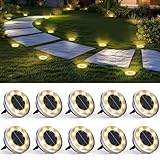
Maggift 8-Pack Solar Powered LED Garden Lights
Who it suits: Buyers who read spec sheets — anyone who wants a cheap set that can be kept alive past its second season with a battery swap instead of a re-buy.
The Maggift 8-pack is the oldest design in this guide and, on paper, the most honest. The maker’s manual and specification material publish the figure almost no budget brand will print: each light is rated at 3 lumens. That is dim — dimmer than the SOLPEX disks above — and the Maggift earns its place anyway, because a brand that prints 3 lumens is telling you the truth about what a small panel and a small cell can do, and because of what sits under its cap: a standard AAA Ni-MH rechargeable battery, pre-installed and replaceable. The manual even names a replacement battery listing. In a category built on sealed, disposable lights, that one fact changes the ownership picture completely — when the cells fade, as all Ni-MH cells do, fresh AAAs return the set to full runtime instead of sending eight plastic stakes to landfill. The lights themselves are simple: eight warm-white plastic stakes, about 11 inches tall, with an extension piece in the box that lets you run them at two heights, an IP44 splash-resistance rating taken from the spec material rather than the title, and a stated 180-day warranty.
Independent testing of this set is the most useful reality check in the guide: a test site that ran it measured roughly seven to eight hours of light against the maker’s ten-hour claim, and found the set needed more than eight hours of sun to charge fully — which is the whole cheap-solar story in one product. In a sunny bed in summer you will see most of the claim; in a shaded bed or a northern winter you will see half of it or less, and no setting fixes it, because there are none: like every pick here, the Maggift is photocell-only, on at dusk and off at dawn, with no manual switch. Now the pricing honesty this guide owes you: this pick is linked as a check-price pick with no static price printed, and the rule is strict — check the current price on Amazon and buy it only if the live listing shows the full 8-pack within this guide’s budget. (A warning worth printing: a stainless-and-glass Maggift set with a similar name sells at big-box stores; it is a different product, and its positioning says nothing about this one.) If the live price qualifies, the replaceable battery makes this the best long-term value in the guide; if it does not, the GIGALUMI on sale is the better buy.
- The only pick with a replaceable battery — a standard AAA Ni-MH cell the manual tells you how to swap — so the set can outlive its first cells.
- Maker publishes a real 3-lumen rating and an IP44 spec instead of title adjectives; independent testing exists and roughly backs the runtime story.
- Two stake heights from parts in the box, and a stated 180-day warranty.
Honest limitation: At 3 lumens a light it is the dimmest pick in the guide, it qualifies only when the live price falls within budget, and IP44 is splash resistance, not storm proofing.
Choose it if the live 8-pack price falls within budget — check price on Amazon — and you value a set you can maintain. Skip it if the live price is over budget, or you need the brightest marker glow here — the SOLPEX disks are rated higher.
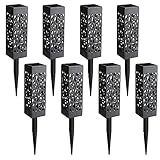
ASMAD Solar Firefly Lights, 2-Pack (16 LEDs)
Who it suits: Anyone decorating a flower bed, a planter or a garden corner who wants the firefly effect tonight at a verified in-budget price — and who understands that is all this is.
This is the only product in the guide verified within budget at a regular price, with no sale, coupon or code needed — check price on Amazon to confirm it is still in budget before you buy. What you get needs stating just as plainly, because the listing’s own framing will not state it: two stakes. Not twelve, not ten — two, making this the weakest per-light value in this guide by a wide margin. Each stake carries eight LED bulbs on thin flexible wires, sixteen LEDs in total, which sway in the breeze and flicker like fireflies over a bed; at about 32 inches tall the lights float above low planting, and the effect is genuinely charming. It is also purely decorative. Two stakes cannot line a path, mark a driveway or outline anything larger than a planter, and the light they give off is a sparkle, not a glow — nobody will navigate by it. Bought as garden jewelry, this is the guide’s easiest recommendation; bought as path lighting, it is money spent twice.
The maker’s published figures are the strongest spec set in the guide, with the usual caveat that they are the maker’s: an IP65 rating, a 600 mAh rechargeable battery — the largest cell capacity verified anywhere in this guide, larger than the step-up set’s reported 250 mAh — and a claimed ten to twelve hours of light after six to eight hours of charging — read as a summer best case, as with every pick here. Two ownership notes matter more than the numbers. The listing does not present the battery as replaceable, so treat each stake as a sealed unit: when the cell fades after a few seasons, the stake is finished, and for a small decorative pack that stings more than it does for a large, economical stake set. And if the effect wins you over, know that the same line is also sold in larger packs positioned in the tier above this budget — outside this guide’s scope, and the honest way to get more coverage is that step-up or a second 2-pack bought within budget. As with every pick here, operation is photocell-only: charge by day, on at dusk, off at dawn, no switch and no timer.
- The only pick verified within budget at a regular, no-code price — check the current price on Amazon to confirm before buying.
- The largest verified battery in the guide at 600 mAh (maker figure), plus a maker-stated IP65 rating.
- The firefly sway effect is unique in this guide — decoration no stake light here can imitate.
Honest limitation: Two stakes is decoration, not path-light coverage, and per-light value is the weakest in the guide; the battery is not presented as replaceable, so each stake is a sealed unit with a few-season life.
Choose it if you want the effect for a bed or planter and want it verifiably inside the budget today. Skip it if you need to mark an actual path — two lights cannot do it at any brightness.

GIGALUMI 12-Pack Crackle Glass Hanging Solar Lights
Who it suits: Buyers with hooks, branches, a pergola or a fence line who want the light up in the air and patterned — and who can accept a near-miss price.
Every other pick in this guide stakes into the ground; this one hangs. Twelve crackle-glass globes, each with its own small panel and LED, hang from shepherd’s hooks, tree branches, pergola beams or fence hooks, and the cracked glass throws a dappled, patterned glow that plain plastic diffusers cannot match — it is the prettiest light in the guide. The pricing, though, is this guide’s closest near-miss: even when a checkout code applies, the set has sat just over this guide’s budget, and without a code it sits further above it. There is no honest way to call that “under $15,” so this pick is labeled what it is: the closest hanging option to the budget, included because hanging is a genuinely different job, and governed by the same rule as the other near-miss — check the current price on Amazon and buy it only if a live code or coupon brings the 12-pack within budget, and know that even coded pricing has not quite got there in the past.
The practical trade-offs of hanging glass deserve their lines. Glass breaks where plastic bounces: a globe knocked off a hook in a storm is a globe gone, and there are no spares in the box. The coverage that documents this set does not publish a battery capacity or a numeric IP rating for it, so neither is claimed here — assume the category’s standard small sealed cell, a few-season life, and weather resistance suited to covered or semi-covered hanging spots. Placement has one solar-specific catch: a hanging panel under a tree canopy is a shaded panel, and a shaded panel is a short night — hang these where the tops of the globes still see direct sun for most of the day, which usually means the edge of the canopy, not under it. Operation is the family standard: photocell on at dusk, off at dawn, no manual control.
- The only hanging format in the guide — twelve crackle-glass globes whose patterned glow no plastic stake here can reproduce.
- At a qualifying price it matches the guide’s best per-light economics, with twelve globes spreading the cost across the pack.
- Gets light off the ground entirely — nothing to trip on, mow around or kick.
Honest limitation: Even its coded pricing has sat over budget — a near-miss, not an in-budget buy — and glass globes break, with no published battery capacity or numeric IP rating in the coverage available.
Choose it if a live code brings the 12-pack within budget — check price on Amazon — and you have sunny hooks or branches. Skip it if it sits above budget, or your hanging spots are under dense canopy — the panels will starve.

DenicMic 10-Pack Solar Pathway Lights
Who it suits: Buyers who read this far, concluded that this budget does not buy the path set they actually want, and would rather step up a tier once than buy within budget twice.
This pick breaks the guide’s budget on purpose and says so in its heading slot: the DenicMic 10-pack is positioned in the tier above this guide, and it is included — prose-only, without a link, because its exact listing could not be pinned to the standard this guide requires for links — as the answer to the question the whole guide raises: what does the honest floor for a real path set look like? What stepping up buys is specification. The set’s reported battery capacity is published — 250 mAh per light — its shade is an acrylic starburst design that throws a patterned pool rather than a bare dot, the stakes stand about 13 inches tall, and reported output figures of roughly 8 to 10 lumens a light put it modestly ahead of the 3-to-5-lumen verified sets above. Read those numbers with the guide’s standing skepticism: they are maker and coverage figures, not lab results, and 250 mAh is a small cell by any measure — roughly the energy budget that makes “up to ten hours” a fair-weather claim rather than a promise. Even stepped up, you are buying accent markers with better manners, not illumination.
Why print a pick you cannot click? Because the alternative guides in this category pretend that in-budget versions of this set exist at regular prices, and they do not — not verifiably. If the GIGALUMI above is within budget on the day you shop, the in-budget buy is real and this step-up is unnecessary. If the GIGALUMI is at its regular above-budget price, the SOLPEX is at regular price and the Maggift fails its check-price rule, then the choice is between stepping up now and spending within budget on a set that disappoints, followed by stepping up later. Search Amazon by the product name, confirm the 10-pack configuration and the live price before buying, and apply every rule in the choosing section below — sun, stakes, sealed battery — because stepping up one tier buys better specs, not different physics.
- Published specifications, including a reported 250 mAh battery per light — rare candor one tier up, and a realistic runtime budget.
- Acrylic starburst shades and roughly 13-inch stakes: a patterned pool of light instead of a bare dot.
- It marks the true floor for a spec’d 10-pack path set — the first tier above this guide’s budget where published specs become normal.
Honest limitation: It is over this guide’s budget, in the tier above, and prose-only because its exact listing could not be pinned for a link; its 250 mAh cells are still small, and its output is still accent-level.
Choose it if no in-budget pick qualifies on the day you shop and the path actually matters. Skip it if the GIGALUMI or SOLPEX is within budget that day — check price on Amazon for both — because the in-budget buy wins.
No link for this pick — search Amazon by the product name, and buy only the 10-pack configuration at a price you have confirmed live.
Comparison Table
Every figure below is a maker or coverage figure gathered during research — there is no common brightness or runtime standard in this category, so treat the lumen and hour columns as each maker’s own claim, useful for ranking within this table and for nothing grander. Prices are not printed here: for every linked pick, check the current price on Amazon and judge it against this guide’s budget and the stated pack count.
| Pick | Pack | Price basis | Per light | Maker brightness | Battery | Weather rating | Format |
|---|---|---|---|---|---|---|---|
| GIGALUMI Pathway (Plastic) | 12 | Near-miss: regular price just above budget, regularly within budget on sale — check price on Amazon | Best in guide when within budget (largest pack) | Not published; “up to 10 hours” title claim | Capacity not published; not presented as replaceable | Varies by version (IP44/IP65 both appear) | Plastic stakes |
| SOLPEX Ground Lights | 10 | Deal/code only: regular price above budget — check the current price on Amazon | Strong when a deal brings it within budget | 5 lumens max (spec table) | Sealed disk; no replaceable-battery claim | No numeric code in spec table (“Waterproof”) | Flush ground disks, steel spikes |
| Maggift Garden Lights | 8 | Check-price: buy only if the live price falls within budget — check price on Amazon | Judge live, per light, against the pack count | 3 lumens per light (maker spec) | AAA Ni-MH, replaceable | IP44 (spec material) | Plastic stakes, two heights |
| ASMAD Firefly | 2 | Verified within budget at a regular price — check the current price on Amazon | Weakest in guide (smallest pack) | Not published; decorative sparkle | 600 mAh (maker); not presented as replaceable | IP65 (maker) | Flexible-wire firefly stakes, 32 in |
| GIGALUMI Crackle Glass Hanging | 12 | Near-miss: just over budget even with a code — check price on Amazon | Strong if a code brings it within budget | Not published | Capacity not published | No numeric code in coverage | Hanging crackle-glass globes |
| DenicMic Pathway (step-up) | 10 | Prose-only step-up, in the tier above this budget | Mid-range for a spec’d step-up pack | ~8–10 lumens reported | 250 mAh reported per light | Not pinned for this guide | Stakes, acrylic starburst shades, ~13 in |
How to Choose Solar Garden Lights Under $15
- Audit your sun before your style. Every pick in this guide needs six to eight hours of direct sun on its panel to deliver anything near its claimed runtime. Walk the path at midday and again at four o’clock: beds that sit in house shadow, fence shadow or tree canopy for most of the day will give you two or three dim hours a night in summer and almost nothing in winter. If the spot fails the sun test, move the lights, move the planting, or choose a different lighting technology — no set at this tier outruns a shaded panel.
- Do the per-light comparison, never the pack comparison alone. Divide what you would pay by the count before you judge any set. At this tier, a large pack bought within budget is fair value for a plastic stake or disk, a spec’d step-up pack in the tier above costs noticeably more per light, and a small decorative pack — like this guide’s firefly stakes — is decoration pricing that should be bought as decoration, knowingly. Whatever the live prices are on the day you shop, check price on Amazon for each candidate and run the same per-light comparison.
- Read the spec table, not the title. Brightness in lumens, battery capacity in mAh and a numeric IP code either appear in the maker’s specification fields or they do not exist as facts. A title that says “super bright,” “waterproof” or “long-lasting” without spec-table numbers behind it is telling you the numbers would not help the sale. The two most trustworthy listings in this guide are the two that print unflattering figures — 5 lumens and 3 lumens.
- Decide how the set dies before you buy it. A replaceable standard cell (the Maggift’s AAA Ni-MH) makes a set maintainable for years. A sealed set — disks, most stakes, the firefly pick — is a consumable with a two-to-three-season life, after which the whole light is waste. Neither is automatically wrong at this budget, but the value should know which one it is: a sealed large pack bought within budget is a fair consumable; a sealed small decorative pack is a short-lived ornament.
- Match the stake to your soil. Plastic stakes snap in hard, dry, rocky or clay ground — the failure happens at installation, not in year two. Soak the spot first or open a pilot hole, and never hammer a plastic stake. If your soil is genuinely hard, prefer the formats that ask least of a stake: flush disks with steel spikes, or hanging globes that skip the ground entirely. For design-led spaces where the fixtures show — front walks, courtyards, entertaining areas — the companion guide Best Solar Garden Lights For Modern Homes Under $15 applies the same budget with the emphasis on how the sets look by day.
- Accept the photocell bargain. Every pick here is dusk-to-dawn automatic with no manual switch, no timer and no brightness modes worth the name. That is a feature until it is not: a porch light or streetlight spilling onto a panel can convince a cheap photocell that dawn has come, so place sets away from other light sources, and do not buy this tier if you need lights that stay off during a party or on past a set hour.
What $15 Buys — and What It Honestly Doesn’t
What $15 buys, on the right day, is a dozen plastic stake lights or ten ground disks at strong per-light value, a photocell that turns them on at dusk without you, and a warm marker glow that shows guests where the path edge runs and keeps flower beds visible after dark. Bought on sale and planted in full sun, that is a real product and a fair trade. What it buys every day, without a sale, is less: one verified two-pack of decorative firefly lights within budget, or a check-price rule on a well-documented 8-pack — check the current price on Amazon and buy only if it falls within budget.
What $15 does not buy is illumination. The verified output figures in this guide are 3 and 5 lumens per light; a single household bulb produces around 800. These lights mark, they do not light — they will not make steps safer to read, faces recognizable or a driveway usable, and any of them sold as security lighting is being mis-sold. It does not buy longevity: sealed cells, plastic stakes and splash-level weather ratings add up to a one-to-two-season working life for most sets here, with the replaceable-battery Maggift as the designed exception. It does not buy winter: at short days and low sun angles, expect a fraction of the claimed runtime or none at all. And it does not buy the category’s better materials — glass lenses, stainless bodies and published everything start with the step-up sets in the tier above this budget. If those are the properties you actually need, Best Solar Garden Lights Under $30 is the guide where they begin to appear — step up for a named reason like that, not because a sale price felt too cheap to be real.
Common Buying Mistakes
- Comparing pack prices instead of per-light value. A small pack and a large pack at similar pack prices are not near-neighbors; per light, they are worlds apart. The pack count is the first line of every honest comparison, and listings that hide the count behind a lifestyle photo are counting on you not to do this division.
- Believing LED counts and unscoped lumen claims. More LEDs is a styling fact, not a brightness fact — this guide’s firefly pick markets sixteen LEDs across two stakes and produces a sparkle. And when a listing claims a big lumen number without saying whether it is per light or per box, read it as per box and divide; the makers who mean per light say so in the spec table, next to figures like 5.
- Buying path lights as security lights. A 3-to-5-lumen marker does not deter anyone or record anything; it shows where the path is. If the goal is safety on steps or visibility at a door, that is a job for a wired or motion-sensor fixture with output in the hundreds of lumens, and no pick in this guide — including the step-up — is a substitute.
- Planting the panel in shade and blaming the light. The most common failure in this category is placement: stakes pushed into a bed that the house shades by two o’clock, disks under a shrub, globes under a canopy. The light is doing exactly what a starved panel lets it do. Small, awkward spaces fail this way most often — balconies, side yards and tight beds — and Best Solar Garden Lights For Small Rooms Under $15 works through placement for exactly those cramped, part-shaded spots.
- Paying the regular price for a sale-driven product. Prices in this category swing widely on coupons and codes: the guide’s main 12-pack rotates between its sale position, its regular position and its list position across its selling cycle. Buying it at its regular above-budget price because the guide “recommended” it misses the guide’s actual recommendation — the product is the pick; the live price falling within budget is the condition. Check the current price on Amazon before you judge any pick here.
- Hammering plastic stakes into hard ground. The snap you hear is the most common sound in budget solar. Soak the soil, open a pilot hole with a screwdriver or a spare metal stake, and push by hand.
Final Recommendation
Start with the sun audit, then shop by the day’s prices in this order. If the GIGALUMI 12-pack falls within budget when you look — check price on Amazon — buy it: the strongest per-light value for the category’s standard path set is the best trade in this guide, and nothing else here beats it for lining a real path. If it is at its regular above-budget price, check the SOLPEX ground disks for a live deal or code that brings them within budget — especially if your path edge needs to survive mowers and feet — and check the Maggift 8-pack against its rule, because when its live price falls within budget its replaceable battery makes it the only set here built to be kept. Buy the ASMAD firefly 2-pack whenever decoration is the actual goal: verified within budget at a regular price, it is the one purchase in this guide that needs no timing, no code and no apology — check the current price on Amazon to confirm before you order. Let the crackle-glass hanging set wait for a code that truly brings it within budget. And if none of the in-budget conditions are met on the day you shop and the path genuinely matters, step up a tier to the DenicMic step-up rather than forcing an in-budget set into a job it cannot do — in this category, the disciplined buy is the one that matches the money to the physics.
Frequently Asked Questions
Can solar garden lights under $15 actually light a path?
No — they mark a path rather than light it. The verified output figures in this guide are 3 lumens (Maggift) and 5 lumens maximum (SOLPEX) per light, against roughly 800 lumens from one household bulb. That is enough glow to show where a path edge, a step border or a bed line runs on a dark night. It is not enough to read the ground, judge a step or recognize a face, and no set at this price — including the step-up — should be bought as task or security lighting.
How long do cheap solar path lights really stay on at night?
Less than the title says, and it depends on the day more than the brand. Makers at this tier claim eight to twelve hours; the one independent test available for a pick in this guide measured about seven to eight hours from the Maggift after a full charge — and found the set needed more than eight hours of sun to get there. After a cloudy day, in a part-shaded bed, or in winter, expect two to four hours or less.
Do solar garden lights work in winter or in a shaded yard?
Poorly, and the physics is not negotiable: the panel needs six to eight hours of direct sun, and winter offers fewer hours at a weaker angle while shade offers none at any season. Sets in a sunny bed will still glow in winter, for fewer hours; sets in shade will disappoint in July too. If your only spots are shaded, the honest options are to move the lights to the sun you have, accept short seasonal runtimes, or choose a wired low-voltage set instead.
What do IP44 and IP65 actually mean on these lights?
They are defined test results, unlike the word “waterproof” in a title. IP44 means the light resists splashing water from any direction — rain, yes; sprinkler jets and puddles, not promised. IP65 means dust-tight and resistant to water jets — a genuinely tougher rating for a light that lives outdoors. Two cautions from this guide’s research: some listings attach different IP figures to different versions of the same family, and some publish no numeric code in their spec table at all. Believe the spec table of the exact listing you are buying, and treat a missing code as no rating.
Are the batteries replaceable in budget solar lights?
Usually not, and that decides how long the set lives. Most budget sets — disks, firefly stakes, most pathway stakes — are sealed: when the rechargeable cell fades after a few hundred cycles, typically two to three seasons, the whole light is done. The exception in this guide is the Maggift, which uses a standard AAA Ni-MH cell the manual tells you how to replace, turning a dead set into a set of fresh batteries. If you keep one question from this guide, make it this one: a set you can re-battery is a product; a set you cannot is a consumable, and it should be priced like one.
Why do prices on the same solar light set swing so much?
Because the list price is a stage prop and the real price rotates through sales, clip-on coupons and checkout codes. During this guide’s research, the same 12-pack family moved between its sale position, its regular selling position and its list position — a range wide enough to move it in and out of this budget entirely. The practical response is to shop the conditions, not the headline: fix your per-light ceiling within this budget, verify the pack count on the live listing, apply any code before judging the price, check the current price on Amazon, and be willing to wait a week for the dip.