Where to buy
Check the latest price, availability and delivery on Amazon. Orders are placed on Amazon. We may earn a commission from qualifying purchases.
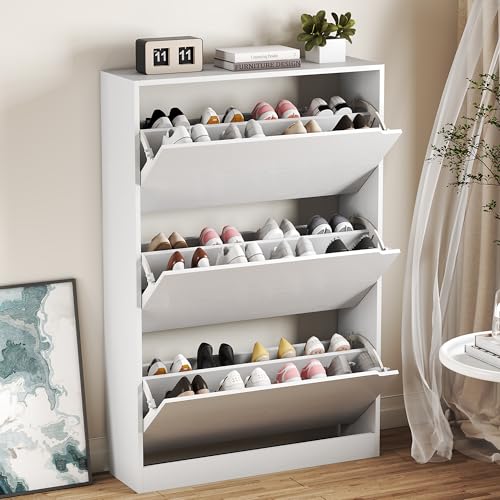
- Best for small spaces: BORNOON Shoe Cabinet with 3 Flip Drawers, White — Check on Amazon
- IRONCK Shoe Cabinet with 2 Flip Drawers and Rattan Doors, Oak — Check on Amazon
- Fsbecl Shoe Cabinet with 2 Flip Drawers, Fluted Panel, Walnut — Check on Amazon
- Maupvit Shoe Cabinet with 3 Flip Louvered Doors, Noble Blue Gray — Check on Amazon
- VASAGLE LIRY Shoe Cabinet with 3 Flip Drawers, Rustic White — Check on Amazon
See 1 more Amazon option
- Tribesigns Shoe Cabinet with Doors, 7-Tier, Wood and Gold — Check on Amazon
Read the full guide ↓
Disclosure: As an Amazon Associate, dailyhomedecorating.com earns from qualifying purchases. Links to Amazon on this page are affiliate links; they cost you nothing extra. Listing details such as price and availability change often, so check the current Amazon listing before you buy.
The best shoe cabinet for small spaces under $300 is not necessarily a small cabinet — it is a cabinet whose shape matches a space that was never meant to hold furniture. Small spaces, in the sense this guide uses the term, are the leftovers of a floor plan: the nine-inch strip of wall beside the front door, the hallway that narrows at the linen closet, the dead corner under the stairs, the laundry-room wall between the door swing and the sink. These places share one property — depth is the scarce dimension, and anything deeper than about ten inches stops being storage and becomes an obstruction. That is why the slim flip-drawer cabinet dominates this guide: at roughly nine and a half inches deep with every pair hidden behind a closed front, it converts leftover wall into finished storage, where an open rack of the same size would merely move the shoe pile somewhere more visible.
Notice how this differs from shopping for a small apartment, a search our companion guide covers on its own terms. The apartment buyer furnishes a small home; the small-space buyer — often in a house of perfectly ordinary size — is solving one impossible location. That changes the questions. Width becomes negotiable in a way it is not in an apartment: a small space may be only thirty inches wide but completely unused, so a compact two-drawer cabinet is not a compromise there, it is an exact fit. Height becomes an asset, because leftover spaces are frequently tall and narrow. And placement options multiply — closets, under-stair walls, bedroom corners, the back of a wide airing cupboard — each with its own ventilation and access logic, which the reviews below take one by one.
Our top pick is the three-drawer BORNOON in white: the most storage that fits the standard leftover footprint — about 31.5 inches wide and 9.45 inches deep — in a finish that disappears against the walls these spaces usually have. The two-drawer IRONCK and Fsbecl serve narrower leftovers, the louvered Maupvit serves the damp and airless ones, and the Tribesigns closes the guide as the closet option, the one place a deeper, door-swinging cabinet belongs. Below: quick picks by space type, the selection method, detailed reviews, a comparison table, a measuring protocol for awkward spaces, the mistakes this category invites, and answers to the small-space questions we hear most.
In this guide
Quick Picks
Short on time? Each row names a small-space type and the cabinet that fits it.
| Small-space type | Pick | Why it stands out | Link |
|---|---|---|---|
| Best overall for small spaces | BORNOON Shoe Cabinet, 3 Flip Drawers, White | Three drawers in the standard slim footprint; white fronts disappear | Check on Amazon |
| Narrow leftover wall | IRONCK Shoe Cabinet, 2 Flip Drawers, Oak | Two generous drawers for a short wall; fits sizes to US 11.5 | Check on Amazon |
| Visible corner or landing | Fsbecl Shoe Cabinet, 2 Flip Drawers, Walnut | Fluted fronts make a leftover corner look intentional | Check on Amazon |
| Damp or airless space | Maupvit Shoe Cabinet, 3 Flip Louvered Doors | Louvered fronts ventilate in under-stair and closet spaces | Check on Amazon |
| Large shoes, tight depth | VASAGLE LIRY Shoe Cabinet, 3 Flip Drawers | Maker-rated to US size 14 at only 9.4 inches deep | Check on Amazon |
| Inside a closet | Tribesigns Shoe Cabinet with Doors, 7-Tier | Shelved capacity where depth and swing already exist | Check on Amazon |
How These Picks Were Chosen
The closed-cabinet rule came first, as in every guide in this series: a pick stores every pair behind doors or flip drawers. In small spaces this rule carries extra weight, because leftover spaces are usually visible spaces — a hallway, a landing, a corner of a bedroom — and an open organizer in a visible leftover simply relocates the eyesore. The budget rule followed: real Amazon listings with research sightings inside the ceiling; check price on Amazon for the current figure on any pick.
The small-space filters were dimensional above all. We scored depth first — five of six picks stand under ten inches deep — then width, because leftover walls run short, then height, because tall-and-slim converts air into storage in a way a low cabinet cannot. We checked opening mechanics for confined spots: a flip drawer opens into the user’s own standing space, while a hinged door demands a clear arc that many small spaces cannot give — the reason the one door cabinet here is assigned specifically to closets, where the arc already exists. Ventilation was scored for enclosed placements, since under-stair and closet air is still air. Capacity claims were discounted as usual — makers count small shoes, so plan on roughly two-thirds of any headline — and we state each maker’s maximum shoe size where one is published, because in a shallow tray, length is the binding constraint.
We did not install these in an actual under-stair cupboard. Dimensions and systems come from maker listings and manuals cross-checked against independent records; placement advice is reasoned from those dimensions, and maker-only claims are flagged as such in the reviews.
The 6 Picks for the Best Shoe Cabinet for Small Spaces Under $300
BORNOON Shoe Cabinet with 3 Flip Drawers, White
Who it suits: Anyone with the classic leftover: about thirty-two inches of wall, about ten inches of depth, and a pile of shoes currently occupying both.
This is the reference size of the whole category — three flip drawers, two compartments each, in a white engineered-wood cabinet about 31.5 inches wide, 9.45 inches deep and 47.2 inches high — and it leads this guide because that footprint fits more leftover spaces than any other here: beside a front door, at the end of a hall, on the wall a bedroom door opens against. Independent coverage puts its realistic capacity at eighteen to twenty-four pairs, which for a small space is transformative arithmetic: the entire daily rotation of a couple, or one person’s full collection, removed from the floor and put behind flat white fronts that read as part of the wall. The height earns its keep in leftover spaces specifically, because these spots are usually floor-poor and air-rich — the wall above a shoe pile is almost always empty, and this cabinet is how you move the pile up it.
The white fronts will record the scuffs of a tight space, where everything brushes past everything; a melamine sponge is part of ownership. The small brand’s hardware is basic, and the flip trays share the format’s refusal of tall boots. Assembly is mid-pack. Check price on Amazon — sightings during research sat in the lower half of the budget — and if your leftover wall is shorter than thirty inches, go directly to the two-drawer picks below rather than forcing this one into a space it will overhang.
- Three drawers in the standard slim footprint: 31.5 in wide, 9.45 in deep.
- Realistic eighteen to twenty-four pairs — a whole rotation off the floor.
- Height uses the empty wall above the old shoe pile.
- Flat white fronts disappear against typical hallway walls.
Honest limitation: Needs its full thirty-one-plus inches of width, and white fronts show tight-space scuffs.
Choose it if your leftover space matches the standard footprint. Skip it if your wall is shorter — that is what the IRONCK and Fsbecl are for.
IRONCK Shoe Cabinet with 2 Flip Drawers and Rattan Doors, Oak
Who it suits: Shorter leftover walls — the stretch beside a door, a landing turn, a bedroom corner — where thirty-one inches is not available or not needed.
Two drawers sounds like the compromise pick until you measure real leftover spaces, a surprising number of which are two-drawer-sized: the wall segment between a door frame and a corner, the turn of a landing, the gap a radiator leaves. The IRONCK fills those segments properly — two flip drawers, each double-layered with an adjustable or removable center divider, behind hand-woven rattan fronts in an oak finish that warms the utilitarian corners these spaces tend to be. The maker’s specific claim that men’s shoes to US size 11.5 fit without removing the panel matters doubly in small spaces, because a small cabinet that rejects the household’s largest daily pair has failed at its only job. Plan on a realistic load in the high teens of pairs despite the higher headline claim.
Rattan is the delicate front of the guide — in a tight corner where bags and vacuum cleaners swing past, it will collect the occasional knock, and woven fronts forgive less than flat ones. Two drawers also cap the system hard. Check price on Amazon; sightings put it in the lower-middle of the budget. For spaces that are small but belong to a whole apartment rather than one location, Best Shoe Cabinet For Small Apartments Under $300 takes the whole-home view.
- Two double-layer drawers for short leftover walls.
- Maker states up to US 11.5 fits without panel removal.
- Rattan and oak warm up utilitarian corners.
- Adjustable divider handles heels and ankle boots.
Honest limitation: Delicate fronts in knock-prone corners, and a firm two-drawer ceiling.
Choose it if your space is short-walled and adult-sized shoes must fit. Skip it if the corner takes heavy traffic — a flat front survives it better.
Fsbecl Shoe Cabinet with 2 Flip Drawers, Fluted Panel, Walnut
Who it suits: Visible small spaces — an entry corner guests see, a landing, a living-room wall — where the storage has to look deliberate.
The Fsbecl’s contribution to a small space is not capacity but intent: fluted walnut-finish fronts and black handles turn a leftover corner into a designed one, the difference between a room with storage in it and a room that happens to contain a shoe cabinet. The carcass is about 31.5 inches wide, 9.4 inches deep and 35.4 inches high — lower than the three-drawer picks, which suits spaces under windows, under stair slopes and beneath wall art, where a taller unit would crowd the composition. About 4.72 inches of clearance underneath lets a robot vacuum patrol beneath it, a small-space virtue out of proportion to its size, because leftover corners are where dust settles deepest. Inside: two double-layer drawers with removable shelves, about twelve to sixteen pairs by the maker’s count.
Twelve to sixteen pairs is an edited rotation, and a small space that serves a whole household will outgrow it; this is a per-location solution, not a whole-home one. The walnut finish is a surface over engineered wood, and the brand is a small marketplace maker. Check price on Amazon — deal coverage during research placed it in the lower-middle of the budget, remarkable for the best-looking object in the guide.
- Fluted fronts make a leftover corner look designed.
- Lower height suits under-window and under-stair-slope spots.
- Vacuum clearance beneath — leftover corners stay cleanable.
- Two drawers, about twelve to sixteen pairs.
Honest limitation: The smallest capacity here; a location solution, not a household one.
Choose it if the space is visible and the rotation edited. Skip it if this spot must hold a household’s shoes.
Maupvit Shoe Cabinet with 3 Flip Louvered Doors, Noble Blue Gray
Who it suits: Enclosed small spaces — under-stair cupboards, closets without doors of their own, laundry corners — where air does not move and shoes should not marinate.
Small enclosed spaces have an atmosphere problem: the air under the stairs or at the back of a deep closet barely circulates, and a sealed cabinet of daily shoes placed there concentrates everything the shoes brought home. This Maupvit’s louvered flip fronts are the engineering answer — slatted doors that let the cabinet breathe passively while keeping every pair hidden — on a cabinet about 31.5 inches wide, 9.45 inches deep and 47.24 inches tall. Three double-layer drawers are rated by the maker at twenty-four to thirty-two pairs, and the third drawer is extended to about 15.75 inches for larger shoes, a detail that matters when the small space is also the only space and the big pair has nowhere else to go. The blue-gray finish gives an overlooked corner a deliberate color, which in practice makes households treat the spot as furnished rather than forgotten.
Louvers pass dust along with air, and enclosed small spaces generate their own dust, so the grooves want a brush when you clean the space itself. Ventilation also has limits: a truly damp under-stair area should be dried at the source before any cabinet moves in, because no louver fixes a leak. Check price on Amazon for the current figure.
- Louvered fronts ventilate in airless enclosed spaces.
- Three drawers; maker-rated twenty-four to thirty-two pairs.
- Extended bottom drawer for the largest pair.
- Color finish upgrades a forgotten corner.
Honest limitation: Louvers admit dust, and no cabinet belongs in a space with an active damp problem.
Choose it if your small space is enclosed and still-aired. Skip it if the space is dusty or damp at the source.
VASAGLE LIRY Shoe Cabinet with 3 Flip Drawers, Rustic White
Who it suits: Small spaces that must accommodate large shoes — the hallway niche of a tall household, the only wall a big-footed renter has.
Depth and shoe length pull in opposite directions: a tray shallow enough for a leftover space is usually too short for a large shoe, and the pair ends up on the floor in front of the cabinet bought to hide it. The VASAGLE LIRY is the exception this guide keeps returning to — maker-rated for shoes up to US size 14, with three-position adjustable shelves in each of its three flip drawers so a long shoe can lie flatter, in a carcass only about 9.4 inches deep, 34.3 inches wide and 48.7 inches tall, holding a stated eighteen to twenty-four pairs. For a small space, the extra height is well spent: it converts the wall above into storage while the footprint stays leftover-sized. VASAGLE’s included anti-tip kit and proper manual matter here too, because tall cabinets in tight spaces get bumped, and the anchor is what a bump meets.
The large-size configuration costs capacity in the drawer you configure, and the rustic white farmhouse finish will look stranded in a sleek hallway — in a small space there is nowhere for a style mismatch to hide. Check price on Amazon; sightings placed it mid-budget. Households whose small space is a whole small home should cross-check Best Shoe Cabinet Under $300 for the wider comparison.
- Maker-rated to US size 14 at only 9.4 inches deep.
- Three drawers with three-position adjustable shelves.
- Tall format converts empty wall above into storage.
- Anti-tip kit included — essential for tall units in tight spots.
Honest limitation: Large-size setup costs drawer capacity, and the farmhouse finish is conspicuous in a small space.
Choose it if big shoes and shallow depth must coexist. Skip it if your space is style-sensitive modern.
Tribesigns Shoe Cabinet with Doors, 7-Tier, Wood and Gold
Who it suits: The one small space with depth to spare: the inside of a closet, a wide airing cupboard, a utility room — where shelves can do what trays cannot.
Every other pick here is slim because most small spaces are shallow. But one common small space is deep: a closet. Inside a closet, the constraints invert — depth exists, swing exists (the closet door already claims it), and what is scarce is organized capacity. There, this Tribesigns is the right tool: two hinged doors over seven adjustable shelves, about 29.6 inches wide, 14.6 inches deep and 43.3 inches high, E0-grade MDF with 0.59-inch boards, rated up to thirty pairs on the maker’s US listing and twenty-four on its Canadian one. Shelves take boots, boxes and the odd shapes a household accumulates, a shelf removes for a tall row, and the whole collection closes behind the cabinet’s doors and then the closet’s — storage squared. Raised gold-tone legs keep the base clear of closet floors that see the occasional leak or spill.
Outside a closet, in a genuinely shallow small space, this is the wrong cabinet and the guide says so without hedging: 14.6 inches of depth plus a door arc will obstruct a hallway that a flip cabinet would have left alone. Shelves also need a per-shelf system to stay orderly. Check price on Amazon; sightings placed it mid-budget.
- Seven shelves behind two doors — maximum closet capacity.
- Takes boots, boxes and tall rows with a shelf removed.
- Double-doored storage inside a closet stays dust-free.
- Raised legs protect the base on utility floors.
Honest limitation: Wrong for shallow spaces — this is the closet pick, and only the closet pick.
Choose it if your small space is a closet interior. Skip it if your space is a hallway or corner — every other pick here is five inches shallower for a reason.
Comparison Table
| Product | Type | Best small-space use | Link |
|---|---|---|---|
| BORNOON, 3 Flip Drawers, White | Flip drawers, 9.45 in deep | The standard leftover footprint | Check on Amazon |
| IRONCK Rattan, 2 Flip Drawers | Flip drawers, compact | Short walls and landing turns | Check on Amazon |
| Fsbecl, 2 Flip Drawers, Walnut | Fluted fronts, lower height | Visible corners; under windows | Check on Amazon |
| Maupvit Louvered, 3 Flip Doors | Flip drawers, louvered fronts | Enclosed, airless spaces | Check on Amazon |
| VASAGLE LIRY, 3 Flip Drawers | Flip drawers, size 14 rated | Large shoes at shallow depth | Check on Amazon |
| Tribesigns 7-Tier with Doors | Hinged doors, 14.6 in deep | Inside closets and cupboards | Check on Amazon |
How to Choose a Shoe Cabinet for a Small Space
- Measure the space in three dimensions, including the slope and the swing. Small spaces have complications flat walls do not: stair slopes, skirting boards, door arcs, radiator pipes. Measure width at the floor and at cabinet height, depth to the first obstruction, and the arc of every door that opens nearby.
- Tape the footprint and live with it for a day. A painter’s-tape outline on the floor and a cardboard silhouette against the wall will tell you more than any dimension table — especially whether the walkway still works at laundry-basket width.
- Match the cabinet to the space type, not just the size. Open hallway leftovers want slim flips; enclosed airless spots want louvers; closets want shelves. The same dimensions in the wrong type still fail.
- Spend height before width. Leftover spaces are usually taller than they are wide. A taller three-drawer cabinet on the same footprint stores half again as much as a low one — provided it is anchored, which in a tight space is doubly non-negotiable.
- Check the largest shoe against the tray, not the average shoe. In shallow storage, one oversized daily pair defeats the system. Look for a published maximum size or an extended drawer, or accept a door cabinet in a closet as the big pair’s home.
- Plan cleaning access. A cabinet wedged into a leftover with no room to open fully, vacuum beneath or brush out will decay in place. Leave the inches that maintenance needs, or choose a raised design whose underside a vacuum can reach.
- Respect the space’s other job. Under-stair spots store suitcases too; hallway leftovers host the vacuum’s charge point; corners hold the plant. A cabinet that consumes a dual-purpose space entirely has solved one problem by creating another.
- Check the live price on the day you buy. This guide prints no fixed prices, because furniture figures move with sale events and the two-drawer and three-drawer tiers often converge in event weeks. Compare the current price on Amazon across your shortlist before letting price decide the size.
A Field Guide to Leftover Spaces
Under the stairs is the classic: deep at one end, sloping at the other, dark and still-aired. The working pattern is a cabinet at the tall end — measure the height where the slope clears the cabinet’s top, not where the space begins — with louvered fronts if the cupboard door usually stays shut, and the low end left for the boot tray and the vacuum. The hallway narrowing is the second classic: a wall that loses six inches to a linen closet or a chimney breast, leaving a segment too shallow for any normal furniture. That segment is precisely flip-cabinet depth, and the correct move is to fill it completely, wall to wall if the widths allow, because a cabinet that fills its leftover looks built-in and a cabinet that almost fills it looks apologetic.
The laundry and utility corner is the third: damp-adjacent, warm, and already the home of the shoes that work hardest. Louvers or rattan again, legs rather than a plinth against the occasional spill, and never the household’s best shoes — this is the working cabinet, and the good pairs live at the front door. Finally, the bedroom corner and the closet interior, the quiet spaces: here the cabinet’s job is overflow and out-of-season storage, the closet is where the deep shelved Tribesigns belongs, and the bedroom corner takes whichever slim pick matches the room, holding the collection so the entryway can hold only the rotation. Four space types, four logics — the guide’s picks map onto them one to one, which is the real structure beneath the ranking.
Seasonal Rotation: Making a Small Space Hold a Whole Year
A small space fails in a predictable month: not when it is installed, but at the first change of season, when the boots arrive and the sandals have nowhere to go, or the reverse in spring. The cabinet did not shrink; the collection rotated, and nobody planned the exchange. The system that prevents it is a two-location household, and it works at almost any home size. The small-space cabinet — whichever pick from this guide fits your leftover — holds only the current season’s rotation: the pairs in weekly use, plus one occasion pair per person. Everything else lives in the household’s second location, which can be a closet shelf, under-bed boxes, or the deep Tribesigns-style cabinet in a cupboard if you have one. Twice a year, on a fixed weekend rather than a vague intention, the two locations trade contents: out-of-season pairs are cleaned, dried, stuffed to hold their shape and moved out; the incoming season moves in.
The rotation does three kinds of work at once. It keeps the small cabinet at the load its drawers were designed for, so trays close cleanly and nothing is forced. It forces a twice-yearly audit, which is when outgrown, worn-out and simply unloved pairs leave the house — the only mechanism that reliably stops a shoe collection growing past its storage. And it protects the stored shoes themselves, because a pair resting a season in a dry box with its shape held ages better than a pair crushed at the back of an over-full tray for a year. Small-space storage is often described as a compromise, a lesser version of having room. Run on a rotation, it is closer to the opposite: a system that keeps every pair you own clean, shaped, findable and honestly counted — something many a walk-in closet full of shelves never achieves.
Two Small Spaces, One Household: Splitting Storage by Job
Many homes do not have one small space with a shoe problem; they have two, and treating them as one problem with one cabinet is why both stay half-solved. The common pattern is a front-door leftover and a back-of-house leftover — the hallway segment and the laundry corner, the entry niche and the under-stair cupboard — with different jobs that a single cabinet, wherever it stands, cannot do simultaneously. The front space needs the daily rotation, fast and presentable: a slim flip cabinet, drawers assigned, top kept clear. The back space needs the opposite virtues — capacity, tolerance, discretion — for the working shoes, the seasonal bench and the pairs in time-out. Split the budget across the two jobs and each space gets the format it actually wants, which is usually a three-drawer cabinet at the front and either a second slim unit or the shelved closet pattern at the back.
The discipline that makes the split work is a strict border between the two locations. A pair lives in exactly one place, and the border moves only at the seasonal rotation or when a pair’s job genuinely changes — the trainers promoted to daily wear, the work boots retired to weekends. What destroys the system is the casual third location: the pair that lives “temporarily” by the sofa, the shoes migrating to a bedroom floor because both cabinets were full on a wet night. Temporary locations are where small-space systems go to die, because a leftover space has no slack to absorb them visibly. Keep the border, run the rotation, and two modest cabinets in two awkward spaces will outperform one large cabinet in a good space — because the shoes, like everything else in a house, are stored best nearest the door they actually use.
What Small-Space Owners Learn in the First Year
Talk to people a year after they solve a small-space shoe problem and the lessons repeat with unusual consistency. The first is that the cabinet was never really about shoes: it was about the ten square feet of floor the shoes were occupying, and the day those ten feet come back — as passage, as a place a laundry basket can land, as the spot a child can sit to tie laces — the purchase is reclassified in the owner’s mind from storage to renovation. This is why satisfaction in this category runs higher than the modest objects seem to promise: a small space has no slack, so every recovered inch is felt at full value, every day, in a way that the same cabinet in a large hall would never be noticed.
The second lesson is that access beats capacity at the margin. Owners consistently report using the top two drawers daily and the bottom drawer weekly, whatever they intended at installation, because small spaces make bending and reaching feel more expensive than they are. The practical response is to stock by frequency, ruthlessly: the daily pair at the height of your hand, the weekly pair below, the monthly pair at the bottom — and to re-sort without sentimentality when a pair’s frequency changes, because a small cabinet stocked by habit instead of by use quietly wastes its most valuable shelf. The third lesson is about the space itself: a leftover that has been given a finished, closed, deliberate piece of furniture stops being perceived as a leftover. Visitors read it as a nook; owners read it as the hardest-working wall in the house. That transformation — from apology to architecture — is the real product this category sells, and it is why the finish and the fit matter as much as the drawer count in every review above.
Measuring Awkward Spaces: A Ten-Minute Protocol
Small spaces punish casual measuring more than any other location in the home, because their dimensions are rarely what a single tape reading suggests. Work through the space in a fixed order and write the numbers down. First, width at three heights — at the skirting, at waist height and at the cabinet’s proposed top — because old walls lean and chimney breasts bulge, and the smallest of the three readings is your true width. Second, depth at both ends of the proposed footprint, for the same reason; a cabinet rocked on an uneven shallow floor will tell you about it every time a drawer tips. Third, the obstructions inventory: skirting boards steal half an inch of depth and tilt a cabinet that is pushed hard against them, radiator pipes steal more, and door casings steal width that a flat measurement of the wall alone will happily promise you. Measure to the casing, not past it.
Fourth, the arcs: open every door that swings near the space — the room door, the cupboard door, the cabinet’s own doors if it is a hinged model — and mark their sweeps on the floor with tape, because a placement that works with every door shut can fail the first time two of them move at once. Fifth, the human test: stand in the space as you will stand to use the cabinet, shopping in hand, and tip an imaginary drawer toward you; if your elbows negotiate with a wall, the real drawer will too. Ten minutes of this protocol is the entire difference between a cabinet that fits its leftover like it was built there and one that spends its life slightly, permanently wrong — and in a small space, slightly wrong is the kind you see every day.
Common Buying Mistakes
- Measuring width and depth but not the slope, the skirting or the nearby door’s swing.
- Forcing a standard-width cabinet into a shorter leftover so it overhangs into the walkway.
- Putting a sealed cabinet in an airless under-stair space and discovering the smell by autumn.
- Buying a deep door cabinet for a shallow hallway because the pair count looked generous.
- Wasting a tall leftover on a low cabinet and leaving the storage the wall offered unused.
- Wedges the cabinet in with no cleaning access, then never opening the bottom drawer again.
- Forgetting the anchor in a tight space, where a tipping cabinet has the least room to be caught.
- Solving the shoe space by consuming the only spot the vacuum, the suitcases or the laundry basket had.
Final Recommendation
- Most small spaces: BORNOON Shoe Cabinet, 3 Flip Drawers, White.
- Short walls: IRONCK Shoe Cabinet, 2 Flip Drawers, Oak.
- Visible corners: Fsbecl Shoe Cabinet, 2 Flip Drawers, Walnut.
- Enclosed spaces: Maupvit Shoe Cabinet with 3 Flip Louvered Doors.
- Large shoes, shallow depth: VASAGLE LIRY Shoe Cabinet, 3 Flip Drawers.
- Closet interiors: Tribesigns Shoe Cabinet with Doors, 7-Tier.
Start with the BORNOON if your space is the standard leftover — thirty-odd inches of wall and ten of depth — because three drawers in that footprint is the most useful object in this category. Shrink to the IRONCK or the Fsbecl when the wall is shorter or the corner is on display, breathe with the louvered Maupvit when the space is enclosed, stretch to the VASAGLE when the shoes are large, and reserve the Tribesigns for the closet, the one small space where depth is a feature. Measure in three dimensions, tape the footprint, anchor the result, check the current price on Amazon, and the least promising square footage in your home becomes the hardest-working.
Frequently Asked Questions
What is the shallowest useful shoe cabinet?
About nine and a half inches deep is the practical floor for closed shoe storage, and it is where the flip-drawer format lives: shoes stand nearly upright in double-layer trays, so the cabinet hugs the wall while still hiding every pair. Shallower products exist, but below this depth shoes must be stored at angles that waste the space saved, or the product stops being a cabinet and becomes a rack with a cloth over it.
Can a shoe cabinet go under the stairs?
Yes, and it is one of the best uses in this guide — with two checks. Measure the height where the stair slope actually clears the cabinet’s top, since the tall end and the low end of an under-stair space are different rooms dimensionally. And if the under-stair door stays shut, choose a breathing front — louvered or rattan — because the air in there does not circulate on its own. Solve any actual damp at the source first; no cabinet belongs against a wet wall.
My space is only about 24 inches wide. Is there a cabinet for it?
Honestly, not among the verified picks in this guide — the compact two-drawer cabinets here cluster around thirty-one inches wide, and we will not invent a narrower product to complete the answer. The realistic options for a two-foot wall are a slim cabinet on the nearest wider wall with the rotation split, or a closet solution like the Tribesigns pattern. A space that narrow is usually better given to hooks, a boot tray and a bench than to a cabinet that would have to be custom to fit it.
Flip cabinet in a closet, or shelved cabinet in a closet?
Shelved, in most closets. A closet already provides the enclosure and the door swing, so the flip format’s two advantages — slimness and a finished front — are wasted inside it, while shelves use the closet’s depth for boots, boxes and bulk capacity. The exception is a shallow reach-in closet under about twelve inches of usable depth, where a flip cabinet’s trays use the space better than shelves can.
How do I stop a small-space shoe cabinet from smelling?
Ventilation matched to the space. In an open hallway, any front works if shoes go in dry. In an enclosed space — under-stair, closet, laundry — choose louvered or rattan fronts, air daily shoes before storing them, and add a charcoal bag per drawer. If the space itself smells damp before the cabinet arrives, treat that first: a cabinet amplifies the room it stands in.
Does a tall slim cabinet need anchoring in a tight space?
More than anywhere else. A tight space means a falling cabinet meets a wall, a door or a person within inches, and an open flip drawer moves the center of gravity toward whoever opened it. Every pick here includes or supports an anti-tip kit; in a small space, fitting it is part of the installation, not an optional extra — and the confined placement often makes the fitting easier, since studs and solid walls are usually close at hand in leftover spaces.


