Where to buy
Check the latest price, availability and delivery on Amazon. Orders are placed on Amazon. We may earn a commission from qualifying purchases.
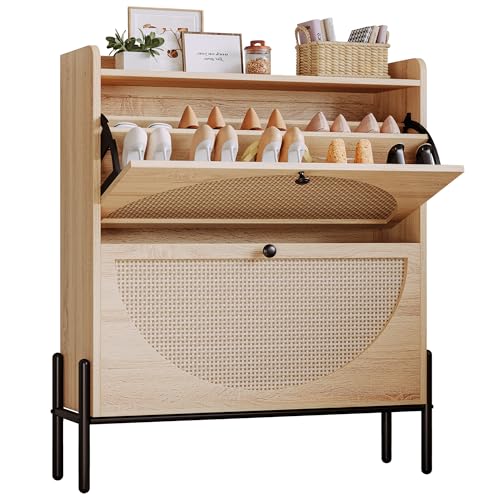
- Best for small apartments: IRONCK Shoe Cabinet with 2 Flip Drawers and Rattan Doors, Oak — Check on Amazon
- BORNOON Shoe Cabinet with 3 Flip Drawers, White — Check on Amazon
- VASAGLE LIRY Shoe Cabinet with 3 Flip Drawers, Rustic White — Check on Amazon
- Maupvit Shoe Cabinet with 3 Flip Louvered Doors, Noble Blue Gray — Check on Amazon
- Fsbecl Shoe Cabinet with 2 Flip Drawers, Fluted Panel, Walnut — Check on Amazon
See 1 more Amazon option
- Tribesigns Shoe Cabinet with Doors, 7-Tier, Wood and Gold — Check on Amazon
Read the full guide ↓
Disclosure: As an Amazon Associate, dailyhomedecorating.com earns from qualifying purchases. Links to Amazon on this page are affiliate links; they cost you nothing extra. Listing details such as price and availability change often, so check the current Amazon listing before you buy.
The best shoe cabinet for small apartments under $300 is decided by a measurement most listings print in small type and most buyers read too late: depth. In a small apartment the entryway is usually a fiction — a patch of hallway, the wall beside the door, the three feet between the kitchen counter and the sofa — and every inch a cabinet projects into that space is an inch taken from a walkway you use fifty times a day. That is why this guide is built around the slim flip-drawer format, whose cabinets stand only about nine and a half inches deep while hiding every pair behind a closed front. An open rack would be shallower still in a few cases, but it displays your shoes to the whole apartment permanently; in a studio, your entryway storage is your living room furniture, and closed doors are the difference between a home and a hallway with a sofa in it.
Two apartment-specific problems shape the ranking below. The first is swing and tip clearance: a hinged door needs an arc of empty floor in front of it, while a flip drawer needs only the space your own feet already occupy — one reason five of our six picks flip, and why the single hinged-door cabinet, the Tribesigns, appears here with its depth and swing stated plainly as the option for apartments with a genuinely separate entry alcove. The second problem is the wall. Tall, narrow cabinets must be anchored against tipping, and renters must do it without losing a deposit: the reviews and the buying guide cover the anchor hardware each model includes and the least-invasive ways to fit it, because “freestanding” on a listing does not repeal physics.
Our top pick for a small apartment is the two-drawer IRONCK in oak — the right capacity for one or two people’s daily rotation, in a footprint a studio can spare — with the three-drawer BORNOON and VASAGLE close behind for couples whose rotations run larger. Below you will find the quick picks, the selection method, detailed reviews written around apartment dimensions and rental realities, a comparison table, a measuring protocol for tiny entries, the mistakes small-space buyers make, and the questions that come up again and again in apartments specifically.
In this guide
Quick Picks
Short on time? Each row names an apartment situation and the cabinet that suits it.
| Apartment situation | Pick | Why it stands out | Link |
|---|---|---|---|
| Best overall for small apartments | IRONCK Shoe Cabinet, 2 Flip Drawers, Oak | Two generous drawers, rattan fronts, slim depth — studio scale | Check on Amazon |
| Couple with a bigger rotation | BORNOON Shoe Cabinet, 3 Flip Drawers, White | Three drawers in a plain white finish that brightens a small entry | Check on Amazon |
| Large shoe sizes, small flat | VASAGLE LIRY Shoe Cabinet, 3 Flip Drawers | Maker-rated to US size 14 without eating floor space | Check on Amazon |
| Studio with no entry hall | Maupvit Shoe Cabinet, 3 Flip Louvered Doors | Louvered fronts ventilate and read as furniture in a living space | Check on Amazon |
| Design-led small entry | Fsbecl Shoe Cabinet, 2 Flip Drawers, Walnut | Fluted fronts make the storage double as the entry console | Check on Amazon |
| Apartment with a real entry alcove | Tribesigns Shoe Cabinet with Doors, 7-Tier | Hinged doors and shelves for boots — if you have the depth | Check on Amazon |
How These Picks Were Chosen
The closed-cabinet rule came first, as in every guide in this series: doors or flip drawers over every pair. In a small apartment this rule matters more, not less — the smaller the home, the more of your life happens within sight of the entryway, and the more an open shoe rack taxes the room. The budget rule followed: real Amazon listings with research sightings inside the ceiling; check price on Amazon for the current figure on any pick, as furniture pricing moves with sale events.
The apartment filters then did the real work. Depth was scored first — every pick except the Tribesigns stands under ten inches deep, and we state the Tribesigns’ 14.6 inches wherever it appears so no studio buyer orders it by mistake. Footprint came next: width against the wall lengths apartments actually have, which is why the two-drawer cabinets rank higher here than in our general guide. We checked opening mechanics — flip drawers that need no swing arc — and anchoring provisions, noting which kits are included. Capacity claims were discounted in the usual way (makers count small shoes; plan on roughly two-thirds), but for apartments the honest question is inverted: not “how much can it hold?” but “how little storage can you live with beautifully?” — because the correct apartment cabinet is the smallest one that holds your real rotation.
We did not test these in an actual studio. Dimensions, materials and drawer systems come from maker listings and manuals cross-checked against independent records; the apartment scenarios are reasoned from those dimensions, and where a claim belongs to the maker alone, the review says so.
The 6 Picks for the Best Shoe Cabinet for Small Apartments Under $300
IRONCK Shoe Cabinet with 2 Flip Drawers and Rattan Doors, Oak
Who it suits: Solo renters and couples in studios and one-bedrooms whose entryway is a wall, not a room.
Two drawers is the correct size for most small apartments, and this IRONCK makes those two drawers count. Each flip drawer holds two levels of shoes with an adjustable or removable center divider, and the maker states that men’s shoes up to size 11.5 fit without removing the panel — the specific, checkable claim that separates a usable small cabinet from a decorative one. The headline capacity figure runs optimistic, as they all do; plan on the high teens of pairs in adult sizes, which is one person’s full rotation or a couple’s daily set with room for the guest pair. The hand-woven rattan fronts in an oak finish matter more in an apartment than in a house: the cabinet will sit in your living space, visible from the sofa, and woven fronts with warm wood tones read as a sideboard rather than as storage equipment. The depth is the flip format’s standard slim profile, so the piece hugs the wall beside the door and leaves the passage alone.
The limits are the honest ones for its class: a third person’s shoes break the system, tall boots have no home here, and rattan is the most delicate front material in the guide — fine in an adult apartment, less fine with a cat that sharpens its claws vertically. Assembly is the shortest in the guide. Check price on Amazon; sightings during research put it in the lower-middle of the budget, the right tier for a first-apartment piece you may outgrow. If your apartment is small but your household is three, step directly to the three-drawer picks below rather than hoping two drawers stretch.
- Two double-layer flip drawers sized for one or two people.
- Maker states up to US 11.5 fits without removing the divider.
- Rattan and oak finish reads as living-room furniture in a studio.
- Slim flip depth — no swing arc, no lost walkway.
- Adjustable divider flexes for heels and ankle boots.
Honest limitation: A hard ceiling at two drawers, and rattan fronts dislike claws and impacts.
Choose it if your household is one or two people and the cabinet will live in sight. Skip it if three people — or one person with thirty pairs — need storing.
BORNOON Shoe Cabinet with 3 Flip Drawers, White
Who it suits: Couples in small apartments who need the third drawer, and anyone whose entry is a dim corner that white furniture genuinely helps.
The third drawer is the difference between a rotation and a collection, and the BORNOON adds it without adding depth: three flip drawers with two compartments each, in a white engineered-wood cabinet about 31.5 inches wide, 9.45 inches deep and 47.2 inches high. Independent coverage puts the realistic capacity at eighteen to twenty-four pairs — a couple’s complete everyday set, or one person’s rotation plus sports and seasonal pairs. The flat white fronts do apartment-specific work: they bounce what little light a small entry has, they match the white walls most rentals cannot be repainted away from, and they make the cabinet visually quieter than its dimensions, which in a small home is worth as much as an inch of depth. The top becomes the landing strip — keys, mail, a small plant — that most small apartments have nowhere else to put.
White flat fronts record scuffs honestly, and in a tight entry where the cabinet is brushed past daily, expect to wipe them and occasionally de-scuff them with a melamine sponge. The brand is small, the hardware basic. Tall boots remain outside the flip format’s physics. Check price on Amazon — sightings sat in the lower half of the budget — and if even three drawers sound like more than your wall allows, Best Shoe Cabinet For Small Apartments Under $150 covers the smaller tier.
- Three drawers, realistic eighteen to twenty-four pairs.
- White fronts brighten dim rental entries and match rental walls.
- Same slim 9.45-inch depth as the two-drawer picks.
- Top surface doubles as the apartment’s landing strip.
Honest limitation: White shows every brush-past scuff in a tight entry, and hardware is basic.
Choose it if you are a couple who needs the third drawer in a bright, plain finish. Skip it if your entry is a high-traffic scuff zone — a wood finish forgives more.
VASAGLE LIRY Shoe Cabinet with 3 Flip Drawers, Rustic White
Who it suits: Small-apartment dwellers with large feet — the combination slim cabinets usually fail.
Apartment shoe storage has a cruel joke built in: the slimmer the cabinet, the smaller the shoe it fits, and the people most likely to live in small apartments include plenty of size-13 students and size-14 partners. VASAGLE’s LIRY is the exception in this guide — the maker rates its three flip drawers for shoes up to US size 14, with each drawer’s shelf adjustable between three positions so a long shoe can lie flatter in the tray, in a cabinet only about 9.4 inches deep, 34.3 inches wide and 48.7 inches tall. The stated capacity is eighteen to twenty-four pairs. Behind the claim stands one of the category’s established brands, with a proper manual, an included anti-tip kit — essential in a rental, where the anchor must be fitted with the least possible wall damage — and support that exists after delivery.
The size-14 fit is earned by configuration: a drawer set low for the big pair holds fewer ordinary pairs, so a couple sharing this cabinet should assign the configured drawer to the large-footed partner permanently. The rustic white farmhouse finish is the other consideration — in a modern studio it will look like a visitor from a country kitchen, though in a soft, traditional small flat it settles in happily. Check price on Amazon; sightings placed it mid-budget.
- Maker-rated to US size 14 — rare in a 9.4-inch-deep cabinet.
- Three-position adjustable shelves inside each drawer.
- Anti-tip kit included; established brand and manual.
- Three drawers hold a stated eighteen to twenty-four pairs.
Honest limitation: Configuring for very large shoes costs capacity, and the farmhouse finish suits only some apartments.
Choose it if large sizes have been exiled to the floor by other slim cabinets. Skip it if your studio is strictly modern in style.
Maupvit Shoe Cabinet with 3 Flip Louvered Doors, Noble Blue Gray
Who it suits: Studio dwellers whose shoe storage stands in the living area, where it must look like furniture and keep daily shoes aired.
In a studio, the shoe cabinet is never just at the door — it is in the room, often in the sightline from the bed — and this Maupvit earns its place there on looks and air. Its three flip doors are louvered, reading as slatted furniture rather than storage, in a blue-gray finish that holds its own as a color accent against the white walls studios usually have. Behind the louvers: three double-layer drawers rated by the maker at twenty-four to thirty-two pairs, the bottom drawer extended to about 15.75 inches for larger shoes, in a cabinet about 31.5 inches wide, 9.45 inches deep and 47.24 inches tall. The louvers ventilate passively, which in a one-room home is not a refinement — shoes and sleeping share air in a studio, and a cabinet that breathes keeps the room fresher than a sealed box of gym shoes beside the bed.
Louvers pass dust as well as air, and in a small home dust has nowhere else to go, so expect to brush the grooves when you clean. The blue-gray is a commitment a renter cannot repaint around — check it against your sofa and floor before ordering. Check price on Amazon for the current figure. For the wider small-space picture beyond apartments specifically, Best Shoe Cabinet For Small Spaces Under $300 covers closets, corners and under-stair walls as well.
- Louvered fronts ventilate — vital when storage shares air with living space.
- Three drawers; maker-rated twenty-four to thirty-two pairs.
- Extended bottom drawer takes larger shoes.
- Slatted look passes as living-room furniture in a studio.
Honest limitation: Louvers admit dust, and the blue-gray finish must agree with your room.
Choose it if your cabinet lives in the same room as you do. Skip it if dust is heavy or your palette is warm throughout.
Fsbecl Shoe Cabinet with 2 Flip Drawers, Fluted Panel, Walnut
Who it suits: Design-conscious apartment dwellers who want the entry storage to be the entry console — one beautiful object doing both jobs.
Small apartments cannot afford single-purpose furniture, and the Fsbecl is the pick that understands the assignment: fluted walnut-finish fronts on two flip drawers, black handles, a low wide carcass about 31.5 inches wide, 9.4 inches deep and 35.4 inches high, with roughly 4.72 inches of clearance beneath so a robot vacuum — the small apartment’s other essential machine — passes under it. The top is a genuine console surface at a useful height: tray, keys, a small lamp, done. Inside, two double-layer drawers with removable shelves hold about twelve to sixteen pairs by the maker’s count, which is the edited rotation of one person or a disciplined couple — the apartment wardrobe in its honest form.
The edit is the price of admission: if your rotation is twenty pairs, this cabinet will overflow beautifully. The walnut is a finish over engineered wood, convincing in normal light, and the brand is a small marketplace maker. Check price on Amazon; deal coverage during research placed this model in the lower-middle of the budget. In a small apartment, that combination — the best-looking object in the guide at a mid-low tier — is exactly the trade to make.
- Fluted walnut fronts: storage that doubles as a designed console.
- Two drawers, about twelve to sixteen pairs — an edited rotation.
- Underside clearance admits a robot vacuum.
- Slim 9.4-inch depth; top surface at console height.
Honest limitation: The smallest capacity in the guide, and the finish is not timber.
Choose it if your rotation is edited and your entry needs a console. Skip it if you need three drawers of storage — take the BORNOON.
Tribesigns Shoe Cabinet with Doors, 7-Tier, Wood and Gold
Who it suits: Apartment dwellers with a genuine entry alcove, a deep closet wall, or boots that no flip cabinet will take.
Every other pick in this guide flips; this one swings, and it is included with its dimensions in plain sight because some apartments — the ones with a real foyer nook, a wide closet wall or a dead corner beside the door — can use what only doors offer. Behind two hinged doors sit seven adjustable shelves in a cabinet about 29.6 inches wide, 14.6 inches deep and 43.3 inches high, built from E0-grade MDF, rated by the maker at up to thirty pairs on its US listing and twenty-four on its Canadian one. Shelves take boots, high-tops and shoeboxes whole, and one shelf removes for a tall row — storage no 9.4-inch tray can imitate. In the right alcove, that capacity in a single footprint is the most storage per square foot of wall in this guide.
In the wrong apartment it is a daily obstacle: 14.6 inches of depth plus a door’s swing arc claims a circle of floor that a hallway apartment does not have, and shoes on shelves need a per-shelf system or the doors close on chaos. Measure the alcove, then measure the swing, then decide. Check price on Amazon; sightings placed it mid-budget. If the measurement fails, the honest apartment answer is two slim cabinets in two spots, not one deep cabinet in the walkway — see Best Shoe Cabinet Under $300 for the full range.
- Seven shelves behind two doors — boots and boxes included.
- Most storage per foot of wall, where depth exists.
- Adjustable and removable shelves for tall rows.
- Raised gold-tone legs keep the base off damp floors.
Honest limitation: Depth plus door swing makes it wrong for most hallway apartments; included here for alcoves and closets, with the warning attached.
Choose it if you have a real nook and tall footwear. Skip it if your entry is a corridor — it is, for most readers, the skip.
Comparison Table
| Product | Type | Best apartment use | Link |
|---|---|---|---|
| IRONCK Rattan, 2 Flip Drawers | Flip drawers, slim depth | Studios and one-bedrooms, 1–2 people | Check on Amazon |
| BORNOON, 3 Flip Drawers, White | Flip drawers, 9.45 in deep | Couples; brightening a dim entry | Check on Amazon |
| VASAGLE LIRY, 3 Flip Drawers | Flip drawers, size 14 rated | Large feet in a small flat | Check on Amazon |
| Maupvit Louvered, 3 Flip Doors | Flip drawers, louvered fronts | Studios where storage shares the room | Check on Amazon |
| Fsbecl, 2 Flip Drawers, Walnut | Fluted fronts, 9.4 in deep | Storage that doubles as a console | Check on Amazon |
| Tribesigns 7-Tier with Doors | Hinged doors, 14.6 in deep | Alcoves and closets; boots | Check on Amazon |
How to Choose a Shoe Cabinet for a Small Apartment
- Measure depth before anything else. Mark the cabinet’s depth on your floor with tape and live with the outline for a day. Under ten inches passes almost unnoticed in a hall; fourteen-plus inches is a piece of furniture you navigate. The tape test has saved more returns than any review.
- Count your real rotation, then buy one size up from it — not three. Apartment storage fails by overflow, not by shortage: a cabinet that fits your monthly rotation plus two pairs stays tidy, while a maximal cabinet tempts you to store everything at the door and still overflow.
- Choose flip drawers in a corridor, doors only in an alcove. A flip drawer opens into the space your feet already use. A hinged door needs its own arc of empty floor, forever. In a hallway apartment that arc is your walkway.
- Plan the anchor as a renter. Use the included anti-tip kit into a stud where you can find one; the hole is small, fillable and cheaper than the alternative in every currency. If your lease forbids drilling entirely, place the cabinet where a fall is blocked — never freestanding in open floor — and load the bottom drawer heaviest.
- Make the top earn its keep. In a small apartment the cabinet top is prime real estate: a tray for keys and mail, a hook above for the daily bag, and nothing else. A top that becomes storage for non-shoe overflow is a second junk drawer with better lighting.
- Match the finish to your light. Small entries are dim. White and pale finishes genuinely enlarge them visually; dark walnut is beautiful where a window helps and cave-like where one does not. Look at your entry at night before choosing.
- Think vertically only with an anchor. Taller slim cabinets use wall height instead of floor area — the right trade in apartments — but height without anchoring is a hazard, not a saving. The taller the cabinet, the more the kit matters.
- Check the live price on the day you buy. This guide prints no fixed figures because furniture prices swing with sale events; the gap between the two-drawer and three-drawer picks often narrows to almost nothing in an event week. Compare current prices on Amazon for your shortlist before deciding size on price alone.
The Rental Question: Anchoring Without Losing Your Deposit
It deserves its own section because it stops more apartment buyers than any dimension. A slim cabinet loaded with shoes, with its top drawer tipped open, is genuinely tippy — this is physics, not caution theater — and every responsible guide, including this one, will tell you to anchor it. The renter’s version of anchoring, done properly, is a five-millimeter hole in a stud or a drywall anchor behind a piece of furniture nobody will move until you do: invisible in service, and at move-out it fills with a fingertip of filler and a dab of the wall paint every rental accumulates in a cupboard. Photograph the wall before and after, keep the filler receipt with your lease papers, and the deposit conversation becomes a non-event in the overwhelming majority of tenancies.
Where a lease truly forbids any fixing, the fallback hierarchy is: place the cabinet in a corner or alcove where its fall is physically blocked; load it bottom-heavy, with the heaviest shoes in the lowest drawer; choose a shorter, two-drawer model whose center of gravity stays low; and never place a tall slim cabinet freestanding mid-wall in a home with children or large dogs. What does not belong on the list is adhesive strips as a primary restraint for a loaded tall cabinet — they are a supplement, not a structure. Small apartments demand compromises in many places; this is not one of the safe ones.
One Cabinet, Three Apartment Layouts: Where It Actually Goes
Floor plans differ, but small apartments present the same three placement problems in rotation, and each has a known answer. The first is the door-wall layout: the entry door opens into a living room, and the only storage wall is the one the door itself swings against. The cabinet goes on that wall, beside the door’s hinge side rather than its handle side, because a cabinet behind a swinging door collects handle dents and blocks the door’s last ten degrees — check the swing before you assemble, and if the door opens flat against your only wall, the cabinet belongs on the adjacent wall even at the cost of a longer walk with wet shoes. Slim flip cabinets win here precisely because the door’s arc and the cabinet’s depth rarely collide at nine inches.
The second layout is the corridor entry: a short hallway, often with a closet on one side and the living room at the end. Here the cabinet belongs on the wall without the closet door, as far from the living-room threshold as the hall allows, so the hallway’s function — passage — is never negotiated at its narrowest point. Measure at the skirting board, not at waist height, because corridor walls in older buildings are rarely as parallel as they look, and a cabinet that fits at the top can bind at the base. The third layout is the open studio, where there is no entry at all and the cabinet must manufacture one: placed perpendicular to the wall near the door, or flat against it with a hook rail and a small mat defining the zone, the cabinet becomes the boundary object that tells shoes, bags and coats where the home begins. In that role its finish matters most of all — which is why the rattan IRONCK and the fluted Fsbecl, the two most furniture-like picks, are the studio recommendations in this guide.
Across all three layouts, one measurement discipline protects you: measure the space empty, then imagine it at its worst moment — you, in a coat, carrying shopping, with the door open and a drawer tipped toward you. If that moment still has room to happen, the placement works. If it only works on an empty Tuesday morning, it does not work, and a smaller cabinet in a calmer spot will serve you better than the maximal cabinet in the dramatic one. Small apartments reward the honest fit over the ambitious one every single time.
Moving Day, Guests and Other Apartment Stress Tests
An apartment cabinet should be judged on three days that are not ordinary days. The first is moving day — yours, eventually, because apartments are chapters rather than endings. Engineered-wood cabinets travel best upright, assembled, and wrapped, for short moves within a building or a city; for a long move, know that flat-pack furniture tolerates one careful disassembly and reassembly well and resents a third, because cam fixings in particleboard loosen a little each cycle. If you move often, the two-drawer picks are the rational buy: less invested, less to carry, and a size that fits the next apartment’s entry too, whatever shape it takes. Take the anti-tip strap off cleanly, bag the hardware with the instructions, and photograph the drawer brackets before you touch them — your future self, in an empty new hallway, will be grateful out of proportion to the thirty seconds it cost.
The second stress test is the guest night. A small apartment’s entry storage runs at capacity by design, which means visitors’ shoes arrive as a surge the system did not plan for. The graceful answer is not a bigger cabinet but a rehearsed one: the top drawer or a defined section clears for guests because the household’s least-worn pair migrates to the bedroom for the weekend, and a small mat by the door gives the overflow a legal place to exist. Hosts who decide this once never think about it again; hosts who improvise it nightly experience every visit as a small domestic failure, which it is not — it is a capacity plan doing exactly what capacity plans do at their edges.
The third test is the landlord’s inspection, the letting agent’s photograph, the day the apartment must look like the listing. This is where the closed cabinet quietly outperforms every open alternative ever made: one push per drawer and the entryway of a lived-in small home becomes the entryway of a brochure, with no shoes to gather, hide or apologize for. In a small apartment, where the entry is visible from almost everywhere, that thirty-second transformation is not vanity — it is the difference between a home that feels managed and one that feels merely contained, and it is available every day, not just for inspections.
The First Week: Setting Up the System in a Small Home
The cabinet’s first week in a small apartment decides its next five years, because habits form around new furniture exactly once. On assembly day, before a single shoe goes in, decide the drawers’ jobs and say them out loud if you live with someone: top drawer for the daily pairs, middle for sport and work, bottom for the least-used — or one drawer per person in a couple’s flat, with the shared overflow at the bottom. Then load it at eighty percent, deliberately. A cabinet loaded to bursting on day one has nowhere to put the pair you are wearing when you get home, and that pair will found the new floor pile in front of the beautiful closed doors. The twenty percent you leave empty is not wasted space; it is the system’s shock absorber, and in a small apartment it is the whole difference between storage that absorbs life and storage that merely delays it.
By the end of the week, do the one honest audit small homes require: stand in the doorway and look at what the room is telling you. If a pair lives on top of the cabinet, the rotation is one pair too big for the drawers — move that pair to the bedroom closet rather than letting the top become a shelf, because in a small apartment every surface is visible from everywhere, and one tolerated exception becomes the room’s organizing principle within a month. If a drawer will not close cleanly, a shoe in it is lying wrong or does not belong to the slim format at all, and it is kinder to relocate it now than to force the tray all winter. Apartments forgive almost any storage decision except the vague one; be specific in week one and the cabinet will run itself thereafter.
Common Buying Mistakes
- Ordering by pair count and discovering the cabinet’s depth eats the hallway — tape the footprint on the floor first.
- Buying a hinged-door cabinet for a corridor and living with a door that opens into your knees.
- Skipping the anchor because the lease mentions holes, without weighing a five-millimeter fillable hole against a falling cabinet.
- Choosing the tallest cabinet for a studio, then finding its top is unreachable storage and its presence dominates the room.
- Letting the cabinet top become the apartment’s general overflow surface within a month.
- Buying family capacity for a solo apartment “just in case,” and giving prime entry space to empty drawers.
- Ignoring the door’s own swing: a cabinet placed where the apartment door opens into it will be dented by the handle within a week.
- Picking a dark finish for a windowless entry and wondering why the corner feels smaller than before the cabinet arrived.
Final Recommendation
- Most small apartments: IRONCK Shoe Cabinet, 2 Flip Drawers, Oak.
- Couples: BORNOON Shoe Cabinet, 3 Flip Drawers, White.
- Large sizes: VASAGLE LIRY Shoe Cabinet, 3 Flip Drawers.
- Studios: Maupvit Shoe Cabinet with 3 Flip Louvered Doors.
- Design-led entries: Fsbecl Shoe Cabinet, 2 Flip Drawers, Walnut.
- Alcoves and boots: Tribesigns Shoe Cabinet with Doors, 7-Tier.
For the typical small apartment, start with the IRONCK: two honest drawers, a finish that belongs in a living space, and a depth that leaves your hallway yours. Couples should take the BORNOON’s third drawer in stride, large-footed apartment dwellers should go straight to the VASAGLE and its written size rating, and studio residents who will look at their cabinet all day should choose between the louvered Maupvit’s air and the Fsbecl’s fluted good looks. The Tribesigns is the exception that proves the guide’s rule — a fine cabinet for the minority of apartments with somewhere deep to put it. Tape the footprint, plan the anchor, check the current price on Amazon, and your smallest room will feel larger for having storage in it, which is the whole point.
Frequently Asked Questions
What depth of shoe cabinet works in a small apartment hallway?
Under ten inches is the comfortable answer, which is why five of the six picks here are slim flip-drawer cabinets at about 9.4 to 9.45 inches deep: against a wall in a standard hallway they leave the passage essentially intact. A conventional shelved cabinet at fourteen-plus inches deep belongs in an alcove or closet, not a corridor. Whatever you choose, tape the footprint on the floor and walk past it for a day before ordering.
Can I anchor a shoe cabinet in a rental without drilling?
The honest answer is that the included anti-tip kits are designed to be screwed to the wall, and that is the method we recommend — the hole is small and fillable, and most leases tolerate it as they tolerate picture hooks. If drilling is genuinely impossible, use placement as the restraint: corner or alcove positioning, bottom-heavy loading, a shorter two-drawer cabinet, and no tall freestanding unit mid-wall. Adhesive products alone are not a safe primary restraint for a loaded tall cabinet.
How many pairs does a small-apartment dweller actually need at the door?
Fewer than instinct says. Count the pairs you have worn in the last month — for most people that is six to ten, including sports shoes. A two-drawer cabinet holding a realistic twelve to sixteen pairs covers that rotation plus guests and seasonal swaps; everything else belongs in a bedroom closet. Buying for the full collection instead of the rotation is how small apartments end up with a cabinet that is always full and never tidy.
Flip drawers or doors for a studio apartment?
Flip drawers, almost always. They need no swing arc, they open toward you in the space you are already standing in, and their slim depth keeps the room’s floor plan intact. Doors earn their place only where a studio has a genuine alcove or closet wall with depth to spare — or where boots dominate and no tray will take them.
Will a shoe cabinet make a small apartment smell?
Only if it seals in hard-working shoes without air. In a studio the cabinet shares air with your living and sleeping space, so choose a breathing front — louvered or rattan — if your shoes are worn daily, air shoes for an hour before storing them, and keep a charcoal bag in the drawer. Occasional shoes in a solid-front cabinet cause no problem at all.
Is a shoe cabinet worth it in a rental I may leave in a year?
Usually, yes — and the arithmetic is kinder than it looks. The picks in this guide sit in the lower and middle parts of the budget, they move with you (upright, assembled, for local moves), and the slim 31-inch format fits the entry of almost any next apartment, because that footprint is a standard of the category rather than a peculiarity of one model. The year you spend with it is also the year your entry floor is clear every single day, which in a small home is a daily quality-of-life return, not a deferred one. The exception is a tenancy measured in a few months with a furnished entry already provided — there, a simple tray and discipline beat any cabinet, and the honest guide says so.
Where else can a slim shoe cabinet go in a small apartment?
The format’s slimness makes it a general-purpose piece: at the foot of a bed as a low cabinet, along a living-room wall as a console with the television above it, in a wide closet as the closed front row, or in a home-office corner where outdoor shoes should never have been in the first place. Anywhere a nine-inch-deep, door-fronted unit is useful, this category quietly applies — several owners buy the second one for exactly that reason.


